REVIEW 3 major objections 5 minor 1 cited by
Phase-field modelling of cohesive fracture. Part III: From mathematical results to engineering application
T0 review · 3 major / 5 minor · reviewed 2026-08-06 · deepseek-v4-flash
Pith's one-line read Phase-field models built from a prescribed cohesive traction-separation law can look different internally yet deliver the same macroscopic fracture response, independent of the regularization length.
desk verdict Useful closed-form phase-field cohesive models, but the core construction lives in unpublished companions and the exponential example carries an unquantified simplification. read the letter →
The pith
A machine-rendered reading of the paper's core claim, the machinery that carries it, and where it could break.
The reading
What carries the argument
The central objects are the pair of material functions $(l(\alpha), w(\alpha))$ — the local phase-field dissipation potential and the auxiliary function defining the degradation through $g_\ell(\alpha) = 1/(1+(2G_c E/(\ell \bar{\sigma}^2)) w(\alpha)/l(\alpha))$ — together with the closed-form parameterization of the response by the maximum phase-field value $\bar{\alpha}$. The limit stress $\sigma(\bar{\alpha})=\sqrt{K w(\bar{\alpha})/h_\ell(\bar{\alpha})}$ and the crack opening $\delta(\bar{\alpha})$ obtained by integrating the complementary degradation over the localization profile are independent of $\ell$ whenever the degradation has the specific smooth form used throughout the paper. This is the mechanism that makes models with very different phase-field evolutions deliver the same traction-separation law: the construction theorems of Part II choose $(l,w)$ so that the parameterized curve $(\delta(\bar{\alpha}), \sigma(\bar{\alpha}))$ traces the target law, and the length cancels out.
What would settle it
Take the model (E) for the exponential law, compute the traction-separation curve up to very large crack openings in the one-dimensional bar, and compare the area under $\sigma(\delta)$ with $G_c$ and the tail with the target exponential law: if the deviation grows beyond the small-parameter regime, the claim that the modification is negligible fails. Equivalently, run the same test for (L1) with the internal length set to a sizable fraction of the bar length; the claimed independence from $\ell$ predicts no change in the global response, so a visible shift would falsify it.
Extended reading notes
Core claim
For each of the five considered cohesive laws, the reconstruction procedure of Part II produces phase-field energy functionals whose one-dimensional uniaxial response coincides with the prescribed traction-separation law. The paper exhibits explicit material functions for each law: for the linear law three distinct triples (L1), (L2), and (L12), and for Dugdale two models (D1) and (D2). Through the parameterization by the maximum phase-field value, it shows that the limit stress and the crack opening are independent of the internal length $\ell$; only the width of the phase-field localization is controlled by $\ell$. The surface fracture energy recovered from the model has area $G_c$ matching the fracture toughness, with the expected exception that Dugdale's law produces a snap-back response in which the dissipated energy exceeds $G_c$. The paper also notes that a linear term in the local dissipation potential is sufficient but not necessary for an explicit elastic stage.
Load-bearing premise
The load-bearing premise is that the construction theorems and hypotheses of the two companion papers are correct and apply to these five laws, and that for the exponential law the small modification made to satisfy the hypotheses can be neglected without affecting the response.
Editorial extensions
If this is right
- The global response of each constructed model reproduces the target cohesive response, so the internal length can be chosen for mesh resolution without altering the macroscopic softening curve.
- Because many phase-field models realize the same cohesive law, a model can be selected for auxiliary properties: for example, (L12) has a constant finite localization support and thus automatically satisfies the irreversibility condition, while (L2) has unbounded support.
- Closed-form material functions are available for the exponential law, avoiding the fitted polynomials used previously; cohesive forces never vanish because $w(\alpha)\to\infty$ as $\alpha\to1$.
- A phase-field model for a bilinear softening law is constructed, and its response is again independent of the internal length.
- For Dugdale's law the construction yields a snap-back response: at a critical opening the phase-field jumps to its fully damaged profile, and the dissipated energy exceeds $G_c$ although the area under the traction-separation curve is still $G_c$.
Reading between the lines
- The multiplicity result suggests a design principle: within the family of models realizing a given cohesive law, one can search for a member that satisfies side constraints such as monotone growth of the localization support, which is exactly the route the paper proposes for enforcing irreversibility.
- The length independence shown in one dimension plausibly explains why the smooth degradation form avoids the numerical regularization and $\ell$-dependent critical stress reported for truncated-degradation models; a direct finite-element comparison would test this transfer.
- For the exponential law, dropping the small-parameter modification is stated without a quantitative error bound; a targeted numerical check of the tail of $\sigma(\delta)$ would reveal how large an opening is needed before the deviation matters.
- The Dugdale construction shows the method can handle traction-separation laws whose crack opening is non-monotone in the phase-field variable, which may extend to other plateau-type or snap-back laws.
Editorial analysis
A structured set of objections, weighed in public.
Referee Report
Summary. The paper presents one-dimensional mechanical responses of phase-field cohesive models constructed in Part II [33] for linear, bilinear, exponential, hyperbolic, and Dugdale traction-separation laws. It derives closed-form expressions for the material functions l and w, computes phase-field profiles, crack openings, and global responses through analytical formulas, and claims that the global response is independent of the internal length and that several distinct models produce identical cohesive responses. The central mathematical construction is delegated to the companion papers [32,33]; for the exponential law, an admissible modified version from [33] is replaced by the unmodified law (3.8) without a quantitative error estimate.
Significance. If the companion results and the exponential simplification are valid, the paper provides a practically useful catalog: exact (or near-exact) phase-field realizations of common cohesive laws with length-insensitive macroscopic response, and explicit evidence that phase-field profile evolution is not unique. The analytical formulas (2.16), (2.23), and (2.25) are internally consistent, and the claimed independence from the internal length follows from the scaling of the material functions. The paper also correctly identifies the non-monotone displacement jump in the Dugdale models and the associated snap-back response, which is a useful observation for engineering applications. However, the main claims are conditional on theorems stated only in the submitted companion paper [33], and the exponential example is not yet certified.
major comments (3)
- [Sec. 3.3 and Eq. (E)] The exponential model (E) is the one example for which the construction in [33] is not used directly: the text states that [33, Sec. 3.3.6] treats a 'slightly modified version' of (3.9) needed to satisfy the hypotheses of [32, Theorem 1.1], and that neglecting this modification the response 'is well captured'. No error bound, no small parameter, and no explicit modified law are given, and hypotheses (Hp1)-(Hp4) and (Hp6)-(Hp8) are not checked for (E). Because the paper's headline claim is exact reproduction of a prescribed cohesive law, this uncontrolled approximation must be either removed (by using the modified law from [33]) or quantified (by an explicit estimate on the difference between the responses of (E) and law (3.8)).
- [Sec. 2.3 and Sec. 3] The reconstruction of the functions {l,w} for every example is delegated to Theorems 3.1, 3.2, and 2.18 of the unpublished companion paper [33]. These theorems are not stated, and their hypotheses are only partially quoted: (Hp6)-(Hp8) are listed in Sec. 2.3, while (Hp1)-(Hp4) are cited by reference. As a result, the reader cannot verify that the displayed functions (L1), (L2), (L12), (B), (H1), (H2), (D1), and (D2) indeed correspond to the prescribed laws. The authors should state the relevant theorems and either verify the hypotheses for each example or include the verification in an appendix.
- [Secs. 3.1 and 3.5] For models (L1), (L2), (D1), and (D2), the function l(alpha) is obtained by numerical interpolation of an inverse that has no explicit analytic form, but the interpolation method and its error are not reported. Since the plotted traction-separation and global responses are computed through (2.16) and (2.23) using these interpolated functions, the claimed identity of the responses is only as accurate as the interpolation. The authors should specify the interpolation scheme and provide an error estimate or a convergence check with respect to the interpolation parameter.
minor comments (5)
- [Sec. 3.1, first paragraph] The sentence 'the tree models (L1)-(L12) are describing the same cohesive fracture response' contains a typo: 'tree' should be 'three'.
- [Sec. 3.3, text before Eq. (3.9)] The phrase 'the linear traction-separation law within the mathematical framework (3.8)' refers to an exponential law; 'linear' appears to be a typo and should be corrected.
- [Sec. 3.4, Eq. (H1)] The coefficient 0.170 in the expression for w(alpha) is introduced without derivation; it should be traced to condition (2.12) and the stated value k0 approx 0.386/k, and the computation should be shown explicitly.
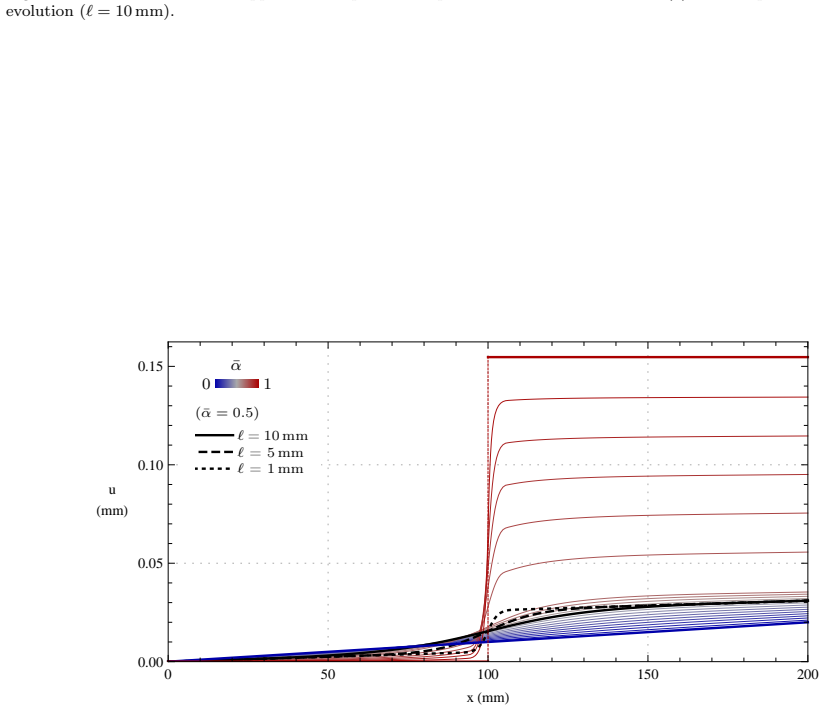
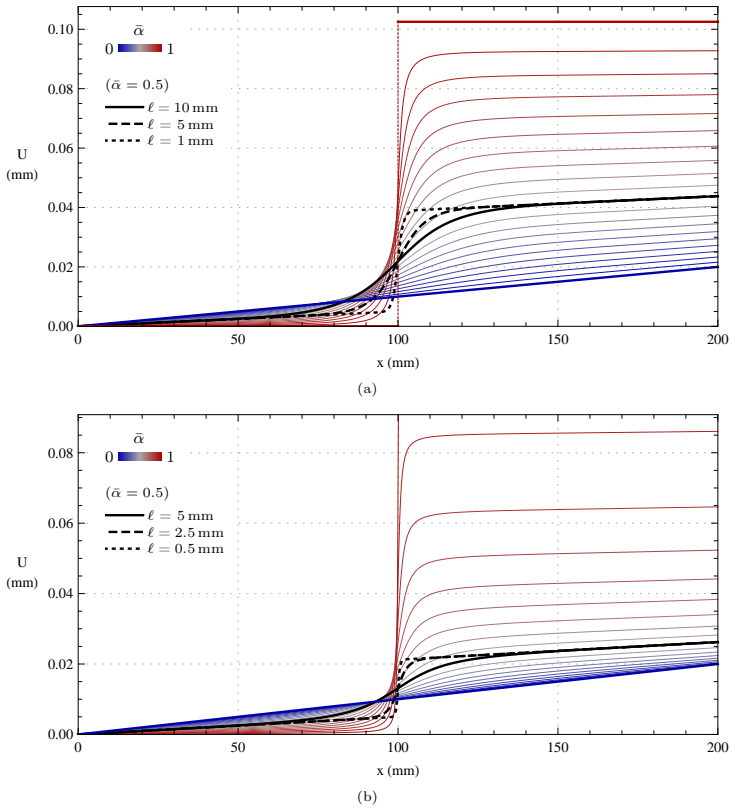
- [Fig. 9 caption] The caption states 'for (L12) and ell = 10 mm' but also highlights displacement profiles for smaller internal lengths; please clarify which curves correspond to which value of ell.
- [Sec. 2.2, Eqs. (2.16) and (2.17)] The notation sigma-bar is used for both the critical stress in (2.17) and the argument of the limit stress function sigma(alpha-bar) in (2.16); the distinction should be made explicit to avoid confusion.
Circularity Check
Sec. 3.3 drops the admissible modification from [33] and asserts, with no error control, that the simplified exponential model (E) 'well captures' law (3.8); combined with unquantified l(alpha)-interpolations for (L1),(L2),(D1),(D2) and hypotheses (Hp1-8) cited only from the submitted companion papers, the exact-reproduction headline is only partially certified.
-
other
[Sec. 3.3, exponential softening law, construction of (E)]
"In fact, a slightly modified version of (3.9) was considered in [33, Sec. 3.3.6] to ensure that all the assumptions of [32, Theorem 1.1] were satisfied, specifically the continuity of the pair {l, omega}. ... Neglecting this modification, which affects only the asymptotic behavior, the corresponding engineering material functions l and w for the exponential model (3.8) simplify to: [E]."
The only proven construction (Theorem 3.1 in [33], subject to the hypotheses of [32, Theorem 1.1]) is stated to apply to a 'slightly modified version' of (3.9), introduced precisely to satisfy those hypotheses. The paper then drops the modification, never exhibits it or its small parameter, and asserts without any quantitative error bound that (E) 'well captures' the target response. The confirming sigma-delta curves are computed from the same parametrization (2.25) that defines the model's own response, so the claim that exponential model (E) reproduces law (3.8) does not follow from the cited theorem chain; for one of the five headline laws the exact reproduction statement is therefore unverified, an omitted proof rather than a derived result.
-
other
[Sec. 3.1 (linear models L1, L2) and Sec. 3.5 (Dugdale models D1, D2)]
"The functions l(alpha) for models (L1) and (L2) do not admit an explicit analytical inverse. As a consequence, interpolation functions to reconstruct l(alpha) are hereafter adopted. ... The function l(alpha) for models (D1) and (D2) does not admit an explicit analytical inverse. As a consequence, an interpolation function to reconstruct l(alpha) is hereafter adopted, similar to what have been done for (L1) and (L2)."
For (L1), (L2), (D1) and (D2), the construction theorems of [33] determine an exact function l(alpha) (or its inverse) that is supposed to deliver the target traction-separation law. The paper replaces this exact function by an unspecified interpolation whose error is never estimated. All displayed response curves and the claimed identity of the cohesive responses for these models are consequently certified only up to this unquantified numerical step; the paper states that the exact agreement with the target law follows from the cited construction, while the quantities actually evaluated use a surrogate l(alpha) rather than the constructed one.
1 more flagged steps
-
self citation load bearing
[Sec. 2.3, identification of the phase-field model for a prescribed cohesive law]
"In Part II of this work [33], we have shown, within a mathematical framework, how to assign a given cohesive law, either linear or superlinear for small amplitude of the displacement jump, by appropriately selecting the parameters of the phase-field model in (2.1). ... we define the corresponding functionals F_epsilon and demonstrate that g0 equals the surface energy density of their Gamma-limit g, as established in [32, Theorem 1.1]. The hypotheses (Hp 1-4) are reported in [32, Sec. 1.2]."
The paper's central premise - that each displayed phase-field model reproduces the prescribed cohesive response exactly - is imported from the authors' own submitted papers [32] (Theorem 1.1) and [33] (Theorems 3.1, 3.2, 2.18). The examples in Sec. 3 evaluate the forward response of the constructed models, but they do not prove the construction theorems, and the hypotheses (Hp1-4, Hp6-8) are only cited, not verified for the five chosen laws and their displayed material functions. If the companion theorems fail or the examples violate the hypotheses, the claimed equivalence collapses within this paper; this is load-bearing self-citation, partially mitigated by the closed-form response evaluation and by the external match of (L12) with the independent model of [29].
full rationale
The core one-dimensional derivation in Sec. 2.2 is self-contained: the limit stress (2.16), the phase-field profile relation (2.19), the crack-opening formula (2.23) and the traction-separation parametrization (2.25) all follow from the equilibrium and Kuhn-Tucker conditions (2.13)-(2.15) of the energy functional (2.4), independently of the companion papers. The 'identical cohesive fracture response' claim, however, is the content of the inverse construction developed in the authors' submitted papers [32, 33]: the material functions {l, omega} are designed there so that the model's Gamma-limit surface energy equals a prescribed g0, so the response curves of Sec. 3 mostly re-evaluate that construction rather than independently predicting it. That is legitimate verification rather than fitting-renamed-as-prediction: no parameter is tuned to data, the target laws are not defined in terms of the model outputs, and model (L12) matches the independent published model of [29]. Nevertheless, three load-bearing steps are only informally certified: (i) in Sec. 3.3 the admissible 'slightly modified' exponential law of [33] is dropped and (E) is asserted to 'well capture' (3.8) with no error estimate and no check of hypotheses (Hp1-8) for (E), an omitted proof affecting one of the five laws; (ii) in Secs. 3.1 and 3.5 the inverse l(alpha) for (L1), (L2), (D1), (D2) is replaced by an unquantified interpolation; (iii) the construction theorems themselves are load-bearing self-citations, cited as 'submitted' with hypotheses not verified for the displayed examples. Since the central derivation does not reduce to its inputs by definition and the main examples are internally and partly externally grounded, this is not a score-6-or-higher case; the uncertified exponential simplification and the unquantified interpolations make the strongest claim only partially supported, so the score is 4.
Assumptions & free parameters
free parameters (6)
- k0 scaling factors for linear models =
ks = 1/(2k)
- k0 scaling factor for bilinear model (B) =
0.91/k
- k0 scaling factor for exponential model (E) =
1/k
- k0 scaling factor for hyperbolic model (H1) =
0.386/k
- k0 scaling factor for hyperbolic model (H2) =
1/k
- coefficient 0.170 in w(α) for (H1) =
0.170
assumptions (7)
- domain assumption Rate-independent energetic formulation (stability condition and energy balance) governs the evolution.
- domain assumption Single symmetric localization at x = L/2, no boundary interaction, and phase-field vanishing at boundaries (or explicitly allowed to be nonzero).
- ad hoc to paper Assumptions (Hp1-4) and (Hp2) on the energy functional, including existence of the critical stress limit σ̄.
- ad hoc to paper Reconstruction Theorems 3.1 and 3.2 (and Theorem 2.18 for Dugdale) in [33] produce the material functions {l,ω} for a prescribed cohesive law.
- standard math Normalization condition (2.12) fixes the scaling factor k0 for each example.
- ad hoc to paper Assumption Q = ω/ς without loss of generality (from [33]).
- ad hoc to paper For the exponential law, the modification of the cohesive law required in [33] can be neglected because it only affects asymptotically large crack openings.
Cite this review
Pith. "Pith review of Phase-field modelling of cohesive fracture. Part III: From mathematical results to engineering application." pith.science (2026). https://pith.science/paper/KLNUW2FO
@misc{pith2026250722072,
  author       = {Pith},
  title        = {Pith review of: Phase-field modelling of cohesive fracture. Part III: From mathematical results to engineering application},
  year         = {2026},
  howpublished = {\url{https://pith.science/paper/KLNUW2FO}},
  note         = {Machine review of arXiv:2507.22072}
}
abstract
This paper concludes a three-part effort aimed at developing a consistent and unified framework for the phase-field modeling of cohesive fracture. Building on the theoretical foundations established in the first two parts, which included a $\Gamma$-convergence result for a broad class of phase-field energy functionals and the presentation of a rigorous analytical methodology for constructing models tailored to specific cohesive laws, this third paper explores the mechanical response of phase-field models, most of which are novel, associated with different cohesive fracture behaviors within a one-dimensional framework. Particular emphasis is placed on the possibility of formulating distinct phase-field models that, despite exhibiting different evolutions of their phase-field and displacement profiles, yield identical cohesive fracture responses. Thus, this work aims at providing a practical interpretation of the mathematical framework connecting the theoretical insights established in the previous parts for physical relevant applications.
Figures


Figures from the paper (30 more)






Forward citations
Cited by 1 Pith paper
-
Strength-degradation phase-field regularization of cohesive fracture: the antiplane case
In antiplane shear, a strength-degrading phase-field model yields an ℓ-independent equivalent cohesive law with independent strength and toughness, verified by closed-form solutions and simulations.
Reference graph
Works this paper leans on
-
[27]
J.-Y. Wu, A unified phase-field theory for the mechanics of damage and quasi- brittle failure, Journal of the Mechanics and Physics of Solids 103 (2017) 72–
work page 2017
- [33]
-
[1]
A. A. Griffith, The phenomena of rupture and flow in solids, Philosophical Transactions of the Royal Society of London A221 (1921) 163–198. URL:http://www.jstor.org/stable/91192
work page 1921
-
[2]
J.-J. Marigo, Initiation of Cracks in Griffith’s Theory: An Argument of Continuity in Favor of Global Minimization, Journal of Nonlinear Science 20 (2010) 831–868. doi:10.1007/s00332-010-9074-x. 38ACF-part-III.tex[September 5, 2025]
- [3]
-
[4]
A. Kumar, B. Bourdin, G. A. Francfort, O. Lopez-Pamies, Revisiting nucleation in the phase-Field approach to brittle fracture, Journal of the Mechanics and Physics of Solids 142 (2020) 104027. URL:https://doi.org/10.1016/j.jmps.2020.104027. doi:10.1016/j.jmps.2020.104027
-
[5]
J.-J. Marigo, Modelling of fracture by cohesive force models: A path to pursue, European Journal of Mechanics, A/Solids 102 (2023). doi:10.1016/j.euromechsol.2023.105088
-
[6]
D. Dugdale, Yielding of steel sheets containing slits, Journal of Mechanics Physics of Solids 8 (1960) 100–104. doi:10.1016/0022-5096(60)90013-2
Show all 59 references
-
[7]
G. I. Barenblatt, The mathematical theory of equilibrium of cracks in brittle fracture, Advances in Applied Mechanics 7 (1962) 55–129
1962
-
[8]
G. A. Francfort, J.-J. Marigo, Revisiting brittle fracture as an energy minimization problem, Journal of the Mechanics and Physics of Solids 46 (1998) 1319–1342. URL:http://www.sciencedirect. com/science/article/B6TXB-3XDH3V4-2/2/6078bc5b38861a78a6b1044a60e0a4bb. doi:10.1016/ ...
1998
-
[9]
Focardi, On the variational approximation of free-discontinuity problems in the vec- torial case, Mathematical Models and Methods in Applied Sciences 11 (2001) 663–
M. Focardi, On the variational approximation of free-discontinuity problems in the vec- torial case, Mathematical Models and Methods in Applied Sciences 11 (2001) 663–
2001
-
[10]
Bourdin, G
B. Bourdin, G. A. Francfort, J.-J. Marigo, The Variational Approach to Fracture, Journal of Elasticity 91 (2008) 5–148. URL:http://www.springerlink.com/content/31370771n83r2637. doi:10.1007/s10659-007-9107-3
2008
-
[11]
Bourdin, G
B. Bourdin, G. A. Francfort, J.-J. Marigo, Numerical experiments in revisited brittle fracture, Journal of the Mechanics and Physics of Solids 48 (2000) 797–826. URL:http://linkinghub. elsevier.com/retrieve/pii/S0022509699000289. doi:10.1016/S0022-5096(99)00028-9
2000 doi
-
[12]
Ambrosio, V
L. Ambrosio, V. M. Tortorelli, On the approximation of free discontinuity problems, Boll. Un. Mat. Ital. 6-B (1992) 105–123
1992
-
[13]
Braides, Approximation of Free-Discontinuity Problems, volume 1694 ofLecture Notes in Math- ematics, Springer Berlin Heidelberg, Berlin, Heidelberg, 1998
A. Braides, Approximation of Free-Discontinuity Problems, volume 1694 ofLecture Notes in Math- ematics, Springer Berlin Heidelberg, Berlin, Heidelberg, 1998. URL:http://link.springer.com/ 10.1007/BFb0097344. doi:10.1007/BFb0097344
1998 doi
-
[14]
Bourdin, J.-J
B. Bourdin, J.-J. Marigo, C. Maurini, P. Sicsic, Morphogenesis and Propagation of Complex Cracks Induced by Thermal Shocks, Physical Review Letters 112 (2014) 014301. URL:http://link.aps. org/doi/10.1103/PhysRevLett.112.014301. doi:10.1103/PhysRevLett.112.014301
2014 doi
-
[15]
Mesgarnejad, B
A. Mesgarnejad, B. Bourdin, M. M. Khonsari, Validation simulations for the variational ap- proach to fracture, Computer Methods in Applied Mechanics and Engineering 290 (2015) 420–
2015
-
[16]
Lemaitre, J.-L
J. Lemaitre, J.-L. Chaboche, Mechanics of Solid Materials, Cambridge University Press, 1985. URL: http://books.google.it/books?id=7PCncQAACAAJ
1985
-
[17]
K. Pham, H. Amor, J.-J. Marigo, C. Maurini, Gradient Damage Models and Their Use to Approximate Brittle Fracture, International Journal of Damage Mechanics 20 (2011) 618–652. doi:10.1177/1056789510386852
2011 doi
-
[18]
Pham, J.-J
K. Pham, J.-J. Marigo, The variational approach to damage: II. The gradient damage models, Comptes Rendus Mecanique 338 (2010) 199–206. doi:10.1016/j.crme.2010.03.012
2010 doi
-
[19]
Pham, J.-J
K. Pham, J.-J. Marigo, The variational approach to damage: I. The foundations, Comptes Rendus Mecanique 338 (2010) 191–198. doi:10.1016/j.crme.2010.03.009
2010 doi
-
[20]
Miehe, F
C. Miehe, F. R. Welschinger, M. Hofacker, Thermodynamically consistent phase-field models of frac- ture: Variational principles and multi-field FE implementations, International Journal for Numerical Methods in Engineering 83 (2010) 1273–1311. URL:http://doi.wiley.com/10.1002/...
2010 doi
-
[21]
Marigo, C
J.-J. Marigo, C. Maurini, K. Pham, An overview of the modelling of fracture by gradient damage models, Meccanica 51 (2016) 3107–3128. URL:http://link.springer.com/10.1007/ s11012-016-0538-4https://hal-ensmp.archives-ouvertes.fr/hal-01321465/. doi:10.1177/ 1056789510386852
2016
-
[22]
Lopez-Pamies, J
O. Lopez-Pamies, J. E. Dolbow, G. A. Francfort, C. J. Larsen, Classical variational phase- field models cannot predict fracture nucleation (2024). URL:http://arxiv.org/abs/2409.00242. arXiv:2409.00242
2024 arXiv
-
[23]
Lorentz, S
E. Lorentz, S. Cuvilliez, K. Kazymyrenko, Convergence of a gradient damage model toward a cohe- sive zone model, Comptes Rendus Mecanique 339 (2011) 20–26. URL:http://www.sciencedirect. com/science/article/pii/S1631072110001671. doi:10.1016/j.crme.2010.10.010
2011 doi
-
[24]
Lorentz, V
E. Lorentz, V. Godard, Gradient damage models: Toward full-scale computations, Com- puter Methods in Applied Mechanics and Engineering 200 (2011) 1927–1944. URL:http:// www.sciencedirect.com/science/article/pii/S0045782510001921. doi:10.1016/j.cma.2010. 06.025
2011 doi
-
[25]
Conti, M
S. Conti, M. Focardi, F. Iurlano, Phase field approximation of cohesive fracture mod- els, Annales de l’Institut Henri Poincaré C, Analyse non linéaire 33 (2016) 1033–1067. URL:http://www.sciencedirect.com/science/article/pii/S0294144915000360https: //ems.press/doi/10.1016/j.a...
2016 arXiv
-
[26]
Freddi, F
F. Freddi, F. Iurlano, Numerical insight of a variational smeared approach to cohesive fracture, Jour- nal of the Mechanics and Physics of Solids 98 (2017) 156–171. URL:http://www.sciencedirect. com/science/article/pii/S0022509616304860. doi:10.1016/j.jmps.2016.09.003
2017 doi
-
[28]
J.-Y. Wu, V. P. Nguyen, A length scale insensitive phase-field damage model for brittle fracture, Journal of the Mechanics and Physics of Solids 119 (2018) 20–42. URL:https://doi.org/10.1016/ j.jmps.2018.06.006. doi:10.1016/j.jmps.2018.06.006
2018 doi
-
[29]
Y. Feng, J. Fan, J. Li, Endowing explicit cohesive laws to the phase-field fracture theory, Journal of the Mechanics and Physics of Solids 152 (2021) 104464. URL:https://doi.org/10.1016/j.jmps. 2021.104464. doi:10.1016/j.jmps.2021.104464
2021
-
[30]
URL:https://linkinghub
H.Lammen, S.Conti, J.Mosler, Afinitedeformationphasefieldmodelsuitableforcohesivefracture, Journal of the Mechanics and Physics of Solids 178 (2023) 105349. URL:https://linkinghub. elsevier.com/retrieve/pii/S0022509623001539. doi:10.1016/j.jmps.2023.105349
2023
-
[31]
Lammen, S
H. Lammen, S. Conti, J. Mosler, Approximating arbitrary traction–separation-laws by means of phase-field theory — Mathematical foundation and numerical implementation, Journal of the Mechanics and Physics of Solids 197 (2025) 106038. URL:https://linkinghub.elsevier.com/ retrie...
2025
-
[32]
Alessi, F
R. Alessi, F. Colasanto, M. Focardi, Phase-field modelling of cohesive fracture. Part I:Γ-convergence results, submitted (2025)
2025
-
[34]
Alessi, J.-J
R. Alessi, J.-J. Marigo, S. Vidoli, Gradient Damage Models Coupled with Plasticity and Nucleation of Cohesive Cracks, Archive for Rational Mechanics and Analysis 214 (2014) 575–615. URL:http: //link.springer.com/10.1007/s00205-014-0763-8. doi:10.1007/s00205-014-0763-8
2014 doi
-
[35]
Alessi, J.-J
R. Alessi, J.-J. Marigo, S. Vidoli, Gradient damage models coupled with plasticity: Variational formulation and main properties, Mechanics of Materials 80 (2015) 351–367. URL:http://www. sciencedirect.com/science/article/pii/S0167663614000039. doi:10.1016/j.mechmat.2013. 12.005
2015 doi
-
[36]
Alessi, J.-J
R. Alessi, J.-J. Marigo, C. Maurini, S. Vidoli, Coupling damage and plasticity for a phase-field regularisation of brittle, cohesive and ductile fracture: One-dimensional examples, International Journal of Mechanical Sciences 149 (2018) 559–576. doi:10.1016/j.ijmecsci.2017.05.047
2018 doi
-
[37]
Conti, M
S. Conti, M. Focardi, F. Iurlano, Phase-Field Approximation of a Vectorial, Geometrically Nonlinear Cohesive Fracture Energy, Archive for Rational Mechanics and Analysis 248 (2024) 21. URL:https: //link.springer.com/10.1007/s00205-024-01962-4. doi:10.1007/s00205-024-01962-4
2024 doi
-
[38]
Colasanto, Phase field approximation of cohesive functionals in the vectorial case, In preparation (2025)
F. Colasanto, Phase field approximation of cohesive functionals in the vectorial case, In preparation (2025)
2025
-
[39]
URL:http://arxiv.org/abs/2505.00852
S.Conti, M.Focardi, F.Iurlano, Superlinearfree-discontinuitymodels: relaxationandphasefieldap- proximation, In preparation (2025). URL:http://arxiv.org/abs/2505.00852. doi:arXiv.2505. 00852.arXiv:2505.00852
2025 arXiv
-
[40]
Pham, J.-J
K. Pham, J.-J. Marigo, From the onset of damage to rupture: construction of responses with dam- age localization for a general class of gradient damage models, Continuum Mechanics and Ther- modynamics25(2011)147–171.URL:http://link.springer.com/10.1007/s00161-011-0228-3. doi:1...
2011 doi
-
[41]
L. Chen, R. de Borst, Phase-field modelling of cohesive fracture, European Journal of Mechan- ics, A/Solids 90 (2021) 104343. URL:https://doi.org/10.1016/j.euromechsol.2021.104343. doi:10.1016/j.euromechsol.2021.104343
2021
-
[42]
Mielke, A Mathematical Framework for Generalized Standard Materials in the Rate-Independent Case, in: R
A. Mielke, A Mathematical Framework for Generalized Standard Materials in the Rate-Independent Case, in: R. Helmig, A. Mielke, B. Wohlmuth (Eds.), Multifield Problems in Solid and Fluid Mechanics, volume 28 ofLecture Notes in Applied and Computational Mechanics, Springer Berli...
2006 doi
-
[43]
Mielke, T
A. Mielke, T. Roubíček, Rate-Independent Systems: Theory and Application, Springer, 2015. URL: https://books.google.com/books?id=RN3HCgAAQBAJ&pgis=1
2015
-
[44]
Wu, A generalized phase-field cohesive zone model (µPF-CZM) for fracture, Journal of the Me- chanics and Physics of Solids 192 (2024)
J.-y. Wu, A generalized phase-field cohesive zone model (µPF-CZM) for fracture, Journal of the Me- chanics and Physics of Solids 192 (2024). doi:10.1016/j.jmps.2024.105841.arXiv:2408.00015
2024
-
[45]
Crismale, G
V. Crismale, G. Lazzaroni, G. Orlando, Cohesive fracture with irreversibility: quasistatic evolution for a model subject to fatigue, Mathematical Models and Methods in Applied Sciences 28 (2018) 1371–1412. URL:http://cvgmt.sns.it/media/doc/paper/3111/Cri-Laz-Orl-preprint2.pdf....
2018 doi
-
[46]
Bonacini, S
M. Bonacini, S. Conti, F. Iurlano, Cohesive Fracture in 1D: Quasi-static Evolution and Derivation from Static Phase-Field Models, Archive for Rational Mechanics and Analysis 239 (2021) 1501–1576. URL:http://link.springer.com/10.1007/s00205-020-01597-1. doi:10. 1007/s00205-020-01597-1
2021 doi
-
[47]
1007/BF02472827
G.V.Guinea, J.Planas, M.Elices, Ageneralbilinearfitforthesofteningcurveofconcrete, Materials andStructures27(1994)99–105.URL:http://link.springer.com/10.1007/BF02472827.doi:10. 1007/BF02472827
1994 doi
-
[48]
Roesler, G
J. Roesler, G. H. Paulino, K. Park, C. Gaedicke, Concrete fracture prediction using bilinear soften- ing, Cement and Concrete Composites 29 (2007) 300–312. URL:https://linkinghub.elsevier. com/retrieve/pii/S0958946506002137. doi:10.1016/j.cemconcomp.2006.12.002
2007 doi
-
[49]
K. Park, G. H. Paulino, Cohesive Zone Models: A Critical Review of Traction-Separation Relationships Across Fracture Surfaces, Applied Mechanics Reviews 64 (2011). URL:https: //asmedigitalcollection.asme.org/appliedmechanicsreviews/article/doi/10.1115/1. 4023110/370063/Cohesiv...
2011 doi
-
[50]
Dourado, M
N. Dourado, M. de Moura, A. de Morais, A. Pereira, Bilinear approximations to the mode II delamination cohesive law using an inverse method, Mechanics of Materials 49 (2012) 42–
2012
-
[51]
Z. P. Bažant, Q. Yu, G. Zi, Choice of standard fracture test for concrete and its statistical evalu- ation, International Journal of Fracture 118 (2002) 303–337. URL:https://doi.org/10.1023/A: 1023399125413. doi:10.1023/A:1023399125413
2002 doi
-
[52]
Kumar, R
M. Kumar, R. Alessi, E. Salvati, GPFniCS: A generalised phase field method to model frac- ture, SoftwareX 24 (2023) 101594. URL:https://linkinghub.elsevier.com/retrieve/pii/ S235271102300290X. doi:10.1016/j.softx.2023.101594. 42ACF-part-III.tex[September 5, 2025]
2023
-
[53]
Alessi, V
R. Alessi, V. Crismale, G. Orlando, Fatigue Effects in Elastic Materials with Variational Damage Models: A Vanishing Viscosity Approach, Journal of Nonlinear Science 29 (2019). doi:10.1007/ s00332-018-9511-9
2019
-
[54]
doi:10.1016/ j.mechmat.2012.02.004
URL:https://linkinghub.elsevier.com/retrieve/pii/S0167663612000361. doi:10.1016/ j.mechmat.2012.02.004
2012
-
[55]
Y. Feng, J. Li, A unified regularized variational cohesive fracture theory with directional energy decomposition, International Journal of Engineering Science 182 (2023) 103773. URL:https:// doi.org/10.1016/j.ijengsci.2022.103773. doi:10.1016/j.ijengsci.2022.103773. 43ACF-part...
2023
-
[58]
Alessi, J
R. Alessi, J. Ulloa, Endowing Griffith’s fracture theory with the ability to describe fatigue cracks, Engineering Fracture Mechanics 281 (2023) 109048. URL:https://linkinghub.elsevier.com/ retrieve/pii/S0013794423000061. doi:10.1016/j.engfracmech.2023.109048
2023
-
[99]
doi:10.1016/j.jmps.2017.03.015
URL:http://dx.doi.org/10.1016/j.jmps.2017.03.015http://www.sciencedirect.com/ science/article/pii/S0022509616308341. doi:10.1016/j.jmps.2017.03.015. 40ACF-part-III.tex[September 5, 2025]
2017 doi
-
[437]
URL:http://www.sciencedirect.com/science/article/pii/S004578251400423X. doi:10. 1016/j.cma.2014.10.052. 39ACF-part-III.tex[September 5, 2025]
2014
-
[684]
com/doi/10.1142/S0218202501001045
URL:http://dx.doi.org/10.1142/S0218202501001045https://www.worldscientific. com/doi/10.1142/S0218202501001045. doi:10.1142/S0218202501001045
Reviewed August 6, 2026 · model on record in the stance chip above.
Discussion (0). Continue with ORCID to comment.