REVIEW 4 major objections 6 minor 39 references
Prototype-Guided Pseudo-Labeling with Neighborhood-Aware Consistency for Unsupervised Adaptation
T0 review · 4 major / 6 minor · reviewed 2026-08-06 · deepseek-v4-flash
Pith's one-line read ALPHA filters and refines CLIP's own pseudo-labels using the geometry of the embedding space, and reports state-of-the-art accuracy on 11 unlabeled benchmarks.
desk verdict A credible, incremental extension of the authors' DPA line with a 1.4-point average gain, but the core filtering mechanism is self-referential and the empirical case would benefit from multi-seed runs. read the letter →
The pith
A machine-rendered reading of the paper's core claim, the machinery that carries it, and where it could break.
The reading
What carries the argument
The machinery is a pair of complementary filters built from cosine similarities. PICS computes per-class prototypes via a memory bank of features, pseudo-labels, and confidence scores, then scores each sample by the difference between in-class compactness and cross-class separation; only samples with a positive difference supervise the main self-training loss. NALR handles the rejected samples by retrieving the most similar LLM-generated class description for each image, then re-weighting that assignment by the sigmoid of the difference between the image's similarity to its chosen description and the average similarity of its nearest image-text neighbors. A memory-bank feedback loop merges both branches so refined labels feed the next epoch's prototypes.
What would settle it
Freeze a pretrained CLIP, compute the in-class and cross-class scores for every sample of a high-intra-class-variability dataset with ground-truth labels available, and measure the precision of the rule against those labels; if the retained set's precision is no higher than the pseudo-label accuracy of unfiltered predictions, the PICS filter is not doing the work attributed to it. A complementary check on the same dataset is to ablate the adaptive weight by setting all values to one and verifying whether accuracy drops, since NALR's weighting is credited with preventing mismatched text descriptions from hurting training.
Extended reading notes
Core claim
ALPHA's central claim is that a pseudo-label is trustworthy exactly when the sample is more similar to its own class prototype than to confident samples of other classes, and that samples failing this test should not be discarded but refined through neighbor-aware weighting of LLM-generated text descriptions. The paper argues that this two-branch design, filter with PICS and refine with NALR, prevents error accumulation better than either branch alone, and that its adaptive weight assigns low influence to image-text pairs whose similarity is below that of their neighbors, suppressing mismatched descriptions. Results across Caltech101, DTD, EuroSAT, Flowers, OxfordPets, UCF101, StanfordCars, Food101, CIFAR100, CUB-200-2011, and RESISC45 support the claim, with all three cross-class selection strategies outperforming prior unsupervised adaptation methods.
Load-bearing premise
The load-bearing premise is that, in CLIP's embedding space, the inequality that in-class similarity exceeds cross-class similarity reliably marks a pseudo-label as correct; on datasets with high intra-class variability the authors concede this filter can discard informative samples, and if the premise fails early in training the refined set is not actually clean and error accumulation is not prevented.
Editorial extensions
If this is right
- PICS-style filtering yields more clean samples than FixMatch-style confidence thresholding from the first epochs, reducing the early overfitting that limits self-training.
- All three ALPHA variants beat zero-shot CLIP by about 10 points on average and outperform prior unsupervised adaptation methods on the 11-dataset suite, with the largest gains on texture, satellite, and action-recognition datasets.
- The method transfers to a ViT-B/16 backbone and to the transductive setting, outperforming ReCLIP and DPA in both regimes.
- Under label-irrelevant noise injected into the training set, ALPHA-CS stays ahead of DPA up to 70% noise and ALPHA-FS remains most stable at higher noise levels.
- Layer-normalization-only fine-tuning suffices to match or beat heavier parameter-efficient methods such as LoRA and K-Adaptation within the ALPHA framework.
Reading between the lines
- An implication the authors leave implicit: PICS's geometric criterion could serve as a label-free calibration proxy for any self-training pipeline whose confidence scores are miscalibrated, not just for CLIP.
- Beyond the paper's classification setting, the filter-and-refine split suggests a general recipe for noisy pseudo-labels: instead of discarding low-confidence samples, re-route them through a richer source of signal, here LLM text descriptions, with local agreement as the trust signal.
- A testable extension the paper does not pursue is making the cross-class set size k adaptive per class based on prototype overlap, since the sensitivity analysis shows k matters more on some datasets than others.
- Because the fairness regularizer already pushes predictions toward balance, a stress test for the method would be a severely class-imbalanced target dataset, where the prototype statistics and the regularizer may interact in ways the current benchmarks do not expose.
Editorial analysis
A structured set of objections, weighed in public.
Referee Report
Summary. The paper proposes ALPHA, an unsupervised adaptation framework for CLIP that combines two pseudo-labeling components: PICS, which filters pseudo-labels by comparing in-class feature compactness with cross-class feature separation, and NALR, which refines noisy pseudo-labels using LLM-generated class descriptions and neighborhood consistency, together with an adaptive weighting scheme. The method is evaluated on 11 image classification datasets with ViT-B/32 and ViT-B/16 backbones, and is compared against zero-shot CLIP, CuPL, UPL, POUF, LaFTer, and DPA. The authors report consistent gains across three variants of the cross-class set construction (CS, RS, FS), achieving an average accuracy of 74.86% with ALPHA-CS on ViT-B/32, which is 1.42 points above DPA. Additional experiments cover component ablations, scalability, transductive settings, parameter-efficient fine-tuning strategies, robustness to injected noise, and hyperparameter sensitivity.
Significance. If the reported results are reliable, ALPHA would be a useful empirical contribution to unsupervised CLIP adaptation, with a filtering criterion that is more geometric than fixed confidence thresholds and a refinement module that exploits both visual and textual neighborhood structure. The paper has several strengths: it evaluates three internally consistent variants across 11 diverse datasets, includes a transductive comparison, reports scalability and noise-robustness experiments, and is unusually candid about the PICS limitation concerning high intra-class variability. However, the central SOTA claim is currently supported only by single-run accuracy numbers, and the paper does not directly demonstrate that the PICS-selected samples are actually cleaner than the raw pseudo-labels. Given that the average margin over DPA is small and per-dataset results are mixed, the missing statistical validation and the lack of direct evidence for the filtering mechanism are load-bearing issues that need to be addressed before the empirical claims can be fully accepted.
major comments (4)
- [Section 4.1, Table 1] The SOTA claim rests on single-run accuracies without error bars, random seeds, or significance tests. The average margin over DPA is 1.42 points, and on several datasets ALPHA-CS is below DPA (Caltech101 94.94 vs 95.94; EuroSAT 78.18 vs 79.94; CUB 56.54 vs 56.70). With no variance estimates, these differences are not distinguishable from training stochasticity. Please report mean and standard deviation over at least three seeds for the main comparison, and provide a paired test or per-dataset effect sizes to support the claim that ALPHA outperforms DPA and other baselines.
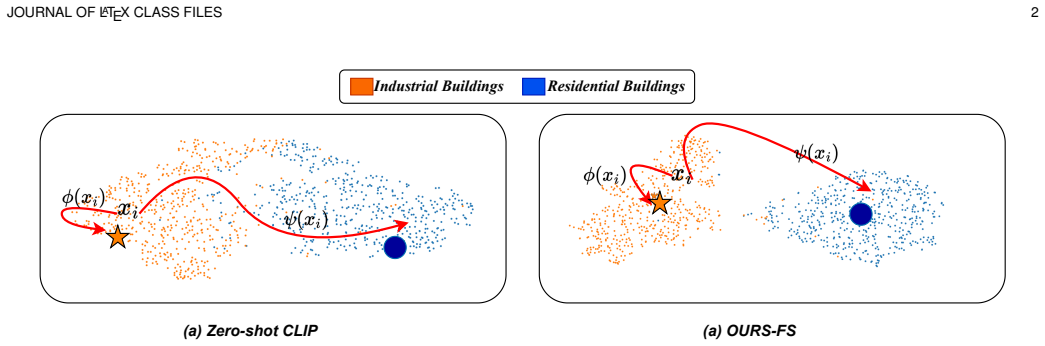
- [Section 3.3, Eq. (15)] The PICS clean/noisy decision is self-referential: phi(x_i) is computed with prototypes mu_c from Eq. (7), which are built from pseudo-labels and confidence scores, and psi(x_i) is computed with cross-class sets O from Eqs. (10)-(13), which are also built from pseudo-labels. If zero-shot CLIP is biased, a confidently wrong pseudo-label can satisfy phi(x_i) > psi(x_i), so the filter can confirm the same bias it is meant to remove. The paper does not provide direct evidence that the selected subset is cleaner: Figure 4 reports pseudo-label accuracy on the full training set, not on the PICS-selected subset. Please report the accuracy of accepted versus rejected samples during training, or compare the PICS score with oracle label correctness on a held-out split, so that the filter's precision is established.
- [Section 4.2, Table 2] The component ablation is run on only 6 of the 11 datasets, excluding StanfordCars, Food101, CIFAR-100, CUB-200-2011, and RESISC45. These excluded datasets include the largest gains over DPA (StanfordCars +3.98, RESISC45 +4.60) and one negative result (CUB -0.16), so the averaged ablation conclusions do not necessarily transfer to the full benchmark. Please extend the ablation to all datasets, or at least to the excluded fine-grained and large-scale datasets, and report per-dataset component contributions so the reader can verify that PICS and NALR help in the same regimes where the final method is claimed to be SOTA.
- [Section 4.2.1 and Conclusion] The paper concedes that PICS can discard informative samples in datasets with high intra-class variability, and Table 2 shows drops for ALPHA-CS w/o NALR on OxfordPets (89.94 vs ALPHA-B 90.30) and for ALPHA-FS w/o NALR on Caltech101 (93.42 vs 93.48). Since PICS is the main novelty, this trade-off needs quantitative characterization: for example, report how many samples are filtered per epoch and the accuracy of the filtered-out samples, to show that the loss of informative samples is outweighed by noise reduction. Without this, the attribution of the final gains to PICS rather than to NALR or the fairness regularizer remains unproven.
minor comments (6)
- [Section 3.3.2 and Table 2 caption] The FS variant is described as 'Confusion-based top-k Selection' in the text but as 'Fusion-based top-k Selection' in the Table 2 caption; please harmonize the terminology.
- [Equations (4) and (15)] Both Eq. (4) and Eq. (15) define the self-training loss Lst, with Eq. (15) adding the PICS indicator. Please use a distinct symbol or explicitly state that Eq. (15) replaces Eq. (4), to avoid confusion in Section 4.2.1 where ALPHA-B is said to use 'the loss function from Eq. 4 + Lreg'.
- [Section 4, Implementation details] The text says the text encoder is discarded after initializing the text prototypes from CuPL descriptions, but Eq. (5) and the losses use textual prototypes Z. Please clarify whether Z is a learnable parameter vector after initialization, and whether the text encoder is used anywhere after the first prototype computation.
- [Figure 1] The t-SNE visualization is not described in enough detail; please specify which embeddings are plotted, how the visual and textual prototypes are obtained, and how the in-class and cross-class metrics are represented in the figure.
- [Section 4.2.2 and Figure 5] The scalability experiment is performed only on Flowers and does not describe how the 20%, 40%, 60%, and 80% subsets are sampled. Please state the sampling strategy and whether results are averaged over multiple subset draws.
- [Figure 6] The caption says circle radius indicates the number of trainable parameters, but the axes are training time and accuracy; please clarify whether the parameter count is encoded only by the circle size and define the unit for the radius.
Circularity Check
No significant circularity: the central claims are grounded in held-out test accuracy against externally reproduced baselines, and the PICS/NALR components are heuristic self-training modules rather than predictions that reduce to their inputs by construction.
full rationale
The paper does not present a derivation in which a predicted quantity is defined in terms of the quantity it is supposed to predict. PICS (Eqs. 7-15) builds prototypes and cross-class sets from CLIP pseudo-labels and embeddings, then uses the resulting in-class and cross-class scores as a filtering criterion; this is a self-training heuristic based on the cluster assumption, not a logical reduction of the method's output to its input. The central performance claim is evaluated on held-out test sets across 11 datasets (Tables 1, 3, 4) against external baselines, and the authors state that SOTA results were reproduced using publicly available codebases, so the comparison is independently grounded. NALR additionally injects external LLM-generated descriptions from CuPL, which is not a self-citation. The only self-citation, DPA [34], is used as a comparison baseline and is not load-bearing for the method's derivation. The acknowledged limitation that PICS may discard informative samples in datasets with high intra-class variability is a robustness concern, not evidence of circularity. No step meets the required bar of exhibiting a specific reduction, such as Eq. X equaling Eq. Y by construction or a fitted parameter being renamed as a prediction, so the appropriate finding is no significant circularity.
Assumptions & free parameters
free parameters (4)
- k (cross-class neighbor count) =
3
- kn (neighbor pair count) =
3
- Learning rates =
5e-5 for most, 1e-6 for StanfordCars and Food101
- M LLM descriptions per class =
Not stated, follows CuPL
assumptions (4)
- domain assumption Pseudo-labels from zero-shot CLIP provide a useful bootstrap for prototypes and self-training.
- domain assumption In the CLIP embedding space, correctly pseudo-labeled images are closer to their own class prototype than to confident samples of other pseudo-classes.
- domain assumption Semantically similar LLM-generated texts are associated with visually similar images.
- domain assumption LLM descriptions in CuPL describe the visual content of each class well enough to relabel noisy samples.
Cite this review
Pith. "Pith review of Prototype-Guided Pseudo-Labeling with Neighborhood-Aware Consistency for Unsupervised Adaptation." pith.science (2026). https://pith.science/paper/JSLABZJZ
@misc{pith2026250722075,
  author       = {Pith},
  title        = {Pith review of: Prototype-Guided Pseudo-Labeling with Neighborhood-Aware Consistency for Unsupervised Adaptation},
  year         = {2026},
  howpublished = {\url{https://pith.science/paper/JSLABZJZ}},
  note         = {Machine review of arXiv:2507.22075}
}
read the original abstract
In unsupervised adaptation for vision-language models such as CLIP, pseudo-labels derived from zero-shot predictions often exhibit significant noise, particularly under domain shifts or in visually complex scenarios. Conventional pseudo-label filtering approaches, which rely on fixed confidence thresholds, tend to be unreliable in fully unsupervised settings. In this work, we propose a novel adaptive pseudo-labeling framework that enhances CLIP's adaptation performance by integrating prototype consistency and neighborhood-based consistency. The proposed method comprises two key components: PICS, which assesses pseudo-label accuracy based on in-class feature compactness and cross-class feature separation; and NALR, which exploits semantic similarities among neighboring samples to refine pseudo-labels dynamically. Additionally, we introduce an adaptive weighting mechanism that adjusts the influence of pseudo-labeled samples during training according to their estimated correctness. Extensive experiments on 11 benchmark datasets demonstrate that our method achieves state-of-the-art performance in unsupervised adaptation scenarios, delivering more accurate pseudo-labels while maintaining computational efficiency.
Figures


Figures from the paper (4 more)


Reference graph
Works this paper leans on
-
[1]
A. Radford et al. Learning transferable visual models from natural language supervision. In International conference on machine learning, pp. 8748–8763. PmLR, 2021
work page 2021
-
[2]
T. Huang et al. Unsupervised prompt learning for vision-language models. arXiv preprint arXiv:2204.03649, 2022
arXiv 2022
-
[3]
K. Tanwisuth et al. Pouf: Prompt-oriented unsupervised fine- tuning for large pre-trained models. In International Conference on Machine Learning, pp. 33816–33832. PMLR, 2023. JOURNAL OF LATEX CLASS FILES 10
work page 2023
-
[4]
X. Wang et al. Debiased learning from naturally imbalanced pseudo-labels. In Proceedings of the IEEE/CVF Conference on Com- puter Vision and Pattern Recognition, pp. 14647–14657, 2022
work page 2022
-
[5]
K. Sohn et al. Fixmatch: Simplifying semi-supervised learning with consistency and confidence. Advances in neural information processing systems, 33:596–608, 2020
work page 2020
-
[6]
M. J. Mirza et al. Lafter: Label-free tuning of zero-shot classifier using language and unlabeled image collections. Advances in Neural Information Processing Systems, 36:5765–5777, 2023
work page 2023
- [7]
-
[8]
W. Yang et al. Prototype-guided pseudo labeling for semi- supervised text classification. In Proceedings of the 61st Annual Meeting of the Association for Computational Linguistics (Volume 1: Long Papers), pp. 16369–16382, 2023
work page 2023
Show all 39 references
-
[9]
Zhou et al
K. Zhou et al. Learning to prompt for vision-language models. International Journal of Computer Vision, 130(9):2337–2348, 2022
2022
-
[10]
M. U. Khattak et al. Maple: Multi-modal prompt learning. In Proceedings of the IEEE/CVF conference on computer vision and pattern recognition, pp. 19113–19122, 2023
2023
-
[11]
Zhang et al
R. Zhang et al. Tip-adapter: Training-free adaption of clip for few- shot classification. In European conference on computer vision , pp. 493–510. Springer, 2022
2022
-
[12]
Huang et al
C. Huang et al. Adapting visual-language models for generaliz- able anomaly detection in medical images. In Proceedings of the IEEE/CVF Conference on Computer Vision and Pattern Recognition , pp. 11375–11385, 2024
2024
-
[13]
Guan et al
D. Guan et al. S2match: Self-paced sampling for data-limited semi- supervised learning. Pattern Recognition, 159:111121, 2025
2025
-
[14]
Kong et al
X. Kong et al. Fgbc: Flexible graph-based balanced classifier for class-imbalanced semi-supervised learning. Pattern Recognition , 143:109793, 2023
2023
-
[15]
Wang et al
K. Wang et al. Evidential pseudo-label ensemble for semi- supervised classification. Pattern Recognition Letters , 177:135–141, 2024
2024
-
[16]
Sachdeva et al
R. Sachdeva et al. Scanmix: Learning from severe label noise via semantic clustering and semi-supervised learning. Pattern recognition, 134:109121, 2023
2023
-
[17]
Wang et al
Y. Wang et al. Learning pseudo labels for semi-and-weakly su- pervised semantic segmentation. Pattern Recognition, 132:108925, 2022
2022
-
[18]
Li et al
J. Li et al. Masked unsupervised self-training for label-free im- age classification. International Conference on Learning Representa- tions(ICLR), 2023
2023
-
[19]
Zhou et al
L. Zhou et al. Source-free domain adaptation with class prototype discovery. Pattern recognition, 145:109974, 2024
2024
-
[20]
Li et al
Y. Li et al. Nac: Mitigating noisy correspondence in cross-modal matching via neighbor auxiliary corrector. In ICASSP 2024-2024 IEEE International Conference on Acoustics, Speech and Signal Pro- cessing (ICASSP), pp. 6815–6819. IEEE, 2024
2024
-
[21]
Pratt et al
S. Pratt et al. What does a platypus look like? generating cus- tomized prompts for zero-shot image classification. In Proceedings of the IEEE/CVF International Conference on Computer Vision , pp. 15691–15701, 2023
2023
-
[22]
Li et al
J. Li et al. Visual-text cross alignment: Refining the similarity score in vision-language models. In Proceedings of the 41st International Conference on Machine Learning, ICML’24. JMLR.org, 2024
2024
-
[23]
L. Fei-Fei. Learning generative visual models from few training examples. In Workshop on Generative-Model Based Vision, IEEE Proc. CVPR, 2004, 2004
2004
-
[24]
Cimpoi et al
M. Cimpoi et al. Describing textures in the wild. In Proceedings of the IEEE conference on computer vision and pattern recognition , pp. 3606–3613, 2014
2014
-
[25]
Helber et al
P . Helber et al. Eurosat: A novel dataset and deep learning benchmark for land use and land cover classification. IEEE Journal of Selected Topics in Applied Earth Observations and Remote Sensing , 12(7):2217–2226, 2019
2019
-
[26]
Nilsback and A
M.-E. Nilsback and A. Zisserman. Automated flower classification over a large number of classes. In 2008 Sixth Indian conference on computer vision, graphics & image processing , pp. 722–729. IEEE, 2008
2008
-
[27]
O. M. Parkhi et al. Cats and dogs. IEEE Conference on Computer Vision and Pattern Recognition, pp. 3498–3505, 2012
2012
-
[28]
Soomro et al
K. Soomro et al. Ucf101: A dataset of 101 human actions classes from videos in the wild. Center for Research in Computer Vision , 2012
2012
-
[29]
Krause et al
J. Krause et al. 3d object representations for fine-grained catego- rization. IEEE International Conference on Computer Vision Work- shops, pp. 554–561, 2013
2013
-
[30]
Bossard et al
L. Bossard et al. Food-101 - mining discriminative components with random forests. In European Conference on Computer Vision (ECCV). Springer, 2014
2014
-
[31]
Krizhevsky et al
A. Krizhevsky et al. Learning multiple layers of features from tiny images. 2009
2009
-
[32]
Wah et al
C. Wah et al. The caltech-ucsd birds-200-2011 dataset. 2011
2011
-
[33]
Cheng et al
G. Cheng et al. Remote sensing image scene classification: Bench- mark and state of the art. Proceedings of the IEEE , 105:1865–1883, 2017
2017
-
[34]
Ali et al
E. Ali et al. Dpa: Dual prototypes alignment for unsupervised adaptation of vision-language models. In 2025 IEEE/CVF Winter Conference on Applications of Computer Vision (WACV) , pp. 6083–
2025
-
[35]
Goyal et al
P . Goyal et al. Vissl. https://github.com/facebookresearch/vissl, 2021
2021
-
[36]
Iscen et al
A. Iscen et al. Label propagation for deep semi-supervised learning. IEEE/CVF Conference on Computer Vision and Pattern Recognition (CVPR), pp. 5065–5074, 2019
2019
-
[37]
E. J. Hu et al. Lora: Low-rank adaptation of large language models. ICLR, 1(2):3, 2022
2022
-
[38]
He et al
X. He et al. Parameter-efficient model adaptation for vision transformers. In Proceedings of the AAAI Conference on Artificial Intelligence, volume 37, pp. 817–825, 2023
2023
-
[39]
Ba et al
J. Ba et al. Layer normalization. Advances in Neural Information Processing Systems, 29, 2016
2016
Reviewed August 6, 2026 · model on record in the stance chip above.
Discussion (0). Sign in to comment.