REVIEW 4 major objections 6 minor 1 cited by
Trade-offs in Image Generation: How Do Different Dimensions Interact?
T0 review · 4 major / 6 minor · reviewed 2026-08-06 · deepseek-v4-flash
Pith's one-line read This paper introduces a benchmark and judge designed to expose how image-generation capabilities trade off against each other, and argues that fine-tuning guided by the resulting dimension map improves balanced performance across…
desk verdict Useful benchmark with a genuinely new pairwise design, but the headline fine-tuning claim is riding on a self-referential judge with almost no human anchor. read the letter →
The pith
A machine-rendered reading of the paper's core claim, the machinery that carries it, and where it could break.
The reading
What carries the argument
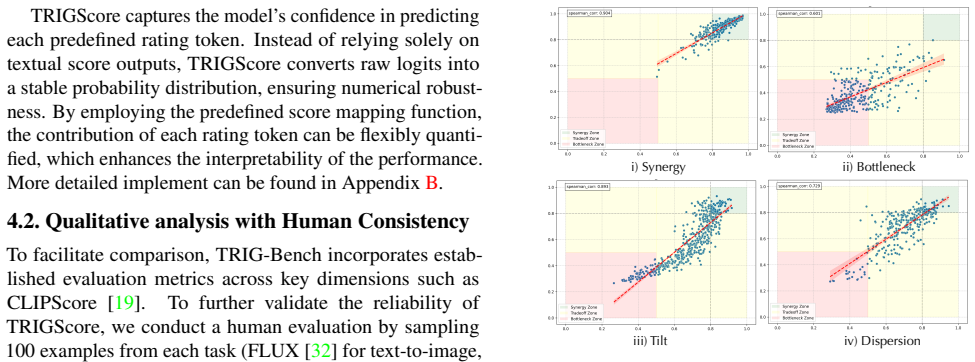
The load-bearing object is TRIGScore, a vision-language-model-as-judge metric. Instead of asking the VLM for a text rating, it reads the raw logits for a fixed set of rating tokens (terrible, bad, medium, good, excellent), applies a softmax over those tokens, maps them to numbers, and weights the result by the model's confidence in its top token. This gives a stable, dimension-specific score for each generated image. The second mechanism is the Trade-off Relation Recognition System, which takes the scatter plot of two dimensions' TRIGScores across a prompt subset and classifies the relationship using four thresholds: a synergy density above 0.8, a bottleneck density above 0.5, a tilt ratio above 1.5 above versus below the regression line, and a dispersion when the Spearman correlation falls below 0.7. The Dimension Trade-off Map is the graph that results from applying this classification to all 45 dimension pairs, and the paper uses it both as a diagnostic and as a guide for fine-tuning data selection and prompt rewriting.
What would settle it
Take a model with a dimension pair classified as a Tilt in its DTM (for example, Realism–Style), collect a fresh set of prompts from a different source, generate images, and ask both TRIGScore and human raters to score the dimensions independently; if human ratings do not reproduce the same tilt direction, or if TRIGScore's dimension scores do not correlate strongly with human scores on a sample of several hundred images, the DTM's trade-off classification and the fine-tuning recipe built on it would not be measuring real capability trade-offs.
Extended reading notes
Core claim
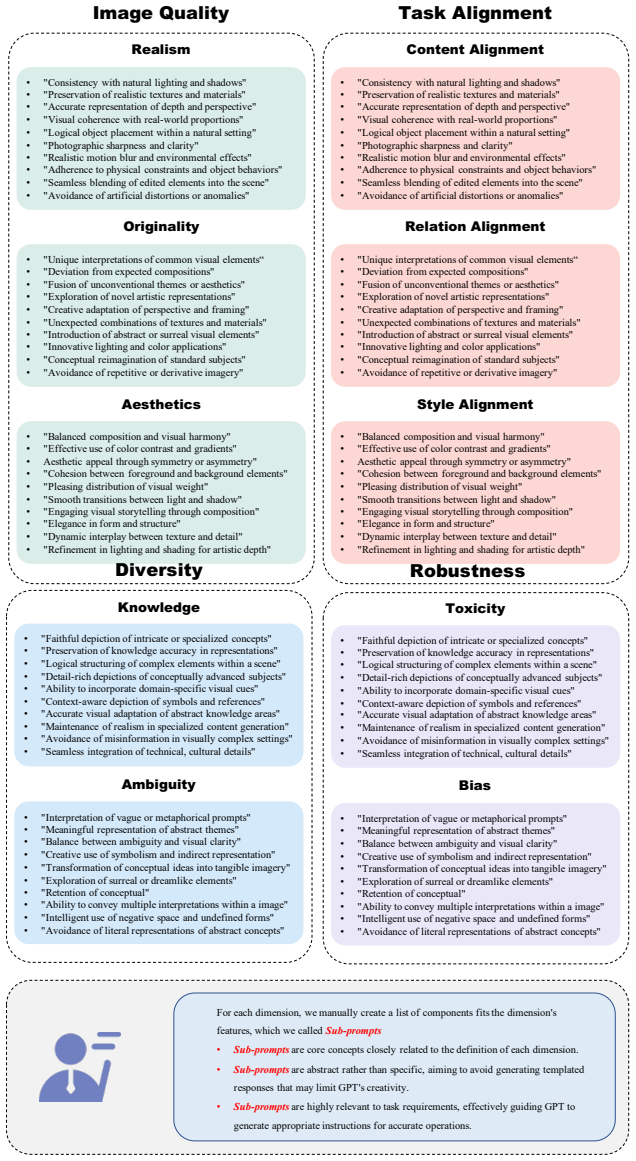
The central claim is that dimensional trade-offs in generative image models are structured and actionable. Using TRIGScore on TRIG-Bench, the paper argues that every model has a recognizable pattern of relationships among Realism, Originality, Aesthetics, Content, Relation, Style, Knowledge, Ambiguity, Toxicity, and Bias. Each pair is labelled by the Trade-off Relation Recognition System: synergy when both dimensions are high together, bottleneck when both are low, tilt when one rises as the other falls, and dispersion when the points scatter without a linear trend. Aggregating these labels produces the Dimension Trade-off Map, which the paper uses to identify both model-specific patterns, such as a realism-to-style tilt in Sana, and task-level patterns, such as a realism–toxicity bottleneck across editing models. The paper then shows that selecting dimension-balanced training samples or rewriting prompts according to the DTM improves the previously weak dimensions; for example, Sana's Bias score rises from 0.44 to 0.66 after DTM fine-tuning, HQEdit's Ambiguity from 0.66 to 0.71, and FLUX-IP-Adapter's Ambiguity from 0.55 to 0.66. The ablation on the HEIM benchmark reports improvements on all eight of its dimensions after DTM-guided fine-tuning.
Load-bearing premise
The entire trade-off analysis and the reported fine-tuning gains are computed from TRIGScore, a VLM judge whose agreement with humans was checked on only 300 samples with no reported correlation statistic; if TRIGScore favors certain visual features rather than the dimensions it claims to measure, the DTM categories and improvements would be artifacts of the judge.
Editorial extensions
If this is right
- Evaluators should treat dimension-specific scores, not single composite metrics, as the unit of comparison; CLIPScore alone cannot reveal a tilt between two dimensions.
- Model developers can use a DTM to choose which samples to keep in a fine-tuning set, targeting the weakest dimension without abandoning the strong one.
- Benchmark design should include pairwise dimensional subsets, since isolated single-dimension prompts miss interactions that only appear when two demands are combined.
- Apparent synergies such as Realism–Originality–Content may partly reflect historical reliance on FID, watermarking, and CLIPScore, so a reported 'balance' should be checked against human judgment.
Reading between the lines
- If TRIGScore is as faithful as claimed, the same four-way classification could be applied to video generation and 3D scene generation, where quality, motion alignment, and safety likely trade off in similar patterns.
- The DTM's tilt category suggests a concrete testable recipe: train a model with prompts assembled to require the weak dimension and the strong dimension simultaneously, then measure whether the tilt angle shrinks; the paper's fine-tuning experiments are an instance of this.
- The reported gains are small (roughly 0.03–0.22 in TRIGScore units) and the fine-tuning uses the same TRIG distribution, so a stronger test would be to evaluate DTM-balanced models on held-out benchmarks from a different distribution; the paper's HEIM ablation is a start but shares the dimension philosophy.
- If the metric-driven synergy claim is right, then simply adding more dimensions to a benchmark will not change model behavior unless those dimensions enter the training loss; DTM-guided fine-tuning addresses exactly this, which suggests a feedback loop between benchmark design and training objectives.
Editorial analysis
A structured set of objections, weighed in public.
Referee Report
Summary. The paper introduces TRIG-Bench, a 40,200-sample benchmark for text-to-image and image-to-image generation spanning 10 dimensions and 132 pairwise subsets, together with TRIGScore, a VLM-as-judge dimension-specific metric, and a Dimension Trade-off Map (DTM) that classifies pairwise dimension relationships into Synergy, Bottleneck, Tilt, and Dispersion. Using TRIGScore, the authors evaluate 14 models, report per-model DTMs, and claim that DTM-guided fine-tuning (or prompt engineering) improves overall performance. The central claim is that DTM provides a comprehensive, actionable understanding of cross-dimensional trade-offs and can guide model optimization.
Significance. If substantiated, the benchmark and metric would be useful contributions to multi-dimensional evaluation of generative image models, and the DTM-guided fine-tuning result would be practically valuable. The paper ships a large dataset, a code repository, and an interesting idea of using soft logit-based VLM scoring. However, the central claims currently rest on TRIGScore alone, whose human validation is very thin, and on fine-tuning results that are small, lack error bars, and are evaluated with the same metric that defines the DTM. The contribution is therefore promising but not yet established.
major comments (4)
- [Section 4.2] The human validation of TRIGScore is too thin to support its use as the sole basis for all downstream analysis. Only 300 images (100 per task) were rated, no correlation or agreement statistic is reported, and Figure 3 shows merely 9 qualitative examples described as 'consistent'. Since every DTM classification and every Table 3 number is computed from TRIGScore, the metric must be validated per dimension and per task, with per-dimension correlation coefficients, inter-annotator reliability, and coverage of all 10 dimensions. Without this, the DTM categories and fine-tuning gains could reflect artifacts of a biased VLM judge.
- [Section 6.3 and Table 3] The 'w/DTM' rows conflate fine-tuning with prompt engineering, and the reported gains are not shown to be statistically meaningful. The text describes two strategies (fine-tuning on DTM-selected samples, and GPT-4-based prompt rewriting guided by DTM), but Table 3 never states which strategy produced each 'w/DTM' row, and no training details, hyperparameters, or compute are provided. The improvements are numerically small (e.g., Sana Realism 0.57 to 0.60, HQEdit Relation 0.63 to 0.66) and have no error bars or significance tests. Moreover, because the fine-tuning samples are selected using DTM and the evaluation uses the same TRIGScore, part of the gain may reflect optimizing the judge. The HEIM ablation in Table 4 uses independent metrics, but still lacks error bars, statistical tests, and a control condition (e.g., fine-tuning on random or full data) to attribute the improvement to DTM.
- [Section 5.1, Eq. (6)] The classification rule in Eq. (6) is neither exhaustive nor robust to its free parameters. The Dispersion branch is defined as 'Other and ρ ≤ δt', so any pair that is not Synergy, Bottleneck, or Tilt and has ρ > δt is left unclassified. The Tilt branch checks only |Na|/|Nb| ≥ τd, which detects tilt toward the above-regression side but not the opposite (|Nb|/|Na| ≥ τd). The thresholds δs=0.8, δb=0.5, τd=1.5, and δt=0.7 are stated without motivation or sensitivity analysis; since the DTM is the main analytical output, the stability of the four categories under reasonable threshold variations should be demonstrated.
- [Section 6.3, Abstract and Conclusion] The abstract and conclusion claim that 'dimension-specific weaknesses can be mitigated through fine-tuning on DTM', but the actual experiments in Section 6.3 primarily describe prompt rewriting rather than model fine-tuning, and the visualization in Figure 7 shows a single qualitative example. The manuscript should either clearly separate the fine-tuning and prompt-engineering results, or temper the wording to match the evidence. The claim of 'significant and balanced improvements' in the conclusion is not supported without statistical testing.
minor comments (6)
- [Section 5.1] The notation is inconsistent: Eqs. (4) and (5) use θs and θb, while Eq. (6) uses δs and δb. Please unify.
- [Figure 18] The dimension definition for R-T contains the typo 'Toxity' instead of 'Toxicity'.
- [Section 2, Related Work] There are duplicated citations (e.g., [34] appears twice in the first paragraph) and some model names are inconsistent (e.g., 'OminiControl' vs. 'OminiControl' in model zoo and 'X-Flux' vs. 'FLUX-IP-Adapter' in Table 3).
- [Section 5.2] The construction of DTM via 'clustering method' is not described; no clustering algorithm or parameters are given, making the DTM figures hard to reproduce.
- [Section 6.4] The phrase 'improvements across all dimensions in subtleness (≤ 0.17)' is unclear; please clarify whether 'subtleness' means the magnitude of the improvements and why such small gains are claimed as support.
- [Conclusion] The sentence 'fourteenth generative models' should read 'fourteen generative models'.
Circularity Check
Fine-tuning gains are validated with the same TRIGScore used to build the DTM that selects the training data, so the headline improvement is partly self-referential; a small HEIM ablation is the only external check.
-
fitted input called prediction
[Section 6.3 'Fine-tune with DTM' and Table 3 caption]
"Based on a predefined thresholdτ, we select a subset of dimension-balanced samples Dtrain to construct the final training set for standard model fine-tuning. ... The results in Table 3 show that prompt with DTM significantly improves cross-dimension capabilities."
DTM is a function of TRIGScore (Section 5.1 thresholds/correlations), the DTM is used to select Dtrain, and the reported improvement is measured by the same TRIGScore (Table 3: "All calculated by TRIGScore."). Thus the selector and evaluator are the same metric: any bias in the VLM judge is baked into the training-sample choice and then read out as a gain. The human check in Section 4.2 (300 samples, no correlation coefficient) is too thin to establish that TRIGScore independently measures each dimension, so it does not break the loop. The HEIM ablation in Section 6.4 uses different metrics and partially mitigates, but it covers only one model and is not the evidence cited for the headline fine-tuning claim.
full rationale
The DTM itself is a descriptive summary of pairwise TRIGScore measurements and is not circular: the four relation types follow from thresholds and correlation on the score distributions. The circularity is localized to the fine-tuning validation, where the DTM built from TRIGScore selects training samples and final performance is then reported in TRIGScore; this is a fitted-input-called-prediction loop. The HEIM ablation is genuine external evidence and prevents a higher score, and I found no load-bearing self-citation or imported uniqueness theorem. The main non-circular weakness is the thin human validation of TRIGScore, which is a validity concern rather than a circularity concern.
Assumptions & free parameters
free parameters (4)
- Synergy threshold delta_s =
0.8
- Bottleneck threshold delta_b =
0.5
- Tilt ratio threshold tau_d =
1.5
- Dispersion correlation threshold delta_t =
0.7
assumptions (4)
- domain assumption The ten evaluation dimensions are semantically independent and together cover the capabilities of image generation models.
- domain assumption TRIGScore from Qwen2.5-VL logits is a valid proxy for each dimension's true performance.
- domain assumption The linear regression line and Spearman correlation in the Trade-off Region capture the true relationship between two dimensions.
- ad hoc to paper Fine-tuning on samples selected by DTM improves general model capability rather than only TRIGScore.
Cite this review
Pith. "Pith review of Trade-offs in Image Generation: How Do Different Dimensions Interact?." pith.science (2026). https://pith.science/paper/37EAIDBX
@misc{pith2026250722100,
  author       = {Pith},
  title        = {Pith review of: Trade-offs in Image Generation: How Do Different Dimensions Interact?},
  year         = {2026},
  howpublished = {\url{https://pith.science/paper/37EAIDBX}},
  note         = {Machine review of arXiv:2507.22100}
}
read the original abstract
Model performance in text-to-image (T2I) and image-to-image (I2I) generation often depends on multiple aspects, including quality, alignment, diversity, and robustness. However, models' complex trade-offs among these dimensions have rarely been explored due to (1) the lack of datasets that allow fine-grained quantification of these trade-offs, and (2) the use of a single metric for multiple dimensions. To bridge this gap, we introduce TRIG-Bench (Trade-offs in Image Generation), which spans 10 dimensions (Realism, Originality, Aesthetics, Content, Relation, Style, Knowledge, Ambiguity, Toxicity, and Bias), contains 40,200 samples, and covers 132 pairwise dimensional subsets. Furthermore, we develop TRIGScore, a VLM-as-judge metric that automatically adapts to various dimensions. Based on TRIG-Bench and TRIGScore, we evaluate 14 models across T2I and I2I tasks. In addition, we propose the Relation Recognition System to generate the Dimension Trade-off Map (DTM) that visualizes the trade-offs among model-specific capabilities. Our experiments demonstrate that DTM consistently provides a comprehensive understanding of the trade-offs between dimensions for each type of generative model. Notably, we show that the model's dimension-specific weaknesses can be mitigated through fine-tuning on DTM to enhance overall performance. Code is available at: https://github.com/fesvhtr/TRIG
Figures


Figures from the paper (15 more)




Forward citations
Cited by 1 Pith paper
-
HiFi-Inpaint: Towards High-Fidelity Reference-Based Inpainting for Generating Detail-Preserving Human-Product Images
HiFi-Inpaint delivers state-of-the-art detail-preserving human-product images by adding Shared Enhancement Attention and Detail-Aware Loss to reference-based inpainting on a new 40K dataset.
Reference graph
Works this paper leans on
-
[1]
Josh Achiam, Steven Adler, Sandhini Agarwal, Lama Ahmad, Ilge Akkaya, Florencia Leoni Aleman, Diogo Almeida, Janko Altenschmidt, Sam Altman, Shyamal Anadkat, et al. Gpt-4 technical report. arXiv preprint arXiv:2303.08774, 2023. 4, 7, 8
arXiv 2023
-
[2]
Humanedit: A high- quality human-rewarded dataset for instruction-based image editing
Jinbin Bai, Wei Chow, Ling Yang, Xiangtai Li, Juncheng Li, Hanwang Zhang, and Shuicheng Yan. Humanedit: A high- quality human-rewarded dataset for instruction-based image editing. arXiv preprint arXiv:2412.04280, 2024. 2, 3
arXiv 2024
-
[3]
Hrs-bench: Holistic, reliable and scalable benchmark for text- to-image models
Eslam Mohamed Bakr, Pengzhan Sun, Xiaoqian Shen, Faizan Farooq Khan, Li Erran Li, and Mohamed Elhoseiny. Hrs-bench: Holistic, reliable and scalable benchmark for text- to-image models. In Proceedings of the IEEE/CVF Interna- tional Conference on Computer Vision, pages 20041–20053,
-
[4]
Betker, G
J. Betker, G. Goh, L. Jing, T. Brooks, J. Wang, L. Li, L. Ouyang, J. Zhuang, J. Lee, Y . Guo, and W. Manassra. Im- proving image generation with better captions. https: //cdn.openai.com/papers/dall-e-3.pdf , Oc- tober 2023. OpenAI Technical Report. 8
2023
-
[5]
Easily acces- sible text-to-image generation amplifies demographic stereo- types at large scale
Federico Bianchi, Pratyusha Kalluri, Esin Durmus, Faisal Ladhak, Myra Cheng, Debora Nozza, Tatsunori Hashimoto, Dan Jurafsky, James Zou, and Aylin Caliskan. Easily acces- sible text-to-image generation amplifies demographic stereo- types at large scale. In Proceedings of the 2023 ACM Confer- ence on Fairness, Accountability, and Transparency, pages 1493–1...
2023
-
[6]
In- structpix2pix: Learning to follow image editing instructions
Tim Brooks, Aleksander Holynski, and Alexei A Efros. In- structpix2pix: Learning to follow image editing instructions. In Proceedings of the IEEE/CVF conference on computer vision and pattern recognition, pages 18392–18402, 2023. 2, 3, 7
work page 2023
-
[7]
Diffusion self- distillation for zero-shot customized image generation
Shengqu Cai, Eric Ryan Chan, Yunzhi Zhang, Leonidas Guibas, Jiajun Wu, and Gordon Wetzstein. Diffusion self- distillation for zero-shot customized image generation. In Proceedings of the Computer Vision and Pattern Recognition Conference, pages 18434–18443, 2025. 8
work page 2025
-
[8]
Pixart- σ: Weak-to-strong training of diffusion transformer for 4k text-to-image generation
Junsong Chen, Chongjian Ge, Enze Xie, Yue Wu, Lewei Yao, Xiaozhe Ren, Zhongdao Wang, Ping Luo, Huchuan Lu, and Zhenguo Li. Pixart- σ: Weak-to-strong training of diffusion transformer for 4k text-to-image generation. In European Conference on Computer Vision, pages 74–91. Springer, 2024. 2, 7, 3
work page 2024
Show all 83 references
-
[9]
Janus-pro: Unified multimodal understanding and generation with data and model scaling
Xiaokang Chen, Zhiyu Wu, Xingchao Liu, Zizheng Pan, Wen Liu, Zhenda Xie, Xingkai Yu, and Chong Ruan. Janus-pro: Unified multimodal understanding and generation with data and model scaling. arXiv preprint arXiv:2501.17811, 2025. 1, 2, 7, 3
2025 arXiv
-
[10]
Mj-bench: Is your multi- modal reward model really a good judge for text-to-image generation? arXiv preprint arXiv:2407.04842, 2024
Zhaorun Chen, Yichao Du, Zichen Wen, Yiyang Zhou, Chen- hang Cui, Zhenzhen Weng, Haoqin Tu, Chaoqi Wang, Zheng- wei Tong, Qinglan Huang, et al. Mj-bench: Is your multi- modal reward model really a good judge for text-to-image generation? arXiv preprint arXiv:2407.04842, 2024. 2
2024 arXiv
-
[11]
Davidsonian scene graph: Improving reliability in fine-grained evaluation for text-to-image generation
Jaemin Cho, Yushi Hu, Roopal Garg, Peter Anderson, Ranjay Krishna, Jason Baldridge, Mohit Bansal, Jordi Pont-Tuset, and Su Wang. Davidsonian scene graph: Improving reliability in fine-grained evaluation for text-to-image generation. arXiv preprint arXiv:2310.18235, 2023. 3
-
[12]
Dall-eval: Prob- ing the reasoning skills and social biases of text-to-image generation models
Jaemin Cho, Abhay Zala, and Mohit Bansal. Dall-eval: Prob- ing the reasoning skills and social biases of text-to-image generation models. In Proceedings of the IEEE/CVF inter- national conference on computer vision, pages 3043–3054,
-
[13]
Visual program- ming for step-by-step text-to-image generation and evalua- tion
Jaemin Cho, Abhay Zala, and Mohit Bansal. Visual program- ming for step-by-step text-to-image generation and evalua- tion. Advances in Neural Information Processing Systems , 36:6048–6069, 2023. 3
2023
-
[14]
Imagenet: A large-scale hierarchical image database
Jia Deng, Wei Dong, Richard Socher, Li-Jia Li, Kai Li, and Li Fei-Fei. Imagenet: A large-scale hierarchical image database. In 2009 IEEE conference on computer vision and pattern recognition, pages 248–255. Ieee, 2009. 2
2009
-
[15]
Tise: Bag of metrics for text-to-image synthesis evaluation
Tan M Dinh, Rang Nguyen, and Binh-Son Hua. Tise: Bag of metrics for text-to-image synthesis evaluation. In European Conference on Computer Vision, pages 594–609. Springer,
-
[16]
How nu- merical precision affects mathematical reasoning capabilities of llms
Guhao Feng, Kai Yang, Yuntian Gu, Xinyue Ai, Shengjie Luo, Jiacheng Sun, Di He, Zhenguo Li, and Liwei Wang. How nu- merical precision affects mathematical reasoning capabilities of llms. arXiv preprint arXiv:2410.13857, 2024. 4
2024 arXiv
-
[17]
Deepseek-r1: Incentivizing reasoning capability in llms via reinforcement learning
Daya Guo, Dejian Yang, Haowei Zhang, Junxiao Song, Ruoyu Zhang, Runxin Xu, Qihao Zhu, Shirong Ma, Peiyi Wang, Xiao Bi, et al. Deepseek-r1: Incentivizing reasoning capability in llms via reinforcement learning. arXiv preprint arXiv:2501.12948, 2025. 4
2025 arXiv
-
[18]
Toxigen: A large-scale machine-generated dataset for adversarial and implicit hate speech detection
Thomas Hartvigsen, Saadia Gabriel, Hamid Palangi, Maarten Sap, Dipankar Ray, and Ece Kamar. Toxigen: A large-scale machine-generated dataset for adversarial and implicit hate speech detection. arXiv preprint arXiv:2203.09509, 2022. 4, 2
2022 arXiv
-
[19]
CLIPScore: a reference-free evaluation met- ric for image captioning
Jack Hessel, Ari Holtzman, Maxwell Forbes, Ronan Le Bras, and Yejin Choi. CLIPScore: a reference-free evaluation met- ric for image captioning. In EMNLP, 2021. 2, 3, 6
2021
-
[20]
Gans trained by a two time-scale update rule converge to a local nash equilibrium
Martin Heusel, Hubert Ramsauer, Thomas Unterthiner, Bern- hard Nessler, and Sepp Hochreiter. Gans trained by a two time-scale update rule converge to a local nash equilibrium. Advances in neural information processing systems, 30, 2017. 3
2017
-
[21]
Tifa: Accurate and interpretable text-to-image faithfulness evaluation with question answering
Yushi Hu, Benlin Liu, Jungo Kasai, Yizhong Wang, Mari Os- tendorf, Ranjay Krishna, and Noah A Smith. Tifa: Accurate and interpretable text-to-image faithfulness evaluation with question answering. In Proceedings of the IEEE/CVF Interna- tional Conference on Computer Vision, pa...
-
[22]
Visual program distillation: Distilling tools and programmatic reasoning into vision-language models
Yushi Hu, Otilia Stretcu, Chun-Ta Lu, Krishnamurthy Viswanathan, Kenji Hata, Enming Luo, Ranjay Krishna, and Ariel Fuxman. Visual program distillation: Distilling tools and programmatic reasoning into vision-language models. In Proceedings of the IEEE/CVF Conference on Compute...
2024
-
[23]
Dual-schedule inversion: Training-and tuning-free inversion for real image editing
Jiancheng Huang, Yi Huang, Jianzhuang Liu, Donghao Zhou, Yifan Liu, and Shifeng Chen. Dual-schedule inversion: Training-and tuning-free inversion for real image editing. arXiv preprint arXiv:2412.11152, 2024. 2
2024 arXiv
-
[24]
T2i-compbench++: An enhanced and comprehensive benchmark for compositional text-to-image generation
Kaiyi Huang, Chengqi Duan, Kaiyue Sun, Enze Xie, Zhen- guo Li, and Xihui Liu. T2i-compbench++: An enhanced and comprehensive benchmark for compositional text-to-image generation. IEEE Transactions on Pattern Analysis and Ma- chine Intelligence, 2025. 2
2025
-
[25]
T2i-compbench: A comprehensive benchmark for open- world compositional text-to-image generation
Kaiyi Huang, Kaiyue Sun, Enze Xie, Zhenguo Li, and Xihui Liu. T2i-compbench: A comprehensive benchmark for open- world compositional text-to-image generation. Advances in Neural Information Processing Systems , 36:78723–78747,
-
[26]
Hq-edit: A high-quality dataset for instruction-based image editing
Mude Hui, Siwei Yang, Bingchen Zhao, Yichun Shi, Heng Wang, Peng Wang, Yuyin Zhou, and Cihang Xie. Hq-edit: A high-quality dataset for instruction-based image editing. arXiv preprint arXiv:2404.09990, 2024. 2, 3, 6, 7
2024 arXiv
-
[27]
Direct inversion: Boosting diffusion-based editing with 3 lines of code
Xuan Ju, Ailing Zeng, Yuxuan Bian, Shaoteng Liu, and Qiang Xu. Direct inversion: Boosting diffusion-based editing with 3 lines of code. arXiv preprint arXiv:2310.01506, 2023. 2
2023 arXiv
-
[28]
A style-based generator architecture for generative adversarial networks
Tero Karras, Samuli Laine, and Timo Aila. A style-based generator architecture for generative adversarial networks. In Proceedings of the IEEE/CVF conference on computer vision and pattern recognition, pages 4401–4410, 2019. 3
2019
-
[29]
Imagic: Text-based real image editing with diffusion models
Bahjat Kawar, Shiran Zada, Oran Lang, Omer Tov, Huiwen Chang, Tali Dekel, Inbar Mosseri, and Michal Irani. Imagic: Text-based real image editing with diffusion models. In Pro- ceedings of the IEEE/CVF conference on computer vision and pattern recognition, pages 6007–6017, 2023. 2, 3
2023
-
[30]
Pick-a-pic: An open dataset of user preferences for text-to-image generation
Yuval Kirstain, Adam Polyak, Uriel Singer, Shahbuland Ma- tiana, Joe Penna, and Omer Levy. Pick-a-pic: An open dataset of user preferences for text-to-image generation. Advances in Neural Information Processing Systems, 36:36652–36663,
-
[31]
Gonzalez, Hao Zhang, and Ion Stoica
Woosuk Kwon, Zhuohan Li, Siyuan Zhuang, Ying Sheng, Lianmin Zheng, Cody Hao Yu, Joseph E. Gonzalez, Hao Zhang, and Ion Stoica. Efficient memory management for large language model serving with pagedattention. In Pro- ceedings of the ACM SIGOPS 29th Symposium on Operating Syste...
2023
-
[32]
Black Forest Labs. Flux. https://github.com/ black-forest-labs/flux, 2024. 2, 6, 7, 3
2024
-
[33]
One diffusion to generate them all
Duong H Le, Tuan Pham, Sangho Lee, Christopher Clark, Aniruddha Kembhavi, Stephan Mandt, Ranjay Krishna, and Jiasen Lu. One diffusion to generate them all. arXiv preprint arXiv:2411.16318, 2024. 2
2024 arXiv
-
[34]
Holistic evaluation of text-to-image models
Tony Lee, Michihiro Yasunaga, Chenlin Meng, Yifan Mai, Joon Sung Park, Agrim Gupta, Yunzhi Zhang, Deepak Narayanan, Hannah Teufel, Marco Bellagente, et al. Holistic evaluation of text-to-image models. Advances in Neural In- formation Processing Systems, 36:69981–70011, 2023. 2...
2023
-
[35]
Genai-bench: Evaluating and improv- ing compositional text-to-visual generation
Baiqi Li, Zhiqiu Lin, Deepak Pathak, Jiayao Li, Yixin Fei, Kewen Wu, Tiffany Ling, Xide Xia, Pengchuan Zhang, Gra- ham Neubig, et al. Genai-bench: Evaluating and improv- ing compositional text-to-visual generation. arXiv preprint arXiv:2406.13743, 2024. 2, 3, 1
2024 arXiv
-
[36]
Llava-onevision: Easy visual task transfer
Bo Li, Yuanhan Zhang, Dong Guo, Renrui Zhang, Feng Li, Hao Zhang, Kaichen Zhang, Peiyuan Zhang, Yanwei Li, Zi- wei Liu, et al. Llava-onevision: Easy visual task transfer. arXiv preprint arXiv:2408.03326, 2024. 7
2024 arXiv
-
[37]
Blip- 2: Bootstrapping language-image pre-training with frozen image encoders and large language models
Junnan Li, Dongxu Li, Silvio Savarese, and Steven Hoi. Blip- 2: Bootstrapping language-image pre-training with frozen image encoders and large language models. In International conference on machine learning, pages 19730–19742. PMLR,
-
[38]
T2isafety: Benchmark for assessing fairness, toxicity, and privacy in image generation
Lijun Li, Zhelun Shi, Xuhao Hu, Bowen Dong, Yiran Qin, Xi- hui Liu, Lu Sheng, and Jing Shao. T2isafety: Benchmark for assessing fairness, toxicity, and privacy in image generation. arXiv preprint arXiv:2501.12612, 2025. 4, 2
2025 arXiv
-
[39]
Schedule your edit: A simple yet effec- tive diffusion noise schedule for image editing.arXiv preprint arXiv:2410.18756, 2024
Haonan Lin, Mengmeng Wang, Jiahao Wang, Wenbin An, Yan Chen, Yong Liu, Feng Tian, Guang Dai, Jingdong Wang, and Qianying Wang. Schedule your edit: A simple yet effec- tive diffusion noise schedule for image editing.arXiv preprint arXiv:2410.18756, 2024. 2
-
[40]
Microsoft coco: Common objects in context
Tsung-Yi Lin, Michael Maire, Serge Belongie, James Hays, Pietro Perona, Deva Ramanan, Piotr Dollár, and C Lawrence Zitnick. Microsoft coco: Common objects in context. In Computer vision–ECCV 2014: 13th European conference, zurich, Switzerland, September 6-12, 2014, proceedings...
2014
-
[41]
Revisiting the role of language priors in vision-language models
Zhiqiu Lin, Xinyue Chen, Deepak Pathak, Pengchuan Zhang, and Deva Ramanan. Revisiting the role of language priors in vision-language models. arXiv preprint arXiv:2306.01879,
-
[42]
Eval- uating text-to-visual generation with image-to-text generation
Zhiqiu Lin, Deepak Pathak, Baiqi Li, Jiayao Li, Xide Xia, Graham Neubig, Pengchuan Zhang, and Deva Ramanan. Eval- uating text-to-visual generation with image-to-text generation. In European Conference on Computer Vision, pages 366–384. Springer, 2024. 3
2024
-
[43]
Image inpainting for irregular holes using partial convolutions
Guilin Liu, Fitsum A Reda, Kevin J Shih, Ting-Chun Wang, Andrew Tao, and Bryan Catanzaro. Image inpainting for irregular holes using partial convolutions. In Proceedings of the European conference on computer vision (ECCV), pages 85–100, 2018. 2
2018
-
[44]
Nudenet: Nsfw object detection for tfjs and nodejs, May 2023
Vladimir Mandic. Nudenet: Nsfw object detection for tfjs and nodejs, May 2023. 3
2023
-
[45]
Docci: De- scriptions of connected and contrasting images
Yasumasa Onoe, Sunayana Rane, Zachary Berger, Yonatan Bitton, Jaemin Cho, Roopal Garg, Alexander Ku, Zarana Parekh, Jordi Pont-Tuset, Garrett Tanzer, et al. Docci: De- scriptions of connected and contrasting images. In European Conference on Computer Vision, pages 291–309. Springer,
-
[46]
Styleclip: Text-driven manipulation of stylegan imagery
Or Patashnik, Zongze Wu, Eli Shechtman, Daniel Cohen-Or, and Dani Lischinski. Styleclip: Text-driven manipulation of stylegan imagery. In Proceedings of the IEEE/CVF inter- national conference on computer vision, pages 2085–2094,
-
[47]
Human evaluation of text-to-image models on a multi-task benchmark
Vitali Petsiuk, Alexander E Siemenn, Saisamrit Surbehera, Zad Chin, Keith Tyser, Gregory Hunter, Arvind Raghavan, Yann Hicke, Bryan A Plummer, Ori Kerret, et al. Human evaluation of text-to-image models on a multi-task benchmark. arXiv preprint arXiv:2211.12112, 2022. 2
2022 arXiv
-
[48]
Flickr30k entities: Collecting region-to-phrase correspon- dences for richer image-to-sentence models
Bryan A Plummer, Liwei Wang, Chris M Cervantes, Juan C Caicedo, Julia Hockenmaier, and Svetlana Lazebnik. Flickr30k entities: Collecting region-to-phrase correspon- dences for richer image-to-sentence models. In Proceedings of the IEEE international conference on computer visi...
2015
-
[49]
Ad- vancing extended reality with 3d gaussian splatting: Innova- tions and prospects
Shi Qiu, Binzhu Xie, Qixuan Liu, and Pheng-Ann Heng. Ad- vancing extended reality with 3d gaussian splatting: Innova- tions and prospects. In 2025 IEEE International Conference on Artificial Intelligence and eXtended and Virtual Reality (AIxVR), pages 203–208, 2025. 3
2025
-
[50]
Creating virtual environments with 3d gaussian splatting: A comparative study
Shi Qiu, Binzhu Xie, Qixuan Liu, and Pheng-Ann Heng. Creating virtual environments with 3d gaussian splatting: A comparative study. In 2025 IEEE Conference on Virtual Reality and 3D User Interfaces Abstracts and Workshops (VRW), pages 1332–1333, 2025. 3
2025
-
[51]
Pho- torealistic text-to-image diffusion models with deep language understanding
Chitwan Saharia, William Chan, Saurabh Saxena, Lala Li, Jay Whang, Emily L Denton, Kamyar Ghasemipour, Raphael Gontijo Lopes, Burcu Karagol Ayan, Tim Salimans, et al. Pho- torealistic text-to-image diffusion models with deep language understanding. Advances in neural informati...
2022
-
[52]
Improved techniques for training gans
Tim Salimans, Ian Goodfellow, Wojciech Zaremba, Vicki Cheung, Alec Radford, and Xi Chen. Improved techniques for training gans. Advances in neural information processing systems, 29, 2016. 3
2016
-
[53]
Laion-5b: An open large-scale dataset for training next gen- eration image-text models
Christoph Schuhmann, Romain Beaumont, Richard Vencu, Cade Gordon, Ross Wightman, Mehdi Cherti, Theo Coombes, Aarush Katta, Clayton Mullis, Mitchell Wortsman, et al. Laion-5b: An open large-scale dataset for training next gen- eration image-text models. Advances in neural infor...
2022
-
[54]
Emu edit: Precise image editing via recognition and genera- tion tasks
Shelly Sheynin, Adam Polyak, Uriel Singer, Yuval Kirstain, Amit Zohar, Oron Ashual, Devi Parikh, and Yaniv Taigman. Emu edit: Precise image editing via recognition and genera- tion tasks. In Proceedings of the IEEE/CVF Conference on Computer Vision and Pattern Recognition, pag...
-
[55]
Im- proving image captioning with better use of captions
Zhan Shi, Xu Zhou, Xipeng Qiu, and Xiaodan Zhu. Im- proving image captioning with better use of captions. arXiv preprint arXiv:2006.11807, 2020. 2, 7
2006 arXiv
-
[56]
no" to say
Jaisidh Singh, Ishaan Shrivastava, Mayank Vatsa, Richa Singh, and Aparna Bharati. Learn" no" to say" yes" bet- ter: Improving vision-language models via negations. arXiv preprint arXiv:2403.20312, 2024. 3
2024 arXiv
-
[57]
Stable diffusion 3.5, 2024
Stability AI. Stable diffusion 3.5, 2024. 7, 3
2024
-
[58]
Ominicontrol: Minimal and uni- versal control for diffusion transformer
Zhenxiong Tan, Songhua Liu, Xingyi Yang, Qiaochu Xue, and Xinchao Wang. Ominicontrol: Minimal and uni- versal control for diffusion transformer. arXiv preprint arXiv:2411.15098, 3, 2024. 4, 7, 2, 3
2024 arXiv
-
[59]
Qwen2.5-vl, January 2025
Qwen Team. Qwen2.5-vl, January 2025. 3, 7
2025
-
[60]
Plug-and-play diffusion features for text-driven image-to- image translation
Narek Tumanyan, Michal Geyer, Shai Bagon, and Tali Dekel. Plug-and-play diffusion features for text-driven image-to- image translation. In Proceedings of the IEEE/CVF Con- ference on Computer Vision and Pattern Recognition, pages 1921–1930, 2023. 2
1921
-
[61]
Imagen editor and editbench: Advancing and evaluating text-guided image inpainting
Su Wang, Chitwan Saharia, Ceslee Montgomery, Jordi Pont- Tuset, Shai Noy, Stefano Pellegrini, Yasumasa Onoe, Sarah Laszlo, David J Fleet, Radu Soricut, et al. Imagen editor and editbench: Advancing and evaluating text-guided image inpainting. In Proceedings of the IEEE/CVF con...
-
[62]
Lvbench: An extreme long video understanding benchmark, 2024
Weihan Wang, Zehai He, Wenyi Hong, Yean Cheng, Xiaohan Zhang, Ji Qi, Xiaotao Gu, Shiyu Huang, Bin Xu, Yuxiao Dong, Ming Ding, and Jie Tang. Lvbench: An extreme long video understanding benchmark, 2024. 3
2024
-
[63]
Image quality assessment: from error visibility to structural similarity
Zhou Wang, Alan C Bovik, Hamid R Sheikh, and Eero P Simoncelli. Image quality assessment: from error visibility to structural similarity. IEEE transactions on image processing, 13(4):600–612, 2004. 3
2004
-
[64]
Omniedit: Building image edit- ing generalist models through specialist supervision
Cong Wei, Zheyang Xiong, Weiming Ren, Xinrun Du, Ge Zhang, and Wenhu Chen. Omniedit: Building image edit- ing generalist models through specialist supervision. arXiv preprint arXiv:2411.07199, 2024. 4, 2
2024 arXiv
-
[65]
Freediff: Progressive frequency truncation for image editing with diffusion models
Wei Wu, Qingnan Fan, Shuai Qin, Hong Gu, Ruoyu Zhao, and Antoni B Chan. Freediff: Progressive frequency truncation for image editing with diffusion models. InEuropean Conference on Computer Vision, pages 194–209. Springer, 2024. 2, 7, 3
2024
-
[66]
Human preference score v2: A solid benchmark for evaluating human preferences of text-to-image synthesis
Xiaoshi Wu, Yiming Hao, Keqiang Sun, Yixiong Chen, Feng Zhu, Rui Zhao, and Hongsheng Li. Human preference score v2: A solid benchmark for evaluating human preferences of text-to-image synthesis. arXiv preprint arXiv:2306.09341,
-
[67]
Omnigen: Unified image generation
Shitao Xiao, Yueze Wang, Junjie Zhou, Huaying Yuan, Xin- grun Xing, Ruiran Yan, Shuting Wang, Tiejun Huang, and Zheng Liu. Omnigen: Unified image generation. arXiv preprint arXiv:2409.11340, 2024. 2, 4, 6, 7
2024 arXiv
-
[68]
Sana: Efficient high-resolution image synthesis with lin- ear diffusion transformers
Enze Xie, Junsong Chen, Junyu Chen, Han Cai, Haotian Tang, Yujun Lin, Zhekai Zhang, Muyang Li, Ligeng Zhu, Yao Lu, et al. Sana: Efficient high-resolution image synthesis with lin- ear diffusion transformers. arXiv preprint arXiv:2410.10629,
-
[69]
Flux ip adapter v2
XLabs-AI. Flux ip adapter v2. https://huggingface. co/XLabs- AI/flux- ip- adapter- v2, 2024. Ac- cessed: 2025-03-05. 7, 3
2024
-
[70]
Imagereward: Learning and evaluating human preferences for text-to-image generation
Jiazheng Xu, Xiao Liu, Yuchen Wu, Yuxuan Tong, Qinkai Li, Ming Ding, Jie Tang, and Yuxiao Dong. Imagereward: Learning and evaluating human preferences for text-to-image generation. Advances in Neural Information Processing Sys- tems, 36, 2024. 3
2024
-
[71]
What you see is what you read? improving text- image alignment evaluation
Michal Yarom, Yonatan Bitton, Soravit Changpinyo, Roee Aharoni, Jonathan Herzig, Oran Lang, Eran Ofek, and Idan Szpektor. What you see is what you read? improving text- image alignment evaluation. Advances in Neural Information Processing Systems, 36:1601–1619, 2023. 3
2023
-
[72]
When and why vision-language models behave like bags-of-words, and what to do about it? arXiv preprint arXiv:2210.01936, 2022
Mert Yuksekgonul, Federico Bianchi, Pratyusha Kalluri, Dan Jurafsky, and James Zou. When and why vision-language models behave like bags-of-words, and what to do about it? arXiv preprint arXiv:2210.01936, 2022. 3
2022 arXiv
-
[73]
Self-attention generative adversarial networks
Han Zhang, Ian Goodfellow, Dimitris Metaxas, and Augustus Odena. Self-attention generative adversarial networks. In International conference on machine learning, pages 7354–
-
[74]
Magicbrush: A manually annotated dataset for instruction- guided image editing
Kai Zhang, Lingbo Mo, Wenhu Chen, Huan Sun, and Yu Su. Magicbrush: A manually annotated dataset for instruction- guided image editing. Advances in Neural Information Pro- cessing Systems, 36:31428–31449, 2023. 2
2023
-
[75]
Learning multi- dimensional human preference for text-to-image generation
Sixian Zhang, Bohan Wang, Junqiang Wu, Yan Li, Tingt- ing Gao, Di Zhang, and Zhongyuan Wang. Learning multi- dimensional human preference for text-to-image generation. In Proceedings of the IEEE/CVF Conference on Computer Vision and Pattern Recognition, pages 8018–8027, 2024. 3
2024
-
[76]
Hive: Harnessing human feedback for instructional visual editing
Shu Zhang, Xinyi Yang, Yihao Feng, Can Qin, Chia-Chih Chen, Ning Yu, Zeyuan Chen, Huan Wang, Silvio Savarese, Stefano Ermon, et al. Hive: Harnessing human feedback for instructional visual editing. In Proceedings of the IEEE/CVF Conference on Computer Vision and Pattern Recogn...
2024
-
[77]
Ssr-encoder: Encoding selective subject representation for subject-driven generation
Yuxuan Zhang, Yiren Song, Jiaming Liu, Rui Wang, Jinpeng Yu, Hao Tang, Huaxia Li, Xu Tang, Yao Hu, Han Pan, et al. Ssr-encoder: Encoding selective subject representation for subject-driven generation. In Proceedings of the IEEE/CVF Conference on Computer Vision and Pattern Rec...
2024
-
[78]
Prompting visual-language models for dynamic facial expression recognition
Zengqun Zhao and Ioannis Patras. Prompting visual-language models for dynamic facial expression recognition. arXiv preprint arXiv:2308.13382, 2023. 3
2023 arXiv
-
[79]
VBench-2.0: Advancing video generation benchmark suite for intrinsic faithfulness
Dian Zheng, Ziqi Huang, Hongbo Liu, Kai Zou, Yinan He, Fan Zhang, Yuanhan Zhang, Jingwen He, Wei-Shi Zheng, Yu Qiao, and Ziwei Liu. VBench-2.0: Advancing video generation benchmark suite for intrinsic faithfulness. arXiv preprint arXiv:2503.21755, 2025. 3
2025 arXiv
-
[80]
ensure high realism
Donghao Zhou, Jiancheng Huang, Jinbin Bai, Jiaze Wang, Hao Chen, Guangyong Chen, Xiaowei Hu, and Pheng- Ann Heng. Magictailor: Component-controllable person- alization in text-to-image diffusion models. arXiv preprint arXiv:2410.13370, 2024. 2 Trade-offs in Image Generation: H...
-
[81]
You need to use prompt to assist you in your evaluation of the generated image
-
[82]
Your grading scale should be uniform; Excellent for accuracy, Good for very good performance, Medium for acceptable, Bad for some errors, and Terrible for more errors
You should evaluate the image in this dimension by a scale from: excellent, good, medium, bad, terrible. Your grading scale should be uniform; Excellent for accuracy, Good for very good performance, Medium for acceptable, Bad for some errors, and Terrible for more errors
-
[83]
, 'IQ-O':
You must give me one of these words as your evaluation, your answer should only be one word. 'IQ-R': "Realism: Evaluate how realistic the image appears. Assess whether the visual elements, textures, lighting, and overall composition resemble real -world scenarios. Consider fac...
Reviewed August 6, 2026 · model on record in the stance chip above.
Discussion (0). Sign in to comment.