REVIEW 4 major objections 4 minor 1 cited by
Phases of Interacting Fibonacci Anyons on a Ladder at Half-Filling
T0 review · 4 major / 4 minor · reviewed 2026-08-06 · deepseek-v4-flash
Pith's one-line read The authors claim that a two-leg ladder of repulsively interacting Fibonacci anyons at half-filling is a metal below $V/t\approx 1.62$ and a charge-density wave above, and that its sixth-order strong-coupling effective model hosts four…
desk verdict Solid derivation and metal-CDW transition, but the two new phases rest on evidence the authors themselves call inconclusive. read the letter →
The pith
A machine-rendered reading of the paper's core claim, the machinery that carries it, and where it could break.
The reading
What carries the argument
The argument is carried by a sixth-order perturbation expansion in $t/V$ in the strong-repulsion sector, using a resolvent formalism that projects onto the two charge-density-wave configurations and produces an effective Hamiltonian acting on the fusion space. The two operators are a golden-chain term projecting each pair of neighboring rungs onto their trivial fusion channel and a ring-exchange term acting on three consecutive rungs with phases $e^{\pm 6\pi i/5}$ and strength proportional to $\phi^2 t^6/V^5$, with the ratio $J_{\mathrm{eff}}=J_{\mathrm{gc}}/|J_{\mathrm{ring}}|$ used as the tuning parameter. Because the ring term breaks one-site translation and pairs time reversal with reflection, the effective model has a two-site unit cell. The phases are identified numerically with infinite matrix product states adapted to non-Abelian anyons: central charges are extracted from the entanglement scaling $S=(c/6)\ln\xi+\mathrm{const}$, and gapless momenta are read off from the complex phases of transfer-matrix eigenvalues and matched to the minima of the lowest quasiparticle dispersion.
What would settle it
Compute the eighth-order terms in perturbation theory, or simulate the original ladder directly at large $V/t$ with iMPS, and check whether the $\mathbb{Z}_2$ and incommensurate correlations predicted by the effective model appear in the original Hamiltonian; alternatively, push the effective-model iMPS to larger bond dimensions and see whether the central-charge intervals in phases II and III converge to a single value or split, which would confirm or rule out the two phases.
Extended reading notes
Core claim
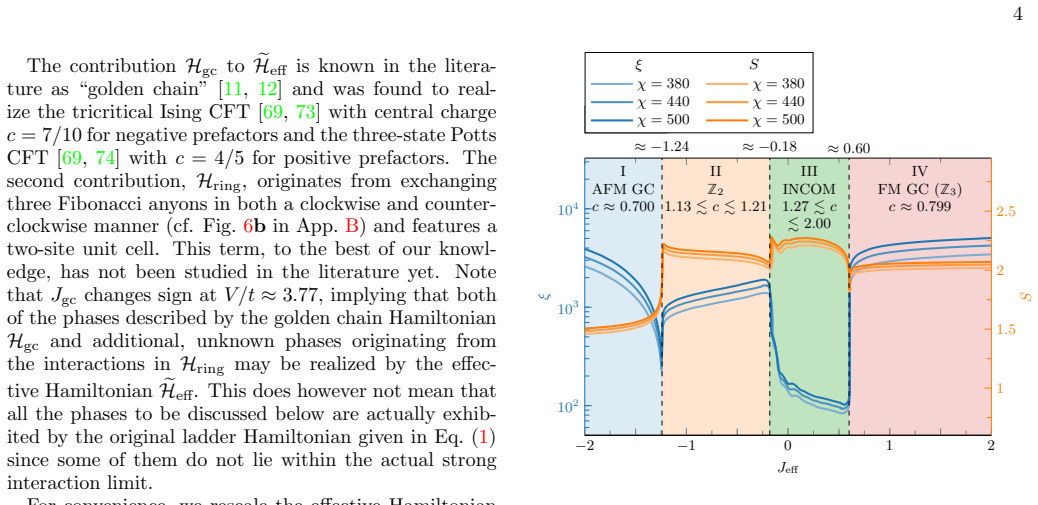
The central claim is that the ladder Hamiltonian with nearest-neighbor repulsion realizes a metal-insulator transition at $V/t\approx 1.62$, and that its sixth-order strong-coupling effective model contains a previously unstudied ring-exchange term $H_{\mathrm{ring}}$ alongside the golden-chain term $H_{\mathrm{gc}}$. The effective model is found to host four gapless phases: for $J_{\mathrm{eff}}\lesssim -1.24$ the tricritical Ising CFT with $c\approx 0.700$, for $-1.24\lesssim J_{\mathrm{eff}}\lesssim -0.18$ a phase whose transfer-matrix spectrum shows $\mathbb{Z}_2$ structure, for $-0.18\lesssim J_{\mathrm{eff}}\lesssim 0.60$ an incommensurate phase with continuously moving gapless momenta, and for $J_{\mathrm{eff}}\gtrsim 0.60$ the three-state Potts CFT with $c\approx 0.799$. Phases I and IV reproduce known golden-chain physics, while phases II and III are new and are attributed to the ring-exchange term, which preserves only translations by two sites and time reversal combined with reflection.
Load-bearing premise
The argument rests on the assumption that the sixth-order strong-coupling expansion catches all relevant processes; if higher-order terms are significant, the $\mathbb{Z}_2$ and incommensurate phases found in the effective model may not be realized by the original ladder Hamiltonian.
Editorial extensions
If this is right
- The original ladder model realizes a genuine metal-to-CDW transition for itinerant Fibonacci anyons, with the transition at $V/t\approx 1.62$ determined from the CDW order parameter and a central charge $c=0.981\pm 0.009$ on the metallic side.
- At very large $V/t$, the effective coupling $J_{\mathrm{gc}}$ changes sign at $V/t\approx 3.77$, so the original ladder is expected to enter the ferromagnetic golden-chain (three-state Potts) regime; the new $\mathbb{Z}_2$ and incommensurate phases occur at intermediate $J_{\mathrm{eff}}$ and are not necessarily reached by the original model in the strong-coupling limit.
- The ring-exchange term naturally doubles the unit cell, so any direct realization in the original ladder would show two-site-period CDW correlations and, in the incommensurate phase, gapless excitations at momenta that move continuously with the coupling.
- The comparison with Ref. [13] suggests that incommensurate gapless phases may be generic for anyonic Hamiltonians containing interactions among three or more anyons, not only for the specific Fibonacci ladder studied here.
- The $"anyonic metal"$ regime confirms that the kinetic contribution of itinerant Fibonacci anyons alone gives central charge $c=1$, matching earlier anyonic chain and ladder studies.
Reading between the lines
- Beyond the paper: if the $\mathbb{Z}_2$ and incommensurate phases survive at larger bond dimensions, the cleanest test would be to compute the eighth-order terms in perturbation theory; the paper's own convergence caveats make the $\mathbb{Z}_2$ central-charge interval the most fragile part of the phase diagram.
- Beyond the paper: the metal-to-CDW transition at $V/t\approx 1.62$ invites a finite-entanglement scaling analysis to determine its universality class; the data presented do not yet identify whether this is a Berezinskii-Kosterlitz-Thouless transition or a different critical regime.
- Beyond the paper: because the sixth-order calculation can be adapted to other fusion rules, analogous ring-exchange terms should stabilize similar $\mathbb{Z}_2$ and incommensurate phases in ladders of other non-Abelian anyons, which would make these phases a generic feature rather than a peculiarity of Fibonacci anyons.
- Beyond the paper: the incommensurate phase, with continuously moving gapless momenta, resembles floating phases found in spin chains; direct correlation-function measurements in the original ladder at large but finite $V/t$ could reveal whether such incommensurate order actually appears or remains confined to the effective model.
Editorial analysis
A structured set of objections, weighed in public.
Referee Report
Summary. The paper studies a two-leg ladder of Fibonacci anyons at half-filling subject to nearest-neighbor repulsion V and hopping t. Using infinite MPS simulations, the authors find a metallic phase for V/t below about 1.62, with central charge close to c=1, and a charge-density-wave phase above. In the strong-coupling limit they derive a sixth-order effective Hamiltonian in the fusion space, consisting of the known golden-chain term and a new ring-exchange term with a two-site unit cell. Numerical analysis of this effective model via central-charge fits and transfer-matrix spectra is used to claim four phases: the tricritical Ising golden-chain phase (c≈0.700), a Z2 phase with central charge estimated in 1.13–1.21, an incommensurate phase with central charge estimated in 1.27–2.00, and the three-state Potts golden-chain phase (c≈0.799).
Significance. If the four-phase claim is confirmed, the paper would establish that a physically motivated anyonic Hubbard model with only real-space repulsion produces, in its strong-coupling limit, an effective Hamiltonian with previously unknown ring-exchange terms and new gapless phases beyond the golden chain. The derivation of the effective Hamiltonian is parameter-free and the prefactors are stated to have been numerically verified, which is a genuine strength. The metal-to-CDW transition with c≈0.981 is a solid, falsifiable numerical result. However, the novelty of the paper centers on the two intermediate phases II and III, and the evidence for these phases is substantially weaker than for phases I and IV, as the authors themselves acknowledge when they say the central-charge estimates are inconclusive. The significance of the paper is therefore conditional on additional convergence evidence for the transfer-matrix data and a more complete characterization of phases II and III.
major comments (4)
- [Sec. IV A, Fig. 4] The central charges for phases II and III are presented as broad intervals (1.13 ≲ c ≲ 1.21 and 1.27 ≲ c ≲ 2.00), and the text explicitly states that a well-defined central charge may not exist even at infinite bond dimension and that the results are inconclusive. Since these intervals are the only quantitative characterization of phases II and III, they do not by themselves distinguish a single gapless phase from a crossover or from a finite-bond-dimension artifact. Please provide a χ-extrapolation of the entanglement-entropy scaling at representative points in phases II and III, or state clearly what alternative diagnostic would resolve the phase identification.
- [Sec. IV B and Figs. 5, 7, 8] The identification of phase II as having Z2 structure and phase III as incommensurate rests entirely on transfer-matrix spectra computed at a single bond dimension χ=100. The incommensurability is inferred from continuous shifts of the minima of the rescaled dispersions as Jeff varies, but no convergence with χ is shown for the complex phases of the dominant transfer-matrix eigenvalues. Finite MPS bond dimensions are known to produce spurious momentum shifts or additional gapless points; please present the χ-dependence of the relevant eigenvalues for at least one point in each of phases II and III, for example by comparing χ=100 with χ=200 and χ=300.
- [Sec. IV A and Fig. 3] The authors observe an oscillation in the entanglement entropy when approaching the II–III transition and state that its position 'seems to converge' to the phase transition point, while also noting the possibility of a fifth phase that cannot be resolved. Because the number of phases is the central claim, this unresolved feature should be addressed explicitly, either by demonstrating with higher bond dimensions that the oscillation is indeed a finite-χ effect or by mapping out the region with a dedicated order parameter.
- [Sec. III, after Eq. (9)] The paper correctly notes that terms beyond sixth order in perturbation theory could in principle drive phase transitions not captured by Heff. This caveat is appropriate for connecting the effective model to the original ladder Hamiltonian, and I do not consider it a fatal flaw. However, please clarify in the conclusions which of the four phases are expected to be realized by the original Hamiltonian for large V/t, given that the sign change of Jgc occurs at V/t≈3.77 and that some phases may lie outside the strict strong-coupling regime.
minor comments (4)
- [Global] There are numerous typographical errors that should be corrected, including 'descibing' in the caption of Fig. 1, 'confromal' in Sec. II, 'efecitve' in Sec. V, 'simualtions' in the captions of Figs. 5, 7, and 8, 'matrix porduct' in Sec. V, and 'quesitions' in Sec. V.
- [App. C, Fig. 7 caption] The caption for Fig. 7 lists '(d) Jeff = 0.4', but the corresponding panel and the plot axis indicate Jeff = 0.5; please correct this mismatch.
- [Sec. IV B] The rescaling factor α used to compare −ln(|λ|) with the quasiparticle dispersion E(k) is introduced without explaining how α is determined; please state the criterion used to choose α in each plot, since the visual matching of minima is part of the evidence for commensurability.
- [App. B] The statement that 'all the prefactors for the fourth and sixth-order terms have also been verified numerically' would be more useful if it specified how the verification was performed, for example by comparing the effective Hamiltonian's spectrum with exact diagonalization of the original ladder for small system sizes.
Circularity Check
No significant circularity: the effective Hamiltonian is obtained by a parameter-free strong-coupling expansion, and the phase identifications are benchmarked against external CFT results with no fitted target phases.
full rationale
The paper's derivation chain is self-contained rather than circular. The anyonic Hubbard ladder in Eq. (1) is transformed into the effective Hamiltonian Eq. (5) by a sixth-order perturbation theory calculation in Appendix B; the couplings Jgc and Jring are computed coefficients, not parameters fitted to reproduce the target phases. The metallic/CDW transition is located using the order parameter OCDW and an entanglement-entropy central-charge fit, and the c ≈ 0.981 result is compared with the independent expectation c = 1 for a one-dimensional metal. For the effective model, phases I and IV are identified by comparing extracted central charges c ≈ 0.700 and c ≈ 0.799 with the known external CFT values c = 7/10 (tricritical Ising) and c = 4/5 (three-state Potts). Phases II and III are characterized by transfer-matrix spectra and broad central-charge intervals; these data may be numerically inconclusive, but inconclusiveness is a correctness or convergence concern, not circularity. Self-citations, such as Ref. [52] for the anyonic tensor-network algorithm, provide methodological support rather than load-bearing evidence for the new phases. The authors explicitly flag the sixth-order truncation and the possible fifth phase near the II-III transition, further showing that the conclusions are not forced by construction.
Assumptions & free parameters
assumptions (4)
- domain assumption Fibonacci anyon fusion rules tau x tau = 1 + tau and the associated F and R symbols are correct.
- domain assumption The total anyon number is conserved; fusion processes that create or annihilate anyons are neglected.
- ad hoc to paper Sixth-order perturbation theory is sufficient to capture the low-energy physics in the strong-coupling limit.
- domain assumption The iMPS ansatz with a two-site unit cell can represent the ground states of the effective model, including the incommensurate phase.
Cite this review
Pith. "Pith review of Phases of Interacting Fibonacci Anyons on a Ladder at Half-Filling." pith.science (2026). https://pith.science/paper/BZPG6M6B
@misc{pith2026250722115,
  author       = {Pith},
  title        = {Pith review of: Phases of Interacting Fibonacci Anyons on a Ladder at Half-Filling},
  year         = {2026},
  howpublished = {\url{https://pith.science/paper/BZPG6M6B}},
  note         = {Machine review of arXiv:2507.22115}
}
abstract
Two-dimensional many-body quantum systems can exhibit topological order and support collective excitations with anyonic statistics different from the usual fermionic or bosonic ones. With the emergence of these exotic point-like particles, it is natural to ask what phases can arise in interacting many-anyon systems. To study this topic, we consider the particular case of Fibonacci anyons subject to an anyonic tight-binding model with nearest-neighbor repulsion on a two-leg ladder. Focusing on the case of half-filling, for low interaction strengths an ``anyonic'' metal is found, whereas for strong repulsion, the anyons form an insulating charge-density wave. Within the latter regime, we introduce an effective one-dimensional model up to sixth order in perturbation theory arising from anyonic superexchange processes. We numerically identify four distinct phases of the effective model, which we characterize using matrix product state methods. These include both the ferro- and antiferromagnetic golden chain phases, as well as phases with $\mathbb{Z}_2$ and incommensurate correlations.
Figures


Figures from the paper (4 more)


Forward citations
Cited by 1 Pith paper
-
Exact Leg-Cut Influence Functional and Emergence of Gaussian Entanglement Theory in a Statistical-Dressing Ladder Model
Exact lattice influence functional on a bipartitioned hard-core ladder proves density-density character for initial mixedness and analytic suppression of higher-order terms to Gaussian continuum form under coarse-graining.
Reference graph
Works this paper leans on
-
[1]
Hubbard, Electron correlations in narrow energy bands, Proc
J. Hubbard, Electron correlations in narrow energy bands, Proc. R. Soc. Lond. A 276, 238 (1963)
1963
-
[2]
M. C. Gutzwiller, Effect of Correlation on the Ferromag- netism of Transition Metals, Phys. Rev. Lett. 10, 159 (1963)
work page 1963
-
[3]
J. Kanamori, Electron Correlation and Ferromagnetism of Transition Metals, Progress of Theoretical Physics 30, 275 (1963)
work page 1963
-
[4]
M. Qin, T. Sch¨ afer, S. Andergassen, P. Corboz, and E. Gull, The Hubbard Model: A Computational Per- spective, Annual Review of Condensed Matter Physics 13, 275 (2022)
2022
-
[5]
M. P. A. Fisher, P. B. Weichman, G. Grinstein, and D. S. Fisher, Boson localization and the superfluid-insulator transition, Phys. Rev. B 40, 546 (1989)
1989
- [6]
- [7]
-
[8]
M. Bonkhoff, K. J¨ agering, S. Eggert, A. Pelster, M. Thor- wart, and T. Posske, Bosonic Continuum Theory of One-Dimensional Lattice Anyons, Phys. Rev. Lett. 126, 163201 (2021)
work page 2021
Show all 81 references
-
[9]
Bonkhoff, S
M. Bonkhoff, S. B. J¨ ager, I. Schneider, A. Pelster, and S. Eggert, Coherence properties of the repulsive anyon- Hubbard dimer, Phys. Rev. B 108, 155134 (2023)
2023
-
[10]
Bonkhoff, K
M. Bonkhoff, K. J¨ agering, S. Hu, A. Pelster, S. Eggert, and I. Schneider, Anyonic phase transitions in the 1D ex- tended Hubbard model with fractional statistics (2024), arXiv:2410.00089 [cond-mat.str-el]
2024 arXiv
-
[11]
Feiguin, S
A. Feiguin, S. Trebst, A. W. W. Ludwig, M. Troyer, A. Kitaev, Z. Wang, and M. H. Freedman, Interacting Anyons in Topological Quantum Liquids: The Golden Chain, Phys. Rev. Lett. 98, 160409 (2007)
2007
-
[12]
Trebst, M
S. Trebst, M. Troyer, Z. Wang, and A. W. W. Ludwig, A Short Introduction to Fibonacci Anyon Models, Progress of Theoretical Physics Supplement 176, 384 (2008)
2008
-
[13]
Trebst, E
S. Trebst, E. Ardonne, A. Feiguin, D. A. Huse, A. W. W. Ludwig, and M. Troyer, Collective States of Interacting Fibonacci Anyons, Phys. Rev. Lett. 101, 050401 (2008)
2008
-
[14]
DeGottardi, Topological insulating phases of non- Abelian anyonic chains, Phys
W. DeGottardi, Topological insulating phases of non- Abelian anyonic chains, Phys. Rev. B 90, 075129 (2014)
2014
-
[15]
Buican and A
M. Buican and A. Gromov, Anyonic Chains, Topological Defects, and Conformal Field Theory, Commun. Math. Phys. 356, 1017 (2017)
2017
-
[16]
C. Gils, E. Ardonne, S. Trebst, A. W. W. Ludwig, M. Troyer, and Z. Wang, Collective States of Interacting Anyons, Edge States, and the Nucleation of Topological Liquids, Phys. Rev. Lett. 103, 070401 (2009)
2009
-
[17]
C. Gils, E. Ardonne, S. Trebst, D. A. Huse, A. W. W. Ludwig, M. Troyer, and Z. Wang, Anyonic quantum spin chains: Spin-1 generalizations and topological stability, Phys. Rev. B 87, 235120 (2013)
2013
-
[18]
Ardonne, J
E. Ardonne, J. Gukelberger, A. W. W. Ludwig, S. Trebst, and M. Troyer, Microscopic models of interact- ing Yang–Lee anyons, New J. Phys. 13, 045006 (2011)
2011
-
[19]
Poilblanc, M
D. Poilblanc, M. Troyer, E. Ardonne, and P. Bon- derson, Fractionalization of Itinerant Anyons in One- Dimensional Chains, Phys. Rev. Lett. 108, 207201 (2012)
2012
-
[20]
Poilblanc, A
D. Poilblanc, A. Feiguin, M. Troyer, E. Ardonne, and P. Bonderson, One-dimensional itinerant interacting non- Abelian anyons, Phys. Rev. B 87, 085106 (2013)
2013
-
[21]
P. E. Finch, H. Frahm, M. Lewerenz, A. Milsted, and T. J. Osborne, Quantum phases of a chain of strongly interacting anyons, Phys. Rev. B 90, 081111 (2014)
2014
-
[22]
P. E. Finch, M. Flohr, and H. Frahm, Integrable anyon chains: From fusion rules to face models to effective field theories, Nuclear Physics B 889, 299 (2014)
2014
-
[23]
Poilblanc, A
D. Poilblanc, A. W. W. Ludwig, S. Trebst, and M. Troyer, Quantum spin ladders of non-Abelian anyons, Phys. Rev. B 83, 134439 (2011)
2011
-
[24]
B. M. Ayeni, S. Singh, R. N. C. Pfeifer, and G. K. Bren- nen, Simulation of braiding anyons using matrix product states, Phys. Rev. B 93, 165128 (2016)
2016
-
[25]
M. Soni, M. Troyer, and D. Poilblanc, Effective models of doped quantum ladders of non-Abelian anyons, Phys. Rev. B 93, 035124 (2016)
2016
-
[26]
B. M. Ayeni, R. N. C. Pfeifer, and G. K. Brennen, Phase transitions on a ladder of braided non-Abelian anyons, Phys. Rev. B 98, 045432 (2018)
2018
-
[27]
J. M. Leinaas and J. Myrheim, On the theory of identical particles, Il Nuovo Cimento B (1971-1996) 37, 1 (1977)
1977
-
[28]
Wilczek, Magnetic Flux, Angular Momentum, and Statistics, Phys
F. Wilczek, Magnetic Flux, Angular Momentum, and Statistics, Phys. Rev. Lett. 48, 1144 (1982)
1982
-
[29]
Wilczek, Quantum Mechanics of Fractional-Spin Par- ticles, Phys
F. Wilczek, Quantum Mechanics of Fractional-Spin Par- ticles, Phys. Rev. Lett. 49, 957 (1982)
1982
-
[30]
R. B. Laughlin, Anomalous Quantum Hall Effect: An In- compressible Quantum Fluid with Fractionally Charged Excitations, Phys. Rev. Lett. 50, 1395 (1983). 13
1983
-
[31]
B. I. Halperin, Statistics of Quasiparticles and the Hi- erarchy of Fractional Quantized Hall States, Phys. Rev. Lett. 52, 1583 (1984)
1984
-
[32]
Arovas, J
D. Arovas, J. R. Schrieffer, and F. Wilczek, Fractional Statistics and the Quantum Hall Effect, Phys. Rev. Lett. 53, 722 (1984)
1984
-
[33]
X. G. Wen and Q. Niu, Ground-state degeneracy of the fractional quantum Hall states in the presence of a random potential and on high-genus Riemann surfaces, Phys. Rev. B 41, 9377 (1990)
1990
-
[34]
Read and E
N. Read and E. Rezayi, Beyond paired quantum Hall states: Parafermions and incompressible states in the first excited Landau level, Phys. Rev. B 59, 8084 (1999)
1999
-
[35]
Stern, Anyons and the quantum Hall effect—A peda- gogical review, Annals of Physics 323, 204 (2008)
A. Stern, Anyons and the quantum Hall effect—A peda- gogical review, Annals of Physics 323, 204 (2008)
2008
-
[36]
Moessner and S
R. Moessner and S. L. Sondhi, Resonating Valence Bond Phase in the Triangular Lattice Quantum Dimer Model, Phys. Rev. Lett. 86, 1881 (2001)
2001
-
[37]
Balents, M
L. Balents, M. P. A. Fisher, and S. M. Girvin, Fraction- alization in an easy-axis Kagome antiferromagnet, Phys. Rev. B 65, 224412 (2002)
2002
-
[38]
Kitaev, Fault-tolerant quantum computation by anyons, Annals of Physics 303, 2 (2003)
A. Kitaev, Fault-tolerant quantum computation by anyons, Annals of Physics 303, 2 (2003)
2003
-
[39]
Hermele, M
M. Hermele, M. P. A. Fisher, and L. Balents, Pyrochlore photons: The U (1) spin liquid in a S = 1 2 three- dimensional frustrated magnet, Phys. Rev. B 69, 064404 (2004)
2004
-
[40]
M. A. Levin and X.-G. Wen, String-net condensation: A physical mechanism for topological phases, Phys. Rev. B 71, 045110 (2005)
2005
-
[41]
Kitaev, Anyons in an exactly solved model and be- yond, Ann
A. Kitaev, Anyons in an exactly solved model and be- yond, Ann. Phys. 321, 2 (2006)
2006
-
[42]
Savary and L
L. Savary and L. Balents, Quantum spin liquids: a re- view, Rep. Prog. Phys. 80, 016502 (2017)
2017
-
[43]
M. H. Freedman, M. Larsen, and Z. Wang, A modu- lar functor which is universal for quantum computation, Commun. Math. Phys. 227, 605 (2002)
2002
-
[44]
Nayak, S
C. Nayak, S. H. Simon, A. Stern, M. Freedman, and S. Das Sarma, Non-Abelian anyons and topological quan- tum computation, Rev. Mod. Phys. 80, 1083 (2008)
2008
-
[45]
R. S. K. Mong, D. J. Clarke, J. Alicea, N. H. Lind- ner, P. Fendley, C. Nayak, Y. Oreg, A. Stern, E. Berg, K. Shtengel, and M. P. A. Fisher, Universal Topological Quantum Computation from a Superconductor-Abelian Quantum Hall Heterostructure, Phys. Rev. X 4, 011036 (2014)
2014
-
[46]
Field and T
B. Field and T. Simula, Introduction to topological quan- tum computation with non-Abelian anyons, Quantum Sci. Technol. 3, 045004 (2018)
2018
-
[47]
Bonderson, Splitting the Topological Degeneracy of Non-Abelian Anyons, Phys
P. Bonderson, Splitting the Topological Degeneracy of Non-Abelian Anyons, Phys. Rev. Lett. 103, 110403 (2009)
2009
-
[48]
Zauner, D
V. Zauner, D. Draxler, L. Vanderstraeten, M. Degroote, J. Haegeman, M. M. Rams, V. Stojevic, N. Schuch, and F. Verstraete, Transfer matrices and excitations with ma- trix product states, New J. Phys. 17, 053002 (2015)
2015
-
[49]
Hatsugai, M
Y. Hatsugai, M. Kohmoto, and Y.-S. Wu, Braid group and anyons on a cylinder, Phys. Rev. B 43, 2661 (1991)
1991
-
[50]
Hatsugai, M
Y. Hatsugai, M. Kohmoto, and Y.-S. Wu, Anyons on a torus: Braid group, Aharonov-Bohm period, and numer- ical study, Phys. Rev. B 43, 10761 (1991)
1991
-
[51]
Kallin, Flux quantization for semions on a torus, Phys
C. Kallin, Flux quantization for semions on a torus, Phys. Rev. B 48, 13742 (1993)
1993
-
[52]
Kirchner, D
N. Kirchner, D. Millar, B. M. Ayeni, A. Smith, J. K. Slingerland, and F. Pollmann, Numerical simulation of non-Abelian anyons, Phys. Rev. B 107, 195129 (2023)
2023
-
[53]
Millar, Interacting Anyons in One and Two Dimen- sions: Strong Zero Modes in Anyon Chains and Non- Abelian Anyons on a Torus , Ph.D
D. Millar, Interacting Anyons in One and Two Dimen- sions: Strong Zero Modes in Anyon Chains and Non- Abelian Anyons on a Torus , Ph.D. thesis, National Uni- versity of Ireland Maynooth (2021)
2021
-
[54]
Kirchner, Simulation of Anyon Dynamics , Master’s thesis, Technische Universit¨ at M¨ unchen (2021)
N. Kirchner, Simulation of Anyon Dynamics , Master’s thesis, Technische Universit¨ at M¨ unchen (2021)
2021
-
[55]
S. H. Simon, Topological Quantum (Oxford University Press, 2023)
2023
-
[56]
Bernevig and T
A. Bernevig and T. Neupert, Topological superconduc- tors and category theory, Lecture Notes of the Les Houches Summer School: Topological Aspects of Con- densed Matter Physics , 63 (2017)
2017
-
[57]
P. H. Bonderson, Non-Abelian anyons and interferom- etry, Ph.D. thesis, California Institute of Technology (2007)
2007
-
[58]
Bonderson, Measuring Topological Order, Phys
P. Bonderson, Measuring Topological Order, Phys. Rev. Research 3, 033110 (2021)
2021
-
[59]
Bonderson, C
P. Bonderson, C. Knapp, and K. Patel, Anyonic entan- glement and topological entanglement entropy, Ann. of Phys. 385, 399 (2017)
2017
-
[60]
Bonderson, K
P. Bonderson, K. Shtengel, and J. Slingerland, Interfer- ometry of non-Abelian anyons, Annals of Physics 323, 2709 (2008)
2008
-
[61]
Kong and Z.-H
L. Kong and Z.-H. Zhang, An invitation to topological or- ders and category theory (2022), arXiv:2205.05565 [cond- mat.str-el]
2022 arXiv
-
[62]
R. S. K. Mong, M. P. Zaletel, F. Pollmann, and Z. Papi´ c, Fibonacci anyons and charge density order in the 12/5 and 13/5 quantum Hall plateaus, Phys. Rev. B 95, 115136 (2017)
2017
-
[63]
Fannes, B
M. Fannes, B. Nachtergaele, and R. F. Werner, Finitely correlated states on quantum spin chains, Commun. Math. Phys. 144, 443 (1992)
1992
-
[64]
Schollw¨ ock, The density-matrix renormalization group in the age of matrix product states, Annals of Physics 326, 96 (2011), january 2011 Special Issue
U. Schollw¨ ock, The density-matrix renormalization group in the age of matrix product states, Annals of Physics 326, 96 (2011), january 2011 Special Issue
2011
-
[65]
Hauschild and F
J. Hauschild and F. Pollmann, Efficient numerical sim- ulations with Tensor Networks: Tensor Network Python (TeNPy), SciPost Phys. Lect. Notes , 5 (2018)
2018
-
[66]
R. N. C. Pfeifer, P. Corboz, O. Buerschaper, M. Aguado, M. Troyer, and G. Vidal, Simulation of anyons with ten- sor network algorithms, Phys. Rev. B 82, 115126 (2010)
2010
-
[67]
Singh, R
S. Singh, R. N. C. Pfeifer, G. Vidal, and G. K. Brennen, Matrix product states for anyonic systems and efficient simulation of dynamics, Phys. Rev. B 89, 075112 (2014)
2014
-
[68]
R. N. C. Pfeifer and S. Singh, Finite density matrix renor- malization group algorithm for anyonic systems, Phys. Rev. B 92, 115135 (2015)
2015
-
[69]
Di Francesco, P
P. Di Francesco, P. Mathieu, and D. S´ en´ echal,Conformal field theory (Springer New York, 2012)
2012
-
[70]
Holzhey, F
C. Holzhey, F. Larsen, and F. Wilczek, Geometric and renormalized entropy in conformal field theory, Nuclear Physics B 424, 443 (1994)
1994
-
[71]
Calabrese and J
P. Calabrese and J. Cardy, Entanglement entropy and quantum field theory, J. Stat. Mech. 2004, P06002 (2004)
2004
-
[72]
Tagliacozzo, T
L. Tagliacozzo, T. R. de Oliveira, S. Iblisdir, and J. I. La- torre, Scaling of entanglement support for matrix product states, Phys. Rev. B 78, 024410 (2008)
2008
-
[73]
Friedan, Z
D. Friedan, Z. Qiu, and S. Shenker, Superconformal invariance in two dimensions and the tricritical Ising 14 model, Physics Letters B 151, 37 (1985)
1985
-
[74]
Dotsenko, Critical behaviour and associated confor- mal algebra of the Z3 Potts model, Nuclear Physics B 235, 54 (1984)
V. Dotsenko, Critical behaviour and associated confor- mal algebra of the Z3 Potts model, Nuclear Physics B 235, 54 (1984)
1984
-
[75]
Rommer and S
S. Rommer and S. ¨Ostlund, Class of ansatz wave func- tions for one-dimensional spin systems and their relation to the density matrix renormalization group, Phys. Rev. B 55, 2164 (1997)
1997
-
[76]
Haegeman, B
J. Haegeman, B. Pirvu, D. J. Weir, J. I. Cirac, T. J. Os- borne, H. Verschelde, and F. Verstraete, Variational ma- trix product ansatz for dispersion relations, Phys. Rev. B 85, 100408 (2012)
2012
-
[77]
Haegeman, T
J. Haegeman, T. J. Osborne, and F. Verstraete, Post- matrix product state methods: To tangent space and beyond, Phys. Rev. B 88, 075133 (2013)
2013
-
[78]
Vanderstraeten, J
L. Vanderstraeten, J. Haegeman, and F. Verstraete, Tangent-space methods for uniform matrix product states, SciPost Phys. Lect. Notes , 7 (2019)
2019
-
[79]
Van Damme, L
M. Van Damme, L. Devos, and J. Haegeman, MPSKit, Zenodo (2025)
2025
-
[80]
Kirchner, R
N. Kirchner, R. Moessner, A. Gammon-Smith, and F. Pollmann, Phases of Interacting Fibonacci Anyons on a Ladder at Half-Filling, 10.5281/zenodo.16563758 (2025), Zenodo
2025 doi
-
[81]
C. E. Soliverez, An effective Hamiltonian and time- independent perturbation theory, J. Phys. C: Solid State Phys. 2, 2161 (1969)
1969
Reviewed August 6, 2026 · model on record in the stance chip above.
Discussion (0). Sign in to comment.