REVIEW 4 major objections 5 minor 46 references
Cycles Protocol: A Peer-to-Peer Electronic Clearing System
T0 review · 4 major / 5 minor · reviewed 2026-08-06 · deepseek-v4-flash
Pith's one-line read The paper claims liquidity is hidden in the cycles of an obligation graph: atomic settlement flows along those cycles clear the most debt with the least money, and full discharge becomes possible once injected liquidity reaches the Net…
desk verdict A candid, well-scoped design sketch for permissionless multilateral clearing; the architecture is interesting, but the headline privacy guarantee rests on TEE assumptions the paper itself flags, and the central simulation lacks methodology. read the letter →
The pith
A machine-rendered reading of the paper's core claim, the machinery that carries it, and where it could break.
The reading
What carries the argument
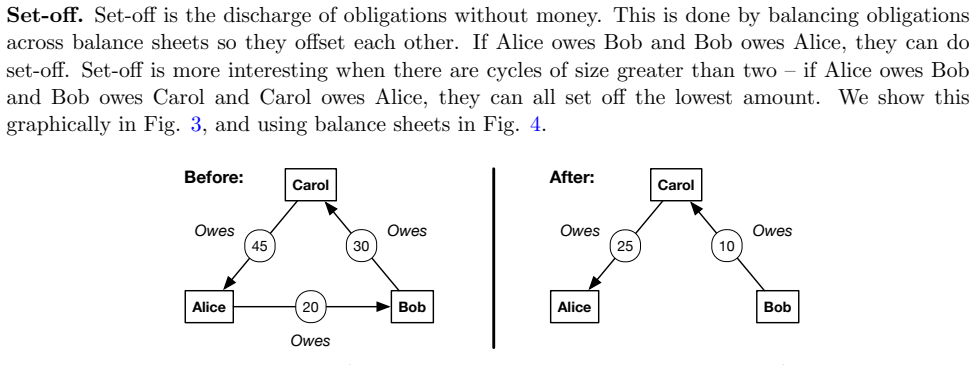
The load-bearing object is the obligation graph, a directed network built from two intent types — Obligations (a debtor's declaration of a debt) and Acceptances (a creditor's willingness to be owed, for example by a bank or a blockchain) — plus Tenders that draw on liquidity sources, all resolved into Settlement Records that execute atomically as balanced Settlement Flows. The solver is MTCS, a min-cost max-flow algorithm: it finds the minimum-cost flow of the maximal dischargeable amount (the Net Internal Debt), and subtracting that flow from the graph exposes the cycles in which set-off clears debt without money. The paper also classifies the four ways to settle an obligation — set-off, assignment, overdraft, and assumption — showing that each is a cyclic configuration of obligations and acceptances around a network node.
What would settle it
Reproduce the figure-10 simulation on the underlying Italian invoice dataset: if zero-liquidity cycle set-off clears substantially less than the reported ~10% of total debt, or if the cleared-debt curve does not rise with slope greater than one for small liquidity injections, the multiplier claim collapses. Separately, a demonstrated side-channel attack that recovers counterparty structure from the enclave's memory-access patterns during a batch MTCS run — an attack the paper explicitly excludes from consideration — would falsify the privacy guarantee.
Extended reading notes
Core claim
Framing every payment as a cycle that includes a liquidity source, the paper discovers that the obligation network contains endogenous liquidity: debts that offset each other through the graph structure. The Multilateral Trade Credit Set-off (MTCS) algorithm, a min-cost max-flow solver, computes the maximal balanced flow that can be settled, and subtracting that flow from the full obligation graph yields the cyclic structure that discharges the most debt. The key quantitative claim is a multiplier effect: with zero injected liquidity, nearly 10% of debt in a real Italian trade-credit dataset (1,280,000 invoices, 760,000 companies) clears purely by cycle set-off, and full discharge of all obligations becomes possible once injected liquidity reaches the Net Internal Debt. Because settlement records are applied atomically as balanced flows, the protocol discharges many debts simultaneously without novating contracts or substituting counterparties, using set-off notices governed by private obligation law rather than financial regulation.
Load-bearing premise
The whole privacy-preserving promise rests on a trusted execution environment (such as Intel SGX or AMD SEV) keeping the obligation graph secret while the solver runs, and the paper itself concedes that today's TEEs have been repeatedly compromised, that the manufacturer is the root of trust, and that memory-access-pattern side-channel leakage is not addressed.
Editorial extensions
If this is right
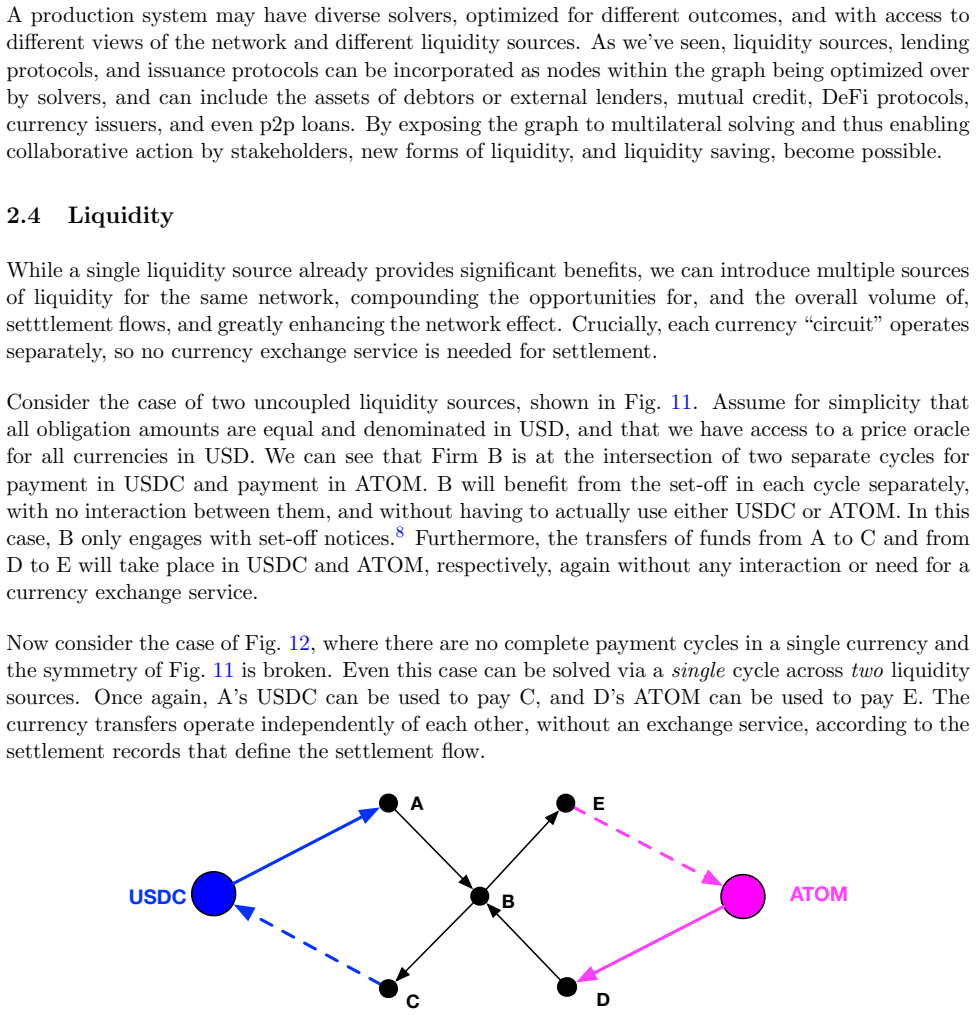
- Any digitally programmable asset — a stablecoin, BTC, a bank deposit, or a mutual-credit balance — can plug into the obligation graph as a liquidity source, so diverse currencies clear debt together in one atomic flow without a currency-exchange step.
- Overdraft facilities and lending protocols become nodes in the graph, letting borrowers draw only the minimal credit needed to discharge their obligations and having repayment optimized automatically through future set-off.
- The 'firms are liquidity sources, liquidity sources are firms' equivalence means a p2p loan can clear an entire chain of debts with no assets at all, leaving a single future obligation.
- Even a zero-liquidity network retains a floor of clearing power: obligations lying in cycles can be partially discharged up to the smallest debt in each cycle, which the Italian data put at nearly 10% of total debt.
- Issuance protocols — mutual credit, trust networks, collateralized stablecoins — can be layered in as overdraft-with-issuance nodes, turning the system into a platform for network-aware credit creation.
Reading between the lines
- If the multiplier effect scales to denser real-world trade networks, a substantial fraction of SME working-capital pressure is a coordination failure rather than a capital shortage: the liquidity to clear most invoices already exists in the web of obligations, and only a small external injection (the NID) is needed to unlock full discharge.
- The TEE dependency points to a testable research direction the paper leaves open: replacing or reducing the enclave's role with multi-party computation or homomorphic encryption, which would move the privacy guarantee from hardware-manufacturer trust to distributed trust.
- The four-ways-to-settle taxonomy and the obligation/acceptance language could serve as a common description language for comparing existing payment systems — banks, fintechs, blockchains, complementary currencies — by how many of the four settlement types they admit and how much of the obligation graph they can see.
- A deployment risk implicit in the design is gaming of the graph: since users choose which debts to submit and which tenders to post, a firm could selectively conceal or postpone obligations to improve its position in a clearing batch, a strategic-behaviour question the protocol does not analyze.
Signed reviews
Editorial analysis
A structured set of objections, weighed in public.
Referee Report
Summary. The paper presents a design for “Cycles,” an open, decentralized clearing and settlement protocol. It introduces a graph-based language of intents — obligations, acceptances, tenders, and settlement records — and a taxonomy of four ways to settle (set-off, assignment, overdraft, assumption). The central proposal is that a min-cost max-flow algorithm, MTCS, can find cyclic settlement flows that discharge the most debt with the least injected liquidity, and that this computation can be performed privately by executing MTCS inside a TEE while posting a ZK proof of validity on-chain. The paper is explicitly a design sketch (v0.5, November 2024): it describes the protocol architecture, user flows, and an idealized ZK verifier, and supports the liquidity-saving claim with one simulation plot (Figure 10) based on anonymized Italian invoice data. The mathematical foundations of MTCS and the proof that “adding at least the NID worth of liquidity① 100% discharge of all obligations is possible” are cited to the authors’ prior work [22, 23] rather than derived here.
Significance. The paper has real conceptual value. The obligation/acceptance/tender/settlement-record vocabulary of Sections 2.1–2.2 is a clear and potentially useful framework for reasoning about payment systems, and the four-ways-to-settle taxonomy is well presented. The ZK+TEE side-car architecture of Section 3.3 is a concrete, coherent design, and the paper is commendably explicit about its own limitations: Section 3.4 concedes that TEEs have known vulnerabilities, that memory-access-pattern leakage is not addressed, and that the privacy of the graph “continue[s] to rely on the TEE.” If the quantitative multiplier claim holds and the privacy assumption can be made robust, the protocol would be a notable contribution to multilateral clearing and could give blockchains a credible real-economy use case. However, as it stands, the central quantitative evidence is a single non-reproducible figure, and the headline privacy guarantee rests on an assumption the paper itself flags as fragile.
major comments (4)
- [§3.3–3.4, Privacy & Settlement Architecture] The “privacy-preserving” claim of the abstract is load-bearing and is not established under a realistic adversary model. Sections 3.3–3.4 make the TEE the sole guardian of the obligation graph: users encrypt intents to the TEE key, the TEE decrypts the full graph and runs MTCS inside the enclave, and the posted ZK proof verifies only validity of the flow. Section 3.4 explicitly states that “For side channels, we are not considering memory access pattern leakage” and that “today’s TEEs have been prone to vulnerabilities.” A single side-channel disclosure or a malicious manufacturer would expose the entire obligation graph (who owes whom, and how much), and the protocol provides no detection or post-hoc privacy reconstruction; forward secrecy only limits cross-epoch contamination. The paper needs a precise threat model (which parties are honest-but-curious, which are Byzantine, what the TEE is trusted for), and it should either provide evidence that MTCS can be implemented in a constant-access-pattern or otherwise side-channel-resistant form for batch graphs, or scope the privacy claim accordingly. This is a correctness-risk concern with a concrete test: the claim cannot be maintained unless such an implementation or mitigation (e.g., ORAM) is at least specified.
- [§2.3, Figure 10] The paper’s central quantitative claim — the multiplier effect shown in Figure 10 — is not reproducible from the manuscript. The caption cites 1,280,000 invoices and 760,000 companies from anonymized Italian data (December 2020), but no dataset methodology, preprocessing steps, parameter choices, error bars, confidence intervals, or code artifacts are provided, and the figure has no axis labels. The caption’s interpretive statements (e.g., that the first plateau of the red curve corresponds to “the clearing of large debts after the chains have been exhausted”) are not directly evidenced by the plotted data. Because this figure is the only quantitative support for the headline claim that the protocol clears more debt per unit of liquidity than the total debt, the authors should supply a full empirical methodology (data source description, sampling or completeness, solver configuration, and uncertainty quantification) or explicitly present the figure as an illustrative example rather than a validated result.
- [§2.3 and §3.1–3.3, MTCS and the NID theorem] The foundational step — that min-cost max-flow over the obligation graph yields the maximal cyclic flow and that adding the Net Internal Debt worth of liquidity gives 100% discharge — is asserted in Section 2.3 and then deferred: “The mathematical details are described in [22].” Since [22, 23] are the authors’ own prior papers, this creates a self-referential evidential base for the protocol’s core mechanism. The manuscript should state precisely which claims are proven here, which are cited, and which are conjectural. In particular, the statement “By adding at least the NID worth of liquidity, 100% discharge of all obligations is possible” needs a formal statement (what is discharged, what remains as newly created obligations, and what role the acyclicity of the residual graph plays). Without this, a reader cannot verify that the protocol achieves its stated objective.
- [§3.3, Zero Knowledge Proofs for Integrity Guarantees] The claim that “the ZK proof in conjunction with the Cycles chain provides an end-to-end security guarantee about atomic multilateral settlement, without depending on the TEE at all” is overstated relative to the described protocol. The ZK verifier in Figure 14 receives the plaintext graph G as a witness from the prover and checks that G opens the commitment ΔG; but ΔG is defined as the set of ciphertexts encrypted to the TEE’s public key, so only the TEE (or a party with xPriv) can produce that opening. The protocol does not specify how the chain, or the ZK proof, binds the TEE to the exact plaintext graph that users posted, as opposed to a graph of the TEE’s choosing. A precise corruption model is needed: is the TEE assumed fail-stop (in which case the ZK proof provides integrity against posting invalid flows), or Byzantine (in which case the ZK proof alone does not prevent the TEE from proving a flow against a substituted graph)? The distinction materially affects the protocol’s integrity guarantee.
minor comments (5)
- [§2.3, Figure 10] The figure lacks axis labels and the caption text is dense; adding explicit labels and a legend would make the multiplier effect legible without requiring the reader to parse the caption alone.
- [§2.4, Liquidity] Typographical error: “setttlement flows” should be “settlement flows.” Uniform spelling of “set-off” vs “setoff” should also be checked throughout.
- [§3.2, “101% discharge” discussion in §2.3] The phrase “100% discharge of all obligations” in Section 2.3 is misleading in the presence of overdraft facilities, where obligations are replaced, not extinguished; the authors should clarify what “discharge” means for net positions versus gross obligations.
- [§2.2–§2.3, Notation] The notation in Section 3.3 (ΔG := {Enc(xPub, G[u,v])}ₙ,ᵥ) is ambiguous about whether each edge is individually encrypted or the whole graph is committed as a unit; this matters for the ZK decryption check in Figure 14.
- [§3.4, Discussion of MPC] The statement that MPC “K nodes could collude to decrypt user inputs” should be qualified: the standard MPC threat model is active or passive security against an adversary controlling a threshold of parties, and a privacy breach by colluding parties is indeed generally undetectable, but this depends on whether the corruption is static or adaptive; the authors should state the assumed model.
Circularity Check
Only the NID statement is definitional; the core MTCS-based design and privacy architecture are not circular, though the TEE dependence is a stated limitation.
-
self definitional
[Section 2.3 (Graph Solving), NID definition and 100% discharge claim]
"The existence of a cyclic structure implies that the amount of liquidity required to discharge all the debt is less than the total amount of debt. We call this amount the Net Internal Debt (NID). ... By adding at least the NID worth of liquidity, 100% discharge of all obligations is possible."
NID is introduced as 'the amount of liquidity required to discharge all the debt'; the later sentence 'By adding at least the NID worth of liquidity, 100% discharge of all obligations is possible' is therefore a restatement of the definition, true by construction. The substantive part of the claim, that MTCS computes this flow and that it is below total debt, is not proven in this paper and is deferred to prior work [22] by the current authors. Thus the headline 'most debt with least money' has a definitional component, although the protocol design itself does not reduce to a fitted parameter or to the simulation.
full rationale
The paper's central solver, MTCS, is cited to the authors' own prior work [22, 23], but it is a parameter-free min-cost max-flow algorithm published in a peer-reviewed venue and is externally checkable; it is not fitted to this paper's data, and the Figure 10 simulation is an illustrative application to Italian invoice data rather than an independent benchmark. The main non-circular limitation is the privacy architecture: Section 3.3 states that the ZK proof checks only validity while 'optimality depends on the TEE', and Section 3.4 explicitly concedes that 'today's TEEs have been prone to vulnerabilities' and that 'For side channels, we are not considering memory access pattern leakage.' These are trust and correctness risks in the privacy claim, not circular derivations. The only genuinely circular phrasing is the NID definition, where the asserted sufficiency of NID liquidity is true by the way NID is defined. That does not undermine the rest of the protocol's contribution, so the overall circularity score is low.
Assumptions & free parameters
assumptions (5)
- domain assumption MTCS finds the minimum cost flow of the maximal liquidity amount (the NID), enabling 100% discharge when NID liquidity is available.
- domain assumption A TEE (Intel SGX or AMD SEV) protects the privacy of the encrypted obligation graph during computation, with the manufacturer as root of trust.
- domain assumption Set-off notices are formally and legally binding communications under international private obligation law, allowing balance sheet discharge.
- domain assumption Real-world trade credit networks contain enough length-2+ cycles and chains to achieve substantial netting benefits.
- domain assumption A BFT blockchain with ZK validity proofs can atomically execute settlement flows and guarantee all-or-none application.
Cite this review
Pith. "Pith review of Cycles Protocol: A Peer-to-Peer Electronic Clearing System." pith.science (2026). https://pith.science/paper/JCRGD5JV
@misc{pith2026250722309,
  author       = {Pith},
  title        = {Pith review of: Cycles Protocol: A Peer-to-Peer Electronic Clearing System},
  year         = {2026},
  howpublished = {\url{https://pith.science/paper/JCRGD5JV}},
  note         = {Machine review of arXiv:2507.22309}
}
read the original abstract
For centuries, financial institutions have responded to liquidity challenges by forming closed, centralized clearing clubs with strict rules and membership that allow them to collaborate on using the least money to discharge the most debt. As closed clubs, much of the general public has been excluded from participation. But the vast majority of private sector actors consists of micro or small firms that are vulnerable to late payments and generally ineligible for bank loans. This low liquidity environment often results in gridlock and leads to insolvency, and it disproportionately impacts small enterprises and communities. On the other hand, blockchain communities have developed open, decentralized settlement systems, along with a proliferation of store of value assets and new lending protocols, allowing anyone to permissionlessly transact and access credit. However, these protocols remain used primarily for speculative purposes, and so far have fallen short of the large-scale positive impact on the real economy prophesied by their promoters. We address these challenges by introducing Cycles, an open, decentralized clearing, settlement, and issuance protocol. Cycles is designed to enable firms to overcome payment inefficiencies, to reduce their working capital costs, and to leverage diverse assets and liquidity sources, including cryptocurrencies, stablecoins, and lending protocols, in service of clearing more debt with less money. Cycles solves real world liquidity challenges through a privacy-preserving multilateral settlement platform based on a graph optimization algorithm. The design is based on a core insight: liquidity resides within cycles in the payment network's structure and can be accessed via settlement flows optimized to reduce debt.
Figures


Figures from the paper (12 more)




Reference graph
Works this paper leans on
-
[22]
Mathematical Foundations for Balancing the Payment System in the Trade Credit Market
Toma˘ z Fleischman and Paolo Dini. Mathematical Foundations for Balancing the Payment System in the Trade Credit Market. Journal of Risk and Financial Management , 14(9):452, 2021. Available online: https://www.mdpi.com/1911-8074/14/9/452
work page 2021
-
[1]
Massimo Amato and Luca Fantacci. The End of Finance . Polity, Cambridge, 2012
work page 2012
-
[2]
Universal basic income in a blockchain-based community currency
Sowelu Avanzo, Teodoro Criscione, Julio Linares, and Claudio Schifanella. Universal basic income in a blockchain-based community currency. In Proceedings of the 2023 ACM conference on information technology for social good, pages 223–232, 2023
work page 2023
-
[3]
Lombard Street: A description of the money market
Walter Bagehot. Lombard Street: A description of the money market . HS King&Company, 1873
-
[4]
Survey on the access to finance of enterprises in the euro area, 2023
European Central Bank. Survey on the access to finance of enterprises in the euro area, 2023. URL: https://www.ecb.europa.eu/stats/ecb_surveys/safe/html/ecb.safe202306~58c0da48d6.en.html
work page 2023
-
[5]
Research Directions for Verifiable Crypto-Physically Secure TEEs
Sylvain Bellemare. Research directions for verifiable crypto-physically secure tees. arXiv preprint arXiv:2410.03183, 2024
work page Pith review arXiv 2024
-
[6]
Predicting corporate credit risk: Network contagion via trade credit
Claudia Berloco, Gianmarco De Francisci Morales, Daniele Frassineti, Greta Greco, Hashani Kumarasinghe, Marco Lamieri, Emanuele Massaro, Arianna Miola, and Shuyi Yang. Predicting corporate credit risk: Network contagion via trade credit. PLoS One , 16(4):e0250115, 2021. URL: https://journals.plos. org/plosone/article?id=10.1371/journal.pone.0250115
-
[7]
Nils Bertschinger, Martin Hoefer, and Daniel Schmand. Strategic payments in financial networks, 2019. arXiv preprint 1908.01714. URL: https://arxiv.org/pdf/1908.01714.pdf
work page Pith review arXiv 2019
Show all 46 references
-
[8]
Trade Credit and Credit Rationing
Bruno Biais and Christian Gollier. Trade Credit and Credit Rationing. The Review of Financial Studies , 10(4):903–937, 1997. URL: https://citeseerx.ist.psu.edu/document?repid=rep1&type=pdf&doi= 72ee9c4a526142780b45c5f65f8f6fb425fbf366
1997
-
[9]
Credit chains and the propagation of financial distress, 2006
Fr´ ed´ eric Boissay. Credit chains and the propagation of financial distress, 2006. ECB Working Paper No. 573, European Central Bank. URL: https://www.econstor.eu/bitstream/10419/153007/1/ecbwp0573.pdf
2006
-
[10]
Routledge, London, 1994
Marie-Th´ er` ese Boyer-Xambeu, Ghislain Deleplace, and Lucien Gillard.Private Money & Public Currencies: The 16th Century Challenge . Routledge, London, 1994
1994
-
[11]
Tendermint: Byzantine fault tolerance in the age of blockchains
Ethan Buchman. Tendermint: Byzantine fault tolerance in the age of blockchains . PhD thesis, University of Guelph, 2016
2016
-
[12]
Fragile by design: The political origins of banking crises and scarce credit
Charles W Calomiris and Stephen Haber. Fragile by design: The political origins of banking crises and scarce credit. Princeton University Press, 2015
2015
-
[13]
The price of time: the real story of interest
Edward Chancellor. The price of time: the real story of interest . Grove Press, 2022
2022
-
[14]
Ekiden: A platform for confidentiality-preserving, trustworthy, and performant smart contracts
Raymond Cheng, Fan Zhang, Jernej Kos, Warren He, Nicholas Hynes, Noah Johnson, Ari Juels, Andrew Miller, and Dawn Song. Ekiden: A platform for confidentiality-preserving, trustworthy, and performant smart contracts. In 2019 IEEE European Symposium on Security and Privacy (Euro...
2019
-
[15]
Money and Hierarchy: Four Ways to Discharge a Payment Obligation
Borja Clavero. Money and Hierarchy: Four Ways to Discharge a Payment Obligation. Technical re- port, Local First CIC, De Monfort University, 2022. URL: https://papers.ssrn.com/sol3/papers. cfm?abstract_id=4032398
2022
-
[16]
Geppetto: Versatile verifiable computation
Craig Costello, C´ edric Fournet, Jon Howell, Markulf Kohlweiss, Benjamin Kreuter, Michael Naehrig, Bryan Parno, and Samee Zahur. Geppetto: Versatile verifiable computation. In2015 IEEE Symposium on Security and Privacy , pages 253–270. IEEE, 2015
2015
-
[17]
The real effects of capital requirements and monetary policy: Evidence from the united kingdom
Filippo De Marco, Christiane Kneer, and Tomasz Wieladek. The real effects of capital requirements and monetary policy: Evidence from the united kingdom. Journal of Banking and Finance , 133:106237, 2021
2021
-
[18]
The alter-politics of complementary currencies: The case of Sardex
Paolo Dini and Alexandros Kioupkiolis. The alter-politics of complementary currencies: The case of Sardex. Cogent Social Sciences, 5(1):1–21, 2019. https://www.tandfonline.com/doi/full/10.1080/23311886. 2019.1646625
2019
-
[19]
Systemic Risk in Financial Systems
Larry Eisenberg and Thomas H Noe. Systemic Risk in Financial Systems. Management Science, 47(2):236– 249, 2001. URL: http://www.jstor.org/stable/2661572
2001
-
[20]
Bargaining power and trade credit
Daniela Fabbri and Leora F Klapper. Bargaining power and trade credit. Journal of corporate finance , pages 66–80, 2016. URL: https://openaccess.city.ac.uk/id/eprint/17179/1/
2016
-
[21]
ECB unconventional monetary policy and SME access to finance
Maria Finnegan and Supriya Kapoor. ECB unconventional monetary policy and SME access to finance. Small Business Economics , 2023. URL: https://doi.org/10.1007/s11187-023-00730-0
2023 doi
-
[23]
Liquidity-Saving through Obligation-Clearing and Mutual Credit: An Effective Monetary Innovation for SMEs in Times of Crisis
Toma˘ z Fleischman, Paolo Dini, and Giuseppe Littera. Liquidity-Saving through Obligation-Clearing and Mutual Credit: An Effective Monetary Innovation for SMEs in Times of Crisis. Journal of Risk and Financial Management , 13(12):295, 2020. Available online: https://www.mdpi.c...
2020
-
[24]
Anoma: a unified architecture for full-stack decen- tralised applications, 2023
Christopher Goes, Awa Sun Yin, and Adrian Brink. Anoma: a unified architecture for full-stack decen- tralised applications, 2023
2023
-
[25]
The End of Money and the Future of Civilization
Thomas Greco. The End of Money and the Future of Civilization . Chelsea Green Publishing, 2009
2009
-
[26]
Rai: a low volatility, trust minimized collateral for the defi ecosystem, 2020
SC Inoescu and Ameen Soleimani. Rai: a low volatility, trust minimized collateral for the defi ecosystem, 2020
2020
-
[27]
Hawk: The blockchain model of cryptography and privacy-preserving smart contracts
Ahmed Kosba, Andrew Miller, Elaine Shi, Zikai Wen, and Charalampos Papamanthou. Hawk: The blockchain model of cryptography and privacy-preserving smart contracts. In 2016 IEEE symposium on security and privacy (SP) , pages 839–858. IEEE, 2016
2016
-
[28]
Cosmos whitepaper, 2016
Jae Kwon and Ethan Buchman. Cosmos whitepaper, 2016
2016
-
[29]
The Rise of Carry
Tim Lee, Jamie Lee, and Kevin Coldiron. The Rise of Carry . McGraw-Hill, New York, 2020
2020
-
[30]
Trade credit, payment duration, and smes’ growth in the european union
Vivien Lefebvre. Trade credit, payment duration, and smes’ growth in the european union. International Entrepreneurship and Management Journal , 19:1313–1340, 2023. URL: https://link.springer.com/ article/10.1007/s11365-023-00871-4
2023 doi
-
[31]
Liquidity, risk and speed in payment and settlement systems – a simulation approach
Harry Leinonen. Liquidity, risk and speed in payment and settlement systems – a simulation approach. Technical report, Bank of Finland, 2005. URL: https://publications.bof.fi/bitstream/handle/ 10024/45674/118263.pdf?sequence=1
2005
-
[32]
Rethinking Money: How New Currencies Turn Scarcity into Prosperity
Bernard Lietaer and Jacqui Dunne. Rethinking Money: How New Currencies Turn Scarcity into Prosperity. Berrett-Koehler, San Francisco, 2013
2013
-
[33]
From an Idea to a Scalable Working Model: Merging Economic Benefits with Social Value in Sardex
Giuseppe Littera, Laura Sartori, Paolo Dini, and Panayotis Antoniadis. From an Idea to a Scalable Working Model: Merging Economic Benefits with Social Value in Sardex. International Journal of Community Cur- rency Research, 21:6–21, 2017. https://ijccr.files.wordpress.com/2017...
2017
-
[34]
The new Lombard Street: how the fed became the dealer of last resort
Perry Mehrling. The new Lombard Street: how the fed became the dealer of last resort. Princeton University Press, 2011
2011
-
[35]
Stabilizing an unstable economy , volume 1
Hyman P Minsky and Henry Kaufman. Stabilizing an unstable economy , volume 1. McGraw-Hill New York, 2008
2008
-
[36]
The emergence of systemic risk: The federal reserve, bailouts, and monetary government at the limits
Onur ¨Ozg¨ ode. The emergence of systemic risk: The federal reserve, bailouts, and monetary government at the limits. Socio-Economic Review, 20(4):2041–2071, 2022. 27
2022
-
[37]
The penumbra protocol
Penumbra. The penumbra protocol. https://protocol.penumbra.zone/, 2024
2024
-
[38]
The benefits of lending relationships: Evidence from small business data
Mitchell A Petersen and Raghuram G Rajan. The benefits of lending relationships: Evidence from small business data. The journal of Finance, 49(1):3–37, 1994. URL: https://onlinelibrary.wiley.com/doi/ 10.1111/j.1540-6261.1994.tb04418.x
1994
-
[39]
Sardex, from complementary currency to institution
Laura Sartori and Paolo Dini. Sardex, from complementary currency to institution. A micro-macro case study. Stato e Mercato , 107:273–304, 2016
2016
-
[40]
Some Remarks on the Problem of Multilateral Compensa- tion
Slobodan Simi´ c and Vladan Milanovi´ c. Some Remarks on the Problem of Multilateral Compensa- tion. Publikacije Elektrotehni˘ ckog fakulteta. Serija Matematika , pages 27–33, 1992. Available online: https://citeseerx.ist.psu.edu/viewdoc/download?doi=10.1.1.100.8429&rep=rep1&t...
1992
-
[41]
Money and its use in medieval Europe
Peter Spufford. Money and its use in medieval Europe . Cambridge University Press, 1988
1988
-
[42]
WIR and the Swiss National Economy
Tobias Studer. WIR and the Swiss National Economy . WIR Bank, Basel, 1998
1998
-
[43]
Principles of International Commercial Contracts, Art
UNIDROIT. Principles of International Commercial Contracts, Art. 1.6(2), 2016. International Institute for the Unification of Private Law
2016
-
[44]
SoK: SGX.Fail: How stuff get eXposed
Stephan van Schaik, Alex Seto, Thomas Yurek, Adam Batori, Bader AlBassam, Christina Garman, Daniel Genkin, Andrew Miller, Eyal Ronen, and Yuval Yarom. SoK: SGX.Fail: How stuff get eXposed. https: //sgx.fail, 2022
2022
-
[45]
The theory of money and credit
Ludwig Von Mises. The theory of money and credit . Skyhorse Publishing, Inc., 2013
2013
-
[46]
A Hoard of Unpaid Invoices: Dissecting Economies & Private Market Forces To Solve B2B Late Payments, 2017
Adam Walker. A Hoard of Unpaid Invoices: Dissecting Economies & Private Market Forces To Solve B2B Late Payments, 2017. MS Thesis, Rocherster Institute of Technology. URL: https://scholarworks.rit. edu/cgi/viewcontent.cgi?article=10760&context=theses. 28
2017
Reviewed August 6, 2026 · model on record in the stance chip above.
Discussion (0). Continue with ORCID to comment.