REVIEW 4 major objections 7 minor 59 references
ShortFT: Diffusion Model Alignment via Shortcut-based Fine-Tuning
T0 review · 4 major / 7 minor · reviewed 2026-08-06 · deepseek-v4-flash
Pith's one-line read ShortFT aligns diffusion models to human preferences by backpropagating reward gradients through a short distilled denoising chain.
desk verdict A clever shortcut for reward backprop in diffusion fine-tuning, but the paper overstates its completeness and never validates the shortcut's fidelity. read the letter →
The pith
A machine-rendered reading of the paper's core claim, the machinery that carries it, and where it could break.
The reading
What carries the argument
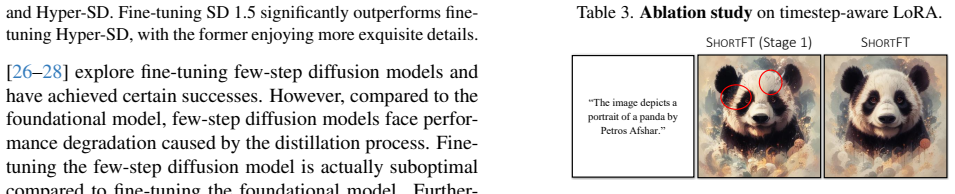
The denoising shortcut: a 4-step Hyper-SD model that retains the original SD 1.5 denoising trajectory while skipping most timesteps; this shortens the backpropagation chain so reward gradients reach every stage of sampling. Assisting machinery: timestep-aware LoRA adapters (a distinct low-rank branch for each denoising segment, capturing how prompt-dependence shifts from text to visual features over the chain) and a progressive training strategy (gradually replacing shortcut steps with original denoising steps so the final model is optimized for inference-time full-chain generation).
What would settle it
Run ShortFT with the same setup but replace Hyper-SD with a trajectory-reformulating few-step model (e.g., an adversarial distillation that intentionally changes the denoising path); if alignment gains vanish or degrade, the shortcut's trajectory preservation is the operative cause. Alternatively, measure per-timestep output differences between the 4-step Hyper-SD path and the 50-step DDIM path on SD 1.5 at the same noise inputs and show whether the reward-gradient directions agree.
Extended reading notes
Core claim
At its core, ShortFT claims that a trajectory-preserving few-step diffusion model distilled from the base model provides a valid denoising shortcut—a shorter path through the sampling process that stays on the same ODE trajectory—and that optimizing on this shortcut, rather than truncating the chain or dropping gradient terms, is what makes end-to-end backpropagation of the reward gradient effective. The paper constructs a shortcut-based denoising chain of four denoising segments, fine-tunes the original SD 1.5 weights with LoRA adapters specialized per timestep segment, and trains progressively so that later stages replace the shortcut with the original chain, closing the train-inference gap. The result is better alignment with diverse rewards (human preference, symmetry, compressibility, combined) and generalization to wild prompts, with fine-tuning the foundational model outperforming fine-tuning the distilled few-step model itself (HPS v2 35.97 vs 32.92 after 10k steps).
Load-bearing premise
The shortcut model Hyper-SD stays close enough to SD 1.5's original 50-step denoising trajectory that reward gradients computed through the 4-step chain are valid for fine-tuning the full model, and the progressive training fully repairs the residual error.
Editorial extensions
If this is right
- End-to-end reward backpropagation becomes a practical fine-tuning recipe for text-to-image models: 4-step shortcuts remove the need for gradient checkpointing and make full-chain supervision feasible on two GPUs in hours.
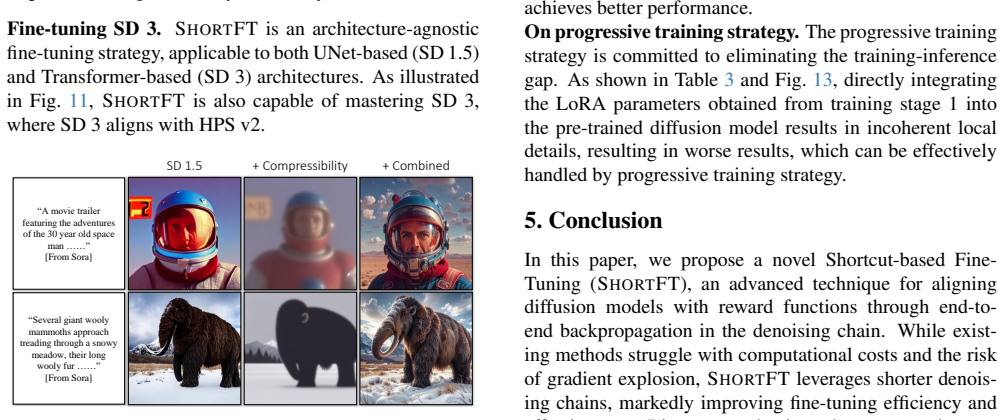
- The same shortcut recipe transfers to different reward functions—HPS v2, PickScore, symmetry, compressibility, and weighted combinations—without changing the fine-tuning procedure.
- Fine-tuning the foundational SD 1.5 model through the shortcut yields higher alignment (HPS v2 35.97) than fine-tuning the distilled Hyper-SD model directly (32.92), because the full model retains generation capacity the distillation lost.
- The method generalizes beyond UNet architectures to Transformer-based SD 3, indicating the shortcut principle is architecture-agnostic.
Reading between the lines
- The load-bearing assumption that Hyper-SD's trajectory is close to SD 1.5's suggests ShortFT's gains will track the fidelity of the distilled shortcut: better trajectory-preserving distillers should yield further alignment gains, while trajectory-reformulating distillers (which intentionally change the path) should break the effect—an experiment the paper does not run.
- Timestep-aware LoRA may be a general principle for reward alignment: since early denoising steps encode prompt semantics and later steps refine visual detail, per-segment adapters allow the reward to adjust different stages differently, and this could be combined with other alignment objectives (e.g., DPO-style losses) as well.
- Because the shortcut is only used during training and removed during inference, ShortFT effectively turns a distillation model into a proxy for computing full-chain gradients; one could test whether the same proxy idea works for other long unrolls, such as video diffusion or multi-step LLM samplers.
Editorial analysis
A structured set of objections, weighed in public.
Referee Report
Summary. The paper proposes Shortcut-based Fine-Tuning (ShortFT), a method for aligning text-to-image diffusion models with differentiable reward functions. ShortFT uses a trajectory-preserving few-step diffusion model (4-step Hyper-SD distilled from SD 1.5) as a 'denoising shortcut' that shortens the denoising/backpropagation chain, combined with a timestep-aware LoRA parameterization and a progressive training strategy intended to close the training-inference gap. Experiments on HPDv2 with HPS v2, PickScore, and Symmetry rewards report improved scores over DRaFT-LV and DRTune under the same computational budget, along with qualitative comparisons, a small user study, and ablations on the LoRA and progressive-training components.
Significance. The core idea of exploiting a distilled few-step model as a differentiable proxy to shorten backpropagation for reward fine-tuning is novel and potentially useful for reducing the cost and instability of end-to-end reward optimization. The paper provides a reasonable breadth of experiments: multiple reward functions, an architecture generalization (SD 3), and component ablations. However, the central mechanism is currently overstated and internally inconsistent, and the empirical validation is thin: the shortcut fidelity is not quantitatively established, the main results lack error bars, and the claim of 'complete gradient backpropagation' is contradicted by the paper's own description of truncated backpropagation. If the authors can clarify the gradient-truncation scheme, add quantitative validation of the shortcut's trajectory/Jacobian fidelity under LoRA updates, and report variance across seeds, the method would be a solid contribution. As it stands, the paper's central claims are not yet fully supported.
major comments (4)
- [Sec. 3.3, Abstract, Fig. 2(d)] The paper repeatedly advertises 'complete gradient backpropagation' and 'full gradient backpropagation throughout the denoising chain' (Abstract; Sec. 3.3; Fig. 2(d) caption), but the last paragraph of Sec. 3.3 states: 'in line with [6], we also employ the truncated backpropagation technique.' This is a direct contradiction. If truncation is used, the method is closer to DRaFT-LV/DRTune-style gradient approximation than advertised, and the claimed novelty of 'complete' backprop is not supported. Please specify exactly which gradient paths are truncated, where in the chain truncation occurs, how the resulting approximation differs from DRaFT-LV's truncation, and revise the claims accordingly.
- [Sec. 3.2, Fig. 3, Sec. 3.3] The load-bearing premise that the Hyper-SD shortcut remains a faithful differentiable proxy for the full 50-step SD1.5 denoising chain is not quantitatively validated. Fig. 3 reports HPS v2 deviations on a few handpicked prompts using the original SD1.5, not a LoRA-perturbed model, and it measures neither trajectory distance nor gradient alignment. Since training updates LoRA weights, the input distribution seen by the fixed shortcut changes, and the shortcut's output Jacobian can diverge from the true chain's Jacobian. The progressive training strategy is a heuristic mitigation; no number is given for shortcut error or for when gradient transfer fails. Please provide quantitative evidence, e.g., per-step output discrepancy and gradient cosine similarity between the shortcut and full chain before and after LoRA updates, or an ablation with varying shortcut lengths/steps, to support the central premise.
- [Table 1, Sec. 4.1, Sec. 4.3] All main results in Table 1 are from single runs with no error bars or significance tests, and the HPS v2 margin over DRaFT-LV is small (33.88 vs 33.13, a difference of 0.75). Because HPS v2 is also the training reward (and is used as a joint regularization term alongside PickScore), the evaluation is partly circular, as the authors acknowledge is common to baselines. Please report mean±std over at least three seeds for all methods, state the number of training steps/iterations each method uses under the fixed computational budget, and clarify whether the 33.88 score is obtained with the combined-reward training objective or with HPS v2 alone. The user study (11 volunteers, 10 questions per pair) and the GPT-4V evaluation (20 queries per pair) are too small to support the strong preference percentages in Fig. 9; please report exact counts and confidence intervals.
- [Sec. 4.4, Sec. 4.1, Fig. 1 caption] The claim that 'the obtained HPS v2 score of 35.97 surpasses the reported score for DRaFT-LV in [6]' is incomplete: the exact DRaFT-LV number under the same 10k-step protocol is not provided, and no comparison is given for DRTune or for ShortFT's own 6-hour budget. Additionally, the 'Combined reward' weights (PickScore=10, HPS v2=2, Aesthetic=0.05) appear only in the Fig. 1 caption and are not fully specified in Sec. 4.1, where the text says only that 'HPS v2 and PickScore in a ratio of 1:10' are amalgamated as a joint regularization term. Please specify the exact combined-reward objective used for each experiment and clarify which reward is optimized in Table 1.
minor comments (7)
- [Throughout] The method name is inconsistent: 'SHORT FT', 'ShortFT', and 'SHORTFT' are all used; please adopt a single spelling (e.g., ShortFT).
- [Fig. 2(d) caption] The caption states 'complete gradient backpropagation through the entire denoising chain,' which is at odds with the truncated-backpropagation statement in Sec. 3.3; please align the figure description with the actual algorithm.
- [Sec. 3.2, Fig. 3] The sentence 'These observations collectively indicate the reliability and validity of the denoising shortcut' overstates what three handpicked prompts and HPS v2 deviations can establish; please rephrase to reflect the limited scope of the evidence.
- [Sec. 4.2] The text says 'Fig. 7 and 8 present the quantitative comparison,' but the figures show qualitative examples; please correct 'quantitative' to 'qualitative'.
- [Sec. 4.3, Fig. 9] The user study and GPT-4V evaluation lack details on the number of unique prompts, inter-annotator agreement, and confidence intervals; please report these to support the preference percentages.
- [Sec. 4.4, Table 2] The comparison between tuning SD 1.5 and tuning Hyper-SD is based on a single HPS v2 score per strategy; please include additional metrics (e.g., PickScore, Fréchet Inception Distance) and multiple seeds to substantiate the claim of superiority.
- [Sec. 4.1] The paper does not state the random seed(s) used for training and evaluation; please provide seed values for reproducibility.
Circularity Check
No significant circularity: ShortFT is an empirical fine-tuning method whose claims are benchmarked against external HPDv2 data and pre-trained Hyper-SD shortcuts, with no derivation that reduces to its own inputs.
full rationale
The paper's core contribution is an empirical training strategy: use the pre-trained 4-step Hyper-SD as a denoising shortcut to backpropagate reward gradients into a LoRA fine-tuned SD 1.5. The shortcut model is an external, fixed artifact, not derived from ShortFT's objective, and the reward gradients are evaluated against external HPS v2, PickScore, and Symmetry benchmarks. The fact that HPS v2 is used both as the training reward and as an evaluation metric is a shared design choice with the baselines (DRaFT-LV, DRTune), and it constitutes potential reward overfitting, not a circular derivation: the reported HPS v2 score is not equal to the training objective by construction. The paper explicitly acknowledges that the shortcut 'inherently introduces errors' (Sec. 3.3), which is a stated limitation rather than a hidden equivalence. The statement 'in line with [6], we also employ the truncated backpropagation technique' (Sec. 3.3) conflicts with the abstract's 'complete gradient backpropagation' claim, but this is a methodological inconsistency, not a circularity. No load-bearing step is justified solely by a self-citation: the two self-citations ([15], [16]) appear only in a general applications list. The central derivation chain—construct a shorter chain with an externally distilled model, backpropagate a differentiable reward, and evaluate on held-out benchmarks—contains no equation that is equivalent to its own input by construction. Therefore the circularity score is 0.
Assumptions & free parameters
free parameters (6)
- Number of shortcut segments k =
4
- LoRA anchor timesteps =
{761, 501, 261, 1}
- LoRA rank =
128
- Learning rate =
5e-5
- Reward regularization weight ratio =
HPS v2 : PickScore = 1:10
- Shortcut distilled model =
4-step Hyper-SD
assumptions (4)
- domain assumption The reward gradient backpropagated through the denoising chain is a usable optimization signal
- domain assumption Trajectory-preserving few-step models preserve the SD1.5 trajectory closely enough for shortcut gradients to transfer
- domain assumption LoRA adapters of rank 128 have enough capacity to capture the alignment shift
- ad hoc to paper The progressive training strategy closes the training-inference gap caused by the shortcut
Cite this review
Pith. "Pith review of ShortFT: Diffusion Model Alignment via Shortcut-based Fine-Tuning." pith.science (2026). https://pith.science/paper/MOPPOJ53
@misc{pith2026250722604,
  author       = {Pith},
  title        = {Pith review of: ShortFT: Diffusion Model Alignment via Shortcut-based Fine-Tuning},
  year         = {2026},
  howpublished = {\url{https://pith.science/paper/MOPPOJ53}},
  note         = {Machine review of arXiv:2507.22604}
}
read the original abstract
Backpropagation-based approaches aim to align diffusion models with reward functions through end-to-end backpropagation of the reward gradient within the denoising chain, offering a promising perspective. However, due to the computational costs and the risk of gradient explosion associated with the lengthy denoising chain, existing approaches struggle to achieve complete gradient backpropagation, leading to suboptimal results. In this paper, we introduce Shortcut-based Fine-Tuning (ShortFT), an efficient fine-tuning strategy that utilizes the shorter denoising chain. More specifically, we employ the recently researched trajectory-preserving few-step diffusion model, which enables a shortcut over the original denoising chain, and construct a shortcut-based denoising chain of shorter length. The optimization on this chain notably enhances the efficiency and effectiveness of fine-tuning the foundational model. Our method has been rigorously tested and can be effectively applied to various reward functions, significantly improving alignment performance and surpassing state-of-the-art alternatives.
Figures


Figures from the paper (10 more)



Reference graph
Works this paper leans on
-
[6]
Directly fine-tuning diffusion models on differentiable re- wards
Kevin Clark, Paul Vicol, Kevin Swersky, and David J Fleet. Directly fine-tuning diffusion models on differentiable re- wards. In ICLR, 2024. 2, 3, 4, 5, 6, 7
work page 2024
-
[1]
Yogesh Balaji, Seungjun Nah, Xun Huang, Arash Vahdat, Jiaming Song, Karsten Kreis, Miika Aittala, Timo Aila, Samuli Laine, Bryan Catanzaro, et al. ediffi: Text-to-image diffusion models with an ensemble of expert denoisers.arXiv preprint arXiv:2211.01324, 2022. 2, 3, 4, 5
arXiv 2022
-
[2]
Improving image generation with better captions
James Betker, Gabriel Goh, Li Jing, Tim Brooks, Jianfeng Wang, Linjie Li, Long Ouyang, Juntang Zhuang, Joyce Lee, Yufei Guo, et al. Improving image generation with better captions. Computer Science. https://cdn. openai. com/papers/dall-e-3. pdf, 2(3):8, 2023. 3
work page 2023
-
[3]
Training diffusion models with reinforce- ment learning
Kevin Black, Michael Janner, Yilun Du, Ilya Kostrikov, and Sergey Levine. Training diffusion models with reinforce- ment learning. arXiv preprint arXiv:2305.13301, 2023. 2, 3
arXiv 2023
-
[4]
Enhancing diffusion models with text-encoder reinforcement learning
Chaofeng Chen, Annan Wang, Haoning Wu, Liang Liao, Wenxiu Sun, Qiong Yan, and Weisi Lin. Enhancing diffusion models with text-encoder reinforcement learning. In ECCV,
-
[5]
Deep reinforcement learn- ing from human preferences
Paul F Christiano, Jan Leike, Tom Brown, Miljan Martic, Shane Legg, and Dario Amodei. Deep reinforcement learn- ing from human preferences. In NeurIPS, 2017. 2
work page 2017
-
[7]
Emu: Enhanc- ing image generation models using photogenic needles in a haystack
Xiaoliang Dai, Ji Hou, Chih-Yao Ma, Sam Tsai, Jialiang Wang, Rui Wang, Peizhao Zhang, Simon Vandenhende, Xi- aofang Wang, Abhimanyu Dubey, et al. Emu: Enhanc- ing image generation models using photogenic needles in a haystack. arXiv preprint arXiv:2309.15807, 2023. 3
arXiv 2023
-
[8]
Prdp: Proximal reward difference prediction for large-scale reward finetuning of diffusion models
Fei Deng, Qifei Wang, Wei Wei, Tingbo Hou, and Matthias Grundmann. Prdp: Proximal reward difference prediction for large-scale reward finetuning of diffusion models. In CVPR,
Show all 59 references
-
[9]
Diffusion models beat gans on image synthesis
Prafulla Dhariwal and Alexander Nichol. Diffusion models beat gans on image synthesis. In NeurIPS, 2021. 2, 3
2021
-
[10]
Raft: Reward ranked finetuning for generative foundation model alignment
Hanze Dong, Wei Xiong, Deepanshu Goyal, Yihan Zhang, Winnie Chow, Rui Pan, Shizhe Diao, Jipeng Zhang, Kashun Shum, and Tong Zhang. Raft: Reward ranked finetuning for generative foundation model alignment. arXiv preprint arXiv:2304.06767, 2023. 2, 3
2023 arXiv
-
[11]
Re- inforcement learning for fine-tuning text-to-image diffusion models
Ying Fan, Olivia Watkins, Yuqing Du, Hao Liu, Moonkyung Ryu, Craig Boutilier, Pieter Abbeel, Moham- mad Ghavamzadeh, Kangwook Lee, and Kimin Lee. Re- inforcement learning for fine-tuning text-to-image diffusion models. In NeurIPS, 2023. 3
2023
-
[12]
Re- inforcement learning for fine-tuning text-to-image diffusion models
Ying Fan, Olivia Watkins, Yuqing Du, Hao Liu, Moonkyung Ryu, Craig Boutilier, Pieter Abbeel, Moham- mad Ghavamzadeh, Kangwook Lee, and Kimin Lee. Re- inforcement learning for fine-tuning text-to-image diffusion models. In NeurIPS, 2023. 2
2023
-
[13]
Policy shaping: Integrating human feedback with reinforcement learning
Shane Griffith, Kaushik Subramanian, Jonathan Scholz, Charles L Isbell, and Andrea L Thomaz. Policy shaping: Integrating human feedback with reinforcement learning. In NeurIPS, 2013. 2
2013
-
[14]
Matryoshka diffusion models.arXiv preprint arXiv:2310.15111, 2023
Jiatao Gu, Shuangfei Zhai, Yizhe Zhang, Josh Susskind, and Navdeep Jaitly. Matryoshka diffusion models.arXiv preprint arXiv:2310.15111, 2023. 3
2023 arXiv
-
[15]
I4vgen: Image as free stepping stone for text-to- video generation
Xiefan Guo, Jinlin Liu, Miaomiao Cui, Liefeng Bo, and Di Huang. I4vgen: Image as free stepping stone for text-to- video generation. arXiv preprint arXiv:2406.02230, 2024
2024 arXiv
-
[16]
Initno: Boosting text-to-image diffu- sion models via initial noise optimization
Xiefan Guo, Jinlin Liu, Miaomiao Cui, Jiankai Li, Hongyu Yang, and Di Huang. Initno: Boosting text-to-image diffu- sion models via initial noise optimization. In CVPR, 2024
2024
-
[17]
Classifier-free diffusion guidance
Jonathan Ho and Tim Salimans. Classifier-free diffusion guidance. arXiv preprint arXiv:2207.12598, 2022. 2, 3
2022 arXiv
-
[18]
Denoising diffu- sion probabilistic models
Jonathan Ho, Ajay Jain, and Pieter Abbeel. Denoising diffu- sion probabilistic models. In NeurIPS, 2020. 2, 3
2020
-
[19]
Lora: Low-rank adaptation of large language models
Edward J Hu, Yelong Shen, Phillip Wallis, Zeyuan Allen- Zhu, Yuanzhi Li, Shean Wang, Lu Wang, and Weizhu Chen. Lora: Low-rank adaptation of large language models. In ICLR, 2022. 5
2022
-
[20]
T2i-compbench: A comprehensive benchmark for open-world compositional text-to-image generation
Kaiyi Huang, Kaiyue Sun, Enze Xie, Zhenguo Li, and Xi- hui Liu. T2i-compbench: A comprehensive benchmark for open-world compositional text-to-image generation. In NeurIPS, 2023. 3
2023
-
[21]
Distilling diffusion models into condi- tional gans
Minguk Kang, Richard Zhang, Connelly Barnes, Sylvain Paris, Suha Kwak, Jaesik Park, Eli Shechtman, Jun-Yan Zhu, and Taesung Park. Distilling diffusion models into condi- tional gans. In ECCV, 2024. 3, 4
2024
-
[22]
Elucidating the design space of diffusion-based generative models
Tero Karras, Miika Aittala, Timo Aila, and Samuli Laine. Elucidating the design space of diffusion-based generative models. In NeurIPS, 2022. 2, 3
2022
-
[23]
Consistency trajectory mod- els: Learning probability flow ode trajectory of diffusion
Dongjun Kim, Chieh-Hsin Lai, Wei-Hsiang Liao, Naoki Mu- rata, Yuhta Takida, Toshimitsu Uesaka, Yutong He, Yuki Mitsufuji, and Stefano Ermon. Consistency trajectory mod- els: Learning probability flow ode trajectory of diffusion. arXiv preprint arXiv:2310.02279, 2023. 2, 3, 4
-
[24]
Pick-a-pic: An open dataset of user preferences for text-to-image generation
Yuval Kirstain, Adam Polyak, Uriel Singer, Shahbuland Ma- tiana, Joe Penna, and Omer Levy. Pick-a-pic: An open dataset of user preferences for text-to-image generation. In NeurIPS, 2023. 3, 6
2023
-
[25]
Aligning text- to-image models using human feedback
Kimin Lee, Hao Liu, Moonkyung Ryu, Olivia Watkins, Yuqing Du, Craig Boutilier, Pieter Abbeel, Mohammad Ghavamzadeh, and Shixiang Shane Gu. Aligning text- to-image models using human feedback. arXiv preprint arXiv:2302.12192, 2023. 2, 3
2023 arXiv
-
[26]
Reward guided latent consistency distillation
Jiachen Li, Weixi Feng, Wenhu Chen, and William Yang Wang. Reward guided latent consistency distillation. arXiv preprint arXiv:2403.11027, 2024. 3, 8
2024 arXiv
-
[27]
T2v- turbo: Breaking the quality bottleneck of video consis- tency model with mixed reward feedback
Jiachen Li, Weixi Feng, Tsu-Jui Fu, Xinyi Wang, Sug- ato Basu, Wenhu Chen, and William Yang Wang. T2v- turbo: Breaking the quality bottleneck of video consis- tency model with mixed reward feedback. arXiv preprint arXiv:2405.18750, 2024
2024 arXiv
-
[28]
T2v- turbo-v2: Enhancing video generation model post-training through data, reward, and conditional guidance design.arXiv preprint arXiv:2410.05677, 2024
Jiachen Li, Qian Long, Jian Zheng, Xiaofeng Gao, Robinson Piramuthu, Wenhu Chen, and William Yang Wang. T2v- turbo-v2: Enhancing video generation model post-training through data, reward, and conditional guidance design.arXiv preprint arXiv:2410.05677, 2024. 3, 8
-
[29]
Aligning diffusion mod- els by optimizing human utility
Shufan Li, Konstantinos Kallidromitis, Akash Gokul, Yusuke Kato, and Kazuki Kozuka. Aligning diffusion mod- els by optimizing human utility. In NeurIPS, 2024. 3 9
2024
-
[30]
Step-aware prefer- ence optimization: Aligning preference with denoising per- formance at each step
Zhanhao Liang, Yuhui Yuan, Shuyang Gu, Bohan Chen, Tiankai Hang, Ji Li, and Liang Zheng. Step-aware prefer- ence optimization: Aligning preference with denoising per- formance at each step. arXiv preprint arXiv:2406.04314 ,
-
[31]
Sdxl- lightning: Progressive adversarial diffusion distillation
Shanchuan Lin, Anran Wang, and Xiao Yang. Sdxl- lightning: Progressive adversarial diffusion distillation. arXiv preprint arXiv:2402.13929, 2024. 3, 4
2024 arXiv
-
[32]
Improved denoising diffusion probabilistic models
Alexander Quinn Nichol and Prafulla Dhariwal. Improved denoising diffusion probabilistic models. In ICML, 2021. 2, 3
2021
-
[33]
Training lan- guage models to follow instructions with human feedback
Long Ouyang, Jeffrey Wu, Xu Jiang, Diogo Almeida, Car- roll Wainwright, Pamela Mishkin, Chong Zhang, Sandhini Agarwal, Katarina Slama, Alex Ray, et al. Training lan- guage models to follow instructions with human feedback. In NeurIPS, 2022. 2
2022
-
[34]
Aligning text-to-image diffusion models with reward backpropagation
Mihir Prabhudesai, Anirudh Goyal, Deepak Pathak, and Katerina Fragkiadaki. Aligning text-to-image diffusion models with reward backpropagation. arXiv preprint arXiv:2310.03739, 2023. 2, 3, 4, 5
2023 arXiv
-
[35]
Learn- ing transferable visual models from natural language super- vision
Alec Radford, Jong Wook Kim, Chris Hallacy, Aditya Ramesh, Gabriel Goh, Sandhini Agarwal, Girish Sastry, Amanda Askell, Pamela Mishkin, Jack Clark, et al. Learn- ing transferable visual models from natural language super- vision. In ICML, 2021. 6
2021
-
[36]
Direct preference optimization: Your language model is secretly a reward model
Rafael Rafailov, Archit Sharma, Eric Mitchell, Christo- pher D Manning, Stefano Ermon, and Chelsea Finn. Direct preference optimization: Your language model is secretly a reward model. In NeurIPS, 2023. 3
2023
-
[37]
Hyper-sd: Trajectory segmented consistency model for efficient image synthesis
Yuxi Ren, Xin Xia, Yanzuo Lu, Jiacheng Zhang, Jie Wu, Pan Xie, Xing Wang, and Xuefeng Xiao. Hyper-sd: Trajectory segmented consistency model for efficient image synthesis. arXiv preprint arXiv:2404.13686, 2024. 2, 3, 4, 5
2024 arXiv
-
[38]
High-resolution image syn- thesis with latent diffusion models
Robin Rombach, Andreas Blattmann, Dominik Lorenz, Patrick Esser, and Bj¨orn Ommer. High-resolution image syn- thesis with latent diffusion models. In CVPR, 2022. 2, 3, 6
2022
-
[39]
Progressive distillation for fast sampling of diffusion models
Tim Salimans and Jonathan Ho. Progressive distillation for fast sampling of diffusion models. In ICLR, 2022. 2, 3, 4
2022
-
[40]
Fast high- resolution image synthesis with latent adversarial diffusion distillation
Axel Sauer, Frederic Boesel, Tim Dockhorn, Andreas Blattmann, Patrick Esser, and Robin Rombach. Fast high- resolution image synthesis with latent adversarial diffusion distillation. arXiv preprint arXiv:2403.12015, 2024. 3, 4
2024 arXiv
-
[41]
Adversarial diffusion distillation
Axel Sauer, Dominik Lorenz, Andreas Blattmann, and Robin Rombach. Adversarial diffusion distillation. In ECCV, 2024. 3, 4
2024
-
[42]
Laoin aes- thetic predictor
Christoph Schuhmann and Romain Beaumont. Laoin aes- thetic predictor. https://laion.ai/blog/laion- aesthetics/, 2022. 2, 3
2022
-
[43]
A picture is worth a thousand words: Principled recaptioning improves image generation
Eyal Segalis, Dani Valevski, Danny Lumen, Yossi Matias, and Yaniv Leviathan. A picture is worth a thousand words: Principled recaptioning improves image generation. arXiv preprint arXiv:2310.16656, 2023. 3
2023 arXiv
-
[44]
Denois- ing diffusion implicit models
Jiaming Song, Chenlin Meng, and Stefano Ermon. Denois- ing diffusion implicit models. In ICLR, 2021. 2, 3, 5
2021
-
[45]
Score-based generative modeling through stochastic differential equa- tions
Yang Song, Jascha Sohl-Dickstein, Diederik P Kingma, Ab- hishek Kumar, Stefano Ermon, and Ben Poole. Score-based generative modeling through stochastic differential equa- tions. In ICLR, 2021. 2, 3
2021
-
[46]
Consistency models
Yang Song, Prafulla Dhariwal, Mark Chen, and Ilya Sutskever. Consistency models. In ICML, 2023. 2, 3, 4
2023
-
[47]
Learning to summarize with human feed- back
Nisan Stiennon, Long Ouyang, Jeffrey Wu, Daniel Ziegler, Ryan Lowe, Chelsea V oss, Alec Radford, Dario Amodei, and Paul F Christiano. Learning to summarize with human feed- back. In NeurIPS, 2020. 2
2020
-
[48]
Diffusion model align- ment using direct preference optimization
Bram Wallace, Meihua Dang, Rafael Rafailov, Linqi Zhou, Aaron Lou, Senthil Purushwalkam, Stefano Ermon, Caiming Xiong, Shafiq Joty, and Nikhil Naik. Diffusion model align- ment using direct preference optimization. In CVPR, 2024. 3
2024
-
[49]
Human preference score v2: A solid benchmark for evaluating human preferences of text-to-image synthesis
Xiaoshi Wu, Yiming Hao, Keqiang Sun, Yixiong Chen, Feng Zhu, Rui Zhao, and Hongsheng Li. Human preference score v2: A solid benchmark for evaluating human preferences of text-to-image synthesis. arXiv preprint arXiv:2306.09341 ,
-
[50]
Human preference score: Better aligning text-to- image models with human preference
Xiaoshi Wu, Keqiang Sun, Feng Zhu, Rui Zhao, and Hong- sheng Li. Human preference score: Better aligning text-to- image models with human preference. In ICCV, 2023. 2, 3
2023
-
[51]
Deep reward supervisions for tuning text-to-image diffusion models
Xiaoshi Wu, Yiming Hao, Manyuan Zhang, Keqiang Sun, Zhaoyang Huang, Guanglu Song, Yu Liu, and Hongsheng Li. Deep reward supervisions for tuning text-to-image diffusion models. In ECCV, 2024. 2, 3, 4, 5, 6, 7
2024
-
[52]
Imagere- ward: Learning and evaluating human preferences for text- to-image generation
Jiazheng Xu, Xiao Liu, Yuchen Wu, Yuxuan Tong, Qinkai Li, Ming Ding, Jie Tang, and Yuxiao Dong. Imagere- ward: Learning and evaluating human preferences for text- to-image generation. In NeurIPS, 2023. 2, 3, 5
2023
-
[53]
Raphael: Text-to-image generation via large mixture of diffusion paths
Zeyue Xue, Guanglu Song, Qiushan Guo, Boxiao Liu, Zhuo- fan Zong, Yu Liu, and Ping Luo. Raphael: Text-to-image generation via large mixture of diffusion paths. In NeurIPS,
-
[54]
Using human feedback to fine-tune diffusion models without any reward model
Kai Yang, Jian Tao, Jiafei Lyu, Chunjiang Ge, Jiaxin Chen, Weihan Shen, Xiaolong Zhu, and Xiu Li. Using human feedback to fine-tune diffusion models without any reward model. In CVPR, 2024. 3
2024
-
[55]
A dense reward view on aligning text-to-image diffusion with prefer- ence
Shentao Yang, Tianqi Chen, and Mingyuan Zhou. A dense reward view on aligning text-to-image diffusion with prefer- ence. arXiv preprint arXiv:2402.08265, 2024. 3
2024 arXiv
-
[56]
One-step diffusion with distribution matching distillation
Tianwei Yin, Micha ¨el Gharbi, Richard Zhang, Eli Shecht- man, Fredo Durand, William T Freeman, and Taesung Park. One-step diffusion with distribution matching distillation. In CVPR, 2024. 3, 4
2024
-
[57]
Adding conditional control to text-to-image diffusion models
Lvmin Zhang, Anyi Rao, and Maneesh Agrawala. Adding conditional control to text-to-image diffusion models. In ICCV, 2023. 3
2023
-
[58]
Large-scale reinforcement learning for diffusion models
Yinan Zhang, Eric Tzeng, Yilun Du, and Dmitry Kislyuk. Large-scale reinforcement learning for diffusion models. In ECCV, 2024. 3
2024
-
[59]
Fine-tuning language models from human preferences
Daniel M Ziegler, Nisan Stiennon, Jeffrey Wu, Tom B Brown, Alec Radford, Dario Amodei, Paul Christiano, and Geoffrey Irving. Fine-tuning language models from human preferences. arXiv preprint arXiv:1909.08593, 2019. 2 10
1909 arXiv
Reviewed August 6, 2026 · model on record in the stance chip above.
Discussion (0). Sign in to comment.