REVIEW 3 major objections 5 minor 1 cited by
Bridging the Gap in Missing Modalities: Leveraging Knowledge Distillation and Style Matching for Brain Tumor Segmentation
T0 review · 3 major / 5 minor · reviewed 2026-08-06 · deepseek-v4-flash
Pith's one-line read MST-KDNet claims to keep brain tumor segmentation accurate when MRI modalities are missing, beating leading methods on BraTS and FeTS 2024.
desk verdict Plausible incremental gains on missing-modality brain tumor segmentation, but two loss equations are misprinted as typeset and must be fixed before the method is actually specified. read the letter →
The pith
A machine-rendered reading of the paper's core claim, the machinery that carries it, and where it could break.
The reading
What carries the argument
The engine is a three-part loss added to a 3D-convolutional and Transformer baseline (a UNETR-style encoder–decoder). Multi-Scale Transformer Knowledge Distillation extracts attention weights at each resolution and distills their max, min, and mean aggregates to the student, alongside MSE on hidden features. Dual-Mode Logit Distillation aligns teacher and student logits with an MSE term and a KL divergence after Z-score-normalizing logits, avoiding a shared temperature. Global Style Matching concatenates the encoder and Transformer outputs, matches their fused feature matrices under MSE, and adds an adversarial discriminator that tries to tell teacher and student features apart. The three losses plus a Dice loss are combined into one joint objective $\mathcal{L}_{\text{joint}} = \lambda_1 \mathcal{L}_{\text{MS-TKD}} + \lambda_2 \mathcal{L}_{\text{logit}} + \lambda_3 \mathcal{L}_{\text{GSME}} + \lambda_4 \mathcal{L}_{\text{Dice}}$.
What would settle it
Run the released code on a held-out clinical cohort where modality absence is natural and structured (e.g., all scans from one site lack T1Gd), and verify whether MST-KDNet still beats SMU-Net by the reported margin; if the Dice gap narrows below noise, the random-masking evaluation protocol is the driver of the claimed gains. A second check is to recompute the BraTS average Dice after removing any near-duplicate patient pairs across the 80/20 split and seeing whether the roughly 2-point whole-tumor Dice gap persists.
Extended reading notes
Core claim
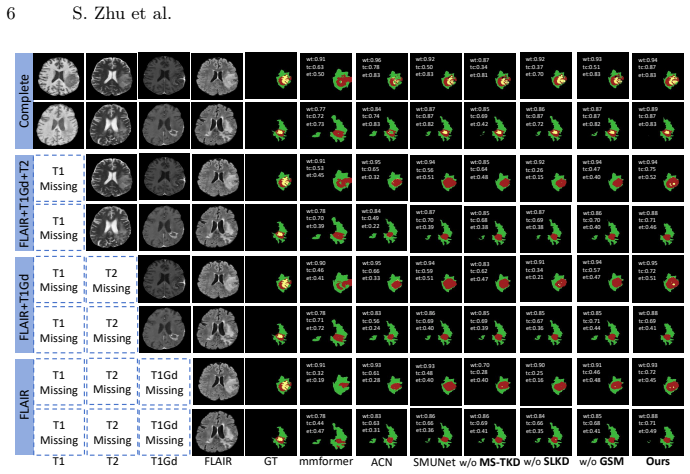
On the paper's own terms, the central discovery is that aligning a missing-modality student to a full-modality teacher at three complementary levels—attention statistics across resolutions, logit distributions after Z-score standardization, and fused feature style matched with an adversarial discriminator—consistently improves tumor segmentation under incomplete input. Concretely, on BraTS 2024 the model reports average Dice of 81.8/59.5/59.8 for whole tumor, tumor core, and enhancing tumor, against 79.7/50.7/49.3 for SMU-Net, and it similarly leads on HD95 and on the FeTS 2024 average scores. The ablation study attributes these gains to each of the three modules, with removal of any one lowering Dice and raising HD95.
Load-bearing premise
The reported gains depend on the assumption that randomly dropping MRI sequences in an 80/20 split of the BraTS and FeTS datasets resembles how modalities actually go missing in hospitals; if real missingness is selective (for example, a whole scanner site always lacks FLAIR) or the split leaks near-duplicate patients, the robustness numbers will not transfer to clinical use.
Editorial extensions
If this is right
- If the reported averages hold, missing-modality segmentation no longer requires reconstructing the absent MRI sequences; a student distilled once from a full-modality teacher can run at inference with whatever subset is available.
- The HD95 improvements (e.g., 6.6 vs 7.4 average on BraTS) suggest that boundary accuracy specifically benefits, which matters for surgical planning where tumor margins drive decisions.
- The modular losses are architecture-agnostic enough that they can be lifted onto other teacher–student segmentation models, not only the UNETR-style baseline used here.
- The method's robustness in the one-modality regime (e.g., Dice around 73 for WT from FLAIR alone) indicates the model extracts substantial signal from single sequences, which could reduce the number of required acquisitions.
Reading between the lines
- The evaluation masks modalities at random, but clinical missingness is often structured (a whole site lacks one sequence); a reader should test the released model under structured masks before trusting the robustness claim in deployment.
- Because the student is trained by distillation from a teacher that sees all four sequences, a natural extension is to check how close the student gets to the teacher's full-input Dice; the paper reports gains over baselines but does not directly report this teacher–student gap.
- The style-matching and adversarial components could transfer to other multi-modal medical tasks (cardiac, prostate, retinal imaging) where modality drop-out is also common, though the results here only support brain tumor MRI.
- A cheaper testable prediction: the improvement over SMU-Net should be largest when the missing modality is T1Gd (the key sequence for enhancing tumor), because the logit-standardization and style losses should most help there.
Editorial analysis
A structured set of objections, weighed in public.
Referee Report
Summary. The manuscript proposes MST-KDNet, a teacher-student framework for brain tumor segmentation under missing MRI modalities. The method combines three loss modules: Multi-Scale Transformer Knowledge Distillation (MS-TKD), which aligns extreme statistics of attention maps and reshaped features; Dual-Mode Logit Distillation (DMLD), which combines an MSE logit loss with a normalized KL divergence; and a Global Style Matching Module (GSME), which pairs feature-matching MSE with adversarial learning. Experiments on BraTS 2024 and FeTS 2024 cover all 16 modality subsets and report Dice and HD95 comparisons against six published baselines, with an ablation study attributing gains to each of the three modules.
Significance. If the reported results are reproducible, the paper offers a practical improvement in missing-modality brain tumor segmentation, with the largest gains appearing in severe missing-modality settings. The empirical comparison against six baselines on two public benchmarks is a strength, and the authors' release of source code is a material asset for verification. However, the central claim rests on three proposed loss modules, and two of the defining equations (Eq. (6) and Eq. (9)) are internally inconsistent as printed. The paper therefore does not yet specify the method it evaluates; this is the decisive issue and it is larger than the data-protocol concern. The manuscript is within the scope of the venue, and the claim is plausible enough to warrant correction and re-review.
major comments (3)
- [Section 2.3, Eq. (6)-(7)] As printed, Z(l; tau) = (1 - mu)/((sigma + 1e-7) * tau) depends only on the scalar mean and standard deviation of the logit vector, not on the logit values themselves. Softmax of a constant produces a uniform distribution, so q(lf) and q(lm) are identical and the KL divergence in Eq. (7) carries no distillation signal regardless of any teacher-student disagreement. The intended form is almost certainly (l - mu)/((sigma + 1e-7) * tau) applied element-wise. Because the DMLD module is one of the three principal contributions, this is a load-bearing error: the method as written does not implement the described distillation loss.
- [Section 2.4, Eq. (9)] The adversarial loss is written as Ladv = log(1 - D(ff_enc&t)) + log(D(fm_enc&t)), with ff and fm denoting complete-modality and missing-modality features. Under the standard convention that D outputs the probability that its input is drawn from the complete/teacher distribution, the correct adversarial loss is log(D(ff_enc&t)) + log(1 - D(fm_enc&t)). The printed form trains the discriminator to label teacher features as fake and student features as real, and it encourages the student to produce features that the discriminator identifies as student-like, which is the opposite of the stated alignment goal. The authors should either correct the equation or explicitly define D as outputting the probability that the input is student-like; without this clarification, the GSME adversarial component is not well defined.
- [Section 3.2, Tables 1-4] The experimental evidence is reported as single-run point estimates from one random 80/20 split, with no error bars, no seeds, and no statistical significance tests. Some of the headline improvements are modest (e.g., FeTS 2024 WT Dice 88.4 vs. 87.5 and HD95 5.9 vs. 6.4), so without variance information the robustness of the gains cannot be assessed. In addition, Table 4 lists MST-KDNet FeTS WT Dice as 88.2 while Table 3 lists it as 88.4; this internal inconsistency must be corrected. This concern does not invalidate the architecture, but it directly affects the strength of the generalization claim made in the abstract and conclusion.
minor comments (5)
- [Section 2.5 and Section 3.1] The hyperparameters lambda_1 through lambda_4 in Eq. (12), as well as alpha, beta, epsilon, theta, and tau, are not reported in the implementation details; please provide these values or state explicitly that they are fixed in the released code, since the total loss cannot be reproduced otherwise.
- [Section 2.2, Eq. (2)] The notation n is used for different quantities: it appears as the number of attention heads in Eq. (2), as the number of summed elements in Eq. (4), and again in Eq. (5); please define each dimension consistently to avoid confusion.
- [Section 2.3 and Table 4] The method is called Dual-Mode Logit Distillation (DMLD) in the introduction and Section 2.3, but the ablation table and text refer to SLKD; please unify the terminology.
- [Tables 1 and 2] The 16 modality combinations are encoded with bullets, but no legend explains the column ordering; please make the mapping from columns to available modality subsets explicit.
- [Section 3.1] The statement that the dataset was 'randomly divided' should specify whether the split was patient-level and whether any patient could appear in both training and test sets; this matters for the validity of the reported generalization numbers.
Circularity Check
No circularity: benchmark claims rest on held-out evaluation and independently defined losses.
full rationale
The paper does not contain a derivation chain in which a claimed prediction reduces to its inputs by construction. The reported Dice/HD95 metrics are computed on a held-out 20% test split of BraTS 2024 and FeTS 2024, and the compared methods are trained under the same random modality-masking protocol. No target metric is inserted into the training objective; the loss terms in Eq. (12) supervise the student network against teacher outputs and segmentations, which is standard supervised training rather than a fitted parameter being renamed as a prediction. The self-citations in the bibliography (e.g., [3], [6], [20], [22], [26]) appear only in introductory background or funding contexts and are not load-bearing for any equation or benchmark claim. The apparent inconsistencies in Eqs. (6) and (9) noted by the skeptic are real internal-consistency or correctness concerns requiring code verification, but they are not circularity: a mis-specified loss does not make the result equivalent to its inputs by definition, it makes the method as printed not fully specified. Since no specific circular step can be quoted and exhibited, the appropriate finding is no significant circularity.
Assumptions & free parameters
free parameters (5)
- Lambda_1, Lambda_2, Lambda_3, Lambda_4 (Eq. 12) =
not reported
- Alpha, Beta (Eq. 4) =
not reported
- Epsilon, Theta (Eq. 11) =
not reported
- Temperature tau (Eq. 6) =
not reported
- Architecture hyperparameters (P, K, number of transformer blocks, attention heads, stages) =
not reported
assumptions (5)
- standard math Softmax attention and standard transformer building blocks behave as specified in Eq. (1).
- domain assumption Teacher model trained on complete four-modality data supplies reliable distillation targets for students with missing modalities.
- domain assumption The random 80/20 split of BraTS 2024 and FeTS 2024 gives a test set representative of clinical missing-modality conditions.
- domain assumption Randomly masking modalities during training simulates the real-world process that causes missing MRI modalities.
- domain assumption Multi-head self-attention statistics (max, min, mean) are meaningful semantic summaries for distillation.
Cite this review
Pith. "Pith review of Bridging the Gap in Missing Modalities: Leveraging Knowledge Distillation and Style Matching for Brain Tumor Segmentation." pith.science (2026). https://pith.science/paper/IONDMUGP
@misc{pith2026250722626,
  author       = {Pith},
  title        = {Pith review of: Bridging the Gap in Missing Modalities: Leveraging Knowledge Distillation and Style Matching for Brain Tumor Segmentation},
  year         = {2026},
  howpublished = {\url{https://pith.science/paper/IONDMUGP}},
  note         = {Machine review of arXiv:2507.22626}
}
read the original abstract
Accurate and reliable brain tumor segmentation, particularly when dealing with missing modalities, remains a critical challenge in medical image analysis. Previous studies have not fully resolved the challenges of tumor boundary segmentation insensitivity and feature transfer in the absence of key imaging modalities. In this study, we introduce MST-KDNet, aimed at addressing these critical issues. Our model features Multi-Scale Transformer Knowledge Distillation to effectively capture attention weights at various resolutions, Dual-Mode Logit Distillation to improve the transfer of knowledge, and a Global Style Matching Module that integrates feature matching with adversarial learning. Comprehensive experiments conducted on the BraTS and FeTS 2024 datasets demonstrate that MST-KDNet surpasses current leading methods in both Dice and HD95 scores, particularly in conditions with substantial modality loss. Our approach shows exceptional robustness and generalization potential, making it a promising candidate for real-world clinical applications. Our source code is available at https://github.com/Quanato607/MST-KDNet.
Figures

Forward citations
Cited by 1 Pith paper
-
No Modality Left Behind: Adapting to Missing Modalities via Knowledge Distillation for Brain Tumor Segmentation
AdaMM uses graph-guided adapters, bi-bottleneck distillation, and lesion-presence priors to maintain brain tumor segmentation accuracy when MRI modalities are missing.
Reference graph
Works this paper leans on
-
[1]
In: International Conference on Medical Imaging with Deep Learning
Azad, R., Khosravi, N., Merhof, D.: Smu-net: Style matching u-net for brain tumor segmentation with missing modalities. In: International Conference on Medical Imaging with Deep Learning. pp. 48–62. PMLR (2022)
work page 2022
-
[2]
In: International Conference on Medical Image Computing and Computer-Assisted Intervention
Chen, C., Dou, Q., Jin, Y., Chen, H., Qin, J., Heng, P.A.: Robust multimodal brain tumor segmentation via feature disentanglement and gated fusion. In: International Conference on Medical Image Computing and Computer-Assisted Intervention. pp. 447–456. Springer (2019)
work page 2019
-
[3]
Chen, Y., Zhu, S., Fang, Z., Liu, C., Zou, B., Qiu, L., Wang, Y., Chang, S., Jia, F., Qin, F., Fan, J., Peng, Y., Wang, C.: Toward robust early detection of alzheimer’s disease via an integrated multimodal learning approach. In: ICASSP 2025 - 2025 IEEE International Conference on Acoustics, Speech and Signal Pro- cessing (ICASSP). pp. 1–5 (2025)
work page 2025
-
[4]
In: Proceedings of the AAAI Conference on Artificial Intelligence
Dai, Q., Wei, D., Liu, H., Sun, J., Wang, L., Zheng, Y.: Federated modality-specific encoders and multimodal anchors for personalized brain tumor segmentation. In: Proceedings of the AAAI Conference on Artificial Intelligence. vol. 38, pp. 1445– 1453 (2024)
work page 2024
-
[5]
In: Proceedings of the IEEE/CVF Inter- national Conference on Computer Vision
Ding, Y., Yu, X., Yang, Y.: Rfnet: Region-aware fusion network for incomplete multi-modal brain tumor segmentation. In: Proceedings of the IEEE/CVF Inter- national Conference on Computer Vision. pp. 3975–3984 (2021)
work page 2021
-
[6]
Ge, R., Yu, X., Chen, Y., Zhou, G., Jia, F., Zhu, S., Jia, J., Zhang, C., Sun, Y., Zeng, D., et al.: Tc-kanrecon: High-quality and accelerated mri reconstruc- tion via adaptive kan mechanisms and intelligent feature scaling. arXiv preprint arXiv:2408.05705 (2024)
work page Pith review arXiv 2024
-
[7]
In: Proceedings of the IEEE/CVF Winter Conference on Applications of Computer Vision
Hatamizadeh, A., Tang, Y., Nath, V., Yang, D., Myronenko, A., Landman, B., Roth, H.R., Xu, D.: Unetr: Transformers for 3d medical image segmentation. In: Proceedings of the IEEE/CVF Winter Conference on Applications of Computer Vision. pp. 574–584 (2022)
work page 2022
-
[8]
In: Proceedings of the IEEE/CVF Conference on Computer Vision and Pattern Recognition
Huo, F., Xu, W., Guo, J., Wang, H., Guo, S.: C2kd: Bridging the modality gap for cross-modal knowledge distillation. In: Proceedings of the IEEE/CVF Conference on Computer Vision and Pattern Recognition. pp. 16006–16015 (2024)
work page 2024
Show all 27 references
-
[9]
In: Proceed- ings of the Asian Conference on Computer Vision
Jeong, S., Cho, H., Kwon, J., Park, H.: Region-of-interest attentive heteromodal variational encoder-decoder for segmentation with missing modalities. In: Proceed- ings of the Asian Conference on Computer Vision. pp. 3707–3723 (2022)
2022
-
[10]
In: Pro- ceedings of the AAAI Conference on Artificial Intelligence
Liu, H., Wei, D., Lu, D., Sun, J., Wang, L., Zheng, Y.: M3ae: multimodal repre- sentation learning for brain tumor segmentation with missing modalities. In: Pro- ceedings of the AAAI Conference on Artificial Intelligence. vol. 37, pp. 1657–1665 (2023)
2023
-
[11]
IEEE Transactions on Instrumentation and Measurement (2024)
Liu, M., Jiao, Y., Lu, J., Chen, H.: Anomaly detection for medical images using teacher-student model with skip connections and multi-scale anomaly consistency. IEEE Transactions on Instrumentation and Measurement (2024)
2024
-
[12]
arXiv preprint arXiv:2105.05874 (2021)
Pati, S., Baid, U., Zenk, M., Edwards, B., Sheller, M., Reina, G.A., Foley, P., Gruzdev, A., Martin, J., Albarqouni, S., et al.: The federated tumor segmentation (fets) challenge. arXiv preprint arXiv:2105.05874 (2021)
2021 arXiv
-
[13]
IEEE Journal of Biomedical and Health Informatics (2023)
Shi, J., Yu, L., Cheng, Q., Yang, X., Cheng, K.T., Yan, Z.: M2ftrans: Modality- masked fusion transformer for incomplete multi-modality brain tumor segmenta- tion. IEEE Journal of Biomedical and Health Informatics (2023)
2023
-
[14]
In: Proceedings of the IEEE/CVF Conference on Computer Vision and Pattern Recognition
Sun, S., Ren, W., Li, J., Wang, R., Cao, X.: Logit standardization in knowledge distillation. In: Proceedings of the IEEE/CVF Conference on Computer Vision and Pattern Recognition. pp. 15731–15740 (2024) Bridging the Gap in Missing Modalities 11
2024
-
[15]
In: International Conference on Medical Image Computing and Computer-Assisted Intervention
Varsavsky, T., Eaton-Rosen, Z., Sudre, C.H., Nachev, P., Cardoso, M.J.: Pimms: permutation invariant multi-modal segmentation. In: International Conference on Medical Image Computing and Computer-Assisted Intervention. pp. 201–209. Springer (2018)
2018
-
[16]
arXiv preprint arXiv:2405.18368 (2024)
de Verdier, M.C., Saluja, R., Gagnon, L., LaBella, D., Baid, U., Tahon, N.H., Foltyn-Dumitru, M., Zhang, J., Alafif, M., Baig, S., et al.: The 2024 brain tumor segmentation (brats) challenge: Glioma segmentation on post-treatment mri. arXiv preprint arXiv:2405.18368 (2024)
2024 arXiv
-
[17]
In: International Conference on Medical Image Computing and Computer-Assisted Intervention
Wang, H., Ma, C., Zhang, J., Zhang, Y., Avery, J., Hull, L., Carneiro, G.: Learnable cross-modal knowledge distillation for multi-modal learning with missing modality. In: International Conference on Medical Image Computing and Computer-Assisted Intervention. pp. 216–226. Spri...
2023
-
[18]
In: International Conference on Medical Image Computing and Computer-Assisted Intervention
Wang, Y., Zhang, Y., Liu, Y., Lin, Z., Tian, J., Zhong, C., Shi, Z., Fan, J., He, Z.: Acn: adversarial co-training network for brain tumor segmentation with miss- ing modalities. In: International Conference on Medical Image Computing and Computer-Assisted Intervention. pp. 41...
2021
-
[19]
Nature Reviews Disease Primers 1(1), 1–18 (2015)
Weller, M., Wick, W., Aldape, K., Brada, M., Berger, M., Pfister, S.M., Nishikawa, R., Rosenthal, M., Wen, P.Y., Stupp, R., et al.: Glioma. Nature Reviews Disease Primers 1(1), 1–18 (2015)
2015
-
[20]
arXiv preprint arXiv:2506.09695 (2025)
Wu, C., Chen, Y., Du, Y., Zong, J., Dong, J., Liu, M., Peng, Y., Fan, J., Qin, F., Wang, C.: Towards practical alzheimer’s disease diagnosis: A lightweight and interpretable spiking neural model. arXiv preprint arXiv:2506.09695 (2025)
2025
-
[21]
Medical Im- age Analysis 91, 102990 (2024)
Xing, X., Zhu, M., Chen, Z., Yuan, Y.: Comprehensive learning and adaptive teach- ing: Distilling multi-modal knowledge for pathological glioma grading. Medical Im- age Analysis 91, 102990 (2024)
2024
-
[22]
In: 2024 IEEE International Symposium on Biomedical Imaging (ISBI)
Zhang, C., Chen, Y., Fan, Z., Huang, Y., Weng, W., Ge, R., Zeng, D., Wang, C.: Tc-diffrecon: Texture coordination mri reconstruction method based on diffusion model and modified mf-unet method. In: 2024 IEEE International Symposium on Biomedical Imaging (ISBI). pp. 1–5 (2024)
2024
-
[23]
IEEE Transactions on Medical Imaging 43(1), 76–95 (2023)
Zhang, J., Zhang, S., Shen, X., Lukasiewicz, T., Xu, Z.: Multi-condos: Multimodal contrastivedomainsharinggenerativeadversarialnetworksforself-supervisedmed- ical image segmentation. IEEE Transactions on Medical Imaging 43(1), 76–95 (2023)
2023
-
[24]
In: International Conference on Medical Image Computing and Computer-Assisted Intervention
Zhang, Y., He, N., Yang, J., Li, Y., Wei, D., Huang, Y., Zhang, Y., He, Z., Zheng, Y.: mmformer: Multimodal medical transformer for incomplete multimodal learn- ing of brain tumor segmentation. In: International Conference on Medical Image Computing and Computer-Assisted Inter...
2022
-
[25]
In: International Conference on Medical Im- age Computing and Computer-Assisted Intervention
Zhao, Z., Yang, H., Sun, J.: Modality-adaptive feature interaction for brain tumor segmentation with missing modalities. In: International Conference on Medical Im- age Computing and Computer-Assisted Intervention. pp. 183–192. Springer (2022)
2022
-
[26]
In: 2025 IEEE 22nd International Symposium on Biomedical Imaging (ISBI)
Zhu, S., Chen, Y., Jiang, S., Chen, W., Liu, C., Wang, Y., Chen, X., Ke, Y., Qin, F., Wang, C., Zhu, Z.: Xlstm-hved: Cross-modal brain tumor segmentation and mri reconstruction method using vision xlstm and heteromodal variational encoder- decoder. In: 2025 IEEE 22nd Internati...
2025
-
[27]
Pattern Recognition153, 110553 (2024)
Zhu, Z., Wang, Z., Qi, G., Mazur, N., Yang, P., Liu, Y.: Brain tumor segmentation in mri with multi-modality spatial information enhancement and boundary shape correction. Pattern Recognition153, 110553 (2024)
2024
Reviewed August 6, 2026 · model on record in the stance chip above.
Discussion (0). Sign in to comment.