REVIEW 3 major objections 6 minor 4 cited by
Non-conformal branes wrapped on a disk
T0 review · 3 major / 6 minor · reviewed 2026-08-06 · deepseek-v4-flash
Pith's one-line read This paper classifies disk solutions from non-conformal D6, D5/NS5, D4, and D2 branes and identifies their common global geometry: a 1/ℓ Euler characteristic, a central monopole, and, in most cases, smeared branes at the boundary, with…
desk verdict Mostly solid taxonomy of non-conformal disk solutions, but the equal-charge D5 sector (§3.2) fails its own flux-quantization condition and should be revised or removed. read the letter →
The pith
A machine-rendered reading of the paper's core claim, the machinery that carries it, and where it could break.
The reading
What carries the argument
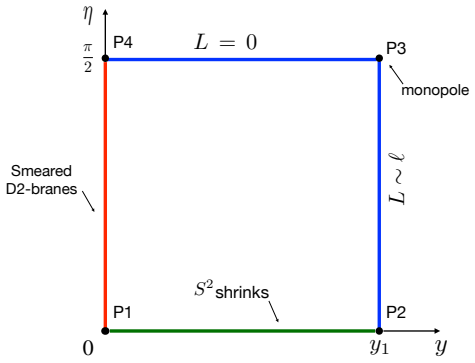
The load-bearing object is the local spindle solution, truncated to a $U(1)^n$ subsector of the relevant gauged supergravity and written in coordinates $(y,z)$ with a metric function $h(y)$ and gauge fields $A_i = (q_i/(y^2+q_i))\,dz$. A disk is obtained by choosing the radial interval $y \in [0,y_1]$ or $y \in [y_1,\infty)$, imposing the orbifold periodicity $\ell\Delta z/2\pi = 1/E(\cdots)$ so that the $(y,z)$ surface becomes the orbifold $R^2/\mathbb{Z}_\ell$, and computing the Euler characteristic $\chi = (1/4\pi)\int R_\Sigma \mathrm{vol}_\Sigma = 1/\ell$. The ten-dimensional interpretation is produced by uplift formulas: the $D=6$ formula from [41] for D4, the $D=7$ sphere reduction from [49] for D5/NS5, a $D=4$ uplift constructed in appendix C for D2, and the standard $S^2$ reduction for D6. The boundary asymptotics are then matched against the smeared Dp-brane ansatz of appendix A, and the monopole is read off from a jump in the twist function $L(y,\xi)$ at a corner of the base rectangle.
What would settle it
For the equal-charge D5/NS5 disk, solve the pair of conditions (3.31) and (3.33) for integer $\ell$ and real $p$, $\Delta z$; if no solution exists, the background violates Dirac flux quantization and must either be discarded or supplied with a modified quantization rule, and the paper's taxonomy would lose one of its entries.
Extended reading notes
Core claim
The central discovery is a classification with a common geometric skeleton: each disk solution from a non-conformal Dp-brane spindle has a $(y,z)$ base that is a disk with a single $R^2/\mathbb{Z}_\ell$ orbifold point, which fixes the Euler characteristic at $1/\ell$, and the uplifted metric carries a monopole source at the corner of the base where the circle fibration's twist function jumps. This is verified explicitly for D6, D5/NS5, D4, and D2 branes in the no-charge, single-charge, equal-charge, and multi-charge sectors. The classification also finds two systematic exceptions: non-compact disks with $y \in [y_1, \infty)$ end in un-smeared brane sources rather than smeared ones, and the equal-charge D5/NS5 solution has no monopole structure at all. In that same equal-charge D5/NS5 sector the orbifold periodicity and flux-quantization equations are proportional, so $p$ and $\Delta z$ cannot be solved for in terms of $\ell$ and $p$; the paper nonetheless lists it as a disk solution.
Load-bearing premise
The classification assumes that for every listed charge sector the orbifold periodicity condition and the gauge-field flux quantization can be solved simultaneously; the author explicitly notes that in the equal-charge D5/NS5 case these conditions are proportional and do not fix $p$ and $\Delta z$, so that solution is presented without the standard flux quantization.
Editorial extensions
If this is right
- For the D6, D4, and D2 families, every charge sector yields a disk background whose local geometry and boundary brane interpretation are now explicit; these can serve as gravity duals of non-conformal field theories on a disk.
- The universal $1/\ell$ Euler characteristic ties the orbifold order to the global topology and should persist for any further disk solutions built from the same spindle seed.
- The distinction between compact disks (smeared boundary branes) and non-compact disks (un-smeared boundary branes) is controlled by which root of $h(y)=0$ is chosen, giving a simple rule for where each behaviour occurs.
- If the equal-charge D5/NS5 disk is accepted without flux quantization, the common features of disk solutions are not universal; if it is rejected, the classification reduces to the sectors where quantization works.
Reading between the lines
- Deriving the missing uplifted flux forms for the $D=6$ and $D=4$ truncations (appendices B and C) and checking their Bianchi identities would independently test the smeared-brane source interpretation, which is currently inferred only from the metric and dilaton asymptotics.
- The same spindle-seed construction should produce disk×disk and spindle⋉disk products for non-conformal branes, extending the known conformal results; the twist-function jump argument predicts where monopole sources would sit in each factor.
- The obstruction in the equal-charge D5/NS5 sector may point to a modified quantization condition for NS5-branes; a worldsheet or double-field-theory computation could decide whether that solution has a consistent string-theory completion.
Editorial analysis
A structured set of objections, weighed in public.
Referee Report
Summary. The paper classifies disk solutions obtained by restricting the spindle solutions for non-conformal Dp-branes (D6, D5/NS5, D4, D2) constructed by Boisvert and Ferrero. For each brane type and for each charge sector (no charge, single charge, equal charge, multi charge), the paper gives the explicit gauged-supergravity metric, the orbifold periodicity condition, the Euler characteristic 1/ℓ of the disk, and, when available, the uplifted ten-dimensional metric and dilaton. It also analyzes the global geometry of the uplifted solutions, identifying monopole sources at the disk center and smeared versus un-smeared brane asymptotics at the boundary, with the D5 equal-charge and multi-charge sectors claimed as exceptions. Appendix C constructs a U(1)^3 uplift formula for D=4 ISO(7) gauged supergravity, and Appendix D treats no-charge M5-brane disks.
Significance. If the classification is correct, the paper provides a useful taxonomy of disk solutions for non-conformal branes, with explicit metrics, systematic compact/non-compact classification, and a clear criterion (smeared versus un-smeared boundary behavior) that organizes many examples. The Euler-characteristic computations are explicit and internally consistent, and the paper correctly identifies that several sectors require no fitting because they are obtained by direct restriction of known spindle solutions. The proposed D=4 uplift formula in Appendix C is a concrete new ingredient, though it is not fully checked. However, the completeness of the taxonomy is undermined by unresolved flux-quantization issues in at least one sector explicitly acknowledged by the author, and by missing flux-quantization data in other sectors.
major comments (3)
- [§3.2, Eqs. (3.31) and (3.33)] The equal-charge D5 sector is not a flux-quantized disk as presented. Eq. (3.31) fixes ℓΔz/(2π) = 1/[2gp(1±p)], and eq. (3.33) defines the holonomy as p = -gΔz/(2π) p(1±p). Substituting the first into the second gives p = -1/(2ℓ), so the holonomy is fixed by ℓ alone while the gauge-field parameter p and the period Δz remain undetermined. The author's own text after (3.33) acknowledges that one cannot solve for p and Δz in terms of ℓ and p. Since the abstract claims a complete classification and this sector is one of the exceptions to the 'monopoles and smeared branes' rule, the taxonomy is over-inclusive unless this sector is either removed, relabelled as an unquantized family, or supplemented with an additional physical condition that fixes the remaining parameter.
- [§5.4 and §4.4] The multi-charge D2 sector in §5.4 presents no flux-quantization equation at all: after the periodicity condition (5.62) and Euler characteristic (5.63), the discussion moves directly to the uplift. For a claimed classification, each gauge field should be quantized; here there are two nonzero gauge fields A1 and A2, so two holonomy conditions are needed. Similarly, in the multi-charge D4 sector of §4.4, eq. (4.66) defines a holonomy p using a symbol q that is not defined in that section, and only one equation is given for two gauge fields A1 and A2; the cross-reference to '(4.44)' is also wrong (it should refer to (4.64)). These sectors are therefore incomplete as classified, and the paper should either provide the missing quantization conditions or explicitly state that they are not imposed.
- [Apps. B, C and §§4.1.2, 4.2.2, 5.2.2] For the D4 and D2 uplifts, only the metric and dilaton are presented; the flux fields are not obtained, as the author acknowledges ('Explicit form of the uplift formula for flux fields is not given in [41]' and 'We have not obtained the uplift formula for the three-form potential'). Since the paper's title and abstract present these as brane-wrapped solutions, the ten-dimensional interpretation is incomplete: without the RR or NSNS fluxes one cannot verify the brane charge content or the precise source terms. The smeared/asymptotic analysis based on the metric and dilaton is suggestive but should be labelled as provisional until the fluxes are computed.
minor comments (6)
- [Eq. (3.24)] In the equal-charge D5 solution, the scalar expressions read e^{λ1+gρ/5} = e^{λ1+gρ/5} on both sides; the second should involve λ2.
- [After Eq. (3.33)] The cross-reference '(3.48)' in the sentence 'Δz p(1±p) is common in both of (3.48) and (3.33)' should be '(3.31)'.
- [§3.2, §3.3, §4.1, §5.1] For the non-compact solutions with y ∈ [ya, ∞), the text repeatedly states that the disk has 'the boundary at y=0'; the boundary is at y=∞, which is the side where the metric is analyzed in the corresponding uplifted sections.
- [§5.4, text above Eq. (5.64)] The sentence 'For the solution with < y2 < y <∞' is missing the variable y; it should read 'For the solution with y2 < y <∞'.
- [§4.4 and §4.3] The flux-quantization equations in these sections contain typographical inconsistencies: eq. (4.66) uses an undefined q, and the sentence after (4.44) refers to solving '(4.64) and (4.44)' where (4.44) is the equation just displayed; the intended references need to be corrected.
- [Throughout] There are several duplicated words, e.g., 'the the spindle solution' in §§2.2.1, 3.1.1 and D.1, and 'a single real root, y1, and two complex roots' with 'We find solutions' where the text is clear but would benefit from editing.
Circularity Check
No significant circularity: the disk solutions are restrictions of the spindle solutions of [14], and the claimed global features are computed from the explicit metrics.
full rationale
The paper's derivation chain is not circular in the sense of the analysis. Each disk solution is obtained by fixing parameters in the spindle solutions previously constructed by Boisvert and Ferrero, e.g., §2.1 sets A=0, q=0 in the spindle solution (3.15) of [14], §3.1 sets q1=1, q2=0 for the solution (4.26) of [14], and the other sectors proceed analogously. The global features are then read off from the explicit metrics: the Euler characteristic χ=1/ℓ is computed from the curvature integral (e.g., eqs. 2.8, 3.10, 4.9), the monopole structure is inferred from the jump of a connection function L on the base space (e.g., eqs. 3.21, 4.29, 5.28), and the smeared or un-smeared brane asymptotics are matched to the independent smeared-brane ansatz in appendix A. None of these conclusions is identical by construction to the input spindle solutions; they are derived properties. Flux quantization is imposed as an additional condition and solved in most sectors (e.g., eqs. 3.11–3.12, 4.22–4.23). In the equal-charge D5 sector, the paper explicitly flags that eqs. (3.31) and (3.33) are proportional, so p and Δz cannot both be determined; this is a correctness gap or limitation in that sector, not a circular step, because the text admits the failure rather than silently using the condition to force the claimed result. The self-citations to the author's earlier disk papers concern known conformal-brane disk solutions and serve as context for the common-features discussion; they are not load-bearing for the non-conformal disk constructions presented here. The paper also explicitly states missing uplift fluxes (appendices B and C) and the absence of a three-form uplift formula, which are acknowledged limitations rather than disguised inputs. Overall, no equation or fitted parameter is renamed as a prediction, and no load-bearing claim reduces to a self-citation chain.
Assumptions & free parameters
assumptions (4)
- domain assumption Validity of the consistent truncations and uplift formulas of D=8, D=7, D=6, D=4 gauged supergravities used to embed the solutions in 10D and 11D.
- domain assumption The local spindle solutions of [14] remain solutions when restricted to disk ranges and charge limits.
- ad hoc to paper The proposed D=4 ISO(7) U(1)^3 uplift formula in appendix C is consistent.
- domain assumption Boundary singularities of the uplifted metrics are correctly identified as smeared or un-smeared Dp-brane sources via the asymptotic matching in appendix A.
Cite this review
Pith. "Pith review of Non-conformal branes wrapped on a disk." pith.science (2026). https://pith.science/paper/BXJUJU7G
@misc{pith2026250722991,
  author       = {Pith},
  title        = {Pith review of: Non-conformal branes wrapped on a disk},
  year         = {2026},
  howpublished = {\url{https://pith.science/paper/BXJUJU7G}},
  note         = {Machine review of arXiv:2507.22991}
}
abstract
We classify the disk solutions which are obtained from the spindle solutions from non-conformal D$p$-branes recently constructed by Boisvert and Ferrero. Then we study the global geometry of the disk solutions. We discover several common features of disk solutions, $e.g.$, monopoles and smeared branes, in most cases, but there are also exceptions.
Figures
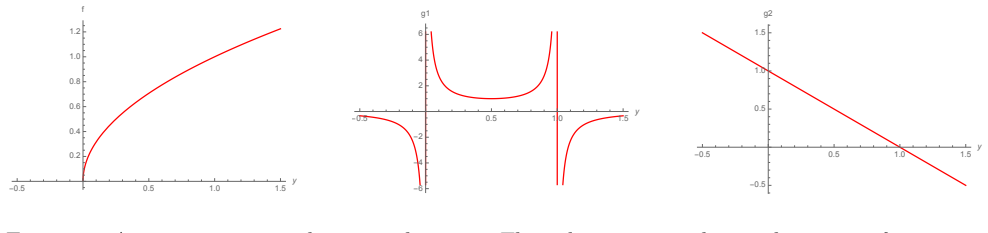


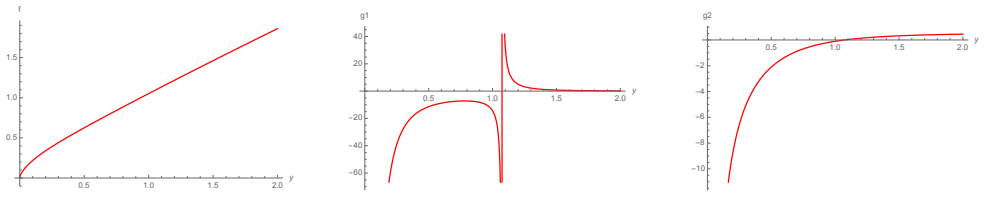
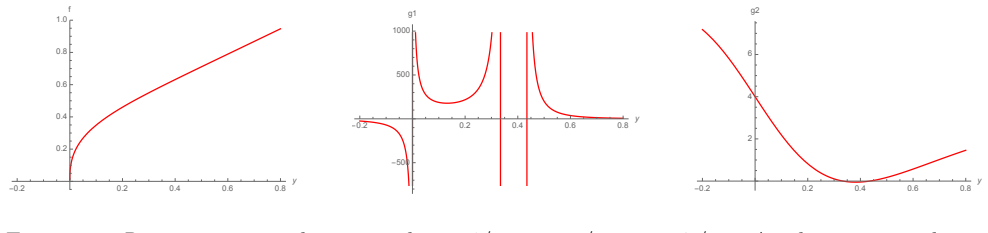
Figures from the paper (22 more)






Forward citations
Cited by 4 Pith papers
-
Supersymmetric $\mathbb{WCP}^n$, AdS near horizons and orbifolds
Weighted projective spaces WCP² and WCP³ can be made supersymmetric for tuned integer weights, yielding new AdS₅×WCP²×S¹, AdS₄×WCP³, and AdS₃×WT(1,1) supergravity solutions.
-
M5 branes wrapping $\mathbb{WCP}^2$ and spindles fibred over constant curvature Riemann surfaces
Classification of supersymmetric AdS3 solutions in 7d supergravity yielding M5-brane wrappings on WCP2 and spindle fibrations, with central charges matched via holography and c-extremization.
-
Localisation of $\mathcal{N} = (2,2)$ theories on spindles of both twists
A general formula is derived for the exact partition function of abelian vector and charged chiral multiplets on both twisted and anti-twisted spindles.
-
Localisation of $\mathcal{N} = (2,2)$ theories on spindles of both twists
Exact partition functions for N=(2,2) theories on spindles are computed via localisation for both twist and anti-twist, yielding a unified formula.
Reference graph
Works this paper leans on
-
[14]
M. Boisvert and P. Ferrero, A story of non-conformal branes: spindles, disks, circles and black holes , JHEP 06 (2024) 013, [ 2403.03989]
arXiv 2024
-
[41]
S^3 and S^4 Reductions of Type IIA Supergravity
M. Cvetic, H. Lu, C. N. Pope, A. Sadrzadeh and T. A. Tran, S**3 and S**4 reductions of type IIA supergravity, Nucl. Phys. B 590 (2000) 233–251, [ hep-th/0005137]
work page Pith review arXiv 2000
-
[1]
G. T. Horowitz and A. Strominger, Black strings and P-branes , Nucl. Phys. B 360 (1991) 197–209. 57
work page 1991
-
[2]
J. Dai, R. G. Leigh and J. Polchinski, New Connections Between String Theories , Mod. Phys. Lett. A 4 (1989) 2073–2083
1989
-
[3]
R. G. Leigh, Dirac-Born-Infeld Action from Dirichlet Sigma Model , Mod. Phys. Lett. A 4 (1989) 2767
work page 1989
-
[4]
Polchinski, Dirichlet Branes and Ramond-Ramond charges , Phys
J. Polchinski, Dirichlet Branes and Ramond-Ramond charges , Phys. Rev. Lett. 75 (1995) 4724–4727, [hep-th/9510017]
arXiv 1995
-
[5]
J. M. Maldacena, The Large N limit of superconformal field theories and supergravity , Adv. Theor. Math. Phys. 2 (1998) 231–252, [ hep-th/9711200]
arXiv 1998
-
[6]
N. Itzhaki, J. M. Maldacena, J. Sonnenschein and S. Yankielowicz, Supergravity and the large N limit of theories with sixteen supercharges , Phys. Rev. D 58 (1998) 046004, [hep-th/9802042]
arXiv 1998
Show all 60 references
-
[7]
Witten, Topological Quantum Field Theory, Commun
E. Witten, Topological Quantum Field Theory, Commun. Math. Phys. 117 (1988) 353
1988
-
[8]
J. M. Maldacena and C. Nunez, Supergravity description of field theories on curved manifolds and a no go theorem , Int. J. Mod. Phys. A 16 (2001) 822–855, [hep-th/0007018]
2001 arXiv
-
[9]
Ferrero, J
P. Ferrero, J. P. Gauntlett, J. M. P´ erez Ipi˜ na, D. Martelli and J. Sparks,D3-Branes Wrapped on a Spindle , Phys. Rev. Lett. 126 (2021) 111601, [ 2011.10579]
2021 arXiv
-
[10]
Ferrero, J
P. Ferrero, J. P. Gauntlett, J. M. P´ erez Ipi˜ na, D. Martelli and J. Sparks,Accelerating black holes and spinning spindles , Phys. Rev. D 104 (2021) 046007, [ 2012.08530]
2021 arXiv
-
[11]
I. Bah, F. Bonetti, R. Minasian and E. Nardoni, Holographic Duals of Argyres-Douglas Theories, Phys. Rev. Lett. 127 (2021) 211601, [ 2105.11567]
2021 arXiv
-
[12]
I. Bah, F. Bonetti, R. Minasian and E. Nardoni, M5-brane sources, holography, and Argyres-Douglas theories, JHEP 11 (2021) 140, [ 2106.01322]
2021 arXiv
-
[13]
Ferrero, D6 branes wrapped on a spindle and Y p,q manifolds, JHEP 05 (2024) 182, [2403.03988]
P. Ferrero, D6 branes wrapped on a spindle and Y p,q manifolds, JHEP 05 (2024) 182, [2403.03988]
2024 arXiv
-
[15]
Gutperle and N
M. Gutperle and N. Klein, A note on co-dimension 2 defects in N=4,d=7 gauged supergravity, Nucl. Phys. B 984 (2022) 115969, [ 2203.13839]. 58
2022 arXiv
-
[16]
Gutperle, N
M. Gutperle, N. Klein and D. Rathore, Holographic 6d co-dimension 2 defect solutions in M-theory, JHEP 11 (2023) 191, [ 2304.12899]
2023 arXiv
-
[17]
Capuozzo, J
P. Capuozzo, J. Estes, B. Robinson and B. Suzzoni, Holographic Weyl anomalies for 4d defects in 6d SCFTs , JHEP 04 (2024) 120, [ 2310.17447]
2024 arXiv
-
[18]
Couzens, N
C. Couzens, N. T. Macpherson and A. Passias, N = (2, 2) AdS 3 from D3-branes wrapped on Riemann surfaces , JHEP 02 (2022) 189, [ 2107.13562]
2022 arXiv
-
[19]
Suh, D3-branes and M5-branes wrapped on a topological disc , JHEP 03 (2022) 043, [2108.01105]
M. Suh, D3-branes and M5-branes wrapped on a topological disc , JHEP 03 (2022) 043, [2108.01105]
2022 arXiv
-
[20]
Suh, M2-branes wrapped on a topological disk , JHEP 09 (2022) 048, [ 2109.13278]
M. Suh, M2-branes wrapped on a topological disk , JHEP 09 (2022) 048, [ 2109.13278]
2022 arXiv
-
[21]
Couzens, K
C. Couzens, K. Stemerdink and D. van de Heisteeg, M2-branes on discs and multi-charged spindles, JHEP 04 (2022) 107, [ 2110.00571]
2022 arXiv
-
[22]
Karndumri and P
P. Karndumri and P. Nuchino, Five-branes wrapped on topological disks from 7D N=2 gauged supergravity, Phys. Rev. D 105 (2022) 066010, [ 2201.05037]
2022 arXiv
-
[23]
Couzens, H
C. Couzens, H. Kim, N. Kim and Y. Lee, Holographic duals of M5-branes on an irregularly punctured sphere, JHEP 07 (2022) 102, [ 2204.13537]
2022 arXiv
-
[24]
I. Bah, F. Bonetti, E. Nardoni and T. Waddleton, Aspects of irregular punctures via holography, JHEP 11 (2022) 131, [ 2207.10094]
2022 arXiv
-
[25]
Couzens, M
C. Couzens, M. J. Kang, C. Lawrie and Y. Lee, Holographic duals of Higgsed Db p(BCD ), 2312.12503
-
[26]
Suh, D4-branes wrapped on a topological disk , JHEP 06 (2023) 008, [ 2108.08326]
M. Suh, D4-branes wrapped on a topological disk , JHEP 06 (2023) 008, [ 2108.08326]
2023 arXiv
-
[27]
Couzens, H
C. Couzens, H. Kim, N. Kim, Y. Lee and M. Suh, D4-branes wrapped on four-dimensional orbifolds through consistent truncation , JHEP 02 (2023) 025, [ 2210.15695]
2023 arXiv
-
[28]
Suh, M5-branes and D4-branes wrapped on disk × disk and spindle ⋉ disk, 2411.09737
M. Suh, M5-branes and D4-branes wrapped on disk × disk and spindle ⋉ disk, 2411.09737
-
[29]
Bomans, C
P. Bomans, C. Couzens, Y. Lee and S. Ning, Symmetry breaking and consistent truncations from M5-branes wrapping a disc , JHEP 01 (2024) 088, [ 2308.08616]
2024 arXiv
-
[30]
Kim and N
H. Kim and N. Kim, Gluing two discs into a spindle , 2507.06097
-
[31]
A. W. Peet and J. Polchinski, UV / IR relations in AdS dynamics , Phys. Rev. D 59 (1999) 065011, [ hep-th/9809022]. 59
1999 arXiv
-
[32]
H. J. Boonstra, K. Skenderis and P. K. Townsend, The domain wall / QFT correspondence, JHEP 01 (1999) 003, [ hep-th/9807137]
1999 arXiv
-
[33]
Kanitscheider, K
I. Kanitscheider, K. Skenderis and M. Taylor, Precision holography for non-conformal branes, JHEP 09 (2008) 094, [ 0807.3324]
2008 arXiv
-
[34]
Bobev, P
N. Bobev, P. Bomans and F. F. Gautason, Spherical Branes, JHEP 08 (2018) 029, [1805.05338]
2018 arXiv
-
[35]
Bobev, P
N. Bobev, P. Bomans, F. F. Gautason, J. A. Minahan and A. Nedelin, Supersymmetric Yang-Mills, Spherical Branes, and Precision Holography , JHEP 03 (2020) 047, [1910.08555]
2020 arXiv
-
[36]
Bobev, P
N. Bobev, P. Bomans and F. F. Gautason, Spherical branes and the BMN matrix quantum mechanics, JHEP 01 (2025) 170, [ 2410.21376]
2025 arXiv
-
[37]
Ryu and T
S. Ryu and T. Takayanagi, Aspects of Holographic Entanglement Entropy , JHEP 08 (2006) 045, [ hep-th/0605073]
2006 arXiv
-
[38]
van Niekerk, Entanglement Entropy in NonConformal Holographic Theories , 1108.2294
A. van Niekerk, Entanglement Entropy in NonConformal Holographic Theories , 1108.2294
-
[39]
Salam and E
A. Salam and E. Sezgin, d=8 supergravity, Nucl. Phys. B 258 (1985) 284–304
1985
-
[40]
J. D. Edelstein and C. Nunez, D6-branes and M theory geometrical transitions from gauged supergravity, JHEP 04 (2001) 028, [ hep-th/0103167]
2001 arXiv
-
[42]
Giani and M
F. Giani and M. Pernici, N=2 Supergravity in Ten-Dimensions, Phys. Rev. D 30 (1984) 325–333
1984
-
[43]
I. C. G. Campbell and P. C. West, N=2 D=10 Nonchiral Supergravity and Its Spontaneous Compactification, Nucl. Phys. B 243 (1984) 112–124
1984
-
[44]
Huq and M
M. Huq and M. A. Namazie, Kaluza-Klein Supergravity in Ten-dimensions, Class. Quant. Grav. 2 (1985) 293
1985
-
[45]
J. H. Schwarz, Covariant Field Equations of Chiral N=2 D=10 Supergravity , Nucl. Phys. B 226 (1983) 269. 60
1983
-
[46]
P. S. Howe and P. C. West, The Complete N=2, D=10 Supergravity , Nucl. Phys. B 238 (1984) 181–220
1984
-
[47]
J. P. Gauntlett, N. Kim, D. Martelli and D. Waldram, Wrapped five-branes and N=2 superYang-Mills theory, Phys. Rev. D 64 (2001) 106008, [ hep-th/0106117]
2001 arXiv
-
[48]
Bigazzi, A
F. Bigazzi, A. L. Cotrone and A. Zaffaroni, N=2 gauge theories from wrapped five-branes , Phys. Lett. B 519 (2001) 269–276, [ hep-th/0106160]
2001 arXiv
-
[49]
Cvetic, H
M. Cvetic, H. Lu and C. N. Pope, Consistent Kaluza-Klein sphere reductions , Phys. Rev. D 62 (2000) 064028, [ hep-th/0003286]
2000 arXiv
-
[50]
P. M. Cowdall, On gauged maximal supergravity in six-dimensions , JHEP 06 (1999) 018, [hep-th/9810041]
1999 arXiv
-
[51]
Pernici, K
M. Pernici, K. Pilch and P. van Nieuwenhuizen, Gauged Maximally Extended Supergravity in Seven-dimensions , Phys. Lett. B 143 (1984) 103–107
1984
-
[52]
J. T. Liu and R. Minasian, Black holes and membranes in AdS(7) , Phys. Lett. B 457 (1999) 39–46, [ hep-th/9903269]
1999 arXiv
-
[53]
C. M. Hull, A New Gauging of N = 8 Supergravity, Phys. Rev. D 30 (1984) 760
1984
-
[54]
Guarino, D
A. Guarino, D. L. Jafferis and O. Varela, String Theory Origin of Dyonic N=8 Supergravity and Its Chern-Simons Duals , Phys. Rev. Lett. 115 (2015) 091601, [ 1504.08009]
2015 arXiv
-
[55]
Guarino and O
A. Guarino and O. Varela, Dyonic ISO(7) supergravity and the duality hierarchy , JHEP 02 (2016) 079, [ 1508.04432]
2016 arXiv
-
[56]
Guarino and O
A. Guarino and O. Varela, Consistent N = 8 truncation of massive IIA on S 6, JHEP 12 (2015) 020, [ 1509.02526]
2015 arXiv
-
[57]
Lozano, N
Y. Lozano, N. T. Macpherson, C. Nunez and A. Ramirez, AdS3 solutions in Massive IIA with small N = (4, 0) supersymmetry, JHEP 01 (2020) 129, [ 1908.09851]
2020 arXiv
-
[58]
K. C. M. Cheung, J. H. T. Fry, J. P. Gauntlett and J. Sparks, M5-branes wrapped on four-dimensional orbifolds , JHEP 08 (2022) 082, [ 2204.02990]
2022 arXiv
-
[59]
Varela, AdS4 solutions of massive IIA from dyonic ISO(7) supergravity , JHEP 03 (2016) 071, [ 1509.07117]
O. Varela, AdS4 solutions of massive IIA from dyonic ISO(7) supergravity , JHEP 03 (2016) 071, [ 1509.07117]
2016 arXiv
-
[60]
Ferrero, J
P. Ferrero, J. P. Gauntlett, D. Martelli and J. Sparks, M5-branes wrapped on a spindle , JHEP 11 (2021) 002, [ 2105.13344]. 61
2021 arXiv
Reviewed August 6, 2026 · model on record in the stance chip above.
Discussion (0). Sign in to comment.