REVIEW 4 major objections 6 minor 57 references
Robust and Efficient 3D Gaussian Splatting for Urban Scene Reconstruction
T0 review · 4 major / 6 minor · reviewed 2026-08-06 · deepseek-v4-flash
Pith's one-line read The paper claims that city-scale 3D scenes can be reconstructed from drone images on a single 24 GB GPU, rendered in real time, with higher quality than prior 3D Gaussian Splatting methods.
desk verdict A competent engineering pipeline for urban 3DGS whose headline comparison is undermined by a test-time appearance-embedding adaptation that favors the proposed method on every reported metric. read the letter →
The pith
A machine-rendered reading of the paper's core claim, the machinery that carries it, and where it could break.
The reading
What carries the argument
Two mechanisms carry the efficiency claim and one carries the robustness claim. The efficiency core is the controllable bottom-up level-of-detail generator: a sequence of budgets $B_1<B_2<\cdots<B_l$, densification intervals $T_1>T_2>\cdots>T_l$, and downsampling factors $D_1<D_2<\cdots<D_l=1$; training starts at the coarsest level and checkpoints upward, so each level refines the previous one while the Gaussian count never exceeds the user-set budget for that level. Supporting it are point-based visibility, the fraction of the projected SfM point cloud's convex hull that an image sees within a partition, which selects training cameras and rebalances partitions, and in-partition prioritized densification, which allows a Gaussian at distance $d_i$ from its partition to densify only when its gradient exceeds $\hat{\tau}_{\min}(\frac{\min(d_i,\hat{d}_{\max})}{\hat{d}_{\max}}(\eta-1)+1)$, concentrating computation inside the partition. The robustness core is the appearance transform module: learned image embeddings and Gaussian embeddings passed through a lightweight MLP that predicts per-Gaussian color and opacity offsets, so appearance variations are modeled explicitly instead of being baked into extra Gaussians.
What would settle it
Run the reported benchmark on a public release of one of the two private drone scenes, or on another public urban scene of comparable scale, with each baseline tuned by its original authors under a 24 GB memory cap; if the reported PSNR, SSIM, LPIPS, and FPS gaps shrink or reverse, the claim fails. A cheaper check is to retrain the two LOD baselines on BigCity with their default pruning and granularity settings to see whether the Supplementary C hyperparameter adjustments, rather than the method itself, produced the quality gap.
Extended reading notes
Core claim
The central claim is that an urban-scale scene can be reconstructed from multi-view drone imagery without post-training compression, in less time and at higher fidelity than previous 3D-Gaussian approaches, by replacing uncontrolled densification with a budgeted level-of-detail hierarchy. The paper shows that three resource controls are sufficient: visibility-based camera assignment removes redundant training views; in-partition prioritized densification directs Gaussians to where they matter; and bottom-up LOD generation produces a sequence of levels, each constrained by a budget $B_i$, densification interval $T_i$, and image downsampling factor $D_i$, so that rendering can switch levels by partition-camera distance. On top of this, the appearance transform module learns a per-image and per-Gaussian embedding, feeding a lightweight MLP that predicts color and opacity offsets, which removes inter-image appearance inconsistencies and permits post-reconstruction appearance changes at no rendering cost. The experiments report that the LOD-enabled model renders the three test scenes at 99.7, 63.9, and 73.0 FPS with 3.60M, 6.65M, and 6.84M Gaussians while improving quality metrics over the compared LOD systems.
Load-bearing premise
The superiority claim rests on the fairness of the baseline hyperparameter adjustments made in Supplementary C and on the public availability of the two largest test scenes; if the adjusted baselines were handicapped more than fair tuning would, or if the private datasets hide unfavorable conditions, the measured gap could be an artifact.
Editorial extensions
If this is right
- LOD mode gives a direct user-controlled trade-off between fidelity and footprint: cutting the budget on Rubble from $(8192,16384,32768)$ to $(1024,2048,4096)$ reduces Gaussians from 3.80M to 1.61M and raises FPS from 96.4 to 126.9 while PSNR drops only from 27.11 to 26.13.
- Visibility-based camera selection removes 1.28–1.70 times as many redundant training views as location-only assignment, so the same quality is reached with fewer training iterations on the tested scenes.
- In-partition prioritized densification accelerates training by 1.30–1.64 times and cuts the final Gaussian count by 1.37–2.05 times, with negligible effect on quality metrics.
- The appearance transform module improves all three quality metrics on all three scenes and typically reduces Gaussian count, because it prevents the model from growing floaters to overfit appearance variation.
- Except for the non-LOD configuration, all training and rendering steps in the reported experiments run within 24 GB of GPU memory, so the pipeline is usable on a single commodity card.
Reading between the lines
- A natural check not performed in the paper is to release the two private scenes and run the same protocol on a public urban dataset; if the gains survive, the method becomes a reproducible benchmark rather than a private-data demonstration.
- The per-Gaussian appearance embeddings point toward editable digital twins: by swapping only the image embedding, the same reconstruction could display different seasons, lighting, or camera styles without re-rendering cost, an ability the paper demonstrates for two building states.
- The visibility-based camera selection is a generic data-reduction idea that could be transplanted to other partition-based scene representations, such as grid- or hash-based NeRF variants, to cut their training data as well.
- Because the LOD levels are checkpoints with increasing budgets, they could be streamed progressively to a viewer—coarse level first, finer levels on approach—which would suit low-bandwidth city-scale browsing; the paper itself notes its current LOD switching is not incremental, so this is an extension rather than a claim.
Editorial analysis
A structured set of objections, weighed in public.
Referee Report
Summary. The paper proposes REUrbanGS, a 3D Gaussian Splatting framework for urban-scale scene reconstruction. It introduces point-based visibility for scene partitioning and training-camera selection, in-partition prioritized densification, a budget-controlled bottom-up LOD generation and selection scheme, an appearance transform module with per-image and per-Gaussian embeddings, and additional regularizers including depth, scale, opacity-offset, and anti-aliasing. Experiments on three large scenes (Rubble, JNU-ZH, BigCity) and four supplementary scenes compare against Switch-NeRF, 3DGS, CityGaussian, Hierarchical-3DGS, and VastGaussian, reporting PSNR, SSIM, LPIPS, number of Gaussians, and FPS. The central claim is that the method reconstructs urban scenes with better quality and efficiency than previous approaches.
Significance. The paper is a solid systems contribution. The visibility-based camera selection and controllable LOD generation are sensible engineering ideas, and the authors provide source code, which supports reproducibility. If the evaluation protocol were symmetric, the reported results would be evidence of a practical single-GPU pipeline for large urban scenes with real-time rendering and controllable memory use. However, the empirical claims are currently not fully supported: the quality numbers for the proposed method are obtained under a test-time adaptation protocol that baselines do not receive, baseline hyperparameters were retuned for the largest scene, and the two primary datasets are private. The significance of the contribution is therefore conditional on rectifying the evaluation.
major comments (4)
- [Supplementary D.1] The protocol used to compute all quality numbers for Ours in Tables 1 and 8 is asymmetric. D.1 states that the image embedding ℓ(I) is first optimized on the left half of each test image and scored on the right half, then repeated with the halves swapped. Because the two halves of the same image share illumination and weather conditions, this is genuine test-time adaptation that can inflate PSNR, SSIM, and LPIPS. No baseline receives an analogous test-image-specific adaptation, so the comparisons are not apples-to-apples. The paper's statement that this 'prevents information leakage and ensures fairness' is therefore not justified. Please report metrics with appearance embeddings fixed to a training-set value, or apply a matched test-time optimization to the baselines; at minimum, quantify the gap between the D.1 protocol and a no-adaptation protocol.
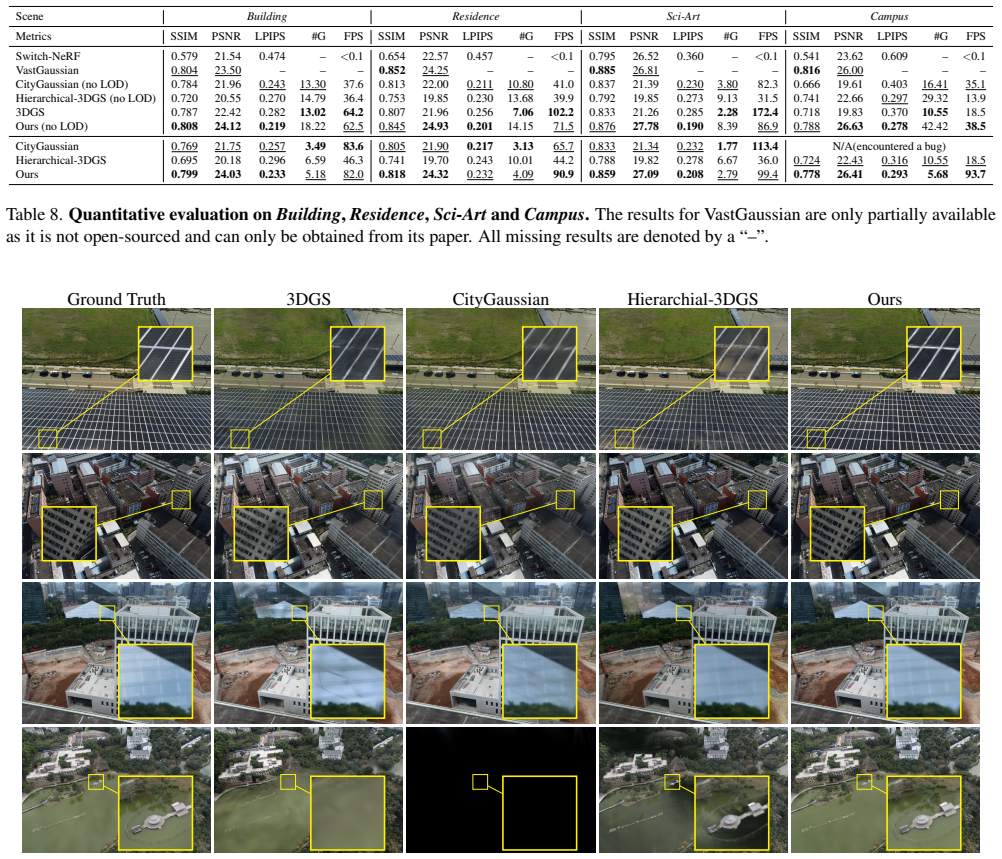
- [Supplementary C] For BigCity, the baselines' hyperparameters were changed substantially to fit in 80GB memory: CityGaussian's pruning ratios were raised from 40/50/60% to 70/80/90%, its densification cycle was tripled and its gradient threshold doubled; 3DGS's densification threshold was doubled; and Hierarchical-3DGS granularity was doubled from 6 to 12 pixels. These changes can plausibly degrade baseline quality beyond ordinary tuning. Table 1 shows CityGaussian LOD dropping from SSIM 0.825 (no LOD) to 0.712 on BigCity, and Hierarchical-3DGS LOD falling to 3.2 FPS. The paper should justify that these settings constitute fair tuning, or report baselines with default hyperparameters together with memory usage, or provide a sensitivity study demonstrating that the chosen settings do not materially alter the comparisons.
- [Section 4.1 and Tables 1, 8] The two primary large-scale datasets, JNU-ZH and BigCity, are private and not released, and no results are averaged over multiple seeds or reported with error bars. Since many reported differences are small (e.g., Rubble LPIPS 0.245 for Ours vs 0.256 for CityGaussian; FPS 99.7 vs 105.2), the absence of variance estimates and public data makes it impossible to assess whether the differences are significant or due to a favorable run. Please release the datasets or provide a detailed access mechanism, and report mean±std over at least three training runs for the headline comparisons.
- [Section 4.2 and Abstract] The abstract and Section 4.2 claim that the method 'outperforms previous approaches in both efficiency and quality,' but Table 1 does not show consistent dominance. With LOD enabled on Rubble, CityGaussian has lower #G (2.95M vs 3.60M) and higher FPS (105.2 vs 99.7); without LOD, 3DGS has lower #G and higher FPS on Rubble and JNU-ZH. The efficiency claim should be qualified (e.g., 'competitive efficiency while providing controllable budgets') or formulated as a trade-off rather than a strict improvement.
minor comments (6)
- [Section 4.4] Table 3 is captioned 'Qualitative ablations' but reports quantitative metrics; please rename it to 'Quantitative ablations'.
- [Figure 5 caption] The caption misspells 'Hierarchial-3DGS'; it should read 'Hierarchical-3DGS'.
- [Acknowledgments] The phrase 'the the Fundamental Research Funds' contains a duplicated article and should be corrected.
- [Section 3.5.1] The notation 'knn_{i;k}' in Equation (9) is not defined; please state explicitly that k is the number of nearest neighbors and clarify how the normalization over pairs is computed.
- [Table 2] The header 'Budget (×100)' is ambiguous; please state whether the listed values are already multiplied by 100 or are in units of 100, and give the actual budget values used.
- [Supplementary E.2, Table 8] The entry 'N/A (encountered a bug)' for CityGaussian on Campus should be replaced with a description of the failure mode or removed, since it is not a quantitative result.
Circularity Check
Reported quality metrics for Ours are computed after fitting the appearance embedding to half of each test image (Supplementary D.1), while baselines are evaluated with no test-image information, so the headline quality comparison is not a like-for-like prediction.
-
fitted input called prediction
[Supplementary Material, Section D.1 (Metric Calculation); affects Tables 1 and 8 and the Section 4.2 claim.]
"Specifically, when computing the metrics for test images, we first optimize the image embedding ℓ(I) using the left half of the image and compute the metrics using the right half. ... Then, we optimize the embedding from scratch using the right half and computed the metrics with the left half. Finally, the average of the results from both rounds was taken as the final metric value for the entire image. This approach prevents information leakage and ensures fairness in the evaluation process."
The paper's central 'outperforms previous approaches' claim is based on PSNR/SSIM/LPIPS numbers that for Ours are produced after a test-time fitting step: the global appearance embedding ℓ(I) is optimized on one half of each test image and then used to render and score the other half. Because both halves of the same image share illumination, weather, and camera settings, optimizing on the left half transfers appearance information into the right-half 'prediction', so the reported score is not a prediction from a fixed reconstruction on an unseen test view. The baselines (3DGS, CityGaussian, Hierarchical-3DGS, Switch-NeRF) are rendered with parameters fixed after training and receive no test-image adaptation.
full rationale
This paper is an empirical systems/engineering contribution, not a derivation chain, so most components (LOD budget scheduling, visibility-based partitioning, prioritized densification, regularization losses) are parameterized by user-defined choices and tested by ablations; none of these reduce to the reported metrics by construction. The one evaluation-circular element is Supplementary D.1: the test metrics for Ours are computed after optimizing the per-image appearance embedding ℓ(I) on half of each test image, while no baseline receives such test-image-specific adaptation. Since ℓ(I) is a global appearance latent, this is a genuine test-time fitting step that partly determines the other half's rendered appearance, making the headline quality comparisons (Tables 1 and 8, Section 4.2) not fully like-for-like. However, the reconstruction fidelity, LOD resource control, and efficiency claims retain independent content, and there is no self-citation chain or definitional tautology in the method itself, so the circularity is partial rather than total.
Assumptions & free parameters
free parameters (7)
- LOD budget B per scene =
(4096,8192,16384) Rubble; (4096,8192,20480) JNU-ZH; (2048,8192,20480) BigCity
- partition size =
180m (JNU-ZH), 400m (BigCity)
- visibility threshold =
1/6
- LOD distance thresholds =
e.g., (45m,90m,inf) to (180m,360m,inf) in supplement
- gradient thresholds tau_min and factor eta =
tau_min=0.0002 (levels 1-2), 0.6 (level 3); eta=4
- regularization weights lambda_sim, lambda_delta_o, lambda_d, lambda_s =
0.2, 0.05, 0.5 to 0.01, 0.05
- smax and rmax =
smax set to typical building size, rmax=10
assumptions (4)
- standard math Gaussian splatting alpha-blending and rasterization equations (Eqs. 1-2) and loss (Eq. 3) are valid background.
- domain assumption Accurate camera poses and sparse point clouds are available from SfM.
- domain assumption Depth Anything V2 monocular depth predictions, aligned to SfM, are sufficiently reliable for depth regularization.
- domain assumption Grounding DINO and SAM2 can segment transient objects (pedestrians, vehicles) adequately.
Cite this review
Pith. "Pith review of Robust and Efficient 3D Gaussian Splatting for Urban Scene Reconstruction." pith.science (2026). https://pith.science/paper/WQEPPKXO
@misc{pith2026250723006,
  author       = {Pith},
  title        = {Pith review of: Robust and Efficient 3D Gaussian Splatting for Urban Scene Reconstruction},
  year         = {2026},
  howpublished = {\url{https://pith.science/paper/WQEPPKXO}},
  note         = {Machine review of arXiv:2507.23006}
}
read the original abstract
We present a framework that enables fast reconstruction and real-time rendering of urban-scale scenes while maintaining robustness against appearance variations across multi-view captures. Our approach begins with scene partitioning for parallel training, employing a visibility-based image selection strategy to optimize training efficiency. A controllable level-of-detail (LOD) strategy explicitly regulates Gaussian density under a user-defined budget, enabling efficient training and rendering while maintaining high visual fidelity. The appearance transformation module mitigates the negative effects of appearance inconsistencies across images while enabling flexible adjustments. Additionally, we utilize enhancement modules, such as depth regularization, scale regularization, and antialiasing, to improve reconstruction fidelity. Experimental results demonstrate that our method effectively reconstructs urban-scale scenes and outperforms previous approaches in both efficiency and quality. The source code is available at: https://yzslab.github.io/REUrbanGS.
Figures


Figures from the paper (8 more)




Reference graph
Works this paper leans on
-
[1]
Mip-nerf 360: Unbounded anti-aliased neural radiance fields
Jonathan T Barron, Ben Mildenhall, Dor Verbin, Pratul P Srinivasan, and Peter Hedman. Mip-nerf 360: Unbounded anti-aliased neural radiance fields. In Proceedings of the IEEE/CVF conference on computer vision and pattern recognition, pages 5470–5479, 2022. 1, 2
work page 2022
-
[2]
Zip-nerf: Anti-aliased grid-based neural radiance fields
Jonathan T Barron, Ben Mildenhall, Dor Verbin, Pratul P Srinivasan, and Peter Hedman. Zip-nerf: Anti-aliased grid-based neural radiance fields. In Proceedings of the IEEE/CVF International Conference on Computer Vision , pages 19697–19705, 2023. 2
2023
-
[3]
Hallucinated neural radiance fields in the wild
Xingyu Chen, Qi Zhang, Xiaoyu Li, Yue Chen, Ying Feng, Xuan Wang, and Jue Wang. Hallucinated neural radiance fields in the wild. In Proceedings of the IEEE/CVF Con- ference on Computer Vision and Pattern Recognition, pages 12943–12952, 2022. 1
work page 2022
-
[4]
Hac: Hash-grid assisted context for 3d gaussian splatting compression
Yihang Chen, Qianyi Wu, Weiyao Lin, Mehrtash Harandi, and Jianfei Cai. Hac: Hash-grid assisted context for 3d gaussian splatting compression. In European Conference on Computer Vision, pages 422–438. Springer Nature Switzer- land Cham, 2024. 2
work page 2024
-
[5]
Swag: Splatting in the wild images with appearance-conditioned gaussians
Hiba Dahmani, Moussab Bennehar, Nathan Piasco, Luis Roldao, and Dzmitry Tsishkou. Swag: Splatting in the wild images with appearance-conditioned gaussians. In European Conference on Computer Vision , pages 325–340. Springer,
-
[6]
A sys- tematic review of a digital twin city: A new pattern of urban governance toward smart cities
Tianhu Deng, Keren Zhang, and Zuo-Jun Max Shen. A sys- tematic review of a digital twin city: A new pattern of urban governance toward smart cities. Journal of management sci- ence and engineering, 6(2):125–134, 2021. 1
work page 2021
-
[7]
Plenoxels: Radiance fields without neural networks
Sara Fridovich-Keil, Alex Yu, Matthew Tancik, Qinhong Chen, Benjamin Recht, and Angjoo Kanazawa. Plenoxels: Radiance fields without neural networks. In Proceedings of the IEEE/CVF conference on computer vision and pattern recognition, pages 5501–5510, 2022. 2
2022
-
[8]
3d gaussian splatting for real-time radiance field rendering
Bernhard Kerbl, Georgios Kopanas, Thomas Leimk ¨uhler, and George Drettakis. 3d gaussian splatting for real-time radiance field rendering. ACM Trans. Graph., 42(4):139–1,
Show all 57 references
-
[9]
A hierarchical 3d gaussian representation for real-time ren- dering of very large datasets.ACM Transactions on Graphics (TOG), 43(4):1–15, 2024
Bernhard Kerbl, Andreas Meuleman, Georgios Kopanas, Michael Wimmer, Alexandre Lanvin, and George Drettakis. A hierarchical 3d gaussian representation for real-time ren- dering of very large datasets.ACM Transactions on Graphics (TOG), 43(4):1–15, 2024. 2, 6
2024
-
[10]
3d gaussian splat- ting as markov chain monte carlo
Shakiba Kheradmand, Daniel Rebain, Gopal Sharma, Wei- wei Sun, Yang-Che Tseng, Hossam Isack, Abhishek Kar, Andrea Tagliasacchi, and Kwang Moo Yi. 3d gaussian splat- ting as markov chain monte carlo. Advances in Neural Infor- mation Processing Systems, 37:80965–80986, 2025. 2
2025
-
[11]
Light field rendering
Marc Levoy and Pat Hanrahan. Light field rendering. In Seminal Graphics Papers: Pushing the Boundaries, Volume 2, pages 441–452. 2023. 2
2023
-
[12]
Dngaussian: Optimizing sparse-view 3d gaussian radiance fields with global-local depth normaliza- tion
Jiahe Li, Jiawei Zhang, Xiao Bai, Jin Zheng, Xin Ning, Jun Zhou, and Lin Gu. Dngaussian: Optimizing sparse-view 3d gaussian radiance fields with global-local depth normaliza- tion. In Proceedings of the IEEE/CVF conference on com- puter vision and pattern recognition , pages 2...
-
[13]
Aads: Aug- mented autonomous driving simulation using data-driven al- gorithms
Wei Li, CW Pan, Rong Zhang, JP Ren, YX Ma, Jin Fang, FL Yan, QC Geng, XY Huang, HJ Gong, et al. Aads: Aug- mented autonomous driving simulation using data-driven al- gorithms. Science robotics, 4(28):eaaw0863, 2019. 1
2019
-
[14]
Neuralangelo: High-fidelity neural surface reconstruction
Zhaoshuo Li, Thomas M ¨uller, Alex Evans, Russell H Tay- lor, Mathias Unberath, Ming-Yu Liu, and Chen-Hsuan Lin. Neuralangelo: High-fidelity neural surface reconstruction. In Proceedings of the IEEE/CVF Conference on Computer Vi- sion and Pattern Recognition, pages 8456–8465, 2023. 2
2023
-
[15]
Spacetime gaus- sian feature splatting for real-time dynamic view synthesis
Zhan Li, Zhang Chen, Zhong Li, and Yi Xu. Spacetime gaus- sian feature splatting for real-time dynamic view synthesis. In Proceedings of the IEEE/CVF Conference on Computer Vision and Pattern Recognition, pages 8508–8520, 2024. 2
2024
-
[16]
Vastgaussian: Vast 3d gaussians for large scene reconstruction
Jiaqi Lin, Zhihao Li, Xiao Tang, Jianzhuang Liu, Shiyong Liu, Jiayue Liu, Yangdi Lu, Xiaofei Wu, Songcen Xu, You- liang Yan, et al. Vastgaussian: Vast 3d gaussians for large scene reconstruction. In Proceedings of the IEEE/CVF Con- ference on Computer Vision and Pattern Recogn...
2024
-
[17]
Capturing, reconstructing, and simulating: the urbanscene3d dataset
Liqiang Lin, Yilin Liu, Yue Hu, Xingguang Yan, Ke Xie, and Hui Huang. Capturing, reconstructing, and simulating: the urbanscene3d dataset. In European Conference on Computer Vision, pages 93–109. Springer, 2022. 6, 2
2022
-
[18]
Citygaussian: Real-time high-quality large-scale scene rendering with gaussians
Yang Liu, Chuanchen Luo, Lue Fan, Naiyan Wang, Jun- ran Peng, and Zhaoxiang Zhang. Citygaussian: Real-time high-quality large-scale scene rendering with gaussians. In European Conference on Computer Vision, pages 265–282. Springer Nature Switzerland Cham, 2024. 2, 4, 6
2024
-
[19]
Dynamic 3d gaussians: Tracking by per- sistent dynamic view synthesis
Jonathon Luiten, Georgios Kopanas, Bastian Leibe, and Deva Ramanan. Dynamic 3d gaussians: Tracking by per- sistent dynamic view synthesis. In 2024 International Con- ference on 3D Vision (3DV), pages 800–809. IEEE, 2024. 2, 5
2024
-
[20]
Taming 3dgs: High-quality radiance fields with limited resources
Saswat Subhajyoti Mallick, Rahul Goel, Bernhard Kerbl, Markus Steinberger, Francisco Vicente Carrasco, and Fer- nando De La Torre. Taming 3dgs: High-quality radiance fields with limited resources. In SIGGRAPH Asia 2024 Con- ference Papers, pages 1–11, 2024. 2, 3, 4
2024
-
[21]
Nerf in the wild: Neural radiance fields for uncon- strained photo collections
Ricardo Martin-Brualla, Noha Radwan, Mehdi SM Sajjadi, Jonathan T Barron, Alexey Dosovitskiy, and Daniel Duck- worth. Nerf in the wild: Neural radiance fields for uncon- strained photo collections. In Proceedings of the IEEE/CVF conference on computer vision and pattern recogn...
2021
-
[22]
Nerf: Representing scenes as neural radiance fields for view syn- thesis
Ben Mildenhall, Pratul P Srinivasan, Matthew Tancik, Jonathan T Barron, Ravi Ramamoorthi, and Ren Ng. Nerf: Representing scenes as neural radiance fields for view syn- thesis. Communications of the ACM, 65(1):99–106, 2021. 1, 2
2021
-
[23]
Compact 3d scene representation via self- organizing gaussian grids
Wieland Morgenstern, Florian Barthel, Anna Hilsmann, and Peter Eisert. Compact 3d scene representation via self- organizing gaussian grids. In European Conference on Computer Vision, pages 18–34. Springer Nature Switzerland Cham, 2024. 2
2024
-
[24]
Instant neural graphics primitives with a mul- tiresolution hash encoding
Thomas M ¨uller, Alex Evans, Christoph Schied, and Alexan- der Keller. Instant neural graphics primitives with a mul- tiresolution hash encoding. ACM transactions on graphics (TOG), 41(4):1–15, 2022. 2
2022
-
[25]
A survey of urban reconstruction
Przemyslaw Musialski, Peter Wonka, Daniel G Aliaga, Michael Wimmer, Luc Van Gool, and Werner Purgathofer. A survey of urban reconstruction. In Computer graphics fo- rum, pages 146–177. Wiley Online Library, 2013. 1
2013
-
[26]
Compressed 3d gaussian splatting for accelerated novel view synthesis
Simon Niedermayr, Josef Stumpfegger, and R ¨udiger West- ermann. Compressed 3d gaussian splatting for accelerated novel view synthesis. In Proceedings of the IEEE/CVF Con- ference on Computer Vision and Pattern Recognition, pages 10349–10358, 2024. 2
2024
-
[27]
Neural scene graphs for dynamic scenes
Julian Ost, Fahim Mannan, Nils Thuerey, Julian Knodt, and Felix Heide. Neural scene graphs for dynamic scenes. In Proceedings of the IEEE/CVF Conference on Computer Vi- sion and Pattern Recognition, pages 2856–2865, 2021. 1
2021
-
[28]
Nerfies: Deformable neural radiance fields
Keunhong Park, Utkarsh Sinha, Jonathan T Barron, Sofien Bouaziz, Dan B Goldman, Steven M Seitz, and Ricardo Martin-Brualla. Nerfies: Deformable neural radiance fields. In Proceedings of the IEEE/CVF international conference on computer vision, pages 5865–5874, 2021. 2
2021
-
[29]
Hypernerf: A higher- dimensional representation for topologically varying neural radiance fields
Keunhong Park, Utkarsh Sinha, Peter Hedman, Jonathan T Barron, Sofien Bouaziz, Dan B Goldman, Ricardo Martin- Brualla, and Steven M Seitz. Hypernerf: A higher- dimensional representation for topologically varying neural radiance fields. arXiv preprint arXiv:2106.13228, 2021
2021 arXiv
-
[30]
D-nerf: Neural radiance fields for dynamic scenes
Albert Pumarola, Enric Corona, Gerard Pons-Moll, and Francesc Moreno-Noguer. D-nerf: Neural radiance fields for dynamic scenes. In Proceedings of the IEEE/CVF con- ference on computer vision and pattern recognition , pages 10318–10327, 2021. 2
2021
-
[31]
Stopthepop: Sorted gaussian splatting for view-consistent real-time rendering
Lukas Radl, Michael Steiner, Mathias Parger, Alexan- der Weinrauch, Bernhard Kerbl, and Markus Steinberger. Stopthepop: Sorted gaussian splatting for view-consistent real-time rendering. ACM Transactions on Graphics (TOG), 43(4):1–17, 2024. 2, 4, 5
2024
-
[32]
Sam 2: Segment anything in images and videos
Nikhila Ravi, Valentin Gabeur, Yuan-Ting Hu, Ronghang Hu, Chaitanya Ryali, Tengyu Ma, Haitham Khedr, Roman R¨adle, Chloe Rolland, Laura Gustafson, et al. Sam 2: Segment anything in images and videos. arXiv preprint arXiv:2408.00714, 2024. 6
2024 arXiv
-
[33]
Kilonerf: Speeding up neural radiance fields with thousands of tiny mlps
Christian Reiser, Songyou Peng, Yiyi Liao, and Andreas Geiger. Kilonerf: Speeding up neural radiance fields with thousands of tiny mlps. In Proceedings of the IEEE/CVF international conference on computer vision , pages 14335– 14345, 2021. 2
2021
-
[34]
Grounding dino 1.5: Advance the” edge” of open-set object detection
Tianhe Ren, Qing Jiang, Shilong Liu, Zhaoyang Zeng, Wen- long Liu, Han Gao, Hongjie Huang, Zhengyu Ma, Xiaoke Jiang, Yihao Chen, et al. Grounding dino 1.5: Advance the” edge” of open-set object detection. arXiv preprint arXiv:2405.10300, 2024. 6
2024 arXiv
-
[35]
Spotlesssplats: Ignor- ing distractors in 3d gaussian splatting
Sara Sabour, Lily Goli, George Kopanas, Mark Matthews, Dmitry Lagun, Leonidas Guibas, Alec Jacobson, David J Fleet, and Andrea Tagliasacchi. Spotlesssplats: Ignor- ing distractors in 3d gaussian splatting. arXiv preprint arXiv:2406.20055, 2024. 2
2024 arXiv
-
[36]
Structure- from-motion revisited
Johannes L Schonberger and Jan-Michael Frahm. Structure- from-motion revisited. In Proceedings of the IEEE con- ference on computer vision and pattern recognition , pages 4104–4113, 2016. 1
2016
-
[37]
Pixelwise view selection for unstructured multi-view stereo
Johannes L Sch ¨onberger, Enliang Zheng, Jan-Michael Frahm, and Marc Pollefeys. Pixelwise view selection for unstructured multi-view stereo. In Computer Vision–ECCV 2016: 14th European Conference, Amsterdam, The Nether- lands, October 11-14, 2016, Proceedings, Part III 14, pag...
2016
-
[38]
Nerf- player: A streamable dynamic scene representation with de- composed neural radiance fields.IEEE Transactions on Visu- alization and Computer Graphics , 29(5):2732–2742, 2023
Liangchen Song, Anpei Chen, Zhong Li, Zhang Chen, Lele Chen, Junsong Yuan, Yi Xu, and Andreas Geiger. Nerf- player: A streamable dynamic scene representation with de- composed neural radiance fields.IEEE Transactions on Visu- alization and Computer Graphics , 29(5):2732–2742, 2023. 2
2023
-
[39]
Sc-nerf: Self-correcting neural radiance field with sparse views
Liang Song, Guangming Wang, Jiuming Liu, Zhenyang Fu, Yanzi Miao, et al. Sc-nerf: Self-correcting neural radiance field with sparse views. arXiv preprint arXiv:2309.05028 ,
-
[40]
Direct voxel grid optimization: Super-fast convergence for radiance fields reconstruction
Cheng Sun, Min Sun, and Hwann-Tzong Chen. Direct voxel grid optimization: Super-fast convergence for radiance fields reconstruction. In Proceedings of the IEEE/CVF conference on computer vision and pattern recognition , pages 5459– 5469, 2022. 2
2022
-
[41]
Block-nerf: Scalable large scene neural view synthesis
Matthew Tancik, Vincent Casser, Xinchen Yan, Sabeek Prad- han, Ben Mildenhall, Pratul P Srinivasan, Jonathan T Barron, and Henrik Kretzschmar. Block-nerf: Scalable large scene neural view synthesis. In Proceedings of the IEEE/CVF con- ference on computer vision and pattern rec...
2022
-
[42]
Mega-nerf: Scalable construction of large- scale nerfs for virtual fly-throughs
Haithem Turki, Deva Ramanan, and Mahadev Satya- narayanan. Mega-nerf: Scalable construction of large- scale nerfs for virtual fly-throughs. In Proceedings of the IEEE/CVF conference on computer vision and pattern recognition, pages 12922–12931, 2022. 2, 6
2022
-
[43]
Neus: Learning neural implicit surfaces by volume rendering for multi-view reconstruction
Peng Wang, Lingjie Liu, Yuan Liu, Christian Theobalt, Taku Komura, and Wenping Wang. Neus: Learning neural implicit surfaces by volume rendering for multi-view reconstruction. arXiv preprint arXiv:2106.10689, 2021. 2
2021 arXiv
-
[44]
4d gaussian splatting for real-time dynamic scene rendering
Guanjun Wu, Taoran Yi, Jiemin Fang, Lingxi Xie, Xiaopeng Zhang, Wei Wei, Wenyu Liu, Qi Tian, and Xinggang Wang. 4d gaussian splatting for real-time dynamic scene rendering. In Proceedings of the IEEE/CVF conference on computer vi- sion and pattern recognition, pages 20310–2032...
2024
-
[45]
Bungeenerf: Progressive neural radiance field for extreme multi-scale scene rendering
Yuanbo Xiangli, Linning Xu, Xingang Pan, Nanxuan Zhao, Anyi Rao, Christian Theobalt, Bo Dai, and Dahua Lin. Bungeenerf: Progressive neural radiance field for extreme multi-scale scene rendering. In European conference on computer vision, pages 106–122. Springer, 2022. 2
2022
-
[46]
Grid-guided neural radiance fields for large urban scenes
Linning Xu, Yuanbo Xiangli, Sida Peng, Xingang Pan, Nanxuan Zhao, Christian Theobalt, Bo Dai, and Dahua Lin. Grid-guided neural radiance fields for large urban scenes. In Proceedings of the IEEE/CVF Conference on Computer Vi- sion and Pattern Recognition, pages 8296–8306, 2023. 2
2023
-
[47]
Depth any- thing v2
Lihe Yang, Bingyi Kang, Zilong Huang, Zhen Zhao, Xiao- gang Xu, Jiashi Feng, and Hengshuang Zhao. Depth any- thing v2. Advances in Neural Information Processing Sys- tems, 37:21875–21911, 2025. 5
2025
-
[48]
Deformable 3d gaussians for high- fidelity monocular dynamic scene reconstruction
Ziyi Yang, Xinyu Gao, Wen Zhou, Shaohui Jiao, Yuqing Zhang, and Xiaogang Jin. Deformable 3d gaussians for high- fidelity monocular dynamic scene reconstruction. In Pro- ceedings of the IEEE/CVF conference on computer vision and pattern recognition, pages 20331–20341, 2024. 2
2024
-
[49]
V ol- ume rendering of neural implicit surfaces
Lior Yariv, Jiatao Gu, Yoni Kasten, and Yaron Lipman. V ol- ume rendering of neural implicit surfaces. Advances in Neu- ral Information Processing Systems, 34:4805–4815, 2021. 2
2021
-
[50]
gsplat: An open-source library for gaussian splatting
Vickie Ye, Ruilong Li, Justin Kerr, Matias Turkulainen, Brent Yi, Zhuoyang Pan, Otto Seiskari, Jianbo Ye, Jeffrey Hu, Matthew Tancik, et al. gsplat: An open-source library for gaussian splatting. arXiv preprint arXiv:2409.06765, 2024. 1
2024 arXiv
-
[51]
Absgs: Recovering fine details in 3d gaussian splat- ting
Zongxin Ye, Wenyu Li, Sidun Liu, Peng Qiao, and Yong Dou. Absgs: Recovering fine details in 3d gaussian splat- ting. In Proceedings of the 32nd ACM International Confer- ence on Multimedia, pages 1053–1061, 2024. 6, 1
2024
-
[52]
Plenoctrees for real-time rendering of neural radiance fields
Alex Yu, Ruilong Li, Matthew Tancik, Hao Li, Ren Ng, and Angjoo Kanazawa. Plenoctrees for real-time rendering of neural radiance fields. In Proceedings of the IEEE/CVF international conference on computer vision , pages 5752– 5761, 2021. 2
2021
-
[53]
Mip-splatting: Alias-free 3d gaussian splat- ting
Zehao Yu, Anpei Chen, Binbin Huang, Torsten Sattler, and Andreas Geiger. Mip-splatting: Alias-free 3d gaussian splat- ting. In Proceedings of the IEEE/CVF conference on com- puter vision and pattern recognition , pages 19447–19456,
-
[54]
Gaussian in the wild: 3d gaussian splatting for unconstrained image collections
Dongbin Zhang, Chuming Wang, Weitao Wang, Peihao Li, Minghan Qin, and Haoqian Wang. Gaussian in the wild: 3d gaussian splatting for unconstrained image collections. In European Conference on Computer Vision, pages 341–359. Springer, 2024. 2
2024
-
[55]
Effi- cient large-scale scene representation with a hybrid of high- resolution grid and plane features
Yuqi Zhang, Guanying Chen, and Shuguang Cui. Effi- cient large-scale scene representation with a hybrid of high- resolution grid and plane features. Pattern Recognition, 158: 111001, 2025. 2
2025
-
[56]
On scaling up 3d gaussian splatting training
Hexu Zhao, Haoyang Weng, Daohan Lu, Ang Li, Jinyang Li, Aurojit Panda, and Saining Xie. On scaling up 3d gaussian splatting training. arXiv preprint arXiv:2406.18533, 2024. 2
2024
-
[57]
Switch-nerf: Learning scene de- composition with mixture of experts for large-scale neural radiance fields
MI Zhenxing and Dan Xu. Switch-nerf: Learning scene de- composition with mixture of experts for large-scale neural radiance fields. In The Eleventh International Conference on Learning Representations, 2022. 2, 6 Robust and Efficient 3D Gaussian Splatting for Urban Scene Recon...
2022
Reviewed August 6, 2026 · model on record in the stance chip above.
Discussion (0). Sign in to comment.