REVIEW 4 major objections 7 minor 25 references
Place-cell heterogeneity underlies power-laws in hippocampal activity
T0 review · 4 major / 7 minor · reviewed 2026-08-06 · deepseek-v4-flash
Pith's one-line read The paper claims that power-law scaling under a phenomenological renormalization group applied to hippocampal data arises from heterogeneous, non-interacting place cells, not from critical dynamics.
desk verdict Confirms that PRG power laws do not imply criticality, but the stronger 'underlies' claim needs a test of conditional independence before it fully lands. read the letter →
The pith
A machine-rendered reading of the paper's core claim, the machinery that carries it, and where it could break.
The reading
What carries the argument
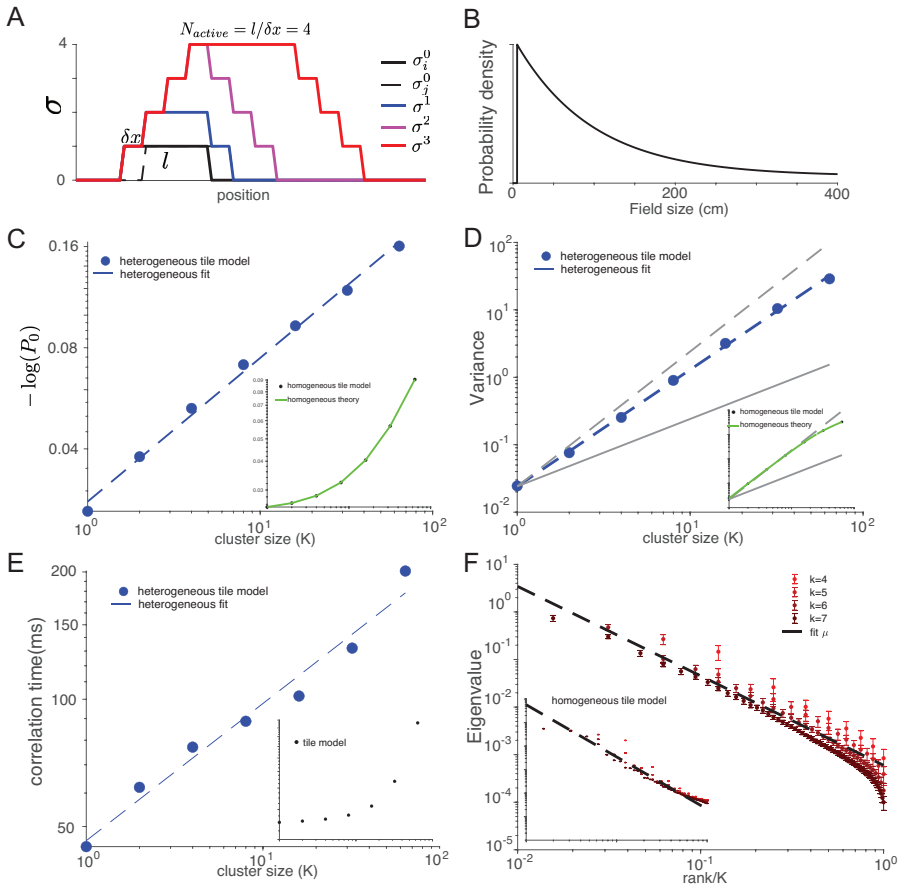
The load-bearing object is the Gamma-Poisson place-field model: each neuron forms fields as a Poisson process with a Gamma-distributed rate, giving heterogeneous field numbers and sizes fitted to recordings, and neurons are independent conditional on spatial location. The argument also relies on a simplified binary tile model whose coarse-graining can be analyzed exactly: a homogeneous tile model has a scaling transition at $K^* = N_{\rm active} = l/\delta x$, the number of active fields at a location, and heterogeneity in field sizes smooths this transition into apparent power laws. This transition structure is what turns unit-level variability into apparent scale invariance.
What would settle it
A concrete test would be to compute PRG exponents from hippocampal data and from surrogate spike trains in which each neuron's spikes are shuffled within small spatial bins, preserving the spatial rate map, field counts, and field sizes while destroying any non-spatial correlations; if the surrogate exponents deviate substantially from the real ones, the model misses an essential interaction, whereas if they match, spatial heterogeneity alone suffices.
Extended reading notes
Core claim
The central claim is that population heterogeneity alone can produce power-law scaling under the PRG when units are independent, so the PRG power laws observed in hippocampal CA1 activity do not indicate critical interactions. The experimental exponents are matched by a statistical model in which each neuron has independent, spatially structured place fields drawn from a Gamma-Poisson distribution, with correlations arising only from shared spatial location. A simplified binary tile model shows that a homogeneous population of place fields has non-power-law scaling with two regimes separated by $N_{\rm active}$, the number of units active at a location, while heterogeneity in field size removes the sharp transition and yields apparent power laws. The resulting exponents depend systematically on population size and environment size, and the paper confirms these dependencies by subsampling the recorded data.
Load-bearing premise
The load-bearing premise is that the fitted Gamma-Poisson place-field model captures the correlation structure of the recorded CA1 population, so that matching PRG exponents with independent neurons is not a coincidence; if unmodeled non-spatial correlations or interactions are present, the exponents could match for other reasons.
Editorial extensions
If this is right
- PRG power-law exponents previously read as signatures of criticality in hippocampal data should be reinterpreted as consequences of heterogeneous spatial tuning.
- PRG exponents depend on population size and environment size, so comparisons between studies must control for these experimental parameters.
- Subsampling predictions from the model match the recorded data, supporting the claim that the scaling is not scale-invariant in origin.
- The distribution of tuning curves is a more direct and intuitive quantity to analyse than PRG exponents when interpreting neural population activity.
Reading between the lines
- The same heterogeneity mechanism may apply to PRG analyses of other brain areas where neurons are tuned to continuous variables, such as orientation or head direction, even though the paper does not test those systems.
- A practical testable extension would be to run the PRG on surrogate spike trains that preserve each neuron's spatial rate map but destroy all non-spatial correlations; the paper's account predicts unchanged exponents.
- The paper implicitly suggests that null models preserving empirically measured heterogeneity should become standard controls before any biological coarse-graining result is attributed to criticality.
Editorial analysis
A structured set of objections, weighed in public.
Referee Report
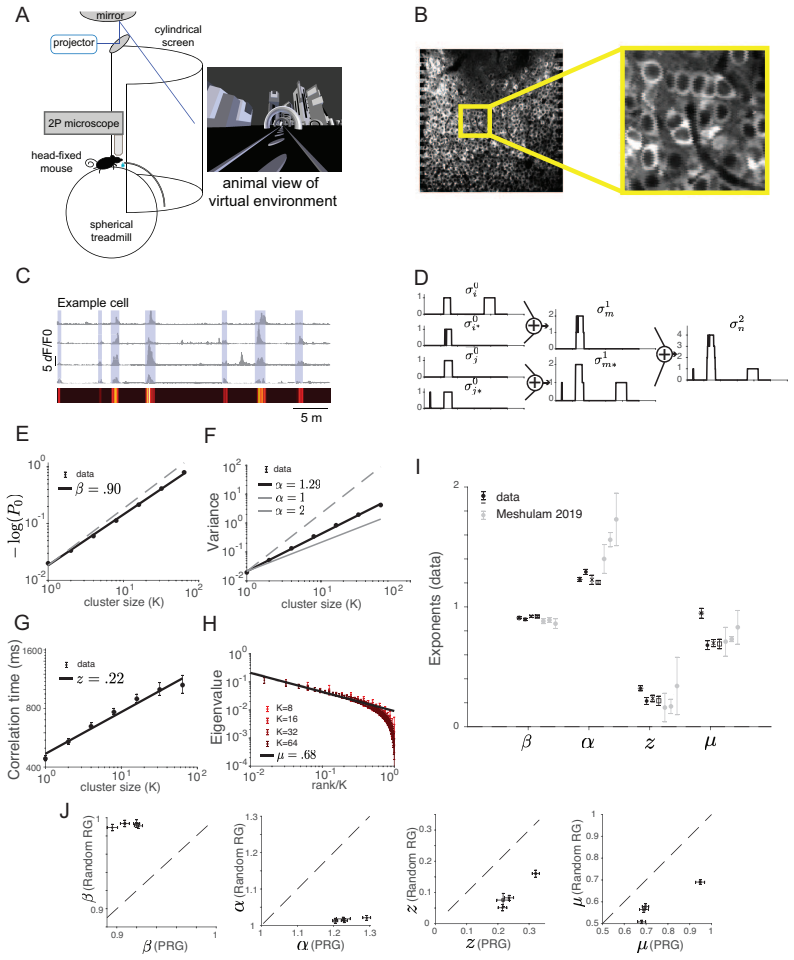
Summary. The manuscript applies the phenomenological renormalization group (PRG) of Meshulam et al. to calcium imaging recordings of CA1 place cells from mice navigating a 40 m virtual linear track, reproduces the previously reported power-law scaling, and shows that a random-pair control yields trivial exponents. It then builds a statistical model of place cells as independent Poisson processes with Gamma-distributed field counts and position-conditioned firing rates, and shows that PRG exponents obtained from simulated independent neurons match the empirical exponents. A simplified one-dimensional tile model is solved analytically in the homogeneous case, demonstrating that no exact power law emerges and that two scaling regimes meet at a cluster size equal to the number of simultaneously active units; adding heterogeneity in field sizes produces approximate power laws for all four PRG observables. The model predicts a systematic dependence of the exponents on population size and environment size, and subsampling the data confirms these trends. The authors conclude that PRG power-law scaling in hippocampal data does not constitute evidence for critical dynamics, because population heterogeneity alone can generate it.
Significance. If the conclusions hold, the paper has a clear conceptual payoff: it identifies a concrete non-critical mechanism—heterogeneous spatial tuning with independent neurons—for the PRG power laws observed in hippocampus, and it offers testable predictions (dependence on population size and environment size) that distinguish this account from scale-invariant critical dynamics. The homogeneous tile model is derived analytically rather than fitted, and the exponents in the detailed model are not free parameters fitted to the PRG outputs; they emerge from forward simulations with parameters calibrated to field counts, transient rates, and transient durations. The random-PRG control and the subsampling analyses strengthen the empirical side of the paper. The main risk is the untested conditional-independence assumption, which is load-bearing for the stronger "underlies" interpretation in the title and abstract, though not for the weaker claim that PRG scaling alone is not evidence for criticality.
major comments (4)
- [Results, Fig. 2] The explanatory claim that place-cell heterogeneity, rather than critical interactions, underlies the measured PRG power laws rests on the Gamma-Poisson independent place-field model being an accurate statistical null for the recorded population. The model assumes that, given position, every neuron is independent; real CA1 recordings are subject to global non-spatial modulations (running speed, theta, sharp-wave ripples, arousal, reward-related transients) that are not explained by position. If such non-spatial correlations are present in the binarized traces, the greedy correlation-based clustering of the PRG could be driven by them, and the agreement between model and data exponents in Fig. 2F could arise for reasons other than place-field overlap. The random-PRG control in Fig. 1J shows that correlation-based pairing matters, but it does not identify which correlations are responsible. Please add a control that incorporates a common latent gain or arousal process in the model, or an analysis showing that PRG pairing in the data is explained by spatial tuning rather than by non-spatial co-fluctuations; otherwise the title's "underlies" claim is not supported.
- [Results, Figs. 1I, 2F, and 4] The PRG exponents are reported as point estimates without error bars or confidence intervals, and the text does not state the number of K points used for each fit or the fit quality (e.g., R² or residuals). This makes the comparisons across mice, between data and model, and across subsampled conditions difficult to weigh. For example, the mouse-to-mouse spread in Fig. 1I and the model-versus-data agreement in Fig. 2F are presented visually, but there is no statistical measure of whether the differences are significant. Please provide per-session bootstrap errors for alpha, beta, z, and mu, and report fit quality for each power-law fit, at least in the supplement.
- [Results, Fig. 3, and End Matter] The heterogeneous tile model's smoothing effect is asserted as "likely due to the heterogeneous length scales across neurons" but is only demonstrated by simulation, with no quantitative criterion for "more closely matched to a power law." The central explanatory role of the simplified model requires a quantitative comparison: please report log-log residuals, R² values, or an information-theoretic comparison between the homogeneous and heterogeneous fits, and, if possible, provide an analytic argument for why heterogeneity removes the Nactive transition. Without this, the simplified model remains suggestive rather than established.
- [Results, Fig. 4C-D] The subsampling validation is not fully specified. It is unclear how "environment size fraction" is implemented in the data: is the track truncated to smaller spatial segments, or is the environment rescaled? Truncation may introduce boundary effects and alter running speed, reward structure, and lap structure, which the constant-speed model does not capture. The same ambiguity applies to the population-size subsampling, where the model curves and data curves may not use the same subsampling procedure. Please clarify the exact protocol and, if truncation is used, apply the same truncation protocol to the model before comparing with the data.
minor comments (7)
- [Abstract] There is a typo in the abstract: "heteregeneous" should be "heterogeneous."
- [End Matter, Table I] The Table I caption contains a typo: "repectively" should be "respectively."
- [End Matter, Eqs. (1)-(2)] The condition "For K ≥ ρ" uses an undefined symbol; it should be "K ≥ Nactive" consistently with the preceding text. Please define Nactive before its first use in Eq. (1).
- [Fig. 3 caption] The Fig. 3A caption refers to "K = ρ," but ρ is not defined in the main text or figure; please use Nactive for consistency with the End Matter.
- [Results, Fig. 1J] The statement that the random-PRG control gives "trivial scaling exponents for α ≈ 1 and β ≈ 1, as expected from combining uncorrelated Gaussian processes" is not derived; please provide a short justification or a citation.
- [References] Reference [25] is an unpublished conference abstract; if it is used to support a claim, please provide more details or remove it.
- [Discussion] The Discussion notes that the tile model uses heterogeneity in field size while the biological model uses heterogeneity in field number; a formal connection between these two forms of heterogeneity would strengthen the simplified model's relevance to the detailed simulations.
Circularity Check
PRG exponents emerge from forward simulation of an independently calibrated place-field model; no step reduces to its own inputs.
full rationale
The paper's derivation chain is self-contained. The PRG exponents in Figure 2F are not fitted parameters: they are computed by running the PRG on forward simulations of a Gamma-Poisson place-field model, with parameters (a, b, A, B, T in Table I) calibrated only to measured field counts and transient statistics, not to the PRG exponents themselves. The homogeneous tile model is derived analytically in the End Matter and explicitly shown to lack exact power-law scaling, providing an independent mathematical control. The heterogeneous tile model is a forward demonstration that heterogeneity smooths the transition, and the size-dependence predictions in Figure 4 are confirmed by subsampling the data rather than by refitting the model to the subsampled exponents. Self-citations [21, 22] support the statistical structure of CA1 place fields from separate empirical work, but the central logical claim—that independent, spatially heterogeneous units can produce PRG power laws—is demonstrated both by the simplified tile model without those citations and by the calibrated simulations, so the cited model is not serving as a circularly justified input. No equation is defined in terms of the target result, and no fitted quantity is renamed as a prediction.
Assumptions & free parameters
free parameters (5)
- Gamma shape a and rate b per mouse =
a=0.443..2.37, b=0.226..0.969 (Table I)
- Calcium transient peak rate A and background rate B =
A=2.00..2.75 Hz, B=0.002..0.010 Hz (Table I)
- Transient duration timescale T =
11.0..14.3 30 Hz bins (Table I)
- Heterogeneous tile model field size parameters l0, lr, ar, br =
l0=5 cm, lr=95 cm, ar=1, br=1
- Homogeneous tile model parameters l, L, N, v =
l=1 m, L=40 m, N=1000, v=30 cm/s
assumptions (5)
- domain assumption CA1 neurons are independent Poisson processes conditioned on spatial location, with Gamma-distributed field rates
- domain assumption In the tile model, the PRG maximal-correlation pairing is equivalent to summing adjacent place fields
- standard math Power-law exponents can be estimated by linear fits to log-transformed quantities over the largest K values
- domain assumption The eigenvalue spectrum fit should exclude r/K > 0.5 to capture larger eigenvalues
- ad hoc to paper The Gamma-Poisson field formation distribution with l0=5 cm, lr=95 cm, ar=1, br=1 suffices to represent heterogeneity in the simplified tile model
Cite this review
Pith. "Pith review of Place-cell heterogeneity underlies power-laws in hippocampal activity." pith.science (2026). https://pith.science/paper/JL6ZX3ID
@misc{pith2026250723030,
  author       = {Pith},
  title        = {Pith review of: Place-cell heterogeneity underlies power-laws in hippocampal activity},
  year         = {2026},
  howpublished = {\url{https://pith.science/paper/JL6ZX3ID}},
  note         = {Machine review of arXiv:2507.23030}
}
read the original abstract
Power-law scaling in coarse-grained data suggests critical dynamics, but the true source of this scaling often remains unclear. Here, we analyze neural activity recorded during spatial navigation, reproducing power-law scaling under a phenomenological renormalization group (PRG) procedure that clusters units by activity similarity. Such scaling was previously linked to criticality. Here, we show that the iterative nature of the procedure itself leads to the emergence of power laws when applied to heterogeneous, non-interacting units obeying spatially structured activity without requiring critical interactions. Furthermore, the scaling exponents produced by heteregeneous non-interacting units match the observed exponents in recorded neural data. A simplified version of the PRG further reveals how heterogeneity smooths transitions across scales, mimicking critical behavior. The resulting exponents depend systematically on system and population size, predictions confirmed by subsampling the data.
Figures

Figures from the paper (1 more)

Reference graph
Works this paper leans on
-
[1]
L. P. Kadanoff, Scaling laws for Ising models near Tc, Physics Physique Fizika 2, 263 (1966)
work page 1966
-
[2]
K. G. Wilson, Renormalization Group and Critical Phenom ena. I. Renormalization Group and the Kadanoff Scaling picture, Phys. Rev. B 4, 3174 (1971)
work page 1971
-
[3]
K. G. Wilson and J. Kogut, The renormalization group and t he ǫ expansion, Physics Reports 12, 75 (1974)
work page 1974
-
[4]
D. J. Amit and V. Mart ´ ın-Mayor,Field Theory, the Renormalization Group, and Critical Phen omena, 3rd ed. (World Scientific, Singapore, 2005)
work page 2005
-
[5]
L. Meshulam, J. L. Gauthier, C. D. Brody, D. W. Tank, and W. Bialek, Coarse–graining and hints of scaling in a population of 1000+ neurons (2018), arX iv:1812.11904 [physics.bio-ph]
arXiv 2018
-
[6]
L. Meshulam, J. L. Gauthier, C. D. Brody, D. W. Tank, and W. Bialek, Coarse graining, fixed points, and scaling in a large population of neurons, Phys. R ev. Lett. 123, 178103 (2019)
work page 2019
-
[7]
D. S. Berman, M. S. Klinger, and A. G. Stapleton, Bayesian renormalization, Mach. Learn.: Sci. Technol. 4, 045011 (2023)
work page 2023
-
[8]
E. Garuccio, M. Lalli, and D. Garlaschelli, Multiscale n etwork renormalization: Scale- invariance without geometry, Phys. Rev. Res. 5, 043101 (2023)
work page 2023
Show all 25 references
-
[9]
J. S. Sooter, A. J. Fontenele, C. Ly, A. K. Barreiro, and W. L. Shew, Cortex deviates from criticality during action and deep sleep: a temporal renorm alization group approach, bioRxiv , 2024.05.29.596499 (2024)
2024
-
[10]
D. J. Schwab, I. Nemenman, and P. Mehta, Zipf’s law and cr iticality in multivariate data without fine-tuning, Phys. Rev. Lett. 113, 068102 (2014)
2014
-
[11]
Aitchison, N
L. Aitchison, N. Corradi, and P. E. Latham, Zipf’s law ar ises naturally when there are under- 11 lying, unobserved variables, PLOS Computational Biology 12, 1 (2016)
2016
-
[12]
Touboul and A
J. Touboul and A. Destexhe, Power-law statistics and un iversal scaling in the absence of criticality, Physical Review E 95, 012413 (2017)
2017
-
[13]
Stringer, M
C. Stringer, M. Pachitariu, N. Steinmetz, M. Carandini , and K. D. Harris, High-dimensional geometry of population responses in visual cortex, Nature 571, 361 (2019)
2019
-
[14]
Faqeeh, S
A. Faqeeh, S. Osat, F. Radicchi, and J. P. Gleeson, Emerg ence of power laws in noncritical neuronal systems, Phys. Rev. E 100, 010401 (2019)
2019
-
[15]
R. J. Cubero, J. Jo, M. Marsili, Y. Roudi, and J. Song, Sta tistical criticality arises in most informative representations, Journal of Statistical Mech anics: Theory and Experiment 2019, 063402 (2019)
2019
-
[16]
M. C. Morrell, A. J. Sederberg, and I. Nemenman, Latent d ynamical variables produce sig- natures of spatiotemporal criticality in large biological systems, Phys. Rev. Lett. 126, 118302 (2021)
2021
-
[17]
Priesemann and O
V. Priesemann and O. Shriki, Can a time varying external drive give rise to apparent criticality in neural systems?, PLoS Comput. Biol. 14, e1006081 (2018)
2018
-
[18]
Ponce-Alvarez, M
A. Ponce-Alvarez, M. L. Kringelbach, and G. Deco, Criti cal scaling of whole-brain resting-state dynamics, Communications Biology 6, 627 (2023)
2023
-
[19]
G. B. Morales, S. di Santo, and M. A. Mu˜ noz, Quasiuniver sal scaling in mouse-brain neuronal activity stems from edge-of-instability critical dynamic s, Proceedings of the National Academy of Sciences 120, e2208998120 (2023)
2023
-
[20]
Nicoletti, S
G. Nicoletti, S. Suweis, and A. Maritan, Scaling and cri ticality in a phenomenological renor- malization group, Physical Review Research 2, 023144 (2020)
2020
-
[21]
P. D. Rich, H.-P. Liaw, and A. K. Lee, Large environments reveal the sta- tistical structure governing hippocampal representation s, Science 345, 814 (2014), https://www.science.org/doi/pdf/10.1126/science.1255635
2014 doi
-
[22]
J. S. Lee, J. J. Briguglio, J. D. Cohen, S. Romani, and A. K . Lee, The statistical structure of the hippocampal code for space as a function of time, conte xt, and value, Cell 183, 620 (2020). 12
2020
-
[23]
Hu and H
Y. Hu and H. Sompolinsky, The spectrum of covariance mat rices of randomly connected recurrent neuronal networks with linear dynamics, PLOS Com putational Biology 18, 1 (2022)
2022
-
[24]
Derrida, C
B. Derrida, C. Godr` eche, and I. Yekutieli, Scale-inva riant regimes in one-dimensional models of growing and coalescing droplets, Phys. Rev. A 44, 6241 (1991)
1991
-
[25]
ˇZivadinovi´ c, F
P. ˇZivadinovi´ c, F. Lombardi, G. Tkaˇ cik, and J. Csicsvari, Critical scaling exponents of hip- pocampal activity predict spatial memory performance (202 5), abstract presented by P. ˇZivadinovi´ c at Workshop on Collective Dynamics and Inform ation Processing in Neural Sys-...
2025
Reviewed August 6, 2026 · model on record in the stance chip above.
Discussion (0). Continue with ORCID to comment.