REVIEW 2 major objections 4 minor 1 cited by
Adaptive direct search algorithms for constrained optimization
T0 review · 2 major / 4 minor · reviewed 2026-08-06 · deepseek-v4-flash
Pith's one-line read This paper introduces ADS, a direct-search family whose exclusion-ball acceptance rule avoids both meshes and sufficient-decrease tests, and argues the same convergence theory applies.
desk verdict A genuinely new direct search framework whose convergence claim overreaches: the punctured space idea is neat, but Clarke stationarity requires an unstated density condition on poll directions. read the letter →
The pith
A machine-rendered reading of the paper's core claim, the machinery that carries it, and where it could break.
The reading
What carries the argument
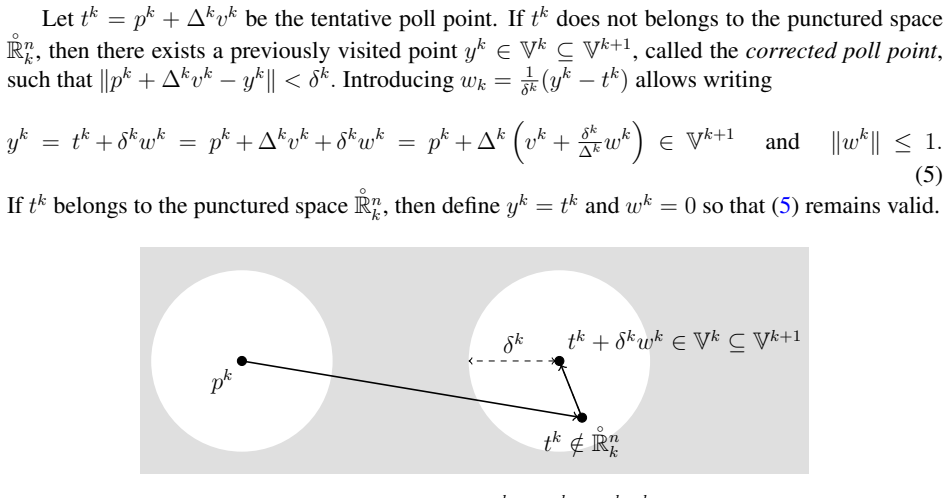
The central object is the punctured space $$ \overset{\circ}{\mathbb{R}}^n_k = \{x \in \mathbb{R}^n : \|x-y\| \ge \delta_k \text{ for all } y \in V_k\}, $$ the complement of the union of exclusion balls of radius $\delta_k$ around all points visited so far. It replaces the MADS mesh: trial points may be anywhere, but any point closer than $\delta_k$ to a past evaluation is skipped. The convergence proof's key step is a correction argument: a poll point $p_k + \Delta_k v_k$ rejected for falling inside an exclusion ball is replaced by a visited point $y_k = p_k + \Delta_k(v_k + (\delta_k/\Delta_k) w_k)$ with $\|w_k\| \le 1$; since the update rules (2)-(3) make $\delta_k/\Delta_k \to 0$, the corrected point tracks the same direction, and the inequality $f(y_k) \ge f(p_k)$ transfers to the Clarke-Jahn derivative at the limit.
What would settle it
Run ADS with an empty search step on the compact box $[-1,1]^2$ with $f(x,y)=-x+y^2$, starting at the origin with $\Delta_0=1/2$ and $\delta_0=1/2$, using the update rule (2) and poll sets $D_k=\{e_2,-e_2,w_k,-w_k\}$, where $w_k=(\Delta_k^3,\sqrt{1-\Delta_k^6}) \to e_2$. Every poll point then fails to improve, so $x_k$ stays at $0$, $\delta_k \to 0$, and the only accumulated refining directions are $\pm e_2$. At $0$ the Clarke-Jahn derivative along $e_1$ is $-1$, so $0$ is not Clarke-stationary even though Theorem 4.4's inequality holds for the refining directions; this shows the stationarity conclusion needs an explicit density assumption on poll directions.
Extended reading notes
Core claim
The central claim is that the punctured-space acceptance rule is enough to inherit the convergence theory of directional direct search without a mesh or a sufficient-decrease test. For a refining subsequence of unsuccessful incumbents with limit $\hat{x}$ and a refining direction $\hat{v}$ belonging to the hypertangent cone at $\hat{x}$ (the directions that remain feasible under small perturbations), Theorem 4.4 gives $f^\circ(\hat{x}; \hat{v}) \ge 0$ whenever $f$ is Lipschitz near $\hat{x}$, where $f^\circ$ is the Clarke-Jahn directional derivative restricted to the feasible set. The paper presents this as the basis for concluding that a refining subsequence converges to a Clarke-stationary point. Theorem 4.6 then constructs an ADS instance whose parameters and sequence of trial points coincide with OrthoMADS, and the same argument covers QRMADS, so those established mesh-based methods fall inside the new class.
Load-bearing premise
The load-bearing premise is an unstated density condition: the poll directions used on unsuccessful iterations must eventually cover the whole hypertangent cone at the limit point. The proof only shows that the Clarke-Jahn derivative is nonnegative along one accumulated poll direction; that single inequality does not imply Clarke stationarity, and the algorithm statement does not force the needed directional coverage.
Editorial extensions
If this is right
- Trial points may be generated anywhere in the variable space; the only restriction is that an improving search point inside an exclusion ball does not immediately win, but becomes the poll center and is promoted if the poll fails.
- Because Theorem 4.1 forces $\delta_k \to 0$, a user can treat $\delta_k$ as a precision knob and stop when the exclusion radius falls below a chosen threshold, with the guarantee that infinitely many refinements occur otherwise.
- OrthoMADS and QRMADS become special cases of ADS, so a single implementation and a single convergence analysis cover both mesh-based and mesh-free direct search.
- In the reported experiments, ADS with a quadratic-model search step meets or exceeds the performance of MADS and SDDS on smooth and nonsmooth Moré-Wild problems, constrained CUTEst problems, and the SOLAR10 and Simplified-Wing blackboxes, in most cases using fewer evaluations because rejected poll points are skipped.
Reading between the lines
- The Section 4 conclusion of Clarke stationarity depends on an unstated assumption that the poll directions at unsuccessful iterations become asymptotically dense in the hypertangent cone; Algorithm 1 permits positive spanning sets for which this fails, so the theorem as written supports nonnegative derivative only along individual refining directions.
- Because the punctured space already economizes evaluations near past points, choosing $\delta_k$ to scale with an estimated noise level could give ADS built-in robustness to noisy blackboxes, an extension the paper does not explore.
- The corrected-poll-point technique is transferable: the same $\delta_k/\Delta_k \to 0$ accounting could prove convergence for other relaxed acceptance rules, such as probabilistic or filter-based direct search, without requiring a mesh.
- The update rules cited for granular and integer variables suggest that a mesh-free ADS variant for mixed-integer problems is a plausible next step, though the paper only mentions those rules and does not develop such a variant.
Editorial analysis
A structured set of objections, weighed in public.
Referee Report
Summary. The paper proposes Adaptive Direct Search (ADS), a new family of directional direct-search methods for constrained blackbox optimization. Instead of forcing trial points onto a mesh (MADS) or requiring a sufficient decrease (SDDS), ADS evaluates points in a 'punctured space' obtained by removing δ_k-balls around previously visited points and accepts any strict improvement. Algorithm 1 defines the opportunistic search/poll/update structure. The theoretical section claims that under compactness of the level set, every instance generates a refining subsequence converging to a Clarke-stationary point, with Theorem 4.4 proving nonnegative Clarke derivatives along refining directions; Theorem 4.6 shows that OrthoMADS and QRMADS are instances of ADS. Computational experiments compare ADS with MADS and SDDS on the Moré-Wild set, constrained CUTEst problems, SOLAR10, and a simplified-wing MDO problem.
Significance. The punctured-space acceptance rule is an attractive and original idea that genuinely sits between mesh-based and sufficient-decrease methods, and the numerical results suggest it can be practically competitive. The construction of Section 4.2, showing that OrthoMADS and QRMADS are instances with identical trial-point sequences, is elegant and is the strongest part of the paper. The claimed convergence theorem, however, is currently overbroad: it is only valid for instances whose poll directions satisfy an asymptotic density condition in the hypertangent cone, which Algorithm 1 does not require. If that condition is added and the proof of Theorem 4.1 is repaired, the theoretical contribution would be a useful and correct generalization of MADS-style convergence analysis.
major comments (2)
- [Section 4, Theorem 4.4] The central claim that an instance of ADS generates a refining subsequence converging to a Clarke-stationary point is not established. Theorem 4.4 only proves f^∘(x̂; v̂) ≥ 0 for a single refining direction v̂, whereas Clarke stationarity requires f^∘(x̂; v) ≥ 0 for every v in the hypertangent cone T_H^Ω(x̂). Algorithm 1 does not constrain D_k beyond forming the poll set; Section 3.3 states that directions are 'typically chosen to form a positive spanning set,' so a fixed set D_k = D is allowed. This is not a benign omission: for f(x,y) = max{-x,-y,-x-y} on R^2 with D = {e1, e2, (-e1+e2)/√2, (-e1-e2)/√2} and initial point (0,0), the Clarke subdifferential at 0 is conv{(0,-1),(-1,0),(-1,-1)}, hence f^∘(0;(1,1)) = -1 < 0 and 0 is not Clarke-stationary, while f^∘(0;d) ≥ 0 for all d ∈ D, so every poll is unsuccessful and the constant sequence is a refining subsequence. The statement becomes correct if one adds the standard MADS-type hypothesis that the poll directions over unsuccessful iterations are asymptotically dense in the hypertangent cone, and this hypothesis should be explicitly stated and used to pass from Theorem 4.4 to stationarity.
- [Section 4, Theorem 4.1] The proof of Theorem 4.1 is not valid as written. From finiteness of S_ε it does not follow that every sufficiently large iteration is unsuccessful, because successful iterations with δ_k < ε can increase δ_k back above ε; the first scenario in the proof is therefore unjustified. In the second scenario, the point that is guaranteed to belong to the punctured space at a successful iteration k is the newly accepted point x_{k+1}, not the incumbent x_k, so inequality (4) uses the wrong index. The result is likely repairable by a compactness argument applied to the accepted points and to decreasing thresholds for δ_k, but the present proof does not establish the stated limit, which is load-bearing for Corollary 4.2.
minor comments (4)
- [Sections 3.1 and 3.2] There are several typos: 'not to close' should be 'not too close' in Section 3.1, and Section 3.2 contains 'opportuinistic', 'unsuccesful', and 'non-opportuinistic'; Lemma 4.5 contains 'by by using'.
- [Section 4.1] The terms 'Clark-Jahn stationary' and 'Clarke-stationary' are used interchangeably; the intended notion should be defined once and used consistently throughout.
- [Section 4.1, proof of Theorem 4.4] The proof of Theorem 4.4 invokes 'the requirement that lim_{k∈L} δ_k/Δ_k = 0', but this is not stated as an explicit standing assumption; it follows from the update rule (2)-(3) together with Theorem 4.1 only after additional argument, so the dependence should be stated clearly before the theorem.
- [Section 5, Table 3] The column labeled 'Search efficiency' is not defined; the formula used to compute the listed percentages should be provided so the reader can interpret the comparison.
Circularity Check
No significant circularity: the ADS convergence proof and the OrthoMADS containment theorem are derived in-paper from standard MADS lemmas, not assumed; the Section 4 Clarke-stationarity claim has a correctness gap (fixed poll sets need not yield dense refining directions), but this is not a circularity.
full rationale
Section 4.1 opens with "The convergence analysis of Algorithm 1 follows the same structure as the one for MADS [8, 10]" and the proof of Theorem 4.4 invokes "[8, Proposition 3.9]" to justify replacing the limit over x,t by a limit over v approaching v-hat. These are self-citations to the authors' prior MADS work, but they are not load-bearing circularity: Proposition 3.9 is a published standard result in the same literature, and the surrounding argument (corrected poll points, delta_k/Delta_k converging to 0, Lipschitz continuity) is carried out in the paper itself. Theorem 4.6, claiming OrthoMADS as an ADS instance, is proven by induction using Lemma 4.5 and Proposition 4.4, which are established in the paper rather than assumed. The punctured-space acceptance rule is a new construction, not a renamed existing result, and the computational benchmarks are external. The main substantive weakness is that the introductory claim of Clarke-stationarity ("the algorithm generates a refining subsequence converging to a Clarke-stationary point") is stronger than Theorem 4.4, which only proves f^circ(x-hat; v-hat) >= 0 for individual refining directions; with a fixed poll-direction set (allowed by Section 3.3, since directions are only "typically" positive spanning) those directions need not cover the hypertangent cone. This is an omitted assumption and an incorrect inference, i.e., a correctness risk, not a circular dependence of the conclusion on its inputs. No circular step is exhibited.
Assumptions & free parameters
assumptions (5)
- domain assumption Assumption 1: the set L, the closure of {x in Omega : f(x) <= f(x0)}, is compact.
- domain assumption Lipschitz continuity of f near the refined point.
- standard math Existence of the hypertangent cone and use of Jahn's Clarke derivative for constrained sets.
- standard math Use of [8, Proposition 3.9] to pass from one-sided directional differences to the Clarke derivative.
- ad hoc to paper Unstated density of refining directions in the hypertangent cone for the Clarke-stationarity conclusion.
Cite this review
Pith. "Pith review of Adaptive direct search algorithms for constrained optimization." pith.science (2026). https://pith.science/paper/AO4LKJWB
@misc{pith2026250723054,
  author       = {Pith},
  title        = {Pith review of: Adaptive direct search algorithms for constrained optimization},
  year         = {2026},
  howpublished = {\url{https://pith.science/paper/AO4LKJWB}},
  note         = {Machine review of arXiv:2507.23054}
}
read the original abstract
Two families of directional direct search methods have emerged in derivative-free and blackbox optimization (DFO and BBO), each based on distinct principles: Mesh Adaptive Direct Search (MADS) and Sufficient Decrease Direct Search (SDDS). MADS restricts trial points to a mesh and accepts any improvement, ensuring none are missed, but at the cost of restraining the placement of trial points. SDDS allows greater freedom by evaluating points anywhere in the space, but accepts only those yielding a sufficient decrease in the objective function value, which may lead to discarding improving points. This work introduces a new class of methods, Adaptive Direct Search (ADS), which uses a novel acceptance rule based on the so-called punctured space, avoiding both meshes and sufficient decrease conditions. ADS enables flexible search while addressing the limitations of MADS and SDDS, and retains the theoretical foundations of directional direct search. Computational results in constrained and unconstrained settings highlight its performance compared to both MADS and SDDS.
Figures
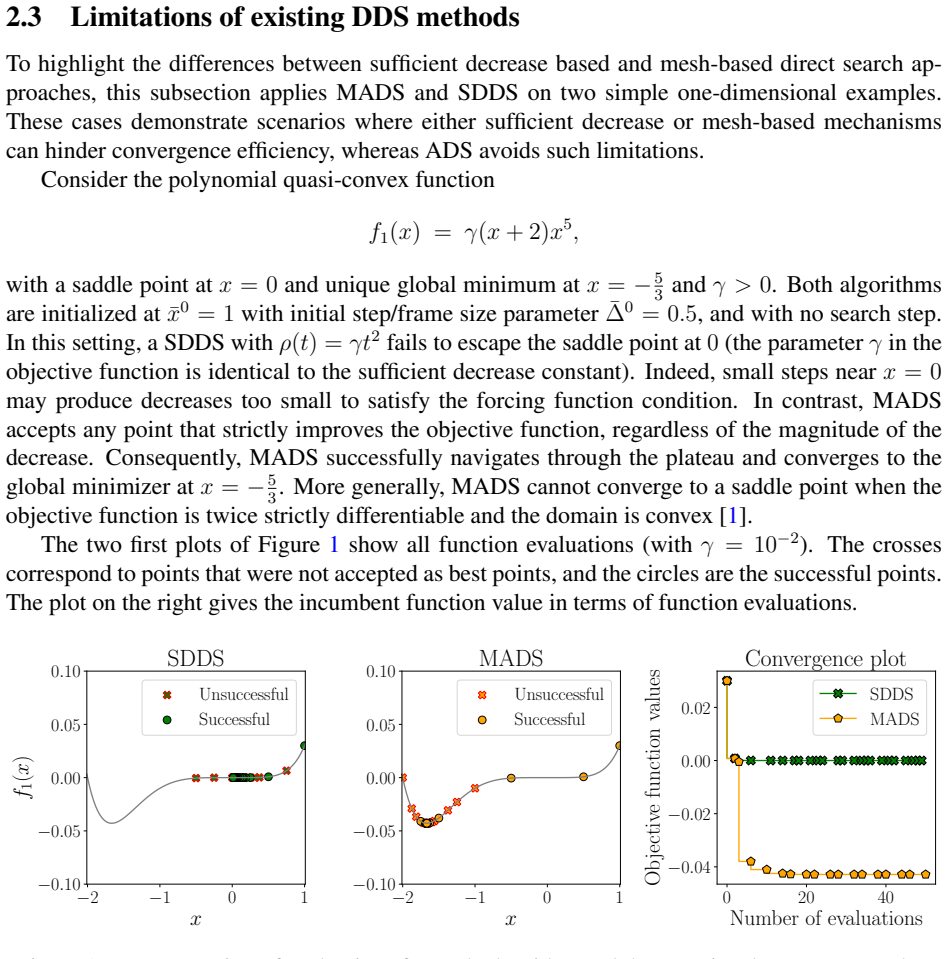


Figures from the paper (7 more)




Forward citations
Cited by 1 Pith paper
-
Adaptive direct search algorithms with relaxable and quantifiable constraints
ADS-PB extends mesh-free adaptive direct search to constrained blackbox optimization by incorporating a progressive barrier mechanism, with convergence guarantees and improved practical performance over mesh-based methods.
Reference graph
Works this paper leans on
-
[1]
M.A. Abramson and C. Audet. Convergence of Mesh Adaptive Direct Search to Second-Order Sta- tionary Points. SIAM Journal on Optimization, 17(2):606–619, 2006. doi: 10.1137/050638382. URL https://dx.doi.org/10.1137/050638382
-
[2]
M.A. Abramson, C. Audet, J.E. Dennis, Jr., and S. Le Digabel. OrthoMADS: A Deterministic MADS Instance with Orthogonal Directions. SIAM Journal on Optimization , 20(2):948–966, 2009. doi: 10.1137/080716980. URL https://dx.doi.org/10.1137/080716980
- [3]
-
[4]
N. Andr ´es-Thi´o, C. Audet, M. Diago, A.E. Gheribi, S. Le Digabel, X. Lebeuf, M. Lemyre Garneau, and C. Tribes. solar: A solar thermal power plant simulator for blackbox optimization benchmarking. Technical Report G-2024-37, Les cahiers du GERAD, 2025. URL https://dx.doi.org/10. 1007/s11081-024-09952-x . To appear in Optimization and Engineering
work page 2024
- [5]
-
[6]
C. Audet. A survey on direct search methods for blackbox optimization and their applications. In P.M. Pardalos and T.M. Rassias, editors, Mathematics without boundaries: Surveys in inter- disciplinary research , chapter 2, pages 31–56. Springer, New York, NY , 2014. doi: 10.1007/ 978-1-4939-1124-0. URL http://www.springer.com/mathematics/analysis/book/ 97...
work page 2014
-
[7]
C. Audet and J.E. Dennis, Jr. Analysis of Generalized Pattern Searches. SIAM Journal on Optimiza- tion, 13(3):889–903, 2003. doi: 10.1137/S1052623400378742. URL https://dx.doi.org/ 10.1137/S1052623400378742
-
[8]
C. Audet and J.E. Dennis, Jr. Mesh Adaptive Direct Search Algorithms for Constrained Optimization. SIAM Journal on Optimization , 17(1):188–217, 2006. doi: 10.1137/040603371. URL https:// dx.doi.org/10.1137/040603371
Show all 51 references
-
[9]
Audet and J.E
C. Audet and J.E. Dennis, Jr. A Progressive Barrier for Derivative-Free Nonlinear Programming.SIAM Journal on Optimization, 20(1):445–472, 2009. doi: 10.1137/070692662. URL https://dx.doi. org/10.1137/070692662. 26
2009 doi
-
[10]
Audet and W
C. Audet and W. Hare. Derivative-Free and Blackbox Optimization . Springer Series in Oper- ations Research and Financial Engineering. Springer, Cham, Switzerland, 2017. doi: 10.1007/ 978-3-319-68913-5. URL https://dx.doi.org/10.1007/978-3-319-68913-5
2017 doi
-
[11]
Audet and C
C. Audet and C. Tribes. Mesh-based Nelder-Mead algorithm for inequality constrained optimization. Computational Optimization and Applications , 71(2):331–352, 2018. doi: 10.1007/s10589-018-0016-0. URL https://link.springer.com/article/10.1007/ s10589-018-0016-0
2018 doi
-
[12]
Audet, V
C. Audet, V . B ´echard, and S. Le Digabel. Nonsmooth optimization through Mesh Adaptive Direct Search and Variable Neighborhood Search. Journal of Global Optimization , 41(2):299– 318, 2008. doi: 10.1007/s10898-007-9234-1. URL https://dx.doi.org/10.1007/ s10898-007-9234-1
2008 doi
-
[13]
Audet, S
C. Audet, S. Le Digabel, and C. Tribes. The Mesh Adaptive Direct Search Algorithm for Granu- lar and Discrete Variables. SIAM Journal on Optimization , 29(2):1164–1189, 2019. doi: 10.1137/ 18M1175872. URL https://dx.doi.org/10.1137/18M1175872
2019 doi
-
[14]
Audet, S
C. Audet, S. Le Digabel, V . Rochon Montplaisir, and C. Tribes. Algorithm 1027: NOMAD ver- sion 4: Nonlinear optimization with the MADS algorithm. ACM Transactions on Mathematical Soft- ware, 48(3):35:1–35:22, 2022. doi: 10.1145/3544489. URL https://dx.doi.org/10.1145/ 3544489
2022 doi
-
[15]
analysis of direct searches for discontinuous functions
C. Audet, P.-Y . Bouchet, and L. Bourdin. Counterexample and an additional revealing poll step for a result of “analysis of direct searches for discontinuous functions”. Mathematical Programming, 208(1):411–424, 2024. doi: 10.1007/s10107-023-02042-3. URL https://doi.org/10.100...
2024 doi
-
[16]
Audet, W
C. Audet, W. Hare, and C. Tribes. Benchmarking constrained, multi-objective and surrogate-assisted derivative-free optimization methods. Technical Report G-2025-36, Les cahiers du GERAD, 2025. URL https://www.gerad.ca/en/papers/G-2025-36
2025
-
[17]
Berahas, O
A.S. Berahas, O. Sohab, and L.N. Vicente. Full-low evaluation methods for derivative-free opti- mization. Optimization Methods and Software, 38(2):386–411, 2023. doi: 10.1080/10556788.2022. 2142582. URL https://doi.org/10.1080/10556788.2022.2142582
2023
-
[18]
Brilli, M
A. Brilli, M. Kimiaei, G. Liuzzi, and S. Lucidi. Worst case complexity bounds for linesearch- type derivative-free algorithms. Journal of Optimization Theory and Applications , 203(1): 419–454, 2024. doi: 10.1007/s10957-024-02519-x. URL https://doi.org/10.1007/ s10957-024-02519-x
2024 doi
-
[19]
F.H. Clarke. Optimization and Nonsmooth Analysis . John Wiley and Sons, New York, 1983. URL http://www.ec-securehost.com/SIAM/CL05.html. Reissued in 1990 by SIAM Publica- tions, Philadelphia, as V ol. 5 in the series Classics in Applied Mathematics
1983
-
[20]
Conn and S
A.R. Conn and S. Le Digabel. Use of quadratic models with mesh-adaptive direct search for con- strained black box optimization. Optimization Methods and Software , 28(1):139–158, 2013. doi: 10.1080/10556788.2011.623162. URL https://dx.doi.org/10.1080/10556788.2011. 623162. 27
2013
-
[21]
A.R. Conn, K. Scheinberg, and L.N. Vicente. Introduction to Derivative-Free Optimization. MOS- SIAM Series on Optimization. SIAM, Philadelphia, 2009. ISBN 978-0-898716-68-9. doi: 10.1137/1. 9780898718768. URL https://dx.doi.org/10.1137/1.9780898718768
2009 doi
-
[22]
Cust ´odio and J.F.A
A.L. Cust ´odio and J.F.A. Madeira. GLODS: Global and Local Optimization using Direct Search. Journal of Global Optimization, 62(1):1–28, 2015. doi: 10.1007/s10898-014-0224-9. URL https: //dx.doi.org/10.1007/s10898-014-0224-9"
2015 doi
-
[23]
Cust ´odio, K
A.L. Cust ´odio, K. Scheinberg, and L.N. Vicente. Methodologies and software for derivative-free opti- mization. In T. Terlaky, M.F. Anjos, and S. Ahmed, editors,Advances and Trends in Optimization with Engineering Applications, MOS-SIAM Book Series on Optimization, chapter 37...
-
[24]
C. Davis. Theory of positive linear dependence. American Journal of Mathematics, 76:733–746, 1954. URL http://www.ams.org/mathscinet-getitem?mr=16:211e
1954
-
[25]
De Leone, M
R. De Leone, M. Gaudioso, and L. Grippo. Stopping criteria for linesearch methods without derivatives. Mathematical Programming, 30(3):285–300, 1984. doi: 10.1007/BF02591934. URL https://dx.doi.org/10.1007/BF02591934
1984 doi
-
[26]
Diouane, V
Y . Diouane, V . Picheny, R. Le Riche, and A. Scotto Di Perrotolo. TREGO: a trust-region framework for efficient global optimization. Journal of Global Optimization , pages 1–23, 2022. doi: 10.1007/ s10898-022-01245-w. URL https://dx.doi.org/10.1007/s10898-022-01245-w
2022 doi
-
[27]
Dzahini, F
K.J. Dzahini, F. Rinaldi, C.W. Royer, and D. Zeffiro. Direct-search methods in the year 2025: Theoretical guarantees and algorithmic paradigms. EURO Journal on Computational Optimiza- tion, 13:100110, 2025. ISSN 2192-4406. doi: https://doi.org/10.1016/j.ejco.2025.100110. URL h...
2025
-
[28]
Fasano, G
G. Fasano, G. Liuzzi, S. Lucidi, and F. Rinaldi. A Linesearch-Based Derivative-Free Approach for Nonsmooth Constrained Optimization. SIAM Journal on Optimization , 24(3):959–992, 2014. doi: 10.1137/130940037. URL https://dx.doi.org/10.1137/130940037
2014 doi
-
[29]
Fermi and N
E. Fermi and N. Metropolis. Numerical solution of a minimum problem. Los Alamos Unclassified Report LA–1492, Los Alamos National Laboratory, Los Alamos, USA, 1952
1952
-
[30]
Fletcher and S
R. Fletcher and S. Leyffer. Nonlinear programming without a penalty function. Mathematical Pro- gramming, Series A, 91:239–269, 2002. doi: 10.1007/s101070100244. URL https://dx.doi. org/10.1007/s101070100244
2002 doi
-
[31]
Garmanjani and L.N
R. Garmanjani and L.N. Vicente. Smoothing and worst-case complexity for direct-search methods in nonsmooth optimization. IMA Journal of Numerical Analysis , 33:1008–1028, 2013. doi: 10.1093/ imanum/drs027. URL https://dx.doi.org/10.1093/imanum/drs027
2013 doi
-
[32]
Gould, D
N.I.M. Gould, D. Orban, and Ph.L. Toint. CUTEst: a Constrained and Unconstrained Testing Envi- ronment with safe threads for mathematical optimization. Computational Optimization and Applica- tions, 60(3):545–557, 2015. doi: 10.1007/s10589-014-9687-3. URL https://dx.doi.org/10...
2015 doi
-
[33]
Hansen and A
N. Hansen and A. Ostermeier. Completely Derandomized Self-Adaptation in Evolution Strategies. Evolutionary Computation, 9(2):159–195, 2001. doi: 10.1162/106365601750190398. URL https: //dx.doi.org/10.1162/106365601750190398
2001 doi
-
[34]
J. Jahn. Introduction to the Theory of Nonlinear Optimization . Springer, Berlin, 1994. URL http: //www.springer.com/mathematics/book/978-3-540-49378-5
1994
-
[35]
Jones, C.D
D.R. Jones, C.D. Perttunen, and B.E. Stuckman. Lipschitzian optimization without the Lipschitz constant. Journal of Optimization Theory and Application , 79(1):157–181, 1993. doi: 10.1007/ BF00941892. URL https://dx.doi.org/10.1007/BF00941892
1993 doi
-
[36]
Kolda, R.M
T.G. Kolda, R.M. Lewis, and V . Torczon. Optimization by direct search: New perspectives on some classical and modern methods.SIAM Review, 45(3):385–482, 2003. doi: 10.1137/S003614450242889. URL https://dx.doi.org/10.1137/S003614450242889
2003 doi
-
[37]
Larson, M
J. Larson, M. Menickelly, and S.M. Wild. Derivative-free optimization methods. Acta Numerica, 28: 287–404, 2019. doi: 10.1017/S0962492919000060. URL https://dx.doi.org/10.1017/ S0962492919000060
2019 doi
-
[38]
Le Digabel and S.M
S. Le Digabel and S.M. Wild. A taxonomy of constraints in black-box simulation-based optimization. Optimization and Engineering , 25(2):1125–1143, 2024. doi: 10.1007/s11081-023-09839-3. URL https://dx.doi.org/10.1007/s11081-023-09839-3
2024 doi
-
[39]
Liuzzi and S
G. Liuzzi and S. Lucidi. Worst-case complexity analysis of derivative-free methods for multi-objective optimization. Technical Report 2505.17594, arXiv, 2025. URL https://arxiv.org/abs/ 2505.17594
2025 arXiv
-
[40]
Lucidi and M
S. Lucidi and M. Sciandrone. On the Global Convergence of Derivative-Free Methods for Un- constrained Optimization. SIAM Journal on Optimization , 13(1):97–116, 2002. doi: 10.1137/ S1052623497330392. URL https://dx.doi.org/10.1137/S1052623497330392
2002 doi
-
[41]
Mor ´e and S.M
J.J. Mor ´e and S.M. Wild. Benchmarking Derivative-Free Optimization Algorithms. SIAM Journal on Optimization, 20(1):172–191, 2009. doi: 10.1137/080724083. URL https://dx.doi.org/10. 1137/080724083
2009 doi
-
[42]
Oeuvray and M
R. Oeuvray and M. Bierlaire. A new derivative-free algorithm for the medical image registration problem. International Journal of Modelling and Simulation, 2007
2007
-
[43]
M.J.D. Powell. A Direct Search Optimization Method That Models the Objective and Constraint Functions by Linear Interpolation. In S. Gomez and J.-P. Hennart, editors, Advances in Opti- mization and Numerical Analysis , volume 275 of Mathematics and Its Applications , pages 51–...
1994 doi
-
[44]
Rockafellar
R.T. Rockafellar. Generalized directional derivatives and subgradients of nonconvex functions. Cana- dian Journal of Mathematics, 32(2):257–280, 1980
1980
-
[45]
Tfaily, Y
A. Tfaily, Y . Diouane, N. Bartoli, and M. Kokkolaras. Bayesian optimization with hidden constraints for aircraft design. Structural and Multidisciplinary Optimization , 67(7):123, 2024. doi: 10.1007/ s00158-024-03833-8. URL https://dx.doi.org/10.1007/s00158-024-03833-8 . 29
2024 doi
-
[46]
V . Torczon. On the convergence of pattern search algorithms. SIAM Journal on Optimization , 7 (1):1–25, 1997. doi: 10.1137/S1052623493250780. URL https://dx.doi.org/10.1137/ S1052623493250780
1997 doi
-
[47]
Tribes, J.-F
C. Tribes, J.-F. Dub ´e, and J.-Y . Tr´epanier. Decomposition of multidisciplinary optimization prob- lems: formulations and application to a simplified wing design. Engineering Optimization, 37(8): 775–796, 2005. doi: 10.1080/03052150500289305. URL https://dx.doi.org/10.1080/...
2005 doi
-
[48]
Van Dyke and T.J
B. Van Dyke and T.J. Asaki. Using QR Decomposition to Obtain a New Instance of Mesh Adaptive Direct Search with Uniformly Distributed Polling Directions. Journal of Optimization Theory and Applications, 159(3):805–821, 2013. doi: 10.1007/s10957-013-0356-y. URL https://dx.doi. ...
2013 doi
-
[49]
L.N. Vicente. Worst case complexity of direct search. EURO Journal on Computational Optimization, 1(1):143–153, 2013. doi: 10.1007/s13675-012-0003-7. URL https://dx.doi.org/10.1007/ s13675-012-0003-7
2013 doi
-
[50]
M.H. Wright. Nelder, Mead, and the Other Simplex Method. In M. Gr ¨otschel, editor, Docu- menta Mathematica Extra Volume: Optimization Stories , pages 271–276. Journal der Deutschen Mathematiker-Vereinigung Gegr¨undet 1996, Berlin, 2012. URL http://www.math.uiuc.edu/ documenta...
1996
-
[2017]
URL http://www.mat.uc.pt/˜lnv/papers/dfo-survey.pdf
Reviewed August 6, 2026 · model on record in the stance chip above.
Discussion (0). Continue with ORCID to comment.