REVIEW 4 major objections 6 minor 3 cited by
X-NeMo: Expressive Neural Motion Reenactment via Disentangled Latent Attention
T0 review · 4 major / 6 minor · reviewed 2026-08-06 · deepseek-v4-flash
Pith's one-line read X-NeMo claims that a compact 1D motion vector, injected through cross-attention, animates portraits without leaking the driver's identity.
desk verdict Well-engineered portrait animation paper with a plausible architecture, but the headline SOTA claim rides on a self-collected benchmark with no error bars and uneven baseline tuning. read the letter →
The pith
A machine-rendered reading of the paper's core claim, the machinery that carries it, and where it could break.
The reading
What carries the argument
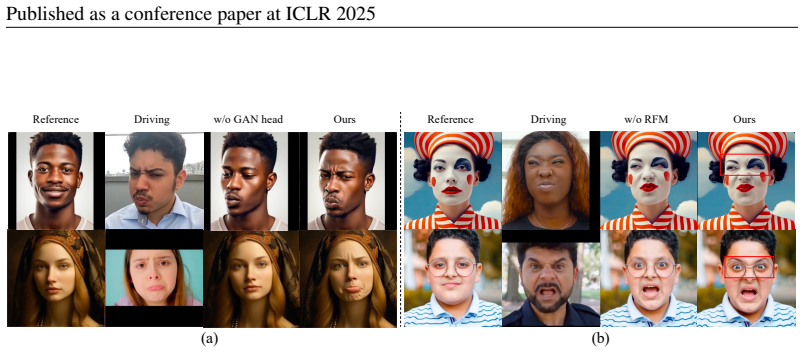
The load-bearing object is the implicit 1D latent motion descriptor f_mot, produced by a motion encoder E_mot (a feature-alignment backbone with attention layers and MLP heads) from the driving image. Its compactness is meant to act as a low-pass information bottleneck that excludes 2D structural cues; motion is injected into the diffusion U-Net through newly inserted cross-attention layers, so no spatially aligned additive offset reaches the backbone. A dual GAN decoder head (a StyleGAN-style generator) co-trained with image-level losses guides the descriptor toward fine-grained expressions, while spatial and color augmentations and 30% reference-feature masking push identity and motion apart. A relative translation and scale triplet (Δx, Δy, scale ratio) accounts for head motion lost by face-centered cropping.
What would settle it
Train a linear or shallow classifier on extracted motion descriptors f_mot from many identities and test whether the driver's identity can be predicted above chance; if accuracy is well above chance, the 1D code carries identity information, contradicting the claimed identity-agnostic property. A complementary check would measure the identity similarity between generated frames and the driving identity in cross-reenactment on a large benchmark; values rivaling the reference identity similarity would indicate leakage through the motion path.
Extended reading notes
Core claim
X-NeMo's central claim is that a structure-agnostic motion control path, built on a 1D identity-agnostic latent motion descriptor, can drive a pretrained latent diffusion model to perform expressive zero-shot portrait animation while preserving the reference identity. The authors argue that explicit motion signals such as landmarks and synthetic cross-identity images encode the driving identity's structure, and that ControlNet-like additive spatial guidance lets the U-Net shortcut semantic correspondence by mimicking 2D layout, both causing identity leakage. Their remedy is an end-to-end motion encoder that outputs a 512-dimensional global latent, cross-attention injection into the U-Net, color and spatial augmentation of driving frames, reference-feature masking, and a jointly trained GAN head that supervises the latent with image-level losses. On their benchmark, the method reports the best L1, SSIM, LPIPS, ID-SIM, AED/APD, and EMO-SIM among the methods compared.
Load-bearing premise
The method's disentanglement rests on the assumption that a 1D bottlenecked latent vector, even with augmentations and a GAN decoder, cannot encode identity-specific spatial structure; if the motion encoder packs identity information into that vector, identity leakage will persist despite the architecture.
Editorial extensions
If this is right
- Cross-identity reenactment should preserve the reference identity even when the driving and reference faces differ strongly in structure, style, and appearance.
- The motion descriptor supports latent motion interpolation and video outpainting, so it can serve as a unified motion representation beyond frame-to-frame animation.
- End-to-end training without pretrained motion detectors means the system can improve as more diverse and expressive video data become available.
- Classifier-free guidance that uses the reference's own motion as a negative prompt steers inference toward more accurate expression transfer.
- Replacing spatially aligned additive control with cross-attention to a global latent may be a general recipe for reducing conditional leakage in diffusion models.
Reading between the lines
- If the 1D bottleneck truly blocks identity, the same structure-agnostic cross-attention control could generalize to full-body or object animation, where 2D pose conditions typically leak source identity or structure.
- The identity-agnostic claim is directly testable: a probe classifier trained on extracted motion descriptors should not predict the driver's identity above chance level.
- The paper's framing implies that residual identity leakage in any diffusion animator can be diagnosed by asking whether its motion control path carries spatial structure, and that such leakage may be reduced by compressing the motion condition into a global latent.
Editorial analysis
A structured set of objections, weighed in public.
Referee Report
Summary. The paper proposes X-NeMo, a zero-shot diffusion-based portrait animation method. It introduces a 1D latent motion descriptor extracted from driving frames by a motion encoder and injected into a Stable-Diffusion U-Net via newly inserted cross-attention layers, alongside a reference network for appearance conditioning and temporal modules for video consistency. Training is self-supervised on talking-head and expression video datasets, with spatial/color augmentations, a dual GAN decoder head for image-level latent supervision, and reference-feature masking to reduce motion leakage from the appearance branch. The paper reports quantitative comparisons against several baselines in Table 1 on a self-collected benchmark, ablations in Table 2, and demonstrations of latent motion interpolation and portrait video outpainting.
Significance. If the empirical results are reliable, the paper makes a solid contribution to portrait animation: it shows that a compact 1D motion embedding with cross-attention control can drive a diffusion portrait animator, and the ablations give plausible evidence for each design choice. Strengths include end-to-end training without pretrained motion detectors, external evaluation metrics (ArcFace, MediaPipe, EmoNet) that avoid direct circularity, qualitative and quantitative ablations, and a stated commitment to release code and models. The claimed state-of-the-art status, however, rests on a self-collected benchmark whose comparison protocol is asymmetric and lacks any statistical characterization; until that evidence is strengthened, the abstract's SOTA claim is not fully supported.
major comments (4)
- [§4.2, Table 1] The central claim that X-NeMo 'consistently outperforms all baseline methods' is supported only by point estimates on a self-collected benchmark (100 reference portraits plus 300 driving videos), with no error bars, confidence intervals, or significance tests. Several margins are small (e.g., self-reenactment L1 0.057 vs. 0.055 for AniPortrait; SSIM 0.812 vs. 0.826), and even the larger margins (e.g., EMO-SIM 0.65 vs. 0.52) could be sensitive to the particular video set and generation seed. Please report standard deviations or bootstrap confidence intervals over videos and repeated inference, run paired significance tests (e.g., Wilcoxon signed-rank) for each metric, and state exactly how many reference–driving pairs are scored in each row.
- [§4.2, Evaluation protocol] The baseline comparison is asymmetric: AniPortrait, X-Portrait, and PD-FGC are fine-tuned on the authors' training data, while FYE, LivePortrait, and EchoMimic are used as released pretrained models. With no fine-tuning budget or protocol stated, this asymmetry can change rankings, especially where Table 1 margins are within a few hundredths. Please either fine-tune all baselines under a comparable protocol, report both zero-shot and fine-tuned results for each baseline, or explicitly justify why the chosen protocol is fair; at minimum, disclose the fine-tuning data and iteration counts.
- [§4.2, Table 1 row coverage] The text lists EchoMimic among the compared baselines, but Table 1 contains no EchoMimic row, so the phrase 'all baseline methods' is not supported by the table as printed. Also, the self-reenactment columns L1/SSIM/LPIPS are pixel- and feature-space image similarities, not motion-accuracy metrics, despite the text saying they assess 'image quality and motion accuracy.' Please add the missing row (or remove EchoMimic from the list) and include a direct motion metric (e.g., AED/APD or landmark distance) for self-reenactment.
- [§3.2, Appendix B] The 1D bottleneck is described as a low-pass filter that guarantees identity-motion disentanglement, but this is a design hypothesis rather than a proven property. The paper's own high-masking-ratio experiment (Appendix B) shows that when reference features are heavily masked, the motion encoder 'compensates by encoding appearance information,' indicating the bottleneck does not strictly prevent identity encoding. I recommend a direct identity-leakage probe (e.g., train a linear classifier on the motion latent to predict the driving identity, or report a mutual-information proxy) and, absent that, softening the guarantee language in the abstract and Section 3.2.
minor comments (6)
- [§1] The sentence 'we aim to advent the field of zero-shot portrait reenactment' appears to use 'advent' where 'advance' is intended.
- [§4.3] There are typos: 'sorely with the diffusion loss' should be 'solely with the diffusion loss', and 'yeilding' should be 'yielding'.
- [§4.1] Please state whether the reported batch sizes are per-GPU or total, and clarify that the evaluation videos/portraits are disjoint from the training data (HDTF, VFHQ, NerSemble).
- [Eq. (2)] The CFG negative prompt uses a motion latent extracted from the reference image; since the reference image has its own expression, this choice may suppress motion transfer when reference and driving expressions are correlated. Please justify this design or note the limitation.
- [Figure 2 caption] The caption says the motion embedding is encoded from the driving image 'after applying spatial and color augmentations'; those augmentations are training-only, and the caption should make that explicit to avoid implying augmentations are used at inference.
- [Table 2, w/o cross-attn] For the 'w/o cross-attn' ablation, please describe how the 1D latent is expanded into a 2D control map and which UNet layers receive the additive control, so the comparison is reproducible.
Circularity Check
No significant circularity: the latent motion descriptor is learned end-to-end and evaluated with external metrics; self-citations are comparative, not load-bearing.
full rationale
The paper contains no formal derivation whose conclusions reduce to its own inputs. The central motion descriptor f_mot is learned end-to-end via the diffusion loss in Eq. (1) and the GAN-head losses in Eqs. (3)-(7); it is never fitted to the evaluation metrics used in Table 1 (ArcFace, MediaPipe, EmoNet). The identity-disentanglement claim is presented as an architectural hypothesis and is validated by ablations (Table 2, Figures 3-4) rather than assumed by definition. Self-citations, notably to X-Portrait, appear as a baseline and as a point of contrast, not as load-bearing support for X-NeMo's own claims. The quantitative SOTA assertion is empirically checkable through an external-metric benchmark, so any concerns about benchmark construction or statistical robustness belong to correctness/risk assessment, not to circularity.
Assumptions & free parameters
free parameters (5)
- motion latent dimension =
512
- CFG scale w =
3.5
- reference feature masking ratio =
30%
- augmentation magnitudes =
color jittering, 30% random scaling, piecewise affine
- GAN loss weights =
lambda_r=1.0, lambda_vgg=3e-2, lambda_vggf=6e-3, lambda_fm=10.0
assumptions (6)
- standard math DDPM/LDM formulation: images are generated by denoising a Gaussian latent over T steps, trained with L2 loss in noise space
- domain assumption The training video datasets (HDTF, VFHQ, NerSemble) are representative of diverse facial expressions and head motions
- domain assumption MediaPipe blendshapes and EmoNet provide valid and sensitive measures of facial motion and emotion for evaluation
- ad hoc to paper A 1D bottleneck acts as a low-pass filter that forces identity-motion disentanglement
- ad hoc to paper Color and spatial augmentations sufficiently remove identity cues from the driving image without destroying motion semantics
- ad hoc to paper Cross-attention control injects motion without reintroducing spatial structure
Cite this review
Pith. "Pith review of X-NeMo: Expressive Neural Motion Reenactment via Disentangled Latent Attention." pith.science (2026). https://pith.science/paper/U6WDEBSY
@misc{pith2026250723143,
  author       = {Pith},
  title        = {Pith review of: X-NeMo: Expressive Neural Motion Reenactment via Disentangled Latent Attention},
  year         = {2026},
  howpublished = {\url{https://pith.science/paper/U6WDEBSY}},
  note         = {Machine review of arXiv:2507.23143}
}
read the original abstract
We propose X-NeMo, a novel zero-shot diffusion-based portrait animation pipeline that animates a static portrait using facial movements from a driving video of a different individual. Our work first identifies the root causes of the key issues in prior approaches, such as identity leakage and difficulty in capturing subtle and extreme expressions. To address these challenges, we introduce a fully end-to-end training framework that distills a 1D identity-agnostic latent motion descriptor from driving image, effectively controlling motion through cross-attention during image generation. Our implicit motion descriptor captures expressive facial motion in fine detail, learned end-to-end from a diverse video dataset without reliance on pretrained motion detectors. We further enhance expressiveness and disentangle motion latents from identity cues by supervising their learning with a dual GAN decoder, alongside spatial and color augmentations. By embedding the driving motion into a 1D latent vector and controlling motion via cross-attention rather than additive spatial guidance, our design eliminates the transmission of spatial-aligned structural clues from the driving condition to the diffusion backbone, substantially mitigating identity leakage. Extensive experiments demonstrate that X-NeMo surpasses state-of-the-art baselines, producing highly expressive animations with superior identity resemblance. Our code and models are available for research.
Figures


Figures from the paper (9 more)




Forward citations
Cited by 3 Pith papers
-
Instant Expressive Gaussian Head Avatars at Over 100 FPS
A single-photo avatar encoder with per-Gaussian feature-space deformation animates faces at 107 FPS with expression quality competitive with diffusion models.
-
TongueReenact: Geometry-Anchored Tongue Synthesis for Face Reenactment
A two-stage pipeline (Gaussian reenactment plus geometry-anchored masked diffusion) transfers cross-identity tongue dynamics, roughly doubling tongue-specific metrics over prior reenactment baselines.
-
HairWeaver: Few-Shot Photorealistic Hair Motion Synthesis with Sim-to-Real Guided Video Diffusion
HairWeaver animates a single human photo with physically plausible hair motion by transferring simulated CG hair dynamics into a frozen video diffusion model via two lightweight LoRA adapters.
Reference graph
Works this paper leans on
-
[3]
Taming transformers for high-resolution image synthesis
11 Published as a conference paper at ICLR 2025 Patrick Esser, Robin Rombach, and Bjorn Ommer. Taming transformers for high-resolution image synthesis. In Proceedings of the IEEE/CVF conference on computer vision and pattern recogni- tion, pp. 12873–12883,
work page 2025
-
[4]
Angry” 91th frame42th frame … … … … EmotionCondition: “Happy
This allows us to represent T frames of motion with T /4 discrete motion tokens, where T is the training sequence length (we use T = 128), facilitating the use of GPT-like frameworks for long-sequence motion generation. In Figure. 12, we train a GPT2-small network that extends preceding motions derived from a driving video with extrapolated motions. The r...
work page 2020
-
[7]
Animate anyone: Consistent and controllable image-to-video synthesis for character animation
Li Hu, Xin Gao, Peng Zhang, Ke Sun, Bang Zhang, and Liefeng Bo. Animate anyone: Consistent and controllable image-to-video synthesis for character animation. arXiv preprint arXiv:2311.17117,
-
[8]
Mediapipe: A framework for building perception pipelines
12 Published as a conference paper at ICLR 2025 Camillo Lugaresi, Jiuqiang Tang, Hadon Nash, Chris McClanahan, Esha Uboweja, Michael Hays, Fan Zhang, Chuo-Ling Chang, Ming Guang Yong, Juhyun Lee, et al. Mediapipe: A framework for building perception pipelines. arXiv preprint arXiv:1906.08172,
arXiv 2025
-
[10]
Animating arbitrary objects via deep motion transfer
Aliaksandr Siarohin, St´ephane Lathuili`ere, Sergey Tulyakov, Elisa Ricci, and Nicu Sebe. Animating arbitrary objects via deep motion transfer. In CVPR, 2019a. Aliaksandr Siarohin, St´ephane Lathuili`ere, Sergey Tulyakov, Elisa Ricci, and Nicu Sebe. First order motion model for image animation. NeurIPS, 2019b. Karen Simonyan and Andrew Zisserman. Very dee...
-
[11]
Denoising diffusion implicit models
Jiaming Song, Chenlin Meng, and Stefano Ermon. Denoising diffusion implicit models. arXiv preprint arXiv:2010.02502, 2020a. Yang Song, Jascha Sohl-Dickstein, Diederik P Kingma, Abhishek Kumar, Stefano Ermon, and Ben Poole. Score-based generative modeling through stochastic differential equations. arXiv preprint arXiv:2011.13456, 2020b. Linrui Tian, Qi Wan...
arXiv 2010
-
[12]
The information bottleneck method
Naftali Tishby, Fernando C Pereira, and William Bialek. The information bottleneck method. arXiv preprint physics/0004057,
-
[14]
Towards localized fine-grained control for facial expression generation
Tuomas Varanka, Huai-Qian Khor, Yante Li, Mengting Wei, Hanwei Kung, Nicu Sebe, and Guoying Zhao. Towards localized fine-grained control for facial expression generation. arXiv preprint arXiv:2407.20175,
Show all 21 references
-
[15]
V-express: Conditional dropout for progressive training of portrait video generation
Cong Wang, Kuan Tian, Jun Zhang, Yonghang Guan, Feng Luo, Fei Shen, Zhiwei Jiang, Qing Gu, Xiao Han, and Wei Yang. V-express: Conditional dropout for progressive training of portrait video generation. arXiv preprint arXiv:2406.02511,
-
[16]
Aniportrait: Audio-driven synthesis of photorealistic portrait animation
Huawei Wei, Zejun Yang, and Zhisheng Wang. Aniportrait: Audio-driven synthesis of photorealistic portrait animation. arXiv preprint arXiv:2403.17694,
-
[17]
Facechain-imagineid: Freely crafting high-fidelity diverse talking faces from disentangled audio
Chao Xu, Yang Liu, Jiazheng Xing, Weida Wang, Mingze Sun, Jun Dan, Tianxin Huang, Siyuan Li, Zhi-Qi Cheng, Ying Tai, et al. Facechain-imagineid: Freely crafting high-fidelity diverse talking faces from disentangled audio. In CVPR, 2024a. Mingwang Xu, Hui Li, Qingkun Su, Hanlin...
-
[18]
Styleheat: One-shot high-resolution editable talking face generation via pre-trained stylegan
14 Published as a conference paper at ICLR 2025 Fei Yin, Yong Zhang, Xiaodong Cun, Mingdeng Cao, Yanbo Fan, Xuan Wang, Qingyan Bai, Baoyuan Wu, Jue Wang, and Yujiu Yang. Styleheat: One-shot high-resolution editable talking face generation via pre-trained stylegan. In ECCV,
2025
-
[19]
Following Burkov et al
A T RAINING AND INFERENCE DETAILS GAN Head Training Losses. Following Burkov et al. (2020), we train our dual GAN decoder in a self-supervised manner to reconstruct ID using a combination of losses. Specifically, a L1 reconstruction loss is employed to minimize pixel-wise L1 d...
2020
-
[20]
These results underscore the robustness and identity disentanglement of our motion latent embedding
This interpolation yields smooth and natural expression transitions, maintaining motion coherence across different portraits and appearance consistency with the reference images. These results underscore the robustness and identity disentanglement of our motion latent embeddin...
2023
-
[2014]
Liveportrait: Efficient portrait animation with stitching and retargeting control
Jianzhu Guo, Dingyun Zhang, Xiaoqiang Liu, Zhizhou Zhong, Yuan Zhang, Pengfei Wan, and Di Zhang. Liveportrait: Efficient portrait animation with stitching and retargeting control. arXiv preprint arXiv:2407.03168, 2024a. Yuwei Guo, Ceyuan Yang, Anyi Rao, Yaohui Wang, Yu Qiao, D...
-
[2019]
Follow-your-emoji: Fine-controllable and expressive freestyle portrait animation
Yue Ma, Hongyu Liu, Hongfa Wang, Heng Pan, Yingqing He, Junkun Yuan, Ailing Zeng, Chengfei Cai, Heung-Yeung Shum, Wei Liu, et al. Follow-your-emoji: Fine-controllable and expressive freestyle portrait animation. arXiv preprint arXiv:2406.01900,
-
[2020]
Mas- actrl: Tuning-free mutual self-attention control for consistent image synthesis and editing
Mingdeng Cao, Xintao Wang, Zhongang Qi, Ying Shan, Xiaohu Qie, and Yinqiang Zheng. Mas- actrl: Tuning-free mutual self-attention control for consistent image synthesis and editing. arXiv preprint arXiv:2304.08465,
-
[2021]
13 Published as a conference paper at ICLR 2025 Jonathan Tseng, Rodrigo Castellon, and C
URL https://www.nature.com/articles/ s42256-020-00280-0 . 13 Published as a conference paper at ICLR 2025 Jonathan Tseng, Rodrigo Castellon, and C. Karen Liu. Edge: Editable dance generation from music,
2025
-
[2022]
Classifier-free diffusion guidance
Jonathan Ho and Tim Salimans. Classifier-free diffusion guidance. arXiv preprint arXiv:2207.12598,
-
[2023]
Animatediff: Animate your personalized text-to-image diffu- sion models without specific tuning
Yuwei Guo, Ceyuan Yang, Anyi Rao, Zhengyang Liang, Yaohui Wang, Yu Qiao, Maneesh Agrawala, Dahua Lin, and Bo Dai. Animatediff: Animate your personalized text-to-image diffu- sion models without specific tuning. In ICLR, 2024b. Yue Han, Jiangning Zhang, Junwei Zhu, Xiangtai Li,...
-
[2024]
Anifacediff: High-fidelity face reenactment via facial parametric conditioned diffusion models
Ken Chen, Sachith Seneviratne, Wei Wang, Dongting Hu, Sanjay Saha, Md Tarek Hasan, Sanka Rasnayaka, Tamasha Malepathirana, Mingming Gong, and Saman Halgamuge. Anifacediff: High-fidelity face reenactment via facial parametric conditioned diffusion models. arXiv preprint arXiv:2...
Reviewed August 6, 2026 · model on record in the stance chip above.
Discussion (0). Sign in to comment.