REVIEW 4 major objections 6 minor 47 references
Effect of RKKY and dipolar interaction on the nucleation of skyrmion in Pt/Co multilayer with Ir spacer
T0 review · 4 major / 6 minor · reviewed 2026-08-06 · deepseek-v4-flash
Pith's one-line read Room-temperature skyrmions nucleate in Pt/Co multilayers with an Ir spacer when DMI, RKKY, dipolar, and anisotropy energies are balanced; increasing Co thickness enlarges and densifies them.
desk verdict A new Pt/Co multilayer stack with Ir spacer shows plausible room-temperature skyrmion-like domains and a small THE hump, but the RKKY mechanism is inferred, not measured. read the letter →
The pith
A machine-rendered reading of the paper's core claim, the machinery that carries it, and where it could break.
The reading
What carries the argument
The central design is the FM1/Ir/FM2 synthetic antiferromagnet with repeated Pt/Co layers on both sides of the Ir spacer. The Ir thickness is chosen at 1.3 nm to give antiferromagnetic RKKY coupling between the Co layers adjacent to the spacer (verified on a control sample), while the repetitions of Pt/Co layers below and above the spacer add dipolar coupling and interfacial DMI. The balance of DMI, RKKY, dipolar, and anisotropy energies is inferred from slanted hysteresis loops with near-zero remanence and labyrinth domains at zero field that break into isolated skyrmions under field. Chiral character is established by extracting a hump-shaped topological Hall resistivity after scaling and subtracting the ordinary and anomalous Hall contributions.
What would settle it
Measure the interlayer exchange coupling directly in S1 or S2 (for example by fitting minor loops or using a sample with only the two Co layers adjacent to Ir but otherwise identical stack); if the coupling is zero or ferromagnetic while skyrmions still appear, the proposed RKKY-based stabilization mechanism would be disproved. Alternatively, replacing Ir with a non-RKKY spacer of similar thickness and observing unchanged skyrmion nucleation would falsify the claimed mechanism.
Extended reading notes
Core claim
In a synthetic-antiferromagnet multilayer FM1/Ir/FM2 where each FM block is a [Pt/Co] repetition, the paper reports room-temperature nucleation of isolated skyrmions in zero-applied-field demagnetized states that evolve under out-of-plane field, with a topological Hall signal confirming chirality. The authors attribute stabilization to a balance of interfacial DMI from Pt/Co and Co/Ir interfaces, antiferromagnetic RKKY coupling through the 1.3 nm Ir spacer, dipolar coupling between the repeated Co layers, and reduced perpendicular anisotropy. Increasing the Co layer thickness from 0.8 to 1.0 nm lowers the effective anisotropy from 5.81e5 to 3.86e5 J/m3 and produces denser (5.2e8 vs 3.6e8 $cm^{-2}$) and larger (154 vs 135 nm) skyrmions.
Load-bearing premise
The paper assumes that the antiferromagnetic RKKY coupling measured in the simple two-layer control sample persists in the full multilayer stacks, and interprets the lack of a step in the hysteresis as dipolar coupling dominating rather than as the coupling vanishing.
Editorial extensions
If this is right
- Room-temperature skyrmions in SAF-type multilayers without external field stabilization could be used in racetrack-type devices.
- Tuning Co thickness provides a simple knob to control skyrmion size and density.
- The coexistence of RKKY and dipolar coupling may reduce the skyrmion Hall effect, since the synthetic antiferromagnet cancels the Magnus force.
- The observation of topological Hall effect in these samples provides an electrical readout for the chiral textures, useful for device integration.
Reading between the lines
- If RKKY coupling is not actually dominant in S1/S2, the mechanism may be mostly dipolar plus DMI plus reduced anisotropy; a direct measurement of the interlayer exchange coupling would clarify this.
- The design suggests a family of materials where spacer thickness and repetition number can be independently tuned; varying Ir thickness across antiferromagnetic RKKY peaks could map skyrmion stability as a function of coupling strength.
- The slanted loop and near-zero remanence may also be compatible with a stripe-domain ground state rather than a skyrmion ground state; the distinction matters for device reliability.
Signed reviews
Editorial analysis
A structured set of objections, weighed in public.
Referee Report
Summary. The manuscript reports on Pt/Co multilayers with an Ir spacer (samples S1, S2) plus two controls (R1-FM, R2-SAF), and claims that a balance of DMI, RKKY, dipolar, and anisotropy energies stabilizes high-density skyrmions. The evidence includes a cross-sectional TEM image, SQUID hysteresis loops, hard-axis anisotropy measurements, MFM imaging of labyrinth-to-isolated-domain evolution, and Hall-effect measurements from which a topological Hall hump is extracted after subtracting ordinary and anomalous Hall contributions. The authors also report the average skyrmion size and areal density for S1 and S2 and attribute the larger, denser skyrmions in S2 to reduced magnetic anisotropy for thicker Co.
Significance. If substantiated, the work would provide a useful demonstration of skyrmion stabilization via the combined effect of RKKY and dipolar interactions in SAF-type Pt/Co stacks, with room-temperature MFM and transport signatures. The sample growth is described in reproducible detail, and the control samples address PMA and AFM coupling separately. The density and size statistics are quantified from MFM images. However, the central mechanism claim currently rests on two indirect pieces of evidence: RKKY coupling is not measured in the actual S1/S2 stacks, and the topological Hall signal is a small residual whose extraction procedure is under-specified. The MFM images do not by themselves distinguish Néel skyrmions from magnetic bubbles.
major comments (4)
- [III, Fig. 2 and Fig. S1] The AFM RKKY coupling is demonstrated only in the two-layer control R2-SAF, whose step-like loop at t_Ir = 1.3 nm is a clean signature of antiparallel alignment. In S1 and S2 the Co layers adjacent to Ir are part of [Pt/Co] repeats, and the paper states that the absence of a step indicates dipolar dominance over RKKY. A missing step is not a quantitative measurement of RKKY strength, and it does not establish that the coupling persists in the multilayer geometry. Please provide direct evidence for RKKY in S1/S2 (e.g., minor-loop or field-sweep analysis, comparison with an otherwise identical stack without Ir, or a direct measurement of interlayer exchange coupling J) and quantify its magnitude or at least its sign and relevant energy scale. The abstract's claim of strong AFM coupling also needs to be reconciled with the claim of dipolar dominance in the body.
- [III, Fig. 4 and Eq. (1)] The topological Hall resistivity is the only chirality-specific transport evidence, yet the extraction is not described reproducibly. The AHE background is obtained by scaling the measured rho_AHE+THE with a coefficient Rs, but the fitting range, the scaling criterion, and the uncertainty are not given, and the OHE slope correction is likewise unspecified. The reported residuals, 0.062 and 0.068 nOhm-m, are small; please show that they are robust against the choice of Rs within a physically reasonable range and against alternative AHE normalization (e.g., using the independently measured M(H) in Eq. (1) instead of scaling). Without this sensitivity analysis, the hump cannot be securely attributed to a topological contribution.
- [III, Fig. 3] The MFM images show circular domains whose contrast is consistent with either Néel skyrmions stabilized by DMI or ordinary magnetic bubbles in a perpendicular film with strong dipolar interactions. The paper moves from 'skyrmion-like magnetic domains' in the text to 'skyrmions' in the density and size analysis, but MFM alone cannot establish chirality or topological charge. Please add a chirality-sensitive measurement (e.g., Lorentz TEM, or field-polarity asymmetry expected for Néel skyrmions) or clearly moderate the conclusions so that the DMI-stabilized Néel skyrmion claim is not presented as established.
- [III, Table S1] The formula K_eff = H_K M_S /2 is dimensionally inconsistent with the stated units: with H_K in mT and M_S in A/m, the expression would give K_eff of order 1 J/m^3, not 10^5 J/m^3. The numerical values in Table S1 are consistent with H_K in Oe and M_S in emu/cm^3. Please state the correct SI form (including mu0) and the unit conversion, and recalculate or re-report the anisotropy values. The relative ordering S2 < S1 < R2-SAF may survive, but the quantitative discussion of anisotropy reduction must be based on correctly converted numbers.
minor comments (6)
- [Abstract and Introduction] In the abstract and several places, the name should be consistently hyphenated as 'Ruderman–Kittel–Kasuya–Yosida' rather than 'Ruderman Kittel Kasuya Yosida'.
- [III, Hall measurements] The sentence beginning 'The curve with blue circles in Figure 4 (a) and (b) depicts the Hall resistivity (AHE and THE ( rho_AHE+THE^xy )' has unbalanced parentheses; please rephrase for clarity.
- [III, hysteresis discussion] The text refers to an out-of-plane loop with 'almost zero remanence' for S1 and S2; please clarify how the demagnetized state used for the MFM images was prepared and how it relates to the remanent state after saturation.
- [III, paragraph on dipolar energy] The sentence 'Due to a smaller number of repetitions of Pt/Co layers, the dipolar energy may not have been sufficient...' is ambiguous as to whether it refers to the present samples or to the previous report [23]; please make the comparison explicit.
- [III, density and size analysis] In the density and size analysis, '5 µm × 5 µm area' should be typeset with the multiplication sign, and 'dimeter' should be 'diameter'.
- [Supplementary Information, Fig. S2] The green arrow indicating H_K should be more clearly visible in the printed file, and the definition of the saturation magnetization line (the red line) should be stated explicitly in the caption.
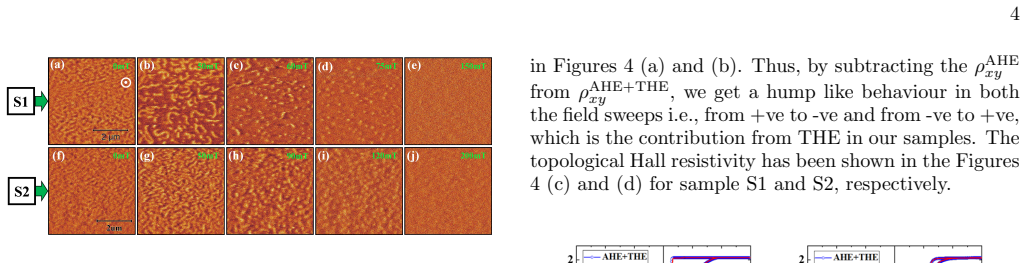
Circularity Check
Mild circularity: the topological Hall hump is produced by subtracting an AHE background scaled to the same measured Hall curves, so the chirality evidence is partly a fitted residual.
-
fitted input called prediction
[Section III (Results and Discussion), Eq. (1) and Figure 4]
"the contribution from AHE is scaled with the ρAHE+THE xy by evaluating the AHE coefficient (Rs) which is plotted as the red line curve ρAHE xy in Figures 4 (a) and (b). Thus, by subtracting the ρAHE xy from ρAHE+THE xy, we get a hump like behaviour in both the field sweeps i.e., from +ve to -ve and from -ve to +ve, which is the contribution from THE in our samples."
The topological Hall resistivity is obtained by subtracting an AHE contribution whose coefficient Rs is evaluated from the same measured total Hall curve that is being analyzed. No independent determination of Rs is specified, so the reported hump is the residual left after scaling part of the data to the same data. This makes the THE a fitted quantity presented as the confirmation of chirality, rather than an independent prediction. The MFM images do show domain features, but they do not by themselves establish chirality, so the chiral attribution substantially depends on this self-referential subtraction.
full rationale
The paper's central claim that S1 and S2 host chiral skyrmions rests on two types of evidence: MFM images of circular domains and a finite topological Hall effect. The MFM data are independent evidence for isolated, circular magnetic domains, though they cannot distinguish DMI-stabilized chiral skyrmions from dipolar bubble domains in a perpendicular film. The THE extraction, however, is circular in a mild sense: the red AHE curve is scaled to the same measured Hall data before subtraction, and the residual hump is then called the topological Hall signal. Without a clearly stated independent criterion for fixing Rs, this procedure can generate a hump by construction whenever the AHE scaling does not capture all low-field features. The RKKY coupling, another load-bearing ingredient, is directly demonstrated only in the two-layer control R2-SAF; its persistence inside the repeated [Pt/Co] stacks of S1 and S2 is assumed, and the absence of a hysteresis step is interpreted as dipolar dominance over RKKY. That is an inferential gap rather than a circular definition, but it weakens the mechanism attribution. Overall, the paper has independent experimental content, and the circularity is confined to the Hall-analysis step, so a moderate score of 3 is appropriate.
Assumptions & free parameters
free parameters (2)
- AHE coefficient Rs =
not stated numerically
- OHE slope correction =
not stated numerically
assumptions (5)
- domain assumption The total Hall resistivity is rho_xy = R0H + RsM + rho_THE, with additive separable contributions.
- domain assumption Antiferromagnetic coupling at tIr=1.3 nm measured on R2-SAF persists in the repeated [Pt/Co] stacks of S1/S2.
- ad hoc to paper Absence of a step in S1/S2 hysteresis means dipolar interaction dominates over RKKY.
- domain assumption MFM circular domains plus a THE hump identify chiral skyrmions rather than achiral bubble domains.
- standard math Keff = HK MS / 2 and Keff = Kv + Ks/tCo describe the anisotropy reduction.
Cite this review
Pith. "Pith review of Effect of RKKY and dipolar interaction on the nucleation of skyrmion in Pt/Co multilayer with Ir spacer." pith.science (2026). https://pith.science/paper/FJPGV2CP
@misc{pith2026250723153,
  author       = {Pith},
  title        = {Pith review of: Effect of RKKY and dipolar interaction on the nucleation of skyrmion in Pt/Co multilayer with Ir spacer},
  year         = {2026},
  howpublished = {\url{https://pith.science/paper/FJPGV2CP}},
  note         = {Machine review of arXiv:2507.23153}
}
read the original abstract
Magnetic skyrmions, topologically protected spin textures, have emerged as promising candidates for next-generation spintronic applications. In this study, we investigate the stabilization of skyrmionic states in a uniquely engineered Pt/Co multilayer system with an Ir spacer, where both Ruderman Kittel Kasuya Yosida (RKKY) and dipolar interactions play a crucial role. The studied multilayer structure consists of a synthetic antiferromagnetic (SAF) configuration, where a single Ir layer facilitates strong antiferromagnetic coupling between two ferromagnetic regions: FM1 (top) and FM2 (bottom), each formed by repeated Co layers separated by Pt, enabling significant dipolar interactions. This FM1/Ir/FM2 configuration results in a distinctive skyrmionic hysteresis loop, driven by the interplay of dipolar and RKKY interactions. Magnetic force microscopy (MFM) imaging confirms the nucleation of isolated skyrmions, while magnetotransport measurements reveal a finite topological Hall effect (THE), indicating the chiral nature of these spin textures. Furthermore, we demonstrate that increasing the Co layer thickness leads to a reduction in magnetic anisotropy, which in turn results in the formation of relatively larger and denser skyrmions. Our findings establish a robust approach for stabilizing skyrmions through the combined effects of dipolar and RKKY interactions, offering new pathways for controlled skyrmion manipulation in spintronic devices.
Figures


Figures from the paper (2 more)


Reference graph
Works this paper leans on
-
[1]
A. Fert, N. Reyren, and V. Cros, Magnetic skyrmions: advances in physics and potential applications, Nature Reviews Materials 2, 1 (2017)
2017
-
[2]
K. Wang, V. Bheemarasetty, J. Duan, S. Zhou, and G. Xiao, Fundamental physics and applications of skyrmions: A review, Journal of Magnetism and Mag- netic Materials 563, 169905 (2022)
2022
-
[3]
F. Jonietz, S. M¨ uhlbauer, C. Pfleiderer, A. Neubauer, W. M¨ unzer, A. Bauer, T. Adams, R. Georgii, P. B¨ oni, R. A. Duine, et al., Spin transfer torques in mnsi at ul- tralow current densities, Science 330, 1648 (2010)
work page 2010
- [4]
-
[5]
J. Iwasaki, M. Mochizuki, and N. Nagaosa, Universal current-velocity relation of skyrmion motion in chiral magnets, Nature communications 4, 1463 (2013)
work page 2013
-
[6]
A. Fert, V. Cros, and J. Sampaio, Skyrmions on the track, Nature nanotechnology 8, 152 (2013)
2013
-
[7]
Nagaosa and Y
N. Nagaosa and Y. Tokura, Topological properties and dynamics of magnetic skyrmions, Nature nanotechnology 8, 899 (2013)
2013
-
[8]
J. Sampaio, V. Cros, S. Rohart, A. Thiaville, and A. Fert, Nucleation, stability and current-induced motion of iso- lated magnetic skyrmions in nanostructures, Nature nan- otechnology 8, 839 (2013)
work page 2013
Show all 47 references
-
[9]
Iwasaki, M
J. Iwasaki, M. Mochizuki, and N. Nagaosa, Current- induced skyrmion dynamics in constricted geometries, Nature nanotechnology 8, 742 (2013)
2013
-
[10]
Soumyanarayanan, M
A. Soumyanarayanan, M. Raju, A. Gonzalez Oyarce, A. K. Tan, M.-Y. Im, A. P. Petrovi´ c, P. Ho, K. Khoo, M. Tran, C. Gan, et al., Tunable room-temperature mag- netic skyrmions in ir/fe/co/pt multilayers, Nature mate- rials 16, 898 (2017)
2017
-
[11]
M. He, L. Peng, Z. Zhu, G. Li, J. Cai, J. Li, H. Wei, L. Gu, S. Wang, T. Zhao, et al., Realization of zero-field skyrmions with high-density via electromagnetic manip- ulation in pt/co/ta multilayers, Applied Physics Letters 111 (2017)
2017
-
[12]
T. Lin, H. Liu, S. Poellath, Y. Zhang, B. Ji, N. Lei, J. Yun, L. Xi, D. Yang, T. Xing, et al., Observation of room-temperature magnetic skyrmions in pt/co/w struc- tures with a large spin-orbit coupling, Physical Review B 98, 174425 (2018)
2018
-
[13]
Cheng, N
S. Cheng, N. Bagu´ es, C. M. Selcu, J. B. Freyermuth, Z. Li, B. Wang, S. Das, P. C. Hammel, M. Rande- ria, D. W. McComb, et al., Room-temperature magnetic skyrmions in pt/co/cu multilayers, Physical Review B 108, 174433 (2023)
2023
-
[14]
B. Ojha, S. Mallick, S. Panigrahy, M. Sharma, A. Thiav- ille, S. Rohart, and S. Bedanta, Driving skyrmions with low threshold current density in pt/cofeb thin film, Phys- ica Scripta 98, 035819 (2023)
2023
-
[15]
Boulle, J
O. Boulle, J. Vogel, H. Yang, S. Pizzini, D. de Souza Chaves, A. Locatelli, T. O. Mente¸ s, A. Sala, L. D. Buda-Prejbeanu, O. Klein, et al., Room- temperature chiral magnetic skyrmions in ultrathin magnetic nanostructures, Nature nanotechnology 11, 449 (2016)
2016
-
[16]
S. Woo, K. Litzius, B. Kr¨ uger, M.-Y. Im, L. Caretta, K. Richter, M. Mann, A. Krone, R. M. Reeve, M. Weigand, et al., Observation of room-temperature magnetic skyrmions and their current-driven dynamics in ultrathin metallic ferromagnets, Nature materials 15, 501 (2016)
2016
-
[17]
Moreau-Luchaire, C
C. Moreau-Luchaire, C. Moutafis, N. Reyren, J. Sam- paio, C. Vaz, N. Van Horne, K. Bouzehouane, K. Gar- cia, C. Deranlot, P. Warnicke, et al., Additive interfacial chiral interaction in multilayers for stabilization of small individual skyrmions at room temperature, Nature nan...
2016
-
[18]
Salikhov, F
R. Salikhov, F. Samad, S. S. P. K. Arekapudi, R. Ehrler, J. Lindner, N. S. Kiselev, and O. Hellwig, Control and tunability of magnetic bubble states in multilayers with strong perpendicular magnetic anisotropy at ambient conditions, Physical Review B 106, 054404 (2022)
2022
-
[19]
Lemesh and G
I. Lemesh and G. S. Beach, Twisted domain walls and skyrmions in perpendicularly magnetized multilayers, Physical Review B 98, 104402 (2018)
2018
-
[20]
Herv´ e, B
M. Herv´ e, B. Dup´ e, R. Lopes, M. B¨ ottcher, M. D. Martins, T. Balashov, L. Gerhard, J. Sinova, and W. Wulfhekel, Stabilizing spin spirals and isolated skyrmions at low magnetic field exploiting vanishing magnetic anisotropy, Nature communications 9, 1015 (2018)
2018
-
[21]
Jiang, P
W. Jiang, P. Upadhyaya, W. Zhang, G. Yu, M. B. Jungfleisch, F. Y. Fradin, J. E. Pearson, Y. Tserkovnyak, K. L. Wang, O. Heinonen, et al., Blowing magnetic skyrmion bubbles, Science 349, 283 (2015)
2015
-
[22]
Tolley, S
R. Tolley, S. Montoya, and E. Fullerton, Room- temperature observation and current control of skyrmions in pt/co/os/pt thin films, Physical Re- view Materials 2, 044404 (2018)
2018
-
[23]
Mohanty, B
S. Mohanty, B. Ojha, M. Sharma, and S. Bedanta, Observation of topological hall effect and skyrmions in pt/co/ir/co/pt system, Materials Research Express 11, 046406 (2024)
2024
-
[24]
Duine, K.-J
R. Duine, K.-J. Lee, S. S. Parkin, and M. D. Stiles, Syn- thetic antiferromagnetic spintronics, Nature physics 14, 6 217 (2018)
2018
-
[25]
Mohanty, M
S. Mohanty, M. Sharma, A. K. Moharana, B. Ojha, E. Pandey, B. B. Singh, and S. Bedanta, Magnetiza- tion reversal and domain structures in perpendicular syn- thetic antiferromagnets prepared on rigid and flexible substrates, Jom 74, 2319 (2022)
2022
-
[26]
Gabor, T
M. Gabor, T. Petrisor, R. Mos, M. Nasui, and C. Tiusan, Interlayer exchange coupling in perpendicularly magne- tized pt/co/ir/co/pt structures, Journal of Physics D: Applied Physics 50, 465004 (2017)
2017
-
[27]
Chen, Skyrmion hall effect, Nature Physics 13, 112 (2017)
G. Chen, Skyrmion hall effect, Nature Physics 13, 112 (2017)
2017
-
[28]
Jiang, X
W. Jiang, X. Zhang, G. Yu, W. Zhang, X. Wang, M. Ben- jamin Jungfleisch, J. E. Pearson, X. Cheng, O. Heinonen, K. L. Wang, et al., Direct observation of the skyrmion hall effect, Nature Physics 13, 162 (2017)
2017
-
[29]
T. Dohi, S. DuttaGupta, S. Fukami, and H. Ohno, For- mation and current-induced motion of synthetic antifer- romagnetic skyrmion bubbles, Nature communications 10, 5153 (2019)
2019
-
[30]
V. T. Pham, N. Sisodia, I. Di Manici, J. Urrestarazu- Larra˜ naga, K. Bairagi, J. Pelloux-Prayer, R. Guedas, L. D. Buda-Prejbeanu, S. Auffret, A. Locatelli, et al., Fast current-induced skyrmion motion in synthetic anti- ferromagnets, Science 384, 307 (2024)
2024
-
[31]
Ikeda, K
S. Ikeda, K. Miura, H. Yamamoto, K. Mizunuma, H. Gan, M. Endo, S. Kanai, J. Hayakawa, F. Mat- sukura, and H. Ohno, A perpendicular-anisotropy cofeb– mgo magnetic tunnel junction, Nature materials 9, 721 (2010)
2010
-
[32]
Nagaosa, J
N. Nagaosa, J. Sinova, S. Onoda, A. H. MacDonald, and N. P. Ong, Anomalous hall effect, Reviews of modern physics 82, 1539 (2010)
2010
-
[33]
Neubauer, C
A. Neubauer, C. Pfleiderer, B. Binz, A. Rosch, R. Ritz, P. Niklowitz, and P. B¨ oni, Topological hall effect in the a phase of mnsi, Physical review letters102, 186602 (2009)
2009
-
[34]
Kanazawa, Y
N. Kanazawa, Y. Onose, T. Arima, D. Okuyama, K. Ohoyama, S. Wakimoto, K. Kakurai, S. Ishiwata, and Y. Tokura, Large topological hall effect in a short-period helimagnet mnge, Physical review letters 106, 156603 (2011)
2011
-
[35]
Y. Li, N. Kanazawa, X. Yu, A. Tsukazaki, M. Kawasaki, M. Ichikawa, X. Jin, F. Kagawa, and Y. Tokura, Ro- bust formation of skyrmions and topological hall effect anomaly¡? format?¿ in epitaxial thin films of mnsi, Phys- ical review letters 110, 117202 (2013)
2013
-
[36]
M. He, G. Li, Z. Zhu, Y. Zhang, L. Peng, R. Li, J. Li, H. Wei, T. Zhao, X.-G. Zhang, et al., Evolution of topo- logical skyrmions across the spin reorientation transition in pt/co/ta multilayers, Physical Review B 97, 174419 (2018)
2018
-
[37]
M. Raju, A. Yagil, A. Soumyanarayanan, A. K. Tan, A. Almoalem, F. Ma, O. Auslaender, and C. Panagopou- los, The evolution of skyrmions in ir/fe/co/pt multilayers and their topological hall signature, Nature communica- tions 10, 696 (2019)
2019
-
[38]
M. Raju, A. Petrovi´ c, A. Yagil, K. Denisov, N. Duong, B. G¨ obel, E. S ¸a¸ sıo˘ glu, O. Auslaender, I. Mertig, I. Rozhansky, et al., Colossal topological hall effect at the transition between isolated and lattice-phase interfa- cial skyrmions, Nature communications 12, 2758 (2021)
2021
-
[39]
Mourkas, A
A. Mourkas, A. Markou, P. Swekis, and I. Panagiotopou- los, Topological hall effect in pt/co/w multilayers with different anisotropies, Journal of Magnetism and Mag- netic Materials 530, 167937 (2021)
2021
-
[40]
Maccariello, W
D. Maccariello, W. Legrand, N. Reyren, K. Garcia, K. Bouzehouane, S. Collin, V. Cros, and A. Fert, Elec- trical detection of single magnetic skyrmions in metallic multilayers at room temperature, Nature nanotechnology 13, 233 (2018)
2018
-
[41]
R. Chen, Y. Gao, X. Zhang, R. Zhang, S. Yin, X. Chen, X. Zhou, Y. Zhou, J. Xia, Y. Zhou, et al., Realization of isolated and high-density skyrmions at room tempera- ture in uncompensated synthetic antiferromagnets, Nano letters 20, 3299 (2020). 7 SUPPLEMENT AR Y INFORMA TION
2020
-
[42]
Figure S1 (a) and (b) show the out-of-plane hysteresis loops for the sample S1 and S2, respectively, measured via SQUID magnetometer. FIG. S1. Out-of-plane hysteresis loop for the sample (a) S1 and (b) S2, measured by SQUID-VSM
-
[43]
Figure S2 (a), (b) and (c) show the hard axis hysteresis loops for the sample R2-SAF, S1 and S2, respectively
The effective anisotropy energies of the samples have been calculated by measuring the hysteresis loop in presence of an in-plane applied magnetic field. Figure S2 (a), (b) and (c) show the hard axis hysteresis loops for the sample R2-SAF, S1 and S2, respectively. The green ar...
-
[44]
TABLE S1
The calculated values of HK, MS and Keff for the samples R2-SAF, S1 and S2 have been mentioned in Table S1 below. TABLE S1. Calculated values of HK , MS and Keff for the samples R2-SAF, S1 and S2. Sample MS (A/m) HK (mT) Keff (J/m3) R2-SAF 1.56 × 10⁶ 1240 9.67 × 10⁵ S1 1.56 × ...
-
[45]
The labyrinth type of domains appeared at demagnetized state, gradually breaks into skyrmions and then gets saturated at high magnetic field forming a uniform magnetic state
Figure S3 shows the MFM images for sample S1 at different applied magnetic field. The labyrinth type of domains appeared at demagnetized state, gradually breaks into skyrmions and then gets saturated at high magnetic field forming a uniform magnetic state. 8 FIG. S3. Gradual e...
-
[46]
The labyrinth type of domains appeared at demagnetized state, gradually breaks into skyrmions and then gets saturated at high magnetic field forming a uniform magnetic state
Figure S4 shows the MFM images for sample S2 at different applied magnetic field. The labyrinth type of domains appeared at demagnetized state, gradually breaks into skyrmions and then gets saturated at high magnetic field forming a uniform magnetic state. FIG. S4. Gradual evo...
-
[47]
To measure the Hall resistivity accurately for a rectangular sample, a five-probe method is employed, as shown in Figure S5. While a conventional four-probe setup can measure the Hall voltage using transverse contacts, any misalignment from the ideal perpendicular configuratio...
Reviewed August 6, 2026 · model on record in the stance chip above.
Discussion (0). Continue with ORCID to comment.