REVIEW 4 major objections 6 minor 1 cited by
Neural Multi-View Self-Calibrated Photometric Stereo without Photometric Stereo Cues
T0 review · 4 major / 6 minor · reviewed 2026-08-06 · deepseek-v4-flash
Pith's one-line read Multi-view photometric stereo can be solved as a single joint optimization, recovering shape, material, and uncalibrated per-light directions from raw images alone.
desk verdict A genuinely end-to-end MVPS method that mostly delivers on its central claim; referee it, but ask for seeds, error bars, and a global-illumination stress test. read the letter →
The pith
A machine-rendered reading of the paper's core claim, the machinery that carries it, and where it could break.
The reading
What carries the argument
The load-bearing object is the single-reflection image formation model of Eq. (1), $r = e f(x, n, v, \ell)(n^\top \ell)_+$, rendered through shadow-aware volume rendering. A spatial multilayer perceptron with multi-resolution hash encoding outputs the signed distance and a reflectance latent code per point; a reflectance (bidirectional reflectance distribution function, BRDF) multilayer perceptron predicts RGB BRDF values from that latent code and the angular encoding $A(n, v, \ell) = [n^\top h, \ell^\top h, n^\top \ell, n^\top v, (n^\top h)^{10}]$ with $h = \ell + v$; and a shadow multilayer perceptron refines SDF-transmittance shadow factors into smooth values that tolerate inter-reflection fill. The joint optimization has one channel through which photometric information flows into geometry: the spatial MLP's analytic SDF gradient acts as the surface normal in the BRDF evaluation, so raw pixel loss supervises shape directly.
What would settle it
Render a synthetic concave reflective object with a renderer that includes inter-reflections, using known geometry, material, and lighting, then run the method on those images: if reconstruction errors concentrate in the concavity and grow with the ratio of indirect to direct radiance, the single-reflection model of Eq. (1) is the failing component.
Extended reading notes
Core claim
The central claim is that multi-view photometric stereo can be solved as one inverse rendering problem, without photometric stereo cues. Given posed multi-view OLAT images and foreground masks, the method optimizes a neural signed distance field for geometry, a latent-driven reflectance network for spatially varying material, per-light camera-space directions and RGB intensities, and a shadow-refining network, all from raw pixel values under a weighted L1 loss. On a standard multi-view photometric stereo benchmark, it reports lower surface-distance error and normal-angle error than stage-by-stage normal-guided baselines and point-based inverse rendering, and lower light-direction error than a baseline that initializes lighting from a pretrained network, while remaining accurate with as few as one light per view. The same pipeline is demonstrated on self-captured view-unaligned OLAT images of reflective objects, where viewpoints differ from light to light.
Load-bearing premise
The load-bearing premise is that every pixel records one surface point lit by one directional source, with inter-reflections and ambient light negligible; the paper itself reports that concave regions of reflective surfaces break under this assumption.
Editorial extensions
If this is right
- Light calibration objects such as chrome spheres and white boards can be dropped; each light's direction and relative intensity is an optimizable parameter recovered from pixels.
- The capture rig no longer needs aligned viewpoints across lights: a light can stay fixed to the camera while the object rotates, and the next light starts a fresh multi-view pass.
- The method remains accurate when lighting variation is sparse, down to a single light per view, a regime where per-view normal-map estimation degrades.
- Because material is represented by a per-point latent code instead of a fixed analytic model, the same pipeline handles diffuse, ceramic, metallic, and hybrid surfaces, and supports unshadowed rendering and relighting.
Reading between the lines
- Editorial inference: recovered camera-space light directions could serve as a calibration signal for structure-from-motion or hand-eye calibration, since a light rigidly fixed to the camera gives each frame a known directional reference.
- Editorial inference: the tolerance for view-unaligned capture suggests a handheld camera-and-strobe rig could replace turntable capture, because object rotation no longer has to be synchronized with light switching.
- Editorial inference: a direct stress test is to replace the directional-light assumption with an inverse-square point light model; if the joint optimization fails to separate distance falloff from BRDF, that would identify the lighting model as the next bottleneck.
- Editorial inference: because the angular encoding is rotation-invariant, the reflectance network is effectively learning a local-coordinate material model, which raises a testable question of whether latent codes transfer across scenes that share a material.
Editorial analysis
A structured set of objections, weighed in public.
Referee Report
Summary. The paper presents a neural inverse rendering method for multi-view photometric stereo (MVPS) that jointly reconstructs geometry, spatially varying reflectance, and per-light direction and intensity from raw one-light-at-a-time (OLAT) images in a single-stage optimization. Geometry is represented as a neural SDF with a per-point BRDF latent code, reflectance is predicted by a latent-driven BRDF MLP, and lighting is parameterized as per-light directions and RGB intensities; a shadow MLP refines volume-rendered shadow factors. The method is evaluated on DiLiGenT-MV for shape, normal, lighting, and test-view rendering quality, and on a new self-captured view-unaligned OLAT dataset. The central claim is that discarding intermediate photometric-stereo cues and light calibration, and optimizing all scene parameters directly against pixels, outperforms normal-guided MVPS baselines in shape and lighting accuracy while also supporting sparse lighting and view-unaligned capture.
Significance. If the result holds, the paper is a useful step for MVPS: it removes the need for light calibration and per-view normal maps, demonstrates that a neural latent-driven BRDF can be trained from scratch from OLAT images, and provides a practical view-unaligned capture protocol. The authors are commendably explicit about the main limitation (inter-reflections, Sec. 4.2) and release code. The evaluation uses a public benchmark with external ground-truth meshes and calibrated lights, and the derivation is not circular: all scene parameters are optimized against raw pixels and evaluated against external references. However, several load-bearing empirical claims lack support: no error bars or multiple seeds, no quantitative evaluation of light intensities, no quantitative reflectance error, and no controlled test of the directional-light / no-interreflection assumption that underlies the forward model.
major comments (4)
- [Sec. 3.1, Eq. (1); Sec. 4.2, Fig. 12] The forward model assumes a single directional light and neglects inter-reflections, and the paper's own Sec. 4.2 reports that the method breaks down in concave regions of reflective surfaces. Because Eq. (14) multiplies the entire volume-rendered color by a single MLP-refined shadow factor s' from Eq. (13), indirect light has no dedicated channel; it can be absorbed by s', by the BRDF latent code, or by the estimated light intensities. Under model mismatch, geometry, reflectance, and lighting can co-degrade while still fitting the input images. The paper should add a synthetic experiment with known ground truth and path-traced global illumination to quantify how much model mismatch the optimization tolerates, or at least provide a quantitative analysis of the failure mode in Fig. 12. This is load-bearing for the abstract's claims about 'challenging geometry and reflectance' and real-world applicability.
- [Sec. 4.1.3, Table 1; Supplementary Eq. (22)] The lighting evaluation reports only direction MAE, yet the abstract and conclusion claim recovery of per-light intensities (relative intensities). The supplementary defines scale-invariant MSE (SI-MSE) in Eq. (22), but no SI-MSE results are reported anywhere in the paper. Since DiLiGenT-MV provides calibrated light intensities via a white board, the authors should report SI-MSE for the configurations in Table 1 and for the ablation in Table 2; without this, the intensity component of the lighting-recovery claim is unsupported.
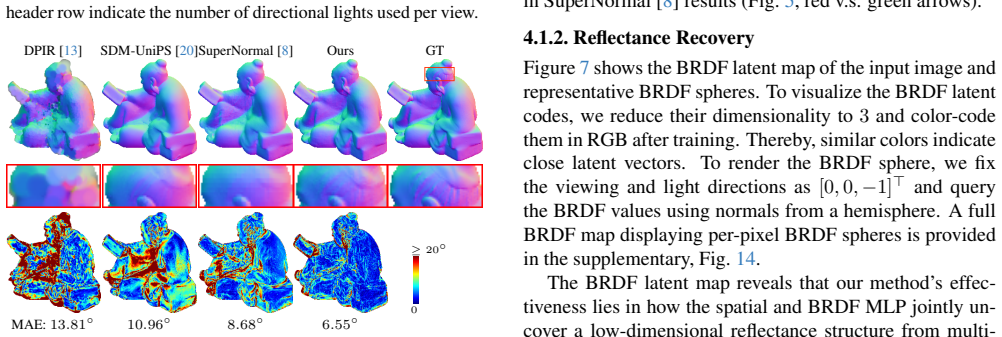
- [Sec. 4.1.1, Fig. 4; Sec. 4.1.3, Table 1] The central empirical claim is that the method 'outperforms' baselines across lighting counts, but no error bars or multiple seeds are reported. Some comparisons are close (e.g., Fig. 4 CD curves for bear and pot2 at dense lighting, and several light-direction MAE differences in Table 1 below 0.3 degrees). A single run cannot support fine-grained comparative claims. At minimum, three seeds with mean and standard deviation for the headline metrics (CD, normal MAE, light MAE) should be reported for the main configurations, or the claims should be scoped to qualitative trends.
- [Sec. 4.1.2, Fig. 8] Reflectance recovery is evaluated only through qualitative BRDF latent maps and BRDF spheres, plus test-view PSNR, where DPIR actually achieves higher PSNR than the proposed method. The explanation that weighted-L1 loss is less correlated with PSNR is plausible, but no quantitative reflectance error (e.g., albedo or BRDF error on a synthetic object with known material, or a perceptual metric such as LPIPS on held-out renderings) is provided. Since the abstract explicitly claims recovery of spatially varying reflectance, the paper should either add a quantitative reflectance metric or clearly scope the claim to 'plausible relighting' rather than 'accurate SVBRDF'.
minor comments (6)
- [Fig. 4] The y-axis labels in Fig. 4 are difficult to read or missing; the top row should clearly say 'Chamfer distance (mm)' and the bottom row 'Normal MAE (deg)', and the caption should state the units for each row.
- [Table 1] The column header 'R EADING' contains an unintended space and should be 'READING'.
- [Supplementary Sec. 7.1] The text contains typos: 'stobes' should be 'strobes', and '1 maway' should be '1 m away'.
- [Sec. 3.2, Eq. (7)] The sentence 'the bar over a vector indicates it is normalized' is confusing because the normalized gradient is written with the same symbol as the unnormalized one; please define explicitly, e.g., n = ∇g / ||∇g||.
- [Sec. 3.2, Eq. (10)] The halfway vector is defined as h = ℓ + v, but it is not normalized; since the angular encoding uses n^T h, the unnormalized magnitude affects the feature value. Please state whether h is meant to be normalized, and if not, justify why the unnormalized sum is used.
- [Sec. 4.1.4, Table 2] The ablation study is performed on a single scene (POT2 with 32L18V); the main text should state this limitation, or add a second scene, before drawing general conclusions about the loss and angular encoding.
Circularity Check
No significant circularity: the method optimizes raw pixels against external ground truth, and the self-cited prior work appears only as a comparison baseline.
full rationale
The paper's central claim—joint recovery of geometry, SVBRDF, and per-light direction/intensity from raw OLAT pixels—is implemented as a direct optimization of Eq. (14) against input colors via Eq. (16), and the evaluation uses external ground truth (scanned meshes, calibrated lights, held-out test views and test lights), so the reported quantities are not the fitted parameters by construction. The forward model in Eq. (1) is a stated physical assumption (directional light, no inter-reflections), not a definition that presupposes the target outputs; the paper explicitly identifies its failure mode (Sec. 4.2, Fig. 12) and lists the relaxation as future work. Self-citations [8, 9] are the authors' own SuperNormal and azimuth-stereo papers, but they are used only as comparison baselines and related work, not as justification for the method's correctness or uniqueness. There is no imported uniqueness theorem, no ansatz smuggled via citation, and no renaming of a known empirical pattern as unification. The ablation study (Table 2) tests the contribution of angular encoding and weighted L1 loss against alternatives, and the lighting estimation is compared to PS-NeRF with ground-truth calibration, further confirming the predictions are independently validated. The noted limitations (inter-reflection neglect, heuristic angular encoding) are correctness risks, not circularity.
Assumptions & free parameters
free parameters (5)
- Per-light direction and RGB intensity (e_j, l_j) =
Optimized per scene; Table 1 reports light direction MAE 1.16 to 2.51 degrees
- Spatial, BRDF, and shadow MLP weights plus hash encoding parameters =
Trained per scene; not enumerated
- Sigmoid sharpness a in opacity conversion =
Optimizable, not reported
- Scene normalization scale factor k =
5 for all scenes
- Loss weights and optimization hyperparameters =
lambda1 = lambda2 = 1, learning rates 1e-2 and 1e-3, 20k or 100k steps, 4096 rays per step
assumptions (6)
- domain assumption Each image is captured under a single directional light; each light is static relative to the camera.
- domain assumption No inter-reflections; radiance is direct illumination only.
- ad hoc to paper All sample points on a viewing ray share the surface point's shadow factor.
- domain assumption Linear radiometric response of the input raw images.
- domain assumption Known camera poses and foreground masks for all views.
- standard math NeuS SDF-to-opacity conversion and Eikonal regularization are valid for surface reconstruction.
invented entities (2)
-
Per-point BRDF latent code b(x)
-
Shadow MLP refinement s' = S(b(x'), s, v)
Cite this review
Pith. "Pith review of Neural Multi-View Self-Calibrated Photometric Stereo without Photometric Stereo Cues." pith.science (2026). https://pith.science/paper/26M5NCXN
@misc{pith2026250723162,
  author       = {Pith},
  title        = {Pith review of: Neural Multi-View Self-Calibrated Photometric Stereo without Photometric Stereo Cues},
  year         = {2026},
  howpublished = {\url{https://pith.science/paper/26M5NCXN}},
  note         = {Machine review of arXiv:2507.23162}
}
read the original abstract
We propose a neural inverse rendering approach that jointly reconstructs geometry, spatially varying reflectance, and lighting conditions from multi-view images captured under varying directional lighting. Unlike prior multi-view photometric stereo methods that require light calibration or intermediate cues such as per-view normal maps, our method jointly optimizes all scene parameters from raw images in a single stage. We represent both geometry and reflectance as neural implicit fields and apply shadow-aware volume rendering. A spatial network first predicts the signed distance and a reflectance latent code for each scene point. A reflectance network then estimates reflectance values conditioned on the latent code and angularly encoded surface normal, view, and light directions. The proposed method outperforms state-of-the-art normal-guided approaches in shape and lighting estimation accuracy, generalizes to view-unaligned multi-light images, and handles objects with challenging geometry and reflectance.
Figures


Figures from the paper (10 more)



Forward citations
Cited by 1 Pith paper
-
A Hybrid Neural-Microfacet BRDF Model for Real-Time Rendering
A hybrid BRDF model, combining a GGX analytical term with a tiny learned residual and gating network, fits measured materials more accurately than fully neural models at equal memory cost.
Reference graph
Works this paper leans on
- [1]
-
[2]
Sal: Sign agnostic learn- ing of shapes from raw data
Matan Atzmon and Yaron Lipman. Sal: Sign agnostic learn- ing of shapes from raw data. In Proc. of Computer Vision and Pattern Recognition (CVPR), pages 2565–2574, 2020. 5
work page 2020
-
[3]
Models of light reflection for computer syn- thesized pictures
James F Blinn. Models of light reflection for computer syn- thesized pictures. In Proceedings of the 4th annual con- ference on Computer graphics and interactive techniques , pages 192–198, 1977. 3
work page 1977
-
[4]
NeRD: Neural re- flectance decomposition from image collections
Mark Boss, Raphael Braun, Varun Jampani, Jonathan T Barron, Ce Liu, and Hendrik Lensch. NeRD: Neural re- flectance decomposition from image collections. In Proc. of International Conference on Computer Vision (ICCV), pages 12684–12694, 2021. 3
work page 2021
-
[5]
Sparse views near light: A practical paradigm for uncalibrated point-light pho- tometric stereo
Mohammed Brahimi, Bjoern Haefner, Zhenzhang Ye, Bas- tian Goldluecke, and Daniel Cremers. Sparse views near light: A practical paradigm for uncalibrated point-light pho- tometric stereo. In Proc. of Computer Vision and Pattern Recognition (CVPR), pages 11862–11872, 2024. 2, 3
work page 2024
-
[6]
Rnb-neus: Reflectance and normal-based multi- view 3d reconstruction
Baptiste Brument, Robin Bruneau, Yvain Qu ´eau, Jean M´elou, Franc ¸ois Bernard Lauze, Jean-Denis Durou, and Lil- ian Calvet. Rnb-neus: Reflectance and normal-based multi- view 3d reconstruction. In Proc. of Computer Vision and Pattern Recognition (CVPR), pages 5230–5239, 2024. 1, 2, 4
work page 2024
-
[7]
Multi-view surface reconstruction using nor- mal and reflectance cues
Robin Bruneau, Baptiste Brument, Yvain Qu ´eau, Jean M´elou, Franc ¸ois Bernard Lauze, Jean-Denis Durou, and Lil- ian Calvet. Multi-view surface reconstruction using nor- mal and reflectance cues. arXiv preprint arXiv:2506.04115,
-
[8]
Supernormal: Neural sur- face reconstruction via multi-view normal integration
Xu Cao and Takafumi Taketomi. Supernormal: Neural sur- face reconstruction via multi-view normal integration. In Proc. of Computer Vision and Pattern Recognition (CVPR), pages 20581–20590, 2024. 1, 2, 4, 5, 6
work page 2024
Show all 59 references
-
[9]
Multi-view azimuth stereo via tangent space consis- tency
Xu Cao, Hiroaki Santo, Fumio Okura, and Yasuyuki Mat- sushita. Multi-view azimuth stereo via tangent space consis- tency. In Proc. of Computer Vision and Pattern Recognition (CVPR), 2023. 2
2023
-
[10]
Mul- tiview normal field integration using level set methods
Ju Yong Chang, Kyoung Mu Lee, and Sang Uk Lee. Mul- tiview normal field integration using level set methods. In Proc. of Computer Vision and Pattern Recognition (CVPR), pages 1–8. IEEE, 2007. 2
2007
-
[11]
Guanying Chen, Kai Han, Boxin Shi, Yasuyuki Matsushita, and Kwan-Yee K. Wong. SDPS-Net: Self-calibrating deep photometric stereo networks. In Proc. of Computer Vision and Pattern Recognition (CVPR), 2019. 7
2019
-
[12]
Wildlight: In- the-wild inverse rendering with a flashlight
Ziang Cheng, Junxuan Li, and Hongdong Li. Wildlight: In- the-wild inverse rendering with a flashlight. InProc. of Com- puter Vision and Pattern Recognition (CVPR), pages 4305– 4314, 2023. 3
2023
-
[13]
Differentiable point-based inverse rendering
Hoon-Gyu Chung, Seokjun Choi, and Seung-Hwan Baek. Differentiable point-based inverse rendering. InProceedings of the IEEE/CVF Conference on Computer Vision and Pat- tern Recognition (CVPR), pages 4399–4409, 2024. 2, 3, 5, 6, 7
2024
-
[14]
Differentiable inverse rendering with interpretable basis brdfs
Hoon-Gyu Chung, Seokjun Choi, and Seung-Hwan Baek. Differentiable inverse rendering with interpretable basis brdfs. In Proc. of Computer Vision and Pattern Recognition (CVPR), 2024. 1
2024
-
[15]
R. L. Cook and K. E. Torrance. A reflectance model for computer graphics. ACM Trans. Graph., 1(1):7–24, 1982. 3
1982
-
[16]
Pan- dora: Polarization-aided neural decomposition of radiance
Akshat Dave, Yongyi Zhao, and Ashok Veeraraghavan. Pan- dora: Polarization-aided neural decomposition of radiance. In European conference on computer vision, pages 538–556. Springer, 2022. 3
2022
-
[17]
Multiview photometric stereo
Carlos Hernandez Esteban, George V ogiatzis, and Roberto Cipolla. Multiview photometric stereo. IEEE Transactions on Pattern Analysis and Machine Intelligence (PAMI), 30(3): 548–554, 2008. 2
2008
-
[18]
Implicit geometric regularization for learning shapes
Amos Gropp, Lior Yariv, Niv Haim, Matan Atzmon, and Yaron Lipman. Implicit geometric regularization for learning shapes. In Proceedings of Machine Learning and Systems 2020, pages 3569–3579. 2020. 4, 5
2020
-
[19]
On Neural BRDFs: A thorough comparison of state-of-the-art approaches
Florian Hofherr, Bjoern Haefner, and Daniel Cremers. On Neural BRDFs: A thorough comparison of state-of-the-art approaches. In 2025 IEEE/CVF Winter Conference on Ap- plications of Computer Vision (WACV) , pages 1785–1794. IEEE, 2025. 3
2025
-
[20]
Scalable, detailed and mask-free universal photometric stereo
Satoshi Ikehata. Scalable, detailed and mask-free universal photometric stereo. In Proc. of Computer Vision and Pattern Recognition (CVPR), 2023. 5, 6
2023
-
[21]
Uncertainty-aware deep multi-view photometric stereo
Berk Kaya, Suryansh Kumar, Carlos Oliveira, Vittorio Fer- rari, and Luc Van Gool. Uncertainty-aware deep multi-view photometric stereo. 2022. 2
2022
-
[22]
Neural radiance fields ap- proach to deep multi-view photometric stereo
Berk Kaya, Suryansh Kumar, Francesco Sarno, Vittorio Ferrari, and Luc Van Gool. Neural radiance fields ap- proach to deep multi-view photometric stereo. In Proc. of IEEE/CVF Winter Conference on Applications of Computer Vision (WACV), pages 1965–1977, 2022. 2
1965
-
[23]
Multi-view photometric stereo revis- ited
Berk Kaya, Suryansh Kumar, Carlos Oliveira, Vittorio Fer- rari, and Luc Van Gool. Multi-view photometric stereo revis- ited. In Proc. of IEEE/CVF Winter Conference on Applica- tions of Computer Vision (WACV), pages 3126–3135, 2023. 2
2023
-
[24]
NeISF: Neural incident stokes field for geometry and ma- terial estimation
Chenhao Li, Taishi Ono, Takeshi Uemori, Hajime Mihara, Alexander Gatto, Hajime Nagahara, and Yusuke Moriuchi. NeISF: Neural incident stokes field for geometry and ma- terial estimation. In Proc. of Computer Vision and Pattern Recognition (CVPR), pages 21434–21445, 2024. 3
2024
-
[25]
NeISF++: Neural incident stokes field for polar- ized inverse rendering of conductors and dielectrics
Chenhao Li, Taishi Ono, Takeshi Uemori, Sho Nitta, Hajime Mihara, Alexander Gatto, Hajime Nagahara, and Yusuke Moriuchi. NeISF++: Neural incident stokes field for polar- ized inverse rendering of conductors and dielectrics. InProc. of Computer Vision and Pattern Recognition (C...
2025
-
[26]
Self-calibrating photomet- ric stereo by neural inverse rendering
Junxuan Li and Hongdong Li. Self-calibrating photomet- ric stereo by neural inverse rendering. In Proc. of European Conference on Computer Vision (ECCV) , pages 166–183. Springer, 2022. 3, 2
2022
-
[27]
Multi-view photometric stereo: A ro- bust solution and benchmark dataset for spatially varying isotropic materials
Min Li, Zhenglong Zhou, Zhe Wu, Boxin Shi, Changyu Diao, and Ping Tan. Multi-view photometric stereo: A ro- bust solution and benchmark dataset for spatially varying isotropic materials. IEEE Transactions on Image Process- ing, 29:4159–4173, 2020. 1, 2, 5, 4, 6
2020
-
[28]
NerfAcc: Efficient sampling accelerates nerfs
Ruilong Li, Hang Gao, Matthew Tancik, and Angjoo Kanazawa. NerfAcc: Efficient sampling accelerates nerfs. In Proc. of International Conference on Computer Vision (ICCV), pages 18537–18546, 2023. 1
2023
-
[29]
Neuralangelo: High-fidelity neural surface reconstruction
Zhaoshuo Li, Thomas M ¨uller, Alex Evans, Russell H Tay- lor, Mathias Unberath, Ming-Yu Liu, and Chen-Hsuan Lin. Neuralangelo: High-fidelity neural surface reconstruction. In IEEE Conference on Computer Vision and Pattern Recogni- tion (CVPR), 2023. 4
2023
-
[30]
A differential volumetric approach to multi-view photometric stereo
Fotios Logothetis, Roberto Mecca, and Roberto Cipolla. A differential volumetric approach to multi-view photometric stereo. In Proc. of International Conference on Computer Vision (ICCV), 2019. 1, 2
2019
-
[31]
Nplmv-ps: Neural point-light multi-view photometric stereo
Fotios Logothetis, Ignas Budvytis, and Roberto Cipolla. Nplmv-ps: Neural point-light multi-view photometric stereo. arXiv preprint arXiv:2405.12057, 2024. 2
2024 arXiv
-
[32]
Marching cubes: A high resolution 3D surface construction algorithm
William E Lorensen and Harvey E Cline. Marching cubes: A high resolution 3D surface construction algorithm. ACM siggraph computer graphics, 21(4):163–169, 1987. 5
1987
-
[33]
Decoupled weight de- cay regularization
Ilya Loshchilov and Frank Hutter. Decoupled weight de- cay regularization. In International Conference on Learning Representations, 2019. 1
2019
-
[34]
A data-driven reflectance model
Wojciech Matusik. A data-driven reflectance model. ACM SIGGRAPH 2003 Papers, 2003. 3
2003
-
[35]
Srinivasan, and Jonathan T
Ben Mildenhall, Peter Hedman, Ricardo Martin-Brualla, Pratul P. Srinivasan, and Jonathan T. Barron. NeRF in the dark: High dynamic range view synthesis from noisy raw images. CVPR, 2022. 5
2022
-
[36]
tiny-cuda-nn, 2021
Thomas M ¨uller. tiny-cuda-nn, 2021. 1
2021
-
[37]
Instant neural graphics primitives with a multires- olution hash encoding
Thomas M ¨uller, Alex Evans, Christoph Schied, and Alexan- der Keller. Instant neural graphics primitives with a multires- olution hash encoding. ACM Trans. Graph. , 41(4):102:1– 102:15, 2022. 3
2022
-
[38]
Directional reflectance and emissivity of an opaque surface
Fred E Nicodemus. Directional reflectance and emissivity of an opaque surface. Applied optics, 4(7):767–775, 1965. 3
1965
-
[39]
Multiview photometric stereo using planar mesh parameterization
Jaesik Park, Sudipta N Sinha, Yasuyuki Matsushita, Yu- Wing Tai, and In So Kweon. Multiview photometric stereo using planar mesh parameterization. In Proc. of Interna- tional Conference on Computer Vision (ICCV), pages 1161– 1168, 2013. 2
2013
-
[40]
Robust multiview photometric stereo using planar mesh parameterization
Jaesik Park, Sudipta N Sinha, Yasuyuki Matsushita, Yu- Wing Tai, and In So Kweon. Robust multiview photometric stereo using planar mesh parameterization. IEEE Transac- tions on Pattern Analysis and Machine Intelligence (PAMI), 39(8):1591–1604, 2016. 2
2016
-
[41]
Illumination for computer generated pic- tures
Bui Tuong Phong. Illumination for computer generated pic- tures. Seminal graphics: pioneering efforts that shaped the field, 1975. 3
1975
-
[42]
SAM 2: Segment anything in images and videos
Nikhila Ravi, Valentin Gabeur, Yuan-Ting Hu, Ronghang Hu, Chaitanya Ryali, Tengyu Ma, Haitham Khedr, Roman R¨adle, Chloe Rolland, Laura Gustafson, Eric Mintun, Junt- ing Pan, Kalyan Vasudev Alwala, Nicolas Carion, Chao- Yuan Wu, Ross Girshick, Piotr Dollar, and Christoph Feich...
2025
-
[43]
A new change of variables for ef- ficient BRDF representation
Szymon M Rusinkiewicz. A new change of variables for ef- ficient BRDF representation. In Rendering Techniques’ 98: Proceedings of the Eurographics Workshop in Vienna, Aus- tria, June 29—July 1, 1998 9 , pages 11–22. Springer, 1998. 3, 4
1998
-
[44]
MVCPS-NeuS: Multi-view constrained photometric stereo for neural surface reconstruction
Hiroaki Santo, Fumio Okura, and Yasuyuki Matsushita. MVCPS-NeuS: Multi-view constrained photometric stereo for neural surface reconstruction. In Proc. of Computer Vi- sion and Pattern Recognition (CVPR), pages 20475–20484,
-
[45]
Nerv: Neural reflectance and visibility fields for relighting and view synthesis
Pratul P Srinivasan, Boyang Deng, Xiuming Zhang, Matthew Tancik, Ben Mildenhall, and Jonathan T Barron. Nerv: Neural reflectance and visibility fields for relighting and view synthesis. In Proc. of Computer Vision and Pattern Recognition (CVPR), pages 7495–7504, 2021. 3
2021
-
[46]
NeuS: Learning neural im- plicit surfaces by volume rendering for multi-view recon- struction
Peng Wang, Lingjie Liu, Yuan Liu, Christian Theobalt, Taku Komura, and Wenping Wang. NeuS: Learning neural im- plicit surfaces by volume rendering for multi-view recon- struction. Advances in Neural Information Processing Sys- tems (NeurIPS), 2021. 4, 5
2021
-
[47]
Photometric method for determining surface orientation from multiple images
Robert J Woodham. Photometric method for determining surface orientation from multiple images. Optical engineer- ing, 19(1):139–144, 1980. 1
1980
-
[48]
Fusing multiview and photometric stereo for 3d reconstruction under uncalibrated illumination
Chenglei Wu, Yebin Liu, Qionghai Dai, and Bennett Wilburn. Fusing multiview and photometric stereo for 3d reconstruction under uncalibrated illumination. IEEE trans- actions on visualization and computer graphics, 17(8):1082– 1095, 2010. 2
2010
-
[49]
Wenqi Yang, Guanying Chen, Chaofeng Chen, Zhenfang Chen, and Kwan-Yee K. Wong. Ps-nerf: Neural inverse ren- dering for multi-view photometric stereo. In Proc. of Euro- pean Conference on Computer Vision (ECCV), 2022. 1, 2, 3, 7
2022
-
[50]
Neilf: Neural incident light field for physically-based mate- rial estimation
Yao Yao, Jingyang Zhang, Jingbo Liu, Yihang Qu, Tian Fang, David McKinnon, Yanghai Tsin, and Long Quan. Neilf: Neural incident light field for physically-based mate- rial estimation. In European conference on computer vision, pages 700–716. Springer, 2022. 3
2022
-
[51]
Multiview neu- ral surface reconstruction by disentangling geometry and ap- pearance
Lior Yariv, Yoni Kasten, Dror Moran, Meirav Galun, Matan Atzmon, Basri Ronen, and Yaron Lipman. Multiview neu- ral surface reconstruction by disentangling geometry and ap- pearance. Advances in Neural Information Processing Sys- tems (NeurIPS), 33, 2020. 3
2020
-
[52]
V olume rendering of neural implicit surfaces
Lior Yariv, Jiatao Gu, Yoni Kasten, and Yaron Lipman. V olume rendering of neural implicit surfaces. In Thirty- Fifth Conference on Neural Information Processing Systems,
-
[53]
IRON: Inverse rendering by optimizing neural sdfs and mate- rials from photometric images
Kai Zhang, Fujun Luan, Zhengqi Li, and Noah Snavely. IRON: Inverse rendering by optimizing neural sdfs and mate- rials from photometric images. In Proc. of Computer Vision and Pattern Recognition (CVPR), pages 5565–5574, 2022. 3
2022
-
[54]
Ner- factor: Neural factorization of shape and reflectance under an unknown illumination
Xiuming Zhang, Pratul P Srinivasan, Boyang Deng, Paul De- bevec, William T Freeman, and Jonathan T Barron. Ner- factor: Neural factorization of shape and reflectance under an unknown illumination. ACM Transactions on Graphics (ToG), 40(6):1–18, 2021. 3
2021
-
[55]
Mvpsnet: Fast generalizable multi-view photometric stereo
Dongxu Zhao, Daniel Lichy, Pierre-Nicolas Perrin, Jan- Michael Frahm, and Soumyadip Sengupta. Mvpsnet: Fast generalizable multi-view photometric stereo. In Proceedings of the IEEE/CVF International Conference on Computer Vi- sion, pages 12525–12536, 2023. 2
2023
-
[56]
Multi-view pho- tometric stereo with spatially varying isotropic materials
Zhenglong Zhou, Zhe Wu, and Ping Tan. Multi-view pho- tometric stereo with spatially varying isotropic materials. In Proc. of Computer Vision and Pattern Recognition (CVPR), pages 1482–1489, 2013. 2 Neural Multi-View Self-Calibrated Photometric Stereo without Photometric Stere...
2013
-
[57]
Network Architecture As shown in Fig
Implementation Details 6.1. Network Architecture As shown in Fig. 2, our forward rendering pipeline com- prises three MLPs: the spatial MLP, the BRDF MLP, and the shadow MLP. We detail each MLP’s architecture below and visualize them in Fig. 13. Spatial MLP. The spatial MLP ta...
-
[58]
Capture Setup Details As shown in Fig
Real-World Data Collection 7.1. Capture Setup Details As shown in Fig. 10, we prepare six strobe lights that emit point flashlights and a Sony ILCE-7RM5 camera equipped with a telephoto zoom lens. Both the camera and the strobes are mounted on tripods to ensure that each light...
-
[59]
This normalization facilitates the training of the neural SDF and is conducted before recon- struction
Scene Normalization Scene normalization applies a global scaling and translation to world coordinates such that the target object is bounded within a unit sphere [51]. This normalization facilitates the training of the neural SDF and is conducted before recon- struction. For c...
Reviewed August 6, 2026 · model on record in the stance chip above.
Discussion (0). Continue with ORCID to comment.