REVIEW 4 major objections 5 minor 1 cited by
Training-free Geometric Image Editing on Diffusion Models
T0 review · 4 major / 5 minor · reviewed 2026-08-06 · deepseek-v4-flash
Pith's one-line read Decoupled diffusion editing wins on move, rotate, and resize tasks.
desk verdict A practical training-free geometric editor with a sensible three-step pipeline, but the 'consistent superiority' claim is not supported by the paper's own Table 1. read the letter →
The pith
A machine-rendered reading of the paper's core claim, the machinery that carries it, and where it could break.
The reading
What carries the argument
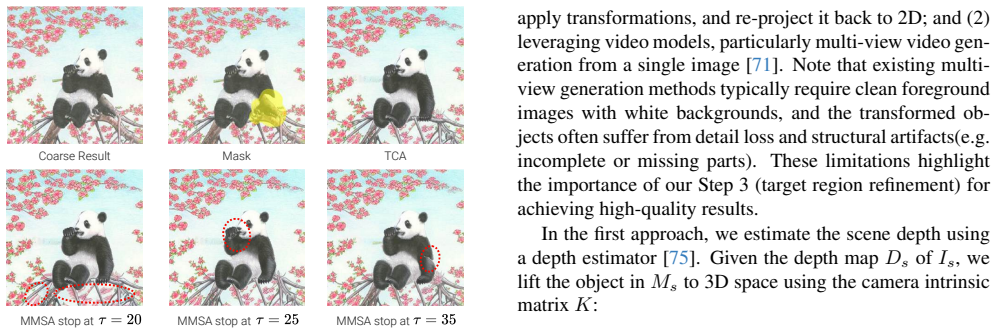
The central object is Temporal Contextual Attention (TCA), a mask-aware attention schedule for latent diffusion. At denoising step $\tau$ it computes the output as $(1-\alpha_\tau)\,S_t + \alpha_\tau\,[S_o\cdot M_t + S_b\cdot(1-M_t)]$, where $S_t$ is ordinary self-attention on the current latent, $S_o$ and $S_b$ are masked mutual self-attention outputs using source key/value pairs for the object and background, and $\alpha_\tau = (\tau_1-\tau)/(\tau_1-\tau_0)$ decreases linearly from 1 at $\tau_0$ to 0 at the final step $\tau_1$. This gradual hand-off lets early steps copy global structure from the source image while later steps repair fine details, which the paper argues avoids both the artifacts of pure mask-guided attention and the unwanted global changes of pure self-attention. Two supporting mechanisms carry the local changes: Local Perturbation applies DDPM-style stochastic updates only inside a specified mask while keeping DDIM deterministic updates elsewhere, and Content-specified Generation replaces cross-attention keys/values with text-derived ones and applies classifier-free guidance only inside the target mask. The three modules together turn a standard pretrained latent diffusion model into a region-refinement engine with no training.
What would settle it
Run FreeFine on the full GeoBench while sweeping $\tau_0$ for Step 3 over a range such as 1, 5, 13, 25, and 40, keeping all other settings fixed; if the optimal $\tau_0$ changes across move, rotate, resize, and structural-completion subsets, or if per-task tuned $\tau_0$ erases the reported margin over the strongest baseline, then the fixed schedule is not the mechanism the paper claims. A second check: replace the linear $\alpha_\tau$ with a constant early-stop switch at $\tau_0$; the appendix's few-example comparison would need to fail across the whole benchmark for the smooth schedule to be load-bearing.
Extended reading notes
Core claim
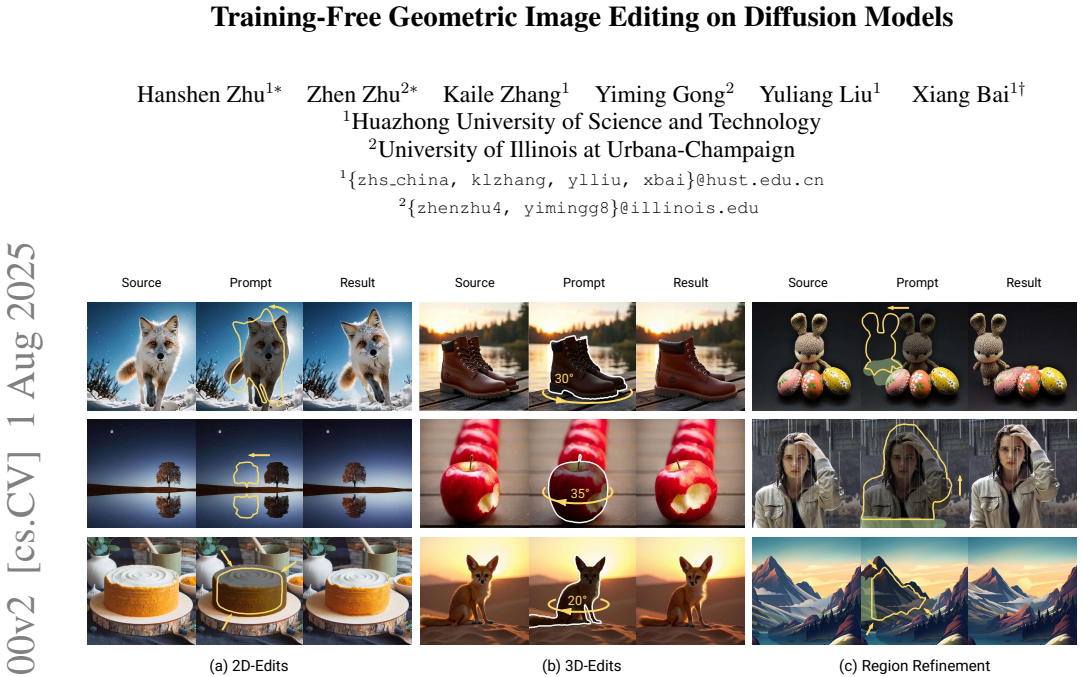
The paper's central claim is that the reason diffusion-based editing fails on large or structurally complex geometric changes is not a lack of model capacity but a conflict of objectives within a single denoising loop, and that separating the edit into object transformation, source inpainting, and target refinement resolves the conflict. The training-free component, FreeFine, rests on a temporal observation: major content changes happen early in denoising and later steps only refine details. Its Temporal Contextual Attention therefore starts from mask-guided mutual self-attention that borrows key/value features from the source image to preserve global structure, then linearly transitions to unconstrained self-attention over the remaining steps, with the blend weight $\alpha_\tau = (\tau_1 - \tau)/(\tau_1 - \tau_0)$. Local Perturbation adds stochastic DDPM-style updates only inside user-defined masks so that regions needing new structure can re-randomize while the rest of the image stays deterministic, and Content-specified Generation restricts cross-attention and classifier-free guidance to those masks so text prompts affect only intended areas. The paper further argues and demonstrates on GeoBench that this decoupled, training-free recipe achieves higher subject and background consistency, lower warp error, and better FID than state-of-the-art editing and inpainting baselines.
Load-bearing premise
The load-bearing premise is that one fixed linear schedule for blending mask-guided attention with ordinary self-attention, using hand-picked start times (1 for inpainting, 13 for structural completion, 25 for general refinement), transfers across all 5,988 GeoBench instructions; if the ideal blend depends on image content or edit size, the method becomes threshold tuning rather than a general mechanism.
Editorial extensions
If this is right
- A single off-the-shelf diffusion model can perform move, rotate, resize, and 3D viewpoint edits at arbitrary difficulty without any task-specific fine-tuning.
- The decoupled pipeline allows each step to use the best available tool: affine transforms for 2D edits, depth estimation or single-image 3D lifting for 3D edits, and the same FreeFine sampler for both inpainting and refinement.
- Editing quality under large transformations is governed by when in the denoising trajectory mask-guided attention is released, not by the capacity of the inpainting network.
- Because the modules are training-free, improvements or replacements in the base diffusion model, the segmenter, or the depth estimator transfer directly to the editing pipeline.
- GeoBench's difficulty levels and structural-completion subset provide a common yardstick for comparing geometric editing methods on 5,988 instructions.
Reading between the lines
- If the fixed schedule is the true mechanism, then making $\tau_0$ content-adaptive—say, inferred from edit size or mask entropy—should improve results further, an untested extension.
- The same linear blend could apply to other attention-controlled editing tasks such as object removal or appearance transfer, which the appendix already sketches, suggesting that the schedule is a general control knob rather than a geometric-editing-specific fix.
- The reliance on hand-picked $\tau_0$ values (1, 13, 25) means the method might need recalibration for a different base diffusion model, resolution, or sampling schedule than the one used in the paper.
Editorial analysis
A structured set of objections, weighed in public.
Referee Report
Summary. The paper proposes a decoupled three-step pipeline for geometric image editing: (1) coarse geometric transformation of the object, (2) source-region inpainting, and (3) target-region refinement. Steps 2 and 3 are implemented by a training-free diffusion module called FreeFine, which combines Temporally Contextual Attention (TCA), Local Perturbation (LP), and Content-specified Generation (CG). The authors introduce a new benchmark, GeoBench, with 811 source images and 5,988 editing instructions spanning 2D and 3D transformations, and report comparisons against state-of-the-art editing and inpainting methods. The central claim is that FreeFine outperforms existing alternatives in image fidelity and edit precision, especially under demanding transformations.
Significance. If the central claims hold, the paper would make a useful contribution: a training-free, modular approach to geometric editing that decomposes a hard monolithic optimization into simpler, controllable subtasks, with code and benchmark released. The paper also includes qualitative ablations for each proposed component and a user study, which are positive elements. However, the evidence as presented does not support the strongest claims: the quantitative table contradicts 'consistent superiority across all scenarios and metrics,' and the editing-effectiveness metrics are confounded with the geometric warp performed in Step 1. These issues are addressable with additional analyses and revised claims, but they are load-bearing for the paper's stated message.
major comments (4)
- [Sec. 4.2, Table 1] The statement 'FreeFine demonstrates consistent superiority across all scenarios and metrics' is contradicted by the paper's own Table 1. On 2D edits, GeoDiffuser achieves better FID (33.89 vs. 34.72) and better DINOv2 (437.75 vs. 478.18), and DragDiffusion achieves a better KD (0.142 vs. 0.144); on structure completion, BrushNet achieves better KD (0.971 vs. 0.982) and better DINOv2 (2516.52 vs. 2526.38). No error bars or significance tests are reported anywhere in the paper, so even the small 3D improvements (e.g., FID 150.89 vs. 152.06) are not established as statistically reliable. The paper should either revise the superiority claim to a more nuanced statement or add uncertainty quantification (e.g., multiple seeds with confidence intervals, paired significance tests).
- [Sec. 4.1 (metrics) and Sec. 3.1 (pipeline)] The two metrics on which FreeFine shows the largest gains, Warp Error (WE) and Mean Distance (MD), are defined directly in terms of the same geometric warp used in Step 1. WE is the L1 distance inside the target mask between the output and the warped source object, and MD compares SIFT keypoints transformed by F with their expected positions. Since Step 1 explicitly produces the coarse image Ic via Tθ and Step 3 initializes from the composite of Ic and Ibg, low WE/MD can be largely inherited from the warp itself rather than from FreeFine's attention and perturbation modules. Baselines such as GeoDiffuser and DragDiffusion do not receive this composite initialization. The authors should provide an ablation that separates the contribution of the warp initialization from the contribution of FreeFine's modules (e.g., evaluate the composite before refinement, or initialize baselines with the same composite), otherwise the editing-effectiveness comparisons are confounded.
- [Sec. 3.2.1 and Appendix Fig. 10] TCA's temporal schedule alpha_tau = (tau1 - tau)/(tau1 - tau0) relies on hand-selected starting steps tau0 = 1 for Step 2, tau0 = 13 for Step 3 structural completion, and tau0 = 25 for general refinement. The paper claims that TCA is 'free from this concern and thus more robust' relative to early-stopping, but the only evidence (Appendix Fig. 10) is a few qualitative examples. No sensitivity analysis of tau0 is reported across GeoBench, across edit difficulties, or across different object sizes. Without such an analysis, the claim of robustness over threshold tuning is not supported. Please add a quantitative sweep over tau0 for each task and report how FID, SUBC, WE, and MD vary.
- [Sec. 4.3, Fig. 7] The ablations for TCA, LP, and CG are presented only qualitatively. Since the central claim is that each of these components contributes to the method's performance, quantitative ablation results (FID, DINOv2, SUBC, WE, MD, or user-study preferences) should be reported for removing or replacing each component. This is especially important because the qualitative figures show subtle differences that may not be representative across the 5,988-instruction benchmark.
minor comments (5)
- [Abstract] The phrase 'outperforms state-of-the-art alternatives in image fidelity, and edit precision' has an awkward comma before 'and'; please rephrase for clarity.
- [Appendix E.1] There is a typo: 'cgenetated image' should be 'generated image'.
- [Appendix Table 3 caption] The caption reads 'V oting statistics' with a spurious space; should be 'Voting statistics'.
- [Sec. 4.1 (Datasets)] The sentence 'We randomly sample 2k images from PIE-Bench and Subjects200K as data from the target' is unclear; specify that these images form the reference distribution for FID and clarify whether they overlap with the GeoBench source images.
- [Appendix G, Table 4] The user-study table reports absolute vote counts but not the number of participants per condition; adding confidence intervals or a statistical test for the preference percentages would strengthen the conclusions.
Circularity Check
No derivation-level circularity; the WE/MD edit-precision metric is partly self-referential because it scores against the pipeline's own Step-1 warp.
-
other
[Sec. 3.1 (Step 1 and Step 3, coarse composite equation) and Sec. 4.1 (Metrics, WE/MD definition)]
"Given the target mask Mt and the coarse image Ic from Step 1, and Ibg with clean background in the source object location obtained from Step 2, we can easilyBlend them together to create a composite image ˆIc: ˆIc = Mt · Ic + (1− Mt) · Ibg. ... we employ the same Warp Error (WE) and Mean Distance(MD) as GeoDiffuser [56] to measure editing effectiveness, which warps the source object to the target location and then computes L1 error within masked regions of the generated images."
WE is computed against Iw, the warped source object, while Step 1 explicitly produces the coarse image Ic by applying the same transformation Tθ to the source object, and Step 3 is initialized from Îc = Mt·Ic + (1−Mt)·Ibg. Thus the metric's ground truth is the pipeline's own Step-1 output: any variant that simply pastes Ic into the target mask would achieve near-zero WE, and MD likewise checks SIFT points against F, the same transformation used to build Ic. The paper's leading claim of superiority in 'edit precision' therefore rests substantially on agreement with its own initialization rather than on an independent check of the TCA/LP/CG modules.
full rationale
The mechanics of FreeFine (DDIM inversion, MMSA blending with a linear schedule, local DDPM perturbation, and masked CFG) are not fitted to or defined by the evaluation numbers; no evaluation target appears in Eqs. (1)-(6), and the τ0/τ1 schedule is a hand-set hyperparameter rather than a fitted parameter. There is no load-bearing self-citation: the method builds on externally published components (MasaCtrl [5], SV3D [71], GeoDiffuser [56], DepthAnything [75]) and no uniqueness argument by the authors is invoked. The only construction-level overlap found is in the edit-precision metrics: WE/MD compare the output to the Step-1 warp that also seeds Step 3, so the abstract's 'edit precision' superiority is partly inherited from the pipeline's own initialization rather than independently established. This is an evaluation-circularity caveat, not a reduction of the method's derivation to its inputs. Separately, and not as circularity, Table 1 contradicts the sentence claiming 'consistent superiority across all scenarios and metrics' (e.g., GeoDiffuser's 2D FID 33.89 vs FreeFine 34.72; BrushNet's SC KD 0.971 vs 0.982), and Appendix G itself concedes that the WE metric 'shows some degree of misalignment' with human preference; these are reporting and benchmark-validity risks that lower confidence in the conclusions but do not change the circularity verdict.
Assumptions & free parameters
free parameters (5)
- TCA start step tau_0 for Step 2 =
1
- TCA start step tau_0 for Step 3 structural completion =
13
- TCA start step tau_0 for general refinement =
25
- CFG guidance scale w =
7.5
- Mask dilation factor for Step 2 inpainting =
30
assumptions (6)
- domain assumption Stable Diffusion v1-5's pretrained prior can synthesize plausible content in masked regions without training.
- domain assumption DDIM inversion of the source and composite images preserves enough scene context for mask-guided attention editing.
- domain assumption The affine or 3D transformation function T_theta accurately realizes the user's edit instruction.
- domain assumption DepthAnything relative depth plus an assumed camera intrinsic matrix K is sufficient for 3D edits.
- domain assumption GeoBench masks, instructions, difficulty levels, and manual completion masks are valid evaluation ground truth.
- domain assumption Warp Error and Mean Distance using SIFT and DiFT measure true editing precision.
Cite this review
Pith. "Pith review of Training-free Geometric Image Editing on Diffusion Models." pith.science (2026). https://pith.science/paper/6QXIF3F3
@misc{pith2026250723300,
  author       = {Pith},
  title        = {Pith review of: Training-free Geometric Image Editing on Diffusion Models},
  year         = {2026},
  howpublished = {\url{https://pith.science/paper/6QXIF3F3}},
  note         = {Machine review of arXiv:2507.23300}
}
read the original abstract
We tackle the task of geometric image editing, where an object within an image is repositioned, reoriented, or reshaped while preserving overall scene coherence. Previous diffusion-based editing methods often attempt to handle all relevant subtasks in a single step, proving difficult when transformations become large or structurally complex. We address this by proposing a decoupled pipeline that separates object transformation, source region inpainting, and target region refinement. Both inpainting and refinement are implemented using a training-free diffusion approach, FreeFine. In experiments on our new GeoBench benchmark, which contains both 2D and 3D editing scenarios, FreeFine outperforms state-of-the-art alternatives in image fidelity, and edit precision, especially under demanding transformations. Code and benchmark are available at: https://github.com/CIawevy/FreeFine
Figures


Figures from the paper (16 more)




Forward citations
Cited by 1 Pith paper
-
InsEdit: Towards Instruction-based Visual Editing via Data-Efficient Video Diffusion Models Adaptation
InsEdit adapts a video diffusion backbone for text-instruction video editing via Mutual Context Attention, achieving SOTA open-source results with O(100K) data while also supporting image editing.
Reference graph
Works this paper leans on
-
[1]
Cross-image attention for zero- shot appearance transfer
Yuval Alaluf, Daniel Garibi, Or Patashnik, Hadar Averbuch- Elor, and Daniel Cohen-Or. Cross-image attention for zero- shot appearance transfer. In ACM SIGGRAPH, pages 1–12,
-
[2]
Improving image generation with better captions
James Betker, Gabriel Goh, Li Jing, Tim Brooks, Jianfeng Wang, Linjie Li, Long Ouyang, Juntang Zhuang, Joyce Lee, Yufei Guo, et al. Improving image generation with better captions. Computer Science. https://cdn. openai. com/papers/dall-e-3. pdf, 2(3):8, 2023. 1, 2
2023
-
[3]
Sutherland, Michael Arbel, and Arthur Gretton
Mikolaj Binkowski, Danica J. Sutherland, Michael Arbel, and Arthur Gretton. Demystifying MMD gans. In ICLR. OpenReview.net, 2018. 5
work page 2018
-
[4]
G. Bradski. The OpenCV Library. Dr. Dobb’s Journal of Software Tools, 2000. 3
work page 2000
-
[5]
Masactrl: Tuning-free mu- tual self-attention control for consistent image synthesis and editing
Mingdeng Cao, Xintao Wang, Zhongang Qi, Ying Shan, Xi- aohu Qie, and Yinqiang Zheng. Masactrl: Tuning-free mu- tual self-attention control for consistent image synthesis and editing. In ICCV, pages 22503–22513, 2023. 3, 4, 5, 7
work page 2023
-
[6]
Emerg- ing properties in self-supervised vision transformers
Mathilde Caron, Hugo Touvron, Ishan Misra, Herv ´e J´egou, Julien Mairal, Piotr Bojanowski, and Armand Joulin. Emerg- ing properties in self-supervised vision transformers. In ICCV, pages 9630–9640, 2021. 4
work page 2021
-
[7]
Sharegpt4v: Improving large multi-modal models with better captions
Lin Chen, Jinsong Li, Xiaoyi Dong, Pan Zhang, Conghui He, Jiaqi Wang, Feng Zhao, and Dahua Lin. Sharegpt4v: Improving large multi-modal models with better captions. In ECCV, pages 370–387, 2024. 5
work page 2024
-
[8]
Aiyu Cui, Daniel McKee, and Svetlana Lazebnik. Dressing in order: Recurrent person image generation for pose trans- fer, virtual try-on and outfit editing. In ICCV, pages 14618– 14627. IEEE, 2021. 2
work page 2021
Show all 82 references
-
[9]
Stabledrag: Stable dragging for point-based image editing
Yutao Cui, Xiaotong Zhao, Guozhen Zhang, Shengming Cao, Kai Ma, and Limin Wang. Stabledrag: Stable dragging for point-based image editing. In ECCV, pages 340–356,
-
[10]
Deep image homography estimation
Daniel DeTone, Tomasz Malisiewicz, and Andrew Rabi- novich. Deep image homography estimation. CoRR, abs/1606.03798, 2016. 2
2016 arXiv
-
[11]
Efros, and Aleksander Holynski
Dave Epstein, Allan Jabri, Ben Poole, Alexei A. Efros, and Aleksander Holynski. Diffusion self-guidance for control- lable image generation. In NeurIPS, 2023. 1, 2, 6, 4
2023
-
[12]
Generative dif- fusion prior for unified image restoration and enhancement
Ben Fei, Zhaoyang Lyu, Liang Pan, Junzhe Zhang, Weidong Yang, Tianyue Luo, Bo Zhang, and Bo Dai. Generative dif- fusion prior for unified image restoration and enhancement. In CVPR, pages 9935–9946, 2023. 2
2023
-
[13]
Motion guidance: Diffusion-based image editing with differentiable motion es- timators
Daniel Geng and Andrew Owens. Motion guidance: Diffusion-based image editing with differentiable motion es- timators. In ICLR, 2024. 1, 2, 6, 4
2024
-
[14]
Focus on your instruction: Fine-grained and multi-instruction image editing by atten- tion modulation
Qin Guo and Tianwei Lin. Focus on your instruction: Fine-grained and multi-instruction image editing by atten- tion modulation. In CVPR, pages 6986–6996, 2024. 4
2024
-
[15]
Xintong Han, Zuxuan Wu, Zhe Wu, Ruichi Yu, and Larry S. Davis. VITON: an image-based virtual try-on network. In CVPR, pages 7543–7552. Computer Vision Foundation / IEEE Computer Society, 2018. 2
2018
-
[16]
Magicman: Generative novel view synthesis of humans with 3d-aware diffusion and iterative refinement
Xu He, Zhiyong Wu, Xiaoyu Li, Di Kang, Chaopeng Zhang, Jiangnan Ye, Liyang Chen, Xiangjun Gao, Han Zhang, and Haolin Zhuang. Magicman: Generative novel view synthesis of humans with 3d-aware diffusion and iterative refinement. In AAAI, pages 3437–3445, 2025. 3
2025
-
[17]
Prompt-to-prompt image editing with cross-attention control
Amir Hertz, Ron Mokady, Jay Tenenbaum, Kfir Aberman, Yael Pritch, and Daniel Cohen-Or. Prompt-to-prompt image editing with cross-attention control. In ICLR, 2023. 3, 4
2023
-
[18]
Style aligned image generation via shared atten- tion
Amir Hertz, Andrey V oynov, Shlomi Fruchter, and Daniel Cohen-Or. Style aligned image generation via shared atten- tion. In CVPR, pages 4775–4785, 2024. 3, 7
2024
-
[19]
Gans trained by a two time-scale update rule converge to a local nash equilib- rium
Martin Heusel, Hubert Ramsauer, Thomas Unterthiner, Bernhard Nessler, and Sepp Hochreiter. Gans trained by a two time-scale update rule converge to a local nash equilib- rium. In NeurIPS, pages 6626–6637, 2017. 2, 5, 3
2017
-
[20]
Classifier-free diffusion guidance
Jonathan Ho and Tim Salimans. Classifier-free diffusion guidance. CoRR, abs/2207.12598, 2022. 5
2022 arXiv
-
[21]
Denoising diffu- sion probabilistic models
Jonathan Ho, Ajay Jain, and Pieter Abbeel. Denoising diffu- sion probabilistic models. In NeurIPS, 2020. 2, 3
2020
-
[22]
VBench: Com- prehensive benchmark suite for video generative models
Ziqi Huang, Yinan He, Jiashuo Yu, Fan Zhang, Chenyang Si, Yuming Jiang, Yuanhan Zhang, Tianxing Wu, Qingyang Jin, Nattapol Chanpaisit, Yaohui Wang, Xinyuan Chen, Limin Wang, Dahua Lin, Yu Qiao, and Ziwei Liu. VBench: Com- prehensive benchmark suite for video generative models....
2024
-
[23]
Spatial transformer networks
Max Jaderberg, Karen Simonyan, Andrew Zisserman, and koray kavukcuoglu. Spatial transformer networks. In NeurIPS. Curran Associates, Inc., 2015. 2
2015
-
[24]
Designedit: Multi- layered latent decomposition and fusion for unified & accu- rate image editing
Yueru Jia, Yuhui Yuan, Aosong Cheng, Chuke Wang, Ji Li, Huizhu Jia, and Shanghang Zhang. Designedit: Multi- layered latent decomposition and fusion for unified & accu- rate image editing. CoRR, abs/2403.14487, 2024. 2, 6, 7, 5
2024 arXiv
-
[25]
Brushnet: A plug-and-play image inpainting model with decomposed dual-branch diffusion
Xuan Ju, Xian Liu, Xintao Wang, Yuxuan Bian, Ying Shan, and Qiang Xu. Brushnet: A plug-and-play image inpainting model with decomposed dual-branch diffusion. In ECCV, pages 150–168, 2024. 2, 6, 5
2024
-
[26]
Pnp inversion: Boosting diffusion-based editing with 3 lines of code
Xuan Ju, Ailing Zeng, Yuxuan Bian, Shaoteng Liu, and Qiang Xu. Pnp inversion: Boosting diffusion-based editing with 3 lines of code. International Conference on Learning Representations (ICLR), 2024. 5
2024
-
[27]
Denoising diffusion restoration models
Bahjat Kawar, Michael Elad, Stefano Ermon, and Jiaming Song. Denoising diffusion restoration models. In NeurIPS,
-
[28]
3d gaussian splatting for real-time radiance field rendering
Bernhard Kerbl, Georgios Kopanas, Thomas Leimk ¨uhler, and George Drettakis. 3d gaussian splatting for real-time radiance field rendering. ACM Trans. Graph., 42(4):139:1– 139:14, 2023. 2
2023
-
[29]
Berg, Wan-Yen Lo, Piotr Doll ´ar, and Ross B
Alexander Kirillov, Eric Mintun, Nikhila Ravi, Hanzi Mao, Chlo´e Rolland, Laura Gustafson, Tete Xiao, Spencer White- head, Alexander C. Berg, Wan-Yen Lo, Piotr Doll ´ar, and Ross B. Girshick. Segment anything. In ICCV, pages 3992– 4003, 2023. 3, 6, 5 9
2023
-
[30]
Semantic-sam: Segment and recognize anything at any gran- ularity
Feng Li, Hao Zhang, Peize Sun, Xueyan Zou, Shilong Liu, Jianwei Yang, Chunyuan Li, Lei Zhang, and Jianfeng Gao. Semantic-sam: Segment and recognize anything at any gran- ularity. arXiv preprint arXiv:2307.04767, 2023. 5
2023 arXiv
-
[31]
Dragapart: Learning a part-level motion prior for articulated objects
Ruining Li, Chuanxia Zheng, Christian Rupprecht, and An- drea Vedaldi. Dragapart: Learning a part-level motion prior for articulated objects. In ECCV, pages 165–183, 2024. 2
2024
-
[32]
MAT: mask-aware transformer for large hole image in- painting
Wenbo Li, Zhe Lin, Kun Zhou, Lu Qi, Yi Wang, and Jiaya Jia. MAT: mask-aware transformer for large hole image in- painting. In CVPR, pages 10748–10758, 2022. 2, 6, 5
2022
-
[33]
Towards understanding cross and self-attention in stable diffusion for text-guided image editing
Bingyan Liu, Chengyu Wang, Tingfeng Cao, Kui Jia, and Jun Huang. Towards understanding cross and self-attention in stable diffusion for text-guided image editing. In CVPR, pages 7817–7826. IEEE, 2024. 3
2024
-
[34]
Drag your noise: Interactive point-based editing via diffusion semantic propagation
Haofeng Liu, Chenshu Xu, Yifei Yang, Lihua Zeng, and Shengfeng He. Drag your noise: Interactive point-based editing via diffusion semantic propagation. In CVPR, pages 6743–6752, 2024. 2
2024
-
[35]
Zero-1-to-3: Zero-shot one image to 3d object
Ruoshi Liu, Rundi Wu, Basile Van Hoorick, Pavel Tok- makov, Sergey Zakharov, and Carl V ondrick. Zero-1-to-3: Zero-shot one image to 3d object. In ICCV, pages 9264–
-
[36]
Flow straight and fast: Learning to generate and transfer data with rectified flow
Xingchao Liu, Chengyue Gong, and Qiang Liu. Flow straight and fast: Learning to generate and transfer data with rectified flow. In ICLR, 2023. 2
2023
-
[37]
Sift-the scale invariant feature transform
G Lowe. Sift-the scale invariant feature transform. Int. j,
-
[38]
Regiondrag: Fast region-based image editing with diffusion models
Jingyi Lu, Xinghui Li, and Kai Han. Regiondrag: Fast region-based image editing with diffusion models. InECCV, pages 231–246, 2024. 1, 2, 6, 4
2024
-
[39]
Repaint: Inpainting using denoising diffusion probabilistic models
Andreas Lugmayr, Martin Danelljan, Andr´es Romero, Fisher Yu, Radu Timofte, and Luc Van Gool. Repaint: Inpainting using denoising diffusion probabilistic models. In CVPR, pages 11451–11461, 2022. 2
2022
-
[40]
Goldman, and Aleksander Holynski
Grace Luo, Trevor Darrell, Oliver Wang, Dan B. Goldman, and Aleksander Holynski. Readout guidance: Learning con- trol from diffusion features. In CVPR, pages 8217–8227,
-
[41]
Fourier priors-guided diffusion for zero-shot joint low-light enhance- ment and deblurring
Xiaoqian Lv, Shengping Zhang, Chenyang Wang, Yichen Zheng, Bineng Zhong, Chongyi Li, and Liqiang Nie. Fourier priors-guided diffusion for zero-shot joint low-light enhance- ment and deblurring. In CVPR, pages 25378–25388, 2024. 2
2024
-
[42]
Pose guided person image genera- tion
Liqian Ma, Xu Jia, Qianru Sun, Bernt Schiele, Tinne Tuyte- laars, and Luc Van Gool. Pose guided person image genera- tion. In NeurIPS, pages 406–416, 2017. 2
2017
-
[43]
Srinivasan, Matthew Tancik, Jonathan T
Ben Mildenhall, Pratul P. Srinivasan, Matthew Tancik, Jonathan T. Barron, Ravi Ramamoorthi, and Ren Ng. Nerf: Representing scenes as neural radiance fields for view syn- thesis. In ECCV, pages 405–421. Springer, 2020. 2
2020
-
[44]
Dragondiffusion: Enabling drag-style manipu- lation on diffusion models
Chong Mou, Xintao Wang, Jiechong Song, Ying Shan, and Jian Zhang. Dragondiffusion: Enabling drag-style manipu- lation on diffusion models. In ICLR, 2024. 1, 2, 6, 7, 4
2024
-
[45]
Ed- itable image elements for controllable synthesis
Jiteng Mu, Micha ¨el Gharbi, Richard Zhang, Eli Shechtman, Nuno Vasconcelos, Xiaolong Wang, and Taesung Park. Ed- itable image elements for controllable synthesis. In ECCV, pages 39–56, 2024. 2
2024
-
[46]
Drag your GAN: interactive point-based manipulation on the generative image manifold
Xingang Pan, Ayush Tewari, Thomas Leimk ¨uhler, Lingjie Liu, Abhimitra Meka, and Christian Theobalt. Drag your GAN: interactive point-based manipulation on the generative image manifold. In ACM SIGGRAPH, pages 78:1–78:11,
-
[47]
Karran Pandey, Paul Guerrero, Matheus Gadelha, Yannick Hold-Geoffroy, Karan Singh, and Niloy J. Mitra. Diffusion handles enabling 3d edits for diffusion models by lifting ac- tivations to 3d. In CVPR, pages 7695–7704. IEEE, 2024. 2, 6, 4, 5
2024
-
[48]
SDXL: improving latent diffusion models for high-resolution image synthesis
Dustin Podell, Zion English, Kyle Lacey, Andreas Blattmann, Tim Dockhorn, Jonas M ¨uller, Joe Penna, and Robin Rombach. SDXL: improving latent diffusion models for high-resolution image synthesis. In ICLR, 2024. 1
2024
-
[49]
Learning transferable visual models from natural language supervision
Alec Radford, Jong Wook Kim, Chris Hallacy, Aditya Ramesh, Gabriel Goh, Sandhini Agarwal, Girish Sastry, Amanda Askell, Pamela Mishkin, Jack Clark, Gretchen Krueger, and Ilya Sutskever. Learning transferable visual models from natural language supervision. In ICML, pages 8748–...
2021
-
[50]
Zero-shot text-to-image generation
Aditya Ramesh, Mikhail Pavlov, Gabriel Goh, Scott Gray, Chelsea V oss, Alec Radford, Mark Chen, and Ilya Sutskever. Zero-shot text-to-image generation. In ICML, pages 8821– 8831, 2021. 2
2021
-
[51]
Hierarchical text-conditional image gener- ation with CLIP latents
Aditya Ramesh, Prafulla Dhariwal, Alex Nichol, Casey Chu, and Mark Chen. Hierarchical text-conditional image gener- ation with CLIP latents. CoRR, abs/2204.06125, 2022. 2
2022 arXiv
-
[52]
Move anything with layered scene diffusion
Jiawei Ren, Mengmeng Xu, Jui-Chieh Wu, Ziwei Liu, Tao Xiang, and Antoine Toisoul. Move anything with layered scene diffusion. In CVPR, pages 6380–6389, 2024. 2
2024
-
[53]
Grounded SAM: assembling open-world models for diverse visual tasks
Tianhe Ren, Shilong Liu, Ailing Zeng, Jing Lin, Kun- chang Li, He Cao, Jiayu Chen, Xinyu Huang, Yukang Chen, Feng Yan, Zhaoyang Zeng, Hao Zhang, Feng Li, Jie Yang, Hongyang Li, Qing Jiang, and Lei Zhang. Grounded SAM: assembling open-world models for diverse visual tasks. arXi...
2024 arXiv
-
[54]
High-resolution image syn- thesis with latent diffusion models
Robin Rombach, Andreas Blattmann, Dominik Lorenz, Patrick Esser, and Bj¨orn Ommer. High-resolution image syn- thesis with latent diffusion models. In CVPR, pages 10674– 10685, 2022. 1, 2, 5, 6
2022
-
[55]
Denton, Seyed Kamyar Seyed Ghasemipour, Raphael Gontijo Lopes, Burcu Karagol Ayan, Tim Salimans, Jonathan Ho, David J
Chitwan Saharia, William Chan, Saurabh Saxena, Lala Li, Jay Whang, Emily L. Denton, Seyed Kamyar Seyed Ghasemipour, Raphael Gontijo Lopes, Burcu Karagol Ayan, Tim Salimans, Jonathan Ho, David J. Fleet, and Mohammad Norouzi. Photorealistic text-to-image diffusion models with de...
2022
-
[56]
Geodiffuser: Geometry-based image editing with diffusion models
Rahul Sajnani, Jeroen van Baar, Jie Min, Kapil Katyal, and Srinath Sridhar. Geodiffuser: Geometry-based image editing with diffusion models. In WACV, pages 472–482, 2025. 2, 6, 4, 5
2025
-
[57]
pytorch-fid: FID Score for PyTorch
Maximilian Seitzer. pytorch-fid: FID Score for PyTorch. https://github.com/mseitzer/pytorch-fid ,
-
[58]
Yujun Shi, Chuhui Xue, Jun Hao Liew, Jiachun Pan, Han- shu Yan, Wenqing Zhang, Vincent Y . F. Tan, and Song Bai. Dragdiffusion: Harnessing diffusion models for interactive point-based image editing. In CVPR, 2024. 1, 2, 6, 4 10
2024
-
[59]
Instant- drag: Improving interactivity in drag-based image editing
Joonghyuk Shin, Daehyeon Choi, and Jaesik Park. Instant- drag: Improving interactivity in drag-based image editing. In ACM SIGGRAPH, pages 39:1–39:10, 2024. 2
2024
-
[60]
Deformable gans for pose-based human im- age generation
Aliaksandr Siarohin, Enver Sangineto, St ´ephane Lathuili`ere, and Nicu Sebe. Deformable gans for pose-based human im- age generation. In CVPR, pages 3408–3416. Computer Vi- sion Foundation / IEEE Computer Society, 2018. 2
2018
-
[61]
Denois- ing diffusion implicit models
Jiaming Song, Chenlin Meng, and Stefano Ermon. Denois- ing diffusion implicit models. In ICLR, 2021. 2, 5, 3
2021
-
[62]
Train stable diffusion for inpainting,
Lorenzo Stacchio. Train stable diffusion for inpainting,
-
[63]
Cresswell, Rasa Hosseinzadeh, Yi Sui, Brendan Leigh Ross, Valentin Villecroze, Zhaoyan Liu, Anthony L
George Stein, Jesse C. Cresswell, Rasa Hosseinzadeh, Yi Sui, Brendan Leigh Ross, Valentin Villecroze, Zhaoyan Liu, Anthony L. Caterini, J. Eric T. Taylor, and Gabriel Loaiza- Ganem. Exposing flaws of generative model evaluation metrics and their unfair treatment of diffusion m...
2023
-
[64]
Attentive eraser: Unleashing diffusion model’s object re- moval potential via self-attention redirection guidance
Wenhao Sun, Xue-Mei Dong, Benlei Cui, and Jingqun Tang. Attentive eraser: Unleashing diffusion model’s object re- moval potential via self-attention redirection guidance. In AAAI, pages 20734–20742, 2025. 2
2025
-
[65]
Resolution-robust large mask inpainting with fourier convolutions
Roman Suvorov, Elizaveta Logacheva, Anton Mashikhin, Anastasia Remizova, Arsenii Ashukha, Aleksei Silvestrov, Naejin Kong, Harshith Goka, Kiwoong Park, and Victor Lempitsky. Resolution-robust large mask inpainting with fourier convolutions. In WACV, pages 3172–3182, 2022. 2, 6...
2022
-
[66]
Rethinking the inception ar- chitecture for computer vision
Christian Szegedy, Vincent Vanhoucke, Sergey Ioffe, Jon Shlens, and Zbigniew Wojna. Rethinking the inception ar- chitecture for computer vision. In CVPR, 2016. 3
2016
-
[67]
Ominicontrol: Minimal and universal control for diffusion transformer
Zhenxiong Tan, Songhua Liu, Xingyi Yang, Qiaochu Xue, and Xinchao Wang. Ominicontrol: Minimal and universal control for diffusion transformer. CoRR, abs/2411.15098,
-
[68]
Emergent correspondence from image diffusion
Luming Tang, Menglin Jia, Qianqian Wang, Cheng Perng Phoo, and Bharath Hariharan. Emergent correspondence from image diffusion. In NeurIPS, 2023. 4
2023
-
[69]
RAFT: recurrent all-pairs field transforms for optical flow
Zachary Teed and Jia Deng. RAFT: recurrent all-pairs field transforms for optical flow. In ICCV, pages 402–419, 2020. 6, 4
2020
-
[70]
Training-free consis- tent text-to-image generation
Yoad Tewel, Omri Kaduri, Rinon Gal, Yoni Kasten, Lior Wolf, Gal Chechik, and Yuval Atzmon. Training-free consis- tent text-to-image generation. ACM Transactions on Graph- ics (TOG), 43(4):1–18, 2024. 3, 7
2024
-
[71]
SV3D: novel multi-view syn- thesis and 3d generation from a single image using latent video diffusion
Vikram V oleti, Chun-Han Yao, Mark Boss, Adam Letts, David Pankratz, Dmitry Tochilkin, Christian Laforte, Robin Rombach, and Varun Jampani. SV3D: novel multi-view syn- thesis and 3d generation from a single image using latent video diffusion. In ECCV, pages 439–457, 2024. 2, 3, 4
2024
-
[72]
Toward characteristic- preserving image-based virtual try-on network
Bochao Wang, Huabin Zheng, Xiaodan Liang, Yimin Chen, Liang Lin, and Meng Yang. Toward characteristic- preserving image-based virtual try-on network. In ECCV, pages 607–623. Springer, 2018. 2
2018
-
[73]
Feng Wang, Jieru Mei, and Alan L. Yuille. SCLIP: rethink- ing self-attention for dense vision-language inference. In ECCV, pages 315–332, 2024. 5
2024
-
[74]
Dreamclean: Restoring clean image using deep diffusion prior
Jie Xiao, Ruili Feng, Han Zhang, Zhiheng Liu, Zhantao Yang, Yurui Zhu, Xueyang Fu, Kai Zhu, Yu Liu, and Zheng- Jun Zha. Dreamclean: Restoring clean image using deep diffusion prior. In ICLR, 2024. 3
2024
-
[75]
Depth anything: Unleashing the power of large-scale unlabeled data
Lihe Yang, Bingyi Kang, Zilong Huang, Xiaogang Xu, Jiashi Feng, and Hengshuang Zhao. Depth anything: Unleashing the power of large-scale unlabeled data. In CVPR, pages 10371–10381, 2024. 2, 3, 6, 4
2024
-
[76]
Diffusion models: A comprehensive survey of methods and applications
Ling Yang, Zhilong Zhang, Yang Song, Shenda Hong, Run- sheng Xu, Yue Zhao, Wentao Zhang, Bin Cui, and Ming- Hsuan Yang. Diffusion models: A comprehensive survey of methods and applications. ACM Comput. Surv., 56(4):105:1– 105:39, 2024. 2
2024
-
[77]
Image sculpting: Precise object editing with 3d geometry control
Jiraphon Yenphraphai, Xichen Pan, Sainan Liu, Daniele Panozzo, and Saining Xie. Image sculpting: Precise object editing with 3d geometry control. In CVPR, pages 4241– 4251, 2024. 2
2024
-
[78]
Diffusion self guidance implementation
Shengzhe Zhou. Diffusion self guidance implementation. 4
-
[79]
Denoising diffu- sion models for plug-and-play image restoration
Yuanzhi Zhu, Kai Zhang, Jingyun Liang, Jiezhang Cao, Bi- han Wen, Radu Timofte, and Luc Van Gool. Denoising diffu- sion models for plug-and-play image restoration. In CVPR, pages 1219–1229, 2023. 2
2023
-
[80]
Progressive pose attention transfer for person image generation
Zhen Zhu, Tengteng Huang, Baoguang Shi, Miao Yu, Bofei Wang, and Xiang Bai. Progressive pose attention transfer for person image generation. In CVPR, pages 2347–2356, 2019. 2
2019
-
[81]
empty scene
Zhen Zhu, Tengteng Huang, Mengde Xu, Baoguang Shi, Wenqing Cheng, and Xiang Bai. Progressive and aligned pose attention transfer for person image generation. IEEE Trans. Pattern Anal. Mach. Intell. , 44(8):4306–4320, 2022. 2 11 Training-Free Geometric Image Editing on Diffusio...
2022
-
[82]
Editing Instruction Generation
An alternative approach, GroundingSAM [53], offers si- multaneous mask and label generation but shares the same limitations regarding segmentation granularity and error ac- cumulation, often resulting in irrelevant or overly coarse masks. Editing Instruction Generation. To ena...
2004
Reviewed August 6, 2026 · model on record in the stance chip above.
Discussion (0). Sign in to comment.