REVIEW 4 major objections 5 minor 79 references
Who is a Better Talker: Subjective and Objective Quality Assessment for AI-Generated Talking Heads
T0 review · 4 major / 5 minor · reviewed 2026-08-06 · deepseek-v4-flash
Pith's one-line read A single composite image made of a first frame, a vertical time slice through the mouth, and two lip-sync error maps can predict human quality ratings for AI-generated talking heads and beats 15 comparison methods on three datasets.
desk verdict Large AGTH quality dataset is the real contribution; FSCD is a solid metric but its Y-T slice alignment assumption is unverified and should be checked before the SOTA claim is accepted. read the letter →
The pith
A machine-rendered reading of the paper's core claim, the machinery that carries it, and where it could break.
The reading
What carries the argument
The load-bearing object is the FSCD composite image, assembled from four aligned inputs: the first frame, a Y-T slice, and two SyncNet consistency maps. The Y-T slice is a vertical column of pixels taken at the mouth's horizontal position and laid out over time, so mouth motion becomes a static texture that a spatial backbone can read. The mouth position is found by detecting landmarks in the T2I-generated still portrait and scaling that centroid by the video-to-image resolution ratio (Eq. 5), and SyncNet's LSE-C and LSE-D expand into two additional image channels instead of being regressed with fixed weights. Swin-T then extracts quality features from the composite and predicts the MOS directly.
What would settle it
Measure the true mouth position in the videos of THQA-10K and compare it with the scaled portrait centroid used to place each Y-T slice; if many slices miss the mouth while FSCD still achieves its reported 0.81 SRCC, the slice is not doing the claimed temporal work, whereas if re-centering slices on true mouth landmarks raises accuracy, the alignment assumption is load-bearing.
Extended reading notes
Core claim
The central discovery is FSCD, an objective quality assessment method that treats an AI-generated talking head as a single composite image rather than as a sequence of frames. The composite stacks the first frame (spatial quality), a Y-T slice cut through the mouth column over time (temporal mouth motion), and the LSE-C and LSE-D outputs of SyncNet (tone-lip consistency), and feeds all four channels into a Swin-T regression network trained with mean squared error against human mean opinion scores. The paper reports that FSCD outperforms all fifteen compared image, video, and lip-sync quality metrics on the new THQA-10K dataset and on the earlier THQA and THQA-3D benchmarks, and its ablations show that each of the four input components contributes positively to performance.
Load-bearing premise
The method assumes that scaling the mouth center found in the still portrait by the video-to-image resolution ratio puts the vertical slice through the mouth in every generated video, even when a talker crops, warps, translates, or changes the aspect ratio.
Editorial extensions
If this is right
- If FSCD is right, talker design can be iterated against an automatic score instead of repeated human rating sessions, since the composite image predicts perceived quality at state-of-the-art accuracy.
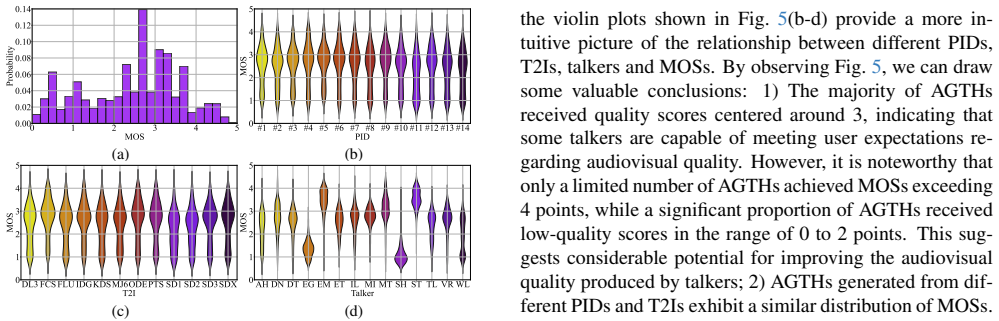
- Different talkers differ substantially in output quality, with EchoMimic and SadTalker rated highest and EmoGen and StyleHeat lowest, while choice of T2I model matters less, so talker selection can be based on the FSCD score.
- The 10,457-video dataset records 17,191 distortions, with blur, noise, and artifacts most common but misaligned keypoints most damaging to perceived quality, giving talker developers a concrete list of failure modes to fix.
- Even without the first frame, the Y-T slice plus lip-sync features still achieve competitive accuracy, so temporal mouth-motion information alone is sufficient for a useful quality signal.
- FSCD generalizes across three datasets with different content and distortion mixes, suggesting the composite-image format transfers beyond the specific T2I models and talkers used to build THQA-10K.
Reading between the lines
- An implicit extension is that the same composite trick could compress any temporally structured generative video into a single image for quality prediction, which may benefit other domains such as lip-synced dubbing or expressive avatars without requiring video backbones.
- Because the first frame is the most important component and many talkers keep identity static, FSCD may work best for near-static talking heads and could lose accuracy on methods with large head motion or camera motion, where a single vertical slice no longer tracks the mouth.
- The paper's own distortion analysis shows misaligned keypoints have the largest perceptual impact, so a direct misalignment detector, trained on landmark displacement rather than on MOS, could complement FSCD and give talker developers an actionable fault signal.
- A testable consequence not reported in the paper is that re-centering the Y-T slice on mouth landmarks detected directly in each generated video, rather than scaling the portrait centroid, could further improve accuracy for talkers that crop or translate the face.
Editorial analysis
A structured set of objections, weighed in public.
Referee Report
Summary. This paper presents THQA-10K, a dataset of 10,457 AI-generated talking-head videos produced by 12 text-to-image models and 14 speech-driven talkers, with subjective MOS and distortion labels collected from 25 raters. The authors analyze how talker generalization and output quality vary, and propose FSCD, an objective quality regression model that concatenates the first video frame, a Y-T temporal slice, and SyncNet-derived LSE-C/LSE-D maps into a single image and regresses it to MOS with a Swin-T backbone. On THQA-10K, THQA, and THQA-3D, FSCD is reported to achieve SRCC of 0.8066, 0.7812, and 0.8235, outperforming 15 baselines, and ablations show each of the four components contributes.
Significance. The dataset is a substantial contribution: it is the largest AGTH quality assessment dataset to date, covers a wide range of modern generative models, and its subjective data enable analysis of talker generalization and distortion prevalence. The release of the dataset and code is a positive step for the community. FSCD's design is novel in treating the Y-T slice as an image-level temporal feature and in feeding SyncNet scores through the same backbone as the spatial frame. If the statistical and methodological concerns below are addressed, the paper would be a useful benchmark for AGTH quality assessment.
major comments (4)
- [Section 4.1, Eq. (5)] The Y-T slice position is computed by scaling the mouth centroid Co of the T2I portrait by the resolution ratio Rv/Ro (Eq. 5), which assumes that the talker output is a uniformly scaled version of the portrait with no translation, cropping, letterboxing, or aspect-ratio change. The talkers in Table 3 include methods that output 1024×1024 from 512×512 inputs (Wav2Lip, Video-Retalking, DINet, IP-LAP, TalkLip, MuseTalk) and StyleGAN-based methods (StyleHeat), for which such preprocessing is common. The paper never verifies that Cv falls inside the mouth region for each AGTH. Since Table 5 shows that removing the Y-T slice reduces THQA-10K SRCC from 0.8066 to 0.7330, the slice is a major contributor to the reported performance; an unverified alignment assumption is therefore load-bearing. Please validate the alignment, for example by running a landmark detector on AGTH frames and reporting the distance between Cv and the true mouth centroid per talker, and if misalignment is found, correct the slice placement or exclude misaligned cases.
- [Section 5.1, Table 4] The SOTA claim is based on SRCC margins of +0.029 (THQA-10K), +0.021 (THQA), and +0.036 (THQA-3D) over the second-best methods, but only the averaged metrics over five folds are reported, without standard deviations or significance tests. The five-fold average can be sensitive to a single fold, and the margin is within typical cross-fold variability. Please report per-fold results with mean±std for all four metrics and run a paired significance test (e.g., Wilcoxon signed-rank) between FSCD and the top baselines on each dataset. Without this, the claim that FSCD surpasses the next best algorithm by at least +2% SRCC is not statistically grounded.
- [Section 4.1, Eqs. (4)-(5)] FSCD uses the T2I source portrait to compute the mouth centroid Co, and therefore requires access to the original portrait at test time. The 15 baselines in Table 4 are no-reference methods (with LSE-C/LSE-D using only the video and audio). This makes the comparison asymmetric: FSCD is effectively a reduced-reference method, since the source image provides information about the intended framing and identity. The paper should either (a) compute the mouth centroid from the AGTH video itself, for example by applying a face landmark detector to the first frame of the AGTH, which would make FSCD no-reference; or (b) explicitly frame FSCD as reduced-reference and compare with appropriate baselines. If option (a) is taken, the experiments and ablations need to be rerun.
- [Section 5.1, data partitioning] The paper states that the five-fold data partitioning ensures that there is no content overlap, but it does not specify the unit of partitioning. If splits are video-level random, the same portrait and audio can appear in both training and test sets (for different talkers), which would constitute content leakage because FSCD's first-frame and slice features are strongly tied to the portrait. Please specify whether the split is at the level of prompt (PID), portrait, or audio, and demonstrate that no content from one fold appears in another. If the current splits are video-level, please re-split at the portrait or prompt level and rerun the experiments.
minor comments (5)
- [Section 4.1, Eq. (4)] The text says 'identify the key points pk of the mouth' but the variable description says 'K denotes the total number of key points on the face.' Please correct to 'on the mouth.'
- [Section 4.3, Fig. 8] The arrangement of the four FSCD input components (first frame, Y-T slice, LSE-C, LSE-D) is not specified; the paper should state whether they are tiled as a 2×2 grid, concatenated along the channel dimension, or arranged otherwise, and give the resizing and normalization steps.
- [Section 3.2, Table 3] The table lists 'Head Motion' but the paper does not explain how head-motion presence affects the Y-T slice extraction or quality; a sentence clarifying whether the slice is computed over the whole frame regardless of head motion would be helpful.
- [Section 5.2] The conclusions state that the next best algorithm is surpassed by at least +2% SRCC, but the second-best method differs per dataset; the text should name the second-best method per dataset for clarity.
- [Abstract] The phrase 'figuratively known as Talkers' is informal; consider rephrasing for a more formal tone.
Circularity Check
No significant circularity: FSCD is a supervised regressor with held-out evaluation; self-citations supply benchmarks and distortion taxonomy but do not force the SOTA claim.
full rationale
FSCD's quality prediction is a learned function: Eq. (6) trains a Swin-T regressor with MSE loss against subject-rated MOS, and Sec. 5.1 states that all comparisons use five-fold cross-validation with no content overlap. No equation reduces an FSCD prediction to a fitted constant or to the T2I-portrait landmark input. Eq. (5), Cv = Rv/Ro * Co, is a heuristic alignment for the Y-T slice; it is a preprocessing assumption, not a derivation of quality scores, and the paper's own acknowledgment of output-resolution variability (Sec. 3.2) makes this a correctness risk rather than a circular step. The distortion labels collected in Sec. 3.6 do not enter FSCD's training or inference. The main self-citations are to the authors' prior THQA/THQA-3D datasets used as evaluation benchmarks and to [72] for the distortion taxonomy and Y-T-slice visualization; these are not load-bearing for the core claim because the method is validated by held-out tests and by the ablation study (Table 5). Thus the central SOTA claim has independent empirical content; only minor self-citation is present.
Assumptions & free parameters
free parameters (2)
- Swin-T backbone and regression head weights =
learned from THQA-10K training folds
- Distortion threshold T_j = N_j/2 =
half the number of raters per video
assumptions (4)
- domain assumption Video quality is approximately stationary over time for a stationary talker, so the first frame is representative of spatial quality.
- domain assumption The mouth centroid in the T2I portrait, after scaling by Rv/Ro, locates the mouth in every talker's output.
- domain assumption SyncNet's LSE-C and LSE-D are valid indicators of audio-lip consistency on AI-generated faces.
- ad hoc to paper Five-fold splits have no content overlap.
Cite this review
Pith. "Pith review of Who is a Better Talker: Subjective and Objective Quality Assessment for AI-Generated Talking Heads." pith.science (2026). https://pith.science/paper/SNGO7D47
@misc{pith2026250723343,
  author       = {Pith},
  title        = {Pith review of: Who is a Better Talker: Subjective and Objective Quality Assessment for AI-Generated Talking Heads},
  year         = {2026},
  howpublished = {\url{https://pith.science/paper/SNGO7D47}},
  note         = {Machine review of arXiv:2507.23343}
}
read the original abstract
Speech-driven methods for portraits are figuratively known as "Talkers" because of their capability to synthesize speaking mouth shapes and facial movements. Especially with the rapid development of the Text-to-Image (T2I) models, AI-Generated Talking Heads (AGTHs) have gradually become an emerging digital human media. However, challenges persist regarding the quality of these talkers and AGTHs they generate, and comprehensive studies addressing these issues remain limited. To address this gap, this paper presents the largest AGTH quality assessment dataset THQA-10K to date, which selects 12 prominent T2I models and 14 advanced talkers to generate AGTHs for 14 prompts. After excluding instances where AGTH generation is unsuccessful, the THQA-10K dataset contains 10,457 AGTHs. Then, volunteers are recruited to subjectively rate the AGTHs and give the corresponding distortion categories. In our analysis for subjective experimental results, we evaluate the performance of talkers in terms of generalizability and quality, and also expose the distortions of existing AGTHs. Finally, an objective quality assessment method based on the first frame, Y-T slice and tone-lip consistency is proposed. Experimental results show that this method can achieve state-of-the-art (SOTA) performance in AGTH quality assessment. The work is released at https://github.com/zyj-2000/Talker.
Figures


Figures from the paper (4 more)


Reference graph
Works this paper leans on
- [1]
-
[2]
Shakhmatov Arseniy, Razzhigaev Anton, Nikolich Alek- sandr, Arkhipkin Vladimir, Pavlov Igor, Kuznetsov Andrey, and Dimitrov Denis. kandinsky 2.1, 2023. 4
work page 2023
-
[3]
Improving image generation with better captions
James Betker, Gabriel Goh, Li Jing, Tim Brooks, Jianfeng Wang, Linjie Li, Long Ouyang, Juntang Zhuang, Joyce Lee, Yufei Guo, et al. Improving image generation with better captions. Computer Science, 2(3):8, 2023. 1, 4
work page 2023
-
[4]
Methodology for the subjective assessment of the quality of television pictures
RECOMMENDATION ITU-R BT. Methodology for the subjective assessment of the quality of television pictures. International Telecommunication Union, 2002. 4, 5
work page 2002
-
[5]
A no-reference quality assessment metric for dynamic 3d digital human
Shi Chen, Zicheng Zhang, Yingjie Zhou, Wei Sun, and Xiongkuo Min. A no-reference quality assessment metric for dynamic 3d digital human. Displays, 80:102540, 2023. 2
work page 2023
-
[6]
Echomimic: Lifelike audio-driven por- trait animations through editable landmark conditions
Zhiyuan Chen, Jiajiong Cao, Zhiquan Chen, Yuming Li, and Chenguang Ma. Echomimic: Lifelike audio-driven por- trait animations through editable landmark conditions. arXiv preprint arXiv:2407.08136, 2024. 1, 2, 4
arXiv 2024
-
[7]
Videoretalking: Audio-based lip synchronization for talking head video editing in the wild
Kun Cheng, Xiaodong Cun, Yong Zhang, Menghan Xia, Fei Yin, Mingrui Zhu, Xuan Wang, Jue Wang, and Nannan Wang. Videoretalking: Audio-based lip synchronization for talking head video editing in the wild. In ACM Special In- terest Group on Computer Graphics Asia 2022 , pages 1–9,
work page 2022
-
[8]
Out of time: auto- mated lip sync in the wild
Joon Son Chung and Andrew Zisserman. Out of time: auto- mated lip sync in the wild. InAsian Conference on Computer Vision 2016 Workshops, pages 251–263, 2017. 3, 7, 8
work page 2016
Show all 79 references
-
[9]
Scaling recti- fied flow transformers for high-resolution image synthesis
Patrick Esser, Sumith Kulal, Andreas Blattmann, Rahim Entezari, Jonas M ¨uller, Harry Saini, Yam Levi, Dominik Lorenz, Axel Sauer, Frederic Boesel, et al. Scaling recti- fied flow transformers for high-resolution image synthesis. In Forty-first International Conference on Mach...
2024
-
[10]
https://huggingface.co/black- forest-labs/FLUX.1-dev, 2024
FLUX.1-dev. https://huggingface.co/black- forest-labs/FLUX.1-dev, 2024. 4
2024
-
[11]
https :// github
Fooocus. https :// github. com/ lllyasviel/ Fooocus, 2023. 1, 4
2023
-
[12]
Real-time multimodal human–avatar interaction
Yun Fu, Renxiang Li, Thomas S Huang, and Mike Danielsen. Real-time multimodal human–avatar interaction. IEEE Transactions on Circuits and Systems for Video Technology, 18(4):467–477, 2008. 2
2008
-
[13]
Efficient emotional adaptation for audio-driven talking-head generation
Yuan Gan, Zongxin Yang, Xihang Yue, Lingyun Sun, and Yi Yang. Efficient emotional adaptation for audio-driven talking-head generation. In Proceedings of the IEEE/CVF International Conference on Computer Vision, pages 22634– 22645, 2023. 2, 4
2023
-
[14]
Gans trained by a two time-scale update rule converge to a local nash equilib- rium
Martin Heusel, Hubert Ramsauer, Thomas Unterthiner, Bernhard Nessler, and Sepp Hochreiter. Gans trained by a two time-scale update rule converge to a local nash equilib- rium. Advances in neural information processing systems , 30, 2017. 3
2017
-
[15]
A style-based generator architecture for generative adversarial networks
Tero Karras, Samuli Laine, and Timo Aila. A style-based generator architecture for generative adversarial networks. In Proceedings of the IEEE/CVF Conference on Computer Vision and Pattern Recognition, pages 4401–4410, 2019. 3
2019
-
[16]
Analyzing and improv- ing the image quality of stylegan
Tero Karras, Samuli Laine, Miika Aittala, Janne Hellsten, Jaakko Lehtinen, and Timo Aila. Analyzing and improv- ing the image quality of stylegan. In Proceedings of the IEEE/CVF Conference on Computer Vision and Pattern Recognition, pages 8110–8119, 2020. 3
2020
-
[17]
Two-level approach for no-reference con- sumer video quality assessment
Jari Korhonen. Two-level approach for no-reference con- sumer video quality assessment. IEEE Transactions on Im- age Processing, 28(12):5923–5938, 2019. 8
2019
-
[18]
Blindly assess quality of in-the-wild videos via quality-aware pre-training and motion perception
Bowen Li, Weixia Zhang, Meng Tian, Guangtao Zhai, and Xianpei Wang. Blindly assess quality of in-the-wild videos via quality-aware pre-training and motion perception. IEEE Transactions on Circuits and Systems for Video Technology, 32(9):5944–5958, 2022. 8
2022
-
[19]
Aigiqa-20k: A large database for ai-generated image quality assessment
Chunyi Li, Tengchuan Kou, Yixuan Gao, Yuqin Cao, Wei Sun, Zicheng Zhang, Yingjie Zhou, Zhichao Zhang, Weixia Zhang, Haoning Wu, et al. Aigiqa-20k: A large database for ai-generated image quality assessment. arXiv preprint arXiv:2404.03407, 2(3):5, 2024. 3
2024 arXiv
-
[20]
Quality as- sessment of in-the-wild videos
Dingquan Li, Tingting Jiang, and Ming Jiang. Quality as- sessment of in-the-wild videos. In ACM International Con- ference on Multimedia, pages 2351–2359, 2019. 8
2019
-
[21]
Ntire 2025 xgc quality assessment chal- lenge: Methods and results
Xiaohong Liu, Xiongkuo Min, Qiang Hu, Xiaoyun Zhang, Jie Guo, Guangtao Zhai, Shushi Wang, Yingjie Zhou, Lu Liu, Jingxin Li, et al. Ntire 2025 xgc quality assessment chal- lenge: Methods and results. In Proceedings of the Computer Vision and Pattern Recognition Conference , pag...
2025
-
[22]
Swin transformer: Hierarchical vision transformer using shifted windows
Ze Liu, Yutong Lin, Yue Cao, Han Hu, Yixuan Wei, Zheng Zhang, Stephen Lin, and Baining Guo. Swin transformer: Hierarchical vision transformer using shifted windows. In IEEE/CVF International Conference on Computer Vision , pages 10012–10022, 2021. 7
2021
-
[23]
Dreamtalk: When expressive talking head generation meets diffusion probabilistic models
Yifeng Ma, Shiwei Zhang, Jiayu Wang, Xiang Wang, Yingya Zhang, and Zhidong Deng. Dreamtalk: When expressive talking head generation meets diffusion probabilistic models. arXiv preprint arXiv:2312.09767, 2023. 1, 2, 4
2023 arXiv
-
[24]
Realistic modeling and animation of human body based on scanned data
Yong-You Ma, Hui Zhang, and Shou-Wei Jiang. Realistic modeling and animation of human body based on scanned data. Journal of Computer Science and Technology , 19(4): 529–537, 2004. 2
2004
-
[25]
https : / / www
Midjourney. https : / / www . midjourney . com / home, 2023. 1, 4
2023
-
[26]
Perceptual video quality assessment: A sur- vey
Xiongkuo Min, Huiyu Duan, Wei Sun, Yucheng Zhu, and Guangtao Zhai. Perceptual video quality assessment: A sur- vey. Science China Information Sciences , 67(11):211301,
-
[27]
No-reference image quality assessment in the spa- tial domain
Anish Mittal, Anush Krishna Moorthy, and Alan Conrad Bovik. No-reference image quality assessment in the spa- tial domain. IEEE Transactions on Image Processing , 21 (12):4695–4708, 2012. 8
2012
-
[28]
completely blind
Anish Mittal, Rajiv Soundararajan, and Alan C Bovik. Mak- ing a “completely blind” image quality analyzer. IEEE Sig- nal Processing Letters, 20(3):209–212, 2012. 8
2012
-
[29]
A com- pletely blind video integrity oracle
Anish Mittal, Michele A Saad, and Alan C Bovik. A com- pletely blind video integrity oracle. IEEE Transactions on Image Processing, 25(1):289–300, 2015. 8
2015
-
[30]
A no-reference im- age blur metric based on the cumulative probability of blur detection (cpbd)
Niranjan D Narvekar and Lina J Karam. A no-reference im- age blur metric based on the cumulative probability of blur detection (cpbd). IEEE Transactions on Image Processing , 20(9):2678–2683, 2011. 3, 8
2011
-
[31]
https : / / huggingface
OpenDalleV1.1. https : / / huggingface . co / dataautogpt3/OpenDalleV1.1, 2023. 1, 4
2023
-
[32]
Sdxl: Improving latent diffusion mod- els for high-resolution image synthesis
Dustin Podell, Zion English, Kyle Lacey, Andreas Blattmann, Tim Dockhorn, Jonas M ¨uller, Joe Penna, and Robin Rombach. Sdxl: Improving latent diffusion mod- els for high-resolution image synthesis. arXiv preprint arXiv:2307.01952, 2023. 1, 4
2023 arXiv
-
[33]
A lip sync expert is all you need for speech to lip generation in the wild
KR Prajwal, Rudrabha Mukhopadhyay, Vinay P Nambood- iri, and CV Jawahar. A lip sync expert is all you need for speech to lip generation in the wild. In ACM International Conference on Multimedia, pages 484–492, 2020. 1, 2, 4
2020
-
[34]
https : / / huggingface
ProteusV0.2. https : / / huggingface . co / dataautogpt3/ProteusV0.2, 2024. 1, 4
2024
-
[35]
High-resolution image synthesis with latent diffusion models
Robin Rombach, Andreas Blattmann, Dominik Lorenz, Patrick Esser, and Bj ¨orn Ommer. High-resolution image synthesis with latent diffusion models. In Proceedings of the IEEE/CVF Conference on Computer Vision and Pattern Recognition, pages 10684–10695, 2022. 1, 4
2022
-
[36]
Blind prediction of natural video quality
Michele A Saad, Alan C Bovik, and Christophe Charrier. Blind prediction of natural video quality. IEEE Transactions on Image Processing, 23(3):1352–1365, 2014. 8
2014
-
[37]
Real-time vision and speech driven avatars for mul- timedia applications
Oliver Schreer, Roman Englert, Peter Eisert, and Ralf Tanger. Real-time vision and speech driven avatars for mul- timedia applications. IEEE Transactions on Multimedia, 10 (3):352–360, 2008. 2
2008
-
[38]
An xt slice based method for action recognition
Yanhu Shan, Shiquan Wang, Zhang Zhang, and Kaiqi Huang. An xt slice based method for action recognition. In 2011 IEEE International Conference on Computer Vision Workshops, pages 1897–1903, 2011. 2
2011
-
[39]
A deep learning based no-reference quality assessment model for ugc videos
Wei Sun, Xiongkuo Min, Wei Lu, and Guangtao Zhai. A deep learning based no-reference quality assessment model for ugc videos. In ACM International Conference on Multi- media, 2022. 8
2022
-
[40]
Ugc-vqa: Benchmarking blind video quality assessment for user generated content
Zhengzhong Tu, Yilin Wang, Neil Birkbeck, Balu Adsumilli, and Alan C Bovik. Ugc-vqa: Benchmarking blind video quality assessment for user generated content. IEEE Trans- actions on Image Processing, 30:4449–4464, 2021. 8
2021
-
[41]
Rapique: Rapid and accurate video quality prediction of user generated content
Zhengzhong Tu, Xiangxu Yu, Yilin Wang, Neil Birkbeck, Balu Adsumilli, and Alan C Bovik. Rapique: Rapid and accurate video quality prediction of user generated content. IEEE Open Journal of Signal Processing, 2:425–440, 2021. 8
2021
-
[42]
Seeing what you said: Talking face gen- eration guided by a lip reading expert
Jiadong Wang, Xinyuan Qian, Malu Zhang, Robby T Tan, and Haizhou Li. Seeing what you said: Talking face gen- eration guided by a lip reading expert. In Proceedings of the IEEE/CVF Conference on Computer Vision and Pattern Recognition, pages 14653–14662, 2023. 1, 2, 4
2023
-
[43]
Audio2head: Audio-driven one-shot talking- head generation with natural head motion
Suzhen Wang, Lincheng Li, Yu Ding, Changjie Fan, and Xin Yu. Audio2head: Audio-driven one-shot talking- head generation with natural head motion. arXiv preprint arXiv:2107.09293, 2021. 1, 2, 4
2021 arXiv
-
[44]
Bovik, H.R
Zhou Wang, A.C. Bovik, H.R. Sheikh, and E.P. Simoncelli. Image quality assessment: from error visibility to structural similarity. IEEE Transactions on Image Processing , 13(4): 600–612, 2004. 3
2004
-
[45]
Fast- vqa: Efficient end-to-end video quality assessment with frag- ment sampling
Haoning Wu, Chaofeng Chen, Jingwen Hou, Liang Liao, Annan Wang, Wenxiu Sun, Qiong Yan, and Weisi Lin. Fast- vqa: Efficient end-to-end video quality assessment with frag- ment sampling. In European Conference on Computer Vi- sion, pages 538–554. Springer, 2022. 8
2022
-
[46]
Emogen: Emotional image content generation with text-to-image dif- fusion models
Jingyuan Yang, Jiawei Feng, and Hui Huang. Emogen: Emotional image content generation with text-to-image dif- fusion models. In Proceedings of the IEEE/CVF Conference on Computer Vision and Pattern Recognition , pages 6358– 6368, 2024. 1, 2, 4
2024
-
[47]
Styleheat: One-shot high-resolution editable talking face generation via pre-trained stylegan
Fei Yin, Yong Zhang, Xiaodong Cun, Mingdeng Cao, Yanbo Fan, Xuan Wang, Qingyan Bai, Baoyuan Wu, Jue Wang, and Yujiu Yang. Styleheat: One-shot high-resolution editable talking face generation via pre-trained stylegan. InEuropean Conference on Computer Vision, pages 85–101, 2022...
2022
-
[48]
A feature-enriched completely blind image quality evaluator.IEEE Transactions on Image Processing, 24(8):2579–2591, 2015
Lin Zhang, Lei Zhang, and Alan C Bovik. A feature-enriched completely blind image quality evaluator.IEEE Transactions on Image Processing, 24(8):2579–2591, 2015. 8
2015
-
[49]
Sadtalker: Learning realistic 3d motion coefficients for stylized audio- driven single image talking face animation
Wenxuan Zhang, Xiaodong Cun, Xuan Wang, Yong Zhang, Xi Shen, Yu Guo, Ying Shan, and Fei Wang. Sadtalker: Learning realistic 3d motion coefficients for stylized audio- driven single image talking face animation. In Proceedings of the IEEE/CVF Conference on Computer Vision and P...
2023
-
[50]
Musetalk: Real-time high quality lip syn- chronization with latent space inpainting
Yue Zhang, Minhao Liu, Zhaokang Chen, Bin Wu, Yubin Zeng, Chao Zhan, Yingjie He, Junxin Huang, and Wen- jiang Zhou. Musetalk: Real-time high quality lip syn- chronization with latent space inpainting. arXiv preprint arXiv:2410.10122, 2024. 2, 4
-
[51]
Dinet: Deformation inpainting network for realistic face visually dubbing on high resolution video
Zhimeng Zhang, Zhipeng Hu, Wenjin Deng, Changjie Fan, Tangjie Lv, and Yu Ding. Dinet: Deformation inpainting network for realistic face visually dubbing on high resolution video. arXiv preprint arXiv:2303.03988, 2023. 1, 2, 4
2023 arXiv
-
[52]
Eep-3dqa: Effi- cient and effective projection-based 3d model quality assess- ment
Zicheng Zhang, Wei Sun, Yingjie Zhou, Wei Lu, Yucheng Zhu, Xiongkuo Min, and Guangtao Zhai. Eep-3dqa: Effi- cient and effective projection-based 3d model quality assess- ment. In 2023 IEEE international conference on Multimedia and expo (ICME), pages 2483–2488. IEEE, 2023. 7
2023
-
[53]
Advancing zero-shot digital human quality assessment through text-prompted evaluation.arXiv preprint arXiv:2307.02808, 2023
Zicheng Zhang, Wei Sun, Yingjie Zhou, Haoning Wu, Chunyi Li, Xiongkuo Min, Xiaohong Liu, Guangtao Zhai, and Weisi Lin. Advancing zero-shot digital human quality assessment through text-prompted evaluation.arXiv preprint arXiv:2307.02808, 2023. 2, 5
2023 arXiv
-
[54]
Ddh-qa: A dynamic digital humans quality assessment database
Zicheng Zhang, Yingjie Zhou, Wei Sun, Wei Lu, Xiongkuo Min, Yu Wang, and Guangtao Zhai. Ddh-qa: A dynamic digital humans quality assessment database. In IEEE Inter- national Conference on Multimedia and Expo , pages 2519– 2524, 2023. 2
2023
-
[55]
Perceptual quality assess- ment for digital human heads
Zicheng Zhang, Yingjie Zhou, Wei Sun, Xiongkuo Min, Yuzhe Wu, and Guangtao Zhai. Perceptual quality assess- ment for digital human heads. In IEEE International Con- ference on Acoustics, Speech and Signal Processing , pages 1–5, 2023. 2, 5
2023
-
[56]
Geometry-aware video quality assessment for dynamic digital human
Zicheng Zhang, Yingjie Zhou, Wei Sun, Xiongkuo Min, and Guangtao Zhai. Geometry-aware video quality assessment for dynamic digital human. In IEEE International Confer- ence on Image Processing, pages 1365–1369, 2023. 2
2023
-
[57]
Simple baselines for projection-based full- reference and no-reference point cloud quality assessment
Zicheng Zhang, Yingjie Zhou, Wei Sun, Xiongkuo Min, and Guangtao Zhai. Simple baselines for projection-based full- reference and no-reference point cloud quality assessment. arXiv preprint arXiv:2310.17147, 2023. 7
2023 arXiv
-
[58]
A-bench: Are lmms masters at evaluat- ing ai-generated images? arXiv preprint arXiv:2406.03070,
Zicheng Zhang, Haoning Wu, Chunyi Li, Yingjie Zhou, Wei Sun, Xiongkuo Min, Zijian Chen, Xiaohong Liu, Weisi Lin, and Guangtao Zhai. A-bench: Are lmms masters at evaluat- ing ai-generated images? arXiv preprint arXiv:2406.03070,
-
[59]
Quality assessment in the era of large models: A survey
Zicheng Zhang, Yingjie Zhou, Chunyi Li, Baixuan Zhao, Xi- aohong Liu, and Guangtao Zhai. Quality assessment in the era of large models: A survey. ACM Transactions on Multi- media Computing, Communications and Applications, 2024. 5
2024
-
[60]
Quality-of-experience evaluation for digital twins in 6g net- work environments
Zicheng Zhang, Yingjie Zhou, Long Teng, Wei Sun, Chunyi Li, Xiongkuo Min, Xiao-Ping Zhang, and Guangtao Zhai. Quality-of-experience evaluation for digital twins in 6g net- work environments. IEEE Transactions on Broadcasting ,
-
[61]
Aibench: Towards trustworthy evaluation under the 45° law
Zicheng Zhang, Junying Wang, Yijin Guo, Farong Wen, Zijian Chen, Hanqing Wang, Wenzhe Li, Lu Sun, Yingjie Zhou, Jianbo Zhang, Bowen Yan, Ziheng Jia, Jiahao Xiao, Yuan Tian, Xiangyang Zhu, Kaiwei Zhang, Chunyi Li, Xi- aohong Liu, Xiongkuo Min, Qi Jia, and Guangtao Zhai. Aibench...
2025
-
[62]
Mm- pcqa+: Advancing multi-modal learning for point cloud quality assessment
Zicheng Zhang, Yingjie Zhou, Chunyi Li, Wei Sun, Xiongkuo Min, Xiaohong Liu, and Guangtao Zhai. Mm- pcqa+: Advancing multi-modal learning for point cloud quality assessment. ACM Transactions on Multimedia Computing, Communications and Applications, 21(4):1–22,
-
[63]
Identity- preserving talking face generation with landmark and ap- pearance priors
Weizhi Zhong, Chaowei Fang, Yinqi Cai, Pengxu Wei, Gangming Zhao, Liang Lin, and Guanbin Li. Identity- preserving talking face generation with landmark and ap- pearance priors. In Proceedings of the IEEE/CVF Confer- ence on Computer Vision and Pattern Recognition , pages 9729–...
2023
-
[64]
Makelttalk: speaker-aware talking-head animation
Yang Zhou, Xintong Han, Eli Shechtman, Jose Echevar- ria, Evangelos Kalogerakis, and Dingzeyu Li. Makelttalk: speaker-aware talking-head animation. ACM Transactions On Graphics, 39(6):1–15, 2020. 1, 4
2020
-
[65]
Omnidirectional image quality assessment by distortion dis- crimination assisted multi-stream network
Yu Zhou, Yanjing Sun, Leida Li, Ke Gu, and Yuming Fang. Omnidirectional image quality assessment by distortion dis- crimination assisted multi-stream network. IEEE Transac- tions on Circuits and Systems for Video Technology , 32(4): 1767–1777, 2021. 5
2021
-
[66]
Pyramid feature aggregation for hierarchi- cal quality prediction of stitched panoramic images
Yu Zhou, Weikang Gong, Yanjing Sun, Leida Li, Jinjian Wu, and Xinbo Gao. Pyramid feature aggregation for hierarchi- cal quality prediction of stitched panoramic images. IEEE Transactions on Multimedia, 25:4177–4186, 2022. 5
2022
-
[67]
An implementation of multimodal fusion sys- tem for intelligent digital human generation
Yingjie Zhou, Yaodong Chen, Kaiyue Bi, Lian Xiong, and Hui Liu. An implementation of multimodal fusion sys- tem for intelligent digital human generation. arXiv preprint arXiv:2310.20251, 2023. 1
2023 arXiv
-
[68]
Quality assessment for stitched panoramic images via patch registration and bidimensional feature ag- gregation
Yu Zhou, Weikang Gong, Yanjing Sun, Leida Li, Ke Gu, and Jinjian Wu. Quality assessment for stitched panoramic images via patch registration and bidimensional feature ag- gregation. IEEE Transactions on Multimedia, 2023. 5
2023
-
[69]
A no-reference quality as- sessment method for digital human head
Yingjie Zhou, Zicheng Zhang, Wei Sun, Xiongkuo Min, Xi- anghe Ma, and Guangtao Zhai. A no-reference quality as- sessment method for digital human head. In IEEE Interna- tional Conference on Image Processing, pages 36–40, 2023. 2
2023
-
[70]
Perceptual quality assessment for point clouds: A survey
Yingjie Zhou, Zicheng Zhang, Wei Sun, Xiongkuo Min, and Guangtao Zhai. Perceptual quality assessment for point clouds: A survey. ZTE Communications, 21(4):3, 2023. 5
2023
-
[71]
Memo-bench: A multiple benchmark for text-to-image and multimodal large language models on hu- man emotion analysis
Yingjie Zhou, Zicheng Zhang, Jiezhang Cao, Jun Jia, Yan- wei Jiang, Farong Wen, Xiaohong Liu, Xiongkuo Min, and Guangtao Zhai. Memo-bench: A multiple benchmark for text-to-image and multimodal large language models on hu- man emotion analysis. arXiv preprint arXiv:2411.11235 ,
-
[72]
Thqa: A perceptual quality assessment database for talking heads
Yingjie Zhou, Zicheng Zhang, Wei Sun, Xiaohong Liu, Xiongkuo Min, Zhihua Wang, Xiao-Ping Zhang, and Guang- tao Zhai. Thqa: A perceptual quality assessment database for talking heads. In IEEE International Conference on Image Processing, pages 15–21, 2024. 2, 3, 5, 7
2024
-
[73]
Subjective and objective quality-of-experience assessment for 3d talking heads
Yingjie Zhou, Zicheng Zhang, Wei Sun, Xiaohong Liu, Xiongkuo Min, and Guangtao Zhai. Subjective and objective quality-of-experience assessment for 3d talking heads. In ACM International Conference on Multimedia, pages 6033– 6042, 2024. 2, 7
2024
-
[74]
3dgcqa: A quality assessment database for 3d ai-generated contents
Yingjie Zhou, Zicheng Zhang, Farong Wen, Jun Jia, Yanwei Jiang, Xiaohong Liu, Xiongkuo Min, and Guangtao Zhai. 3dgcqa: A quality assessment database for 3d ai-generated contents. arXiv preprint arXiv:2409.07236, 2024. 5
2024 arXiv
-
[75]
Reli-qa: A multidimensional quality assessment dataset for relighted human heads
Yingjie Zhou, Zicheng Zhang, Farong Wen, Jun Jia, Xiongkuo Min, Jia Wang, and Guangtao Zhai. Reli-qa: A multidimensional quality assessment dataset for relighted human heads. In IEEE Visual Communications and Image Processing, 2024. 2
2024
-
[76]
Q-agent: Quality-driven chain-of-thought image restoration agent through robust multimodal large lan- guage model
Yingjie Zhou, Jiezhang Cao, Zicheng Zhang, Farong Wen, Yanwei Jiang, Jun Jia, Xiaohong Liu, Xiongkuo Min, and Guangtao Zhai. Q-agent: Quality-driven chain-of-thought image restoration agent through robust multimodal large lan- guage model. arXiv preprint arXiv:2504.07148, 2025. 5
2025 arXiv
-
[77]
Cdhqa: A quality assessment database for conversa- tional digital human
Yingjie Zhou, Jing Wan, Sitong Liu, Yinghan Xia, Zhixi- ang Lu, Farong Wen, Zicheng Zhang, Yu Wang, Yu Zhou, Xiaohong Liu, Xiongkuo Min, Jiezhang Cao, and Guangtao Zhai. Cdhqa: A quality assessment database for conversa- tional digital human. In International Conference on Ima...
2025
-
[78]
Who is a bet- ter imitator: Subjective and objective quality assessment of animated humans
Yingjie Zhou, Zicheng Zhang, Jun Jia, Yanwei Jiang, Xiao- hong Liu, Xiongkuo Min, and Guangtao Zhai. Who is a bet- ter imitator: Subjective and objective quality assessment of animated humans. IEEE Transactions on Circuits and Sys- tems for Video Technology, 2025. 2
2025
-
[79]
Ct-pcqa: A convolutional neural network and transformer combined method for point cloud quality as- sessment
Yingjie Zhou, Zicheng Zhang, Wei Sun, Xiongkuo Min, and Guangtao Zhai. Ct-pcqa: A convolutional neural network and transformer combined method for point cloud quality as- sessment. Signal Processing: Image Communication , page 117371, 2025. 7
2025
Reviewed August 6, 2026 · model on record in the stance chip above.
Discussion (0). Sign in to comment.