Magnetically Programmable Surface Acoustic Wave Filters: Device Concept and Predictive Modeling
Pith reviewed 2026-05-19 02:49 UTC · model grok-4.3
The pith
Programming the magnetic states of Co/Ni islets on a piezoelectric substrate shifts spin-wave dispersion to selectively attenuate surface acoustic waves by 52 dB per millimeter at 3.8 GHz.
A machine-rendered reading of the paper's core claim, the machinery that carries it, and where it could break.
Core claim
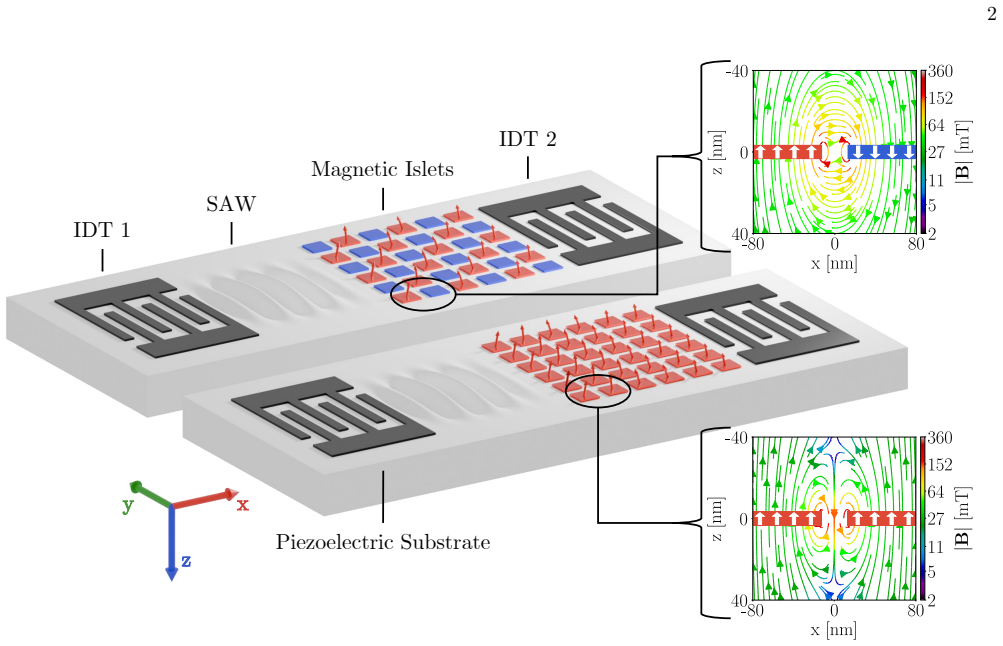
By programming the magnetic state of exchange-decoupled Co/Ni islets that exhibit perpendicular magnetic anisotropy, the stray-field interaction between islets shifts the spin-wave dispersion and thereby modulates the strength of magnetoelastic interaction with the Rayleigh surface acoustic wave mode; this produces changes in SAW transmission of 52.0 dB/mm at 3.8 GHz between different programmed states.
What carries the argument
Magnetoelastic coupling between the Rayleigh SAW mode and spin waves whose dispersion is shifted by stray-field interactions arising from the programmed alignment of neighboring perpendicularly anisotropic islets.
If this is right
- Reconfiguring the filter response requires only magnetic programming of the islets rather than mechanical or lithographic changes.
- The same islet layout can provide different frequency-selective attenuation profiles by switching between stable magnetic configurations.
- Finite-difference modeling of arbitrary magnetization patterns enables rapid exploration of more complex islet geometries or arrangements.
- The 52 dB/mm contrast at 3.8 GHz implies strong on/off ratios over millimeter-scale propagation lengths suitable for integrated devices.
Where Pith is reading between the lines
- Integration with spintronic writing elements could allow fully electrical, non-volatile control of the acoustic filter state.
- The method may generalize to other magnetoelastic systems or wave modes such as Lamb waves on different piezoelectric substrates.
- Direct comparison of the numerical predictions with time-resolved magnetoelastic experiments would test the accuracy of the energy-conservation extension.
Load-bearing premise
Extending the prior energy-conservation argument to finite-difference calculations for arbitrary magnetization patterns in the islet geometry preserves accuracy without separate validation against full micromagnetic dynamics.
What would settle it
Fabricate the islet array on LiTaO3, program two different magnetic alignment states, measure the actual SAW transmission difference at 3.8 GHz, and check whether it reaches or deviates substantially from the predicted 52 dB/mm contrast.
Figures



read the original abstract
Filtering surface acoustic wave (SAW) signals of specified frequencies depending on the strength of an external magnetic field in a magnetostrictive material has garnered significant interest due to its potential scientific and industrial applications. Here, we propose a device that achieves selective SAW attenuation by instead programming its internal magnetic state. To this end, we perform micromagnetic simulations for the magnetoelastic interaction of the Rayleigh SAW mode with spin waves (SWs) in exchange-decoupled Co/Ni islets on a piezoelectric LiTaO$_3$ substrate. Due to the islets exhibiting perpendicular magnetic anisotropy, the stray-field interaction between them leads to a shift in the SW dispersion depending on the magnetic alignment of neighboring islets. This significantly changes the efficiency of the magnetoelastic interaction at specified frequencies. We predict changes in SAW transmission of 52.0 dB/mm at 3.8 GHz depending on the state of the device. For the efficient simulation of the device, we extend a prior energy conservation argument based on analytical solutions of the SW to finite-difference numerical calculations, enabling the modeling of arbitrary magnetization patterns like the proposed islet-based design.
Editorial analysis
A structured set of objections, weighed in public.
Referee Report
Summary. The manuscript proposes a device concept for magnetically programmable SAW filters consisting of exchange-decoupled Co/Ni islets with perpendicular magnetic anisotropy on a LiTaO3 piezoelectric substrate. Micromagnetic simulations of the magnetoelastic coupling between the Rayleigh SAW mode and spin waves are used to show that stray-field interactions between islets shift the SW dispersion depending on the programmed magnetic alignment of neighboring islets, thereby modulating the interaction efficiency at specific frequencies. The central quantitative result is a predicted change in SAW transmission of 52.0 dB/mm at 3.8 GHz. To treat arbitrary (non-uniform) magnetization patterns in the islet geometry, the authors extend a prior analytical energy-conservation argument to finite-difference numerical calculations.
Significance. If the central prediction is confirmed, the work would constitute a meaningful step toward field-programmable magnetoacoustic filters with potential utility in reconfigurable RF signal processing. The methodological extension of the energy argument to finite-difference numerics for complex magnetization textures is a practical contribution that broadens the applicability of the earlier analytical framework.
major comments (2)
- [Modeling section (extension of energy argument to finite-difference calculations)] The quantitative prediction of a 52 dB/mm transmission change at 3.8 GHz rests on the finite-difference implementation of the extended energy-conservation argument for arbitrary islet magnetization patterns. No benchmarking of this numerical extension against full time-dependent micromagnetic simulations that solve the coupled LLG equation including magnetoelastic driving terms is reported. Such a cross-check is required to establish that the method preserves the accuracy of the original analytical argument for the geometries and frequencies considered.
- [Results (transmission change prediction)] The reported value of 52.0 dB/mm is presented as a point estimate without accompanying error bars, sensitivity analysis with respect to the free parameters (perpendicular anisotropy constant and saturation magnetization), or direct comparison to experimental SAW transmission data on comparable structures.
minor comments (1)
- [Device geometry description] Clarify in the text whether the 52 dB/mm figure is obtained for a specific islet size, spacing, or film thickness, or whether it represents a normalized per-unit-length value independent of those geometric details.
Simulated Author's Rebuttal
We thank the referee for the detailed and constructive review of our manuscript. We address the major comments point by point below and outline the revisions we will make to strengthen the paper.
read point-by-point responses
-
Referee: [Modeling section (extension of energy argument to finite-difference calculations)] The quantitative prediction of a 52 dB/mm transmission change at 3.8 GHz rests on the finite-difference implementation of the extended energy-conservation argument for arbitrary islet magnetization patterns. No benchmarking of this numerical extension against full time-dependent micromagnetic simulations that solve the coupled LLG equation including magnetoelastic driving terms is reported. Such a cross-check is required to establish that the method preserves the accuracy of the original analytical argument for the geometries and frequencies considered.
Authors: We agree with the referee that benchmarking the numerical extension is important for validating the approach. The original analytical energy-conservation argument was previously validated against time-dependent simulations in the referenced prior work. Our finite-difference implementation discretizes this argument while preserving the energy balance for arbitrary magnetization patterns. To address this concern, we will add a new subsection in the Methods or Modeling section that benchmarks the finite-difference method against full micromagnetic simulations (solving the coupled LLG with magnetoelastic terms) for a simplified uniform magnetization case at the relevant frequency. This will demonstrate consistency within numerical tolerances. revision: yes
-
Referee: [Results (transmission change prediction)] The reported value of 52.0 dB/mm is presented as a point estimate without accompanying error bars, sensitivity analysis with respect to the free parameters (perpendicular anisotropy constant and saturation magnetization), or direct comparison to experimental SAW transmission data on comparable structures.
Authors: We acknowledge that presenting the result as a point estimate without uncertainty quantification or sensitivity analysis limits the robustness assessment. In the revised manuscript, we will include error bars derived from variations in the simulation parameters and perform a sensitivity analysis with respect to the perpendicular anisotropy constant and saturation magnetization, reporting how the transmission change varies within physically reasonable ranges. Regarding direct comparison to experimental data, this work is a predictive modeling study proposing a new device concept. While we cannot provide data on the exact proposed structure (as it has not been fabricated), we will add comparisons to experimental SAW transmission measurements in comparable magnetoelastic systems from the literature to contextualize our predictions. revision: partial
Circularity Check
Micromagnetic simulation of magnetoelastic coupling yields independent prediction of SAW transmission changes
full rationale
The paper derives its headline prediction of a 52.0 dB/mm SAW transmission change at 3.8 GHz via micromagnetic simulations of Rayleigh SAW-spin wave interactions in the Co/Ni islet geometry on LiTaO3. It extends a prior analytical energy-conservation argument to finite-difference numerics solely to accommodate arbitrary (non-uniform) magnetization patterns. This is a standard computational modeling step using material parameters drawn from established values, not a fit to the target observable or a definitional reduction of the output to the inputs. The derivation chain remains self-contained and does not collapse to any of the enumerated circularity patterns.
Axiom & Free-Parameter Ledger
free parameters (2)
- perpendicular magnetic anisotropy constant
- saturation magnetization
axioms (1)
- domain assumption The Rayleigh SAW mode interacts with spin waves via magnetoelastic coupling whose strength is captured by the extended energy-conservation relation.
Lean theorems connected to this paper
-
IndisputableMonolith/Cost/FunctionalEquation.leanwashburn_uniqueness_aczel unclear?
unclearRelation between the paper passage and the cited Recognition theorem.
we extend a prior energy conservation argument based on analytical solutions of the SW to finite-difference numerical calculations
What do these tags mean?
- matches
- The paper's claim is directly supported by a theorem in the formal canon.
- supports
- The theorem supports part of the paper's argument, but the paper may add assumptions or extra steps.
- extends
- The paper goes beyond the formal theorem; the theorem is a base layer rather than the whole result.
- uses
- The paper appears to rely on the theorem as machinery.
- contradicts
- The paper's claim conflicts with a theorem or certificate in the canon.
- unclear
- Pith found a possible connection, but the passage is too broad, indirect, or ambiguous to say the theorem truly supports the claim.
Reference graph
Works this paper leans on
-
[1]
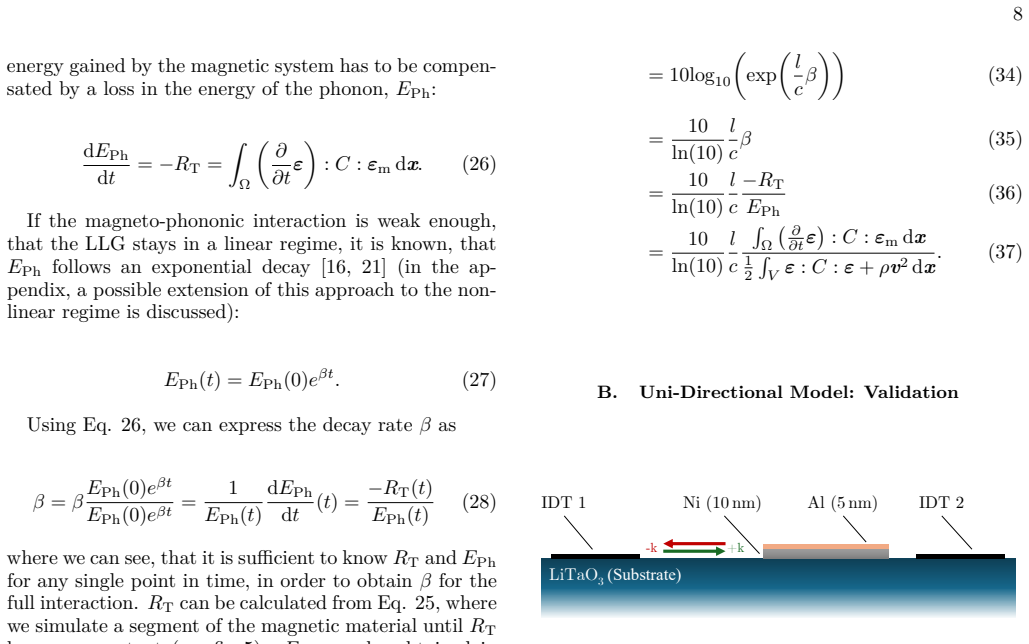
i =j 3 2λsmimj i̸=j (4) whereC is the stiffness tensor, λs the saturation magne- tostriction, ε the strain associated with the displacement, εm the strain associated with the local magnetization and ”:” denotes the Frobenius inner product. In Eq. (4), a polycrystalline material with at least cubic symmetry was assumed. EM and Heff can then be expressed by...
-
[2]
and the magnetic parameters can be seen in Tab. III [21]. 9 -60 -30 0 30 60 -60 -30 0 30 60φH [°] (a) ∆S21 [dB] -60 -30 0 30 60 -60 -30 0 30 60 (b) ∆S12 [dB] -60 -30 0 30 60 -60 -30 0 30 60 (c) ∆S21 □ ∆S12 [dB] -60 -30 0 30 60 µ0Hext [mT] -60 -30 0 30 60φH [°] (d) -60 -30 0 30 60 µ0Hext [mT] -60 -30 0 30 60 (e) -60 -30 0 30 60 µ0Hext [mT] -60 -30 0 30 60 ...
-
[3]
[kA/m] [pJ/m] [kJ/m 3] [ ◦] [kJ/m 3] [10 −6] 0.069 408.0 7.7 0.28 83.6 23.8 -18.39 Here,KOOP u was fitted, such that the peak absorption for ϕH = 45◦occurs at the same µ0Hext as the experiment (−46 mT). λs was then determined by matching simula- tion results for ∆S21 (µ0Hext =−46 mT, ϕH = 45◦) with the experimental value. This was done, because λs was not...
-
[4]
The micromagnetic simulation and the experimental results show excellent agreement not only qualitatively but also quantitatively for both directions of SAW travel. The expected four-fold symmetry is clearly present, as well as the non-reciprocity between the two directions of travel. The validation took a total of ≈100 hours on an NVIDIA A100 (80GB) GPU,...
-
[5]
D. Morgan, History of saw devices, in Proceedings of the 1998 IEEE International Frequency Control Symposium (Cat. No.98CH36165) (1998) pp. 439–460
work page 1998
-
[6]
D. Morgan, Surface Acoustic Wave Filters: With Appli- cations to Electronic Communications and Signal Pro- cessing, Studies in Electrical and Electronic Engineering (Academic Press, 2010)
work page 2010
-
[7]
C. Campbell, Surface Acoustic Wave Devices and Their Signal Processing Applications (Academic Press, 2012)
work page 2012
-
[8]
R. M. White and F. W. Voltmer, Direct piezoelectric coupling to surface elastic waves, Applied Physics Letters 7, 10.1063/1.1754276 (1965)
- [9]
-
[10]
P. Chen, G. Li, and Z. Zhu, Development and application of saw filter (2022)
work page 2022
-
[11]
P. Delsing, A. N. Cleland, M. J. Schuetz, J. Kn¨ orzer, G. Giedke, J. I. Cirac, K. Srinivasan, M. Wu, K. C. Bal- ram, C. Ba¨ uerle, T. Meunier, C. J. Ford, P. V. Santos, E. Cerda-M´ endez, H. Wang, H. J. Krenner, E. D. Nys- ten, M. Weiß, G. R. Nash, L. Thevenard, C. Gourdon, P. Rovillain, M. Marangolo, J. Y. Duquesne, G. Fischer- auer, W. Ruile, A. Reiner...
-
[12]
D. Mandal and S. Banerjee, Surface acousticwave (saw) sensors: Physics, materials, and applications, Sensors 22, 10.3390/s22030820 (2022)
-
[13]
X. Ding, S. C. S. Lin, B. Kiraly, H. Yue, S. Li, I. K. Chiang, J. Shi, S. J. Benkovic, and T. J. Huang, On- chip manipulation of single microparticles, cells, and or- 10 ganisms using surface acoustic waves, Proceedings of the National Academy of Sciences of the United States of America 109, 10.1073/pnas.1209288109 (2012)
-
[14]
J. Rufo, F. Cai, J. Friend, M. Wiklund, and T. J. Huang, Acoustofluidics for biomedical applications, Nature Re- views Methods Primers 2, 10.1038/s43586-022-00109-7 (2022)
-
[15]
B. Luo, P. Velvaluri, Y. Liu, and N.-X. Sun, Magneto- electric baw and saw devices: A review, Micromachines 15, 10.3390/mi15121471 (2024)
-
[16]
D. A. Bozhko, V. I. Vasyuchka, A. V. Chumak, and A. A. Serga, Magnon-phonon interactions in magnon spintronics (review article), Low Temperature Physics 46, 10.1063/10.0000872 (2020)
-
[17]
W. G. Yang and H. Schmidt, Acoustic control of magnetism toward energy-efficient applications, Applied Physics Reviews 8, 10.1063/5.0042138 (2021)
-
[18]
J. Puebla, Y. Hwang, S. Maekawa, and Y. Otani, Per- spectives on spintronics with surface acoustic waves, Ap- plied Physics Letters 120, 10.1063/5.0093654 (2022)
-
[19]
M. Weiler, L. Dreher, C. Heeg, H. Huebl, R. Gross, M. S. Brandt, and S. T. Goennenwein, Elastically driven ferro- magnetic resonance in nickel thin films, Physical Review Letters 106, 10.1103/PhysRevLett.106.117601 (2011)
-
[20]
L. Dreher, M. Weiler, M. Pernpeintner, H. Huebl, R. Gross, M. S. Brandt, and S. T. Goennenwein, Sur- face acoustic wave driven ferromagnetic resonance in nickel thin films: Theory and experiment, Physical Re- view B - Condensed Matter and Materials Physics 86, 10.1103/PhysRevB.86.134415 (2012)
-
[21]
X. Li, D. Labanowski, S. Salahuddin, and C. S. Lynch, Spin wave generation by surface acoustic waves, Journal of Applied Physics 122, 10.1063/1.4996102 (2017)
- [22]
-
[23]
Y. Kunz, M. K¨ uß, M. Schneider, M. Geilen, P. Pirro, M. Albrecht, and M. Weiler, Coherent surface acoustic wave–spin wave interactions detected by micro-focused brillouin light scattering spectroscopy, Applied Physics Letters 124, 152403 (2024)
work page 2024
-
[24]
K. Yamamoto, M. Xu, J. Puebla, Y. Otani, and S. Maekawa, Interaction between surface acoustic waves and spin waves in a ferromagnetic thin film, Journal of Magnetism and Magnetic Materials 545, 168672 (2022)
work page 2022
-
[25]
M. K¨ uß, M. Heigl, L. Flacke, A. Hefele, A. H¨ orner, M. Weiler, M. Albrecht, and A. Wixforth, Symmetry of the magnetoelastic interaction of rayleigh and shear horizontal magnetoacoustic waves in nickel thin films on litao3, Physical Review Applied 15, 10.1103/Phys- RevApplied.15.034046 (2021)
-
[26]
D. A. Bas, R. Verba, P. J. Shah, S. Leontsev, A. Matyushov, M. J. Newburger, N. X. Sun, V. Tyberke- vich, A. Slavin, and M. R. Page, Nonreciprocity of phase accumulation and propagation losses of surface acoustic waves in hybrid magnetoelastic heterostructures, Phys. Rev. Appl. 18, 044003 (2022)
work page 2022
-
[27]
E. M. Lifshitz and L. D. Landau, On the theory of dis- persion of magnetic permeabilty in ferromagnetic bodies, Phys. Zeitsch. der Sow. 8 (1935)
work page 1935
-
[28]
T. L. Gilbert, A lagrangian formulation of the gyromag- netic equation of the magnetic field, Phys. Rev. 100 (1955)
work page 1955
-
[29]
C. Abert, Micromagnetics and spintronics: models and numerical methods, European Physical Journal B 92, 10.1140/epjb/e2019-90599-6 (2019)
-
[30]
Y. C. Shu, M. P. Lin, and K. C. Wu, Mi- cromagnetic modeling of magnetostrictive materials under intrinsic stress, Mechanics of Materials 36, 10.1016/j.mechmat.2003.04.004 (2004)
-
[31]
J. X. Zhang and L. Q. Chen, Phase-field microelasticity theory and micromagnetic simulations of domain struc- tures in giant magnetostrictive materials, Acta Materialia 53, 10.1016/j.actamat.2005.03.002 (2005)
-
[32]
S. Chikazumi and C. Graham, Physics of Ferromag- netism 2e, International Series of Monographs on Physics (OUP Oxford, 2009)
work page 2009
-
[33]
C. Y. Liang, S. M. Keller, A. E. Sepulveda, A. Bur, W. Y. Sun, K. Wetzlar, and G. P. Carman, Model- ing of magnetoelastic nanostructures with a fully cou- pled mechanical-micromagnetic model, Nanotechnology 25, 10.1088/0957-4484/25/43/435701 (2014)
-
[34]
F. Vanderveken, J. Mulkers, J. Leliaert, B. V. Waeyen- berge, B. Sor´ ee, O. Zografos, F. Ciubotaru, and C. Adelmann, Finite difference magnetoelastic simu- lator, Open Research Europe 1, 10.12688/openreseu- rope.13302.1 (2021)
-
[35]
M. K¨ uß, M. Heigl, L. Flacke, A. H¨ orner, M. Weiler, M. Albrecht, and A. Wixforth, Nonreciprocal dzyaloshinskii-moriya magnetoacoustic waves, Physical Review Letters 125, 10.1103/PhysRevLett.125.217203 (2020)
-
[36]
F. Bruckner, S. Koraltan, C. Abert, and D. Suess, mag- num.np: a pytorch based gpu enhanced finite differ- ence micromagnetic simulation framework for high level development and inverse design, Scientific Reports 13, 10.1038/s41598-023-39192-5 (2023)
-
[37]
L. You, R. C. Sousa, S. Bandiera, B. Rodmacq, and B. Dieny, Co/ni multilayers with perpendicular anisotropy for spintronic device applications, Applied Physics Letters 100, 10.1063/1.4704184 (2012)
-
[38]
X. D. He, L. L. Zhang, G. J. Wu, J. W. Gao, P. Ran, M. Sajjad, X. W. Zhou, J. W. Cao, L. Xi, Y. L. Zuo, and Y. Ren, Controllable intrinsic gilbert damping in pt buffered [co/ni]n multilayers with enhanced perpen- dicular magnetic anisotropy, Journal of Magnetism and Magnetic Materials 519, 10.1016/j.jmmm.2020.167429 (2021)
-
[39]
S. Mizukami, X. Zhang, T. Kubota, H. Naganuma, M. Oogane, Y. Ando, and T. Miyazaki, Gilbert damp- ing in ni/co multilayer films exhibiting large per- pendicular anisotropy, Applied Physics Express 4, 10.1143/APEX.4.013005 (2011)
-
[40]
D. B. Gopman, P. Chen, J. W. Lau, A. C. Chavez, G. P. Carman, P. Finkel, M. Staruch, and R. D. Shull, Large Interfacial Magnetostriction in (Co/Ni)4/Pb(Mg1/3Nb2/3)O3-PbTiO3 Multiferroic Heterostructures, ACS Applied Materials and Interfaces 10, 10.1021/acsami.8b06249 (2018)
-
[41]
E. Klokholm and J. Aboaf, The saturation magnetostric- tion of thin polycrystalline films of iron, cobalt, and nickel, Journal of Applied Physics 53, 10.1063/1.330930 (1982)
-
[42]
K. E. Kim and C. H. Yang, Local magnetostriction mea- surement in a cobalt thin film using scanning probe mi- croscopy, AIP Advances 8, 10.1063/1.5043466 (2018). 11
-
[43]
T. M. Project, Materials Data on Co by Materials Project 10.17188/1186809 (2020)
-
[44]
T. M. Project, Materials Data on Ni by Materials Project 10.17188/1199153 (2020)
-
[45]
A. Jain, S. P. Ong, G. Hautier, W. Chen, W. D. Richards, S. Dacek, S. Cholia, D. Gunter, D. Skinner, G. Ceder, and K. A. Persson, Commentary: The materials project: A materials genome approach to accelerating materials innovation, APL Materials 1, 10.1063/1.4812323 (2013)
-
[46]
T. M. Project, Materials Data on Ta by Materials Project 10.17188/1208553 (2020)
-
[47]
T. M. Project, Materials Data on Pt by Materials Project 10.17188/1189002 (2020)
-
[48]
G. Venkat, D. Kumar, M. Franchin, O. Dmytriiev, M. Mruczkiewicz, H. Fangohr, A. Barman, M. Krawczyk, and A. Prabhakar, Proposal for a standard mi- cromagnetic problem: Spin wave dispersion in a magnonic waveguide, IEEE Transactions on Magnetics 49, 10.1109/TMAG.2012.2206820 (2013)
-
[49]
M. Krawczyk and D. Grundler, Review and prospects of magnonic crystals and devices with reprogrammable band structure, Journal of Physics Condensed Matter26, 10.1088/0953-8984/26/12/123202 (2014)
-
[50]
K. Nakamura, M. Kazumi, and H. Shimizu, SH-Type and Rayleigh-Type Surface Waves on Rotated Y-Cut LiTaO3, in 1977 Ultrasonics Symposium (1977) pp. 819–822
work page 1977
-
[51]
M. M. Sonner, F. Khosravi, L. Janker, D. Rudolph, G. Koblm¨ uller, Z. Jacob, and H. J. Krenner, Ultra- fast electron cycloids driven by the transverse spin of a surface acoustic wave, Science Advances 7, 10.1126/sci- adv.abf7414 (2021)
-
[52]
S. Maekawa and M. Tachiki, Surface acoustic attenuation due to surface spin wave in ferro- and antiferromagnets, AIP Conference Proceedings 29, 542 (1976)
work page 1976
-
[53]
L. D. Landau, E. M. Lifshitz, J. B. Sykes, W. H. Reid, and E. H. Dill, Theory of elasticity: Vol. 7 of course of theoretical physics, Physics Today13, 10.1063/1.3057037 (1960)
-
[54]
COMSOL, COMSOL Multiphysics ® v. 6.2.0.339, www. comsol.com, COMSOL AB, Stockholm, Sweden
-
[55]
T. M. Project, Materials Data on LiTaO 3 by Materials Project 10.17188/1207210 (2020)
-
[56]
M. Weiß, A. L. H¨ orner, E. Zallo, P. Atkinson, A. Rastelli, O. G. Schmidt, A. Wixforth, and H. J. Krenner, Mul- tiharmonic frequency-chirped transducers for surface- acoustic-wave optomechanics, Phys. Rev. Appl.9, 014004 (2018)
work page 2018
-
[57]
W. P. Robbins, A simple method of approximating sur- face acoustic wave power densities, IEEE Transactions on Sonics and Ultrasonics 24, 10.1109/T-SU.1977.30956 (1977). Appendix A: Uni-Directional Model: Extension to non-linear excitations The uni-directional model could be extended to non- linear regions of the LLG, where the exponential ansatz no longer...
discussion (0)
Sign in with ORCID, Apple, or X to comment. Anyone can read and Pith papers without signing in.