REVIEW 2 major objections 4 minor 79 references
Analysis of untrusted-node quantum key distribution from a geostationary satellite
T0 review · 2 major / 4 minor · reviewed 2026-08-06 · deepseek-v4-flash
Pith's one-line read A single geostationary satellite carrying two 50 cm telescopes could support untrusted-node quantum key distribution with terrestrial stations of 20 cm to 1 m aperture, achieving secret-key rates of a few hundred bits per second with…
desk verdict First serious rate estimates for GEO untrusted-node TF/MP-QKD; results hinge on simulated MMSE gain and optimistic detector assumptions, but the paper is careful and deserves peer review. read the letter →
The pith
A machine-rendered reading of the paper's core claim, the machinery that carries it, and where it could break.
The reading
What carries the argument
The carrying mechanism is a reciprocity identity: the coupling efficiency of the precompensated uplink into the satellite receiver equals the coupling of the satellite receiver mode back-propagated to the ground and coupled to the transmitter mode, evaluated at the point-ahead angle. This turns the GEO uplink with adaptive-optics correction into a downlink problem solvable with known phase and log-amplitude statistics, with a numerical overlap integral as the final step. The paper compares a standard on-axis phase correction with an MMSE estimator that reconstructs the phase at the point-ahead angle from downlink phase and amplitude measurements. The resulting per-channel efficiency distributions are convolved with satellite-jitter losses and fixed losses to form the probability distribution of transmission efficiency $\tau$, which is then fed into square-root-scaling secret-key-rate models for sending-or-not-sending TF-QKD and MP-QKD; a Gaussian phase-drift model with standard deviation $\sigma_{\mathrm{fs}}=150$ rad/s sets the phase-locking requirement for TF-QKD and the optimal maximal pairing length $L_{\mathrm{max}}$ for MP-QKD.
What would settle it
Measure the uplink coupling efficiency of a 1 m ground station with MMSE precompensation to a GEO terminal at 30° elevation and 1550 nm under turbulence comparable to the model's ($r_0=25$ cm, $\theta_0=8.51\ \mu$rad). If the mean turbulence coupling falls below the simulated value of about $0.56$ or the mean one-way channel attenuation stays above roughly $60$ dB, the predicted few-hundred-bit/s rates would not survive; a free-space phase drift several times larger than the assumed $150$ rad/s would likewise break the TF-QKD phase-locking and MP-QKD pairing assumptions.
Extended reading notes
Core claim
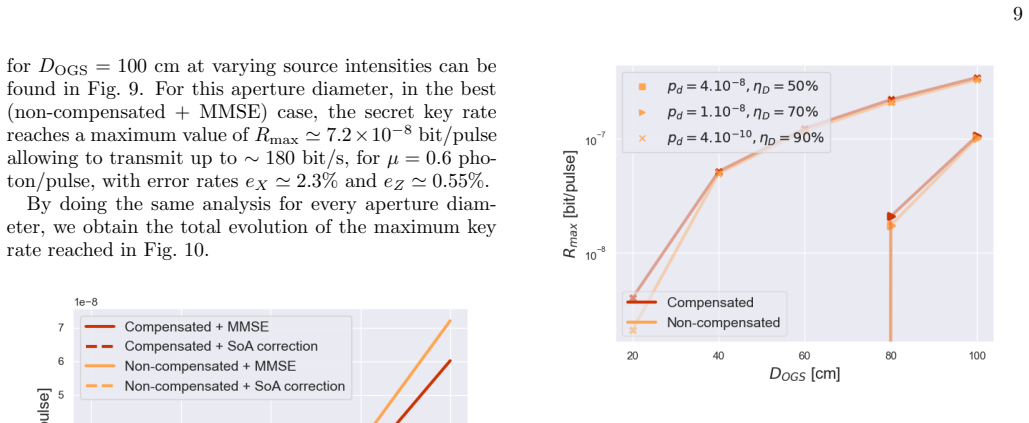
The paper's central claim is that a GEO satellite carrying two 50 cm telescopes can act as an untrusted measurement node for TF-QKD and MP-QKD with practical ground stations. Using the simulated channel model with MMSE adaptive-optics precompensation, the optimum secret-key rate at 1 m ground apertures is about $260$ bit/s for TF-QKD and $180$ bit/s for MP-QKD when detectors have 70% efficiency and dark-count probability $10^{-8}$; with detector parameters matching ground-based superconducting nanowire detectors (90% efficiency, dark-count probability $4\times10^{-10}$), both protocols give positive rates down to 20 cm apertures, reaching $822$ bit/s for TF-QKD and $280$ bit/s for MP-QKD at 1 m. With currently demonstrated space-qualified detector parameters (50% efficiency, 100 Hz dark count), only MP-QKD with 1 m ground stations gives a positive rate, $17$ bit/s. The authors conclude that detector performance and advanced adaptive-optics correction, rather than telescope size, set the feasibility boundary for a scalable GEO untrusted-node QKD service.
Load-bearing premise
The load-bearing premise is that the advanced MMSE adaptive-optics precompensation achieves in a real GEO uplink the coupling efficiencies the simulation assigns to it; with only standard correction the model predicts no positive key rate at any studied aperture.
Editorial extensions
If this is right
- With 1 m ground stations and MMSE precompensation, the predicted maximum rates are ~260 bit/s for TF-QKD and ~180 bit/s for MP-QKD under the optimistic realistic detector scenario (70% efficiency, dark-count probability $10^{-8}$).
- Under the currently demonstrated space-detector parameters (50% efficiency, 100 Hz dark count), the model still yields 17 bit/s for MP-QKD with two 1 m stations, so a positive-rate GEO link is within reach of present hardware.
- If space detectors reach ground-commercial performance (90% efficiency, 1 Hz dark count), both protocols give positive rates down to 20 cm ground apertures, with rates of 822 bit/s (TF-QKD) and 280 bit/s (MP-QKD) at 1 m.
- With standard, non-MMSE adaptive-optics correction, the model finds no positive key rate at any studied aperture, making the advanced precompensation a necessary ingredient of the predicted performance.
- MP-QKD achieves the same order of magnitude of key rate as TF-QKD without global phase locking, which the paper identifies as a practical advantage for space deployment.
Reading between the lines
- A consequence the paper leaves implicit is network-level: the same per-link rates, combined with GEO coverage geometry, imply a single satellite could act as a key-distribution hub for many small ground stations, with total throughput set by detector dark counts and scheduling rather than by telescope size.
- The detector comparison sets a concrete technology target: space-qualified SNSPDs with dark-count probability below about $10^{-8}$ and efficiency above about 70% would make the 20 cm terminal viable, a threshold that a dedicated space-demonstration mission could test before committing to a full QKD service.
- The assumed free-space phase-drift standard deviation of $150$ rad/s implies TF-QKD phase locking over GEO needs only millisecond-scale feedback; an experimental measurement of the drift on a real GEO uplink would settle whether phase locking is a modest engineering task or a dominant cost.
Signed reviews
Editorial analysis
A structured set of objections, weighed in public.
Referee Report
Summary. The paper analyzes the feasibility of untrusted-node satellite QKD using twin-field (TF) and mode-pairing (MP) protocols with a geostationary satellite as the central untrusted node. It develops an end-to-end channel model that includes atmospheric turbulence with adaptive optics (SoA and MMSE pre-compensation), satellite pointing jitter, geometrical/absorption/system losses, and detector dark counts and efficiency. The authors simulate the probability distribution of the end-to-end transmission efficiency and compute asymptotic secret key rates for TF-QKD and MP-QKD for ground telescope apertures from 20 cm to 1 m, under three detector scenarios (optimistic, pessimistic/space-demonstrated, and idealized). They find, in the optimistic scenario, maximum rates around 260 bit/s (TF) and 180 bit/s (MP) at 1 m apertures, and positive rates at 20 cm only for the idealized detector parameters; with only state-of-the-art AO correction no positive key rate is found for any aperture.
Significance. This is one of the first detailed end-to-end simulations of an untrusted-node GEO satellite QKD architecture with small-aperture ground telescopes. The work is thorough in its channel modeling: it uses the reciprocity principle for pre-compensated uplinks, a pseudo-analytical turbulence model, a realistic jitter model, and the established asymmetric TF and MP-QKD security formulas. It also compares multiple detector scenarios, which is useful for assessing technology roadmaps. The key-rate predictions are quantitative and falsifiable. However, the central feasibility claim is conditional on the MMSE adaptive-optics model (not independently validated here) and on the optimistic detector scenario for the headline numbers; these conditions must be clearly communicated.
major comments (2)
- [Abstract and Section IV C 3] The abstract's central claim of 'a few hundred bit/s for both TF and MP-QKD' 'considering realistic detectors' is not supported by the detector scenario that corresponds to currently demonstrated space technology. With the space-qualified detector parameters from [49] (pd=4e-8, etaD=50%), the paper reports positive rates only for MP-QKD with a 1 m OGS aperture, at 17 bit/s (Section IV C 3), and no positive rate for TF-QKD. The few-hundred-bit/s figures are obtained for the 'optimistic' scenario (pd=1e-8, etaD=70%), which the paper itself labels as not yet demonstrated in space, and for 20 cm apertures only the 'idealized' scenario (pd=4e-10, etaD=90%) yields positive rates. Please either present the demonstrated-technology rates as the headline or explicitly label the optimistic/idealized assumptions as future-technology projections in the abstract.
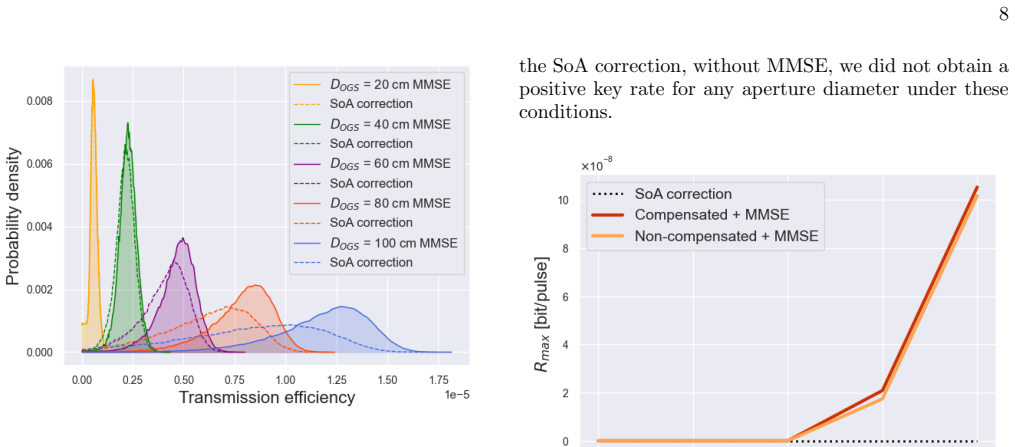
- [Section IV C 1 and Appendix A] Every positive key rate in the paper relies on the MMSE pre-compensation model: the paper states in Section IV C 1 that with SoA correction 'we did not obtain a positive key rate for any aperture diameter under these conditions.' The MMSE model is taken from the authors' previous work [32,62] and is not validated against an independent experiment or simulation in this manuscript. The residual covariance model in Eqs. (A14)-(A15) assumes known phase/amplitude statistics, no wavefront-sensor noise, no temporal error, and an exact point-ahead covariance; deviations from these idealizations would reduce the achieved coupling. Because the key rate is a threshold function of the tail of the PDTE, a modest overestimate of the MMSE gain (the mean coupling gain is only ~1.5 dB at 1 m, Table II) could eliminate the claimed positive rates. Please add a sensitivity analysis of the final key rates to the assumed MMSE residual variance (e.g., by scaling the covariance or adding uncorrected wavefront-sensor noise), and discuss how the results would degrade if MMSE performance fell between the SoA and ideal cases.
minor comments (4)
- [Appendix C, Eq. (C3)] The free-space phase-drift term e^{-sigma_fs^2 Delta t^2/2} is inconsistent with the text stating sigma_fs is the per-channel drift. For two independent uplink channels, the difference Delta theta_fs,b - Delta theta_fs,a has variance 2 sigma_fs^2, so the exponent should be -sigma_fs^2 Delta t^2. As written, the phase error is underestimated by a factor of sqrt(2) in the standard deviation. The numerical impact is small for the parameters used here (sigma_fs Delta t << 1), but the formula and text should be reconciled.
- [Text before Eq. (C3)] The sentence 'the linewidth effect follows a Gaussian distribution with a standard deviation of sqrt(2) sigma_nu' is ambiguous: the sqrt(2) factor arises from the difference between Alice's and Bob's laser frequencies, not from the round index. Please rephrase to clarify which difference is being considered.
- [Section IV] The simulated key rates are point estimates from Monte Carlo sampling of the turbulence and jitter distributions, but the number of samples and the statistical uncertainty are not reported. Given that the 20 cm aperture cases lie near threshold, provide confidence intervals or at least state the number of Monte Carlo draws.
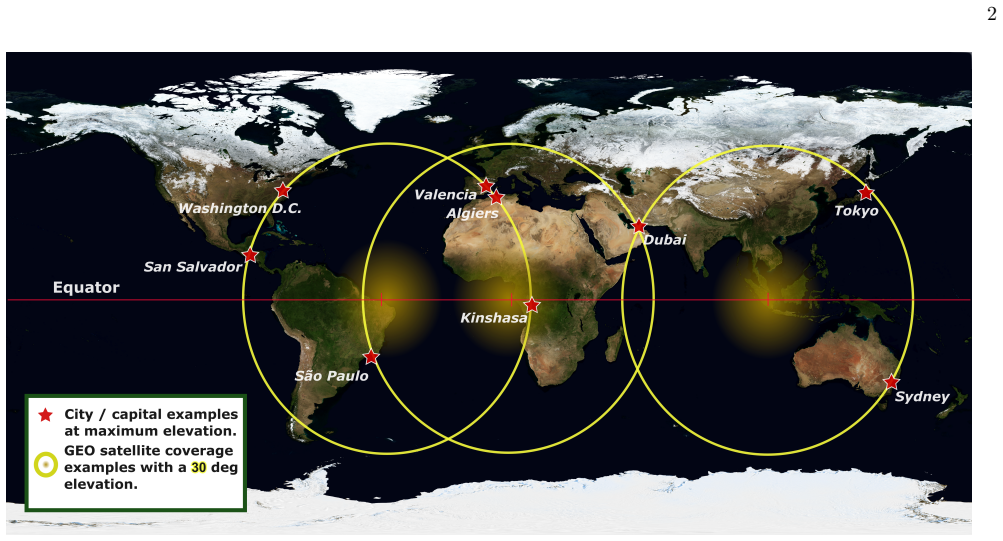
- [Section I] The claim that the GEO satellite coverage is 'approximately one-third of the planet's surface' is not quantified with a source; consider adding a reference or a clarifying calculation.
Circularity Check
No significant circularity: the QKD rates are computed from external protocol formulas and a prior AO channel model, with no target result assumed as an input.
full rationale
The paper's derivation chain is a forward simulation: Section II builds a channel model (Eq. 1) from independent loss factors; Eqs. (A3)-(A15) implement a reciprocity-based turbulence model whose MMSE reconstructor is taken from Ref. [32]; the QKD secret-key rates are computed with security models from Refs. [20,46] (Appendix B), decoy-state bounds, and phase-drift formulas from Refs. [17,51] (Appendix C). No equation in the paper defines a quantity in terms of the final key rate, and no fitted parameter is relabeled as a prediction: the parameters tau_abs, theta_jitter, p_d, eta_D, and sigma_fs are inputs with stated sources, and the intensity mu is optimized. The main caveat, namely that positive rates require the MMSE pre-compensation model and that with state-of-the-art correction no positive rate is obtained, is a robustness or validation issue rather than a circularity: the MMSE model was developed and published in prior work (Ref. [32]) by overlapping authors, but it does not assume the QKD rates derived here, and the present paper re-implements the published model instead of using the target result as an input. Similarly, Refs. [25,34,35,62] are self-citations that supply channel statistics and AO tools, but they are independent prior results that do not contain the present QKD-rate claim. No uniqueness theorem is invoked to forbid alternatives, and no known result is renamed as a new unification. The conditional dependence on simulated AO performance should be assessed as a scientific risk, not as circular reasoning.
Assumptions & free parameters
free parameters (9)
- free-space phase drift standard deviation sigma_fs =
150 rad/s per uplink channel
- optimistic detector scenario (dark count probability pd, detection efficiency etaD) =
pd=1e-8 (Y0=25 Hz), etaD=70%
- pessimistic space detector scenario =
pd=4e-8 (Y0=100 Hz), etaD=50%
- idealized space detector scenario =
pd=4e-10 (Y0=1 Hz), etaD=90%
- point-ahead angle alpha_PAA =
18.5 murad
- OGS static misalignment Delta_alpha =
0.2 murad
- satellite residual tracking jitter theta_jitter =
0.07 murad
- system fixed loss tau_syst =
2.8 dB
- atmospheric turbulence scenario =
r0=25 cm, theta0=8.51 murad, sigma_chi^2=0.03 at 1550 nm, 30 deg elevation
assumptions (6)
- domain assumption Total channel loss factorizes into independent turbulence, jitter, absorption, system, and geometric losses (Eq 1).
- domain assumption Reciprocity principle maps the AO-pre-compensated uplink coupling to a downlink coupling at the point-ahead angle (Eq A3).
- domain assumption Both OGS channels are statistically identical and asymmetries can be symmetrized by adding loss at Charlie or adjusting intensities (Section III).
- standard math Asymptotic decoy-state security models for TF-QKD (Ref [46]) and MP-QKD (Ref [20]) are valid.
- domain assumption MMSE estimator performance from Ref [32] transfers to the GEO QKD geometry and turbulence conditions.
- domain assumption Free-space phase drift is zero-mean Gaussian with sigma_fs=150 rad/s per channel, approximated from VERTIGO data (Fig 4).
Cite this review
Pith. "Pith review of Analysis of untrusted-node quantum key distribution from a geostationary satellite." pith.science (2026). https://pith.science/paper/RUPSFLOZ
@misc{pith2026250723466,
  author       = {Pith},
  title        = {Pith review of: Analysis of untrusted-node quantum key distribution from a geostationary satellite},
  year         = {2026},
  howpublished = {\url{https://pith.science/paper/RUPSFLOZ}},
  note         = {Machine review of arXiv:2507.23466}
}
read the original abstract
In pursuit of a global quantum key distribution (QKD) network, a service based on untrusted nodes on geostationary satellites could offer wide coverage, continuous operation, and enhanced security compared to the trusted node alternative. Although this scenario has been studied for entanglement-based protocols, such an approach would require large-area telescopes both on the ground and in space. In this work, we analyze the performance of two QKD protocols well adapted to this scenario, namely twin-field (TF) and mode-pairing (MP) QKD, which exhibit high resilience to high-loss channels. Leveraging an in-depth simulation of communication channels corrected with adaptive optics, we assess the expected secret key rates for both protocols in a configuration involving two 50 cm telescopes on board the satellite and ground-based telescopes ranging from 20 cm to 1 m in aperture. Our results show that, in the best case and considering realistic detectors, it is possible to achieve secret key rates on the order of a few hundred bit/s for both TF and MP-QKD. We show, notably, that secret key generation is potentially feasible even with 20 cm ground telescopes, highlighting the high scalability potential of such a configuration.
Figures


Figures from the paper (10 more)





Reference graph
Works this paper leans on
- [49]
-
[1]
Turbulence effects and beam pre-compensation A crucial element in determining the end-to-end trans- mission efficiency of a free-space communication system is the divergence of the beam and the spatial fluctua- tions of the optical pattern in the far-field plane. Al- though divergence close to the diffraction limit can be achieved by optical telescopes, t...
-
[2]
Satellite jitter model Next, we also model the fluctuating losses caused by the satellite pointing jitter by applying the reciprocity principle. This allows us to use tools from the litera- ture [33, 34] that apply to downlink scenarios. In a downlink scenario, the satellite jitter induces a random beam displacement around the ground station telescope ape...
-
[3]
The numerical comparison between the two correction schemes is given in Table II. We observe an increasing impact of the MMSE esti- mator on the quality of the coupling efficiency as the OGS aperture diameter increases. This can be explained by two factors. First, the MMSE estimator is a phase estimator and is therefore more efficient when the phase contr...
-
[4]
Twin-field QKD The evolution of the performance of TF-QKD, with re- spect to the average intensity used per pulse, is shown in Fig. 7 for DOGS = 100 cm. In this scenario, for the best (compensated + MMSE) case, the secret key rate reaches 8 FIG. 6. PDTE comparison for one channel with AO pre- compensation, considering the MMSE or the SoA correction, for d...
-
[5]
Mode-pairing QKD FIG. 9. MP-QKD secret key rate performance for DOGS = 100 cm. Other parameters are pd = 10−8, ηD = 70%, Lmin =
-
[6]
D. Elkouss, J. Martinez-Mateo, A. Ciurana, and V. Mar- tin, Journal of Optical Communications and Networking 5, 316 (2013)
work page 2013
-
[7]
An overall comparison for TF-QKD is given in Fig
Comparison with different SNSPD scenarios We further analyze the secret key rate performance as a function of the single-photon detector parameters using the values discussed in Section III C. An overall comparison for TF-QKD is given in Fig. 11 and for MP- QKD in Fig. 12. Considering the technology that is currently being de- veloped for space applicatio...
Show all 79 references
-
[8]
Bedington, J
R. Bedington, J. M. Arrazola, and A. Ling, npj Quantum Information 3, 30 (2017)
2017
-
[9]
Liao, W.-Q
S.-K. Liao, W.-Q. Cai, W.-Y. Liu, L. Zhang, Y. Li, J.-G. Ren, J. Yin, Q. Shen, Y. Cao, Z.-P. Li, et al. , Nature 549, 43 (2017)
2017
- [10]
-
[11]
H. Dai, Q. Shen, C.-Z. Wang, S.-L. Li, W.-Y. Liu, W.-Q. Cai, S.-K. Liao, J.-G. Ren, J. Yin, Y.-A. Chen, et al. , Nature Physics 16, 848 (2020)
2020
-
[12]
Salvail, M
L. Salvail, M. Peev, E. Diamanti, R. All´ eaume, N. L¨ utkenhaus, and T. L¨ anger, Journal of Computer Se- curity 18, 61 (2010)
2010
-
[13]
Liu, Z.-W
Y. Liu, Z.-W. Yu, W. Zhang, J.-Y. Guan, J.-P. Chen, C. Zhang, X.-L. Hu, H. Li, C. Jiang, J. Lin, et al., Phys- ical Review Letters 123, 100505 (2019)
2019
-
[14]
Huttner, R
B. Huttner, R. All´ eaume, E. Diamanti, F. Fr¨ owis, P. Grangier, H. H¨ ubel, V. Martin, A. Poppe, J. A. Slater, T. Spiller, et al., npj Quantum Information 8, 108 (2022)
2022
-
[15]
Fan-Yuan, F.-Y
G.-J. Fan-Yuan, F.-Y. Lu, S. Wang, Z.-Q. Yin, D.-Y. He, Z. Zhou, J. Teng, W. Chen, G.-C. Guo, and Z.-F. Han, Photonics Research 9, 1881 (2021)
2021
-
[16]
Y. Cao, Y. Zhao, J. Li, R. Lin, J. Zhang, and J. Chen, IEEE Journal on Selected Areas in Communications 39, 2701 (2021)
2021
-
[17]
G¨ unthner, I
K. G¨ unthner, I. Khan, D. Elser, B. Stiller,¨O. Bayraktar, C. R. M¨ uller, K. Saucke, D. Tr¨ ondle, F. Heine, S. Seel, et al. , Optica 4, 611 (2017)
2017
-
[18]
Wille, H
E. Wille, H. Hauschildt, C. Heese, J. Huesing, B. G. Gutierrez, Z. Sodnik, and C. Elia, in Free-Space Laser Communications XXXII , Vol. 11272 (SPIE, 2020) pp. 140–148
2020
-
[19]
Dirks, I
B. Dirks, I. Ferrario, A. Le Pera, D. V. Finocchiaro, M. Desmons, D. de Lange, H. de Man, A. J. Meskers, J. Morits, N. M. Neumann, et al. , in International Con- ference on Space Optics—ICSO 2020 , Vol. 11852 (SPIE,
2020
-
[20]
Z. Lu, G. Wang, C. Li, and Z. Cao, Physical Review A 109, 012401 (2024)
2024
-
[21]
Wang, Z.-W
X.-B. Wang, Z.-W. Yu, and X.-L. Hu, Physical Review A 98, 062323 (2018)
2018
-
[22]
Wang, Z.-Q
S. Wang, Z.-Q. Yin, D.-Y. He, W. Chen, R.-Q. Wang, P. Ye, Y. Zhou, G.-J. Fan-Yuan, F.-X. Wang, W. Chen, et al. , Nature photonics 16, 154 (2022)
2022
-
[23]
P. Zeng, H. Zhou, W. Wu, and X. Ma, Nature Commu- nications 13, 3903 (2022)
2022
-
[24]
H.-T. Zhu, Y. Huang, H. Liu, P. Zeng, M. Zou, Y. Dai, S. Tang, H. Li, L. You, Z. Wang, et al., Physical Review Letters 130, 030801 (2023)
2023
-
[25]
Minder, M
M. Minder, M. Pittaluga, G. L. Roberts, M. Lucamarini, J. F. Dynes, Z. Yuan, and A. J. Shields, Nature Photonics 13, 334 (2019)
2019
-
[26]
J.-P. Chen, C. Zhang, Y. Liu, C. Jiang, W. Zhang, X.-L. Hu, J.-Y. Guan, Z.-W. Yu, H. Xu, J. Lin, et al., Physical review letters 124, 070501 (2020)
2020
-
[27]
R. R. Parenti, J. M. Roth, J. H. Shapiro, F. G. Walther, and J. A. Greco, Optics express 20, 21635 (2012)
2012
-
[28]
Vedrenne, C
N. Vedrenne, C. Petit, A. Montmerle-Bonnefois, C. Lim, J.-M. Conan, L. Paillier, M.-T. Velluet, K. Caillault, F. Gustave, A. Durecu, et al. , in International Confer- ence on Space Optics—ICSO 2020 , Vol. 11852 (SPIE, 11
2020
-
[29]
Montmerle-Bonnefois, M.-T
A. Montmerle-Bonnefois, M.-T. Velluet, M. Ciss´ e, C. B. Lim, J.-M. Conan, C. Petit, J.-F. Sauvage, S. Meimon, P. Perrault, J. Montri, et al. , Optics Express 30, 47179 (2022)
2022
-
[30]
I. R. Hristovski, A. R. Campelo, B. Femen ´ ıa-Castella, E. Doensdorf-Sternal, A. O. Duliu, S. Haeusler, J. F. Holzman, K. Klemich, D. J. Laidlaw, T. Marynowski, et al., in Free-Space Laser Communications XXXVI, Vol. 12877 (SPIE, 2024) pp. 328–336
2024
-
[31]
V´ edrenne, A
N. V´ edrenne, A. Montmerle-Bonnefois, C. Petit, E. Cha- lali, Y. Lai-Tim, L. Krafft, J. Henrion, J. Houy, F. Gus- tave, K. Caillault, et al. , in ICSO 2024 (2024)
2024
-
[32]
Lognon´ e, Optimization of High Data Rate Ground to Satellite Links Pre-compensated by Adaptive Optics , Ph.D
P. Lognon´ e, Optimization of High Data Rate Ground to Satellite Links Pre-compensated by Adaptive Optics , Ph.D. thesis, Institut Polytechnique de Paris (2023)
2023
-
[33]
J. H. Shapiro and A. L. Puryear, Journal of Optical Com- munications and Networking 4, 947 (2012)
2012
-
[34]
V. M. Acosta, D. Dequal, M. Schiavon, A. Montmerle- Bonnefois, C. B. Lim, J.-M. Conan, and E. Diamanti, arXiv preprint arXiv:2411.09564 (2024)
2024 arXiv
-
[35]
H. Yao, C. Chen, X. Ni, S. Tong, B. Li, P. Chidike, Z. Liu, Y. Zhao, and H. Jiang, Optics express 27, 25000 (2019)
2019
-
[36]
Lognon´ e, A
P. Lognon´ e, A. M. Bonnefois, J.-M. Conan, L. Paillier, C. Petit, C. B. Lim, S. Meimon, J. Montri, J.-F. Sauvage, and N. V´ edrenne, in 2022 IEEE International Confer- ence on Space Optical Systems and Applications (ICSOS) (IEEE, 2022) pp. 261–266
2022
-
[37]
Robert, J.-M
C. Robert, J.-M. Conan, and P. Wolf, Phys. Rev. A 93, 033860 (2016)
2016
-
[38]
O. J. D. Farley, M. J. Townson, and J. Osborn, Opt. Express 30, 10.1364/OE.458659 (2022)
2022 doi
-
[39]
Lognon´ e, J.-M
P. Lognon´ e, J.-M. Conan, G. Rekaya, and N. V´ edrenne, Optics Express 31, 3441 (2023)
2023
-
[40]
D. Y. Vasylyev, A. Semenov, and W. Vogel, Physical re- view letters 108, 220501 (2012)
2012
-
[41]
Lucamarini, Z
M. Lucamarini, Z. L. Yuan, J. F. Dynes, and A. J. Shields, Nature 557, 400 (2018)
2018
-
[42]
V. M. Acosta, D. Dequal, M. Schiavon, A. Montmerle- Bonnefois, C. B. Lim, J.-M. Conan, and E. Diamanti, New Journal of Physics 26, 023039 (2024)
2024
-
[43]
Zhong, J
X. Zhong, J. Hu, M. Curty, L. Qian, and H.-K. Lo, Phys- ical Review Letters 123, 100506 (2019)
2019
-
[44]
Zhong, W
X. Zhong, W. Wang, L. Qian, and H.-K. Lo, npj Quan- tum Information 7, 8 (2021)
2021
-
[45]
Z. Li, T. Dou, M. Cheng, Y. Liu, and J. Tang, Optics Letters 49, 6609 (2024)
2024
-
[46]
Zhang, W
L. Zhang, W. Li, J. Pan, Y. Lu, W. Li, Z.-P. Li, Y. Huang, X. Ma, F. Xu, and J.-W. Pan, Physical Review X 15, 021037 (2025)
2025
-
[47]
Zhou, C.-H
X.-Y. Zhou, C.-H. Zhang, C.-M. Zhang, and Q. Wang, Physical Review A 99, 062316 (2019)
2019
-
[48]
J.-P. Chen, F. Zhou, C. Zhang, C. Jiang, F.-X. Chen, J. Huang, H. Li, L.-X. You, X.-B. Wang, Y. Liu, et al. , Physical Review Letters 132, 260802 (2024)
2024
-
[50]
Y.-H. Li, T. Zeng, M.-Y. Wang, C. Jiang, J. Lin, H.-B. Fu, X.-Y. Zheng, J.-P. Chen, Z.-S. Lin, C.-L. Li, et al. , arXiv preprint arXiv:2503.17744 (2025)
2025 arXiv
-
[51]
Takenaka, A
H. Takenaka, A. Carrasco-Casado, M. Fujiwara, M. Ki- tamura, M. Sasaki, and M. Toyoshima, Nature photonics 11, 502 (2017)
2017
-
[52]
J. Yin, Y. Cao, Y.-H. Li, S.-K. Liao, L. Zhang, J.-G. Ren, W.-Q. Cai, W.-Y. Liu, B. Li, H. Dai, et al., Science 356, 1140 (2017)
2017
-
[53]
Wang and H.-K
W. Wang and H.-K. Lo, New Journal of Physics 22, 013020 (2020)
2020
-
[54]
H.-T. Zhu, Y. Huang, W.-X. Pan, C.-W. Zhou, J. Tang, H. He, M. Cheng, X. Jin, M. Zou, S. Tang, et al., Optica 11, 883 (2024)
2024
-
[55]
Beesley, R
L. Beesley, R. Griffiths, K. Hartley, O. Farley, F. Qua- tresooz, A. Rodriguez-Gomez, A. Comeron, M. Town- son, D. Alaluf, and J. Osborn, Optics Express 33, 10140 (2025)
2025
-
[56]
L. You, J. Quan, Y. Wang, Y. Ma, X. Yang, Y. Liu, H. Li, J. Li, J. Wang, J. Liang, et al. , Optics Express 26, 2965 (2018)
2018
-
[57]
Le Kernec, L
A. Le Kernec, L. Canuet, A. Maho, M. Sotom, D. Mat- ter, L. Francou, J. Edmunds, M. Welch, E. Kehayas, N. Perlot, et al. , in International Conference on Space Optics—ICSO 2020 , Vol. 11852 (SPIE, 2021) pp. 508– 519
2020
-
[58]
Zhou, J.-R
X.-Y. Zhou, J.-R. Hu, C.-H. Zhang, and Q. Wang, Optics Letters 50, 249 (2025)
2025
-
[59]
Mengali, C
A. Mengali, C. I. Kourogiorgas, N. K. Lyras, B. Shankar Mysore Rama Rao, F. Kayhan, A. D. Panagopoulos, T. B¨ aumer, and K. Liolis, International Journal of Satel- lite Communications and Networking (2020)
2020
-
[60]
Osborn, R
J. Osborn, R. W. Wilson, M. Sarazin, T. But- terley, A. Chac´ on, F. Derie, O. J. D. Farley, X. Haubois, D. Laidlaw, M. LeLouarn, E. Masci- adri, J. Milli, J. Navarrete, and M. J. Townson, Monthly Notices of the Royal Astronomical Society 478, 825 (2018), https://academic.oup....
2018
-
[61]
Sprung and E
D. Sprung and E. Sucher, in Remote Sensing of Clouds and the Atmosphere XVIII; and Optics in Atmospheric Propagation and Adaptive Systems XVI, Vol. 8890 (SPIE,
-
[62]
Lognon´ e, J.-M
P. Lognon´ e, J.-M. Conan, L. Paillier, N. V´ edrenne, and G. Rekaya, in Signal Processing in Photonic Communi- cations (Optica Publishing Group, 2022) pp. SpTu3G–3. 12
2022
-
[63]
Conan, A
J.-M. Conan, A. Montmerle-Bonnefois, N. V´ edrenne, C. B. Lim, C. Petit, V. Michau, M.-T. Velluet, J.-F. Sauvage, S. Meimon, C. Robert, et al. , in COAT-2019- workshop (Communications and Observations through Atmospheric Turbulence: characterization and mitiga- tion) (2019)
2019
-
[64]
A. Berk, P. Conforti, R. Kennett, T. Perkins, F. Hawes, and J. Van Den Bosch, in 2014 6th Workshop on Hyper- spectral Image and Signal Processing: Evolution in Re- mote Sensing (WHISPERS) (IEEE, 2014) pp. 1–4
2014
-
[65]
Cantore, D
C. Cantore, D. Monopoli, A. Altamura, A. Mengali, M. Grande, and A. D’Orazio, Scientific Reports 14, 8579 (2024)
2024
-
[66]
Xu, Z.-W
H. Xu, Z.-W. Yu, C. Jiang, X.-L. Hu, and X.-B. Wang, Physical Review A 101, 042330 (2020)
2020
-
[67]
F. Mah´ e, Application d’un mod` ele atmosph´ erique ` a l’´ etude des fluctuations d’indice de r´ efraction dans la couche limite : influence de la scintillation sur l’analyse de front d’onde , Ph.D. thesis (2000)
2000
-
[68]
Chassat, Journal of Optics 20, 10.1088/0150- 536x/20/1/002 (1989)
F. Chassat, Journal of Optics 20, 10.1088/0150- 536x/20/1/002 (1989)
1989 doi
-
[70]
Canuet, N
L. Canuet, N. V´ edrenne, J.-M. Conan, C. Petit, G. Ar- taud, A. Rissons, and J. Lacan, JOSA A 35, 148 (2018)
2018
-
[71]
R. J. Sasiela, in Electromagnetic Wave Propagation in Turbulence (Springer, 1994) pp. 19–46
1994
-
[72]
D. L. Fried, JOSA 57, 169 (1967)
1967
-
[73]
Conan, Etude de la correction partielle en optique adaptative, Ph.D
J.-M. Conan, Etude de la correction partielle en optique adaptative, Ph.D. thesis, Paris 11 (1994)
1994
-
[74]
Roddier, Adaptive Optics in Astronomy (Cambridge University, 1999)
F. Roddier, Adaptive Optics in Astronomy (Cambridge University, 1999). Appendix A: Atmospheric turbulence induced losses model To simulate the turbulence impact on the optical link, we use a pseudo-analytical model - pseudo-analytical as we consider the phase and amplitude spa...
1999
-
[75]
Reciprocal uplink losses To model the uplink turbulence-induced losses, we adopt a reciprocal formalism. The reciprocity principle states that the coupling efficiency of an emitted mode, propagated and coupled to a receiver mode, is equal to the coupling efficiency of this rec...
-
[76]
Log-amplitude induced losses We assume the aperture averaged scintillation to dom- inate the log-amplitude contribution ρχ. Therefore, ρχ is expressed as [62, 63]: ρχ = e−σ2 χ e−2χAp , (A5) where e−σ2 χ is a static penalty term to account for the spa- tial log-amplitude fluctu...
-
[77]
T urbulent phase induced losses a. General expression The phase contribution to the coupling ρΦ is derived as the overlap integral of the complex field, neglecting the log-amplitude fluctuation, to the Gaussian mode M0(r), therefore expressed as: ρΦ = exp −σ2 super-fitting Z Z...
-
[78]
Security model for asymmetric twin-field QKD The model used was proposed in [46]. To compensate for asymmetry, the protocol suggests adjusting the signal intensities such that the arriving intensities at Charlie’s side are balanced, satisfying the condition: γA = α2 AηA, γ B =...
-
[79]
Security model for asymmetric mode-pairing QKD The model used was proposed in [20]. The key rate R, in the asymptotic case, is expressed as: R = rp(p, Lmax)rs q(1,1) 1 − H(e(1,1)) − fECH(eZ) , (B7) where rp(p, Lmax) is the pairing rate with p the successful click probability i...
-
[100]
For MP-QKD, it is also necessary to optimize the maximal pairing length Lmax
Lmin is the minimal pairing length introduced to account for the detector dead time; see Appendix B 2. For MP-QKD, it is also necessary to optimize the maximal pairing length Lmax. For each OGS aper- ture diameter, we scan the best key rate reached for Lmax ∈ [103, 106] and th...
Reviewed August 6, 2026 · model on record in the stance chip above.
Discussion (0). Continue with ORCID to comment.