REVIEW 2 major objections 6 minor 58 references
In-medium effects of nucleon-nucleon cross sections in heavy-ion collisions
T0 review · 2 major / 6 minor · reviewed 2026-08-06 · deepseek-v4-flash
Pith's one-line read In heavy-ion collisions, the standard effective-mass rescaling of the in-medium nucleon-nucleon cross section is insufficient; the full BHF cross section, including scattering-amplitude and total-momentum corrections, changes predictions…
desk verdict Useful sensitivity map of in-medium NN cross sections across heavy-ion observables, but the claimed K-dependence isolation is contaminated and the quantitative case is weaker than the abstract suggests. read the letter →
The pith
A machine-rendered reading of the paper's core claim, the machinery that carries it, and where it could break.
The reading
What carries the argument
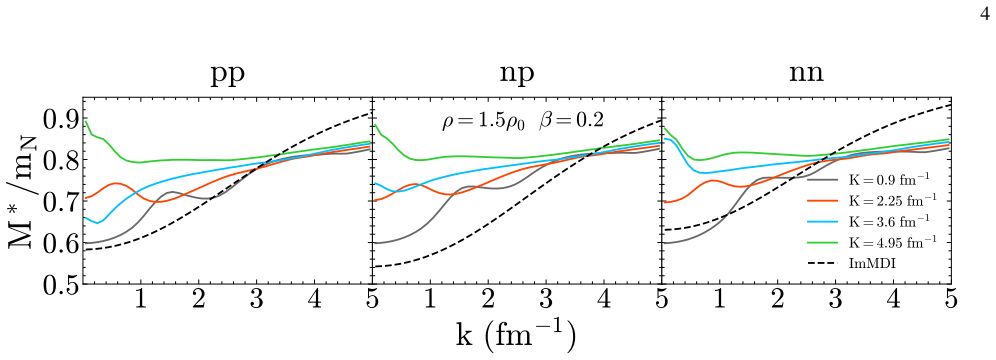
The load-bearing object is the BHF in-medium elastic cross section $\sigma(\rho,\beta,k,K)$ of Eq. (5), computed from partial-wave $G$-matrix elements $G^{SJ}_{L'L}$ and the in-medium effective mass $M^*$ of the colliding pair. The paper constructs three variants to separate medium effects: $\sigma^*_{\rm BHF}$ (vacuum mass, so only the $G$-matrix scattering amplitude is medium modified), $\sigma^K_{\rm BHF}$ (reduced effective-mass factor $\mu^*/\mu$ replaces $M^*$, reducing the total-momentum dependence), and the standard $\sigma_{\rm eff}$ from the $R$-factor. Comparing these variants inside the IBUU collision integral is what lets the authors attribute changes in $v_{\rm arl}$, differential flow, and pion yields to the scattering amplitude, the density of states, and the total-momentum dependence separately.
What would settle it
Recompute the five scenarios with finite-temperature BHF cross sections $\sigma_{\rm BHF}(T)$ evaluated at effective fireball temperatures; if the ordering of $v_{\rm arl}$, the differential flow, and the pion yields across $\sigma_{\rm BHF}$, $\sigma^*_{\rm BHF}$, $\sigma^K_{\rm BHF}$, and $\sigma_{\rm eff}$ changes, the paper's decomposition of medium effects would not hold in the environment where it is applied.
Extended reading notes
Core claim
The paper's central claim is that the commonly used in-medium cross section $\sigma_{\rm eff}=(\mu^*/\mu)^2\,\sigma_{\rm free}$ captures only the density-of-states (effective-mass) part of the medium modification in IBUU simulations of heavy-ion collisions, and that is not enough. On the paper's own terms, a microscopic Brueckner-Hartree-Fock treatment of the nucleon-nucleon cross section—with medium-modified $G$-matrix scattering amplitude, an effective-mass density of states, and explicit dependence on the total momentum $K$ of the colliding pair—gives materially different predictions for nuclear stopping, neutron-proton differential collective flow, and pion multiplicities in $^{132}$Sn+$^{124}$Sn collisions at 270 MeV/nucleon. The same treatment leaves the $n/p$ ratio and the neutron-proton transverse flow difference nearly untouched. The paper therefore establishes, as its core result, that the interplay of scattering amplitude, density of states, and $K$-dependence must be included together, and that nuclear stopping is the most sensitive observable for isolating these in-medium effects.
Load-bearing premise
The load-bearing premise is that zero-temperature BHF cross sections remain faithful inside the non-equilibrium, effectively hot environment of the IBUU simulation; the paper states in Sec. II that it adopts $\sigma_{\rm BHF}$ in the zero-temperature limit as a first approximation and leaves effective-temperature effects for future work.
Editorial extensions
If this is right
- Nuclear stopping, $v_{\rm arl}$, is the most discriminating probe: the ordering of its values across the five cross-section choices directly reflects the competing medium effects, so a measurement of $v_{\rm arl}$ for this reaction could identify which treatment is right.
- The $n/p$ ratio and the neutron-proton transverse flow difference remain almost unchanged across all five treatments, making them relatively clean symmetry-energy probes even when the in-medium cross section is uncertain.
- The neutron-proton differential collective flow and both $\pi^+$ and $\pi^-$ multiplicities shift noticeably when the full BHF cross section replaces $\sigma_{\rm eff}$, so conclusions about the symmetry energy drawn from those observables may need to be revisited.
- The scattering-amplitude and density-of-states medium effects push observables in opposite directions, so a calculation that keeps only one of them can look acceptable for one observable while failing for another.
Reading between the lines
- The paper's separation of the total-momentum effect is only partial, because $\sigma^K_{\rm BHF}$ as defined still contains $K$-dependence from the scattering amplitude; a cleaner decomposition would isolate $K$ in the $G$-matrix alone.
- Because pion production happens in the compressed, hot fireball, the zero-temperature approximation is most likely to break down there; inserting temperature-dependent BHF cross sections at local effective temperatures would directly test whether the $\pi^+$/ $\pi^-$ mismatch with the measured yields comes from the cross section or from other ingredients.
- A joint fit to the sensitive observables ($v_{\rm arl}$, differential flow, pion yields) together with the insensitive ones ($n/p$, transverse flow difference) could simultaneously constrain the symmetry energy and the in-medium cross section; the paper does not perform such a fit but its results set up the degeneracy that makes it possible.
Editorial analysis
A structured set of objections, weighed in public.
Referee Report
Summary. The paper investigates how different treatments of in-medium nucleon-nucleon cross sections affect observables in intermediate-energy heavy-ion collisions. Using the IBUU transport model with cross sections based on the authors' Brueckner-Hartree-Fock calculations, it compares five variants: the free-space cross section, the effective-mass rescaling, the full BHF cross section, the BHF cross section with vacuum mass in the density-of-states factor, and the BHF cross section with the reduced-effective-mass approximation. For 132Sn+124Sn at 270 MeV/nucleon, it examines nuclear stopping, the n/p ratio, the neutron-proton transverse flow difference, the neutron-proton differential collective flow, pion multiplicities, and the (π−/π+)like ratio. The central claim is that effective-mass rescaling alone is insufficient; the medium-modified scattering amplitude and the total-momentum dependence of the pair effective mass both noticeably affect nuclear stopping, differential flow, and pion yields.
Significance. If the conclusions hold, the study provides concrete evidence that transport-model predictions require momentum- and density-dependent BHF cross sections rather than simple effective-mass corrections. The paper gives a systematic side-by-side comparison of five cross-section prescriptions and identifies which observables are sensitive. The use of microscopic inputs from the authors' previous BHF work, including a parameterization already benchmarked in Ref. [30], is a strength. I also note that the stress-test concern about the K-decomposition does not survive a careful reading: σ_BHF and σ^K_BHF share the same G-matrix, so the K-dependence of the scattering amplitude is common-mode and cancels in the comparison. The qualitative ranking, if confirmed, would be a useful guide for future transport calculations and for interpreting stopping and pion data.
major comments (2)
- [II, Eq. (1), Eq. (5), and Sec. III] The collision integral in Eq. (1) uses the differential cross section dσ/dΩ, but Eq. (5) provides only the total cross section σ(ρ,β,k,K), and the implementation text states only that this total cross section is introduced into the transport model. The manuscript never specifies how scattering angles are sampled. Because the results for nuclear stopping and differential collective flow depend directly on the angular distribution, this omission is load-bearing. Please state whether the scattering is treated as isotropic, whether the free-space angular distribution is scaled by the in-medium factor, or whether partial-wave amplitudes from Ref. [30] are used, and discuss the sensitivity to this choice.
- [II, zero-temperature approximation] The paper adopts zero-temperature BHF cross sections while the simulated system is hot and non-equilibrium, and it acknowledges this as a first approximation. However, the abstract and conclusions present the sensitivity ranking without this caveat. Since finite-temperature corrections could alter the relative suppression among σ_BHF, σ^K_BHF, and σ_eff, the central claim should be accompanied by an estimate of the temperature dependence, for example based on Ref. [29], or the conclusions should be explicitly framed as valid only in the zero-T limit.
minor comments (6)
- [II, definition of σ^K_BHF] The definition of σ^K_BHF should state explicitly that the G-matrix is identical to that in σ_BHF. As written, the text says the definition still contains K-dependence from the scattering amplitude, but since both cross sections share the same G, the ratio σ_BHF/σ^K_BHF = (M*/μ*)^2 and the comparison cleanly isolates the density-of-states contribution; an explicit statement would remove ambiguity.
- [Fig. 1 caption] The caption contains a duplicate phrase: both the BHF and MDI lines are described as "black dashed". The caption should be corrected to match the text, which describes a solid line for BHF and a dashed line for MDI.
- [II, after Eq. (6)] In the sentence "the definition of σ^K_BHF still contain the K dependence", "contain" should be "contains".
- [III.B] In "As seen From Fig. 6", "From" should be lowercase: "As seen from Fig. 6".
- [IV, Summary] In "and the the corresponding (π−/π+)like ratio", the duplicated article should be removed: "and the corresponding (π−/π+)like ratio".
- [III.A, Fig. 4] The paper does not provide statistical uncertainties or a convergence statement for the transport results. Since the comparisons are qualitative, a brief note on the number of test particles and numerical stability would be helpful.
Circularity Check
No significant circularity: BHF cross sections are independent microscopic inputs, not fitted to the HIC observables analyzed here.
full rationale
The paper is a transport sensitivity study that injects BHF-derived in-medium NN cross sections (from the authors' prior work, Refs. [23,30]) into the IBUU model. The cross sections are solutions of the BBG equation with realistic NN interactions and are not adjusted to the stopping, flow, or pion data discussed in Sec. III; the SπRIT comparison is a postdiction, not a fit. The decomposition into scattering-amplitude, density-of-states, and K effects is implemented by explicit substitutions in Eq. (5): σ*_BHF sets M* to the vacuum mass while retaining the same G-matrix, and σ^K_BHF replaces M* with the reduced-mass ratio µ*/µ while retaining the same G-matrix. Each comparison therefore isolates the stated factor by construction rather than renaming an output. Self-citations to Refs. [23,30] supply the numerical G-matrix and the parameterization, but these are externally reproducible microscopic inputs, not fitted values from the present observables. The acknowledged caveats (zero-temperature cross sections; residual K-dependence of the scattering amplitude inside σ^K_BHF) are physical limitations of the attribution, not circular steps; indeed the same G(K) enters both σ_BHF and σ^K_BHF, so the difference isolates the effective-mass definition. No load-bearing step reduces to its own input.
Assumptions & free parameters
free parameters (2)
- Three-body force strength in BHF =
Not stated in this paper; tuned to nuclear saturation in prior BHF studies (Refs. [30,36])
- MDI single-particle potential parameters =
Not stated in this paper; fixed by prior empirical constraints (Refs. [31,34])
assumptions (4)
- domain assumption The BHF G-matrix in-medium cross sections (Eq. 5) accurately represent NN scattering in dense asymmetric nuclear matter.
- domain assumption Zero-temperature BHF cross sections can be applied throughout the non-equilibrium transport evolution without significant distortion of the observable rankings.
- ad hoc to paper The kinematic decomposition into scattering amplitude, density of states, and total-momentum K is faithfully realized by σ*_BHF and σ^K_BHF.
- domain assumption The IBUU semiclassical collision integral with v12 independent of effective mass is adequate for the observables studied.
Cite this review
Pith. "Pith review of In-medium effects of nucleon-nucleon cross sections in heavy-ion collisions." pith.science (2026). https://pith.science/paper/SJMCGBSY
@misc{pith2026250723476,
  author       = {Pith},
  title        = {Pith review of: In-medium effects of nucleon-nucleon cross sections in heavy-ion collisions},
  year         = {2026},
  howpublished = {\url{https://pith.science/paper/SJMCGBSY}},
  note         = {Machine review of arXiv:2507.23476}
}
abstract
Based on the isospin-dependent Boltzmann-Uehling-Uhlenbeck transport model, we systematically investigate the in-medium effects of nucleon-nucleon ($NN$) cross sections on nucleonic and pionic observables in heavy-ion collisions, employing microscopic cross sections derived from the Brueckner-Hartree-Fock approach. Key observables include nuclear stopping, the neutron-to-proton ($n/p$) ratio, neutron-proton transverse flow differences, differential collective flow, pion multiplicities, and the resulting $(\pi^-/\pi^+)_{\rm like}$ ratio. The analysis disentangles the respective contributions from the scattering amplitude, the density of states, and the total momentum ($K$) of the colliding pairs. We find that larger in-medium $NN$ cross sections generally enhance free nucleon emission and nuclear stopping, with the nucleon effective mass playing a dominant suppressive role. However, it is insufficient to account only for the medium corrections from effective mass: both the medium effect from the scattering amplitude and the $K$-dependence exert noticeable influences on the observables. In particular, nuclear stopping is found to be highly sensitive to these in-medium modifications of cross sections. While the $n/p$ ratio and transverse flow difference remain largely insensitive, the differential collective flow and pion yields are strongly affected. These results indicate that the interplay between scattering amplitude, density-of-states and $K$-dependence is essential to accurately describe medium effects in heavy-ion collisions.
Figures


Figures from the paper (6 more)


Reference graph
Works this paper leans on
-
[30]
S. C. Han, X. L. Shang, W. Zuo, G. C. Yong, and Y . Gao, Phys. Rev. C106, 064332 (2022)
work page 2022
-
[29]
X. L. Shang, A. Li, Z. Q. Miao, G. F. Burgio, and H. J. Schulze, Phys. Rev. C101, 065801 (2020), arXiv:2001.03859 [nucl-th]
work page Pith review arXiv 2020
-
[1]
G. D. Westfall, W. Bauer, D. Craig, M. Cronqvist, E. Gaultieri, S. Hannuschke, D. Klakow, T. Li, T. Reposeur, A. M. Vander Molen, W. K. Wilson, J. S. Winfield, J. Yee, S. J. Yennello, R. Lacey, A. Elmaani, J. Lauret, A. Nadasen, and E. Norbeck, Phys. Rev. Lett.71, 1986 (1993)
work page 1993
-
[2]
S. Soff, S. A. Bass, C. Hartnack, H. St ¨ocker, and W. Greiner, Phys. Rev. C51, 3320 (1995), arXiv:nucl-th/9502007 [nucl-th]
work page Pith review arXiv 1995
-
[3]
T. Alm, G. R ¨opke, W. Bauer, F. Daffin, and M. Schmidt, Nucl. Phys. A587, 815 (1995)
work page 1995
-
[4]
A. Insolia, U. Lombardo, N. G. Sandulescu, and A. Bonasera, Physics Letters B334, 12 (1994)
work page 1994
-
[5]
V . de La Mota, F. Sebille, M. Farine, B. Remaud, and P. Schuck, Phys. Rev. C46, 677 (1992)
work page 1992
-
[6]
Yong, European Physical Journal A46, 399 (2010)
G.-C. Yong, European Physical Journal A46, 399 (2010)
work page 2010
Show all 58 references
-
[7]
P. Li, Y . Wang, Q. Li, and H. Zhang, Physics Letters B828, 137019 (2022), arXiv:2203.05855 [nucl-th]
2022 arXiv
-
[8]
Y . Wang, C. Guo, Q. Li, A. Le F`evre, Y . Leifels, and W. Traut- mann, Physics Letters B778, 207 (2018), arXiv:1804.04293 [nucl-th]
2018 arXiv
-
[9]
Li, L.-W
B.-A. Li, L.-W. Chen, and C. M. Ko,Phys. Rep.464, 113 (2008), arXiv:0804.3580 [nucl-th]
2008 arXiv
-
[10]
Long and G.-F
X.-X. Long and G.-F. Wei, Phys. Rev. C109, 054619 (2024), arXiv:2402.12912 [nucl-th]
2024 arXiv
-
[11]
Li, Phys
B.-A. Li, Phys. Rev. Lett.85, 4221 (2000), arXiv:nucl- th/0009069 [nucl-th]
2000
-
[12]
Yong, B.-A
G.-C. Yong, B.-A. Li, and L.-W. Chen, Phys. Rev. C74, 064617 (2006), arXiv:nucl-th/0606003 [nucl-th]
2006 arXiv
-
[13]
Y . Wang, C. Guo, Q. Li, H. Zhang, Y . Leifels, and W. Traut- mann, Phys. Rev. C89, 044603 (2014), arXiv:1403.7041 [nucl- th]
2014 arXiv
-
[14]
Li, G.-C
B.-A. Li, G.-C. Yong, and W. Zuo, Phys. Rev. C71, 014608 (2005), arXiv:nucl-th/0411045 [nucl-th]
2005 arXiv
-
[15]
Yong, B.-A
G.-C. Yong, B.-A. Li, L.-W. Chen, and W. Zuo, Phys. Rev. C 73, 034603 (2006), arXiv:nucl-th/0512067 [nucl-th]
2006 arXiv
-
[16]
Xiao, B.-A
Z. Xiao, B.-A. Li, L.-W. Chen, G.-C. Yong, and M. Zhang, Phys. Rev. Lett.102, 062502 (2009), arXiv:0808.0186 [nucl- th]
2009 arXiv
-
[17]
Wolter, M
H. Wolter, M. Colonna, D. Cozma, P. Danielewicz, C. M. Ko, R. Kumar, A. Ono, M. B. Tsang, J. Xu, Y .-X. Zhang, E. Bratkovskaya, Z.-Q. Feng, T. Gaitanos, A. Le F `evre, N. Ikeno, Y . Kim, S. Mallik, P. Napolitani, D. Oliinychenko, T. Ogawa, M. Papa, J. Su, R. Wang, Y .-J. Wang,...
2022
-
[18]
Colonna, Y .-X
M. Colonna, Y .-X. Zhang, Y .-J. Wang, D. Cozma, P. Danielewicz, C. M. Ko, A. Ono, M. B. Tsang, R. Wang, H. Wolter, J. Xu, Z. Zhang, L.-W. Chen, H.-G. Cheng, H. Elfner, Z.-Q. Feng, M. Kim, Y . Kim, S. Jeon, C.-H. Lee, B.-A. Li, Q.-F. Li, Z.-X. Li, S. Mallik, D. Oliinychenko, J...
2021 arXiv
-
[19]
Xu, L.-W
J. Xu, L.-W. Chen, M. B. Tsang, H. Wolter, Y .-X. Zhang, J. Aichelin, M. Colonna, D. Cozma, P. Danielewicz, Z.-Q. Feng, A. Le F `evre, T. Gaitanos, C. Hartnack, K. Kim, Y . Kim, C.-M. Ko, B.-A. Li, Q.-F. Li, Z.-X. Li, P. Napolitani, A. Ono, M. Papa, T. Song, J. Su, J.-L. Tian,...
2016 arXiv
-
[20]
Zhang, Y .-J
Y .-X. Zhang, Y .-J. Wang, M. Colonna, P. Danielewicz, A. Ono, M. B. Tsang, H. Wolter, J. Xu, L.-W. Chen, D. Cozma, Z.-Q. Feng, S. Das Gupta, N. Ikeno, C.-M. Ko, B.-A. Li, Q.-F. Li, Z.-X. Li, S. Mallik, Y . Nara, T. Ogawa, A. Ohnishi, D. Oliiny- chenko, M. Papa, H. Petersen, J...
2018 arXiv
-
[21]
Bohnet, N
A. Bohnet, N. Ohtsuka, J. Aichelin, R. Linden, and A. Faessler, Nucl. Phys. A494, 349 (1989)
1989
-
[22]
H. J. Schulze, A. Schnell, G. R ¨opke, and U. Lombardo, Phys. Rev. C55, 3006 (1997)
1997
-
[23]
X. L. Shang, J. M. Dong, W. Zuo, P. Yin, and U. Lombardo, Phys. Rev. C103, 034316 (2021), arXiv:2107.12228 [nucl-th]
2021 arXiv
-
[24]
G. Q. Li and R. Machleidt, Phys. Rev. C48, 1702 (1993), arXiv:nucl-th/9307028 [nucl-th]
1993 arXiv
-
[25]
G. Q. Li and R. Machleidt, Phys. Rev. C49, 566 (1994), arXiv:nucl-th/9308016 [nucl-th]
1994 arXiv
-
[26]
Fuchs, A
C. Fuchs, A. Faessler, and M. El-Shabshiry, Phys. Rev. C64, 024003 (2001), arXiv:nucl-th/0103057 [nucl-th]
2001 arXiv
-
[27]
Sammarruca and P
F. Sammarruca and P. Krastev, Phys. Rev. C73, 014001 (2006), arXiv:nucl-th/0509011 [nucl-th]
2006 arXiv
-
[28]
V . R. Pandharipande and S. C. Pieper, Phys. Rev. C45, 791 (1992)
1992
-
[31]
Li and L.-W
B.-A. Li and L.-W. Chen, Phys. Rev. C72, 064611 (2005), 11 arXiv:nucl-th/0508024 [nucl-th]
2005 arXiv
-
[32]
Guo, G.-C
W.-M. Guo, G.-C. Yong, Y . Wang, Q. Li, H. Zhang, and W. Zuo, Physics Letters B726, 211 (2013), arXiv:1306.4783 [nucl-th]
2013 arXiv
-
[33]
Zhang, Y .-F
Z.-Z. Zhang, Y .-F. Guo, and G.-C. Yong, Phys. Rev. C103, 034615 (2021), arXiv:2007.09404 [nucl-th]
2021 arXiv
-
[34]
Guo, G.-C
W.-M. Guo, G.-C. Yong, and W. Zuo, Phys. Rev. C90, 044605 (2014), arXiv:1407.0432 [nucl-th]
2014 arXiv
-
[35]
Schmidt, G
M. Schmidt, G. R ¨opke, and H. Schulz, Annals of Physics202, 57 (1990)
1990
-
[36]
show a similar trend. In addition, our previous work [30] demonstrated that this behavior becomes more pronounced at higher densities, consistent with the increasing importance of TBF effects in this regime. An analysis of the single particle potentialU(k)in BHF aproach furthe...
-
[37]
P. S. Shternin, M. Baldo, and P. Haensel, Phys. Rev. C88, 065803 (2013)
2013
-
[38]
Y .-D. Song, R. Wang, Z. Zhang, and Y .-G. Ma, Phys. Rev. C 108, 064603 (2023)
2023
-
[39]
Andronic, J
A. Andronic, J. Łukasik, W. Reisdorf, and W. Trautmann, European Physical Journal A30, 31 (2006), arXiv:nucl- ex/0608015 [nucl-ex]
2006
-
[40]
Li, Y .-J
P.-C. Li, Y .-J. Wang, Q.-F. Li, and H.-F. Zhang, Nuclear Sci- ence and Techniques29, 177 (2018)
2018
-
[41]
C. Y . Tsang, M. Kurata-Nishimura, M. B. Tsang, W. G. Lynch, Y . X. Zhang, J. Barney, J. Estee, G. Jhang, R. Wang, M. Kaneko, J. W. Lee, T. Isobe, T. Murakami, D. S. Ahn, L. Atar, T. Aumann, H. Baba, K. Boretzky, J. Brzychczyk, G. Cerizza, N. Chiga, N. Fukuda, I. Gasparic, B. ...
2024 arXiv
-
[42]
Reisdorf, A
W. Reisdorf, A. Andronic, A. Gobbi, O. N. Hartmann, N. Her- rmann, K. D. Hildenbrand, Y . J. Kim, M. Kirejczyk, P. Koczo´n, T. Kress, Y . Leifels, A. Sch ¨uttauf, Z. Tymi ´nski, Z. G. Xiao, J. P. Alard, V . Barret, Z. Basrak, N. Bastid, M. L. Benab- derrahmane, R. ˇCaplar, P. ...
2004
-
[43]
Huang, G.-F
X. Huang, G.-F. Wei, Q.-J. Zhi, Y .-C. Yang, and Z.-W. Long, Phys. Rev. C106, 014604 (2022), arXiv:2208.13175 [nucl-th]
2022 arXiv
-
[44]
M. D. Cozma, Physics Letters B700, 139 (2011), arXiv:1102.2728 [nucl-th]
2011 arXiv
-
[45]
Di Toro, S
M. Di Toro, S. J. Yennello, and B. A. Li, European Physical Journal A30, 153 (2006)
2006
-
[46]
Zhang, Z
Y . Zhang, Z. Li, and P. Danielewicz, Phys. Rev. C75, 034615 (2007), arXiv:nucl-th/0703046 [nucl-th]
2007 arXiv
-
[47]
Fan, G.-C
X.-H. Fan, G.-C. Yong, and W. Zuo, Phys. Rev. C97, 034604 (2018), arXiv:1803.03338 [nucl-th]
2018 arXiv
-
[48]
Yong, B.-A
G.-C. Yong, B.-A. Li, and L.-W. Chen, Physics Letters B650, 344 (2007), arXiv:nucl-th/0703042 [nucl-th]
2007 arXiv
-
[49]
M. D. Cozma and M. Petrovici, Progress in Particle and Nuclear Physics62, 419 (2009)
2009
-
[50]
Xie and F.-S
W.-J. Xie and F.-S. Zhang, Physics Letters B735, 250 (2014)
2014
-
[51]
Li, Phys
B.-A. Li, Phys. Rev. Lett.88, 192701 (2002), arXiv:nucl- th/0205002 [nucl-th]
2002
-
[52]
Q. Li, Z. Li, S. Soff, M. Bleicher, and H. St ¨ocker, Phys. Rev. C 72, 034613 (2005), arXiv:nucl-th/0506030 [nucl-th]
2005 arXiv
-
[53]
Xu, L.-W
J. Xu, L.-W. Chen, C. M. Ko, B.-A. Li, and Y .-G. Ma, Phys. Rev. C87, 067601 (2013), arXiv:1305.0091 [nucl-th]
2013 arXiv
-
[54]
Gao, Y .-L
Y . Gao, Y .-L. Guo, L. Zhang, G.-C. Yong, Z.-Y . Liu, and W. Zuo, Phys. Rev. C104, 044607 (2021)
2021
-
[55]
Jhang, J
G. Jhang, J. Estee, J. Barney, G. Cerizza, M. Kaneko, J. W. Lee, W. G. Lynch, T. Isobe, M. Kurata-Nishimura, T. Mu- rakami, C. Y . Tsang, M. B. Tsang, R. Wang, D. S. Ahn, L. Atar, T. Aumann, H. Baba, K. Boretzky, J. Brzychczyk, N. Chiga, N. Fukuda, I. Gasparic, B. Hong, A. Hor...
2021 arXiv
- [56]
- [57]
-
[58]
Z. X. Yang, X. L. Shang, G. C. Yong, W. Zuo, and Y . Gao, Phys. Rev. C100, 054325 (2019)
2019
Reviewed August 6, 2026 · model on record in the stance chip above.
Discussion (0). Sign in to comment.