REVIEW 4 major objections 4 minor 33 references
A Verifier Hierarchy
T0 review · 4 major / 4 minor · reviewed 2026-08-06 · deepseek-v4-flash
Pith's one-line read This paper proves a Verifier Trade-off Theorem: reducing verification time from f(n) to g(n) forces certificates to grow by at least Omega(log(f/g)) bits, and uses this to reinterpret P vs NP.
desk verdict The verifier trade-off theorem is true, but the paper's proof is invalid and its applications overclaim; reject. read the letter →
The pith
A machine-rendered reading of the paper's core claim, the machinery that carries it, and where it could break.
The reading
What carries the argument
The carrying mechanism is the simulation of a verifier by a deterministic solver that reuses an existing certificate. The proof supposes a minimal valid certificate w1 for V1 can be fixed for free, decomposes each V2 certificate as (w1,d) with d the extra bits, and enumerates all d. Each simulated run of V2 costs O(g(n)) time, so the whole solver runs in O(2^{$\Delta$(n)} g(n)) time; because V1's lower bound says any solver needs $\Omega$(f(n)) time, this yields 2^{$\Delta$} g(n) >= c f(n), and taking logarithms gives $\Delta$ >= $\Omega$(log(f/g)). The language-level time bounds of Definition 3.5 are the lens that lets lower bounds about all verifiers be compared with an upper bound for one verifier.
What would settle it
To refute Theorem 4.1, exhibit a language L with a verifier using b2-bit certificates running in O(g(n)) time and a language-level lower bound of $\Omega$(f(n)) for b1-bit certificates, but with b2-b1 = o(log(f/g)). The simplest concrete test is to try to build a language decidable in $\Omega$($n^{2}$) time that is nevertheless verifiable in O(n) time with a 1-bit certificate; the theorem says no such language exists.
Extended reading notes
Core claim
The central discovery is the Verifier Trade-off Theorem (Theorem 4.1). For a language L with two certificate-based verifiers, V1 using b1-bit certificates with language-level verification time $\Omega$(f(n)) and V2 using b2-bit certificates with verification time O(g(n)) where f(n) >= c g(n), the theorem asserts b2(n)-b1(n) = $\Omega$(log(f(n)/g(n))). The proof constructs a deterministic solver that fixes a shortest valid V1 certificate w1 and enumerates all 2^(b2-b1) possible extensions d, simulating V2 on each candidate (w1,d); the solver's runtime O(2^(b2-b1) g(n)) must respect V1's lower bound, forcing the logarithmic gap. The paper then derives a solver-verifier corollary (b(n) >= $\Omega$(log(f/g)) when b1=0), applies it to EXPTIME-complete languages and to 3-SAT under ETH, and uses it to argue that certificates of constant or sub-linear size for NP-complete problems would collapse P and NP or violate ETH, while linear certificates would prove P != NP.
Load-bearing premise
The proof's load-bearing assumption is that, for every input, a deciding machine can obtain a shortest certificate of the slower verifier V1 for free, and that every certificate of the faster verifier V2 is exactly that certificate followed by a few extra bits; if that assumption fails, the theorem's lower bound on the certificate-length difference is not established.
Editorial extensions
If this is right
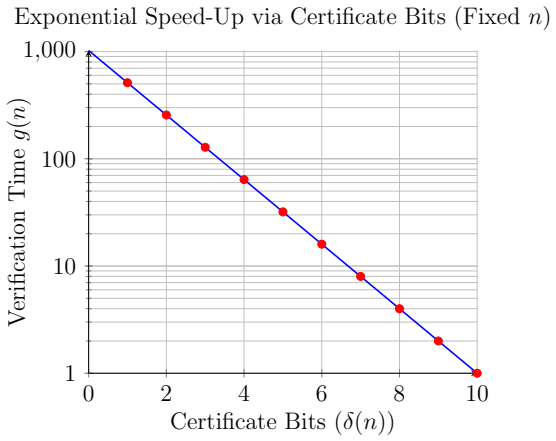
- Each additional certificate bit can at most double the verification speed; halving verification time costs at least one extra certificate bit.
- Any EXPTIME-complete language that has a polynomial-time verifier must use certificates of length at least polynomial in n, making such languages structurally unlike typical NP languages.
- Under the Exponential Time Hypothesis, any polynomial-time verifier for 3-SAT needs certificates of length Omega(n), and the paper's corollary then implies P != NP.
- A constant-size certificate for an NP-complete language would put that language in P and hence collapse P and NP; a sub-linear certificate would violate ETH.
- For PERIODIC and STRING-ROTATION, the natural Theta(log n)-bit certificates exactly match the trade-off bound, showing the theorem is tight in these cases.
Reading between the lines
- Beyond the paper: if the theorem holds generally, certificate length becomes a robust complexity measure, so one could try to prove lower bounds by showing a problem cannot be verified with short certificates; the EXPTIME example hints at this strategy.
- Beyond the paper: the theorem's proof depends on the decomposition of V2 certificates into a fixed V1 certificate plus extra bits; testing whether this decomposition can always be enforced would sharpen the theorem, a question the paper leaves open.
- Beyond the paper: an immediate testable extension is to probabilistic or quantum verifiers, where randomness or entanglement might break the logarithmic bound; the paper lists this as a future direction but does not resolve it.
- Beyond the paper: the worst-case bounds may be loose for average-case instances of PERIODIC and STRING-ROTATION, and measuring certificate complexity on random instances could reveal a different trade-off.
Editorial analysis
A structured set of objections, weighed in public.
Referee Report
Summary. The paper introduces certificate-based deterministic verifiers and defines language-level verification-time bounds (Definition 3.5). Its main result, Theorem 4.1, claims that if a language has every b1(n)-bit verifier running in Omega(f(n)) time and some b2(n)-bit verifier running in O(g(n)) time, with f(n) >= c g(n), then b2(n)-b1(n) = Omega(log(f(n)/g(n))). The paper derives a solver-verifier corollary and applies the framework to EXPTIME-complete languages, the PERIODIC and STRING-ROTATION problems, and conditional statements about 3-SAT and P vs NP.
Significance. If Theorem 4.1 is established, the paper would provide a clean certificate-length hierarchy and a general quantitative speedup bound. The core statement is in fact defensible: under a fixed-length certificate convention, a prefix-verifier construction (a b1-bit verifier that enumerates the b2-b1 suffix bits and simulates V2) yields 2^{b2-b1} g(n) = Omega(f(n)). However, the submitted proof does not contain this construction and instead assumes the solver can fix a minimal V1 certificate for free. The applications draw language-level lower bounds from naive algorithms and use an unjustified strengthening of '3-SAT not in P' to an exponential lower bound. The paper's formulation of the trade-off is interesting, but the central proof and several applications need substantial repair before the claims as stated are supported.
major comments (4)
- [Section 4, proof of Theorem 4.1] The step 'On input x, S fixes a minimal valid certificate w1 for V1' is unjustified. A deterministic solver has no certificate, and finding a minimal valid w1 may itself require enumerating up to 2^{b1(n)} candidates. Moreover, the assertion that every V2 certificate decomposes as w2 = (w1,d) requires that all accepted V2 certificates have w1 as a b1-bit prefix and are of length exactly b2, which is not stated. Consequently the displayed inequality O(2^{b2-b1} g(n)) = Omega(f(n)) is unsupported. The theorem can be repaired by defining a b1-bit verifier V' that, on certificate w1, enumerates all d in {0,1}^{b2-b1} and simulates V2(x,(w1,d)); under the fixed-length certificate convention, V' runs in O(2^{b2-b1} g(n)) time, so the b1-bit lower bound forces 2^{b2-b1} g(n) = Omega(f(n)). The submitted proof must be replaced by this or an equivalent argument, and the fixed-length convention must be stated.
- [Section 5.2, Examples 5.1 and 5.2] Examples 5.1 and 5.2 treat the naive O(n^2) algorithms for PERIODIC and STRING-ROTATION as language-level lower bounds, yet the footnotes in both examples cite efficient O(n log n) or O(n) algorithms. Therefore the assertion that the solver requires Omega(n^2) time is not a language-level lower bound, and the conclusion b(n) = Omega(log n) via Corollary 4.3 does not follow. The examples should be rewritten as conditional on conjectured solver lower bounds, or the lower-bound claims should be removed.
- [Section 5.3, Theorem 5.2] The proof of Theorem 5.2 assumes 3-SAT not in P, which only implies that the best solver time f(n) is super-polynomial. The proof then inserts 'assume conservatively that f(n) = 2^{Omega(n^epsilon)}', which is not conservative; it is a strong ETH-type hypothesis. Without such an assumption, the corollary yields only b(n) = Omega(log f(n)), which may be sublinear. Thus the claimed b(n) = Omega(n^epsilon) or b(n) = Omega(n) certificate lower bound for 3-SAT is not established under the stated assumption. Corollary 5.3 then uses exactly the assumption 3-SAT not in P to conclude P != NP, making it a restatement of the hypothesis rather than a new separation argument.
- [Section 5.3, Example 5.3] The claim that EXPTIME-complete languages that are in NP require certificates 'longer than any fixed-degree polynomial' is inaccurate. If the exponential solver runs in O(2^{p(n)}) with p(n) = n^k, Corollary 4.3 gives b(n) = Omega(p(n)) = Omega(n^k), which is still polynomial-length and compatible with the language being in NP. The example should state that the certificate length is forced to be at least the polynomial exponent of the solver's runtime, not that it exceeds every polynomial.
minor comments (4)
- [Remark 4.1] The appeal to Shannon's source coding theorem is not a formal argument: no probability distribution over computational paths and no coding scheme is defined. It should be labeled as intuition or removed.
- [Section 4, proof of Theorem 4.1] The proof should explicitly adopt a fixed-length certificate convention or justify padding. Without it, the decomposition w2 = (w1,d) for certificates of length less than b2 is undefined, and the prefix-verifier repair also requires this convention.
- [Section 5.3, Example 5.5] In the sub-linear certificate case, the derivation from b(n) = O(n^e) to f(n) = 2^{O(n^e)} poly(n) is correct only up to constants; the exponent should be stated with an explicit constant to make the ETH contradiction precise.
- [Throughout] There are minor typographical and referencing issues, including 'In some case' in Remark 4.2 and the final paragraph of Section 5.3 referring to 'Theorem 5.3' where 'Theorem 5.2' appears to be meant. These should be corrected in revision.
Circularity Check
No circular derivation found: the central trade-off is an enumeration argument, and the conditional applications are explicitly assumption-driven.
full rationale
The paper contains no fitted parameters and no self-citations; all cited results are standard external theorems. Theorem 4.1 derives b2-b1 = Ω(log(f/g)) by constructing a deterministic solver that enumerates V2's certificate extensions and comparing its runtime with the assumed language-level lower bound on shorter-certificate verifiers. This is a direct enumeration argument, not a conclusion that is assumed in its premises. The proof's questionable step—decomposing every V2 certificate as (w1,d) and supposing a minimal V1 certificate can be fixed for free—is a soundness gap that can be repaired by a prefix-verifier construction; it is not an instance of a claim reducing to its own input. The PERIODIC and STRING-ROTATION examples explicitly assume naive solver runtimes ('we proceed under this assumption for our illustration') and then plug those assumed values into the theorem, so their Ω(log n) bounds are conditional illustrations rather than circular predictions. The P vs NP discussion is explicitly conditional on 3-SAT not in P or on ETH, and Corollary 5.3 is essentially the definitional equivalence between a polynomial-time solver and a 0-certificate verifier, labeled by the authors as a conditional perspective. No circular step meets the required evidentiary standard.
Assumptions & free parameters
assumptions (6)
- domain assumption Deterministic multi-tape Turing machine model with separate read-only input tape, read-only certificate tape, work tapes, and write-once output tape.
- standard math Time bounds f(n) and g(n) are time-constructible.
- standard math Exhaustive enumeration of all certificates gives a deterministic solver of time O(2^{b(n)} g(n)).
- ad hoc to paper The solver in Theorem 4.1 may fix a minimal valid V1 certificate w1 for free, and every V2 certificate decomposes as (w1,d).
- ad hoc to paper Naive O(n^2) algorithms for PERIODIC and STRING-ROTATION constitute a language-level lower bound Omega(n^2).
- ad hoc to paper Super-polynomial solver time for 3-SAT may be assumed to be 2^{Omega(n^epsilon)} or 2^{Omega(n)} under ETH.
Cite this review
Pith. "Pith review of A Verifier Hierarchy." pith.science (2026). https://pith.science/paper/VLLPKERL
@misc{pith2026250723504,
  author       = {Pith},
  title        = {Pith review of: A Verifier Hierarchy},
  year         = {2026},
  howpublished = {\url{https://pith.science/paper/VLLPKERL}},
  note         = {Machine review of arXiv:2507.23504}
}
abstract
We investigate the trade-off between certificate length and verifier runtime. We prove a Verifier Trade-off Theorem showing that reducing the inherent verification time of a language from \(f(n)\) to \(g(n)\), where \(f(n) \ge g(n)\), requires certificates of length at least \(\Omega(\log(f(n) / g(n)))\). This theorem induces a natural hierarchy based on certificate complexity. We demonstrate its applicability to analyzing conjectured separations between complexity classes (e.g., \(\np\) and \(\exptime\)) and to studying natural problems such as string periodicity and rotation detection. Additionally, we provide perspectives on the \(\p\) vs. \(\np\) problem by relating it to the existence of sub-linear certificates.
Figures
Reference graph
Works this paper leans on
-
[1]
J. Hartmanis, R. E. Stearns, On the computational complexity of algo- rithms, Transactions of the American Mathematical Society 117 (1965) 285–306
work page 1965
-
[2]
R. E. Stearns, J. Hartmanis, P. M. Lewis, Hierarchies of memory limited computations, in: 6th annual symposium on switching circuit theory and logical design (SWCT 1965), IEEE, 1965, pp. 179–190
work page 1965
-
[3]
S. A. Cook, A hierarchy for nondeterministic time complexity, in: Pro- ceedings of the fourth annual ACM symposium on Theory of computing, 1972, pp. 187–192
work page 1972
-
[4]
S. Even, T. J. Long, Y. Yacobi, A note on deterministic and nonde- terministic time complexity, Information and Control 55 (1-3) (1982) 117–124
work page 1982
-
[5]
L. Fortnow, Time–space tradeoffs for satisfiability, Journal of Computer and System Sciences 60 (2) (2000) 337–353
work page 2000
-
[6]
S. A. Cook, The complexity of theorem-proving procedures, in: Logic, automata, and computational complexity: The works of Stephen A. Cook, 2023, pp. 143–152
2023
-
[7]
J. I. Seiferas, M. J. Fischer, A. R. Meyer, Separating nondeterministic time complexity classes, Journal of the ACM (JACM) 25 (1) (1978) 146–167
work page 1978
-
[8]
S. Goldwasser, S. Micali, C. Rackoff, The knowledge complexity of inter- active proof-systems, in: Providing sound foundations for cryptography: On the work of shafi goldwasser and silvio micali, 2019, pp. 203–225. 22
work page 2019
Show all 33 references
-
[9]
Arora, C
S. Arora, C. Lund, R. Motwani, M. Sudan, M. Szegedy, Proof verifica- tion and the hardness of approximation problems, Journal of the ACM (JACM) 45 (3) (1998) 501–555
1998
-
[10]
Atserias, M
A. Atserias, M. L. Bonet, On the automatizability of resolution and related propositional proof systems, Information and Computation 189 (2) (2004) 182–201
2004
-
[11]
R. M. Karp, R. J. Lipton, Turing machines that take advice, Enseigne- ment Math´ ematique 28 (2) (1982) 191–209
1982
-
[12]
Allender, K
E. Allender, K. Reinhardt, The complexity of non-uniform membership problems, Journal of Complexity 16 (4) (2000) 799–828
2000
-
[13]
Chaubal, A
S. Chaubal, A. G´ al, Diameter versus certificate complexity of boolean functions, in: 46th International Symposium on Mathematical Foun- dations of Computer Science (MFCS 2021), Schloss Dagstuhl–Leibniz- Zentrum f¨ ur Informatik, 2021, pp. 31–1
2021
-
[14]
Kannan, H
R. Kannan, H. Venkateswaran, V. Vinay, A. C. Yao, A circuit-based proof of Toda’s theorem, Information and Computation 104 (2) (1993) 271–276
1993
-
[15]
Impagliazzo, R
R. Impagliazzo, R. Paturi, On the complexity of k-sat, Journal of Com- puter and System Sciences 62 (2) (2001) 367–375
2001
-
[16]
L. Chen, R. D. Rothblum, R. Tell, E. Yogev, On exponential-time hypotheses, derandomization, and circuit lower bounds, in: 2020 IEEE 61st Annual Symposium on Foundations of Computer Science (FOCS), IEEE, 2020, pp. 13–23
2020
-
[17]
V. V. Williams, Some open problems in fine-grained complexity, ACM SIGACT News 49 (4) (2018) 29–35
2018
-
[18]
Atserias, E
A. Atserias, E. Maneva, Mean-payoff games and propositional proofs, Information and Computation 209 (4) (2011) 664–691
2011
-
[19]
C. E. Shannon, A mathematical theory of communication, The Bell system technical journal 27 (3) (1948) 379–423
1948
-
[20]
Arora, B
S. Arora, B. Barak, Computational complexity: a modern approach, Cambridge University Press, 2009. 23
2009
-
[21]
T. H. Cormen, C. E. Leiserson, R. L. Rivest, C. Stein, Introduction to Algorithms, 3rd Edition, MIT Press, 2009
2009
-
[22]
C. H. Papadimitriou, Computational Complexity, Addison-Wesley, Boston, 1994
1994
-
[23]
Sipser, Introduction to the Theory of Computation, 3rd Edition, Course Technology, Boston, MA, 2013
M. Sipser, Introduction to the Theory of Computation, 3rd Edition, Course Technology, Boston, MA, 2013
2013
-
[24]
Mertens, Number partitioning, Computational complexity and statis- tical physics 125 (2006)
S. Mertens, Number partitioning, Computational complexity and statis- tical physics 125 (2006)
2006
-
[25]
Selman, D
B. Selman, D. G. Mitchell, H. J. Levesque, Generating hard satisfiability problems, Artificial intelligence 81 (1-2) (1996) 17–29
1996
-
[26]
Ben-Sasson, M
E. Ben-Sasson, M. Sudan, Short pcps with polylog query complexity, SIAM Journal on Computing 38 (2) (2008) 551–607
2008
-
[27]
Baartse, K
M. Baartse, K. Meer, An algebraic proof of the real number pcp theorem, Journal of Complexity 40 (2017) 34–77
2017
-
[28]
Jacobson, Space-efficient static trees and graphs, in: 30th annual symposium on foundations of computer science, IEEE Computer Society, 1989, pp
G. Jacobson, Space-efficient static trees and graphs, in: 30th annual symposium on foundations of computer science, IEEE Computer Society, 1989, pp. 549–554
1989
-
[29]
M. He, J. I. Munro, Succinct representations of dynamic strings, in: International Symposium on String Processing and Information Retrieval, Springer, 2010, pp. 334–346
2010
-
[30]
Aaronson, S.-H
S. Aaronson, S.-H. Hung, Certified randomness from quantum supremacy, in: Proceedings of the 55th Annual ACM Symposium on Theory of Computing, 2023, pp. 933–944
2023
-
[31]
Marriott, J
C. Marriott, J. Watrous, Quantum arthur–merlin games, computational complexity 14 (2) (2005) 122–152
2005
-
[32]
R. G. Downey, M. R. Fellows, et al., Fundamentals of parameterized complexity, Vol. 4, Springer, 2013
2013
-
[33]
Chiesa, Succinct non-interactive arguments, Ph.D
A. Chiesa, Succinct non-interactive arguments, Ph.D. thesis, Mas- sachusetts Institute of Technology (2014). 24
2014
Reviewed August 6, 2026 · model on record in the stance chip above.
Discussion (0). Continue with ORCID to comment.