Spectroscopic Signatures of Structural Disorder and Electron-Phonon Interactions in Trigonal Selenium Thin Films for Solar Energy Harvesting
Pith reviewed 2026-05-19 02:24 UTC · model grok-4.3
The pith
Short-range structural disorder in selenium thin films stems from processing variations rather than being inherent to the material
A machine-rendered reading of the paper's core claim, the machinery that carries it, and where it could break.
Core claim
Using temperature-dependent Raman and photoluminescence spectroscopy on selenium thin films synthesized under nominally identical conditions, the authors find that short-range structural disorder is not intrinsic but highly sensitive to subtle processing variations. These variations strongly influence electron-phonon coupling and non-radiative recombination. Structural disorder and grown-in stress promote extended defects that act as dominant non-radiative recombination centers, limiting carrier lifetime and open-circuit voltage in photovoltaic devices.
What carries the argument
Temperature-dependent Raman linewidths and peak shifts together with photoluminescence intensity and temperature dependence, used as spectroscopic signatures of short-range structural disorder and grown-in stress
If this is right
- Precise control of synthesis and post-deposition treatments can raise the optoelectronic quality of selenium thin films.
- Targeted control of crystallization dynamics reduces microstructural disorder and improves selenium-based thin-film devices.
- Lower structural disorder and stress decrease the density of extended defects that limit carrier lifetime.
- Minimizing processing variations across fabrication routes reduces non-radiative recombination rates in photovoltaic devices.
Where Pith is reading between the lines
- The same encapsulation and spectroscopic approach could assess microstructural quality in other volatile elemental or compound semiconductors.
- Reproducibility differences between research groups working on selenium devices may largely trace to uncontrolled variations in short-range order.
- Reducing disorder through optimized growth could raise open-circuit voltages in selenium solar cells closer to the material's theoretical limit.
Load-bearing premise
The observed variations in Raman linewidths, peak shifts, and photoluminescence signals across samples arise primarily from differences in short-range structural disorder and grown-in stress rather than from surface contamination, thickness variation, or other unmeasured factors.
What would settle it
High-resolution transmission electron microscopy showing no increase in extended defect density in films that exhibit broader Raman lines and reduced photoluminescence would falsify the claimed causal link between the observed disorder signatures and recombination centers.
Figures


read the original abstract
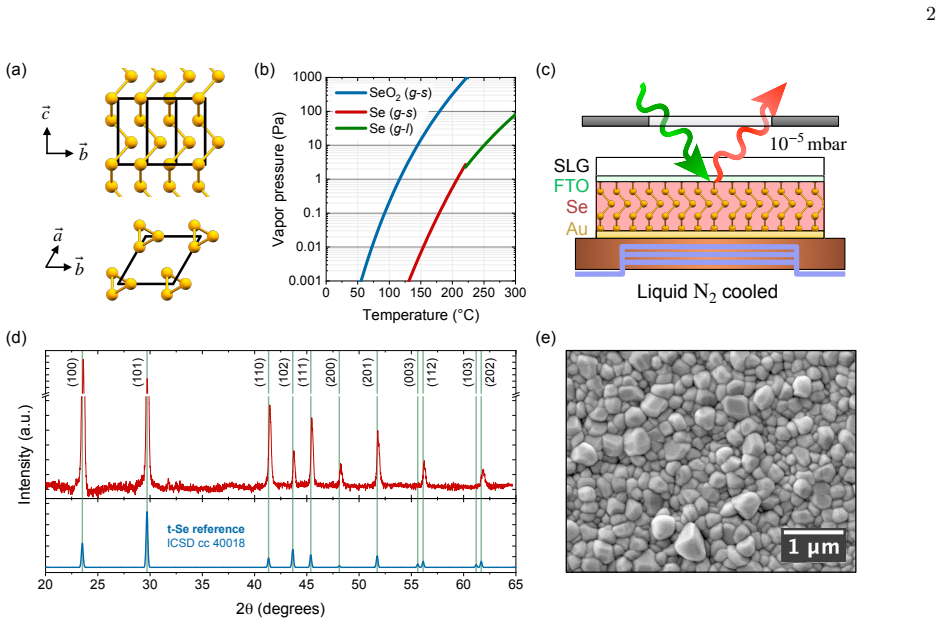
Selenium is experiencing renewed interest as a elemental semiconductor for a range of optoelectronic and energy applications due to its irresistibly simple composition and favorable wide bandgap. However, its high volatility and low radiative efficiency make it challenging to assess structural and optoelectronic quality, calling for advanced, non-destructive characterization methods. In this work, we employ a closed-space encapsulation strategy to prevent degradation during measurement and enable sensitive probing of vibrational and optoelectronic properties. Using temperature-dependent Raman and photoluminescence spectroscopy, we investigate grown-in stress, vibrational dynamics, and electron-phonon interactions in selenium thin films synthesized under nominally identical conditions across different laboratories. Our results reveal that short-range structural disorder is not intrinsic to the material, but highly sensitive to subtle processing variations, which strongly influence electron-phonon coupling and non-radiative recombination. We find that such structural disorder and grown-in stress likely promote the formation of extended defects, which act as dominant non-radiative recombination centers limiting carrier lifetime and open-circuit voltage in photovoltaic devices. These findings demonstrate that the optoelectronic quality of selenium thin films can be significantly improved through precise control of synthesis and post-deposition treatments, outlining a clear pathway toward optimizing selenium-based thin film technologies through targeted control of crystallization dynamics and microstructural disorder.
Editorial analysis
A structured set of objections, weighed in public.
Referee Report
Summary. The manuscript reports temperature-dependent Raman and photoluminescence spectroscopy on trigonal selenium thin films prepared under nominally identical conditions across laboratories. It claims that observed variations in Raman linewidths, peak positions, and PL intensity/temperature dependence arise from short-range structural disorder and grown-in stress (rather than being intrinsic), which in turn strengthen electron-phonon coupling and promote extended defects that dominate non-radiative recombination, thereby limiting carrier lifetime and open-circuit voltage in Se-based photovoltaics. The work concludes that precise control of synthesis and post-deposition treatments can substantially improve optoelectronic quality.
Significance. If the causal attribution to processing-induced disorder holds, the results would be significant for elemental chalcogenide photovoltaics: they identify a practical, non-destructive spectroscopic route to diagnose and mitigate microstructural defects that currently limit Se solar-cell performance, and they demonstrate that nominally identical growth protocols can produce meaningfully different material quality.
major comments (3)
- [Results and Discussion (spectroscopic comparison across samples)] The central interpretation that Raman linewidth/peak-shift and PL variations primarily track short-range structural disorder and stress (rather than thickness non-uniformity or surface contamination) is load-bearing for the abstract claim yet remains under-constrained. No film-thickness maps, profilometry data, or surface-sensitive measurements (e.g., XPS or AFM) are presented to exclude these common confounds in chalcogenide films, which are known to alter both Raman and PL responses.
- [Experimental methods and structural characterization] Direct structural corroboration is absent: the inference of short-range disorder relies entirely on spectroscopic proxies without supporting XRD, TEM, or pair-distribution-function data that would quantify the disorder metric independently of the optical spectra.
- [Implications for photovoltaic performance] The assertion that the inferred defects act as dominant non-radiative recombination centers (limiting lifetime and Voc) is stated without quantitative carrier-lifetime or device-level measurements that correlate the spectroscopic disorder indicators with actual recombination rates.
minor comments (2)
- [Figure captions and data analysis] Error bars or standard deviations are not reported on the extracted Raman linewidths, peak shifts, or PL intensity ratios, making it difficult to assess the statistical significance of the inter-sample differences.
- [Raman spectroscopy results] A single-crystal Se reference spectrum is not shown alongside the thin-film data, which would help anchor the magnitude of the observed shifts and broadening.
Simulated Author's Rebuttal
We thank the referee for their thorough review and constructive comments on our manuscript. We address each major comment in detail below, providing the strongest honest defense of our work while acknowledging areas where additional clarification or data will strengthen the presentation. We have revised the manuscript accordingly where feasible.
read point-by-point responses
-
Referee: [Results and Discussion (spectroscopic comparison across samples)] The central interpretation that Raman linewidth/peak-shift and PL variations primarily track short-range structural disorder and stress (rather than thickness non-uniformity or surface contamination) is load-bearing for the abstract claim yet remains under-constrained. No film-thickness maps, profilometry data, or surface-sensitive measurements (e.g., XPS or AFM) are presented to exclude these common confounds in chalcogenide films, which are known to alter both Raman and PL responses.
Authors: We thank the referee for highlighting this important point. The films were prepared with nominally identical deposition parameters and consistent target thicknesses across laboratories, and the spectroscopic variations are systematic and reproducible rather than stochastic, which argues against random thickness non-uniformity as the primary driver. Surface contamination is further mitigated by our closed-space encapsulation protocol. Nevertheless, we agree that explicit exclusion of these confounds would make the interpretation more robust. In the revised manuscript we will add profilometry thickness maps and AFM surface roughness data for representative samples to directly address this concern. revision: yes
-
Referee: [Experimental methods and structural characterization] Direct structural corroboration is absent: the inference of short-range disorder relies entirely on spectroscopic proxies without supporting XRD, TEM, or pair-distribution-function data that would quantify the disorder metric independently of the optical spectra.
Authors: We acknowledge that independent structural metrics would provide valuable corroboration. Our conclusions rest on the sensitivity of temperature-dependent Raman linewidths and shifts to local vibrational environments and short-range order, which are well-established probes for disorder in chalcogenides. To strengthen this, we will incorporate XRD patterns in the revised manuscript to quantify average crystallite size and crystallinity, thereby providing an orthogonal measure that supports the spectroscopic inference of processing-dependent short-range disorder. revision: yes
-
Referee: [Implications for photovoltaic performance] The assertion that the inferred defects act as dominant non-radiative recombination centers (limiting lifetime and Voc) is stated without quantitative carrier-lifetime or device-level measurements that correlate the spectroscopic disorder indicators with actual recombination rates.
Authors: The link to non-radiative recombination is drawn from the observed suppression of PL intensity and its characteristic temperature dependence, which are established signatures of increased defect-mediated recombination in selenium. While we do not include direct time-resolved lifetime or completed device measurements in the present study—our scope being the identification of spectroscopic signatures—we will expand the discussion section to more explicitly connect our findings to the existing literature on defect-limited Voc in Se photovoltaics and to clarify the inferential nature of this step. This remains an area for future experimental correlation. revision: partial
Circularity Check
No circularity in experimental spectroscopic claims
full rationale
The paper's central claims derive from direct experimental measurements of temperature-dependent Raman linewidths, peak shifts, and photoluminescence intensity/temperature dependence across selenium thin film samples made under nominally identical conditions in different labs. These observed spectral variations are interpreted as evidence that short-range structural disorder and grown-in stress are sensitive to subtle processing differences and promote extended defects. No equations, fitted parameters, or self-citations are invoked in a way that reduces any reported metric or prediction to the same data by construction. The derivation chain is self-contained through empirical observation and standard defect physics interpretation, with no self-definitional loops or fitted-input predictions.
Axiom & Free-Parameter Ledger
axioms (2)
- domain assumption Raman peak broadening and shifts reliably indicate short-range structural disorder and grown-in stress in trigonal selenium
- domain assumption Temperature-dependent photoluminescence quenching reflects non-radiative recombination via extended defects
Lean theorems connected to this paper
-
IndisputableMonolith/Cost/FunctionalEquation.leanwashburn_uniqueness_aczel unclear?
unclearRelation between the paper passage and the cited Recognition theorem.
Temperature dependence of the Raman peaks is modeled as E(T) = E0 − λ / (exp(ℏω/kBT) − 1) and Γ(T) = Γ0 + Γph / (exp(ℏωph/kBT) − 1)
-
IndisputableMonolith/Foundation/AlphaCoordinateFixation.leanalpha_pin_under_high_calibration unclear?
unclearRelation between the paper passage and the cited Recognition theorem.
Electron-phonon coupling strength extracted from PL peak shift and broadening; comparison of DTU vs UPC samples under nominally identical processing
What do these tags mean?
- matches
- The paper's claim is directly supported by a theorem in the formal canon.
- supports
- The theorem supports part of the paper's argument, but the paper may add assumptions or extra steps.
- extends
- The paper goes beyond the formal theorem; the theorem is a base layer rather than the whole result.
- uses
- The paper appears to rely on the theorem as machinery.
- contradicts
- The paper's claim conflicts with a theorem or certificate in the canon.
- unclear
- Pith found a possible connection, but the passage is too broad, indirect, or ambiguous to say the theorem truly supports the claim.
Reference graph
Works this paper leans on
-
[1]
from the CETP-Partnership Program 2023; all of them funded by MCIN/AEI/10.13039/501100011033/ FEDER. A.T. and M.P. acknowledge the SE- LECTRON project (CNS2023-14817) funded by MCIN/AEI/10.13039/501100011033/ NextGenera- tionEU/PRTR. Through our membership of the UK’s HEC Materials ChemistryConsortium, which is funded by the UK Engineering and Physical Sc...
-
[2]
R. Li, X. Chen, S. Bai, W. Xu, C. Xia, B. Zhang, Z. Jia, Y. Liu, H. Liu, X. Tian, Q. Cui, and Q. Lin, Efficient Sele- nium Photodiodes Based on an Inverted P-i-N Structure, Chemistry of Materials 36, 5846 (2024)
work page 2024
-
[3]
X. Chen, S. Bai, R. Li, Y. Yang, and Q. Lin, Resolving the trap levels of Se and Se 1-xTex via deep-level tran- sient spectroscopy, Physical Review Materials 8, 033805 (2024)
work page 2024
-
[4]
Y. Adachi and T. Kobayashi, Formation of Micro- Patterned Ga 2O3/Se Heterojunction and its Application to Highly Sensitive Avalanche Photodiode, Physica Sta- tus Solidi (a) Applications and Materials Science 220, 2200636 (2023)
work page 2023
-
[5]
S. O. Kasap and J. A. Rowlands, X-ray photoconductors and stabilized a-Se for direct conversion digital flat-panel X-ray image-detectors, Journal of Materials Science: Ma- terials in Electronics 11, 179 (2000)
work page 2000
-
[6]
G. Belev and S. O. Kasap, Amorphous selenium as an X-ray photoconductor, Journal of Non-crystalline Solids 345-346, 484 (2004)
work page 2004
-
[7]
B. Yan, X. Liu, W. Lu, M. Feng, H. J. Yan, Z. Li, S. Liu, C. Wang, J. S. Hu, and D. J. Xue, Indoor photovoltaics awaken the world’s first solar cells, Science Advances 8, eadc9923 (2022)
work page 2022
-
[8]
X. Wang, Z. Li, B. Jin, W. Lu, M. Feng, B. Dong, Q. Liu, H. J. Yan, S. M. Wang, and D. J. Xue, Sustainable Re- cycling of Selenium-Based Optoelectronic Devices, Ad- vanced Science 11, 2400615 (2024)
work page 2024
-
[9]
Z. Wei, W. Lu, Z. Li, M. Feng, B. Yan, J. S. Hu, and D. J. Xue, Low-cost and high-performance selenium in- door photovoltaics, Journal of Materials Chemistry A 11, 23837 (2023)
work page 2023
-
[10]
D. M. Bishop, T. Todorov, Y. S. Lee, O. Gunawan, and R. Haight, Record Efficiencies for Selenium Photovoltaics and Application to Indoor Solar Cells, 2017 IEEE 44th Photovoltaic Specialist Conference (PVSC) , 1441 (2017)
work page 2017
-
[11]
W. Lu, Z. Li, M. Feng, J. Wei, X. Wen, X. An, Z. Wei, Y. Lin, J. S. Hu, and D. J. Xue, Lanthanide-Like Con- traction Enables the Fabrication of High-Purity Selenium Films for Efficient Indoor Photovoltaics, Angewandte Chemie - International Edition 64, e202413429 (2025)
work page 2025
-
[12]
M. Placidi, A. Torrens, Z. Jehl Li-Kao, A. Lopez-Garcia, O. Segura, Y. Gong, A. Jimenez-Arguijo, I. Ca˜ no, S. Gi- raldo, E. Saucedo, G. Alvarez, Y. Sanchez, N. Spalatu, I. Oja, E. Artegiani, A. Romeo, R. Scaffidi, and A. Perez- Rodriguez, Benchmarking Inorganic Thin-Film Photo- voltaics Technologies for Indoor Applications, Solar RRL 9, 2500030 (2025)
work page 2025
-
[13]
T. H. Youngman, R. Nielsen, A. Crovetto, B. Seger, O. Hansen, I. Chorkendorff, and P. C. K. Vesborg, Semi- transparent Selenium Solar Cells as a Top Cell for Tan- dem Photovoltaics, Solar RRL 5, 2100111 (2021)
work page 2021
-
[14]
R. Nielsen, A. Crovetto, A. Assar, O. Hansen, I. Chork- endorff, and P. C. K. Vesborg, Monolithic Sele- nium/Silicon Tandem Solar Cells, PRX Energy 3, 013013 (2024)
work page 2024
-
[15]
H. Dou, T. Wang, and H. E. Wang, Unlocking the po- tential of selenium solar cells for indoor and tandem photovoltaics through theoretical and photoelectric sim- ulations, Journal of Materials Chemistry A 13, 17317 (2025)
work page 2025
-
[16]
M. S. Salem, A. Shaker, A. N. Aledaily, T. S. Almurayziq, M. T. Qureshi, and M. Okil, Advanced simulation and design of two-terminal selenium/antimony selenosulfide tandem solar cells, Solar Energy Materials and Solar Cells 283, 113455 (2025)
work page 2025
-
[17]
V. K. Singh, M. K. Singh, S. Parveen, H. Dahiya, Kuldeep, R. P. Yadav, M. S. Chauhan, R. S. Singh, and V. N. Singh, Strategy to improve the performance of the one-element Selenium-based Solar Cells to 16.63%: An experimental and simulation study, Optical Materials 160, 116689 (2025)
work page 2025
-
[18]
J. Wang, M. S. Gudiksen, X. Duan, Y. Cui, and C. M. Lieber, Highly polarized photoluminescence and pho- todetection from single indium phosphide nanowires, Sci- ence 293, 1455 (2001)
work page 2001
-
[19]
S. Nanot, A. W. Cummings, C. L. Pint, A. Ikeuchi, T. Akiho, K. Sueoka, R. H. Hauge, F. L´ eonard, and J. Kono, Broadband, polarization-sensitive photodetec- tor based on optically-thick films of macroscopically long, dense, and aligned carbon nanotubes, Scientific Reports 3, 1335 (2013)
work page 2013
-
[20]
H. Yuan, X. Liu, F. Afshinmanesh, W. Li, G. Xu, J. Sun, B. Lian, A. G. Curto, G. Ye, Y. Hikita, Z. Shen, S. C. Zhang, X. Chen, M. Brongersma, H. Y. Hwang, and Y. Cui, Polarization-sensitive broadband photodetector using a black phosphorus vertical p-n junction, Nature Nanotechnology 10, 707 (2015)
work page 2015
-
[21]
H. Liu, C. Zhu, Y. Chen, X. Yi, X. Sun, Y. Liu, H. Wang, G. Wu, J. Wu, Y. Li, X. Zhu, D. Li, and A. Pan, Polarization-Sensitive Photodetectors Based on Highly In-Plane Anisotropic Violet Phosphorus with Large Dichroic Ratio, Advanced Functional Materials 34, 2314838 (2024)
work page 2024
-
[22]
M. Zhu, G. Niu, and J. Tang, Elemental Se: Fundamen- tals and its optoelectronic applications, Journal of Mate- rials Chemistry C 7, 2199 (2019)
work page 2019
-
[23]
F. Bao, L. Liu, X. Wang, B. Xiao, H. Li, H. Yang, K. Shen, and Y. Mai, Modification of the Se/MoOx Rear Interface for Efficient Wide-Band-Gap Trigonal Selenium Solar Cells, ACS Applied Materials and Interfaces 17, 6222 (2025)
work page 2025
- [24]
- [25]
- [26]
-
[27]
S. D. Deshmukh, C. K. Miskin, A. A. Pradhan, K. Kisslinger, and R. Agrawal, Solution Processed Fab- rication of Se-Te Alloy Thin Films for Application in PV Devices, ACS Applied Energy Materials 5, 3275 (2022)
work page 2022
-
[28]
R. Nielsen, T. H. Youngman, H. Moustafa, S. Levcenco, H. Hempel, A. Crovetto, T. Olsen, O. Hansen, I. Chork- endorff, T. Unold, and P. C. K. Vesborg, Origin of pho- tovoltaic losses in selenium solar cells with open-circuit 11 voltages approaching 1 V, Journal of Materials Chem- istry A 10, 24199 (2022)
work page 2022
-
[29]
S. R. Kavanagh, R. S. Nielsen, J. L. Hansen, R. S. David- sen, O. Hansen, A. E. Samli, P. C. Vesborg, D. O. Scan- lon, and A. Walsh, Intrinsic point defect tolerance in se- lenium for indoor and tandem photovoltaics, Energy and Environmental Science 18, 4431 (2025)
work page 2025
-
[30]
Z. Li, X. An, X. Wang, W. Lu, X. Wen, X. Zhang, and D. J. Xue, Unusual defect properties of the one-dimensional photovoltaic semiconductor selenium, Chemical Communications 60, 11092 (2024)
work page 2024
-
[31]
H. Moustafa, J. Kangsabanik, F. Bertoldo, S. Manti, K. S. Thygesen, K. W. Jacobsen, and T. Olsen, Sele- nium and the role of defects for photovoltaic applications, Physical Review Materials 8, 015402 (2024)
work page 2024
-
[32]
W. Lu, Z. Li, M. Feng, H. J. Yan, B. Yan, L. Hu, X. Zhang, S. Liu, J. S. Hu, and D. J. Xue, Melt- and air-processed selenium thin-film solar cells, Science China Chemistry 65, 2197 (2022)
work page 2022
-
[33]
L. Fu, J. Zheng, X. Yang, Y. He, C. Chen, K. Li, and J. Tang, Rapid thermal annealing process for Se thin- film solar cells, Faraday Discussions 239, 317 (2022)
work page 2022
-
[34]
W. Lu, M. Feng, Z. Li, B. Yan, S. Wang, X. Wen, X. An, S. Liu, J. S. Hu, and D. J. Xue, Ordering one-dimensional chains enables efficient selenium photovoltaics, Joule 8, 1430 (2024)
work page 2024
-
[35]
X. An, Z. Li, X. Wang, W. Lu, X. Wen, M. Feng, Q. Liu, Z. Wei, J. Hu, and D. Xue, Photovoltaic Absorber “Glues” for Efficient Bifa- cial Selenium Photovoltaics, Angewandte Chemie 137, 10.1002/ange.202505297 (2025)
-
[36]
M. Zhu, F. Hao, L. Ma, T.-B. Song, C. E. Miller, M. R. Wasielewski, X. Li, and M. G. Kanatzidis, Solution- Processed Air-Stable Mesoscopic Selenium Solar Cells, ACS Energy Letters 1, 469 (2016)
work page 2016
-
[37]
W. Liu, F. Yu, W. Fan, and Q. Zhang, Improved Stabil- ity and Efficiency of Polymer-based Selenium Solar Cells Through the Usage of Tin(IV) Oxide in the Electron Transport Layers and the Analysis of Aging Dynamics, Physical Chemistry Chemical Physics 22, 14838 (2020)
work page 2020
-
[38]
T. Kirchartz, J. A. M´ arquez, M. Stolterfoht, and T. Unold, Photoluminescence-Based Characterization of Halide Perovskites for Photovoltaics, Advanced Energy Materials 10, 1904134 (2020)
work page 2020
-
[39]
R. S. Nielsen, A. L. ´Alvarez, A. G. Medaille, I. Ca˜ no, A. Navarro-G¨ uell, C. L. ´Alvarez, C. Cazorla, D. R. Ferrer, Z. J. Li-Kao, E. Saucedo, and M. Dim- itrievska, Parallel Exploration of the Optoelectronic Properties of (Sb,Bi)(S,Se)(Br,I) Chalcohalides (2025), arXiv:2505.14208 [cond-mat.mtrl-sci]
work page internal anchor Pith review Pith/arXiv arXiv 2025
-
[40]
M. Dimitrievska, A. Fairbrother, E. Saucedo, A. P´ erez- Rodr ´ ıguez, and V. Izquierdo-Roca, Secondary phase and Cu substitutional defect dynamics in kesterite solar cells: Impact on optoelectronic properties, Solar Energy Mate- rials and Solar Cells 149, 304 (2016)
work page 2016
-
[41]
W. Xu, Q. Song, G. Song, and Q. Yao, The vapor pres- sure of Se and SeO 2 measurement using thermogravimet- ric analysis, Thermochimica Acta 683, 178480 (2020)
work page 2020
-
[42]
H. J. Queisser and J. Stuke, Photoluminescence of trigo- nal selenium, Solid State Communications 5, 75 (1967)
work page 1967
-
[43]
H. Zetsche and R. Fischer, Photoluminescence of trigonal selenium single crystals, Journal of Physics and Chem- istry of Solids 30, 1425 (1969)
work page 1969
-
[44]
K. H. K¨ uhler, Electrophotoluminescence of trigonal se- lenium single crystals, physica status solidi (a) 18, 495 (1973)
work page 1973
-
[45]
B. Moreth, Two Types of Indirect-Exciton Ground States in Trigonal Selenium, Physical Review Letters 42, 264 (1979)
work page 1979
-
[46]
X. Liu, K. Duan, Z. Ma, X. Tian, F. Li, S. Liang, C. Qin, and X. Liu, Enhanced carrier management and photo- generated charge dynamics for selenium (Se) film photo- voltaics, Applied Physics Letters 123, 063901 (2023)
work page 2023
-
[47]
J. Wu, Z. Zhang, C. Tong, D. Li, A. Mei, Y. Rong, Y. Zhou, H. Han, and Y. Hu, Two-Stage Melt Processing of Phase-Pure Selenium for Printable Triple-Mesoscopic Solar Cells, ACS Applied Materials and Interfaces 11, 33879 (2019)
work page 2019
-
[48]
R. S. Nielsen, M. Schleuning, O. Karalis, T. H. Hem- mingsen, O. Hansen, I. Chorkendorff, T. Unold, and P. C. Vesborg, Increasing the Collection Efficiency in Selenium Thin-Film Solar Cells Using a Closed-Space Annealing Strategy, ACS Applied Energy Materials 7, 5209 (2024)
work page 2024
-
[49]
T. Nakada and A. Kunioka, Polycrystalline Thin-Film TiO2/Se Solar Cells, Japanese Journal of Applied Physics, Part 2: Letters 24, 536 (1985)
work page 1985
-
[50]
T. K. Todorov, S. Singh, D. M. Bishop, O. Gunawan, Y. S. Lee, T. S. Gershon, K. W. Brew, P. D. Antunez, and R. Haight, Ultrathin high band gap solar cells with improved efficiencies from the world’s oldest photovoltaic material, Nature Communications 8, 682 (2017)
work page 2017
-
[51]
S. V. Gallego, J. Etxebarria, L. Elcoro, E. S. Tasci, and J. M. Perez-Mato, Automatic calculation of symmetry- adapted tensors in magnetic and non-magnetic materials: A new tool of the Bilbao Crystallographic Server, Acta Crystallographica Section A: Foundations and Advances 75, 438 (2019)
work page 2019
-
[52]
M. Dimitrievska, A. P. Litvinchuk, A. Zakutayev, and A. Crovetto, Phonons in Copper Diphosphide (CuP 2): Raman Spectroscopy and Lattice Dynamics Calculations, Journal of Physical Chemistry Part C 127, 10649 (2023)
work page 2023
-
[53]
R. S. Nielsen, A. L. ´Alvarez, Y. Tomm, G. Gurieva, A. Ortega-Guerrero, J. Breternitz, L. Bastonero, N. Marzari, C. A. Pignedoli, S. Schorr, and M. Dim- itrievska, BaZrS 3 Lights Up: The Interplay of Elec- trons, Photons, and Phonons in Strongly Lumi- nescent Single Crystals, Advanced Optical Materials 10.1002/adom.202500915 (2025)
- [54]
-
[55]
H. S. R Grosse and A. Tausend, Lattice constants a and c of trigonal selenium between 85 and 380K, Journal of Physics C: Solid State Physics 8, L445 (1975)
work page 1975
-
[56]
A. P. Levanyuk and V. V. Osipov, Edge luminescence of direct-gap semiconductors, Soviet Physics Uspekhi 24, 187 (1981)
work page 1981
-
[57]
T. Schmidt, K. Lischka, and W. Zulehner, Excitation- power dependence of the near-band-edge photolumines- cence of semiconductors, Physical Review B 45, 8989 (1992)
work page 1992
- [58]
-
[59]
R. Nielsen, T. H. Hemmingsen, T. G. Bonczyk, O. Hansen, I. Chorkendorff, and P. C. Vesborg, Laser- Annealing and Solid-Phase Epitaxy of Selenium Thin- Film Solar Cells, ACS Applied Energy Materials 6, 8849 (2023)
work page 2023
-
[60]
R. S. Nielsen, O. Gunawan, T. Todorov, C. B. Møller, O. Hansen, and P. C. Vesborg, Variable-temperature and carrier-resolved photo-Hall measurements of high- performance selenium thin-film solar cells, Physical Re- view B 111, 165202 (2025)
work page 2025
-
[61]
I. Ca˜ no, A. Torrens, O. Segura-Blanch, E. Maggi, A. Jim´ enez-Arguijo, O. El Khouja, A. Navarro-G¨ uell, D. Rovira, A. Aroldi, J.-M. Asensi, X. Alcob´ e, C. Puig- janer, R. Schwiddessen, S. Schorr, A. P´ erez-Rodriguez, D. Sylla, Z. Jehl, E. Saucedo, and M. Placidi, Oriented for Efficiency: Textured Se Thin Films Fabricated by Va- por Transport Deposition...
-
[62]
Q. Liu, X. Wang, Z. Li, W. Lu, X. Wen, X. An, M. Feng, H. J. Yan, J. S. Hu, and D. J. Xue, Standing 1D Chains Enable Efficient Wide-Bandgap Selenium Solar Cells, Advanced Materials 37, 2410835 (2025)
work page 2025
-
[63]
C. Y. Chen, M. A. Kastner, and L. H. Robins, Transient photoluminescence and excited-state optical absorption in trigonal selenium, Physical Review B 32, 914 (1985)
work page 1985
-
[64]
G. Kresse and J. Hafner, Ab initio molecular dynamics for liquid metals, Physical Review B 47, 558 (1993)
work page 1993
-
[65]
G. Kresse and J. Hafner, Ab initio molecular-dynamics simulation of the liquid-metal–amorphous-semiconductor transition in germanium, Physical Review B 49, 14251 (1994)
work page 1994
-
[66]
P. E. Bl¨ ochl, Projector augmented-wave method, Physi- cal Review B 50, 17953 (1994)
work page 1994
-
[67]
J. Heyd, G. E. Scuseria, and M. Ernzerhof, Hybrid func- tionals based on a screened Coulomb potential, Journal of Chemical Physics 118, 8207 (2003)
work page 2003
- [68]
-
[69]
S. R. Kavanagh, Vaspup2.0, Zenodo (2023)
work page 2023
-
[70]
A. Togo and I. Tanaka, First principles phonon calcu- lations in materials science, Scripta Materialia 108, 1 (2015)
work page 2015
-
[71]
K. B. Spooner, M. Einhorn, D. W. Davies, and D. O. Scanlon, ThermoParser: Streamlined Analysis of Ther- moelectric Properties, Journal of Open Source Software 9, 6340 (2024) . SUPPORTING INFORMATION Spectroscopic Signatures of Structural Disorder and Electron-Phonon Interacti ons in Trigonal Selenium Thin Films for Solar Energy Harvesting Rasmus S. Nielse...
work page 2024
discussion (0)
Sign in with ORCID, Apple, or X to comment. Anyone can read and Pith papers without signing in.