Swap Network Augmented Ans\"atze on Arbitrary Connectivity
Pith reviewed 2026-05-19 02:01 UTC · model grok-4.3
The pith
Embedding optimized swap networks into layered quantum ansatze yields lower energy errors with fewer gates and parameters on arbitrary qubit connectivities.
A machine-rendered reading of the paper's core claim, the machinery that carries it, and where it could break.
Core claim
By first computing an optimized swap network for a given connectivity graph and then co-designing circuit layers around it, the ansatz captures complex correlations more efficiently. Across tested connectivities the swap-augmented construction consistently outperforms conventional layered ansatze in energy error while requiring fewer resources.
What carries the argument
The optimized swap network obtained from a routing algorithm for arbitrary graphs, embedded inside layered ansatze to enable direct long-range interactions without extra overhead.
If this is right
- The same swap-network construction can be applied to any hardware graph without requiring hand-crafted layer redesigns.
- Ground-state searches for spin-glass and molecular Hamiltonians become feasible with reduced circuit resources on constrained devices.
- The co-design principle directly lowers the gate count needed to generate distant qubit correlations.
- Trainability gains appear across multiple exemplified connectivities rather than being limited to a single topology.
Where Pith is reading between the lines
- The routing optimization step could be reused as a modular preprocessing tool for other variational algorithms that need long-range entanglement.
- Similar swap-augmented layering might reduce resources in quantum machine-learning or optimization tasks that also suffer from connectivity limits.
Load-bearing premise
That the routing optimization produces ansatze whose improved trainability and lower resource use are not offset by new optimization difficulties or hidden costs.
What would settle it
On a chosen connectivity graph, implement both the swap-augmented ansatz and a standard layered ansatz, run the variational optimization for the same number of iterations, and check whether the swap version reaches a lower energy error with measurably fewer gates, shallower depth, and fewer parameters.
Figures




read the original abstract
Efficient parametrizations of quantum states are essential for trainable hybrid classical-quantum algorithms. A key challenge in their design consists in adapting to the available qubit connectivity of the quantum processor, which limits the capacity to generate correlations between distant qubits in a resource-efficient and trainable manner. In this work we first introduce an algorithm that optimizes qubit routing for arbitrary connectivity graphs, resulting in a swap network that enables direct interactions between any pair of qubits. We then propose a co-design of circuit layers and qubit routing by embedding the derived swap networks within layered, connectivity-aware ans\"atze. This construction significantly improves the trainability of the ansatz, leading to enhanced performance with reduced resources. We showcase these improvements through ground-state simulations of strongly correlated systems, including spin-glass and molecular electronic structure models. Across exemplified connectivities, the swap-enhanced ansatz consistently achieves lower energy errors using fewer entangling gates, shallower circuits, and fewer parameters than standard layered-structured baselines. Our results indicate that swap network augmented ans\"atze provide enhanced trainability and resource-efficient design to capture complex correlations on devices with constrained qubit connectivity.
Editorial analysis
A structured set of objections, weighed in public.
Referee Report
Summary. The manuscript introduces an algorithm to optimize qubit routing on arbitrary connectivity graphs, yielding swap networks that enable direct interactions between any qubit pair. It then embeds these networks into layered, connectivity-aware ansatze via a co-design approach. The central claim is that the resulting swap-augmented ansatze improve trainability and achieve lower energy errors with fewer entangling gates, shallower circuits, and fewer parameters than standard layered baselines, as demonstrated in ground-state simulations of spin-glass and molecular electronic structure models across exemplified connectivities.
Significance. If the empirical results hold under detailed scrutiny, the work would offer a practical route to adapting variational quantum algorithms to hardware with limited connectivity, potentially reducing resource overhead while enhancing expressivity for correlated systems.
major comments (1)
- [Abstract] The abstract states that swap-enhanced ansatze achieve lower energy errors using fewer entangling gates, shallower circuits, and fewer parameters than baselines, but provides no specifics on the numerical experiments (graphs, Hamiltonians, baseline constructions, whether swap depths are counted in resources, or convergence statistics). This absence is load-bearing for the central performance claim and prevents verification that gains survive proper accounting for routing overhead.
Simulated Author's Rebuttal
We are grateful to the referee for their insightful comments on our work. We respond to the major comment as follows and indicate the changes we will implement in the revised manuscript.
read point-by-point responses
-
Referee: [Abstract] The abstract states that swap-enhanced ansatze achieve lower energy errors using fewer entangling gates, shallower circuits, and fewer parameters than baselines, but provides no specifics on the numerical experiments (graphs, Hamiltonians, baseline constructions, whether swap depths are counted in resources, or convergence statistics). This absence is load-bearing for the central performance claim and prevents verification that gains survive proper accounting for routing overhead.
Authors: We thank the referee for pointing out the need for greater specificity in the abstract. The detailed numerical experiments are described in the main text, including the use of specific connectivity graphs (e.g., linear, ring, and arbitrary topologies), Hamiltonians for spin-glass models and molecular electronic structures, layered baseline ansatze without swap augmentation, and explicit inclusion of swap network depths in the circuit depth and entangling gate counts. Convergence is assessed over multiple random initializations with reported statistics. To address the referee's concern directly and make the abstract more informative, we will revise it to include brief mentions of the exemplified connectivities and confirm that routing overhead is accounted for in the resource comparisons. This will strengthen the presentation of our central claims. revision: yes
Circularity Check
No circularity: empirical claims rest on external simulations, not self-referential derivations
full rationale
The abstract describes an algorithm for optimizing qubit routing on arbitrary connectivity graphs to produce swap networks, followed by a co-design embedding those networks into layered ansatze. Performance claims (lower energy errors, fewer gates/parameters, shallower circuits) are presented as outcomes of ground-state simulations on spin-glass and molecular Hamiltonians across exemplified connectivities. These are external numerical benchmarks, not derivations that reduce by construction to fitted inputs or prior self-citations. No equations, parameter-fitting steps, uniqueness theorems, or ansatz smuggling via citation appear in the provided text. The construction is therefore self-contained against the reported simulations.
Axiom & Free-Parameter Ledger
invented entities (1)
-
swap network augmented ansatz
no independent evidence
Reference graph
Works this paper leans on
-
[1]
Specifically: R1 =S m ◦ Sm−1 ◦
This function consists of a concatenation of commut- ing label-swapping functions{Si}m i=1, each acting on dif- ferent vertices. Specifically: R1 =S m ◦ Sm−1 ◦. . .◦ S 2 ◦ S1, EachS i represents a distinct label-swapping operation, ensuring that two different operations do not act on the same vertex. This means each node is either swapped once with a neig...
-
[2]
Maximize the number of new direct connections be- tween labels
-
[3]
In this scenario, rings, rather than stars, are the dominant structure
Minimize the distance between labels that have yet to connect in forthcoming steps. Letd ij denote the shortest path distance between labels iandjin the graphG t. We can then define the following cost function on the graphGt with history matrixH t: C(G t, Ht) = X i,j H t ijd2 ij (1) The minimization of this cost function addresses the two key requirements...
-
[4]
M.Cerezoetal.,Variationalquantumalgorithms,Nature Reviews Physics3, 625–644 (2021)
work page 2021
-
[5]
J. R. McClean, J. Romero, R. Babbush and A. Aspuru- Guzik, The theory of variational hybrid quantum- classical algorithms, New Journal of Physics18, 023023 (2016)
work page 2016
-
[6]
J. Tilly et al., The variational Quantum Eigensolver: A review of methods and best practices, Physics Reports 986, 1–128 (2022)
work page 2022
-
[7]
S. Sim, P. D. Johnson and A. Aspuru-Guzik, Ex- pressibility and entangling capability of parameter- ized quantum circuits for hybrid quantum-classical algorithms, Advanced Quantum Technologies2, 10.1002/qute.201900070 (2019)
-
[8]
Strategies for quantum computing molecular energies using the unitary coupled cluster ansatz
J. Romero et al., Strategies for quantum computing molecular energies using the unitary coupled cluster ansatz (2018), arXiv:1701.02691 [quant-ph]
work page internal anchor Pith review Pith/arXiv arXiv 2018
-
[9]
A. Kandala et al., Hardware-efficient variational quan- tum eigensolver for small molecules and quantum mag- nets, Nature549, 242 (2017)
work page 2017
-
[10]
G. Li, Y. Ding and Y. Xie, Tackling the Qubit Map- ping Problem for NISQ-Era Quantum Devices (2019), arXiv:1809.02573 [cs.ET]
work page internal anchor Pith review Pith/arXiv arXiv 2019
-
[11]
A.Cowtanetal.,OntheQubitRoutingProblem(Schloss Dagstuhl – Leibniz-Zentrum für Informatik, 2019)
work page 2019
-
[12]
Noise-Adaptive Compiler Mappings for Noisy Intermediate-Scale Quantum Computers
P. Murali, J. M. Baker, A. J. Abhari, F. T. Chong and M. Martonosi, Noise-Adaptive Compiler Mappings for Noisy Intermediate-Scale Quantum Computers (2019), arXiv:1901.11054 [quant-ph]
work page internal anchor Pith review Pith/arXiv arXiv 2019
- [13]
- [14]
-
[15]
J. R. McClean, S. Boixo, V. N. Smelyanskiy, R. Bab- bush and H. Neven, Barren plateaus in quantum neural network training landscapes, Nature Communications9, 10.1038/s41467-018-07090-4 (2018)
-
[16]
I. D. Kivlichan et al., Quantum Simulation of Electronic Structure with Linear Depth and Connectivity, Phys. Rev. Lett.120, 110501 (2018)
work page 2018
-
[17]
Generalized swap networks for near-term quantum computing
B. O’Gorman, W. J. Huggins, E. G. Rieffel and K. B. Whaley, Generalized swap networks for near-term quan- tum computing (2019), arXiv:1905.05118 [quant-ph]
work page internal anchor Pith review Pith/arXiv arXiv 2019
-
[18]
G.-L. R. Anselmetti, D. Wierichs, C. Gogolin and R. M. Parrish, Local, expressive, quantum-number-preserving VQE Ansätze for Fermionic Systems, New Journal of Physics23, 113010 (2021)
work page 2021
-
[19]
Hagge, Optimal fermionic swap networks for Hubbard models (2022), arXiv:2001.08324 [quant-ph]
T. Hagge, Optimal fermionic swap networks for Hubbard models (2022), arXiv:2001.08324 [quant-ph]
-
[20]
Hashim et al., Optimized SWAP networks with equiv- alent circuit averaging for QAOA, Phys
A. Hashim et al., Optimized SWAP networks with equiv- alent circuit averaging for QAOA, Phys. Rev. Res.4, 033028 (2022)
work page 2022
-
[21]
J. Barberà-Rodríguez, N. Gama, A. K. Narayanan and D. Joseph, Finding dense sublattices as low energy states of a Hamiltonian, Phys. Rev. Res.6, 043279 (2024)
work page 2024
-
[22]
H. R. Grimsley, S. E. Economou, E. Barnes and N. J. Mayhall, An adaptive variational algorithm for exact molecular simulations on a quantum computer (2019)
work page 2019
-
[23]
H. L. Tang et al., Qubit-ADAPT-VQE: An Adaptive Al- gorithm for Constructing Hardware-Efficient Ansätze on 10 a Quantum Processor, PRX Quantum2, 020310 (2021)
work page 2021
-
[24]
Y. S. Yordanov, V. Armaos, C. H. Barnes and D. R. Arvidsson-Shukur, Qubit-excitation-based adaptive vari- ational quantum eigensolver, Communications Physics4, 10.1038/s42005-021-00730-0 (2021)
- [25]
-
[26]
M.Laroccaetal.,Barrenplateausinvariationalquantum computing, Nature Reviews Physics7, 174–189 (2025)
work page 2025
-
[27]
J. S. Kottmann et al., Tequila: A platform for rapid de- velopment of quantum algorithms, Quantum Science and Technology6, 024009 (2021)
work page 2021
-
[28]
Y. Suzuki et al., Qulacs: a fast and versatile quantum circuit simulator for research purpose, Quantum5, 559 (2021)
work page 2021
-
[29]
N. S. Blunt et al., Perspective on the Current State-of- the-Art of Quantum Computing for Drug Discovery Ap- plications, Journal of Chemical Theory and Computation 18, 7001 (2022)
work page 2022
-
[30]
Y. Cao, J. Romero and A. Aspuru-Guzik, Potential of quantum computing for drug discovery, IBM Journal of Research and Development62, 6:1 (2018)
work page 2018
-
[31]
V. von Burg et al., Quantum computing enhanced com- putational catalysis, Physical Review Research3(2021)
work page 2021
-
[32]
V. Lordi and J. M. Nichol, Advances and opportunities in materials science for scalable quantum computing, MRS Bulletin46, 589–595 (2021)
work page 2021
-
[33]
Z. Zimborás et al., Myths around quantum computation before full fault tolerance: What no-go theorems rule out and what they don’t (2025), arXiv:2501.05694 [quant- ph]
-
[34]
S. B. Bravyi and A. Y. Kitaev, Fermionic Quantum Com- putation, Annals of Physics298, 210 (2002)
work page 2002
-
[35]
T. Parella-Dilmé et al., Reducing Entanglement with Physically Inspired Fermion-To-Qubit Mappings, PRX Quantum5, 030333 (2024)
work page 2024
- [36]
-
[37]
A. Y. Vlasov, Clifford Algebras, Spin Groups and Qubit Trees, Quanta11, 97–114 (2022)
work page 2022
- [38]
- [39]
- [40]
- [41]
-
[42]
B. Harrison et al., A Sierpinski Triangle Fermion-to- Qubit Transform (2024), arXiv:2409.04348 [quant-ph]
-
[43]
P. Jordan and E. Wigner, Über das Paulische Äquivalen- zverbot, Zeitschrift für Physik47, 631 (1928)
work page 1928
-
[44]
F. Coester and H. Kümmel, Short-range correlations in nuclear wave functions, Nuclear Physics17, 477–485 (1960)
work page 1960
-
[45]
J. Lee, W. J. Huggins, M. Head-Gordon and K. B. Wha- ley, Generalized unitary coupled cluster wave functions for quantum computation, Journal of Chemical Theory and Computation15, 311–324 (2018)
work page 2018
-
[46]
A. Anand et al., A quantum computing view on uni- tary coupled cluster theory, Chemical Society Reviews 51, 1659–1684 (2022)
work page 2022
-
[47]
J. S. Kottmann, Molecular quantum circuit design: A graph-based approach, Quantum7, 1073 (2023)
work page 2023
-
[48]
R. H. Byrd, P. Lu, J. Nocedal and C. Zhu, A Limited MemoryAlgorithmforBoundConstrainedOptimization, SIAM Journal on Scientific Computing16, 1190 (1995), https://doi.org/10.1137/0916069
-
[49]
M. Hibat-Allah, M. Mauri, J. Carrasquilla and A. Perdomo-Ortiz, A Framework for Demonstrating Practical Quantum Advantage: Racing Quantum against Classical Generative Models (2023), arXiv:2303.15626 [quant-ph]
- [50]
-
[51]
A. Tranter, P. J. Love, F. Mintert, N. Wiebe and P. V. Coveney, Ordering of Trotterization: Impact on Errors in Quantum Simulation of Electronic Structure, Entropy 21, 1218 (2019)
work page 2019
-
[52]
Barnes, Efficient quantum circuits for quantum compu- tational chemistry, Phys
Y.S.Yordanov, D.R.M.Arvidsson-ShukurandC.H.W. Barnes, Efficient quantum circuits for quantum compu- tational chemistry, Phys. Rev. A102, 062612 (2020). 11 Appendix A: Approximate Implementation of Fermionic Excitations In the UCC theory [41], a reference state is parametrized in the form: |ψU CC⟩=e T−T † |ψref. ⟩(A1) with the cluster operator: T= X i,j tj...
work page 2020
-
[53]
Entangling gate (EG) from the CRy-HEA ansatz used in the simulation of spin systems
Entangling Gates Implementation EG = Ry(θ1) • Ry(θ2) Ry(θ3) Figure 6. Entangling gate (EG) from the CRy-HEA ansatz used in the simulation of spin systems. Decomposition into single- qubit rotationsR y(θ1)andR y(θ2), followed by a controlled-Ry(θ3)gate. 0 1 2 3 4 5 6 0 5 6 1 2 3 4 1 2 3 4 5 60 EG EG EG EG EG EG EG EG EG EG EG EG EG EG EG EG EG EG EG EG EG ...
-
[54]
SWAP gate and its equivalent decompositions into CNOT gates, and CZ + Hadamard gates
Swap Networks Implementation SWAP = • • • = • H • H • H • H • H • H Figure 12. SWAP gate and its equivalent decompositions into CNOT gates, and CZ + Hadamard gates. Fswap = • • • • • Figure 14. Fermionic Swap gate (Fswap) and its standard decomposition. |ϕi, α⟩ Oswap |ϕi, β⟩ |ϕj, α⟩ |ϕj, β⟩ = |ϕi, α⟩ Fswap |ϕi, β⟩ Fswap Fswap |ϕj, α⟩ Fswap |ϕj, β⟩ = |ϕj, ...
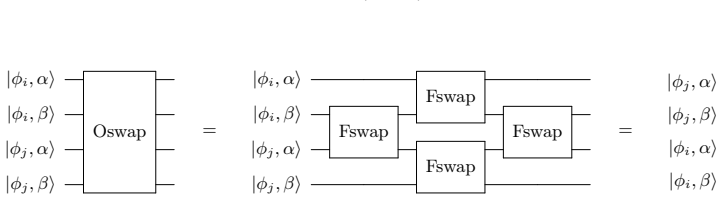
-
[55]
Initialization details for theπactive space system of p-benzyne birradical
Electronic Structure Initialization Molecule Basis Ecorr.(kcal/mol) Cartesian Geometry (Å) p-benzyne cc-pVDZ 76.7520 C -0.7396 -1.1953 0.0000 C 0.7396 -1.1953 0.0000 C 1.3620 0.0000 0.0000 C 0.7396 1.1953 0.0000 C -0.7396 1.1953 0.0000 C -1.3620 0.0000 0.0000 H 1.1999 -2.1824 0.0000 H -1.1999 2.1824 0.0000 H 1.1999 2.1824 0.0000 H -1.1999 -2.1824 0.0000 T...
work page 1953
discussion (0)
Sign in with ORCID, Apple, or X to comment. Anyone can read and Pith papers without signing in.