REVIEW 3 major objections 5 minor 52 references
Topology Optimization in Medical Image Segmentation with Fast Euler Characteristic
T0 review · 3 major / 5 minor · reviewed 2026-08-06 · deepseek-v4-flash
Pith's one-line read A fast Euler-characteristic pipeline detects and repairs topological errors in 2D and 3D medical segmentations, cutting Betti errors while keeping Dice.
desk verdict Strong empirical pipeline and speed gains, but the new 3D Euler characteristic formula is fitted, not proven, and as written it fails on simple 2x2x2 volumes -- the 3D contribution needs a real fix before it can be trusted. read the letter →
The pith
A machine-rendered reading of the paper's core claim, the machinery that carries it, and where it could break.
The reading
What carries the argument
The load-bearing object is the bit-octet: the $2\times2\times2$ pattern of foreground and background voxels that appears at each voxel of a binary volume. Symmetric variants are grouped into 22 classes, of which eight ($O_A$ through $O_H$) enter the formula $\chi = \frac{1}{8}(N_{OA} + 2N_{OB} + 3N_{OC} + 4N_{OD} - N_{OE} - 2N_{OF} - 3N_{OG} - 5N_{OH})$. These pattern counts replace the direct counting of vertices, edges, faces, and cubes, and because the whole computation is a fixed convolution plus a linear readout, it can be applied patchwise to produce local $\chi$-maps that are compatible with gradient-based training. The gradient of the $\chi$-error with respect to the segmentation gives the topological violation map; a U-Net-style correction network takes the masked segmentation together with this map and inpaints the flagged regions.
What would settle it
Enumerate all 256 $2\times2\times2$ voxel patterns, or generate a large batch of random 3D binary volumes, and compare Eq. (8) against the direct cell count $\chi = N_0 - N_1 + N_2 - N_3$; any mismatch in the counts is a counterexample that refutes the 3D extension.
Extended reading notes
Core claim
At the center of the paper is the claim that the Euler characteristic of any 3D binary volume can be written as a simple linear combination of eight pattern-count groups: $\chi = \frac{1}{8}(N_{OA} + 2N_{OB} + 3N_{OC} + 4N_{OD} - N_{OE} - 2N_{OF} - 3N_{OG} - 5N_{OH})$, where the $N_O$ are occurrence counts of symmetry classes of $2\times2\times2$ bit-octets, the 3D analogue of 2D bit-quads. The authors report that this formula was verified by solving a linear system over many generated volumes, and that it is fast enough to use as a per-patch $\chi$-map. The scalar difference between prediction and ground-truth $\chi$-maps produces a topological evaluation metric, and its gradient with respect to the segmentation yields a topological violation map that flags exactly where the topology is wrong. A small generation network then learns to repair the flagged regions from the segmentation itself, so the method works as a plug-in on top of an arbitrary pre-trained segmentation network.
Load-bearing premise
The 3D Euler-characteristic formula in Eq. (8) is assumed to hold for every binary volume, but the paper obtains its coefficients by fitting a linear system to a finite set of generated volumes rather than by proving the identity for all $2\times2\times2$ patterns.
Editorial extensions
If this is right
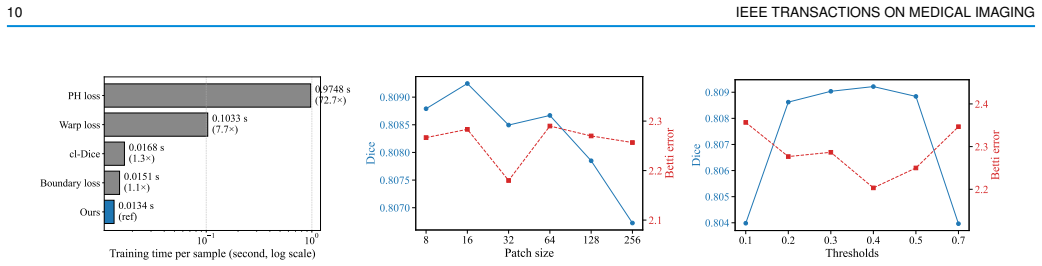
- Topological constraints become practical on 3D volumes: the reported per-sample training time is 0.0134 s versus 0.9748 s for a persistent-homology loss, a 72.7x speedup.
- The TVD+TFS pipeline can be attached to any segmentation backbone; experiments show U-Net and nnU-Net both improve on Betti error when refined this way.
- Training the pre-segmentation and correction network end-to-end further lowers Betti error while keeping Dice, so the method is not limited to post-processing.
- The topological violation map localizes exactly where the topology is wrong at pixel/voxel resolution, and the same map is used to drive the correction.
- Multi-class segmentation can be handled by computing chi per class, extending the speed advantage over PH-based methods to multiple labels.
Reading between the lines
- If Eq. (8) is exact for all 256 voxel patterns, the same coefficient-matching idea could produce closed-form topological losses for other grid types, because the identity is purely local.
- The paper fits coefficients to a finite set of volumes; a mathematical proof or exhaustive pattern check would settle whether larger neighborhoods give even faster or more accurate estimates.
- The violation map itself may transfer to tasks the paper names—generative histopathology image synthesis and surface reconstruction—as a differentiable topological regularizer, not just a correction mask.
Editorial analysis
A structured set of objections, weighed in public.
Referee Report
Summary. The paper proposes a topology-aware medical image segmentation pipeline based on the Euler characteristic (χ). It introduces a 2D bit-quad-based χ computation and extends it to 3D via a bit-octet formula (Eq. 8), then uses local χ-maps to build a topological violation map that highlights regions with topological errors. A topology-aware feature synthesis (TFS) network is trained on masked segmentations to repair these regions. Experiments on five datasets (CREMI, ISBI13, FIVES, dHCP, TopCoW) report improved Betti errors while maintaining Dice scores, with large speedups over persistent-homology-based losses.
Significance. If the technical claims hold, the paper offers a computationally attractive alternative to persistent-homology-based topology losses, with broad applicability as a plug-and-play module for 2D and 3D segmentation. The empirical comparisons span five public datasets and include ablations and backbone-transfer experiments, and the code is made publicly available. The main value depends on the correctness of the 3D χ formula, which is the central new mathematical component; the experimental gains in Betti error are encouraging but would need to rest on a sound and clearly specified χ computation.
major comments (3)
- [Section III-B, Eq. (7)-(8)] The 3D bit-octet formula is not valid for arbitrary 3D binary segmentations as claimed. For a 2x2x2 volume containing exactly one foreground voxel, the only contributing bit-octet is the single-foreground pattern O2 (one occurrence), so Eq. (8) returns χ=1/8, whereas the true Euler characteristic is χ=1. For an all-foreground 2x2x2 volume, the sole pattern is the all-ones octet in the 'Not related' group with coefficient 0, so Eq. (8) returns χ=0 instead of 1; the same failure occurs for any all-foreground volume of any size if no background border is assumed. The coefficients were obtained by solving an overdetermined system on generated volumes (Section III-B), not by proof or exhaustive enumeration of the 256 patterns, and the paper does not state the implicit zero-padding/background-border condition that appears necessary for the formula to hold. Since the χ-maps and topological violation maps in Section III-C depend on Eq. (8), the 3D extension is not established as written. Please state the boundary convention explicitly and provide either a proof or a complete enumeration verifying Eq. (8) under that convention.
- [Section III-C, inference paragraph] The training and inference protocols for the TFS network are inconsistent. During training, the TFS network receives masked segmentations eY, where regions flagged by the ground-truth-based violation map V_t are replaced with Gaussian noise (Eqs. (10)-(11)). At inference, however, the paper states that 'we feed the feature synthesis network with real predictions bY' — i.e., unmasked predictions, with no violation map. This means the network is trained on a corrupted-input distribution and evaluated on a clean-input distribution, and the TVD-derived violation map plays no role at inference time. The paper does not explain how the TVD block is applied to test predictions or why the learned inpainting transfers to unmasked inputs. Please specify the inference-time masking procedure (or else justify the distribution shift and rerun the relevant experiments with the actual inference protocol).
- [Section III-C, χ-Net and violation map] The gradient-based construction of the topological violation map is under-specified and appears to be taken with respect to the wrong variable. The text defines V = ∂e/∂Y, where Y is the ground-truth segmentation, yet the goal is to locate errors in the prediction Ŷ; the ground truth is fixed and cannot be the target of a backpropagation-based explanation. Moreover, the χ-Net binarizes the input probability map before applying the fixed kernels, so the map from Ŷ to χ is piecewise constant and its gradient is zero almost everywhere. The paper needs to state whether the gradient is with respect to Ŷ, how the non-differentiable binarization is handled (e.g., straight-through estimator, soft binarization), and how the resulting map is used in the TFS pipeline. Without this, the TVD block is not reproducible.
minor comments (5)
- [Section II and Section IV-C] The Betti error definition is inconsistent: Eq. (1) defines e as an average over dimensions, while Section IV-C defines e = e0 + e1; please reconcile the notation and the reported values.
- [Throughout] The manuscript alternates between 'Gray' and 'Grey'; please use a single spelling consistently, matching the original reference by S. B. Gray.
- [Table I] The table reports p-values for nearly every comparison but does not mention any multiple-comparison correction; please state whether a correction was applied or note that the p-values are uncorrected.
- [Section IV-E] The sentence beginning 'In 3D TopoCoW dataset, Second, we show the topology violation maps...' is incomplete and should be rewritten.
- [Figure 5 caption] The caption states 'χ error gradient w.r.t GT', which conflicts with the main text's description of the gradient with respect to the segmentation maps; please correct the caption to match the intended computation.
Circularity Check
No significant circularity: the 3D bit-octet coefficients are fitted to independently computed Euler characteristics and the TFS network is supervised by ground truth, so no load-bearing claim reduces to its own inputs.
full rationale
The paper's central new element is Eq. 8, a linear coefficient vector for 3D bit-octets. Section III-B explicitly describes an overdetermined fit: 'we generate M pairs of {χi, #Oi} from M 3D binary volumes... solve the overdetermined linear system to obtain a feasible combination of coefficients that satisfies all M samples.' This is an empirical regression, not a circular definition: the target χi is computed independently from cubical complex counts (Eq. 2), and #Oi,j are pattern counts, so Eq. 8 is not defined in terms of itself. The formula is then used as a computational tool in the χ-Net and TVD block, but the paper does not validate the formula on the same fit samples and present that as a prediction; any universal reading of Eq. 7 is a correctness/finite-sample concern, not a circularity. The TFS network is trained to restore GT-supervised masked predictions and is applied to raw predictions at inference; this is a train/inference distribution shift, but the supervision is the ground-truth label, not the network's own output, so it is not a self-referential loop. The only self-citation is [15], which is the authors' prior MICCAI paper and is used to credit the earlier 2D TVD/TFS design; the current evaluation against external baselines (cl-Dice, Boundary loss, PH loss, Warp loss, Swin-Unet, MedSAM) provides independent support, so this self-citation is not load-bearing. No step in the derivation reduces, by construction, to its own inputs.
Assumptions & free parameters
free parameters (3)
- bit-octet coefficients in Eq. 8 =
Weights 1/8, 2/8, 3/8, 4/8, -1/8, -2/8, -3/8, -5/8 for groups OA to OH
- patch size Delta =
32 (selected from {8, 16, 32, 64, 128, 256} by ablation)
- masking threshold t =
sampled from [0.2, 0.5] during training
assumptions (4)
- domain assumption The Euler characteristic of any 3D binary volume is a linear combination of counts of 2x2x2 bit-octets (Eq. 7).
- ad hoc to paper Local chi-maps computed on patches of size Delta capture the topologically relevant errors of the whole volume.
- ad hoc to paper The gradient of the L1 chi error with respect to the segmentation highlights regions whose correction improves topology.
- ad hoc to paper The TFS network can learn a topological prior from unmasked regions and repair masked regions.
Cite this review
Pith. "Pith review of Topology Optimization in Medical Image Segmentation with Fast Euler Characteristic." pith.science (2026). https://pith.science/paper/VCMJTDWK
@misc{pith2026250723763,
  author       = {Pith},
  title        = {Pith review of: Topology Optimization in Medical Image Segmentation with Fast Euler Characteristic},
  year         = {2026},
  howpublished = {\url{https://pith.science/paper/VCMJTDWK}},
  note         = {Machine review of arXiv:2507.23763}
}
abstract
Deep learning-based medical image segmentation techniques have shown promising results when evaluated based on conventional metrics such as the Dice score or Intersection-over-Union. However, these fully automatic methods often fail to meet clinically acceptable accuracy, especially when topological constraints should be observed, e.g., continuous boundaries or closed surfaces. In medical image segmentation, the correctness of a segmentation in terms of the required topological genus sometimes is even more important than the pixel-wise accuracy. Existing topology-aware approaches commonly estimate and constrain the topological structure via the concept of persistent homology (PH). However, these methods are difficult to implement for high dimensional data due to their polynomial computational complexity. To overcome this problem, we propose a novel and fast approach for topology-aware segmentation based on the Euler Characteristic ($\chi$). First, we propose a fast formulation for $\chi$ computation in both 2D and 3D. The scalar $\chi$ error between the prediction and ground-truth serves as the topological evaluation metric. Then we estimate the spatial topology correctness of any segmentation network via a so-called topological violation map, i.e., a detailed map that highlights regions with $\chi$ errors. Finally, the segmentation results from the arbitrary network are refined based on the topological violation maps by a topology-aware correction network. Our experiments are conducted on both 2D and 3D datasets and show that our method can significantly improve topological correctness while preserving pixel-wise segmentation accuracy.
Figures


Figures from the paper (5 more)


Reference graph
Works this paper leans on
-
[1]
Metrics reloaded: Pitfalls and recom- mendations for image analysis validation,
L. Maier-Hein, B. Menze et al., “Metrics reloaded: Pitfalls and recom- mendations for image analysis validation,” arXiv. org, no. 2206.01653, 2022
arXiv 2022
-
[2]
Cortical surface-based anal- ysis: I. segmentation and surface reconstruction,
A. M. Dale, B. Fischl, and M. I. Sereno, “Cortical surface-based anal- ysis: I. segmentation and surface reconstruction,” Neuroimage, vol. 9, no. 2, pp. 179–194, 1999
work page 1999
-
[3]
nnu-net: a self-configuring method for deep learning-based biomedical image segmentation,
F. Isensee, P. F. Jaeger, S. A. Kohl, J. Petersen, and K. H. Maier-Hein, “nnu-net: a self-configuring method for deep learning-based biomedical image segmentation,” Nature methods, vol. 18, no. 2, pp. 203–211, 2021
2021
-
[4]
Segment anything in medical images,
J. Ma, Y . He, F. Li, L. Han, C. You, and B. Wang, “Segment anything in medical images,” Nature Communications, vol. 15, no. 1, p. 654, 2024
2024
-
[5]
Direct three-dimensional segmen- tation of prostate glands with nnu-net,
R. Wang, S. S. Chow, R. B. Serafin, W. Xie, Q. Han, E. Baraznenok, L. Lan, K. W. Bishop, and J. T. Liu, “Direct three-dimensional segmen- tation of prostate glands with nnu-net,” Journal of Biomedical Optics , vol. 29, no. 3, pp. 036 001–036 001, 2024
work page 2024
-
[6]
L. Huo, X. Hu, Q. Xiao, Y . Gu, X. Chu, and L. Jiang, “Segmentation of whole breast and fibroglandular tissue using nnu-net in dynamic contrast enhanced mr images,” Magnetic Resonance Imaging, vol. 82, pp. 31–41, 2021
work page 2021
-
[7]
J. Funke, F. Tschopp, W. Grisaitis, A. Sheridan, C. Singh, S. Saalfeld, and S. C. Turaga, “Large scale image segmentation with structured loss based deep learning for connectome reconstruction,” IEEE transactions on pattern analysis and machine intelligence , vol. 41, no. 7, pp. 1669– 1680, 2018
work page 2018
-
[8]
Topology-preserving deep im- age segmentation,
X. Hu, F. Li, D. Samaras, and C. Chen, “Topology-preserving deep im- age segmentation,” Advances in neural information processing systems , vol. 32, 2019
work page 2019
Show all 52 references
-
[9]
A topological loss function for deep-learning based image segmentation using persistent homology,
J. R. Clough, N. Byrne, I. Oksuz, V . A. Zimmer, J. A. Schnabel, and A. P. King, “A topological loss function for deep-learning based image segmentation using persistent homology,” IEEE Transactions on Pattern Analysis and Machine Intelligence, vol. 44, no. 12, pp. 8766–8778, 2020
2020
-
[10]
Explicit topological priors for deep-learning based image segmenta- tion using persistent homology,
J. R. Clough, I. Oksuz, N. Byrne, J. A. Schnabel, and A. P. King, “Explicit topological priors for deep-learning based image segmenta- tion using persistent homology,” in Information Processing in Medical Imaging: 26th International Conference, IPMI 2019, Hong Kong, China, Jun...
2019
-
[11]
Topolog- ically faithful image segmentation via induced matching of persistence barcodes,
N. Stucki, J. C. Paetzold, S. Shit, B. Menze, and U. Bauer, “Topolog- ically faithful image segmentation via induced matching of persistence barcodes,” in International Conference on Machine Learning . PMLR, 2023, pp. 32 698–32 727
2023
-
[12]
Local properties of binary images in two dimensions,
S. B. Gray, “Local properties of binary images in two dimensions,” IEEE Transactions on computers, vol. 100, no. 5, pp. 551–561, 1971
1971
-
[13]
A novel bit-quad- based euler number computing algorithm,
B. Yao, L. He, S. Kang, Y . Chao, and X. Zhao, “A novel bit-quad- based euler number computing algorithm,” Springerplus, vol. 4, pp. 1– 16, 2015
2015
-
[14]
Learning an artificial neural network to discover combinations of bit-quads to compute the euler characteristic of a 2-d binary image,
F. Arce Vega, J. H. Sossa Azuela, W. G ´omez Flores, and L. G. Lira Var- gas, “Learning an artificial neural network to discover combinations of bit-quads to compute the euler characteristic of a 2-d binary image,” Computaci´on y Sistemas , vol. 26, no. 1, 2022
2022
-
[15]
Robust segmentation via topology violation detection and feature synthesis,
L. Li, Q. Ma, C. Ouyang, Z. Li, Q. Meng, W. Zhang, M. Qiao, V . Kyriakopoulou, J. V . Hajnal, D. Rueckertet al., “Robust segmentation via topology violation detection and feature synthesis,” in International Conference on Medical Image Computing and Computer-Assisted Inter- ve...
2023
-
[16]
U-net: Convolutional networks for biomedical image segmentation,
O. Ronneberger, P. Fischer, and T. Brox, “U-net: Convolutional networks for biomedical image segmentation,” in Medical Image Computing and Computer-Assisted Intervention–MICCAI 2015: 18th International Conference, Munich, Germany, October 5-9, 2015, Proceedings, Part III
2015
-
[17]
Swin-unet: Unet-like pure transformer for medical image segmenta- tion,
H. Cao, Y . Wang, J. Chen, D. Jiang, X. Zhang, Q. Tian, and M. Wang, “Swin-unet: Unet-like pure transformer for medical image segmenta- tion,” in European conference on computer vision . Springer, 2022, pp. 205–218
2022
-
[18]
Springer, 2015, pp. 234–241
2015
-
[19]
Segment anything,
A. Kirillov, E. Mintun, N. Ravi, H. Mao, C. Rolland, L. Gustafson, T. Xiao, S. Whitehead, A. C. Berg, W.-Y . Loet al., “Segment anything,” in Proceedings of the IEEE/CVF international conference on computer vision, 2023, pp. 4015–4026
2023
-
[20]
Medical sam 2: Segment medical images as video via segment anything model 2,
J. Zhu, A. Hamdi, Y . Qi, Y . Jin, and J. Wu, “Medical sam 2: Segment medical images as video via segment anything model 2,” 2024
2024
-
[21]
Esp-medsam: Efficient self-prompting sam for universal domain-generalized medical image segmentation,
Q. Xu, J. Li, X. He, Z. Liu, Z. Chen, W. Duan, C. Li, M. M. He, F. B. Tesema, W. P. Cheah et al., “Esp-medsam: Efficient self-prompting sam for universal domain-generalized medical image segmentation,” arXiv preprint arXiv:2407.14153, 2024
2024 arXiv
-
[22]
Deformable models in medical image analysis: a survey,
T. McInerney and D. Terzopoulos, “Deformable models in medical image analysis: a survey,” Medical image analysis , vol. 1, no. 2, pp. 91–108, 1996
1996
-
[23]
Tetris: Template transformer networks for image segmentation with shape priors,
M. C. H. Lee, K. Petersen, N. Pawlowski, B. Glocker, and M. Schaap, “Tetris: Template transformer networks for image segmentation with shape priors,” IEEE transactions on medical imaging , vol. 38, no. 11, pp. 2596–2606, 2019
2019
-
[24]
Anatomi- cally constrained neural networks (acnns): application to cardiac image enhancement and segmentation,
O. Oktay, E. Ferrante, K. Kamnitsas, M. Heinrich, W. Bai, J. Caballero, S. A. Cook, A. De Marvao, T. Dawes, D. P. O‘Regan et al., “Anatomi- cally constrained neural networks (acnns): application to cardiac image enhancement and segmentation,” IEEE transactions on medical imagi...
2017
-
[25]
Boundary loss for highly unbalanced segmentation,
H. Kervadec, J. Bouchtiba, C. Desrosiers, E. Granger, J. Dolz, and I. B. Ayed, “Boundary loss for highly unbalanced segmentation,” in Inter- national conference on medical imaging with deep learning . PMLR, 2019, pp. 285–296
2019
-
[26]
cldice-a novel topology- preserving loss function for tubular structure segmentation,
S. Shit, J. C. Paetzold, A. Sekuboyina, I. Ezhov, A. Unger, A. Zhylka, J. P. Pluim, U. Bauer, and B. H. Menze, “cldice-a novel topology- preserving loss function for tubular structure segmentation,” in Pro- ceedings of the IEEE/CVF Conference on Computer Vision and Pattern Rec...
2021
-
[27]
Skeleton recall loss for connectivity conserving and resource efficient segmentation of thin tubular structures,
Y . Kirchhoff, M. R. Rokuss, S. Roy, B. Kovacs, C. Ulrich, T. Wald, M. Zenk, P. V ollmuth, J. Kleesiek, F. Isensee et al. , “Skeleton recall loss for connectivity conserving and resource efficient segmentation of thin tubular structures,” in European Conference on Computer Vis...
2024
-
[28]
Fetal cortex seg- mentation with topology and thickness loss constraints,
L. Li, Q. Ma, Z. Li, C. Ouyang, W. Zhang, A. Price, V . Kyriakopoulou, L. C. Grande, A. Makropoulos, J. Hajnal et al. , “Fetal cortex seg- mentation with topology and thickness loss constraints,” in Ethical and Philosophical Issues in Medical Imaging, Multimodal Learning and F...
2022
-
[29]
Segmentation of the cortical plate in fetal brain mri with a topological loss,
P. de Dumast, H. Kebiri, C. Atat, V . Dunet, M. Koob, and M. B. Cuadra, “Segmentation of the cortical plate in fetal brain mri with a topological loss,” in Uncertainty for Safe Utilization of Machine Learning in Medical Imaging, and Perinatal Imaging, Placental and Preterm Ima...
2021
-
[30]
A persistent homology-based topological loss for cnn-based multiclass segmentation of cmr,
N. Byrne, J. R. Clough, I. Valverde, G. Montana, and A. P. King, “A persistent homology-based topological loss for cnn-based multiclass segmentation of cmr,” IEEE Transactions on Medical Imaging , vol. 42, no. 1, pp. 3–14, 2022
2022
-
[31]
Topologically faithful multi-class segmentation in medical images,
A. H. Berger, N. Stucki, L. Lux, V . Buergin, S. Shit, A. Ba- naszak, D. Rueckert, U. Bauer, and J. C. Paetzold, “Topologically faithful multi-class segmentation in medical images,” arXiv preprint arXiv:2403.11001, 2024
2024 arXiv
-
[32]
Topology preserving compositionality for robust medical image segmentation,
A. Santhirasekaram, M. Winkler, A. Rockall, and B. Glocker, “Topology preserving compositionality for robust medical image segmentation,” in Proceedings of the IEEE/CVF conference on computer vision and pattern recognition, 2023, pp. 543–552
2023
-
[33]
Topology-guided multi-class cell context generation for digital pathol- ogy,
S. Abousamra, R. Gupta, T. Kurc, D. Samaras, J. Saltz, and C. Chen, “Topology-guided multi-class cell context generation for digital pathol- ogy,” in Proceedings of the IEEE/CVF conference on computer vision and pattern recognition , 2023, pp. 3323–3333
2023
-
[34]
Topocellgen: Generating histopathology cell topology with a diffusion model,
M. Xu, S. Gupta, X. Hu, C. Li, S. Abousamra, D. Samaras, P. Prasanna, and C. Chen, “Topocellgen: Generating histopathology cell topology with a diffusion model,” arXiv preprint arXiv:2412.06011 , 2024
2024 arXiv
-
[35]
Cubical ripser: Software for computing persistent homology of image and volume data,
S. Kaji, T. Sudo, and K. Ahara, “Cubical ripser: Software for computing persistent homology of image and volume data,” arXiv:2005.12692, 2020
2005 arXiv
-
[36]
The gudhi library: Simplicial complexes and persistent homology,
C. Maria, J.-D. Boissonnat, M. Glisse, and M. Yvinec, “The gudhi library: Simplicial complexes and persistent homology,” inMathematical Software–ICMS 2014: 4th International Congress, Seoul, South Korea, August 5-9, 2014. Proceedings 4 . Springer, 2014, pp. 167–174
2014
-
[37]
Structure-aware image segmentation with homotopy warp- ing,
X. Hu, “Structure-aware image segmentation with homotopy warp- ing,” Advances in Neural Information Processing Systems , vol. 35, pp. 24 046–24 059, 2022
2022
-
[38]
Topology- aware segmentation using discrete morse theory,
X. Hu, Y . Wang, L. Fuxin, D. Samaras, and C. Chen, “Topology- aware segmentation using discrete morse theory,” arXiv preprint arXiv:2103.09992, 2021
2021 arXiv
-
[39]
Topological data analysis,
L. Wasserman, “Topological data analysis,” Annual Review of Statistics and Its Application , vol. 5, pp. 501–532, 2018
2018
-
[40]
Eilenberg and N
S. Eilenberg and N. Steenrod, Foundations of algebraic topology . Princeton University Press, 2015
2015
-
[41]
An introduction to topological data analysis: fundamental and practical aspects for data scientists,
F. Chazal and B. Michel, “An introduction to topological data analysis: fundamental and practical aspects for data scientists,” Frontiers in artificial intelligence, vol. 4, p. 108, 2021
2021
-
[42]
A user’s guide to topological data analysis,
E. Munch, “A user’s guide to topological data analysis,” Journal of Learning Analytics, vol. 4, no. 2, pp. 47–61, 2017
2017
-
[43]
Algebraic topology for computer vision,
D. Freedman and C. Chen, “Algebraic topology for computer vision,” Computer Vision, pp. 239–268, 2009
2009
-
[44]
Efficient classification using the euler characteristic,
E. Richardson and M. Werman, “Efficient classification using the euler characteristic,” Pattern Recognition Letters, vol. 49, pp. 99–106, 2014
2014
-
[45]
Snemi 3d: 3d segmentation of neurites in em images,
I. Arganda-Carreras, S. Seung, A. Vishwanathan, and D. Berger, “Snemi 3d: 3d segmentation of neurites in em images,” 2013
2013
-
[46]
Fives: A fundus image dataset for artificial intelligence based vessel segmentation,
K. Jin, X. Huang, J. Zhou, Y . Li, Y . Yan, Y . Sun, Q. Zhang, Y . Wang, and J. Ye, “Fives: A fundus image dataset for artificial intelligence based vessel segmentation,” Scientific Data, vol. 9, no. 1, p. 475, 2022
2022
-
[47]
Reconstruction of fetal brain mri with in- tensity matching and complete outlier removal,
M. Kuklisova-Murgasova, G. Quaghebeur, M. A. Rutherford, J. V . Hajnal, and J. A. Schnabel, “Reconstruction of fetal brain mri with in- tensity matching and complete outlier removal,” Medical image analysis, vol. 16, no. 8, pp. 1550–1564, 2012
2012
-
[48]
Fast volume reconstruction from motion corrupted stacks of 2d slices,
B. Kainz, M. Steinberger, W. Wein, M. Kuklisova-Murgasova, C. Mala- mateniou, K. Keraudren, T. Torsney-Weir, M. Rutherford, P. Aljabar, J. V . Hajnal et al., “Fast volume reconstruction from motion corrupted stacks of 2d slices,” IEEE transactions on medical imaging , vol. 34,...
1901
-
[49]
The developing human connectome project: A minimal process- ing pipeline for neonatal cortical surface reconstruction,
A. Makropoulos, E. C. Robinson, A. Schuh, R. Wright, S. Fitzgibbon, J. Bozek, S. J. Counsell, J. Steinweg, K. Vecchiato, J. Passerat-Palmbach et al., “The developing human connectome project: A minimal process- ing pipeline for neonatal cortical surface reconstruction,” Neuroi...
2018
-
[50]
Benchmark- ing the cow with the topcow challenge: Topology-aware anatomical segmentation of the circle of willis for cta and mra,
K. Yang, F. Musio, Y . Ma, N. Juchler, J. C. Paetzold, R. Al-Maskari, L. H ¨oher, H. B. Li, I. E. Hamamci, A. Sekuboyina et al., “Benchmark- ing the cow with the topcow challenge: Topology-aware anatomical segmentation of the circle of willis for cta and mra,” arXiv preprint a...
2023 arXiv
-
[51]
Adam: A method for stochastic optimization,
D. P. Kingma, “Adam: A method for stochastic optimization,” arXiv preprint arXiv:1412.6980, 2014
2014 arXiv
-
[52]
Individual comparisons by ranking methods,
F. Wilcoxon, “Individual comparisons by ranking methods,” in Break- throughs in Statistics: Methodology and Distribution . Springer, 1992, pp. 196–202
1992
Reviewed August 6, 2026 · model on record in the stance chip above.
Discussion (0). Sign in to comment.