REVIEW 5 major objections 6 minor 44 references
TITAN-Guide: Taming Inference-Time AligNment for Guided Text-to-Video Diffusion Models
T0 review · 5 major / 6 minor · reviewed 2026-08-06 · deepseek-v4-flash
Pith's one-line read TITAN-Guide shows that forward gradients can replace backpropagation for classifier guidance, cutting GPU memory roughly in half while keeping or improving video quality.
desk verdict Forward-mode AD for diffusion guidance is a genuinely useful memory saver, but the quality gains are under-evidenced and the score-based tangent needs better justification. read the letter →
The pith
A machine-rendered reading of the paper's core claim, the machinery that carries it, and where it could break.
The reading
What carries the argument
The load-bearing object is the forward-gradient update $G_t = \langle \nabla f, V_t \rangle V_t$, computed with forward-mode automatic differentiation (a Jacobian-vector product) in a single forward pass. $V_t$ is a "gradient guess" direction; the machinery is that projecting the true gradient onto $V_t$ and multiplying back by $V_t$ gives an unbiased but high-variance estimate of $\nabla f$ when $V_t$ is random, and a more deterministic estimate when $V_t$ is the normalized score estimate from the denoiser. This estimate is used in the update $Z_t \leftarrow Z_t - \lambda_t G_t$, avoiding the memory cost of storing the full computational graph for backpropagation. The second component is the traversal to $t=0$ via iterative sampling rather than the Tweedie estimate, which the paper argues gives the guidance classifier a clean video to score at every step.
What would settle it
Measure the cosine similarity between TITAN-Guide's update direction $G_t$ and the true gradient $\nabla f$ at the same latent on a handful of VGG-Sound prompts: if the similarity is zero or negative at early denoising steps while reported FVD gains persist, then the forward-gradient mechanism is not the source of the improvement.
Extended reading notes
Core claim
The paper proposes that a guided text-to-video diffusion step should not rely on backpropagation or on a single-step Tweedie estimate of the clean video. Instead, at each denoising step it fully samples the latent forward to t=0 with the denoiser, decodes the result, scores it with an off-the-shelf predictor, and then updates the original latent by the forward-gradient estimate $G_t = \langle \nabla f, V_t \rangle V_t$. Three choices of the guess direction $V_t$ are studied: isotropic Gaussian noise, the normalized denoiser output $\epsilon_\theta(Z_t,t,c)/\|\epsilon_\theta(Z_t,t,c)\|$, and a gradient sampled from a small subset of frames. The paper claims this update eliminates the backward pass, cuts GPU memory by about half relative to DOODL, TFG, MPGD, and FreeDoM, and produces lower FVD and higher alignment scores on audio-video, aesthetic, style, and frame-interpolation tasks.
Load-bearing premise
The paper assumes the forward-gradient direction $G_t = \langle \nabla f, V_t \rangle V_t$ points downhill enough to improve the latent, most speculatively when $V_t$ is the score-based guess $\epsilon_\theta(Z_t,t,c)/\|\epsilon_\theta(Z_t,t,c)\|$; this is heuristic and only supported by the toy study and qualitative results.
Editorial extensions
If this is right
- Guidance of T2V models becomes feasible on 24GB consumer GPUs; at 256x256 the method uses about 20.6GB versus 40-67GB for prior baselines.
- Higher resolution is unlocked: 384x384 guidance runs in 42GB where baselines exceed 90GB.
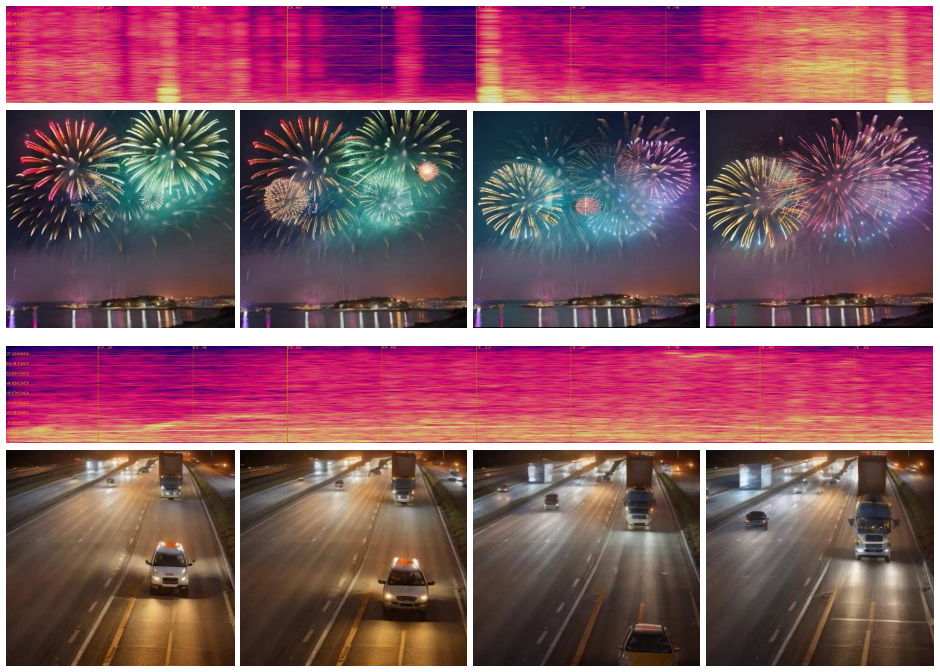
- The same latent-update rule works across multiple off-the-shelf predictors (ImageBind, DOVER, Style-CLIP) and across tasks including audio-video alignment, aesthetic scoring, style transfer, and frame interpolation.
- FVD and alignment metrics improve or match the strongest baselines, with sampled-gradient guesses giving the best quality in the paper's comparisons.
- Because the method avoids backpropagation, it also extends to image-domain guidance tasks such as super-resolution, deblurring, and attribute conditioning, where it is competitive on LPIPS, FID, and KID.
Reading between the lines
- Beyond the paper: the forward-gradient estimator's variance is the main quality bottleneck, so replacing $V_t$ with a lower-variance control variate (e.g., a learned or ensemble direction) should further improve guidance without adding memory.
- Beyond the paper: because the update is forward-only, the same scheme could steer other memory-intensive generative models — high-resolution image diffusion, 3D/NeRF, or long-video generators — where backpropagation through sampling is prohibitive.
- Beyond the paper: the paper's $t=0$ traversal costs about 2 minutes per video versus roughly 40 seconds for single-step estimators; caching trajectory states or amortizing the clean-sample computation could close that speed gap while keeping the memory advantage.
- Beyond the paper: the score-based guess is only heuristically motivated; formalizing when $\langle \nabla f, \epsilon_\theta/\|\epsilon_\theta\| \rangle \epsilon_\theta/\|\epsilon_\theta\|$ is a descent direction (e.g., connecting it to denoising score matching) would put the method on firmer ground.
Editorial analysis
A structured set of objections, weighed in public.
Referee Report
Summary. The paper proposes TITAN-Guide, a training-free classifier-guidance method for text-to-video (T2V) diffusion models. Instead of backpropagating through the denoising and decoding pipeline, the method estimates the gradient of a guidance loss by forward-mode automatic differentiation, computing G_t = <∇f, V_t>V_t for a tangent direction V_t. Three choices of V_t are studied: isotropic Gaussian noise (random guesses), the normalized output of the denoiser (score-based guesses), and a normalized gradient computed on a small subset of frames (sampled-gradient guesses). The method is evaluated on AnimateDiff and CogVideoX for audio–video alignment, aesthetic guidance, style guidance, frame interpolation, and several image-domain tasks. Reported GPU memory usage is roughly half that of backpropagation-based baselines such as DOODL, enabling guidance at resolutions that baselines cannot handle on consumer GPUs.
Significance. The memory-efficiency claim is directly measured and is a practically valuable contribution: controlling memory-intensive T2V models without backpropagation would broaden the applicability of guidance methods. The paper ships code and includes memory measurements at multiple resolutions. However, the central performance claim of 'more optimal control' is not robustly established. The reported quality gains over baselines are small (1–3 FVD points), are shown without error bars or multiple seeds, and partly rely on evaluating with the same models used as guidance objectives. Furthermore, the best-performing variant (sampled-gradient guesses) appears to require backpropagation to compute its tangent direction, which weakens the paper's stated novelty. If the authors can address these concerns with additional experiments and a more careful characterization of the forward-gradient approximation, the method could be a useful addition to the guided-diffusion toolbox.
major comments (5)
- [§4.2, Eq. (9) and Algorithm 1] The score-based guess V_t = εθ(Z_t,t,c)/||εθ(Z_t,t,c)|| is a deterministic direction, so G_t = ⟨∇f, V_t⟩V_t is a rank-one projection of the true gradient, not an unbiased estimator. The update magnitude equals ||∇f|| times the cosine between ∇f and V_t, which can be near zero in high-dimensional latent spaces. The paper provides no measurement of this alignment; the toy experiment in Figure 4 is qualitative and single-seed, and Tables 1–2 report single runs. Without evidence that the denoiser output correlates with the guidance-loss gradient, the claimed quality advantage over DOODL and other baselines is not explained.
- [Tables 1, 2, and 4] All results are reported as single runs without error bars or multiple seeds. The FVD differences between TITAN-Guide and DOODL are 1–3 points (Table 1: 334.21 vs 333.42 and 331.11), and the IB-AV/IB-TV scores are essentially flat across methods (e.g., 0.218 vs 0.215–0.216). Without variance estimates or significance testing, these differences do not support the claim of 'more optimal control'. Please report means and standard deviations over at least three seeds.
- [§4.2, Sampled gradient guesses] This variant defines V_t by sampling from ∇_{Z^F_0|t} f(Dϕ(Z^F_0|t), y, ψ), which is a backpropagation through the decoder and classifier, even though F is small. Therefore the abstract's statement that TITAN-Guide 'eliminates the need for backpropagation' is true only for the random- and score-based guesses, not for the variant that achieves the best scores in Tables 1–2. The authors should clarify this and report the memory and runtime overhead of computing this guess separately.
- [§5.2, Metrics] The guidance objectives (ImageBind, DOVER, Style-CLIP) are also used as evaluation metrics (IB-AV, IB-TV, DOVER, ED in Tables 1–2). Hence part of the reported alignment improvement simply measures how well the optimizer minimized its own loss. Because FVD and KVD are the only external metrics, the authors should either add independent metrics (e.g., human preference or a different video-quality model) or qualify the alignment-based claims accordingly.
- [Figure 4] The toy experiment is presented as evidence that score-based guesses approximate ground-truth gradients, but it is qualitative, uses a single seed, and does not quantify the cosine similarity or step-size behavior between G_t and ∇f. Given the central role of this assumption in the paper, a quantitative comparison would be more convincing.
minor comments (6)
- [Abstract] The first sentence is grammatically incomplete: 'In the recent development of conditional diffusion models still require heavy supervised fine-tuning' should be rephrased, for instance as 'Recent conditional diffusion models still require heavy supervised fine-tuning...'.
- [Equation (4)] Equation (4) contains a spurious negative sign: 'Zt ← -Zt - λt∇ZtL(...)' should presumably be 'Zt ← Zt - λt∇ZtL(...)', consistent with Algorithm 1 and the rest of the paper.
- [Section 5.1] The text says the T2V models are 'noth effective' — this is a typo and should read 'both effective'.
- [Section 9] The phrase 'ig.8' should be 'Fig. 8'.
- [Table 3 and surrounding text] The ablation over iterations is non-monotonic (FVD 348.26 at 20, 340.21 at 50, 350.52 at 100) but the text says improvements are marginal; please explain the degradation at 100 iterations.
- [Appendix 8] The hyperparameter section states λ_t = 0.1 and F = 2 for sampled-gradient guesses, but no sensitivity analysis for F is provided, although F affects the gradient-approximation quality and memory cost.
Circularity Check
No derivation-chain circularity; one minor evaluation overlap from using guidance losses as metrics.
-
other
[Section 5.1 (Guidance tasks and Metrics); Tables 1-2]
"For classifier guidance, we employed off-the-shelf discriminative models: 1) ImageBind [10] for audio-text-video alignment tasks, 2) DOVER [29] to enhance aesthetic aspects e.g., semantics and composition, and 3) Style-CLIP [21] to control the style of generated videos. // For multi-modal alignment, we used ImageBind scores [10] to measure text-video (IB-TV) and audio-video (IB-A V) correspondences."
The guidance update in Algorithm 1 minimizes f(D(hat Z_0|t), y, psi) with psi equal to ImageBind, DOVER, or Style-CLIP, and Tables 1-2 then report IB-TV, IB-AV, DOVER, and style-feature ED as evidence of success. Because these scores are the same cosine-similarity losses being optimized, the reported alignment and aesthetic gains partially measure the optimizer's own objective by construction. This is a real but minor evaluation overlap: FVD/KVD and AV-Align are external, no constants are fitted to the benchmarks, and the forward-gradient derivation itself does not reduce to these metrics.
full rationale
TITAN-Guide's central derivation is self-contained rather than circular. Equation (6) defines the forward-gradient estimator G(Z) = <nabla f(Z), V>V as the standard rank-one projection, and Eq. (9) is an explicit heuristic choice of tangent, not a parameter fitted to the reported data. The memory-efficiency claim follows from forward-mode AD and is verified by direct measurement, and FVD/KVD/AV-Align are external benchmarks. The score-based guess is an accuracy/robustness risk (a projection can be small or misaligned), but that is not circularity. The only mild issue is that the guidance models double as evaluation metrics, so those specific numbers partly reflect the optimizer minimizing its own loss. That does not invalidate the central method, which is an empirical optimization result rather than a derivation that reduces to its inputs.
Assumptions & free parameters
free parameters (3)
- guidance learning rate lambda_t =
0.1
- number of guidance iterations =
20 (ablated 20/50/100 in Table 3)
- number of sampled frames F for sampled-gradient guess =
2
assumptions (3)
- ad hoc to paper The forward gradient G = ⟨∇f, V⟩V approximates the true gradient ∇f for the chosen guess vectors V.
- domain assumption Unrolling the denoiser from Z_t to t=0 produces a clean latent whose decoded video is a valid input for off-the-shelf classifiers.
- domain assumption Off-the-shelf classifiers ψ (ImageBind, DOVER, Style-CLIP) are differentiable with respect to the decoded video input.
Cite this review
Pith. "Pith review of TITAN-Guide: Taming Inference-Time AligNment for Guided Text-to-Video Diffusion Models." pith.science (2026). https://pith.science/paper/INYF2CRO
@misc{pith2026250800289,
  author       = {Pith},
  title        = {Pith review of: TITAN-Guide: Taming Inference-Time AligNment for Guided Text-to-Video Diffusion Models},
  year         = {2026},
  howpublished = {\url{https://pith.science/paper/INYF2CRO}},
  note         = {Machine review of arXiv:2508.00289}
}
read the original abstract
In the recent development of conditional diffusion models still require heavy supervised fine-tuning for performing control on a category of tasks. Training-free conditioning via guidance with off-the-shelf models is a favorable alternative to avoid further fine-tuning on the base model. However, the existing training-free guidance frameworks either have heavy memory requirements or offer sub-optimal control due to rough estimation. These shortcomings limit the applicability to control diffusion models that require intense computation, such as Text-to-Video (T2V) diffusion models. In this work, we propose Taming Inference Time Alignment for Guided Text-to-Video Diffusion Model, so-called TITAN-Guide, which overcomes memory space issues, and provides more optimal control in the guidance process compared to the counterparts. In particular, we develop an efficient method for optimizing diffusion latents without backpropagation from a discriminative guiding model. In particular, we study forward gradient descents for guided diffusion tasks with various options on directional directives. In our experiments, we demonstrate the effectiveness of our approach in efficiently managing memory during latent optimization, while previous methods fall short. Our proposed approach not only minimizes memory requirements but also significantly enhances T2V performance across a range of diffusion guidance benchmarks. Code, models, and demo are available at https://titanguide.github.io.
Figures


Figures from the paper (8 more)


Reference graph
Works this paper leans on
-
[1]
Jinze Bai, Shuai Bai, Shusheng Yang, Shijie Wang, Sinan Tan, Peng Wang, Junyang Lin, Chang Zhou, and Jingren Zhou. Qwen-vl: A versatile vision-language model for un- derstanding, localization, text reading, and beyond. arXiv preprint arXiv:2308.12966, 2023. 6
arXiv 2023
-
[2]
Universal guidance for diffusion models
Arpit Bansal, Hong-Min Chu, Avi Schwarzschild, Soumyadip Sengupta, Micah Goldblum, Jonas Geip- ing, and Tom Goldstein. Universal guidance for diffusion models. In Proceedings of the IEEE/CVF Conference on Computer Vision and Pattern Recognition , pages 843–852,
-
[3]
Gradients without backprop- agation
Atılım G ¨unes ¸ Baydin, Barak A Pearlmutter, Don Syme, Frank Wood, and Philip Torr. Gradients without backprop- agation. arXiv preprint arXiv:2202.08587 , 2022. 2, 3, 5, 10
arXiv 2022
-
[4]
Vggsound: A large-scale audio-visual dataset
Honglie Chen, Weidi Xie, Andrea Vedaldi, and Andrew Zis- serman. Vggsound: A large-scale audio-visual dataset. In International Conference on Acoustics, Speech, and Signal Processing (ICASSP), 2020. 1, 5, 6, 11
work page 2020
-
[5]
Qwen-audio: Advancing universal audio understanding via unified large-scale audio-language models
Yunfei Chu, Jin Xu, Xiaohuan Zhou, Qian Yang, Shil- iang Zhang, Zhijie Yan, Chang Zhou, and Jingren Zhou. Qwen-audio: Advancing universal audio understanding via unified large-scale audio-language models. arXiv preprint arXiv:2311.07919, 2023. 6
arXiv 2023
-
[6]
Flatten: optical flow- guided attention for consistent text-to-video editing
Yuren Cong, Mengmeng Xu, Christian Simon, Shoufa Chen, Jiawei Ren, Yanping Xie, Juan-Manuel Perez-Rua, Bodo Rosenhahn, Tao Xiang, and Sen He. Flatten: optical flow- guided attention for consistent text-to-video editing. arXiv preprint arXiv:2310.05922, 2023. 2
-
[7]
Tweedie’s formula and selection bias
Bradley Efron. Tweedie’s formula and selection bias. Jour- nal of the American Statistical Association , 106:1602 – 1614, 2011. 2, 3, 5
work page 2011
-
[8]
Douceur, Jon Howell, and Jared Saul
Jeremy Elson, John R. Douceur, Jon Howell, and Jared Saul. Asirra: a captcha that exploits interest-aligned manual image categorization. In Conference on Computer and Communi- cations Security, 2007. 12
work page 2007
Show all 44 references
-
[9]
Can forward gra- dient match backpropagation? In International Conference on Machine Learning, pages 10249–10264
Louis Fournier, St ´ephane Rivaud, Eugene Belilovsky, Michael Eickenberg, and Edouard Oyallon. Can forward gra- dient match backpropagation? In International Conference on Machine Learning, pages 10249–10264. PMLR, 2023. 5
2023
-
[10]
Imagebind: One embedding space to bind them all
Rohit Girdhar, Alaaeldin El-Nouby, Zhuang Liu, Mannat Singh, Kalyan Vasudev Alwala, Armand Joulin, and Ishan Misra. Imagebind: One embedding space to bind them all. In CVPR, 2023. 3, 4, 6, 11
2023
-
[11]
Animatediff: Animate your personalized text-to- image diffusion models without specific tuning
Yuwei Guo, Ceyuan Yang, Anyi Rao, Zhengyang Liang, Yaohui Wang, Yu Qiao, Maneesh Agrawala, Dahua Lin, and Bo Dai. Animatediff: Animate your personalized text-to- image diffusion models without specific tuning. Interna- tional Conference on Learning Representations, 2024. 4, 6, 8, 10
2024
-
[12]
Manifold preserving guided diffusion
Yutong He, Naoki Murata, Chieh-Hsin Lai, Yuhta Takida, Toshimitsu Uesaka, Dongjun Kim, Wei-Hsiang Liao, Yuki Mitsufuji, J Zico Kolter, Ruslan Salakhutdinov, and Ste- fano Ermon. Manifold preserving guided diffusion. In The Twelfth International Conference on Learning Represent...
2024
-
[13]
Denoising dif- fusion probabilistic models
Jonathan Ho, Ajay Jain, and Pieter Abbeel. Denoising dif- fusion probabilistic models. Advances in neural information processing systems, 33:6840–6851, 2020. 10, 12
2020
-
[14]
Deep learning face attributes in the wild
Ziwei Liu, Ping Luo, Xiaogang Wang, and Xiaoou Tang. Deep learning face attributes in the wild. In Proceedings of International Conference on Computer Vision (ICCV), 2015. 12
2015
-
[15]
Sdedit: Guided image synthesis and editing with stochastic differential equa- tions
Chenlin Meng, Yutong He, Yang Song, Jiaming Song, Jia- jun Wu, Jun-Yan Zhu, and Stefano Ermon. Sdedit: Guided image synthesis and editing with stochastic differential equa- tions. arXiv preprint arXiv:2108.01073, 2021. 2
2021 arXiv
-
[16]
T2i-adapter: Learning adapters to dig out more controllable ability for text-to-image diffusion models
Chong Mou, Xintao Wang, Liangbin Xie, Yanze Wu, Jian Zhang, Zhongang Qi, and Ying Shan. T2i-adapter: Learning adapters to dig out more controllable ability for text-to-image diffusion models. In Proceedings of the AAAI conference on artificial intelligence, pages 4296–4304, 2024. 2
2024
-
[17]
Patel, and Tim K
Nithin Gopalakrishnan Nair, Anoop Cherian, Suhas Lo- hit, Ye Wang, Toshiaki Koike-Akino, Vishal M. Patel, and Tim K. Marks. Steered diffusion: A generalized framework for plug-and-play conditional image synthesis. In Proceed- ings of the IEEE/CVF International Conference on Co...
2023
-
[18]
Steered diffusion: A generalized framework for plug- and-play conditional image synthesis
Nithin Gopalakrishnan Nair, Anoop Cherian, Suhas Lohit, Ye Wang, Toshiaki Koike-Akino, Vishal M Patel, and Tim K Marks. Steered diffusion: A generalized framework for plug- and-play conditional image synthesis. In Proceedings of the IEEE/CVF International Conference on Compute...
2023
-
[19]
Ditto: Diffusion inference-time t- optimization for music generation
Zachary Novack, Julian McAuley, Taylor Berg-Kirkpatrick, and Nicholas J Bryan. Ditto: Diffusion inference-time t- optimization for music generation. In ICML, 2024. 2, 4
2024
-
[20]
Automatic differentiation in pytorch
Adam Paszke, Sam Gross, Soumith Chintala, Gregory Chanan, Edward Yang, Zachary DeVito, Zeming Lin, Al- ban Desmaison, Luca Antiga, and Adam Lerer. Automatic differentiation in pytorch. 2017. 10
2017
-
[21]
Styleclip: Text-driven manipulation of stylegan imagery
Or Patashnik, Zongze Wu, Eli Shechtman, Daniel Cohen-Or, and Dani Lischinski. Styleclip: Text-driven manipulation of stylegan imagery. In Proceedings of the IEEE/CVF inter- national conference on computer vision , pages 2085–2094,
-
[22]
Scaling forward gradient with local losses
Mengye Ren, Simon Kornblith, Renjie Liao, and Geoffrey Hinton. Scaling forward gradient with local losses. arXiv preprint arXiv:2210.03310, 2022. 5
2022 arXiv
-
[23]
Denoising diffusion implicit models
Jiaming Song, Chenlin Meng, and Stefano Ermon. Denoising diffusion implicit models. arXiv preprint arXiv:2010.02502, 2020. 2, 12
2010 arXiv
-
[24]
Loss-guided diffusion models for plug-and-play controllable generation
Jiaming Song, Qinsheng Zhang, Hongxu Yin, Morteza Mar- dani, Ming-Yu Liu, Jan Kautz, Yongxin Chen, and Arash Vahdat. Loss-guided diffusion models for plug-and-play controllable generation. In Proceedings of the 40th Inter- national Conference on Machine Learning , pages 32483–...
2023
-
[25]
Score-based generative modeling through stochastic differential equa- tions
Yang Song, Jascha Sohl-Dickstein, Diederik P Kingma, Ab- hishek Kumar, Stefano Ermon, and Ben Poole. Score-based generative modeling through stochastic differential equa- tions. arXiv preprint arXiv:2011.13456, 2020. 2, 4
2011 arXiv
-
[26]
To- wards accurate generative models of video: A new metric & challenges
Thomas Unterthiner, Sjoerd van Steenkiste, Karol Kurach, Raphael Marinier, Marcin Michalski, and Sylvain Gelly. To- wards accurate generative models of video: A new metric & challenges. arXiv preprint arXiv:1812.01717, 2018. 6
2018 arXiv
-
[27]
Edict: Ex- act diffusion inversion via coupled transformations
Bram Wallace, Akash Gokul, and Nikhil Naik. Edict: Ex- act diffusion inversion via coupled transformations. arXiv preprint arXiv:2211.12446, 2022. 2
2022 arXiv
-
[28]
End-to-end diffusion latent optimization improves classifier guidance
Bram Wallace, Akash Gokul, Stefano Ermon, and Nikhil Naik. End-to-end diffusion latent optimization improves classifier guidance. In Proceedings of the IEEE/CVF Inter- national Conference on Computer Vision, pages 7280–7290,
-
[29]
Exploring video quality assessment on user generated contents from aesthetic and technical perspectives
Haoning Wu, Erli Zhang, Liang Liao, Chaofeng Chen, Jing- wen Hou Hou, Annan Wang, Wenxiu Sun Sun, Qiong Yan, and Weisi Lin. Exploring video quality assessment on user generated contents from aesthetic and technical perspectives. In International Conference on Computer Vision (ICCV) ,
-
[30]
Tune-a-video: One-shot tuning of image diffusion models for text-to-video generation
Jay Zhangjie Wu, Yixiao Ge, Xintao Wang, Stan Weixian Lei, Yuchao Gu, Yufei Shi, Wynne Hsu, Ying Shan, Xiaohu Qie, and Mike Zheng Shou. Tune-a-video: One-shot tuning of image diffusion models for text-to-video generation. In Proceedings of the IEEE/CVF International Conference...
2023
-
[31]
Cvpr 2023 text guided video editing competition, 2023
Jay Zhangjie Wu, Xiuyu Li, Difei Gao, Zhen Dong, Jin- bin Bai, Aishani Singh, Xiaoyu Xiang, Youzeng Li, Zuwei Huang, Yuanxi Sun, Rui He, Feng Hu, Junhua Hu, Hai Huang, Hanyu Zhu, Xu Cheng, Jie Tang, Mike Zheng Shou, Kurt Keutzer, and Forrest Iandola. Cvpr 2023 text guided vide...
2023
-
[32]
Seeing and hearing: Open-domain visual- audio generation with diffusion latent aligners
Yazhou Xing, Yingqing He, Zeyue Tian, Xintao Wang, and Qifeng Chen. Seeing and hearing: Open-domain visual- audio generation with diffusion latent aligners. In CVPR,
-
[33]
Cogvideox: Text-to-video diffusion models with an expert transformer
Zhuoyi Yang, Jiayan Teng, Wendi Zheng, Ming Ding, Shiyu Huang, Jiazheng Xu, Yuanming Yang, Wenyi Hong, Xiao- han Zhang, Guanyu Feng, et al. Cogvideox: Text-to-video diffusion models with an expert transformer. arXiv preprint arXiv:2408.06072, 2024. 4, 6
2024 arXiv
-
[34]
Diverse and aligned audio-to-video genera- tion via text-to-video model adaptation, 2023
Guy Yariv, Itai Gat, Sagie Benaim, Lior Wolf, Idan Schwartz, and Yossi Adi. Diverse and aligned audio-to-video genera- tion via text-to-video model adaptation, 2023. 6
2023
-
[35]
Tfg: Unified training-free guidance for diffusion models
Haotian Ye, Haowei Lin, Jiaqi Han, Minkai Xu, Sheng Liu, Yitao Liang, Jianzhu Ma, James Zou, and Stefano Ermon. Tfg: Unified training-free guidance for diffusion models
-
[36]
Freedom: Training-free energy-guided condi- tional diffusion model
Jiwen Yu, Yinhuai Wang, Chen Zhao, Bernard Ghanem, and Jian Zhang. Freedom: Training-free energy-guided condi- tional diffusion model. Proceedings of the IEEE/CVF Inter- national Conference on Computer Vision (ICCV) , 2023. 2, 3, 4, 6, 7, 8, 12
2023
-
[37]
Adding conditional control to text-to-image diffusion models
Lvmin Zhang, Anyi Rao, and Maneesh Agrawala. Adding conditional control to text-to-image diffusion models. In IEEE International Conference on Computer Vision (ICCV),
-
[40]
Let f : Rm − →Rn
The Details of Forward Gradient Descents In this section, we provide detailed explanation on using forward AD to estimate gradients. Let f : Rm − →Rn. The directional gradient along V evaluated at X can be defined as: f ′(X) = lim δ→0 f (X + δV ) − f (X) δ . (10) The forward g...
-
[41]
In all experiments, we em- ploy AnimateDiff [11] with epiCRealism 2 as the base text- to-image model to generate 16 frames 8fps
Experimental Settings Text-to-Video (T2V) Models. In all experiments, we em- ploy AnimateDiff [11] with epiCRealism 2 as the base text- to-image model to generate 16 frames 8fps. We set the de- noising process to 20 iterations, as we found this to be suf- ficient for generatin...
-
[42]
A bird in a forest
Additional Results on Video Generation In this section, we present our qualitative results, with addi- tional videos available in the supplementary material. We also provide our generated video samples at our project page3. Qualitative results. We present qualitative results i...
-
[43]
However, since our primary focus is text- to-video tasks, we do not explore this aspect in depth but provide evidence of its applicability
Additional Results on Image Generation We also demonstrate that our proposed approach has the potential to be effectively applied to the image diffusion models [13, 23]. However, since our primary focus is text- to-video tasks, we do not explore this aspect in depth but provid...
-
[44]
Following [35], for super resolution, and deblurring tasks, we use the CAT-DDPM diffusion model trained on the CAT dataset [8]
Super resolution, 2) CelebA (guided by gender and age specification), and deblurring. Following [35], for super resolution, and deblurring tasks, we use the CAT-DDPM diffusion model trained on the CAT dataset [8]. While, we use CelebA-DDPM trained on the CelebA dataset [14] fo...
-
[2023]
2, 4, 5, 6, 7, 8, 12
-
[2024]
2, 3, 4, 5, 6, 7, 8, 11, 12
Reviewed August 6, 2026 · model on record in the stance chip above.
Discussion (0). Sign in to comment.