REVIEW 4 major objections 5 minor 68 references
Occlusion-robust Stylization for Drawing-based 3D Animation
T0 review · 4 major / 5 minor · reviewed 2026-08-06 · deepseek-v4-flash
Pith's one-line read Occlusion-robust edge guidance stabilizes contours in drawing-based 3D animation.
desk verdict Solid niche contribution with a real advance in occlusion handling, but the 'occlusion-robust' claim is conditional on clean starting frames and reliable flow on stylized images. read the letter →
The pith
A machine-rendered reading of the paper's core claim, the machinery that carries it, and where it could break.
The reading
What carries the argument
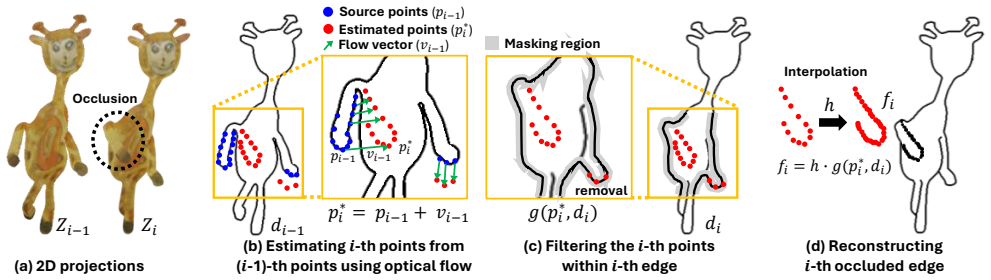
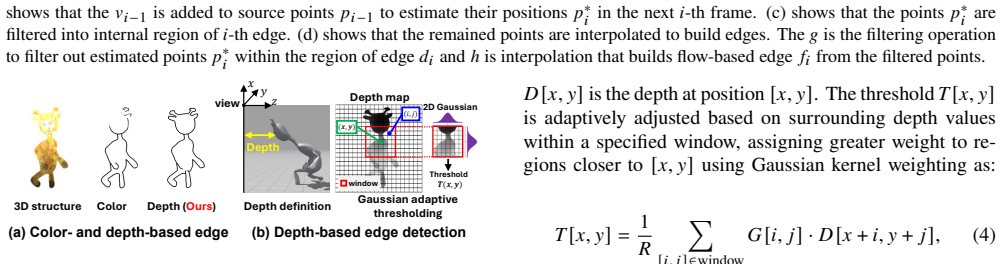
The central object is FDED, a two-part edge detector that fuses a depth-based edge map $d_i$ with a flow-based edge map $f_i$. Depth-based detection applies Gaussian adaptive thresholding to the 3D mesh's depth map and produces the unoccluded edge $e_u$. Flow-based detection takes points lying on the previous clean edge $d_{i-1}$, shifts them by the RAFT flow vector $v_{i-1}$ to estimated positions $p^*_i = p_{i-1} + v_{i-1}$, keeps only points inside the current depth edge $d_i$, and dilates the survivors to form the occluded edge $e_o$. The union $e = e_o \cup e_u$ is concatenated with the 2D projection $Z_i$ as guidance for a single U-Net trained with reconstruction loss plus an edge-guided contrastive ranking loss.
What would settle it
Render a synthetic motion where a limb passes completely behind a torso for several frames, with a known ground-truth contour; measure whether FDED's recovered edge matches the ground truth at the occluded boundary, and whether the output contours stop flickering across those frames.
Extended reading notes
Core claim
The paper claims that the quality drop in drawing-based 3D animation under occlusion is caused by a stylization pose gap: stylization networks are fine-tuned on one occlusion-free drawing pose but must stylize arbitrary target poses at inference, many with overlapping body parts. To close the gap, OSF augments the stylization network's input with an occlusion-robust edge map produced by FDED. FDED keeps the depth-based edge for unoccluded regions and recovers the missing occluded edge by warping the previous frame's edge points along RAFT optical flow, filtering them to the current depth edge, and interpolating with dilation. With this guidance and an edge-guided contrastive loss, the single-stage USNet preserves contours and strokes under occlusion, and the framework runs 2.4x faster with 2.1x less memory than the two-stage baseline.
Load-bearing premise
The whole recovery mechanism depends on the previous frame's edge map being clean and occlusion-free, and on the optical flow correctly tracking those edge points into the current frame.
Editorial extensions
If this is right
- Animations of overlapping body parts keep stable contours because the flow-recovered edge supplies contour information that depth alone misses.
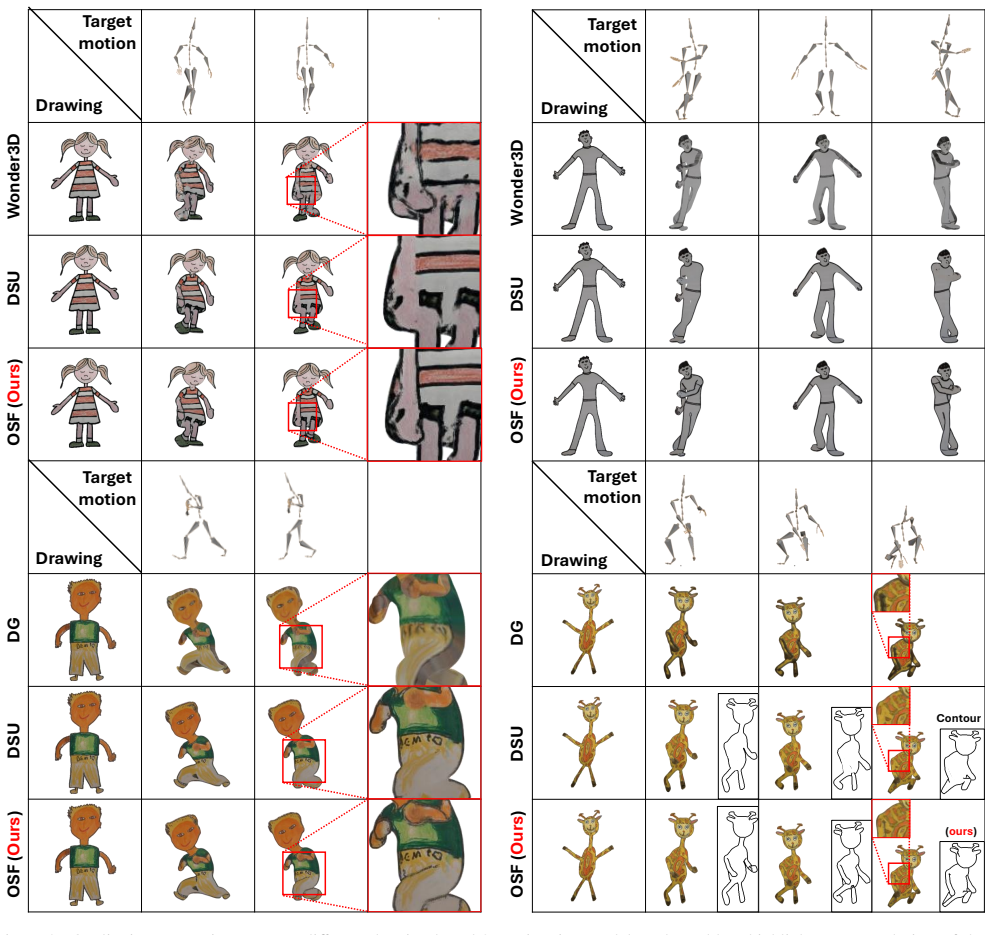
- FDED is a drop-in condition: adding it to the two-stage DrawingSpinUp baseline also improves its occlusion-set consistency and fidelity.
- The single-stage unified stylization network removes the intermediate ground-truth label and the extra network pass, cutting inference time by 2.4x and memory by 2.1x.
- Edge-guided contrastive learning makes the stylization network converge faster and to a lower reconstruction loss, with sharper textures and contours.
- Occlusion robustness is bounded: when the occlusion rate rises above about 40%, output quality still degrades, which the paper attributes to multiple occluded areas obscuring contours and strokes.
Reading between the lines
- Because FDED only relies on consecutive rendered frames and a depth map, it could be lifted into other image-animation systems that render depth, not only drawing stylization.
- A natural cold-start test is to begin a motion at an occluded pose without any clean previous edge map; the current pipeline assumes such a frame exists.
- The edge-guided contrastive loss may transfer to other tasks where ground-truth labels are sparse along one channel, such as line-art colorization or sketch cleanup.
- The reported 40% occlusion ceiling points to a concrete follow-up: combine FDED with patch-wise encoding to maintain quality in heavily occluded poses.
Editorial analysis
A structured set of objections, weighed in public.
Referee Report
Summary. The paper proposes Occlusion-robust Stylization Framework (OSF) for drawing-based 3D animation. OSF introduces Flow-Depth Edge Detection (FDED), which combines a depth-based edge detector with a flow-based branch that warps edge points from the previous frame using RAFT optical flow to recover contours in occluded regions. The stylization network is re-designed as a single-stage unified network (USNet) with an edge-guided contrastive ranking loss, replacing the two-stage texture-then-contour pipeline of DrawingSpinUp. Experiments on 120 Amateur Drawings characters with 20 non-occluded and 20 occluded motions report consistent improvements in CLIP, SSIM, FID, and LPIPS over baselines, and show a 2.4x speedup and roughly 2.3x memory reduction relative to the two-stage baseline. The main weaknesses are that the flow-based edge recovery assumes a well-constructed, occlusion-free previous-frame edge map, and that the paper does not validate optical flow quality on stylized inputs or report variance for its quantitative claims.
Significance. If the occlusion robustness claim were fully established, the paper would be a useful contribution to the small but growing area of drawing-based 3D animation: it identifies a concrete failure mode (occluded contours), proposes a simple and interpretable fix (propagate previous-frame edges via optical flow), and demonstrates that the fix can be plugged into existing stylization networks. The unified single-stage network with contrastive learning is a clean contribution, and the computational analysis is a credible practical advantage. The paper also ships a reproducible pipeline built on public components (Wonder3D, RAFT, Mixamo), which is a strength. However, the central claim of 'occlusion-robust' is currently scoped more narrowly than the title and abstract suggest: it is supported only for motions that begin from an occlusion-free reference frame and for which RAFT provides accurate correspondences on flat stylized images. The quantitative evaluation also lacks error bars and a specified human-evaluation protocol, which weakens the support for the perceptual claims. With additional experiments that directly probe these dependencies, the contribution would be solid.
major comments (4)
- [§3.2, Eq. (5), and footnote 6] The flow-based edge detection assumes that the previous frame's edge map d_{i-1} is well-constructed and occlusion-free. This is load-bearing: if a motion starts in an occluded pose, or maintains occlusion across frames (e.g., crossed arms held through the entire clip), then d_{i-1} already omits the contour the flow branch is supposed to restore, and f_i inherits the same gap. The paper reports an 'occlusion set' of 20 motions but never states how many of those motions have an occlusion-free starting frame, and Figure 13's robustness curve begins at 0% occlusion, so the bootstrap regime is not tested. The authors should either (a) enforce the assumption by detecting and using an occlusion-free reference frame, as suggested in footnote 6, or (b) explicitly scope the claim to motions that begin from an unoccluded reference and provide experiments on persistent-occlusion sequences to characterize the failure mode.
- [§3.2 and §4.1] The optical flow estimator RAFT is trained on photorealistic video, while the inputs here are flat, stylized, texture-sparse drawings. Since the flow branch relies on accurate point correspondences at contour points, the paper should validate flow quality on stylized projections. Concretely, because the 3D animation pipeline provides known correspondences from the rigged mesh, the authors can measure flow endpoint error on the stylized 2D projections, or compare against an oracle flow in an ablation. Without such a check, the possibility that flow errors at contour points produce incorrect p*_i that the filtering/interpolation in Eq. (5) cannot repair remains an open correctness risk for the central claim.
- [§4.2 and Tables 1-2] All metrics are reported as averages over 10 runs with different seeds, but no standard deviations or confidence intervals are given. Given the often small margins between the best and second-best methods (e.g., Table 1: texture CLIP 0.974 vs 0.971; contour CLIP 0.982 vs 0.978), the reader cannot assess whether the improvements are statistically meaningful. Please report variance and, where appropriate, significance tests or per-seed ranges.
- [§4.2 and Table 1 (Human column)] The human evaluation is described only as 'Human evaluation of preferences is performed,' with no protocol details: number of participants, number of comparisons per participant, whether the evaluation was pairwise or single-stimulus, whether the participants were blind to method, and what instructions they received. The Human column in Table 1 is reported as a single score per method, so the perceptual claim is not verifiable. Please provide a full protocol description and appropriate statistical analysis.
minor comments (5)
- [Abstract, Introduction, and Table 3] The memory reduction is reported as 2.1x, but Table 3 gives 11.62 GB / 5.05 GB approximately 2.30x; please reconcile the numbers and use a consistent figure throughout.
- [§3.2, Eq. (5)] The notation f_i = h·g(p*_i, d_i) is terse; the roles of the filter g and the interpolator h (dilation) could be described explicitly for readers who do not rely solely on Figure 5.
- [§4.4, Figure 13] The figure labels the y-axes as 'CLIP' and '1-LPIPS' while the text refers to 'consistency' and 'fidelity'; please make the terminology consistent with the metric definitions in §4.2.
- [§2 and §4.1] The statement that the stylization network is fine-tuned on a single drawing should clarify that this is the same assumption used in DrawingSpinUp [68], to avoid framing it as a newly introduced limitation.
- [§4.2] The contour extraction method is referenced only as 'the method in [68]'; please briefly describe or cite the contour estimator, since contour quality is a central evaluation component.
Circularity Check
No material circularity: FDED is an empirical conditioning module; its occlusion-robustness is conditional on an unoccluded reference frame, not derived from its output.
full rationale
The paper's derivation chain is empirical rather than definitional. FDED (Eq. 5) combines a depth-based edge map d_i with points warped from the previous frame's edge map d_{i-1} by RAFT flow; the resulting occlusion-robust edge e_i is used as a conditioning input to a UNet stylizer trained with reconstruction and contrastive losses. Nothing in Eq. 5 or the loss definitions makes the test-time output equal to a fitted input. The hyperparameters (window w, dilation vs spline) are selected on a validation set and reported as ablations, not presented as predictions. The central claim, that FDED reduces contour flicker under occlusion, is evaluated against held-out motions and against DSU+FDED, so it is not forced by construction. The paper's own footnote 6 states that d_{i-1} is assumed well-constructed without occlusion, which is a genuine scoping limitation: persistent occlusion from the first frame cannot be recovered by flow warping, and RAFT's accuracy on flat stylized frames is not separately measured. But this is an assumption about input conditions, not a circular reduction of the claimed result to its inputs. Self-citations appear in related work and in the footnote's suggestion for detecting occlusion-free frames, but none is load-bearing for the main derivation, and no uniqueness theorem or ansatz is imported from prior work. Overall circularity score: 1.
Assumptions & free parameters
free parameters (3)
- Gaussian adaptive thresholding window size w =
9
- Contrastive margin delta =
0.1
- Edge interpolation strategy h =
dilation
assumptions (4)
- ad hoc to paper A previous frame Z_{i-1} exists whose edge map d_{i-1} is well-constructed and free of occlusion.
- domain assumption RAFT optical flow accurately estimates point correspondences between stylized 2D projections Z_{i-1} and Z_i.
- domain assumption Depth maps of the 3D mesh are available and accurate enough for Gaussian adaptive thresholding to detect contours.
- domain assumption A single ground-truth drawing per object is sufficient to fine-tune the stylization network for arbitrary poses.
Cite this review
Pith. "Pith review of Occlusion-robust Stylization for Drawing-based 3D Animation." pith.science (2026). https://pith.science/paper/QHOUVQR6
@misc{pith2026250800398,
  author       = {Pith},
  title        = {Pith review of: Occlusion-robust Stylization for Drawing-based 3D Animation},
  year         = {2026},
  howpublished = {\url{https://pith.science/paper/QHOUVQR6}},
  note         = {Machine review of arXiv:2508.00398}
}
read the original abstract
3D animation aims to generate a 3D animated video from an input image and a target 3D motion sequence. Recent advances in image-to-3D models enable the creation of animations directly from user-hand drawings. Distinguished from conventional 3D animation, drawing-based 3D animation is crucial to preserve artist's unique style properties, such as rough contours and distinct stroke patterns. However, recent methods still exhibit quality deterioration in style properties, especially under occlusions caused by overlapping body parts, leading to contour flickering and stroke blurring. This occurs due to a `stylization pose gap' between training and inference in stylization networks designed to preserve drawing styles in drawing-based 3D animation systems. The stylization pose gap denotes that input target poses used to train the stylization network are always in occlusion-free poses, while target poses encountered in an inference include diverse occlusions under dynamic motions. To this end, we propose Occlusion-robust Stylization Framework (OSF) for drawing-based 3D animation. We found that while employing object's edge can be effective input prior for guiding stylization, it becomes notably inaccurate when occlusions occur at inference. Thus, our proposed OSF provides occlusion-robust edge guidance for stylization network using optical flow, ensuring a consistent stylization even under occlusions. Furthermore, OSF operates in a single run instead of the previous two-stage method, achieving 2.4x faster inference and 2.1x less memory.
Figures


Figures from the paper (7 more)




Reference graph
Works this paper leans on
-
[1]
Learning character-agnostic motion for motion retargeting in 2d
Kfir Aberman, Rundi Wu, Dani Lischinski, Baoquan Chen, and Daniel Cohen-Or. Learning character-agnostic motion for motion retargeting in 2d. arXiv preprint arXiv:1905.01680,
arXiv 1905
-
[2]
Pose with style: Detail- preserving pose-guided image synthesis with conditional stylegan
Badour Albahar, Jingwan Lu, Jimei Yang, Zhixin Shu, Eli Shechtman, and Jia-Bin Huang. Pose with style: Detail- preserving pose-guided image synthesis with conditional stylegan. ACM Transactions on Graphics (TOG) , 40(6):1– 11, 2021. 3
work page 2021
-
[3]
Automatic rigging and anima- tion of 3d characters
Ilya Baran and Jovan Popovi´c. Automatic rigging and anima- tion of 3d characters. ACM Transactions on graphics (TOG), 26(3):72–es, 2007. 2, 3
work page 2007
-
[4]
Automatic single-view character model reconstruc- tion
Philip Buchanan, Ramakrishnan Mukundan, and Michael Doggett. Automatic single-view character model reconstruc- tion. In Proceedings of the international symposium on sketch-based interfaces and modeling, pages 5–14, 2013. 3
work page 2013
-
[5]
A computational approach to edge detection
John Canny. A computational approach to edge detection. IEEE Transactions on pattern analysis and machine intelli- gence, (6):679–698, 1986. 3, 4
work page 1986
-
[6]
Beyond static features for temporally consistent 3d human pose and shape from a video
Hongsuk Choi, Gyeongsik Moon, Ju Yong Chang, and Ky- oung Mu Lee. Beyond static features for temporally consistent 3d human pose and shape from a video. In Proceedings of the IEEE/CVF conference on computer vision and pattern recognition, pages 1964–1973, 2021. 5
work page 1964
-
[7]
Variational shape approximation
David Cohen-Steiner, Pierre Alliez, and Mathieu Desbrun. Variational shape approximation. In ACM SIGGRAPH 2004 Papers, pages 905–914. 2004. 3
work page 2004
-
[8]
C De Boor. A practical guide to splines. Springer-Verlag google schola, 2:4135–4195, 1978. 7
work page 1978
Show all 68 references
-
[9]
Suggestive contours for conveying shape
Doug DeCarlo, Adam Finkelstein, Szymon Rusinkiewicz, and Anthony Santella. Suggestive contours for conveying shape. ACM Trans. Graph., 22(3):848–855, 2003. 3
2003
-
[10]
Diffusion models beat gans on image synthesis.Advances in neural information processing systems, 34:8780–8794, 2021
Prafulla Dhariwal and Alexander Nichol. Diffusion models beat gans on image synthesis.Advances in neural information processing systems, 34:8780–8794, 2021. 1
2021
-
[11]
Gans trained by a two time-scale update rule converge to a local nash equilibrium
Martin Heusel, Hubert Ramsauer, Thomas Unterthiner, Bern- hard Nessler, and Sepp Hochreiter. Gans trained by a two time-scale update rule converge to a local nash equilibrium. Advances in neural information processing systems, 30, 2017. 5
2017
-
[12]
Denoising dif- fusion probabilistic models
Jonathan Ho, Ajay Jain, and Pieter Abbeel. Denoising dif- fusion probabilistic models. Advances in neural information processing systems, 33:6840–6851, 2020. 1
2020
-
[13]
Joint path alignment framework for 3d human pose and shape estimation from video.IEEE Access, 11:43267–43275,
Ji Woo Hong, Sunjae Yoon, Junyeong Kim, and Chang D Yoo. Joint path alignment framework for 3d human pose and shape estimation from video.IEEE Access, 11:43267–43275,
-
[14]
Ita-mdt: Image-timestep- adaptive masked diffusion transformer framework for image- based virtual try-on
Ji Woo Hong, Tri Ton, Trung X Pham, Gwanhyeong Koo, Sunjae Yoon, and Chang D Yoo. Ita-mdt: Image-timestep- adaptive masked diffusion transformer framework for image- based virtual try-on. In Proceedings of the Computer Vision and Pattern Recognition Conference , pages 28284–28294,
-
[15]
Char- acter animation from 2d pictures and 3d motion data
Alexander Hornung, Ellen Dekkers, and Leif Kobbelt. Char- acter animation from 2d pictures and 3d motion data. ACM Transactions on Graphics (ToG), 26(1):1–es, 2007. 3
2007
-
[16]
Fastdiff: A fast conditional diffu- sion model for high-quality speech synthesis
Rongjie Huang, Max WY Lam, Jun Wang, Dan Su, Dong Yu, Yi Ren, and Zhou Zhao. Fastdiff: A fast conditional diffu- sion model for high-quality speech synthesis. arXiv preprint arXiv:2204.09934, 2022. 8
2022 arXiv
-
[17]
Kinectfusion: real-time 3d reconstruction and inter- action using a moving depth camera
Shahram Izadi, David Kim, Otmar Hilliges, David Molyneaux, Richard Newcombe, Pushmeet Kohli, Jamie Shotton, Steve Hodges, Dustin Freeman, Andrew Davison, et al. Kinectfusion: real-time 3d reconstruction and inter- action using a moving depth camera. In Proceedings of the 24th ...
2011
-
[18]
Apparent ridges for line drawing
Tilke Judd, Fr ´edo Durand, and Edward Adelson. Apparent ridges for line drawing. ACM Trans. Graph., 26(3):19–es,
-
[19]
Avatarone: Monocular 3d human animation
Akash Karthikeyan, Robert Ren, Yash Kant, and Igor Gilitschenski. Avatarone: Monocular 3d human animation. In Proceedings of the IEEE/CVF Winter Conference on Ap- plications of Computer Vision, pages 3647–3657, 2024. 3
2024
-
[20]
Skinning with dual quaternions
Ladislav Kavan, Steven Collins, Ji ˇr´ı ˇZ´ara, and Carol O’Sullivan. Skinning with dual quaternions. In Proceed- ings of the 2007 symposium on Interactive 3D graphics and games, pages 39–46, 2007. 3
2007
-
[21]
3d gaussian splatting for real-time radiance field rendering
Bernhard Kerbl, Georgios Kopanas, Thomas Leimk¨ uhler, and George Drettakis. 3d gaussian splatting for real-time radiance field rendering. ACM Trans. Graph., 42(4):139–1, 2023. 3
2023
-
[22]
Structured co-reference graph attention for video-grounded dialogue
Junyeong Kim, Sunjae Yoon, Dahyun Kim, and Chang D Yoo. Structured co-reference graph attention for video-grounded dialogue. In Proceedings of the AAAI Conference on Artificial Intelligence, pages 1789–1797, 2021. 3
2021
-
[23]
Diffwave: A versatile diffusion model for audio synthesis
Zhifeng Kong, Wei Ping, Jiaji Huang, Kexin Zhao, and Bryan Catanzaro. Diffwave: A versatile diffusion model for audio synthesis. arXiv preprint arXiv:2009.09761, 2020. 1
2009 arXiv
-
[24]
Flexiedit: Frequency-aware latent refinement for en- hanced non-rigid editing
Gwanhyeong Koo, Sunjae Yoon, Ji Woo Hong, and Chang D Yoo. Flexiedit: Frequency-aware latent refinement for en- hanced non-rigid editing. In European Conference on Com- puter Vision, pages 363–379. Springer, 2024. 1
2024
-
[25]
Wavelet- guided acceleration of text inversion in diffusion-based image editing
Gwanhyeong Koo, Sunjae Yoon, and Chang D Yoo. Wavelet- guided acceleration of text inversion in diffusion-based image editing. In ICASSP 2024-2024 IEEE International Confer- ence on Acoustics, Speech and Signal Processing (ICASSP), pages 4380–4384. IEEE, 2024. 8
2024
-
[26]
Flowdrag: 3d-aware drag-based im- age editing with mesh-guided deformation vector flow fields
Gwanhyeong Koo, Sunjae Yoon, Younghwan Lee, Ji Woo Hong, and Chang D Yoo. Flowdrag: 3d-aware drag-based im- age editing with mesh-guided deformation vector flow fields. arXiv preprint arXiv:2507.08285, 2025. 3
2025 arXiv
-
[27]
Neural contours: Learning to draw lines from 3d shapes
Difan Liu, Mohamed Nabail, Aaron Hertzmann, and Evan- gelos Kalogerakis. Neural contours: Learning to draw lines from 3d shapes. In Proceedings of the IEEE/CVF conference on computer vision and pattern recognition , pages 5428– 5436, 2020. 3, 8
2020
-
[28]
Zero-1-to-3: Zero-shot one image to 3d object
Ruoshi Liu, Rundi Wu, Basile Van Hoorick, Pavel Tokmakov, Sergey Zakharov, and Carl Vondrick. Zero-1-to-3: Zero-shot one image to 3d object. In Proceedings of the IEEE/CVF international conference on computer vision , pages 9298– 9309, 2023. 1
2023
-
[29]
Syncdreamer: Gen- erating multiview-consistent images from a single-view im- age
Yuan Liu, Cheng Lin, Zijiao Zeng, Xiaoxiao Long, Lingjie Liu, Taku Komura, and Wenping Wang. Syncdreamer: Gen- erating multiview-consistent images from a single-view im- age. arXiv preprint arXiv:2309.03453, 2023. 3
2023 arXiv
-
[30]
Wonder3d: Sin- gle image to 3d using cross-domain diffusion
Xiaoxiao Long, Yuan-Chen Guo, Cheng Lin, Yuan Liu, Zhiyang Dou, Lingjie Liu, Yuexin Ma, Song-Hai Zhang, Marc Habermann, Christian Theobalt, et al. Wonder3d: Sin- gle image to 3d using cross-domain diffusion. InProceedings of the IEEE/CVF Conference on Computer Vision and Patte...
2024
-
[31]
An iterative image reg- istration technique with an application to stereo vision
Bruce D Lucas and Takeo Kanade. An iterative image reg- istration technique with an application to stereo vision. In IJCAI’81: 7th international joint conference on Artificial intelligence, pages 674–679, 1981. 4
1981
-
[32]
Ra- bit: Parametric modeling of 3d biped cartoon characters with a topological-consistent dataset
Zhongjin Luo, Shengcai Cai, Jinguo Dong, Ruibo Ming, Liangdong Qiu, Xiaohang Zhan, and Xiaoguang Han. Ra- bit: Parametric modeling of 3d biped cartoon characters with a topological-consistent dataset. In Proceedings of the IEEE/CVF Conference on Computer Vision and Pattern Rec...
2023
-
[33]
Predictive coding for decision transformer
Tung M Luu, Donghoon Lee, and Chang D Yoo. Predictive coding for decision transformer. In 2024 IEEE/RSJ Interna- tional Conference on Intelligent Robots and Systems (IROS), pages 7469–7476. IEEE, 2024. 4
2024
-
[34]
Mitigating adversarial perturba- tions for deep reinforcement learning via vector quantization
Tung M Luu, Thanh Nguyen, Tee Joshua Tian Jin, Sungwoon Kim, and Chang D Yoo. Mitigating adversarial perturba- tions for deep reinforcement learning via vector quantization. In 2024 IEEE/RSJ International Conference on Intelligent Robots and Systems (IROS), pages 595–602. IEEE...
2024
-
[35]
Enhancing rating- based reinforcement learning to effectively leverage feed- back from large vision-language models
Tung Minh Luu, Younghwan Lee, Donghoon Lee, Sunho Kim, Min Jun Kim, and Chang D Yoo. Enhancing rating- based reinforcement learning to effectively leverage feed- back from large vision-language models. arXiv preprint arXiv:2506.12822, 2025. 3
2025 arXiv
-
[36]
Vlanet: Video-language alignment network for weakly-supervised video moment re- trieval
Minuk Ma, Sunjae Yoon, Junyeong Kim, Youngjoon Lee, Sunghun Kang, and Chang D Yoo. Vlanet: Video-language alignment network for weakly-supervised video moment re- trieval. In European conference on computer vision , pages 156–171. Springer, 2020. 4
2020
-
[37]
Nerf: Representing scenes as neural radiance fields for view syn- thesis
Ben Mildenhall, Pratul P Srinivasan, Matthew Tancik, Jonathan T Barron, Ravi Ramamoorthi, and Ren Ng. Nerf: Representing scenes as neural radiance fields for view syn- thesis. Communications of the ACM, 65(1):99–106, 2021. 2, 3
2021
-
[38]
Procedural modeling of buildings
Pascal M¨ uller, Peter Wonka, Simon Haegler, Andreas Ulmer, and Luc Van Gool. Procedural modeling of buildings. In ACM SIGGRAPH 2006 Papers, pages 614–623. 2006. 3
2006
-
[39]
Fibermesh: designing freeform surfaces with 3d curves
Andrew Nealen, Takeo Igarashi, Olga Sorkine, and Marc Alexa. Fibermesh: designing freeform surfaces with 3d curves. In ACM SIGGRAPH 2007 papers, pages 41–es. 2007. 3
2007
-
[40]
Charactergen: Efficient 3d character generation from single images with multi-view pose canon- icalization
Hao-Yang Peng, Jia-Peng Zhang, Meng-Hao Guo, Yan-Pei Cao, and Shi-Min Hu. Charactergen: Efficient 3d character generation from single images with multi-view pose canon- icalization. ACM Transactions on Graphics (TOG) , 43(4): 1–13, 2024. 1
2024
-
[41]
Mdsgen: Fast and efficient masked diffusion temporal-aware trans- formers for open-domain sound generation
Trung X Pham, Tri Ton, and Chang D Yoo. Mdsgen: Fast and efficient masked diffusion temporal-aware trans- formers for open-domain sound generation. arXiv preprint arXiv:2410.02130, 2024. 1
2024 arXiv
-
[42]
Learning transferable visual models from natural language supervi- sion
Alec Radford, Jong Wook Kim, Chris Hallacy, Aditya Ramesh, Gabriel Goh, Sandhini Agarwal, Girish Sastry, Amanda Askell, Pamela Mishkin, Jack Clark, et al. Learning transferable visual models from natural language supervi- sion. In International conference on machine learning, ...
2021
-
[43]
U- net: Convolutional networks for biomedical image segmen- tation
Olaf Ronneberger, Philipp Fischer, and Thomas Brox. U- net: Convolutional networks for biomedical image segmen- tation. In Medical image computing and computer-assisted intervention–MICCAI 2015: 18th international conference, Munich, Germany, October 5-9, 2015, proceedings, pa...
2015
-
[44]
Shapeshop: Sketch-based solid model- ing with blobtrees
Ryan Schmidt, Brian Wyvill, Mario Costa Sousa, and Joaquim A Jorge. Shapeshop: Sketch-based solid model- ing with blobtrees. In ACM SIGGRAPH 2007 courses, pages 43–es. 2007. 3
2007
-
[45]
First order motion model for image animation
Aliaksandr Siarohin, St ´ephane Lathuili`ere, Sergey Tulyakov, Elisa Ricci, and Nicu Sebe. First order motion model for image animation. Advances in neural information processing systems, 32, 2019. 3
2019
-
[46]
Harrison Jesse Smith, Qingyuan Zheng, Yifei Li, Somya Jain, and Jessica K. Hodgins. A method for animating children’s drawings of the human figure. ACM Trans. Graph., 42(3),
-
[47]
Denoising diffusion implicit models
Jiaming Song, Chenlin Meng, and Stefano Ermon. Denoising diffusion implicit models. arXiv preprint arXiv:2010.02502,
2010 arXiv
-
[48]
Score-based generative modeling through stochastic differential equations
Yang Song, Jascha Sohl-Dickstein, Diederik P Kingma, Ab- hishek Kumar, Stefano Ermon, and Ben Poole. Score-based generative modeling through stochastic differential equations. arXiv preprint arXiv:2011.13456, 2020. 1
2011 arXiv
-
[49]
Laplacian surface editing
Olga Sorkine, Daniel Cohen-Or, Yaron Lipman, Marc Alexa, Christian R ¨ossl, and H-P Seidel. Laplacian surface editing. In Proceedings of the 2004 Eurographics/ACM SIGGRAPH symposium on Geometry processing , pages 175–184, 2004. 3
2004
-
[50]
Computer vision: algorithms and applica- tions
Richard Szeliski. Computer vision: algorithms and applica- tions. Springer Nature, 2022. 4
2022
-
[51]
Dreamgaussian: Generative gaussian splatting for effi- cient 3d content creation
Jiaxiang Tang, Jiawei Ren, Hang Zhou, Ziwei Liu, and Gang Zeng. Dreamgaussian: Generative gaussian splatting for effi- cient 3d content creation. arXiv preprint arXiv:2309.16653,
-
[52]
Raft: Recurrent all-pairs field transforms for optical flow
Zachary Teed and Jia Deng. Raft: Recurrent all-pairs field transforms for optical flow. InComputer Vision–ECCV 2020: 16th European Conference, Glasgow, UK, August 23–28, 2020, Proceedings, Part II 16 , pages 402–419. Springer,
2020
-
[53]
Taro: Timestep- adaptive representation alignment with onset-aware condi- tioning for synchronized video-to-audio synthesis
Tri Ton, Ji Woo Hong, and Chang D Yoo. Taro: Timestep- adaptive representation alignment with onset-aware condi- tioning for synchronized video-to-audio synthesis. arXiv preprint arXiv:2504.05684, 2025. 1
2025
-
[54]
Disco: Disentangled control for realistic human dance generation
Tan Wang, Linjie Li, Kevin Lin, Yuanhao Zhai, Chung-Ching Lin, Zhengyuan Yang, Hanwang Zhang, Zicheng Liu, and Li- juan Wang. Disco: Disentangled control for realistic human dance generation. In Proceedings of the IEEE/CVF Con- ference on Computer Vision and Pattern Recognitio...
2024
-
[55]
Image quality assessment: from error visibility to structural similarity
Zhou Wang, Alan C Bovik, Hamid R Sheikh, and Eero P Simoncelli. Image quality assessment: from error visibility to structural similarity. IEEE transactions on image processing, 13(4):600–612, 2004. 5
2004
-
[56]
Holistically-nested edge de- tection
Saining Xie and Zhuowen Tu. Holistically-nested edge de- tection. In Proceedings of the IEEE international conference on computer vision, pages 1395–1403, 2015. 3
2015
-
[57]
Magicanimate: Temporally consistent human im- age animation using diffusion model
Zhongcong Xu, Jianfeng Zhang, Jun Hao Liew, Hanshu Yan, Jia-Wei Liu, Chenxu Zhang, Jiashi Feng, and Mike Zheng Shou. Magicanimate: Temporally consistent human im- age animation using diffusion model. In Proceedings of the IEEE/CVF Conference on Computer Vision and Pattern Reco...
2024
-
[58]
Weakly-supervised mo- ment retrieval network for video corpus moment retrieval
Sunjae Yoon, Dahyun Kim, Ji Woo Hong, Junyeong Kim, Kookhoi Kim, and Chang D Yoo. Weakly-supervised mo- ment retrieval network for video corpus moment retrieval. In 2021 IEEE International Conference on Image Processing (ICIP), pages 534–538. IEEE, 2021. 4
2021
-
[59]
Selective query-guided debiasing for video corpus moment retrieval
Sunjae Yoon, Ji Woo Hong, Eunseop Yoon, Dahyun Kim, Junyeong Kim, Hee Suk Yoon, and Chang D Yoo. Selective query-guided debiasing for video corpus moment retrieval. In European Conference on Computer Vision , pages 185–200. Springer, 2022. 4
2022
-
[60]
Information-theoretic text hallucina- tion reduction for video-grounded dialogue
Sunjae Yoon, Eunseop Yoon, Hee Suk Yoon, Junyeong Kim, and Chang D Yoo. Information-theoretic text hallucina- tion reduction for video-grounded dialogue. arXiv preprint arXiv:2212.05765, 2022. 3
2022 arXiv
-
[61]
Counterfactual two-stage debias- ing for video corpus moment retrieval
Sunjae Yoon, Ji Woo Hong, Soohwan Eom, Hee Suk Yoon, Eunseop Yoon, Daehyeok Kim, Junyeong Kim, Chanwoo Kim, and Chang D Yoo. Counterfactual two-stage debias- ing for video corpus moment retrieval. In ICASSP 2023- 2023 IEEE International Conference on Acoustics, Speech and Sign...
2023
-
[62]
Hear: Hearing enhanced audio response for video-grounded dialogue
Sunjae Yoon, Dahyun Kim, Eunseop Yoon, Hee Suk Yoon, Junyeong Kim, and Chnag D Yoo. Hear: Hearing enhanced audio response for video-grounded dialogue. arXiv preprint arXiv:2312.09736, 2023. 3
2023 arXiv
-
[63]
Scanet: Scene complexity aware network for weakly- supervised video moment retrieval
Sunjae Yoon, Gwanhyeong Koo, Dahyun Kim, and Chang D Yoo. Scanet: Scene complexity aware network for weakly- supervised video moment retrieval. In Proceedings of the IEEE/CVF international conference on computer vision , pages 13576–13586, 2023. 4
2023
-
[64]
Dni: Dilutional noise initialization for diffusion video editing
Sunjae Yoon, Gwanhyeong Koo, Ji Woo Hong, and Chang D Yoo. Dni: Dilutional noise initialization for diffusion video editing. In European Conference on Computer Vision, pages 180–195. Springer, 2024. 1
2024
-
[65]
Frag: Frequency adapting group for diffu- sion video editing
Sunjae Yoon, Gwanhyeong Koo, Geonwoo Kim, and Chang D Yoo. Frag: Frequency adapting group for diffu- sion video editing. arXiv preprint arXiv:2406.06044, 2024. 3
2024 arXiv
-
[66]
Tpc: Test-time procrustes calibration for diffusion- based human image animation
Sunjae Yoon, Gwanhyeong Koo, Younghwan Lee, and Chang Yoo. Tpc: Test-time procrustes calibration for diffusion- based human image animation. Advances in Neural Informa- tion Processing Systems, 37:118654–118677, 2024. 3
2024
-
[67]
The unreasonable effectiveness of deep features as a perceptual metric
Richard Zhang, Phillip Isola, Alexei A Efros, Eli Shechtman, and Oliver Wang. The unreasonable effectiveness of deep features as a perceptual metric. In Proceedings of the IEEE conference on computer vision and pattern recognition, pages 586–595, 2018. 1, 5
2018
-
[68]
Drawingspinup: 3d animation from single character draw- ings
Jie Zhou, Chufeng Xiao, Miu-Ling Lam, and Hongbo Fu. Drawingspinup: 3d animation from single character draw- ings. arXiv preprint arXiv:2409.08615, 2024. 1, 2, 5, 6, 7, 8
2024 arXiv
Reviewed August 6, 2026 · model on record in the stance chip above.
Discussion (0). Sign in to comment.