REVIEW 4 major objections 6 minor 69 references
UIS-Mamba: Exploring Mamba for Underwater Instance Segmentation via Dynamic Tree Scan and Hidden State Weaken
T0 review · 4 major / 6 minor · reviewed 2026-08-06 · deepseek-v4-flash
Pith's one-line read The paper claims that a Mamba-based model with dynamic tree scanning and background-state suppression achieves state-of-the-art underwater instance segmentation on UIIS and USIS10K at low parameter cost.
desk verdict Strong empirical SOTA for a Mamba-based underwater segmenter, but the HSW module's Eq. (12) is not a valid SSM recurrence, so the claimed background-suppression mechanism is currently unverifiable. read the letter →
The pith
A machine-rendered reading of the paper's core claim, the machinery that carries it, and where it could break.
The reading
What carries the argument
The load-bearing mechanism is the pair formed by the Dynamic Tree Scan (DTS) and the Hidden State Weaken (HSW). DTS turns the image into a graph whose nodes are deformable patches: a dense predictor outputs offsets and scales, the patches are resampled by bilinear interpolation, edge weights combine spatial distance and cosine similarity, and a minimum spanning tree algorithm defines the order in which the state space model reads the image. HSW reuses that tree and its edge weights, runs a normalized-cut partition into foreground and background patch sets, and in the state update multiplies background-patch inputs by a suppression weight of 0.7 so the recurrent hidden state accumulates instance features rather than background clutter. Together they give Mamba a dynamic local receptive field and a foreground-focused state propagation path.
What would settle it
Compute the overlap between graph-based foreground/background labels and ground-truth instance masks on UIIS and USIS10K; if a large share of true instance pixels falls in suppressed patches yet removing HSW does not lower AP, the claimed mechanism is not the cause. A cleaner test is to replace the normalized-cut labels with ground-truth masks, since the model performing no better with true labels than with the 0.7 setting would show that the foreground/background separation is not the source of the gain.
Extended reading notes
Core claim
The central claim, stated on the paper's own terms, is that existing vision Mamba models fail underwater because fixed-patch scanning severs the internal continuity of instances and complex backgrounds dominate the hidden state, and both faults can be corrected. UIS-Mamba's Dynamic Tree Scan predicts per-patch offsets and scales from local features, deforms the patches, mixes spatial distance and semantic similarity into edge weights, and builds a minimum spanning tree that fixes the scan topology; the Hidden State Weaken module then partitions that tree with normalized cuts, labels patches foreground or background, and multiplies background contributions to the state update by a suppression weight whose optimal value is 0.7. With this machinery the model reports 31.2 mAP on UIIS and 63.8 class-agnostic and 46.2 multi-class mAP on USIS10K with the largest backbone, outperforming WaterMask and USIS-SAM while keeping parameter counts at 56M, 76M, and 115M across three backbone sizes.
Load-bearing premise
The load-bearing premise is that the graph-based foreground/background split of patches is accurate enough on low-contrast, color-distorted underwater images that suppressing background patches by a factor of 0.7 removes clutter rather than erasing instance pixels.
Editorial extensions
If this is right
- On both benchmarks, UIS-Mamba reports higher mAP than previous underwater-specific CNN methods and the Transformer-based USIS-SAM, with parameter counts of 56M, 76M, and 115M.
- The ablations show each component adds: the Mamba backbone gains 0.7 mAP, DTS gains 1.8 mAP, and HSW gains 1.1 mAP over the baseline, and all combined reach 29.4 mAP on UIIS.
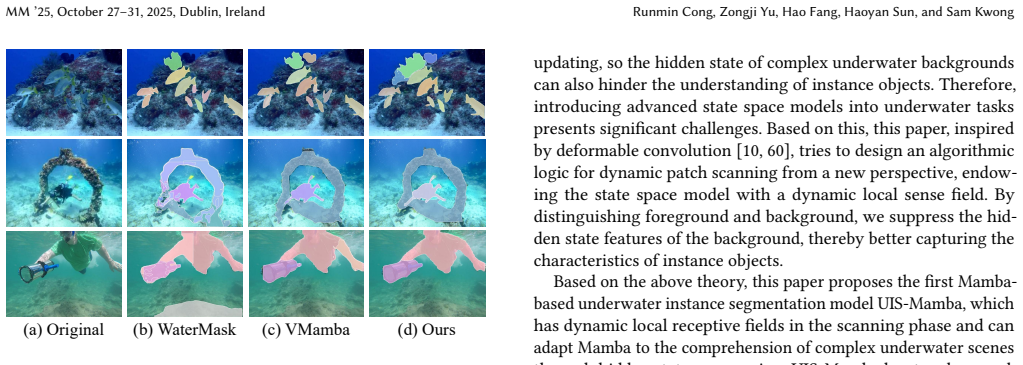
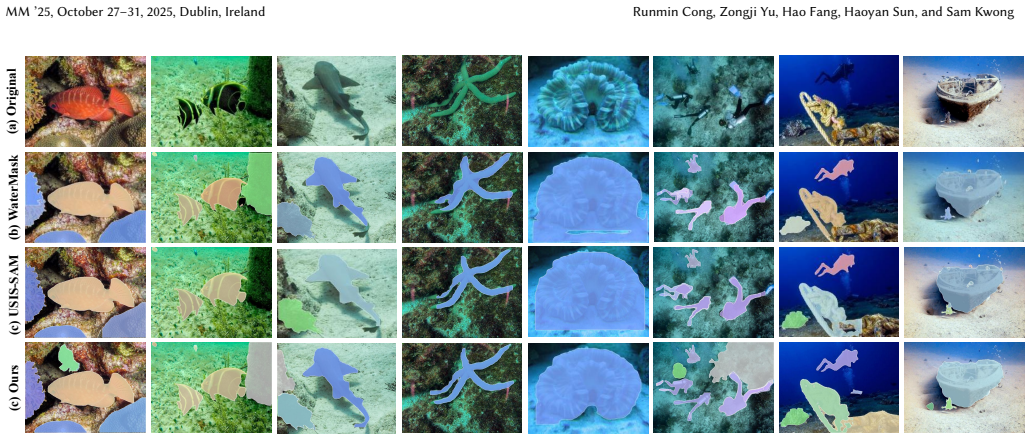
- The model improves on small, medium, and large instances and on fish, diver, and wreck categories, indicating the gains are not confined to one object scale or class.
- On USIS10K, the gains appear in both class-agnostic and multi-class salient instance segmentation, so the architecture covers two task formulations.
Reading between the lines
- A transferable consequence the authors leave implicit is that DTS and HSW form a general recipe for controlling where a Mamba model looks and what it remembers, so fog, turbid water, or medical imaging may benefit whenever instance boundaries blur and background dominates.
- The ablations separate the gains of the backbone, DTS, and HSW on UIIS, but they never compare the normalized-cut patches against ground-truth instance masks; replacing the Ncut labels with true masks or with corrupted masks would show whether the suppression mechanism itself is the source of the improvement.
- The offset and scale ranges are clamped to 0.8 to 1.2 times the patch size, so the scan can only deform locally; the paper does not test whether the design degrades gracefully on extremely small or heavily occluded instances, which is a natural stress test.
- The parameter savings relative to the largest prior model suggest onboard deployment for underwater robots, but inference speed and behavior on densely crowded scenes with hundreds of instances are left unmeasured.
Editorial analysis
A structured set of objections, weighed in public.
Referee Report
Summary. The paper proposes UIS-Mamba, a Mamba-based backbone for underwater instance segmentation, with two new modules: Dynamic Tree Scan (DTS), which deforms patches and builds a minimum spanning tree from spatial and semantic edge weights, and Hidden State Weaken (HSW), which uses normalized-cut patch categorization to suppress background contributions during hidden-state updates. The model is evaluated on UIIS and USIS10K for instance and salient instance segmentation, reporting state-of-the-art mAP with substantially fewer parameters than ViT-H-based USIS-SAM. The paper also includes ablations for each module and for the key hyperparameter.
Significance. If reproducible, the reported results are significant: UIS-Mamba is the first Mamba-based underwater instance segmentation model, demonstrates gains of roughly 3 mAP over prior underwater-specific methods on UIIS and larger gains on USIS10K, and uses a small fraction of the parameters of the largest competitor. Strengths include comparisons on public benchmarks, module-level ablations, and a promised code release. However, the central HSW mechanism is not defined as a valid state-space recurrence, and the computational-complexity claim is not substantiated, so the technical contribution is not yet fully verifiable.
major comments (4)
- [Sec. 4.2, Eq. (12)] Equation (12) does not define a valid SSM recurrence and is inconsistent with Eq. (3). The update is a global sum over all nodes j in G of B_j * phi_i p_j times a product over the 4-connected neighborhood of j; it contains no h_{i-1} and no scan order, so it cannot be executed sequentially as a Mamba state update. It also multiplies by phi_i, the weight of the receiving node, rather than by phi_j or an edge weight, so the claimed suppression of edges connecting background nodes is not expressed by the equation. Because Table 3 credits HSW with +1.1 mAP, this ablation cannot be verified from the manuscript. Please replace Eqs. (12)-(13) with the actual recurrence used in the code, or provide pseudocode and a derivation from Eq. (3).
- [Sec. 4.2, Eqs. (8)-(10)] The Ncut step is underspecified: minimizing Ncut(A,B) in Eq. (8) is invariant to swapping the labels A and B, so the assignment of A* as foreground in Eq. (10) requires an additional criterion, such as a saliency prior or an objectness score, which is not stated. Moreover, the paper does not evaluate the agreement between the Ncut patch labels and ground-truth instance masks; if the two-cluster partition is noisy in low-contrast underwater images, the phi=0.7 suppression in Eq. (11) could suppress true instance patches. Please specify the labeling rule and report a quantitative measure (e.g., IoU or agreement) of the Ncut masks against ground-truth foreground on the validation set.
- [Abstract and Sec. 5.1] The paper claims "low parameter and computational complexity" and "linear complexity," but the experiments report only parameter counts in Tables 1-2; no FLOPs, throughput, latency, or theoretical cost of the DTS/HSW pipeline is given. Since DTS constructs a minimum spanning tree (Eq. (7)) and HSW performs a normalized-cut partition on the graph, the complexity of these components is not obviously linear in the number of patches. Please report FLOPs and runtime, or revise the claim to "low parameter count" only.
- [Sec. 5.4, Tables 3-5] All tables report single runs with no error bars or multiple seeds. Several ablation differences are small (0.4-1.8 mAP), and with no variance estimate it is unclear whether the reported gains, which support the SOTA claim, are statistically distinguishable from noise. Please report mean and standard deviation over at least three seeds, or state explicitly that only one seed was run.
minor comments (6)
- [Eq. (4) and Eq. (5)] Equation (4) omits a bias term in the offset branch, and Eq. (5) appears to have a parenthesis mismatch in the bilinear kernel expression; please clean up the notation and define the dimensions of all variables.
- [Eq. (10)] Equation (10) defines Mask(p_i) as the indicator of p_i in V, where V is the full set of nodes, so the mask is trivially 1 for every patch; the intended condition is presumably p_i in A*. Please correct this.
- [References, Table 1 and Table 2] Table 1 cites "Point Rend [34]" but reference [34] is an underwater image enhancement benchmark; the PointRend citation appears to be [32]. Also, the text and Table 2 alternate between "RDPNet" and "RPDNet"; please unify to the name used in reference [48].
- [Sec. 5.2] The statement "For the Ncut algorithm, we have the same settings as Tokencut [46]" is vague; please specify the affinity matrix construction, the number of eigenvectors used, and the thresholding step that produces the binary patch mask.
- [Sec. 4.2, Eq. (11)] The text says that l indicates the feature pyramid level, but Eq. (11) contains no l; either add the level subscript to phi and the mask or remove the mention of l.
- [Fig. 2] The labels (d) and (e) in Figure 2 are difficult to read at publication size, and the caption does not define all symbols in the UIS-SSM block; please enlarge the figure and add a legend or annotation.
Circularity Check
No significant circularity: UIS-Mamba is an empirical architecture whose contributions are validated against external baselines, and its tuned hyperparameters and module ablations do not reduce to fitted predictions by construction.
full rationale
The paper's central claims are empirical: UIS-Mamba achieves state-of-the-art mAP on UIIS and USIS10K relative to a table of external baselines (Mask R-CNN, Mask2Former, USIS-SAM, RSPrompter, SAM-based methods, and others) that are not derived from the paper's own model. The two novel modules, Dynamic Tree Scan and Hidden State Weaken, are heuristic architectural designs rather than quantities derived from the target metrics. The suppression weight phi=0.7 is selected by a validation-set sweep reported in Table 5; this is standard hyperparameter tuning, not a fitted parameter renamed as a prediction, and the reported gains are on held-out evaluation. The Ncut-based foreground/background labeling in Eqs. (8)-(10) uses patch similarity from the DTS module and does not incorporate ground-truth instance masks, so the reported improvements are not forced by the labels used to construct the method. Self-citations to WaterMask and USIS-SAM are used as baselines and as the detection/segmentation head design, but the comparison set includes many external methods and the backbone is initialized from GrootV's ImageNet-1K weights, which are not the present authors' work. The inconsistency between the recurrent SSM definition in Eq. (3) and the global summation form of Eq. (12) is a reproducibility or formal-correctness concern, not a circularity concern under the defined criteria, because it does not show that a prediction reduces to its input by construction. No load-bearing self-citation chain, no uniqueness theorem imported from the authors, and no ansatz smuggled in via citation were found. Therefore the circularity score is 0.
Assumptions & free parameters
free parameters (3)
- phi (background suppression weight) =
0.7
- offset and scale range bounds =
0.8 to 1.2
- alpha (spatial-semantic balance) =
learnable
assumptions (4)
- domain assumption Scanning along a minimum spanning tree with deformable patches preserves semantic continuity of instance objects.
- domain assumption Ncut on the MST correctly separates foreground and background patches.
- domain assumption The pretrained GrootV backbone weights generalize to underwater imagery.
- standard math State space model update equations (Eq. 1-3) are standard.
Cite this review
Pith. "Pith review of UIS-Mamba: Exploring Mamba for Underwater Instance Segmentation via Dynamic Tree Scan and Hidden State Weaken." pith.science (2026). https://pith.science/paper/XM74LPP2
@misc{pith2026250800421,
  author       = {Pith},
  title        = {Pith review of: UIS-Mamba: Exploring Mamba for Underwater Instance Segmentation via Dynamic Tree Scan and Hidden State Weaken},
  year         = {2026},
  howpublished = {\url{https://pith.science/paper/XM74LPP2}},
  note         = {Machine review of arXiv:2508.00421}
}
read the original abstract
Underwater Instance Segmentation (UIS) tasks are crucial for underwater complex scene detection. Mamba, as an emerging state space model with inherently linear complexity and global receptive fields, is highly suitable for processing image segmentation tasks with long sequence features. However, due to the particularity of underwater scenes, there are many challenges in applying Mamba to UIS. The existing fixed-patch scanning mechanism cannot maintain the internal continuity of scanned instances in the presence of severely underwater color distortion and blurred instance boundaries, and the hidden state of the complex underwater background can also inhibit the understanding of instance objects. In this work, we propose the first Mamba-based underwater instance segmentation model UIS-Mamba, and design two innovative modules, Dynamic Tree Scan (DTS) and Hidden State Weaken (HSW), to migrate Mamba to the underwater task. DTS module maintains the continuity of the internal features of the instance objects by allowing the patches to dynamically offset and scale, thereby guiding the minimum spanning tree and providing dynamic local receptive fields. HSW module suppresses the interference of complex backgrounds and effectively focuses the information flow of state propagation to the instances themselves through the Ncut-based hidden state weakening mechanism. Experimental results show that UIS-Mamba achieves state-of-the-art performance on both UIIS and USIS10K datasets, while maintaining a low number of parameters and computational complexity. Code is available at https://github.com/Maricalce/UIS-Mamba.
Figures

Reference graph
Works this paper leans on
-
[1]
Derya Akkaynak, Tali Treibitz, Tom Shlesinger, Yossi Loya, Raz Tamir, and David Iluz. 2017. What is the space of attenuation coefficients in underwater computer vision?. In Proceedings of the IEEE conference on computer vision and pattern recognition. 4931–4940
work page 2017
-
[2]
Otakar Boruvka. 1926. O jistém problému minimálním. Práce Mor. Prırodved. Spol. v Brne (Acta Societ. Scienc. Natur. Moravicae) 3, 3 (1926), 37–58
work page 1926
-
[3]
Zhaowei Cai and Nuno Vasconcelos. 2018. Cascade r-cnn: Delving into high quality object detection. In Proceedings of the IEEE conference on computer vision and pattern recognition. 6154–6162
work page 2018
-
[4]
Keyan Chen, Chenyang Liu, Hao Chen, Haotian Zhang, Wenyuan Li, Zhengxia Zou, and Zhenwei Shi. 2024. RSPrompter: Learning to prompt for remote sensing instance segmentation based on visual foundation model. IEEE Transactions on Geoscience and Remote Sensing (2024)
work page 2024
-
[5]
Kai Chen, Jiaqi Wang, Jiangmiao Pang, Y Cao, Y Xiong, X Li, S Sun, W Feng, Z Liu, J Xu, et al. 1906. MMDetection: Open mmlab detection toolbox and benchmark. arXiv 2019. arXiv preprint arXiv:1906.07155 (1906)
arXiv 1906
-
[6]
Bowen Cheng, Ishan Misra, Alexander G Schwing, Alexander Kirillov, and Rohit Girdhar. 2022. Masked-attention mask transformer for universal image segmen- tation. In Proceedings of the IEEE/CVF conference on computer vision and pattern recognition. 1290–1299
2022
-
[7]
Schwing, Alexander Kirillov, and Ro- hit Girdhar
Bowen Cheng, Ishan Misra, Alexander G. Schwing, Alexander Kirillov, and Ro- hit Girdhar. 2022. Masked-Attention Mask Transformer for Universal Image Segmentation. In Proceedings of the IEEE/CVF conference on computer vision and pattern recognition. 1290–1299
work page 2022
-
[8]
Tianheng Cheng, Xinggang Wang, Lichao Huang, and Wenyu Liu. 2020. Boundary-preserving mask r-cnn. In Computer Vision–ECCV 2020: 16th European Conference, Glasgow, UK, August 23–28, 2020, Proceedings . Springer, 660–676
work page 2020
Show all 69 references
-
[9]
Runmin Cong, Wenyu Yang, Wei Zhang, Chongyi Li, Chun-Le Guo, Qingming Huang, and Sam Kwong. 2023. Pugan: Physical model-guided underwater image enhancement using gan with dual-discriminators. IEEE Transactions on Image Processing 32 (2023), 4472–4485
2023
-
[10]
Jifeng Dai, Haozhi Qi, Yuwen Xiong, Yi Li, Guodong Zhang, Han Hu, and Yichen Wei. 2017. Deformable convolutional networks. In Proceedings of the IEEE inter- national conference on computer vision . 764–773
2017
-
[11]
Deng-Ping Fan, Ge-Peng Ji, Peng Xu, Ming-Ming Cheng, Christos Sakaridis, and Luc Van Gool. 2023. Advances in deep concealed scene understanding. Visual Intelligence 1, 1 (2023), 16
2023
-
[12]
Ruochen Fan, Ming-Ming Cheng, Qibin Hou, Tai-Jiang Mu, Jingdong Wang, and Shi-Min Hu. 2019. S4Net: Single Stage Salient-Instance Segmentation. In Proceedings of the IEEE/CVF conference on computer vision and pattern recognition
2019
-
[13]
Hao Fang, Runmin Cong, Xiankai Lu, Xiaofei Zhou, Sam Kwong, and Wei Zhang
-
[14]
Hao Fang, Peng Wu, Yawei Li, Xinxin Zhang, and Xiankai Lu. 2024. Unified em- bedding alignment for open-vocabulary video instance segmentation. InEuropean Conference on Computer Vision . Springer, 225–241
2024
-
[15]
Hao Fang, Tong Zhang, Xiaofei Zhou, and Xinxin Zhang. 2024. Learning better video query with sam for video instance segmentation. IEEE Transactions on Circuits and Systems for Video Technology (2024)
2024
-
[16]
Daniel Y Fu, Tri Dao, Khaled K Saab, Armin W Thomas, Atri Rudra, and Christo- pher Ré. 2022. Hungry hungry hippos: Towards language modeling with state space models. arXiv preprint arXiv:2212.14052 (2022)
2022 arXiv
-
[17]
Albert Gu and Tri Dao. 2023. Mamba: Linear-time sequence modeling with selective state spaces. arXiv preprint arXiv:2312.00752 (2023)
2023 arXiv
-
[18]
Albert Gu, Karan Goel, and Christopher Ré. 2021. Efficiently modeling long sequences with structured state spaces. arXiv preprint arXiv:2111.00396 (2021)
2021 arXiv
-
[19]
Albert Gu, Isys Johnson, Karan Goel, Khaled Saab, Tri Dao, Atri Rudra, and Christopher Ré. 2021. Combining recurrent, convolutional, and continuous-time models with linear state space layers. Advances in neural information processing systems 34 (2021), 572–585
2021
-
[20]
Qingfeng Guan, Hao Fang, Chenchen Han, Zhicheng Wang, Ruiheng Zhang, Yitian Zhang, and Xiankai Lu. 2024. Structural transformer with region strip attention for video object segmentation. Neurocomputing 596 (2024), 128076
2024
-
[21]
Hang Guo, Jinmin Li, Tao Dai, Zhihao Ouyang, Xudong Ren, and Shu-Tao Xia
-
[22]
Kaiming He, Georgia Gkioxari, Piotr Dollár, and Ross Girshick. 2017. Mask r-cnn. In Proceedings of the IEEE international conference on computer vision . 2961–2969
2017
-
[23]
Kaiming He, Xiangyu Zhang, Shaoqing Ren, and Jian Sun. 2016. Deep residual learning for image recognition. In Proceedings of the IEEE conference on computer vision and pattern recognition . 770–778
2016
-
[24]
Tao Huang, Xiaohuan Pei, Shan You, Fei Wang, Chen Qian, and Chang Xu. 2024. Localmamba: Visual state space model with windowed selective scan. arXiv preprint arXiv:2403.09338 (2024)
2024 arXiv
-
[25]
Zhaojin Huang, Lichao Huang, Yongchao Gong, Chang Huang, and Xinggang Wang. 2019. Mask scoring r-cnn. In Proceedings of the IEEE/CVF conference on computer vision and pattern recognition . 6409–6418
2019
-
[26]
Qiuping Jiang, Yuese Gu, Chongyi Li, Runmin Cong, and Feng Shao. 2022. Under- water image enhancement quality evaluation: Benchmark dataset and objective metric. IEEE Transactions on Circuits and Systems for Video Technology 32, 9 (2022), 5959–5974
2022
-
[27]
Jianhui Jin, Qiuping Jiang, Qingyuan Wu, Binwei Xu, and Runmin Cong. 2024. Underwater salient object detection via dual-stage self-paced learning and depth emphasis. IEEE Transactions on Circuits and Systems for Video Technology (2024)
2024
-
[28]
Yingjie Jin, Xiaofei Zhou, Zhenjie Zhang, Hao Fang, Ran Shi, and Xiaobin Xu
-
[29]
Reina Kaneko, Yuya Sato, Takumi Ueda, Hiroshi Higashi, and Yuichi Tanaka
-
[30]
Lei Ke, Martin Danelljan, Xia Li, Yu-Wing Tai, Chi-Keung Tang, and Fisher Yu
-
[31]
Image and Vision Computing 154 (2025), 105413
Hierarchical spatiotemporal Feature Interaction Network for video saliency prediction. Image and Vision Computing 154 (2025), 105413
2025
-
[32]
Alexander Kirillov, Yuxin Wu, Kaiming He, and Ross Girshick. 2020. Pointrend: Image segmentation as rendering. In Proceedings of the IEEE/CVF conference on computer vision and pattern recognition . 9799–9808
2020
-
[33]
Alex Krizhevsky, Ilya Sutskever, and Geoffrey E Hinton. 2012. Imagenet classifi- cation with deep convolutional neural networks. Advances in neural information processing systems 25 (2012)
2012
-
[34]
Chongyi Li, Chunle Guo, Wenqi Ren, Runmin Cong, Junhui Hou, Sam Kwong, and Dacheng Tao. 2019. An underwater image enhancement benchmark dataset and beyond. IEEE transactions on image processing 29 (2019), 4376–4389
2019
-
[35]
Shijie Lian, Hua Li, Runmin Cong, Suqi Li, Wei Zhang, and Sam Kwong. 2023. Watermask: Instance segmentation for underwater imagery. In Proceedings of the IEEE/CVF International Conference on Computer Vision . 1305–1315
2023
-
[36]
Berg, Wan-Yen Lo, Piotr Dollar, and Ross Girshick
Alexander Kirillov, Eric Mintun, Nikhila Ravi, Hanzi Mao, Chloe Rolland, Laura Gustafson, Tete Xiao, Spencer Whitehead, Alexander C. Berg, Wan-Yen Lo, Piotr Dollar, and Ross Girshick. 2023. Segment Anything. InProceedings of the IEEE/CVF international conference on computer vi...
2023
-
[37]
Tsung-Yi Lin, Michael Maire, Serge Belongie, James Hays, Pietro Perona, Deva Ramanan, Piotr Dollár, and C Lawrence Zitnick. 2014. Microsoft coco: Common objects in context. In Computer vision–ECCV 2014: 13th European conference, zurich, Switzerland, September 6-12, proceedings...
2014
-
[38]
Yue Liu, Yunjie Tian, Yuzhong Zhao, Hongtian Yu, Lingxi Xie, Yaowei Wang, Qixiang Ye, Jianbin Jiao, and Yunfan Liu. 2024. Vmamba: Visual state space model. Advances in neural information processing systems 37 (2024), 103031–103063
2024
-
[39]
Ze Liu, Yutong Lin, Yue Cao, Han Hu, Yixuan Wei, Zheng Zhang, Stephen Lin, and Baining Guo. 2021. Swin transformer: Hierarchical vision transformer us- ing shifted windows. In Proceedings of the IEEE/CVF international conference on computer vision. 10012–10022
2021
-
[40]
Feiyu Pan, Hao Fang, Fangkai Li, Yanyu Xu, Yawei Li, Luca Benini, and Xiankai Lu
-
[41]
Shijie Lian, Ziyi Zhang, Hua Li, Wenjie Li, Laurence Tianruo Yang, Sam Kwong, and Runmin Cong. 2024. Diving into underwater: Segment anything model guided underwater salient instance segmentation and a large-scale dataset. arXiv preprint arXiv:2406.06039 (2024)
2024 arXiv
-
[42]
Leonardo Rossi, Akbar Karimi, and Andrea Prati. 2021. Recursively refined r-cnn: Instance segmentation with self-roi rebalancing. In International Conference on Computer Analysis of Images and Patterns . Springer, 476–486
2021
-
[43]
Ashish Vaswani, Noam Shazeer, Niki Parmar, Jakob Uszkoreit, Llion Jones, Aidan N Gomez, Łukasz Kaiser, and Illia Polosukhin. 2017. Attention is all you need. Advances in neural information processing systems 30 (2017)
2017
-
[44]
Zifu Wan, Pingping Zhang, Yuhao Wang, Silong Yong, Simon Stepputtis, Katia Sycara, and Yaqi Xie. 2024. Sigma: Siamese mamba network for multi-modal semantic segmentation. arXiv preprint arXiv:2404.04256 (2024)
2024 arXiv
-
[45]
Mingjie Wang, Keke Zhang, Hongan Wei, Weiling Chen, and Tiesong Zhao
-
[46]
In Proceedings of the Computer Vision and Pattern Recognition Conference
Semantic and sequential alignment for referring video object segmentation. In Proceedings of the Computer Vision and Pattern Recognition Conference . 19067– 19076
-
[47]
Jialun Pei, Tianyang Cheng, He Tang, and Chuanbo Chen. 2023. Transformer- Based Efficient Salient Instance Segmentation Networks With Orientative Query. IEEE Transactions on Multimedia 25 (2023), 1964–1978. doi:10.1109/TMM.2022. 3141891
2023 doi
-
[48]
Yu-Huan Wu, Yun Liu, Le Zhang, Wang Gao, and Ming-Ming Cheng. 2021. Regu- larized Densely-Connected Pyramid Network for Salient Instance Segmentation. IEEE Transactions on Image Processing 30 (2021), 3897–3907. doi:10.1109/TIP.2021. 3065822
2021 doi
-
[49]
Chaodong Xiao, Minghan Li, Zhengqiang Zhang, Deyu Meng, and Lei Zhang
-
[50]
Yicheng Xiao, Lin Song, Shaoli Huang, Jiangshan Wang, Siyu Song, Yixiao Ge, Xiu Li, and Ying Shan. 2024. Grootvl: Tree topology is all you need in state space model. arXiv preprint arXiv:2406.02395 (2024)
2024 arXiv
-
[51]
Chenhongyi Yang, Zehui Chen, Miguel Espinosa, Linus Ericsson, Zhenyu Wang, Jiaming Liu, and Elliot J Crowley. 2024. Plainmamba: Improving non-hierarchical mamba in visual recognition. arXiv preprint arXiv:2403.17695 (2024)
2024 arXiv
-
[52]
Image and Vision Computing (2024), 104995
Underwater image quality optimization: Researches, challenges, and future trends. Image and Vision Computing (2024), 104995. MM ’25, October 27–31, 2025, Dublin, Ireland Runmin Cong, Zongji Yu, Hao Fang, Haoyan Sun, and Sam Kwong
2024
-
[53]
Crowley, and Do- minique Vaufreydaz
Yangtao Wang, Xi Shen, Shell Xu Hu, Yuan Yuan, James L. Crowley, and Do- minique Vaufreydaz. 2022. Self-supervised Transformers for Unsupervised Object Discovery using Normalized Cut. In Conference on Computer Vision and Pattern Recognition
2022
-
[54]
Robert L Williams, Douglas A Lawrence, et al. 2007. Linear state-space control systems. John Wiley & Sons
2007
-
[55]
Xinhua Zhao, Litao Jing, and Zeshuai Du. 2020. Research on image segmentation method of underwater pipeline oil leakage point. In 2020 IEEE International Conference on Mechatronics and Automation (ICMA) . IEEE, 165–170
2020
-
[56]
Xiaofei Zhou, Hao Fang, Xiaobo Fei, Ran Shi, and Jiyong Zhang. 2021. Edge- aware multi-level interactive network for salient object detection of strip steel surface defects. IEEE Access 9 (2021), 149465–149476
2021
-
[57]
In The Thirteenth International Conference on Learning Representa- tions
Spatial-Mamba: Effective Visual State Space Models via Structure-Aware State Fusion. In The Thirteenth International Conference on Learning Representa- tions
-
[58]
Xiaofei Zhou, Ming Peng, Qiuping Jiang, Runmin Cong, Jiyong Wang, and Yun Chen. 2025. CA-Net: Cascaded adaptive network for underwater image enhance- ment. IEEE Journal of Oceanic Engineering (2025)
2025
-
[59]
Lianghui Zhu, Bencheng Liao, Qian Zhang, Xinlong Wang, Wenyu Liu, and Xinggang Wang. 2024. Vision Mamba: Efficient Visual Representation Learning with Bidirectional State Space Model. arXiv preprint arXiv:2401.09417 (2024)
2024 arXiv
-
[60]
Qingxiong Yang. 2014. Stereo matching using tree filtering. IEEE Transactions on Pattern Analysis and Machine Intelligence 37, 4 (2014), 834–846
2014
-
[61]
Chunhui Zhang, Li Liu, Guanjie Huang, Hao Wen, Xi Zhou, and Yanfeng Wang
-
[62]
arXiv preprint arXiv:2409.16902 (2024)
Towards underwater camouflaged object tracking: An experimental evalu- ation of sam and sam 2. arXiv preprint arXiv:2409.16902 (2024)
2024 arXiv
-
[63]
Tong Zhang, Hao Fang, Hao Zhang, Jialin Gao, Xiankai Lu, Xiushan Nie, and Yilong Yin. 2024. Learning feature semantic matching for spatio-temporal video grounding. IEEE Transactions on Multimedia 26 (2024), 9268–9279
2024
-
[66]
Xiaofei Zhou, Hao Fang, Zhi Liu, Bolun Zheng, Yaoqi Sun, Jiyong Zhang, and Chenggang Yan. 2021. Dense attention-guided cascaded network for salient object detection of strip steel surface defects. IEEE Transactions on Instrumentation and Measurement 71 (2021), 1–14
2021
-
[69]
Xizhou Zhu, Han Hu, Stephen Lin, and Jifeng Dai. 2019. Deformable convnets v2: More deformable, better results. In Proceedings of the IEEE/CVF conference on computer vision and pattern recognition . 9308–9316
2019
-
[2022]
In Proceedings of the IEEE/CVF Conference on Computer Vision and Pattern Recognition
Mask transfiner for high-quality instance segmentation. In Proceedings of the IEEE/CVF Conference on Computer Vision and Pattern Recognition . 4412–4421
-
[2023]
In 2023 Asia Pacific Signal and Information Processing Association Annual Summit and Conference (APSIPA ASC)
Marine snow removal benchmarking dataset. In 2023 Asia Pacific Signal and Information Processing Association Annual Summit and Conference (APSIPA ASC). IEEE, 771–778
2023
-
[2024]
In European conference on computer vision
Mambair: A simple baseline for image restoration with state-space model. In European conference on computer vision . Springer, 222–241
-
[2025]
In Proceedings of the Computer Vision and Pattern Recognition Conference
Decoupled Motion Expression Video Segmentation. In Proceedings of the Computer Vision and Pattern Recognition Conference . 13821–13831
Reviewed August 6, 2026 · model on record in the stance chip above.
Discussion (0). Sign in to comment.