REVIEW 2 major objections 4 minor 92 references
Court of LLMs: Evidence-Augmented Generation via Multi-LLM Collaboration for Text-Attributed Graph Anomaly Detection
T0 review · 2 major / 4 minor · reviewed 2026-08-06 · deepseek-v4-flash
Pith's one-line read CoLL, a courtroom-style multi-LLM pipeline with a gated GNN, claims average 2.39% AUC and 13.37% AP gains over 11 unsupervised baselines on text-attributed graph anomaly detection.
desk verdict First real combination of multi-LLM courtroom evidence and gated GNN for unsupervised TAG anomaly detection, but the headline AP gain may partly reflect prompt-to-injection alignment on synthetic anomalies. read the letter →
The pith
A machine-rendered reading of the paper's core claim, the machinery that carries it, and where it could break.
The reading
What carries the argument
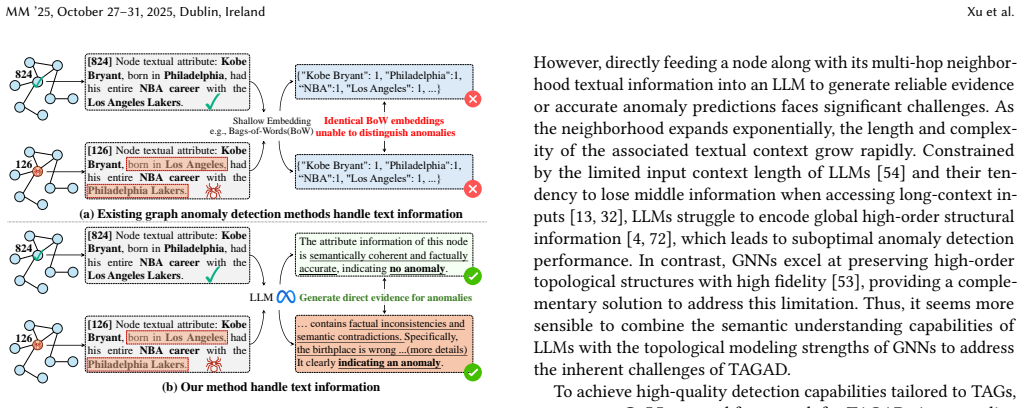
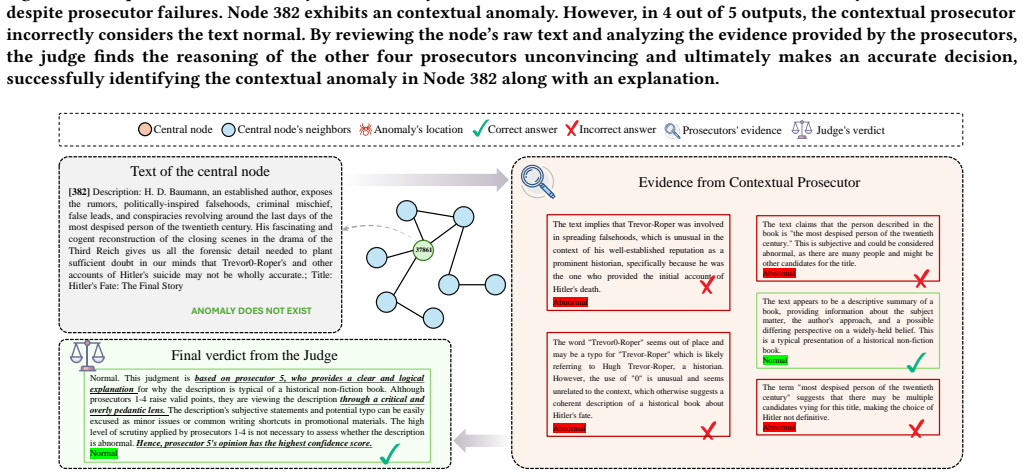
The core mechanism is an LLM 'court': a contextual prosecutor judges whether a node's text is internally coherent and stays on topic, a structural prosecutor samples up to five neighbors and judges whether meaningful relationships exist, and a larger judge LLM reviews all evidence and returns a 'normal' or 'abnormal' verdict with a human-readable rationale. The verdict text is encoded and combined with the original text embedding through LSTM-inspired forget, input, and output gates, producing a fused node representation that a GNN then propagates. A node-subgraph contrastive objective trains the model to match a node with its own neighbors versus other nodes' neighbors, and the final anomaly score is the average difference between negative-pair and positive-pair similarity.
What would settle it
Apply CoLL to a text-attributed graph with naturally occurring anomalies labeled by humans (for example, fraudulent reviews or papers with incorrect metadata) and compare AP against the same 11 baselines; if the 13.37% advantage disappears or reverses, the central claim that LLM evidence is broadly useful for TAGAD fails. A cheaper variant is to hold out an anomaly type the prompts do not mention, such as numerical inconsistency inside an otherwise coherent text, and check whether the judge's verdicts flag it.
Extended reading notes
Core claim
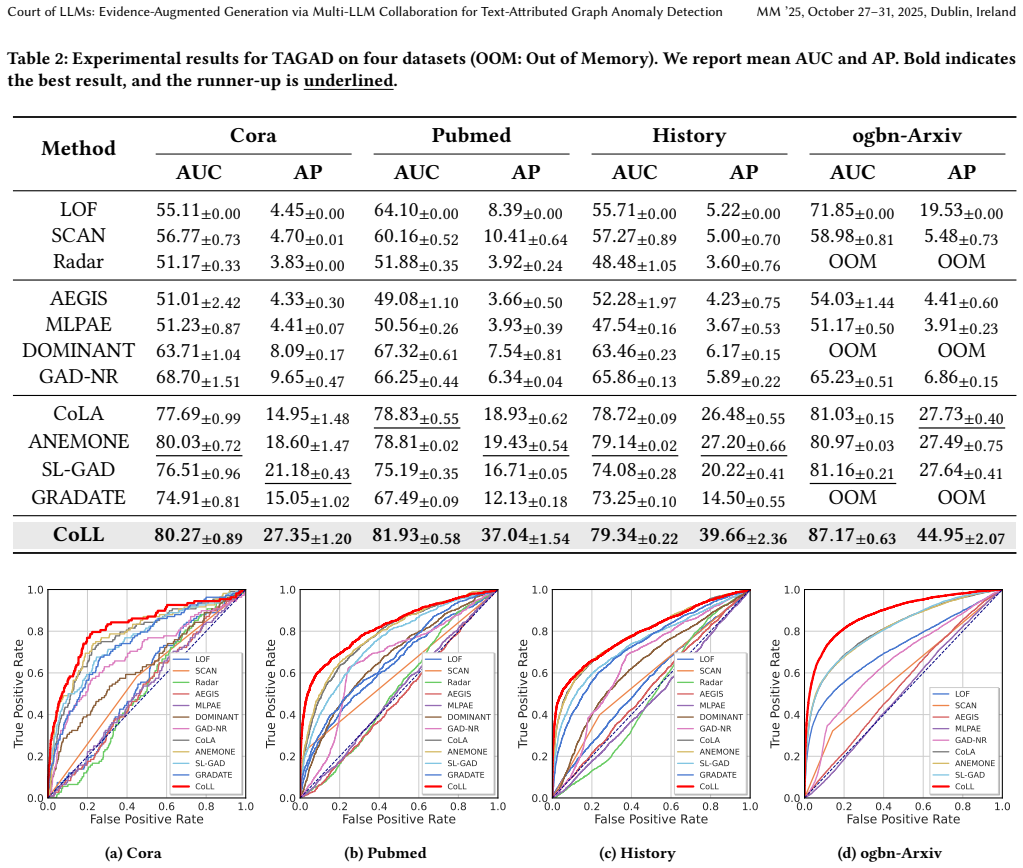
CoLL claims that a courtroom-style multi-LLM pipeline—two specialized prosecutors plus a judge—produces verdicts that capture anomaly-relevant semantics, and that a gated graph neural network fusing raw text embeddings with verdict embeddings preserves high-order topology. The paper reports consistent superiority over all baselines, for example AUC 80.27 versus 80.03 on Cora and 87.17 versus 81.16 on ogbn-Arxiv, with the largest AP gains appearing on the larger, more imbalanced datasets. This is positioned as evidence that representation quality, not just the complexity of self-supervised objectives, is the bottleneck in text-attributed graph anomaly detection.
Load-bearing premise
The reported gains are measured on benchmark anomalies manufactured by the same recipe the prompts describe—splicing in sentences from the least-similar text, forming dense cliques, and adding random edges—so the method's edge may partly reflect a match between the prompts and the injection protocol rather than general anomaly-detection ability.
Editorial extensions
If this is right
- LLM-generated verdicts can be produced once and stored, after which Stage II trains cheaply; the paper reports CoLL runs roughly 9.37x faster than the deep-learning baselines on average while achieving higher AP.
- Every flagged node comes with a readable explanation from the judge, so the method outputs rationales rather than only a scalar score.
- Ablations show two specialized prosecutors outperform one generalist prosecutor, and adding a judge improves performance further, making division of labor among LLMs a reusable design choice.
- The gating fusion beats mean pooling, raw-text-only, and verdict-only inputs, indicating that selectively combining both signals is important to the reported performance.
- The cost estimate for ogbn-Arxiv—about 86.3 USD and 7.1 hours for 169,343 nodes, parallelizable across nodes—suggests the approach is feasible at million-scale graphs if prompts generalize.
Reading between the lines
- If real-world anomalies do not match the signals the prompts instruct the court to look for (for example, fraud hidden in subtly altered numbers rather than an irrelevant sentence), the judge may never write down the decisive evidence, and the gating plus GNN stage cannot recover a signal the verdict does not contain.
- The interpretable verdicts could be turned into a human-in-the-loop audit tool, since operators can read and override the judge's rationale; the authors themselves caution against fully automated high-stakes deployment.
- One testable extension is to measure how much of the 13.37% AP gain comes from the LLM court alone versus the gated GNN, by scoring nodes directly from judge verdicts with no Stage II model.
- The two-prosecutor-plus-judge pattern likely transfers to other node-level tasks on text-attributed graphs, such as fake-review detection or misinformation spread, where anomaly evidence can be defined along similar contextual and structural axes.
Editorial analysis
A structured set of objections, weighed in public.
Referee Report
Summary. The paper proposes CoLL, an unsupervised framework for anomaly detection on text-attributed graphs (TAGAD). It uses two LLM-based 'prosecutors' to generate contextual and structural evidence, a larger LLM 'judge' to synthesize a final verdict, and a gated GNN to fuse raw text embeddings with LLM verdict features. Experiments on four datasets (Cora, Pubmed, History, ogbn-Arxiv) claim average improvements of 2.39% in AUC and 13.37% in AP over 11 baselines, with interpretable rationales as a byproduct.
Significance. If the empirical results are robust, CoLL demonstrates that LLM-generated semantic evidence can substantially improve TAGAD beyond traditional self-supervised objectives. The use of multi-LLM collaboration and the gating mechanism are novel contributions. The paper ships code and provides detailed implementation details. However, the practical significance depends on whether the gains generalize beyond the synthetic anomaly injection protocol used in the benchmark.
major comments (2)
- [Section 4.1 / Appendix B.1 and Appendix D] The synthetic anomaly injection protocol (contextual anomalies via insertion/replacement from the least-similar node; structural anomalies via dense cliques and random edges) is closely mirrored by the hand-written prompts in Appendix D, which instruct the prosecutors and judge to flag 'irrelevant content', 'significant deviation from the research domain', and 'incorrectly related or unrelated' neighbors. This creates a risk that the reported 13.37% average AP gain reflects prompt-anomaly alignment rather than general TAGAD capability. To make the central claim convincing, the authors should evaluate CoLL on held-out anomaly types that are not described in the prompts, or on real-world TAG anomalies, and report the resulting performance.
- [Appendix B.2] Hyperparameters (learning rate, epochs, batch size, weight decay, sampling rounds R, and hidden dimension d) were selected by monitoring AP/AUC on the same four datasets used for evaluation. This is a form of test-set tuning that can inflate CoLL's reported improvements relative to baselines. The authors should either adopt a validation split for hyperparameter selection, or provide results with a single fixed hyperparameter configuration across datasets, to ensure a fair comparison.
minor comments (4)
- [Table 2] The baseline name 'AENMONE' should be spelled 'ANEMONE'.
- [Algorithm 1] The formatting of lines 1 and 5 with repeated '=' characters is unconventional and should be cleaned up for readability.
- [Section 3.2] The terms 'contextual anomaly' and 'attribute anomaly' are used interchangeably; please pick one for consistency.
- [Appendix E] The limitation section mentions risk of data leakage but does not discuss the potential mismatch between the synthetic anomalies and real-world anomaly distributions; this connection would strengthen the paper's honesty.
Circularity Check
No equation-level circularity found; the derivation is self-contained and the empirical claim rests on external baselines and ablations.
full rationale
The derivation chain is self-contained: Eq. (1) encodes raw text and the LLM judge verdict with a frozen text encoder; Eqs. (2)-(3) define the gating fusion; Eqs. (4)-(6) define the GNN, readout, and bilinear discriminator; Eq. (7) is a standard binary cross-entropy contrastive loss on positive and negative node-subgraph pairs; and Eq. (8) defines the final anomaly score as the mean difference between negative-pair and positive-pair similarities. The anomaly score is not constructed from the anomaly labels, nor is it simply the LLM verdict: the verdict is one input feature that is fused with raw text and then re-scored by an unsupervised contrastive objective. The LLM prompts in Appendix D are hand-written and are not fitted to the test labels, and the gating/GNN parameters are trained without access to labels. The comparison against 11 external baselines and the component ablations provide independent empirical content. The main caveat is a benchmark-validity concern rather than circularity: the prompts in Appendix D instruct prosecutors and the judge to flag 'irrelevant content', 'significant deviation' from the stated research domain, and 'incorrectly related or unrelated' neighbors, while the synthetic anomalies in Appendix B.1 are created by inserting/replacing text from the least-similar candidate node, forming dense cliques, and adding random cross-community edges. Thus part of the reported AP gain may reflect prompt-to-injection-protocol alignment rather than general TAGAD ability, and no held-out anomaly type or real-world TAG label set is evaluated. That is an external-validity limitation, not a reduction of the method's output to its inputs by construction. The paper's self-citations are background references and are not load-bearing in the derivation. Therefore no circular step is exhibited, and the appropriate score is 0.
Assumptions & free parameters
free parameters (8)
- Sampling rounds R =
256
- Hidden dimension d =
64
- Per-dataset learning rate =
Cora 3e-3; Pubmed 5e-4; History 5e-3; ogbn-Arxiv 5e-3
- Per-dataset epochs =
Cora 25; Pubmed 100; History 25; ogbn-Arxiv 100
- Per-dataset batch size =
Cora 256; Pubmed 512; History 512; ogbn-Arxiv 256
- Per-dataset weight decay =
Cora 1e-4; Pubmed 1e-4; History 0.0; ogbn-Arxiv 1e-3
- Prosecutor output count per perspective =
5
- Structural prosecutor neighbor sample size =
5
assumptions (4)
- domain assumption The synthetic anomaly injection protocol in Appendix B.1 produces anomalies representative of real-world contextual and structural anomalies in text-attributed graphs.
- ad hoc to paper The LLM prompts in Appendix D operationalize 'anomaly' as irrelevant content or unrelated citations, and this operationalization matches the injected anomaly types.
- domain assumption Normal nodes satisfy homophily with their neighborhoods, which the contrastive objective and Eq. (8) anomaly score rely on.
- domain assumption Llama 3.1 8B as prosecutors and Llama 3.1 70B as judge produce verdicts of sufficient quality and stability to serve as input features.
Cite this review
Pith. "Pith review of Court of LLMs: Evidence-Augmented Generation via Multi-LLM Collaboration for Text-Attributed Graph Anomaly Detection." pith.science (2026). https://pith.science/paper/PMNZ4Y5E
@misc{pith2026250800507,
  author       = {Pith},
  title        = {Pith review of: Court of LLMs: Evidence-Augmented Generation via Multi-LLM Collaboration for Text-Attributed Graph Anomaly Detection},
  year         = {2026},
  howpublished = {\url{https://pith.science/paper/PMNZ4Y5E}},
  note         = {Machine review of arXiv:2508.00507}
}
read the original abstract
The natural combination of intricate topological structures and rich textual information in text-attributed graphs (TAGs) opens up a novel perspective for graph anomaly detection (GAD). However, existing GAD methods primarily focus on designing complex optimization objectives within the graph domain, overlooking the complementary value of the textual modality, whose features are often encoded by shallow embedding techniques, such as bag-of-words or skip-gram, so that semantic context related to anomalies may be missed. To unleash the enormous potential of textual modality, large language models (LLMs) have emerged as promising alternatives due to their strong semantic understanding and reasoning capabilities. Nevertheless, their application to TAG anomaly detection remains nascent, and they struggle to encode high-order structural information inherent in graphs due to input length constraints. For high-quality anomaly detection in TAGs, we propose CoLL, a novel framework that combines LLMs and graph neural networks (GNNs) to leverage their complementary strengths. CoLL employs multi-LLM collaboration for evidence-augmented generation to capture anomaly-relevant contexts while delivering human-readable rationales for detected anomalies. Moreover, CoLL integrates a GNN equipped with a gating mechanism to adaptively fuse textual features with evidence while preserving high-order topological information. Extensive experiments demonstrate the superiority of CoLL, achieving an average improvement of 13.37% in AP. This study opens a new avenue for incorporating LLMs in advancing GAD.
Figures

Figures from the paper (9 more)


Reference graph
Works this paper leans on
-
[1]
Josh Achiam, Steven Adler, Sandhini Agarwal, Lama Ahmad, Ilge Akkaya, Floren- cia Leoni Aleman, Diogo Almeida, Janko Altenschmidt, Sam Altman, Shyamal Anadkat, et al. 2023. Gpt-4 technical report. arXiv preprint arXiv:2303.08774 (2023)
arXiv 2023
-
[2]
Sambaran Bandyopadhyay, N Lokesh, and M Narasimha Murty. 2019. Outlier aware network embedding for attributed networks. In Proceedings of the AAAI conference on artificial intelligence , Vol. 33. 12–19
2019
-
[3]
Markus M Breunig, Hans-Peter Kriegel, Raymond T Ng, and Jörg Sander. 2000. LOF: identifying density-based local outliers. In Proceedings of the 2000 ACM SIGMOD international conference on Management of data . 93–104
2000
-
[4]
Zhikai Chen, Haitao Mao, Hongzhi Wen, Haoyu Han, Wei Jin, Haiyang Zhang, Hui Liu, and Jiliang Tang. 2024. Label-free node classification on graphs with large language models (llms). ICLR (2024)
2024
-
[5]
Lu Cheng, Ruocheng Guo, Kai Shu, and Huan Liu. 2021. Causal understanding of fake news dissemination on social media. InProceedings of the 27th ACM SIGKDD Conference on Knowledge Discovery & Data Mining . 148–157
2021
-
[6]
Eli Chien, Wei-Cheng Chang, Cho-Jui Hsieh, Hsiang-Fu Yu, Jiong Zhang, Ol- gica Milenkovic, and Inderjit S Dhillon. 2022. Node feature extraction by self- supervised multi-scale neighborhood prediction. ICLR (2022)
2022
-
[7]
Jacob Devlin. 2018. Bert: Pre-training of deep bidirectional transformers for language understanding. arXiv preprint arXiv:1810.04805 (2018)
arXiv 2018
-
[8]
Kaize Ding, Jundong Li, Nitin Agarwal, and Huan Liu. 2021. Inductive anomaly detection on attributed networks. In Proceedings of the twenty-ninth international conference on international joint conferences on artificial intelligence . 1288–1294
2021
Show all 92 references
-
[9]
Kaize Ding, Jundong Li, Rohit Bhanushali, and Huan Liu. 2019. Deep anomaly detection on attributed networks. In Proceedings of the 2019 SIAM international conference on data mining . SIAM, 594–602
2019
-
[10]
Jingcan Duan, Siwei Wang, Pei Zhang, En Zhu, Jingtao Hu, Hu Jin, Yue Liu, and Zhibin Dong. 2023. Graph anomaly detection via multi-scale contrastive learning networks with augmented view. InProceedings of the AAAI conference on artificial intelligence, Vol. 37. 7459–7467
2023
-
[11]
Abhimanyu Dubey, Abhinav Jauhri, Abhinav Pandey, Abhishek Kadian, Ahmad Al-Dahle, Aiesha Letman, Akhil Mathur, Alan Schelten, Amy Yang, Angela Fan, et al. 2024. The llama 3 herd of models. arXiv preprint arXiv:2407.21783 (2024)
2024 arXiv
-
[12]
Shangbin Feng, Weijia Shi, Yike Wang, Wenxuan Ding, Vidhisha Balachandran, and Yulia Tsvetkov. 2024. Don’t Hallucinate, Abstain: Identifying LLM Knowledge Gaps via Multi-LLM Collaboration. ACL (2024)
2024
-
[13]
Hamed Firooz, Maziar Sanjabi, Wenlong Jiang, and Xiaoling Zhai. 2024. Lost-in- Distance: Impact of Contextual Proximity on LLM Performance in Graph Tasks. arXiv preprint arXiv:2410.01985 (2024)
2024 arXiv
-
[14]
Xingyu Fu, Sheng Zhang, Gukyeong Kwon, Pramuditha Perera, Henghui Zhu, Yuhao Zhang, Alexander Hanbo Li, William Yang Wang, Zhiguo Wang, Vittorio Castelli, et al. 2023. Generate then select: Open-ended visual question answering guided by world knowledge. arXiv preprint arXiv:23...
2023 arXiv
-
[15]
Zellig S Harris. 1954. Distributional structure. Word 10, 2-3 (1954), 146–162
1954
-
[16]
Kaveh Hassani and Amir Hosein Khasahmadi. 2020. Contrastive multi-view representation learning on graphs. InInternational conference on machine learning. PMLR, 4116–4126
2020
-
[17]
Junwei He, Qianqian Xu, Yangbangyan Jiang, Zitai Wang, and Qingming Huang
-
[18]
Xiaoxin He, Xavier Bresson, Thomas Laurent, Adam Perold, Yann LeCun, and Bryan Hooi. 2024. Harnessing explanations: Llm-to-lm interpreter for enhanced text-attributed graph representation learning. ICLR (2024)
2024
-
[19]
S Hochreiter. 1997. Long Short-term Memory. Neural Computation MIT-Press (1997). MM ’25, October 27–31, 2025, Dublin, Ireland Xu et al
1997
-
[20]
Jingtao Hu, Bin Xiao, Hu Jin, Jingcan Duan, Siwei Wang, Zhao Lv, Siqi Wang, Xinwang Liu, and En Zhu. 2023. SAMCL: Subgraph-Aligned Multiview Con- trastive Learning for Graph Anomaly Detection. IEEE Transactions on Neural Networks and Learning Systems (2023)
2023
-
[21]
Weihua Hu, Matthias Fey, Marinka Zitnik, Yuxiao Dong, Hongyu Ren, Bowen Liu, Michele Catasta, and Jure Leskovec. 2020. Open graph benchmark: Datasets for machine learning on graphs. Advances in neural information processing systems 33 (2020), 22118–22133
2020
-
[22]
Jin Huang, Xingjian Zhang, Qiaozhu Mei, and Jiaqi Ma. 2023. Can llms effectively leverage graph structural information through prompts, and why? arXiv preprint arXiv:2309.16595 (2023)
2023 arXiv
-
[23]
Xuanwen Huang, Kaiqiao Han, Yang Yang, Dezheng Bao, Quanjin Tao, Ziwei Chai, and Qi Zhu. 2024. Can GNN be Good Adapter for LLMs?. In Proceedings of the ACM on Web Conference 2024 . 893–904
2024
-
[24]
Bowen Jin, Gang Liu, Chi Han, Meng Jiang, Heng Ji, and Jiawei Han. 2024. Large language models on graphs: A comprehensive survey. IEEE Transactions on Knowledge and Data Engineering (2024)
2024
-
[25]
Ming Jin, Yixin Liu, Yu Zheng, Lianhua Chi, Yuan-Fang Li, and Shirui Pan. 2021. Anemone: Graph anomaly detection with multi-scale contrastive learning. In Proceedings of the 30th ACM international conference on information & knowledge management. 3122–3126
2021
-
[26]
Saurav Kadavath, Tom Conerly, Amanda Askell, Tom Henighan, Dawn Drain, Ethan Perez, Nicholas Schiefer, Zac Hatfield-Dodds, Nova DasSarma, Eli Tran- Johnson, et al. 2022. Language models (mostly) know what they know. arXiv preprint arXiv:2207.05221 (2022)
2022 arXiv
-
[27]
Adrian Keane and Paul McKeown. 2022. The modern law of evidence . Oxford University Press
2022
-
[28]
Diederik P Kingma. 2015. Adam: A method for stochastic optimization. ICLR (2015)
2015
-
[29]
Jundong Li, Harsh Dani, Xia Hu, and Huan Liu. 2017. Radar: Residual analysis for anomaly detection in attributed networks.. In IJCAI, Vol. 17. 2152–2158
2017
-
[30]
Yiqing Lin, Jianheng Tang, Chenyi Zi, H Vicky Zhao, Yuan Yao, and Jia Li. 2024. UniGAD: Unifying Multi-level Graph Anomaly Detection. NeurIPS (2024)
2024
-
[31]
Hao Liu, Jiarui Feng, Lecheng Kong, Ningyue Liang, Dacheng Tao, Yixin Chen, and Muhan Zhang. 2024. One for all: Towards training one graph model for all classification tasks. ICLR (2024)
2024
-
[32]
Nelson F Liu, Kevin Lin, John Hewitt, Ashwin Paranjape, Michele Bevilacqua, Fabio Petroni, and Percy Liang. 2024. Lost in the middle: How language models use long contexts. Transactions of the Association for Computational Linguistics 12 (2024), 157–173
2024
-
[33]
Yixin Liu, Shiyuan Li, Yu Zheng, Qingfeng Chen, Chengqi Zhang, and Shirui Pan
-
[34]
Yixin Liu, Zhao Li, Shirui Pan, Chen Gong, Chuan Zhou, and George Karypis
-
[35]
NeurIPS (2024)
ARC: A Generalist Graph Anomaly Detector with In-Context Learning. NeurIPS (2024)
2024
-
[36]
Xiaoxiao Ma, Jia Wu, Shan Xue, Jian Yang, Chuan Zhou, Quan Z Sheng, Hui Xiong, and Leman Akoglu. 2021. A comprehensive survey on graph anomaly detection with deep learning. IEEE Transactions on Knowledge and Data Engineering 35, 12 (2021), 12012–12038
2021
-
[37]
Qiheng Mao, Zemin Liu, Chenghao Liu, Zhuo Li, and Jianling Sun. 2024. Advanc- ing Graph Representation Learning with Large Language Models: A Comprehen- sive Survey of Techniques. arXiv preprint arXiv:2402.05952 (2024)
2024 arXiv
-
[38]
Jiebo Luo, Damian Borth, and Quanzeng You. 2017. Social multimedia sentiment analysis. In Proceedings of the 25th ACM international conference on Multimedia . 1953–1954
2017
-
[39]
Katie Morgan and Michael J Zydney Mannheimer. 2008. The impact of informa- tion overload on the capital jury’s ability to assess aggravating and mitigating factors. Wm. & Mary Bill Rts. J. 17 (2008), 1089
2008
-
[40]
Emmanuel Müller, Patricia Iglesias Sánchez, Yvonne Mülle, and Klemens Böhm
-
[41]
Tomas Mikolov, Ilya Sutskever, Kai Chen, Greg S Corrado, and Jeff Dean. 2013. Distributed representations of words and phrases and their compositionality. Advances in neural information processing systems 26 (2013)
2013
-
[42]
Shashank Pandit, Duen Horng Chau, Samuel Wang, and Christos Faloutsos
-
[43]
Armin Danesh Pazho, Ghazal Alinezhad Noghre, Arnab A Purkayastha, Jagan- nadh Vempati, Otto Martin, and Hamed Tabkhi. 2023. A Survey of Graph-based Deep Learning for Anomaly Detection in Distributed Systems. IEEE Transactions on Knowledge and Data Engineering (2023)
2023
-
[44]
Amit Roy, Juan Shu, Jia Li, Carl Yang, Olivier Elshocht, Jeroen Smeets, and Pan Li. 2024. Gad-nr: Graph anomaly detection via neighborhood reconstruction. In Proceedings of the 17th ACM International Conference on Web Search and Data Mining. 576–585
2024
-
[45]
Jianmo Ni, Jiacheng Li, and Julian McAuley. 2019. Justifying recommendations using distantly-labeled reviews and fine-grained aspects. In Proceedings of the 2019 conference on empirical methods in natural language processing and the 9th international joint conference on natura...
2019
-
[46]
Prithviraj Sen, Galileo Namata, Mustafa Bilgic, Lise Getoor, Brian Galligher, and Tina Eliassi-Rad. 2008. Collective classification in network data. AI magazine 29, 3 (2008), 93–93
2008
-
[47]
Bin Shi, Bo Dong, Yiming Xu, Jiaxiang Wang, Yunfan Wang, and Qinghua Zheng
-
[48]
Kijung Shin, Bryan Hooi, Jisu Kim, and Christos Faloutsos. 2017. Densealert: Incremental dense-subtensor detection in tensor streams. In Proceedings of the 23rd ACM SIGKDD International Conference on Knowledge Discovery and Data Mining. 1057–1066
2017
-
[49]
David B Skillicorn. 2007. Detecting anomalies in graphs. In 2007 IEEE Intelligence and Security Informatics. IEEE, 209–216
2007
-
[50]
Mayu Sakurada and Takehisa Yairi. 2014. Anomaly detection using autoencoders with nonlinear dimensionality reduction. In Proceedings of the MLSDA 2014 2nd workshop on machine learning for sensory data analysis . 4–11
2014
-
[51]
Jiabin Tang, Yuhao Yang, Wei Wei, Lei Shi, Lixin Su, Suqi Cheng, Dawei Yin, and Chao Huang. 2024. Graphgpt: Graph instruction tuning for large language models. In Proceedings of the 47th International ACM SIGIR Conference on Research and Development in Information Retrieval . 491–500
2024
-
[52]
Petar Veličković, William Fedus, William L Hamilton, Pietro Liò, Yoshua Bengio, and R Devon Hjelm. 2019. Deep graph infomax. ICLR (2019)
2019
-
[53]
Lilapati Waikhom and Ripon Patgiri. 2023. A survey of graph neural networks in various learning paradigms: methods, applications, and challenges. Artificial Intelligence Review 56, 7 (2023), 6295–6364
2023
-
[54]
Xindi Wang, Mahsa Salmani, Parsa Omidi, Xiangyu Ren, Mehdi Rezagholizadeh, and Armaghan Eshaghi. 2024. Beyond the limits: A survey of techniques to extend the context length in large language models. IJCAI Survey Track (2024)
2024
-
[55]
What It Can Create, It May Not Understand
Peter West, Ximing Lu, Nouha Dziri, Faeze Brahman, Linjie Li, Jena D Hwang, Liwei Jiang, Jillian Fisher, Abhilasha Ravichander, Khyathi Chandu, et al. 2023. THE GENERATIVE AI PARADOX:“What It Can Create, It May Not Understand”. In The Twelfth International Conference on Learni...
2023
-
[56]
Xiuyao Song, Mingxi Wu, Christopher Jermaine, and Sanjay Ranka. 2007. Condi- tional anomaly detection. IEEE Transactions on knowledge and Data Engineering 19, 5 (2007), 631–645
2007
-
[57]
Xiaowei Xu, Nurcan Yuruk, Zhidan Feng, and Thomas AJ Schweiger. 2007. Scan: a structural clustering algorithm for networks. In Proceedings of the 13th ACM SIGKDD international conference on Knowledge discovery and data mining . 824– 833
2007
-
[58]
Yiming Xu, Zhen Peng, Bin Shi, Xu Hua, and Bo Dong. 2024. Learning dynamic graph representations through timespan view contrasts. Neural Networks 176 (2024), 106384
2024
-
[59]
Yiming Xu, Zhen Peng, Bin Shi, Xu Hua, Bo Dong, Song Wang, and Chen Chen
-
[60]
Yiming Xu, Bin Shi, Bo Dong, Jiaxiang Wang, Hua Wei, and Qinghua Zheng. 2025. TED: related party transaction guided tax evasion detection on heterogeneous graph. Data Mining and Knowledge Discovery 39, 2 (2025), 15
2025
-
[61]
Yiming Xu, Bin Shi, Teng Ma, Bo Dong, Haoyi Zhou, and Qinghua Zheng. 2023. CLDG: Contrastive learning on dynamic graphs. In 2023 IEEE 39th International Conference on Data Engineering (ICDE) . IEEE, 696–707
2023
-
[62]
Shitao Xiao, Zheng Liu, Peitian Zhang, and Niklas Muennighoff. 2023. C-Pack: Packaged Resources To Advance General Chinese Embedding. arXiv:2309.07597 [cs.CL]
2023 arXiv
-
[63]
An Yang, Baosong Yang, Binyuan Hui, Bo Zheng, Bowen Yu, Chang Zhou, Cheng- peng Li, Chengyuan Li, Dayiheng Liu, Fei Huang, et al. 2024. Qwen2 technical report. arXiv preprint arXiv:2407.10671 (2024)
2024 arXiv
-
[64]
Guanhua Ye, Hongzhi Yin, Tong Chen, Hongxu Chen, Lizhen Cui, and Xiangliang Zhang. 2021. FENet: a frequency extraction network for obstructive sleep apnea detection. IEEE Journal of Biomedical and Health Informatics 25, 8 (2021), 2848– 2856
2021
-
[65]
Ruosong Ye, Caiqi Zhang, Runhui Wang, Shuyuan Xu, and Yongfeng Zhang. 2024. Language is All a Graph Needs. EACL (2024)
2024
-
[66]
Jifan Yu, Xiaozhi Wang, Shangqing Tu, Shulin Cao, Daniel Zhang-Li, Xin Lv, Hao Peng, Zijun Yao, Xiaohan Zhang, Hanming Li, et al . 2023. Kola: Care- fully benchmarking world knowledge of large language models. arXiv preprint arXiv:2306.09296 (2023). Court of LLMs: Evidence-Aug...
2023 arXiv
-
[67]
Delvin Ce Zhang, Menglin Yang, Rex Ying, and Hady W Lauw. 2024. Text- attributed graph representation learning: Methods, applications, and challenges. In Companion Proceedings of the ACM on Web Conference 2024 . 1298–1301
2024
-
[68]
Ge Zhang, Zhao Li, Jiaming Huang, Jia Wu, Chuan Zhou, Jian Yang, and Jianliang Gao. 2022. efraudcom: An e-commerce fraud detection system via competitive graph neural networks. ACM Transactions on Information Systems (TOIS) 40, 3 (2022), 1–29
2022
-
[69]
Hao Yan, Chaozhuo Li, Ruosong Long, Chao Yan, Jianan Zhao, Wenwen Zhuang, Jun Yin, Peiyan Zhang, Weihao Han, Hao Sun, et al. 2023. A comprehensive study on text-attributed graphs: Benchmarking and rethinking. Advances in Neural Information Processing Systems 36 (2023), 17238–17264
2023
-
[70]
Jiaqiang Zhang, Senzhang Wang, and Songcan Chen. 2022. Reconstruction enhanced multi-view contrastive learning for anomaly detection on attributed networks. IJCAI (2022)
2022
-
[71]
Ziwei Zhang, Haoyang Li, Zeyang Zhang, Yijian Qin, Xin Wang, and Wenwu Zhu
-
[72]
Jianan Zhao, Meng Qu, Chaozhuo Li, Hao Yan, Qian Liu, Rui Li, Xing Xie, and Jian Tang. 2023. Learning on large-scale text-attributed graphs via variational inference. ICLR (2023)
2023
-
[73]
Jianan Zhao, Le Zhuo, Yikang Shen, Meng Qu, Kai Liu, Michael Bronstein, Zhaocheng Zhu, and Jian Tang. 2023. Graphtext: Graph reasoning in text space. arXiv preprint arXiv:2310.01089 (2023)
2023 arXiv
-
[74]
Wayne Xin Zhao, Kun Zhou, Junyi Li, Tianyi Tang, Xiaolei Wang, Yupeng Hou, Yingqian Min, Beichen Zhang, Junjie Zhang, Zican Dong, et al. 2023. A survey of large language models. arXiv preprint arXiv:2303.18223 (2023)
2023 arXiv
-
[75]
Qinghua Zheng, Yiming Xu, Huixiang Liu, Bin Shi, Jiaxiang Wang, and Bo Dong
-
[76]
Jiong Zhang, Wei-Cheng Chang, Hsiang-Fu Yu, and Inderjit Dhillon. 2021. Fast multi-resolution transformer fine-tuning for extreme multi-label text classifica- tion. Advances in Neural Information Processing Systems 34 (2021), 7267–7280
2021
-
[77]
Yushan Zhu, Huaixiao Zhao, Wen Zhang, Ganqiang Ye, Hui Chen, Ningyu Zhang, and Huajun Chen. 2021. Knowledge perceived multi-modal pretraining in e- commerce. In Proceedings of the 29th ACM International Conference on Multimedia. 2744–2752. MM ’25, October 27–31, 2025, Dublin, ...
2021
-
[79]
In NeurIPS 2023 Workshop: New Frontiers in Graph Learning
Graph meets llms: Towards large graph models. In NeurIPS 2023 Workshop: New Frontiers in Graph Learning
2023
-
[84]
A Survey of Tax Risk Detection Using Data Mining Techniques.Engineering (2023)
2023
-
[85]
Yu Zheng, Ming Jin, Yixin Liu, Lianhua Chi, Khoa T Phan, and Yi-Ping Phoebe Chen. 2021. Generative and contrastive self-supervised learning for graph anom- aly detection. IEEE Transactions on Knowledge and Data Engineering 35, 12 (2021), 12220–12233
2021
-
[92]
Trevor0-Roper
Description: H. D. Baumann, an established author, exposes the rumors, politically-inspired falsehoods, criminal mischief, false leads, and conspiracies revolving around the last days of the most despised person of the twentieth century. His fascinating and cogent reconstructi...
2025
-
[288]
astonishing
Description: Van der Vat ( The Ship That Changed the World ) reminds readers that the Allies came close to losing both world wars for exactly the same reason: massive destruction of shipping. He leaves no doubt that the U-boat was Germany's most cost-effective weapon in both c...
1939
-
[382]
Coming to America: A History of Immigration and Ethnicity in American Life
Description: Roger Daniels is Charles Phelps Taft Professor of History Emeritus at the University of Cincinnati. He received his Ph.D. Osprey's Combat series combines the best archival photography available with specially commissioned artworks and first hand accounts, making t...
1939
-
[385]
Coming to America: A History of Immigration and Ethnicity in American Life
Title: mining communication data in a music community a preliminary analysis. Abstract: Comments play an important role within online creative communities because they make it possible to foster the production and improvement of authors’ artifacts. We investigate how comment-b...
2025
-
[2007]
In Proceedings of the 16th international conference on World Wide Web
Netprobe: a fast and scalable system for fraud detection in online auction networks. In Proceedings of the 16th international conference on World Wide Web . 201–210
-
[2013]
In 2013 IEEE 29th international conference on data engineering workshops (ICDEW)
Ranking outlier nodes in subspaces of attributed graphs. In 2013 IEEE 29th international conference on data engineering workshops (ICDEW) . IEEE, 216–222
2013
-
[2021]
IEEE transactions on neural networks and learning systems 33, 6 (2021), 2378–2392
Anomaly detection on attributed networks via contrastive self-supervised learning. IEEE transactions on neural networks and learning systems 33, 6 (2021), 2378–2392
2021
-
[2023]
Expert Systems with Applications 213 (2023), 118903
An edge feature aware heterogeneous graph neural network model to support tax evasion detection. Expert Systems with Applications 213 (2023), 118903
2023
-
[2024]
In Proceedings of the AAAI Conference on Artificial Intelligence , Vol
ADA-GAD: Anomaly-Denoised Autoencoders for Graph Anomaly De- tection. In Proceedings of the AAAI Conference on Artificial Intelligence , Vol. 38. 8481–8489
-
[2025]
In Proceedings of the AAAI Conference on Artificial Intelligence, Vol
Revisiting Graph Contrastive Learning on Anomaly Detection: A Struc- tural Imbalance Perspective. In Proceedings of the AAAI Conference on Artificial Intelligence, Vol. 39. 12972–12980
-
[7440]
Description: Praise for Storm Over LeyteA book every serious World War II student will want.KirkusThe strongest part of the book is Pradoss description of the U.S. intelligence apparatus that meticulously tracked the Japanese militarys communications, leveraging a small army o...
-
[9454]
The Atlantic Campaign: World War II‘s Great Struggle at Sea,
Description: The Philadelphia Inquirer Fast-paced, meticulously reserarched...has all the elements of a spy thriller.The New York Times Book Review Belongs on the bookshelf of every American who contemplates the meaning of the greatest sea war in history ... The Chicago Tribun...
1941
Reviewed August 6, 2026 · model on record in the stance chip above.
Discussion (0). Sign in to comment.