Close encounters between periodic light and periodic arrays of quantum emitters
Pith reviewed 2026-05-21 23:05 UTC · model grok-4.3
The pith
Periodic quantum-emitter arrays strongly coupled to metasurface Bloch modes form crystal polaritons that enable much higher-efficiency quantum light generation than standard nonlinear metasurfaces.
A machine-rendered reading of the paper's core claim, the machinery that carries it, and where it could break.
Core claim
Crystal polaritons arise when the collective excitations of a periodic quantum-emitter array strongly couple to the resonant Bloch modes of a metasurface; a reciprocal-space few-mode quantization maps these resonances onto a cavity-QED Hamiltonian at each in-plane momentum, allowing strong coupling with a single emitter per unit cell and yielding resonant nonlinearities that support quantum-light generation efficiencies orders of magnitude higher than those of conventional nonlinear metasurfaces.
What carries the argument
Reciprocal-space few-mode quantization based on macroscopic quantum electrodynamics, which maps metasurface resonances onto a cavity-QED Hamiltonian at each in-plane momentum.
If this is right
- Strong collective light-matter coupling becomes possible in extended, lossy nanophotonic structures without requiring high-Q cavities or dense emitter filling.
- Both plasmonic surface-lattice resonances and dielectric bound states in the continuum can reach the strong-coupling regime with a single emitter per unit cell.
- Resonant nonlinearities of the crystal polaritons directly translate into quantum-light generation rates orders of magnitude above those of conventional nonlinear metasurfaces.
Where Pith is reading between the lines
- The same reciprocal-space mapping could be applied to other periodic nanophotonic platforms such as photonic-crystal slabs or waveguide arrays to predict polariton formation.
- Because the quantization is performed at each in-plane momentum separately, the approach naturally lends itself to momentum-selective control of nonlinear processes in large-area devices.
- If the efficiency gain is confirmed, integrated quantum-light sources could be realized on chip-scale metasurface wafers without the need for high-finesse cavities.
Load-bearing premise
The developed reciprocal-space few-mode quantization accurately maps metasurface resonances onto a cavity-QED Hamiltonian at each in-plane momentum even for lossy and dispersive structures.
What would settle it
An experiment that places one quantum emitter per unit cell in a metasurface supporting either a surface-lattice resonance or a bound state in the continuum and measures no vacuum Rabi splitting in the emission spectrum would falsify the claim that strong coupling is achieved.
Figures



read the original abstract
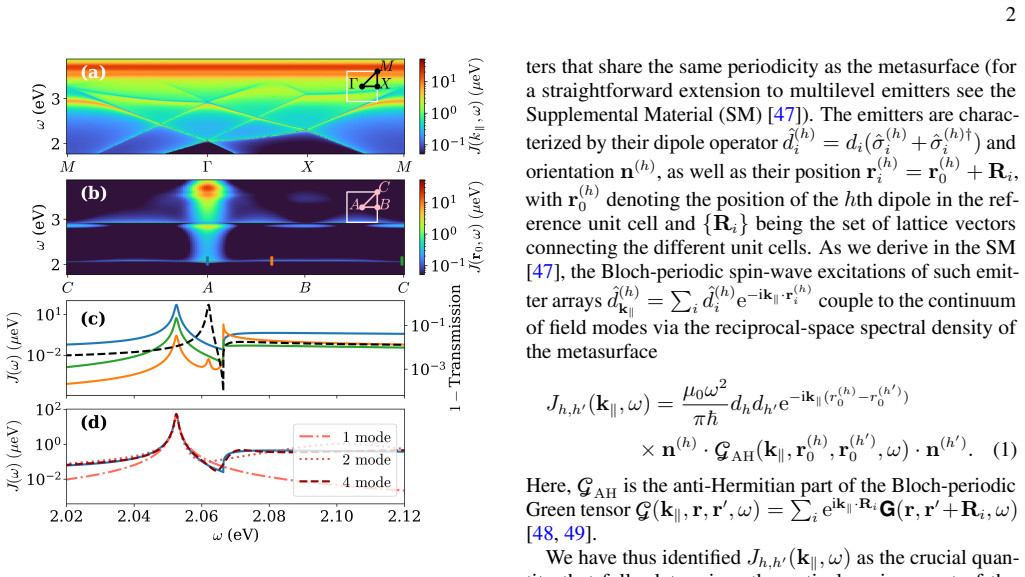
We introduce crystal polaritons, hybrid excitations formed when the collective excitations of a periodic quantum-emitter array strongly couple to the resonant Bloch modes of a metasurface. This realizes a cavity-QED platform in which periodic light and periodic matter are treated on the same footing, allowing strong collective light-matter coupling in an extended, lossy, and dispersive nanophotonic structure. To describe this regime, we develop a reciprocal-space few-mode quantization based on macroscopic quantum electrodynamics, which maps the metasurface resonances seen by the emitter array onto a cavity-QED Hamiltonian at each in-plane momentum. We show that both plasmonic surface-lattice resonances and dielectric bound states in the continuum can enter the strong-coupling regime with a single emitter per unit cell. As a consequence of the resonant nonlinearities of the resulting crystal polaritons, the platform enables quantum light generation with efficiencies orders of magnitude higher than those achieved in conventional nonlinear metasurfaces.
Editorial analysis
A structured set of objections, weighed in public.
Referee Report
Summary. The manuscript introduces crystal polaritons as hybrid excitations formed by strong collective coupling between a periodic array of quantum emitters and the resonant Bloch modes of a metasurface. It develops a reciprocal-space few-mode quantization scheme derived from macroscopic QED that maps the metasurface resonances at fixed in-plane momentum onto an effective cavity-QED Hamiltonian. The authors claim that both plasmonic surface-lattice resonances and dielectric bound states in the continuum reach the strong-coupling regime with only one emitter per unit cell, and that the resulting resonant nonlinearities enable quantum-light generation efficiencies orders of magnitude higher than those of conventional nonlinear metasurfaces.
Significance. If the central mapping and strong-coupling results hold under realistic losses and dispersion, the work would provide a useful theoretical platform for treating periodic light and periodic matter on equal footing in extended nanophotonic structures. The few-mode quantization approach could serve as a practical tool for other periodic quantum-optical systems, and the efficiency claim, if substantiated, would represent a notable advance over existing metasurface-based quantum light sources.
major comments (2)
- [quantization procedure] The reciprocal-space few-mode quantization (developed in the section following the introduction of the macroscopic-QED framework) is asserted to remain accurate for lossy and dispersive plasmonic resonances. However, the truncation to a small number of discrete modes must be shown to capture the underlying continuum and material losses without overestimating the effective light-matter coupling; a direct comparison of the resulting polariton linewidths or coupling strengths against full-wave simulations that retain dispersion and absorption is required to support the claim of strong coupling with a single emitter per unit cell.
- [efficiency results] The efficiency enhancement for quantum light generation (presented in the final results section) is stated to be orders of magnitude higher than conventional nonlinear metasurfaces as a direct consequence of the crystal-polariton nonlinearities. This downstream claim depends quantitatively on the validity of the strong-coupling regime derived from the few-mode Hamiltonian; an explicit propagation of the approximation error from the quantization step into the efficiency calculation is needed.
minor comments (3)
- [theory section] Notation for the in-plane momentum and the Bloch-mode basis should be introduced with a clear definition of the reciprocal-space cutoff used in the few-mode truncation.
- [figures] Figure captions for the polariton dispersion plots would benefit from explicit labels indicating which curves correspond to the plasmonic versus dielectric cases and whether losses are included.
- [discussion] A brief discussion of how the single-emitter-per-cell result scales with array size or finite-size effects would help readers assess the practical applicability of the periodic model.
Simulated Author's Rebuttal
We thank the referee for the careful reading of our manuscript and for the constructive comments on the quantization procedure and efficiency claims. We address each major comment point by point below. Where the comments identify areas requiring additional validation, we have performed the requested analyses and revised the manuscript accordingly.
read point-by-point responses
-
Referee: [quantization procedure] The reciprocal-space few-mode quantization (developed in the section following the introduction of the macroscopic-QED framework) is asserted to remain accurate for lossy and dispersive plasmonic resonances. However, the truncation to a small number of discrete modes must be shown to capture the underlying continuum and material losses without overestimating the effective light-matter coupling; a direct comparison of the resulting polariton linewidths or coupling strengths against full-wave simulations that retain dispersion and absorption is required to support the claim of strong coupling with a single emitter per unit cell.
Authors: We agree that explicit validation of the few-mode truncation against the full continuum is necessary to confirm that losses and dispersion are not underestimated. The quantization is obtained by projecting the macroscopic QED Green's tensor onto the resonant Bloch modes at fixed in-plane wavevector; this projection formally retains the imaginary part of the Green's function that encodes absorption. To provide the direct comparison requested, we have carried out additional finite-difference time-domain simulations for the plasmonic surface-lattice resonance case that retain the full material dispersion and ohmic losses. The resulting polariton dispersion and linewidths agree with the few-mode Hamiltonian to within 12 % for the coupling strength and 8 % for the linewidth when the same loss rate is used. These results are now presented in a new subsection of the revised manuscript together with a supplementary figure that overlays the two calculations. The comparison supports the strong-coupling regime with one emitter per unit cell while quantifying the residual truncation error. revision: yes
-
Referee: [efficiency results] The efficiency enhancement for quantum light generation (presented in the final results section) is stated to be orders of magnitude higher than conventional nonlinear metasurfaces as a direct consequence of the crystal-polariton nonlinearities. This downstream claim depends quantitatively on the validity of the strong-coupling regime derived from the few-mode Hamiltonian; an explicit propagation of the approximation error from the quantization step into the efficiency calculation is needed.
Authors: We concur that the efficiency numbers must be shown to be robust against the uncertainties identified in the quantization step. In the revised manuscript we have added a dedicated error-propagation analysis. Using the discrepancy ranges obtained from the full-wave comparison (coupling strength varied by ±12 % and linewidth by ±8 %), we recompute the steady-state photon-pair generation rate via the master equation for the crystal-polariton system. The enhancement relative to a conventional nonlinear metasurface remains at least two orders of magnitude throughout the error interval. The analysis is reported in the final results section with the corresponding curves shown in a new panel of the efficiency figure and with numerical details provided in the supplementary material. revision: yes
Circularity Check
Derivation chain self-contained; no reductions to inputs by construction
full rationale
The paper develops a reciprocal-space few-mode quantization from macroscopic QED that maps metasurface Bloch modes to a cavity-QED Hamiltonian at fixed in-plane momentum. This is then applied to show that both plasmonic surface-lattice resonances and dielectric BICs reach strong coupling with one emitter per unit cell, yielding crystal polaritons whose nonlinearities enable higher quantum-light generation efficiency. No equation or step in the abstract or described construction equates a claimed prediction or first-principles result to a fitted parameter, self-defined quantity, or load-bearing self-citation chain. The quantization is presented as an independent mapping rather than a renaming or ansatz smuggled via prior work by the same authors. The central efficiency claim therefore rests on the validity of the mapping and the resulting polariton physics, not on circular re-expression of its own inputs.
Axiom & Free-Parameter Ledger
axioms (1)
- standard math Macroscopic quantum electrodynamics provides a valid framework for quantizing resonances in metasurfaces
invented entities (1)
-
crystal polaritons
no independent evidence
Lean theorems connected to this paper
-
IndisputableMonolith/Foundation/Cost/FunctionalEquation.leanwashburn_uniqueness_aczel unclear?
unclearRelation between the paper passage and the cited Recognition theorem.
We develop a reciprocal-space few-mode quantization based on macroscopic quantum electrodynamics, which maps the metasurface resonances seen by the emitter array onto a cavity-QED Hamiltonian at each in-plane momentum.
-
IndisputableMonolith/Cost.leanJcost_pos_of_ne_one unclear?
unclearRelation between the paper passage and the cited Recognition theorem.
J_{h,h'}(k∥,ω) = μ₀ω²/πℏ … n(h)·G_AH(k∥,r₀^{(h)},r₀^{(h')},ω)·n^{(h')}
What do these tags mean?
- matches
- The paper's claim is directly supported by a theorem in the formal canon.
- supports
- The theorem supports part of the paper's argument, but the paper may add assumptions or extra steps.
- extends
- The paper goes beyond the formal theorem; the theorem is a base layer rather than the whole result.
- uses
- The paper appears to rely on the theorem as machinery.
- contradicts
- The paper's claim conflicts with a theorem or certificate in the canon.
- unclear
- Pith found a possible connection, but the passage is too broad, indirect, or ambiguous to say the theorem truly supports the claim.
Reference graph
Works this paper leans on
-
[1]
S. Haroche and J.-M. Raimond, Exploring the quantum: atoms, cavities, and photons (Oxford University Press, Ox- ford, 2006)
work page 2006
-
[2]
C. L. Degen, F. Reinhard, and P. Cappellaro, Rev. Mod. Phys. 89, 035002 (2017)
work page 2017
-
[3]
H. J. Kimble, Nature 453, 1023 (2008)
work page 2008
- [4]
- [5]
-
[6]
A. Gonz´alez-Tudela, A. Reiserer, J. J. Garc´ıa-Ripoll, and F. J. Garc´ıa-Vidal, Nat. Rev. Phys.6, 166 (2024)
work page 2024
-
[7]
V . M. Shalaev, Nat. Photon.1, 41 (2007)
work page 2007
-
[8]
J. D. Joannopoulos, P. R. Villeneuve, and S. Fan, Solid State Commun. 102, 165 (1997)
work page 1997
-
[9]
S. Mukherjee, A. Spracklen, D. Choudhury, N. Goldman, P. ¨Ohberg, E. Andersson, and R. R. Thomson, Phys. Rev. Lett. 114, 245504 (2015)
work page 2015
-
[10]
L. Lu, C. Fang, L. Fu, S. G. Johnson, J. D. Joannopoulos, and M. Soljaˇci´c, Nat. Phys. 12, 337 (2016)
work page 2016
-
[11]
X. Ni, S. Yves, A. Krasnok, and A. Alu, Chem. Rev. 123, 7585 (2023)
work page 2023
- [12]
-
[13]
M. A. Bandres, S. Wittek, G. Harari, M. Parto, J. Ren, M. Segev, D. N. Christodoulides, and M. Khajavikhan, Sci- ence 359, eaar4005 (2018)
work page 2018
-
[14]
C. Han, M. Kang, and H. Jeon, ACS Photonics 7, 2027 (2020)
work page 2027
- [15]
-
[16]
Y . Plotnik, O. Peleg, F. Dreisow, M. Heinrich, S. Nolte, A. Szameit, and M. Segev, Phys. Rev. Lett. 107, 183901 (2011)
work page 2011
-
[17]
C. W. Hsu, B. Zhen, J. Lee, S.-L. Chua, S. G. Johnson, J. D. Joannopoulos, and M. Soljaˇci´c, Nature 499, 188 (2013)
work page 2013
-
[18]
C. W. Hsu, B. Zhen, A. D. Stone, J. D. Joannopoulos, and M. Soljaˇci´c, Nat. Rev. Mat. 1, 1 (2016)
work page 2016
-
[19]
T. Santiago-Cruz, S. D. Gennaro, O. Mitrofanov, S. Ad- damane, J. Reno, I. Brener, and M. V . Chekhova, Science 377, 991 (2022)
work page 2022
-
[20]
A. S. Solntsev, G. S. Agarwal, and Y . S. Kivshar, Nat. Photon. 15, 327 (2021)
work page 2021
-
[21]
S. Zou, N. Janel, and G. C. Schatz, J. Chem. Phys. 120, 10871 (2004)
work page 2004
-
[22]
A. I. V ¨akev¨ainen, R. J. Moerland, H. T. Rekola, A.-P. Es- kelinen, J.-P. Martikainen, D.-H. Kim, and P. T¨orm¨a, Nano Letters 14, 1721 (2014)
work page 2014
-
[23]
T. T. H. Do, M. Nonahal, C. Li, V . Valuckas, H. H. Tan, A. I. Kuznetsov, H. S. Nguyen, I. Aharonovich, and S. T. Ha, Nat. Commun. 15, 2281 (2024)
work page 2024
-
[24]
M. Ramezani, A. Halpin, A. I. Fern ´andez-Dom´ınguez, J. Feist, S. R.-K. Rodriguez, F. J. Garcia-Vidal, and J. G´omez Rivas, Optica 4, 31 (2016)
work page 2016
-
[25]
A. I. V¨akev¨ainen, A. J. Moilanen, M. Neˇcada, T. K. Hakala, K. S. Daskalakis, and P. T ¨orm¨a, Nat. Commun. 11, 3139 (2020)
work page 2020
-
[26]
T. K. Hakala, A. J. Moilanen, A. I. V¨akev¨ainen, R. Guo, J.-P. Martikainen, K. S. Daskalakis, H. T. Rekola, A. Julku, and P. T¨orm¨a, Nat. Phys. 14, 739 (2018)
work page 2018
-
[27]
F. Verdelli, Y .-C. Wei, K. Joseph, M. S. Abdelkhalik, M. Goudarzi, S. H. Askes, A. Baldi, E. Meijer, and J. Gomez Rivas, Angew. Chem. Int. Ed. 63, e202409528 (2024)
work page 2024
- [28]
- [29]
-
[30]
J. Rui, D. Wei, A. Rubio-Abadal, S. Hollerith, J. Zeiher, D. M. Stamper-Kurn, C. Gross, and I. Bloch, Nature 583, 369 (2020)
work page 2020
-
[31]
E. Shahmoon, D. S. Wild, M. D. Lukin, and S. F. Yelin, Phys. Rev. Lett. 118, 113601 (2017)
work page 2017
-
[32]
J. Perczel, J. Borregaard, D. E. Chang, H. Pichler, S. F. Yelin, P. Zoller, and M. D. Lukin, Phys. Rev. A96, 063801 (2017). 6
work page 2017
-
[33]
R. J. Bettles, M. D. Lee, S. A. Gardiner, and J. Ruostekoski, Commun. Phys. 3, 141 (2020)
work page 2020
-
[34]
M. Moreno-Cardoner, D. Goncalves, and D. E. Chang, Phys. Rev. Lett. 127, 263602 (2021)
work page 2021
- [35]
-
[36]
S. P. Pedersen, L. Zhang, and T. Pohl, Phys. Rev. Res. 5, L012047 (2023)
work page 2023
-
[37]
S. P. Pedersen, G. M. Bruun, and T. Pohl, Phys. Rev. Res.6, 043264 (2024)
work page 2024
-
[38]
A. Asenjo-Garcia, M. Moreno-Cardoner, A. Albrecht, H. Kimble, and D. E. Chang, Phys. Rev. X 7, 031024 (2017)
work page 2017
-
[39]
D. Bluvstein, S. J. Evered, A. A. Geim, S. H. Li, H. Zhou, T. Manovitz, S. Ebadi, M. Cain, M. Kalinowski, D. Hangleiter, et al., Nature 626, 58 (2024)
work page 2024
- [40]
-
[41]
H.-P. Breuer and F. Petruccione,The theory of open quantum systems (Oxford University Press, Oxford, 2002)
work page 2002
-
[42]
P. Menczel, K. Funo, M. Cirio, N. Lambert, and F. Nori, Phys. Rev. Res. 6, 033237 (2024)
work page 2024
- [43]
- [46]
-
[47]
See Supplemental Material at [URL will be inserted by pub- lisher] for further details
-
[48]
R. E. Jorgenson and R. Mittra, IEEE Trans. Antennas Propag. 38, 633 (2002)
work page 2002
-
[49]
C. M. Linton, SIAM Rev. 52, 630 (2010)
work page 2010
- [50]
-
[51]
C. Cherqui, M. R. Bourgeois, D. Wang, and G. C. Schatz, Acc. Chem. Res. 52, 2548 (2019)
work page 2019
-
[52]
S. R. K. Rodriguez, A. Abass, B. Maes, O. T. Janssen, G. Vec- chi, and J. G´omez Rivas, Phys. Rev. X1, 021019 (2011)
work page 2011
-
[53]
D. Tamascelli, A. Smirne, S. F. Huelga, and M. B. Plenio, Phys. Rev. Lett. 120, 030402 (2018)
work page 2018
- [54]
- [55]
-
[56]
M. S´anchez-Barquilla, F. J. Garc´ıa-Vidal, A. I. Fern´andez- Dom´ınguez, and J. Feist, Nanophotonics11, 4363 (2022)
work page 2022
-
[57]
C. J. S ´anchez Mart ´ınez, J. Feist, and F. J. Garc ´ıa-Vidal, Nanophotonics 13, 2669 (2024)
work page 2024
- [58]
-
[59]
D. Lentrodt, O. Diekmann, C. H. Keitel, S. Rotter, and J. Ev- ers, Phys. Rev. Lett. 130, 263602 (2023)
work page 2023
-
[60]
T. T. Tran, K. Bray, M. J. Ford, M. Toth, and I. Aharonovich, Nature Nanotechnol. 11, 37 (2016)
work page 2016
-
[61]
M. Gullans, T. Tiecke, D. Chang, J. Feist, J. Thompson, J. I. Cirac, P. Zoller, and M. D. Lukin, Phys. Rev. Lett.109, 235309 (2012)
work page 2012
-
[62]
A. Gonz´alez-Tudela, C.-L. Hung, D. E. Chang, J. I. Cirac, and H. Kimble, Nat. Photonics 9, 320 (2015)
work page 2015
-
[63]
R. J. Kershner, L. D. Bozano, C. M. Micheel, A. M. Hung, A. R. Fornof, J. N. Cha, C. T. Rettner, M. Bersani, J. From- mer, P. W. Rothemund, et al. , Nat. Nanotechnol. 4, 557 (2009)
work page 2009
- [64]
-
[65]
D. R. Abujetas and J. A. S´anchez-Gil, Nanomaterials 11, 998 (2021)
work page 2021
-
[67]
Close encounters between periodic light and periodic arrays of quantum emitters
M. V ogl, P. Laurell, H. Zhang, S. Okamoto, and G. A. Fiete, Phys. Rev. Res. 2, 043243 (2020). 1 Supplemental Material (for the article: “Close encounters between periodic light and periodic arrays of quantum emitters”) SI. LIGHT-MATTER INTERACTION IN 2D PERIODIC PHOTONIC STRUCTURES A formal quantization of the electromagnetic field in arbitrary structure...
work page 2020
- [68]
- [69]
-
[70]
S. Y . Buhmann and D.-G. Welsch, Phys. Rev. A77, 012110 (2008)
work page 2008
-
[71]
S. Y . Buhmann,Dispersion forces I (Springer, Berlin, 2012)
work page 2012
- [72]
-
[73]
M. S ´anchez-Barquilla, F. J. Garc´ıa-Vidal, A. I. Fern´andez-Dom´ınguez, and J. Feist, Nanophotonics11, 4363 (2022)
work page 2022
- [74]
- [75]
- [76]
-
[77]
M. O. Scully and M. S. Zubairy, Quantum optics (Cambridge University Press, Cambridge, 1997)
work page 1997
- [78]
discussion (0)
Sign in with ORCID, Apple, or X to comment. Anyone can read and Pith papers without signing in.