REVIEW 3 major objections 4 minor 1 cited by
Modeling Head-Neck Dynamics under Lateral Perturbations Using MPC to Mimic CNS postural stabilization strategy
T0 review · 3 major / 4 minor · reviewed 2026-08-06 · deepseek-v4-flash
Pith's one-line read This paper argues that a model-predictive controller minimizing muscle effort and the mismatch between predicted and sensed joint motion is sufficient to reproduce human head-neck responses to lateral trunk perturbations, without…
desk verdict Incremental MPC extension with a useful RTF number, but the abstract overclaims validation: the weights are fit on the same Forbes data used for the comparison, so the agreement is in-sample. read the letter →
The pith
A machine-rendered reading of the paper's core claim, the machinery that carries it, and where it could break.
The reading
What carries the argument
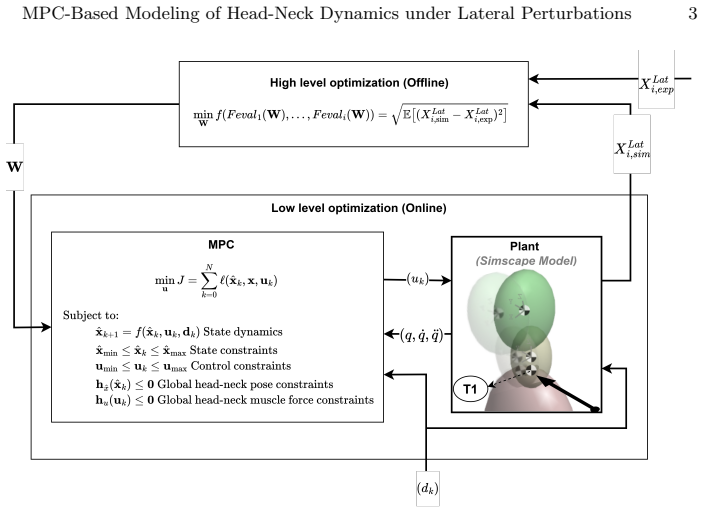
The central object is the model predictive controller itself, treated as the central nervous system's decision process. At each time step it predicts a horizon of head-neck trajectories from a simplified two-joint biomechanical model (lower neck representing T1–C7 and upper neck representing C0–C1, with lower-neck yaw locked) and selects joint torques that minimize a weighted sum of muscle effort and somatosensory conflict, where somatosensory conflict is the difference between the plant's sensed joint motion and the internal model's prediction of it. A high-level optimization tunes the ten weights in the cost function by minimizing the root-mean-square error between simulated and experimental lateral perturbation responses, and a multi-collocation prediction horizon with 10 ms integration makes the computation fast enough to run at 8–11 times real time.
What would settle it
Correct the model so the static head center-of-gravity to T1 displacement falls below the literature upper bound of 34.5 mm and re-run the weight optimization against the same lateral perturbation dataset; if the dynamic fit degrades substantially or the optimized weights shift dramatically, the claimed muscle-effort-plus-partial-somatosensory-feedback strategy is partly an artifact of the plant. Alternatively, record neck muscle activity during the same perturbations and check whether the predicted distribution of effort between lower and upper neck joints matches the measured activation pattern.
Extended reading notes
Core claim
The paper's central claim is that a model predictive controller whose cost function contains muscle-effort terms and partial somatosensory conflict terms reproduces the dynamic responses of the human head-neck system under lateral trunk perturbations. Muscle effort is represented by weighted joint torques, and partial somatosensory conflict is the weighted difference between predicted and sensed joint angular velocities for a chosen subset of neck joints. The controller's ten weights are fitted by a multi-objective genetic algorithm against the average human response in a lateral translation experiment. The best overall fit comes from the configuration without head-in-space or head-on-trunk integrators; the only visible exception is a slightly better low-frequency yaw gain when an upper-neck head-in-space integrator is active. The optimized weights emphasize lower-neck pitch muscle effort and lower-neck roll-rate somatosensory error, and the residual head center-of-gravity to T1 forward displacement (39.86 mm) exceeds the upper literature bound (34.5 mm), which the paper attributes to the chosen initial posture and the simplified biomechanical plant.
Load-bearing premise
The whole result rests on the assumption that the simplified two-joint neck model is a faithful stand-in for real head-neck mechanics during side-to-side motion; if that assumption is wrong, the fitted control weights could be compensating for model error rather than revealing the central nervous system's real priorities.
Editorial extensions
If this is right
- The same MPC cost structure that handled anterior-posterior perturbations transfers to lateral perturbations with only re-tuned weights, suggesting a domain-general CNS objective rather than scenario-specific control.
- Lower-neck control carries most of the explanatory load; models or experiments that omit lower-neck roll and pitch feedback should predict head-neck lateral responses less accurately.
- Corrective head-on-trunk and head-in-space integrators are not needed for dynamic lateral responses, so real-time occupant-simulation pipelines can omit them.
- The real-time factor of 8–11 makes the model usable as a virtual occupant in vehicle dynamics simulations for comfort and motion-sickness assessment.
- The model's static head CG–T1 displacement overshoots the physiological range even though its dynamics match human data, marking posture prediction as the part of the model most in need of further work.
Reading between the lines
- If the fitted weights are read as estimates of a real neural cost function, the large lower-neck pitch effort weight and lower-neck roll-rate sensory weight predict that the T1–C7 region is the dominant stabilizing actuator for lateral perturbations, a claim the paper does not test with electromyography.
- A natural extension is to repeat the lateral perturbation experiment with eyes open or with a visual cue of the perturbation; the framework predicts that visual conflict terms would enter the cost function or the somatosensory weights would shift, which is testable.
- Because the head CG–T1 displacement overshoots the anatomical range, the fitted weights may be partially absorbing plant error; re-identifying neck stiffness and damping from independent measurements would show whether the same weights still fit the data.
- The feature-importance analysis suggests that perturbation spectra concentrated near the lower-neck roll resonance would most sharply discriminate between alternative weight vectors, so a follow-up experiment could be designed specifically around that frequency band.
Signed reviews
Editorial analysis
A structured set of objections, weighed in public.
Referee Report
Summary. The manuscript extends an MPC-based head-neck postural control framework from sagittal-plane perturbations to lateral (coronal-plane) perturbations. The model uses a Simscape biomechanical plant, re-tunes the MPC cost weights through a high-level optimization against a lateral-perturbation dataset from Forbes et al., and compares two configurations (muscle effort with partial somatosensory feedback, with or without a head-in-space integrator at the upper neck joint) against experimental human data in the time and frequency domains. The authors conclude that the muscle-effort configuration best reproduces the human responses and that these cost terms are sufficient to capture CNS decision making during lateral head-neck perturbations.
Significance. If the central validation claim held, a computationally efficient MPC-based head-neck model with a plausible CNS cost structure would be a useful tool for automated-vehicle comfort assessment. The paper is transparent about the model's posture error and provides the full optimized weight vector, runtime information (RTF 8-11), and a feature importance analysis. However, the reported agreement is an in-sample fit to the same dataset used for tuning, and no quantitative error metrics are provided; these issues directly undermine the abstract's claim of experimental validation. The paper's value is therefore more as a modeling proposal than as a validated predictive model.
major comments (3)
- [Section 2.3, Eq. (2); Section 5, Fig. 3] The validation is in-sample. The high-level optimization in Eq. (2) minimizes the RMSE between simulated and experimental signals from the Forbes lateral-translation dataset, and Fig. 3 then compares the model with 'experimental human data' from that same dataset. No held-out subjects or trials, cross-validation, or out-of-sample evaluation is reported. The agreement shown in Fig. 3 is therefore a restatement of the tuning objective, not an independent validation. The abstract's claim that the model 'can accurately reproduce dynamic responses' requires a genuine out-of-sample test and per-condition error metrics.
- [Section 4] The plant model has an acknowledged, load-bearing posture error: the steady-state head CG-T1 displacement is 39.86 mm, exceeding the 34.5 mm upper bound cited from the literature, and the selected configuration leaves a lower-neck joint error of approximately 10 degrees. Because the MPC weights W are optimized on this plant, the optimized weight ratios (e.g., Wty1/Wty2 about 5, and the dominant Wwx1) may be compensating for plant inaccuracy rather than revealing an intrinsic CNS cost function. The Section 6 conclusion that muscle effort plus partial somatosensory feedback 'are sufficient to capture the CNS decision making' is not supported without demonstrating robustness of the fitted weights to plant variations or correcting the plant posture error.
- [Section 5] The performance comparison is only qualitative: the text states that the muscle configuration 'generally provides a closer match' to the experimental responses. No RMSE values, frequency-response gain/phase errors, confidence intervals, or subject-trial statistics are reported. Without numerical error metrics, the central claim of 'accurate' reproduction cannot be quantified, and the claimed superiority of one configuration over the other cannot be substantiated.
minor comments (4)
- [Section 4, paragraph after Table 1] In the sentence listing weight changes, the second mention of 'Wwy1 by a factor of approximately 25.6' should refer to Wwy2; Table 1 shows Wwy2 changing from 1.62 to 41.40.
- [Section 2.2, after Eq. (1)] The phrase 'withinl interval k' is a typo and should read 'within interval k'.
- [Section 3] The reference to '(Fig. 3)' for the experimental setup points to the later results figure. The experimental setup should be shown in a dedicated figure or the cross-reference corrected.
- [Eq. (2)] The notation r E[.] is nonstandard; please specify the expectation is taken over (time points, trials, subjects) and how it is estimated from the discrete data.
Circularity Check
Validation is in-sample: the MPC weights are tuned by Eq. 2 on the same Forbes lateral dataset used as the 'experimental validation' in Fig. 3, and the central sufficiency claim leans on the authors' own prior work [9].
-
fitted input called prediction
[Section 2.3, Eq. (2); Section 5, Fig. 3]
"The high-level optimization procedure aims to tune the cost function weights of the MPC framework offline, ensuring that the model replicates experimentally observed head-neck responses during lateral perturbations. ... min_W f(Feval1(W),...,Fevali(W)) = sqrt(E[(X^S_i,sim − X^S_i,exp)^2]) ... The objective functions considered include ... lateral perturbation scenario (S = Lat)."
Equation (2) optimizes the weight vector W by minimizing RMSE between simulated and experimental signals for the lateral perturbation scenario. Section 5 then presents Fig. 3 as a comparison of the resulting model against 'experimental human data' from the same Forbes lateral-translation dataset described in Section 3. No held-out subjects, trials, or cross-validation are reported, and no quantitative RMSE/FRF error values are given; the text only says the muscle configuration 'generally provides a closer match.' Thus the claimed 'experimental validation' and the conclusion that the configuration 'provides the best overall dynamic fit' restate the fit objective rather than testing prediction on independent data. The fit is in-sample by construction.
-
self citation load bearing
[Section 2.1, Section 2.2, Section 6; references [9]]
"This study extends an existing model predictive control-based framework ... The optimization process [9] tunes MPC weights using average head-neck responses from lateral perturbation datasets ... Based on previous findings [9], the configuration of partial somatosensory feedback and muscle effort was identified as the best overall MPC configuration ... This demonstrates that muscle effort and partial somatosensory feedback are sufficient to capture the CNS decision making during laterally perturbed head-neck dynamics responses, as proven already for anterior-posterior perturbations [9]."
The framework, the MPC cost structure, the tuning procedure, the choice of the 'best' configuration, and the claimed proof of sufficiency for anterior-posterior perturbations are all attributed to [9], which is the authors' own SSRN preprint by the same first author. That prior work is neither machine-checked nor independently reproduced here; its 'proof' is invoked rather than demonstrated. The lateral-plane sufficiency conclusion therefore depends on a self-citation chain in addition to the in-sample fit of the current weights. This is load-bearing because the paper's central claim is that the selected cost terms are sufficient to capture CNS decision making, and the only external support offered for the analogous AP claim is the authors' own prior result.
full rationale
The paper contains substantial genuine modeling work: a Simscape plant, an MPC formulation, a high-level weight optimization, and comparisons against an external experimental dataset from Forbes. However, the central empirical claim of accurate reproduction of human lateral head-neck responses is weakened by a specific in-sample circularity: the weight vector W in Eq. (3) is the output of the RMSE-minimization in Eq. (2) performed on the same Forbes lateral-translation dataset that later serves as the 'validation' in Fig. 3. With no held-out data, cross-validation, or quantitative error reporting, the 'best overall dynamic fit' conclusion is a restatement of the tuning objective rather than an independent test. A second circular element is the reliance on the authors' own prior work [9] for the framework, the tuning method, and the claim that the chosen cost terms were 'proven' sufficient for AP perturbations. This self-citation is load-bearing for the generality of the sufficiency conclusion, although it does not by itself force the lateral result. The acknowledged posture mismatch (39.86 mm vs. the 34.5 mm upper bound) further indicates that optimized weights may compensate for plant error, adding risk but not constituting a separate circular step. Overall, because the headline 'experimental validation' reduces in part to the fit objective, a score of 6 is appropriate: some predictions reduce by construction, while the modeling framework retains independent content beyond the fit.
Assumptions & free parameters
free parameters (2)
- MPC weight vector W =
[Wtx1, Wty1, Wtx2, Wty2, Wtz2, Wwx1, Wwy1, Wwx2, Wwy2, Wwz2] = [17.68, 78.92, 63.77, 15.53, 33.90, 70.84, 15.28, 7.85…
- Initial upper neck joint angle =
11.36 deg (lower neck joint at 0 deg)
assumptions (4)
- domain assumption The Simscape multibody model and ODE-based prediction model accurately represent head-neck dynamics in the coronal plane, including the locking of lower-neck yaw.
- domain assumption The CNS postural control objective is to minimize sensory conflict (the surprise factor) and muscle effort within biomechanical constraints.
- domain assumption The Forbes [6] experimental dataset, specifically the average head-neck responses to lateral seat translation, is a valid ground truth for lateral head-neck dynamics.
- standard math The multi-objective genetic algorithm (multiga) converges to a suitably optimal weight vector for the high-level optimization.
Cite this review
Pith. "Pith review of Modeling Head-Neck Dynamics under Lateral Perturbations Using MPC to Mimic CNS postural stabilization strategy." pith.science (2026). https://pith.science/paper/REBZB25B
@misc{pith2026250800928,
  author       = {Pith},
  title        = {Pith review of: Modeling Head-Neck Dynamics under Lateral Perturbations Using MPC to Mimic CNS postural stabilization strategy},
  year         = {2026},
  howpublished = {\url{https://pith.science/paper/REBZB25B}},
  note         = {Machine review of arXiv:2508.00928}
}
read the original abstract
Automated vehicles will allow occupants to engage in non-driving tasks, but limited visual cues will make them vulnerable to unexpected movements. These unpredictable perturbations create a "surprise factor," forcing the central nervous system to rely on compensatory postural adjustments, which are less effective, and are more likely to trigger sensory conflicts. Since the head is a key reference for sensory input (vestibular and vision), models accurately capturing head-neck postural stabilization are essential for assessing AV comfort. This study extends an existing model predictive control-based framework to simulate head-neck postural control under lateral perturbations. Experimental validation against human data demonstrates that the model can accurately reproduce dynamic responses during lateral trunk perturbations. The results show that muscle effort combined with partial somatosensory feedback provides the best overall dynamic fit without requiring corrective relative and global head orientation integrators for posture.
Figures


Forward citations
Cited by 1 Pith paper
-
Cooperative effects in feature importance of individual patterns: application to air pollutants and Alzheimer disease
A local Hi-Fi framework assigns unique, redundant, and synergistic importance scores to individual data points and reports synergistic O3 and NO2 associations with Alzheimer mortality.
Reference graph
Works this paper leans on
-
[9]
SSRN Electronic Journal DOI 10.2139/ssrn.5095834
Messiou C (2025) MPC-Based Postural Control: Mimicking CNS Strategies for Head Stabilization. SSRN Electronic Journal DOI 10.2139/ssrn.5095834
-
[1]
Fisioterapia em Movimento 30(3):453–461 10 Messiou et al
Aroeira RMC, Furlan RMMM, Pertence AEDM, Casas EBDL, Greco M (2017) Relationship between head posture and lumbar curve in a sitting position: a biomechanical study. Fisioterapia em Movimento 30(3):453–461 10 Messiou et al
work page 2017
-
[2]
Caneiro JP, O’Sullivan P, Burnett A, Barach A, O’Neil D, Tveit O, Olafs- dottir K (2010) The influence of different sitting postures on head/neck posture and muscle activity. Manual Therapy 15(1):54–60
work page 2010
-
[3]
Journal of Biomechanics 104:109,754
Correia MA, McLachlin SD, Cronin DS (2020) Optimization of muscle ac- tivation schemes in a finite element neck model simulating volunteer frontal impact scenarios. Journal of Biomechanics 104:109,754
work page 2020
-
[4]
Annals of Biomedical Engineering 49:1645–1656
Correia MA, McLachlin SD, Cronin DS (2021) Vestibulocollic and cervico- collic muscle reflexes in a finite element neck model during multidirectional impacts. Annals of Biomedical Engineering 49:1645–1656
work page 2021
-
[5]
Desai R, Papaioannou G, Happee R (2024) Vibration transmission through the seated human body captured with a computationally efficient multibody model. Multibody System Dynamics
work page 2024
-
[6]
Phd thesis, Delft University of Technology, The Netherlands
Forbes PA (2014) Heads up – sensorimotor control of the head-neck system. Phd thesis, Delft University of Technology, The Netherlands
work page 2014
-
[7]
Happee R, Kotian V, De Winkel KN (2023) Neck stabilization through sen- sory integration of vestibular and visual motion cues. Frontiers in Neurology 14
work page 2023
Show all 17 references
-
[8]
Human Fac- tors: The Journal of the Human Factors and Ergonomics Society 62(8):1339– 1348
Kuiper OX, Bos JE, Schmidt EA, Diels C, Wolter S (2020) Knowing what’s coming: Unpredictable motion causes more motion sickness. Human Fac- tors: The Journal of the Human Factors and Ergonomics Society 62(8):1339– 1348
2020
-
[10]
International Journal of Crashworthiness 18:40–63
Meyer F, Bourdet N, Gunzel K, Willinger R (2013) Development and vali- dation of a coupled head-neck fem – application to whiplash injury criteria investigation. International Journal of Crashworthiness 18:40–63
2013
-
[11]
In: Ellis SR (ed) Pictorial Communication in Real and Virtual Environments, Taylor & Francis, London, pp 362–376
Oman CM (1991) Sensory conflict in motion sickness: an observer theory approach. In: Ellis SR (ed) Pictorial Communication in Real and Virtual Environments, Taylor & Francis, London, pp 362–376
1991
-
[12]
Spine 26(24):2692–2700
Panjabi MM, Crisco JJ, Vasavada A, Oda T, Cholewicki J, Nibu K, Shin E (2001) Mechanical properties of the human cervical spine as shown by three-dimensional load–displacement curves. Spine 26(24):2692–2700
2001
-
[13]
Papaioannou G, Shen C, Rothh¨ amel M, Happee R (2025) Occupants’ com- fort: what about human body dynamics in road and rail vehicles? Vehicle System Dynamics pp 1–59
2025
-
[14]
The MIT Press
Parr T, Pezzulo G, Friston KJ (2022) Active Inference: The Free Energy Principle in Mind, Brain, and Behavior. The MIT Press
2022
-
[15]
electromyographic analysis
Santos MJ, Kanekar N, Aruin AS (2010) The role of anticipatory postu- ral adjustments in compensatory control of posture: 1. electromyographic analysis. Journal of Electromyography and Kinesiology 20:388–397
2010
-
[16]
Journal of biomechanics 42:1177–92
Yoganandan N, Pintar F, Zhang J, Baisden J (2009) Physical properties of the human head: Mass, center of gravity and moment of inertia. Journal of biomechanics 42:1177–92
2009
-
[17]
Yunus I, Papaioannou G, Jerrelind J, Drugge L (2024) A review of vehicle dynamics and control based approaches for mitigating motion sickness in autonomous vehicles
2024
Reviewed August 6, 2026 · model on record in the stance chip above.
Discussion (0). Continue with ORCID to comment.