REVIEW 3 major objections 6 minor 48 references
T-GRAG: A Dynamic GraphRAG Framework for Resolving Temporal Conflicts and Redundancy in Knowledge Retrieval
T0 review · 3 major / 6 minor · reviewed 2026-08-06 · deepseek-v4-flash
Pith's one-line read Time-stamped graph retrieval beats prior RAG and GraphRAG methods on temporal long-text QA by large margins.
desk verdict A credible temporal GraphRAG extension with a useful new benchmark; the evaluation instrument (LLM judge without human validation) is the main soft spot, not the method's logic. read the letter →
The pith
A machine-rendered reading of the paper's core claim, the machinery that carries it, and where it could break.
The reading
What carries the argument
The load-bearing object is the temporal knowledge graph (Eq. 1), in which each entity $e_i^{T_i}$ is a set of knowledge pieces labelled with their timestamps, $\{k_1^{t_i}, \ldots, k_m^{t_i}\}$, so a single real-world entity gets different node snapshots per time period. Around this object, the three-layer interactive retriever carries the argument: $\mathcal{R}_{\text{time}}$ cuts the graph to the query's timestamp, $\mathcal{R}_{\text{node}}$ selects candidate entities by embedding similarity, and $\mathcal{R}_{\text{knowledge}}$ selects individual knowledge units inside those nodes, so redundant information within a node cannot dilute the match. The temporal query decomposition (TQD) enforces that each sub-query touches exactly one time point, preventing cross-year reasoning confusion.
What would settle it
Take a random sample of 100-200 Time-LongQA questions, collect T-GRAG and GraphRAG outputs, strip model labels, and have human annotators judge correctness with the same rubric; also compute retrieval-only recall by checking whether the gold source sentence containing the correct year appears in the retrieved context. If the human-judged performance gap between T-GRAG and GraphRAG narrows substantially relative to the LLM-judged gap, or if retrieval recall shows no advantage for T-GRAG, then the central claim of improved temporal retrieval accuracy is not supported.
Extended reading notes
Core claim
The central discovery is that temporal knowledge evolution is the main failure mode of graph-based retrieval on long-text QA, and that encoding time into the graph index while refining retrieval from node level to knowledge level resolves both temporal ambiguity and semantic redundancy. T-GRAG represents each entity as a time-stamped bundle of knowledge pieces, restricts retrieval to the subgraph matching the query's time constraints, then selects the top-n nodes by cosine similarity and the top-k knowledge units inside those nodes; the valid nodes' one-hop source texts are scored and passed to the LLM along with the knowledge and relation context. The ablation results attribute the gains to each layer: adding the temporal subgraph retriever improves accuracy by 19.31%, adding fine-grained knowledge retrieval by 5.81%, and adding temporal query decomposition by 25.07% on multi-time questions.
Load-bearing premise
The evaluation assumes that a single LLM judge (Qwen2.5-72B) scoring answers three times with majority voting is a faithful proxy for correctness; the paper reports no human-agreement check, so if the judge systematically prefers T-GRAG's answer phrasing the reported accuracy gaps may overstate the true retrieval improvement.
Editorial extensions
If this is right
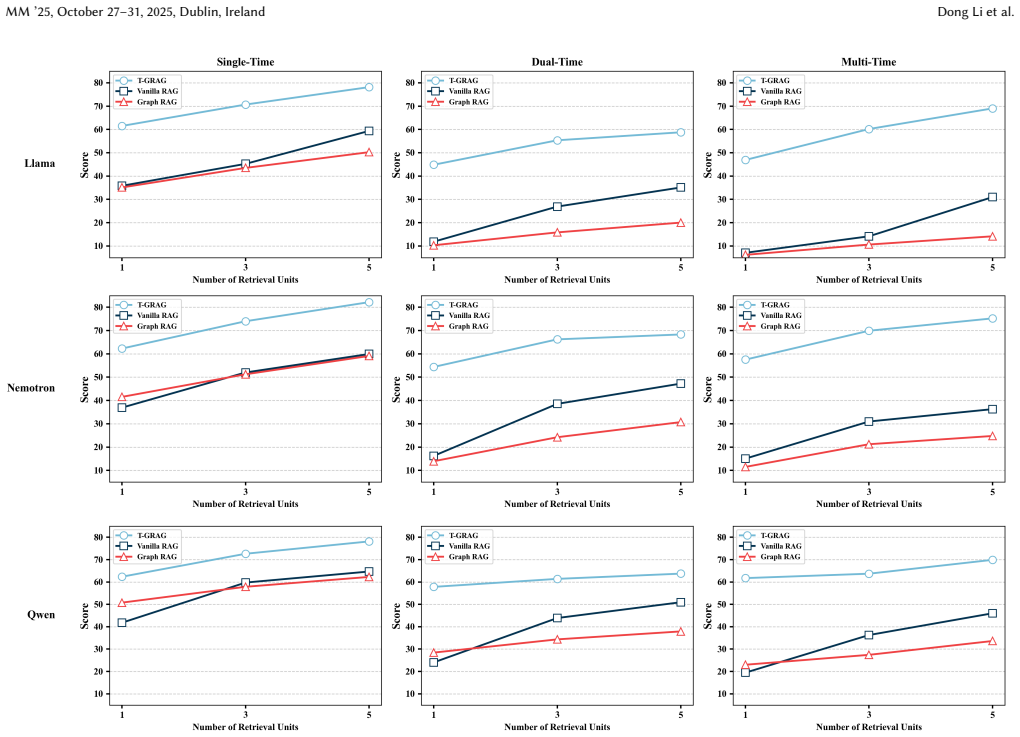
- On Time-LongQA, T-GRAG outperforms both Vanilla RAG and GraphRAG across LLaMA-3.1-70B, Qwen2.5-72B, and Nemotron-70B backbones on all four question types, with the largest gaps on multi-time questions.
- The ablation numbers show each component pays: temporal subgraph filtering (+19.31%), knowledge-level retrieval (+5.81%), and temporal query decomposition (+25.07% on multi-time, +5.79% on dual-time), indicating the gains come from the architecture rather than the backbone.
- T-GRAG degrades less than baselines when the retrieval budget shrinks (20.66% average drop vs 26.65% for GraphRAG and 54.55% for Vanilla RAG), suggesting knowledge-level granularity retains critical facts under tighter constraints.
- T-GRAG also improves non-time questions, so the design is not narrowly temporal; it also addresses node-level semantic redundancy generally.
- The framework is plug-and-play: each of the five modules can be swapped, making it applicable to existing RAG pipelines without retraining.
Reading between the lines
- Because the benchmark is built from a single company's annual reports (Audi, 2012-2023), the reported margins may not transfer to other evolving corpora; a multi-domain temporal QA benchmark (earnings calls, legislation, clinical guidelines) would test whether the temporal-graph mechanism generalizes.
- The TEK-based automatic QA construction pipeline could be reused to build temporal benchmarks for any document series, which would let the community stress-test the reported gains without hand-labeling.
- The success of knowledge-level retrieval suggests a broader principle: embedding whole nodes or whole chunks is lossy for precision-oriented QA, and a second, finer retrieval pass over atomic fact units may help even in non-temporal RAG settings.
- A testable extension is to replace the LLM-based time attribute assignment with a specialized date-aware encoder; if T-GRAG's gains come from timestamp accuracy, a stronger temporal encoder should further widen the gap.
Editorial analysis
A structured set of objections, weighed in public.
Referee Report
Summary. The paper proposes T-GRAG, a temporal GraphRAG framework with temporally stamped knowledge graph construction, temporal query decomposition, a three-layer retriever (temporal subgraph, node, knowledge), a source-text extractor, and an LLM generator. It also introduces Time-LongQA, a 2,292-item QA dataset built from Audi annual reports (2012–2023) with single-, dual-, multi-, and non-time questions. Experiments on three 70B LLMs plus an 8B model report that T-GRAG outperforms Vanilla RAG and GraphRAG by large margins (e.g., 22.28, 34.05, and 47.2 points over GraphRAG on single-, dual-, and multi-time questions), and ablations attribute gains to temporal subgraph retrieval, knowledge-level retrieval, and query decomposition.
Significance. If the empirical claims are sustained, T-GRAG is a meaningful step: separating knowledge by timestamp, decomposing multi-time queries, and filtering at knowledge-unit granularity are sensible and modular ideas that directly address a real limitation of current GraphRAG systems. The authors also provide a much-needed benchmark for temporal long-text QA. The framework is clearly described and the ablations in Figure 4 isolate the contributions of R_time, R_knowledge, and TQD with consistent directional gains. However, the strength of the contribution currently rests on a single unvalidated LLM judge and an unclearly matched baseline context budget; the magnitude of the reported gains is therefore not yet established.
major comments (3)
- [Section 4.1, Table 1] The entire quantitative evaluation rests on a single LLM judge (Qwen2.5-72B) that scores generated answers against reference answers with majority voting over three repeated calls. Section 4.1 describes the protocol but reports no human-annotated sample, no inter-annotator agreement, and no error analysis. Since Qwen2.5-72B-Instruct is itself one of the evaluated backbones, the judge may systematically prefer answers in its own style, and the headline margins (22.28, 34.05, and 47.2 points over GraphRAG on single-, dual-, and multi-time questions) could be inflated by that bias. Majority voting removes sampling noise, not systematic bias. The authors should validate the judge on a human-annotated sample (e.g., 100–200 items per question type), report agreement statistics, and ideally add a second independent judge or rule-based verification for numeric answers.
- [Section 4.1, Parameter Configuration] The baseline context budgets are not clearly matched. The text states that for all RAG methods the source-text retrieval uses chunk size 1000 and top-t 5, and then states that for GraphRAG and T-GRAG the total number of retrieved context tokens is limited to 1600. It is ambiguous whether Vanilla RAG receives 5000 tokens while T-GRAG receives 1600, or whether the 1600-token limit applies only to the graph-derived context. Table 1 also reports no variance, confidence intervals, or significance tests, and the multi-time subset contains only 113 items; the 47.2-point improvement on that subset is therefore not statistically supported. Please specify the per-method context budgets explicitly and report confidence intervals or significance tests, especially for the multi-time condition.
- [Section 3.1 and Abstract] The Time-LongQA dataset is a central contribution, but its construction is not fully validated. Section 3.1 says all generated QA pairs underwent manual validation, yet no details are given about the number of annotators, the validation instructions, or agreement rates. The abstract also promises publicly available code, but no repository link is provided in the manuscript. Without the dataset and code, the claimed state-of-the-art results cannot be independently checked. Please release the dataset and code, and document the manual validation procedure.
minor comments (6)
- [Section 2.3, Eq. (7)] The argtopk in Eq. (7) is written over e∈E, but the scoring is between the query embedding and the knowledge embeddings z_k defined in Eq. (6); the index should be over the knowledge units in the candidate nodes.
- [Figure 2 caption] The caption contains a duplicated article: 'The the overall framework' should be 'The overall framework'.
- [Table 1 and Section 4.2] The red-font increments in Table 1 are relative to the per-cell SOTA baseline, while the text in Section 4.2 describes the gains as 'compared to GraphRAG' and reports averages over the three 70B backbones. Please reconcile this and state explicitly which backbones are included in the reported averages, since the table also includes Llama3.2-8B.
- [Section 3.1] The statement 'all generated QA pairs underwent manual validation' should be accompanied by the number of annotators and an inter-annotator agreement measure.
- [Abstract] The sentence 'Our code is publicly available on the T-GRAG' is incomplete; please add the repository URL.
- [Section 2.4] The scoring rule for source texts ('the more 1-hop neighboring nodes a text block contains, the higher its score') is underspecified; please clarify how text blocks are mapped to graph nodes and how the neighborhood is counted.
Circularity Check
No significant circularity: T-GRAG's reported gains are empirical comparisons against independent baselines on a shared corpus, with no construction-level equivalence forcing the outcome.
full rationale
The paper's central claim is empirical: T-GRAG is compared against Vanilla RAG and GraphRAG on the self-constructed Time-LongQA benchmark (Section 4.2, Table 1). The method itself is specified operationally in Algorithm 1 and Eqs. 1-9: query decomposition, temporal subgraph retrieval, node retrieval, knowledge retrieval, source-text scoring, and final generation are all defined as pipeline steps rather than fitted to the benchmark outcomes. No equation is defined in terms of the target accuracy, and no parameter is tuned to the reported evaluation scores. The benchmark is self-constructed from Audi annual reports, but all methods are evaluated on the same corpus with the same embedding model and comparable retrieval budgets, so the comparison is not forced by construction. The only self-referential element is the LLM judge: Qwen2.5-72B, which is in the same model family as one evaluated backbone, Qwen2.5-72B-Instruct. This creates a possible measurement-validity risk because no human agreement or error analysis is reported, but it is not circularity: the judge scores answers against reference answers using binary correctness criteria and does not encode T-GRAG's answers as correct by construction. Self-citations to prior work by the same authors (refs. 8, 9, 13, 14, 15) are contextual and are not load-bearing premises for the empirical claim. Accordingly, no circular step can be exhibited with the required quote-and-reduction evidence, and the honest finding is no significant circularity.
Assumptions & free parameters
free parameters (5)
- top_n candidate nodes =
30
- top_k knowledge units =
15
- top_t source texts =
5
- chunk size =
1000 tokens
- TEK similarity threshold =
not specified
assumptions (4)
- domain assumption LLM extraction of entities, relations, and descriptions from each yearly chunk is accurate enough for retrieval.
- domain assumption Most of the annual report content is unseen by the tested LLMs.
- domain assumption An LLM judge with majority voting is a valid measure of answer correctness.
- domain assumption Cosine similarity over embeddings is sufficient for temporal and semantic relevance after subgraph filtering.
Cite this review
Pith. "Pith review of T-GRAG: A Dynamic GraphRAG Framework for Resolving Temporal Conflicts and Redundancy in Knowledge Retrieval." pith.science (2026). https://pith.science/paper/2ZHKSBQC
@misc{pith2026250801680,
  author       = {Pith},
  title        = {Pith review of: T-GRAG: A Dynamic GraphRAG Framework for Resolving Temporal Conflicts and Redundancy in Knowledge Retrieval},
  year         = {2026},
  howpublished = {\url{https://pith.science/paper/2ZHKSBQC}},
  note         = {Machine review of arXiv:2508.01680}
}
read the original abstract
Large language models (LLMs) have demonstrated strong performance in natural language generation but remain limited in knowle- dge-intensive tasks due to outdated or incomplete internal knowledge. Retrieval-Augmented Generation (RAG) addresses this by incorporating external retrieval, with GraphRAG further enhancing performance through structured knowledge graphs and multi-hop reasoning. However, existing GraphRAG methods largely ignore the temporal dynamics of knowledge, leading to issues such as temporal ambiguity, time-insensitive retrieval, and semantic redundancy. To overcome these limitations, we propose Temporal GraphRAG (T-GRAG), a dynamic, temporally-aware RAG framework that models the evolution of knowledge over time. T-GRAG consists of five key components: (1) a Temporal Knowledge Graph Generator that creates time-stamped, evolving graph structures; (2) a Temporal Query Decomposition mechanism that breaks complex temporal queries into manageable sub-queries; (3) a Three-layer Interactive Retriever that progressively filters and refines retrieval across temporal subgraphs; (4) a Source Text Extractor to mitigate noise; and (5) a LLM-based Generator that synthesizes contextually and temporally accurate responses. We also introduce Time-LongQA, a novel benchmark dataset based on real-world corporate annual reports, designed to test temporal reasoning across evolving knowledge. Extensive experiments show that T-GRAG significantly outperforms prior RAG and GraphRAG baselines in both retrieval accuracy and response relevance under temporal constraints, highlighting the necessity of modeling knowledge evolution for robust long-text question answering. Our code is publicly available on the T-GRAG
Figures


Figures from the paper (3 more)


Reference graph
Works this paper leans on
-
[1]
Mohammad Reza Abbasifard, Bijan Ghahremani, and Hassan Naderi. 2014. A survey on nearest neighbor search methods. International Journal of Computer Applications 95, 25 (2014)
work page 2014
-
[2]
Josh Achiam, Steven Adler, Sandhini Agarwal, Lama Ahmad, Ilge Akkaya, Floren- cia Leoni Aleman, Diogo Almeida, Janko Altenschmidt, Sam Altman, Shyamal Anadkat, et al. 2023. Gpt-4 technical report. arXiv preprint arXiv:2303.08774 (2023)
arXiv 2023
-
[3]
Mark Chen, Jerry Tworek, Heewoo Jun, Qiming Yuan, Henrique Ponde De Oliveira Pinto, Jared Kaplan, Harri Edwards, Yuri Burda, Nicholas Joseph, Greg Brockman, et al. 2021. Evaluating large language models trained on code. arXiv preprint arXiv:2107.03374 (2021)
arXiv 2021
-
[4]
Abhimanyu Dubey, Abhinav Jauhri, Abhinav Pandey, Abhishek Kadian, Ahmad Al-Dahle, Aiesha Letman, Akhil Mathur, Alan Schelten, Amy Yang, Angela Fan, et al. 2024. The llama 3 herd of models. arXiv preprint arXiv:2407.21783 (2024)
arXiv 2024
-
[5]
Darren Edge, Ha Trinh, Newman Cheng, Joshua Bradley, Alex Chao, Apurva Mody, Steven Truitt, and Jonathan Larson. 2024. From local to global: A graph rag approach to query-focused summarization. arXiv preprint arXiv:2404.16130 (2024)
arXiv 2024
-
[6]
Yunfan Gao, Yun Xiong, Xinyu Gao, Kangxiang Jia, Jinliu Pan, Yuxi Bi, Yi Dai, Jiawei Sun, and Haofen Wang. 2023. Retrieval-augmented generation for large language models: A survey. arXiv preprint arXiv:2312.10997 (2023)
arXiv 2023
-
[7]
Patrick Lewis, Ethan Perez, Aleksandra Piktus, Fabio Petroni, Vladimir Karpukhin, Naman Goyal, Heinrich Küttler, Mike Lewis, Wen-tau Yih, Tim Rocktäschel, et al. 2020. Retrieval-augmented generation for knowledge-intensive nlp tasks. Advances in Neural Information Processing Systems 33 (2020), 9459–9474
2020
-
[8]
Dong Li, Aijia Zhang, Junqi Gao, and Biqing Qi. 2024. An efficient memory module for graph few-shot class-incremental learning. Advances in Neural Information Processing Systems 37 (2024), 130084–130108
work page 2024
Show all 48 references
-
[9]
Dong Li, Aijia Zhang, Huan Xiong, Biqing Qi, and Junqi Gao. 2025. FDphormer: Beyond Homophily with Feature-Difference Position Encoding. ACM Transac- tions on Knowledge Discovery from Data 19, 5 (2025), 1–19
2025
-
[10]
Lei Liu, Shuo Yu, Runze Wang, Zhenxun Ma, and Yanming Shen. 2024. How can large language models understand spatial-temporal data? arXiv preprint arXiv:2401.14192 (2024)
2024 arXiv
-
[11]
Richard Yuanzhe Pang, Alicia Parrish, Nitish Joshi, Nikita Nangia, Jason Phang, Angelica Chen, Vishakh Padmakumar, Johnny Ma, Jana Thompson, He He, and Samuel Bowman. 2022. QuALITY: Question Answering with Long Input Texts, Yes!. In Proceedings of the 2022 Conference of the No...
2022
-
[12]
Boci Peng, Yun Zhu, Yongchao Liu, Xiaohe Bo, Haizhou Shi, Chuntao Hong, Yan Zhang, and Siliang Tang. 2024. Graph retrieval-augmented generation: A survey. arXiv preprint arXiv:2408.08921 (2024)
2024 arXiv
-
[13]
Biqing Qi, Xinquan Chen, Junqi Gao, Dong Li, Jianxing Liu, Ligang Wu, and Bowen Zhou. 2024. Interactive continual learning: Fast and slow thinking. In Proceedings of the IEEE/CVF Conference on Computer Vision and Pattern Recognition. 12882–12892
2024
-
[14]
Biqing Qi, Junqi Gao, Xinquan Chen, Dong Li, Jianxing Liu, Ligang Wu, and Bowen Zhou. 2025. Contrastive augmented graph2graph memory interaction for few shot continual learning. IEEE Transactions on Circuits and Systems for Video Technology (2025)
2025
-
[15]
Biqing Qi, Fangyuan Li, Zhen Wang, Junqi Gao, Dong Li, Peng Ye, and Bowen Zhou. 2025. Less is more: Efficient model merging with binary task switch. In Proceedings of the Computer Vision and Pattern Recognition Conference . 15265– 15274
2025
-
[16]
Apoorv Saxena, Soumen Chakrabarti, and Partha Talukdar. 2021. Question An- swering Over Temporal Knowledge Graphs. In Proceedings of the 59th Annual Meeting of the Association for Computational Linguistics and the 11th Interna- tional Joint Conference on Natural Language Proce...
2021 doi
-
[17]
Hugo Touvron, Thibaut Lavril, Gautier Izacard, Xavier Martinet, Marie-Anne Lachaux, Timothée Lacroix, Baptiste Rozière, Naman Goyal, Eric Hambro, Faisal Azhar, et al. 2023. Llama: Open and efficient foundation language models. arXiv preprint arXiv:2302.13971 (2023)
2023 arXiv
-
[18]
Bin Wang, Chao Xu, Xiaomeng Zhao, Linke Ouyang, Fan Wu, Zhiyuan Zhao, Rui Xu, Kaiwen Liu, Yuan Qu, Fukai Shang, et al. 2024. Mineru: An open-source solution for precise document content extraction. arXiv preprint arXiv:2409.18839 (2024)
2024 arXiv
-
[19]
Zhilin Wang, Alexander Bukharin, Olivier Delalleau, Daniel Egert, Gerald Shen, Jiaqi Zeng, Oleksii Kuchaiev, and Yi Dong. 2025. HelpSteer2-Preference: Comple- menting Ratings with Preferences. In The Thirteenth International Conference on Learning Representations. https://open...
2025
-
[20]
Siheng Xiong, Ali Payani, Ramana Kompella, and Faramarz Fekri. 2024. Large language models can learn temporal reasoning. arXiv preprint arXiv:2401.06853 (2024)
2024 arXiv
-
[21]
Ziwei Xu, Sanjay Jain, and Mohan Kankanhalli. 2024. Hallucination is inevitable: An innate limitation of large language models. arXiv preprint arXiv:2401.11817 (2024)
2024 arXiv
-
[22]
An Yang, Baosong Yang, Beichen Zhang, Binyuan Hui, Bo Zheng, Bowen Yu, Chengyuan Li, Dayiheng Liu, Fei Huang, Haoran Wei, et al . 2024. Qwen2. 5 Technical Report. arXiv preprint arXiv:2412.15115 (2024)
2024 arXiv
-
[23]
Dun Zhang, Jiacheng Li, Ziyang Zeng, and Fulong Wang. 2024. Jasper and Stella: distillation of SOTA embedding models. arXiv preprint arXiv:2412.19048 (2024)
2024 arXiv
-
[24]
Zhihan Zhang, Yixin Cao, Chenchen Ye, Yunshan Ma, Lizi Liao, and Tat-Seng Chua. 2024. Analyzing Temporal Complex Events with Large Language Models? A Benchmark towards Temporal, Long Context Understanding. In Proceedings of the 62nd Annual Meeting of the Association for Comput...
2024 doi
-
[25]
yes" or
Anni Zou, Wenhao Yu, Hongming Zhang, Kaixin Ma, Deng Cai, Zhuosheng Zhang, Hai Zhao, and Dong Yu. 2024. Docbench: A benchmark for evaluating llm-based document reading systems. arXiv preprint arXiv:2407.10701 (2024). T-GRAG: A Dynamic GraphRAG Framework for Resolving Temporal ...
2024 arXiv
-
[26]
The summary should cover a broad range of information, aiming to include the vast majority of details from the original text
-
[27]
Minimize the use of pronouns and clearly specify the names of entities to ensure clarity
-
[28]
Retain any time-related data and other crucial details without omitting them, ensuring the summary is comprehensive and accurate
-
[29]
Please ensure the output aligns with these requirements
Avoid using quotation marks or other special symbols, and present the summary in plain text without complex formatting or lists, structuring it into standard paragraphs. Please ensure the output aligns with these requirements. T-GRAG: A Dynamic GraphRAG Framework for Resolving...
2025
-
[30]
The key points should be independent of each other and the content should avoid overlapping as much as possible
-
[31]
Key points should be concise, accurate, and complete, especially when it comes to numbers, names, and dates
-
[32]
The key points should not have complex formats or line breaks, just one or two sentences
-
[33]
If the key points do not involve events that occurred in year, please ignore them and keep only discussing events that occurred in year
-
[34]
he, she, them, it
Basically, pronouns such as "he, she, them, it" cannot be used, and it is necessary to clearly indicate the entity you are referencing in the key points
-
[35]
point-id
The following opening phrases are not allowed: -The article discussed -The article shows -The article emphasizes -The speaker said -The author mentioned... and so on. Output Format: The response should be JSON formatted as follows: {"point-id":"point"} The beginning and end of...
2012
-
[36]
The questions should be diverse, covering different angles such as people, numbers, places, etc
-
[37]
The information in the questions should be rich and clear enough to avoid ambiguity in the answers
-
[38]
Design three challenging questions, avoiding simple string matching
-
[39]
Each question’s answer should be concise, avoiding redundancy or repetition of the information in the question
-
[40]
If the event’s time cannot be determined, abandon that question and find another event to create a question.(very important)
The events included in the questions must have clear time attributes as specified in the original text. If the event’s time cannot be determined, abandon that question and find another event to create a question.(very important)
-
[41]
Question
Each question must contain a time attribute. In other words, the question must include a specific time reference.(very important) Output Format: The output format should be in JSON format: { "Question": "Question", "Answer": "Answer", "OriginalText": "Original content of the t...
-
[42]
The question must be answered using the original texts corresponding to these two timestamps, and there should be temporal comparability between these original texts
-
[43]
The questions should be close-ended
-
[44]
The question needs to be an inquiry about specific entities, numbers, or time, not about abstract concepts (such as Audi’s strategy, Audi’s plans in the field of electric vehicles)
-
[45]
The information in the question should be sufficient and clear, avoiding ambiguous answers
-
[46]
Multiple sub questions cannot be included in the problem, and the problem should be clear and specific
-
[47]
The problem must contain two timestamps, year1 and year2
-
[48]
Question
The answer should be concise and clear, avoiding being lengthy or repetitive. Output Format: The output format should be in JSON format: { "Question": "Question", "Answer": "Answer", "Original text from {year1} report": "<original text from {year1} report>", "Original text fro...
2007
Reviewed August 6, 2026 · model on record in the stance chip above.
Discussion (0). Sign in to comment.