REVIEW 3 major objections 5 minor 28 references
Energy-Efficient Federated Learning for Edge Real-Time Vision via Joint Data, Computation, and Communication Design
T0 review · 3 major / 5 minor · reviewed 2026-08-06 · deepseek-v4-flash
Pith's one-line read This paper claims that total energy use in federated edge vision can be minimized by jointly tuning data generation, pruning, quantization, and transmission power, backed by a closed-form energy-convergence model and Bayesian optimization.
desk verdict A useful engineering integration whose headline theoretical result has a load-bearing proof gap in Lemma 3. read the letter →
The pith
A machine-rendered reading of the paper's core claim, the machinery that carries it, and where it could break.
The reading
What carries the argument
The load-bearing object is the closed-form energy-convergence model: Eq. (39) defines total device energy as $H(\Delta,\rho,\delta,p) = \Omega \sum_u \tau_u(E_{\text{tr}} + E_{\text{cu}}) + \sum_u E_{\text{gen}}$, where $\Omega$ is the round count from Corollary 2, $E_{\text{tr}}$ depends on pruning ratio $\rho_u$ through CPU cycles, $E_{\text{cu}}$ depends on quantization bits $\delta_u$ and power $p_u$ through the uplink rate, and $E_{\text{gen}}$ depends on the augmentation factor $\Delta_u$. The model is made tractable by Corollary 1's uniform-error-probability assumption ($q_u = q$ for all devices), which removes the cross-device outage term from the convergence bound and makes the power vector a function of the single scalar $q$. A Gaussian-process surrogate with a radial-basis kernel and probability-of-improvement acquisition is then used inside a block-coordinate-descent loop to optimize $q$, $\Delta$, $\rho$, and $\delta$ in turn.
What would settle it
For channel gains drawn from the paper's Rayleigh model, compute whether the optimizer's chosen common error probability q can be realized by some power p_u in [p_min, p_max] for every device; if any device would need power outside that interval, the reformulated problem P2 is not equivalent to the original P1 and the predicted minimal energy is unattainable.
Extended reading notes
Core claim
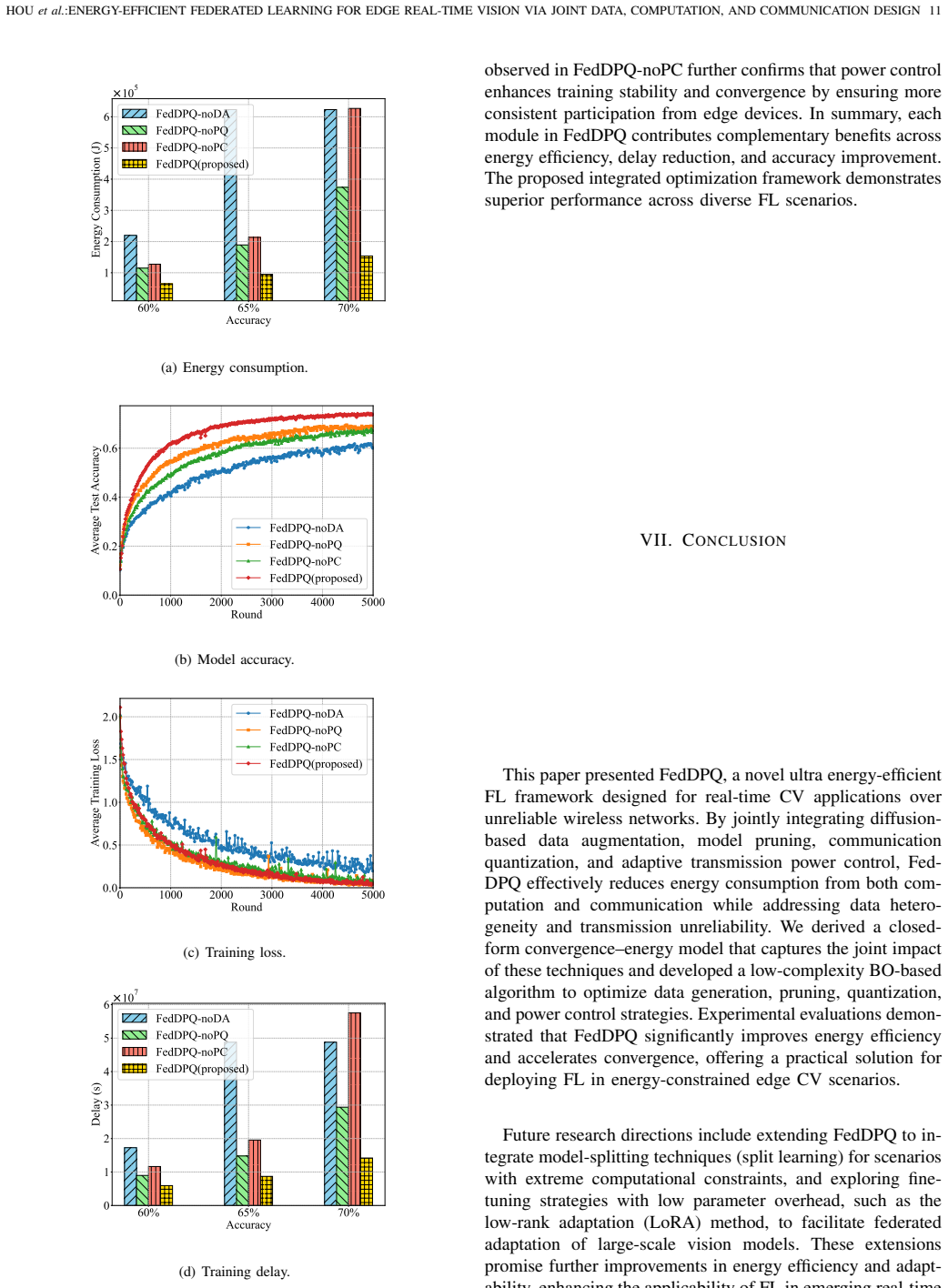
The central claim is that convergence speed and energy consumption in federated learning over lossy wireless channels can be captured in one closed-form energy-convergence model, and that minimizing that model over the four design variables yields a configuration that is genuinely more energy-efficient. Specifically, Theorem 1 bounds the average gradient norm after Ω rounds as a function of the augmentation factors Δ_u, pruning ratios ρ_u, quantization levels δ_u, and transmission error probabilities q_u; Corollary 1 simplifies the bound when all devices share a common q; and Corollary 2 inverts the bound to give the minimum number of rounds Ω to reach target accuracy ε. Combining Ω with per-sample generation, training, and communication energies gives the total energy H in Eq. (39), which the paper minimizes using block coordinate descent with a Gaussian-process surrogate and probability-of-improvement acquisition. The paper reports that this jointly optimized FedDPQ scheme beats traditional FL and all ablated variants in energy, accuracy, and convergence speed on CIFAR-10 with non-i.i.d. data splits.
Load-bearing premise
The whole optimization relies on the assumption that every device can be set to the same transmission error probability q using a feasible transmission power within its allowed range, even though devices have different channel conditions and the paper does not check that such a power setting always exists.
Editorial extensions
If this is right
- If the model is right, per-round compression techniques such as pruning and quantization can raise total energy when they slow convergence, so they should never be tuned in isolation.
- Equalizing transmission error probabilities across devices via power control is not just a reliability feature but a convergence accelerator, because it removes the cross-device outage variance term from the bound.
- Diffusion-based data augmentation yields its largest energy benefit under strongly non-i.i.d. data, where it shortens the required number of rounds.
- The closed-form model reduces the joint design problem to a low-dimensional black-box optimization, so expensive exhaustive search over discrete bit-widths and ratios is unnecessary.
- The framework extends to TDMA and NOMA uplinks with minor changes, since the energy and outage structure is the same.
Reading between the lines
- A natural next step the paper does not take is to test the closed-form model's predictive accuracy directly by comparing the predicted total energy H with measured energy in a real testbed; the experiments compare schemes but do not validate Eq. (39) numerically.
- The uniform-q constraint suggests a testable extension: allow heterogeneous q_u and keep the full Theorem 1 bound in the optimizer, then measure whether heterogeneous power control actually performs differently from the equalized scheme.
- The energy model assumes CPU-bound computation; on GPU-equipped edge devices the exponent γ and cycle-count model change, likely shifting the optimal pruning ratio and augmentation factor.
Editorial analysis
A structured set of objections, weighed in public.
Referee Report
Summary. The paper proposes FedDPQ, a federated learning framework for edge computer vision that jointly applies diffusion-based data augmentation, model pruning, stochastic quantization, and transmission power control. The authors derive an upper bound on the average squared gradient norm under partial participation, pruning, quantization, and transmission outage (Theorem 1), specialize it to uniform outage probability (Corollary 1), and use the resulting required number of rounds Ω to build a closed-form energy–convergence objective H(Δ, ρ, δ, p) in Eq. (39). The optimization problem P1 is reformulated as P2 with a uniform outage constraint, and a block-coordinate-descent scheme using Bayesian optimization is proposed. Experiments on CIFAR-10 with ResNet-18 compare the full scheme against a no-augmentation variant, a no-pruning/no-quantization variant, a no-power-control variant, and traditional FL.
Significance. If the theoretical model is correct, the paper provides a useful engineering contribution: a single objective that explicitly trades off data augmentation, computation compression, communication compression, and outage probability in FL, together with a practical BO-based optimizer. The manuscript follows standard FL convergence-analysis templates, and the appendices are detailed enough to audit. The system model is physically motivated, and the experiments cover several heterogeneity regimes and participation levels. However, the central derivation currently contains a load-bearing gap in the handling of pruning error (Appendix A, propagated through Theorem 1 and Corollary 2 to the energy model), and the uniform-outage reformulation lacks a feasibility check. The experimental section also validates only against self-ablation baselines without error bars, so the empirical claims are suggestive rather than conclusive. These issues are substantial but appear fixable within the manuscript's scope.
major comments (3)
- [Appendix A, Eq. (A.4); Lemma 3; Theorem 1] The proof of Lemma 3 bounds E[∇F_u(w^{t-1}) − ∇F_u(ẽw_u^t)]² by L² E[‖w^{t-1} − ẽw_u^t‖²] and then invokes Lemma 1, which bounds E[‖w_u^t − ẽw_u^t‖²] ≤ ρ_u Γ². These are different quantities: w^{t-1} and w_u^t differ by one local SGD step, so ‖w^{t-1} − ẽw_u^t‖² ≤ 2‖w^{t-1} − w_u^t‖² + 2‖w_u^t − ẽw_u^t‖², and the first term is of order η²‖∇F_u(w^{t-1}, ξ_u^t)‖², which is not controlled by Assumption 4. The same substitution appears again in Eq. (B.7) of Lemma 4. Since Theorem 1, Corollaries 1 and 2, and ultimately the energy objective H in Eq. (39) all rely on these bounds, the pruning-dependent term in Ω is currently not rigorously derived. A fix would be to add a standard bounded-gradient assumption and explicitly propagate the additional η-dependent term through Lemmas 3 and 4, after which the corollaries and objective must be recomputed.
- [Problem formulation, Eq. (40) and Eq. (41)] Constraint (40g) requires q_u = q for all devices, and the reformulation P2 treats the power vector p as an implicit function of q. However, the paper never establishes that a feasible q exists: for each device, q_u(p_u) is an expectation over a Rayleigh-fading channel whose statistics depend on d_u and ζ_u (Eqs. 14–16), and p_u is bounded as p_min ≤ p_u ≤ p_max. For heterogeneous distances, the intervals {q_u(p_max), q_u(p_min)} may be disjoint, in which case no single q satisfies (40g). The authors should characterize the feasible q interval (or add a constraint that a power allocation exists) before claiming that P2 is equivalent to P1; otherwise the BO routine may optimize an energy value computed from an infeasible operating point.
- [Eq. (39) and Section VI] The claimed closed-form coupling with data augmentation is only partially demonstrated. The augmentation strategy Δ enters the convergence bound only through τ_u = (D_u^loc + D_u^gen)/Σ(D^loc + D^gen), with no explicit bound on how synthetic-data quality or distribution affects convergence; the experiments show empirical benefits, but the theoretical energy model assumes generated samples are as informative as real samples. This should be stated as an assumption, or the bound should be extended to account for synthetic-sample quality. In addition, the experiments compare FedDPQ only against TFL and self-ablation baselines; no state-of-the-art FL compression or power-allocation schemes are included, and none of Figures 2–4 report error bars. For a paper whose headline claim is 'superior convergence speed and energy efficiency,' a comparison with existing methods and some measure of variability is needed.
minor comments (5)
- [Eq. (17)] The definition of α_u^t as '1, if 1 − q_u(p_u)' is imprecise; α_u^t should be defined as a Bernoulli random variable with P(α_u^t = 1) = 1 − q_u(p_u), so that the conditional expectation in Eq. (A.1) is well-posed.
- [Eq. (18)] The server update is undefined when all selected devices experience transmission errors, since the denominator Σ_{u∈S^t} α_u^t equals zero. The convergence analysis conditions on Σ α ≠ 0, but the model update should explicitly state this conditioning or adopt a convention for the all-outage round.
- [Corollary 1] The transition from Theorem 1 to Corollary 1 is not fully self-contained: the definitions of β̄_u and ᾱ_u in the uniform-outage case are stated only in the surrounding text, and the derivation of S̄ = (1−q^S)/Σ_{k=1}^S (1/k) C_k^S (1−q)^k q^{S−k} is not shown. A short derivation or reference would help.
- [Section III-C2, Eq. (26)] The quantization error bound in Lemma 2 uses the range [ḡ_{u,v}, g_{u,v}] but the uniform quantization in Eq. (11) divides the range into 2^{δ_u} equal-length intervals; the factor 4(2^{δ_u} − 1)² should be checked against the interval count, because a mismatch by a constant factor changes the δ-dependence in Corollary 2.
- [Section VI] The figures in Section VI appear to contain corrupted font paths in the x-axis labels (for example, 'uni00000017/uni00000013/uni00000008/uni00000017/...' in Figure 2). This is a rendering artifact, but the authors should regenerate the figures for the camera-ready version.
Circularity Check
No significant circularity: the closed-form energy–convergence model is derived from standard assumptions and external lemmas; self-citations are minor and non-load-bearing.
full rationale
The paper's central derivation chain (Lemma 3, Lemma 4, Theorem 1, Corollaries 1–2, and the energy model in Eq. (39)) is a standard federated-learning convergence analysis whose inputs are Assumptions 1–4 and externally cited lemmas, including Stich et al. for pruning error, Zheng et al. for quantization error, Wang et al. for heterogeneity divergence, and Wang et al. for outage aggregation. The convergence-dependent round count Ω comes from the derived upper bound, not from measured convergence curves, and no parameter in the objective H(Δ,ρ,δ,p) is fitted to experimental data. The Bayesian optimization algorithm optimizes this analytical proxy rather than predicting a fitted value, so the 'prediction' is not forced by construction. The self-citations in the paper (refs. [4], [6], [7], and [13]) supply standard energy formulas or related GAI/FL context and are not load-bearing for the core convergence claims; no uniqueness theorem is imported from the authors' prior work. I also examined the Appendix A step where E||w^{t-1} − ũ^t_u||² is bounded via Lemma 1: Lemma 1 bounds E||w^t_u − ũ^t_u||², so the substitution appears to be a proof gap, but a proof gap is a correctness concern rather than circularity, because the pruning term is not equivalent to the input by definition. Similarly, the uniform-error constraint (40g) may create a feasibility gap between P1 and P2, but that is a modeling issue rather than a reduction of the claimed result to its own inputs. Overall, the derivation chain is self-contained against external benchmarks and the minor self-citations do not create circularity.
Assumptions & free parameters
assumptions (9)
- domain assumption Assumption 1: Each local loss function F_u is L-Lipschitz smooth (Eq. 19).
- domain assumption Assumption 2: Unbiased stochastic gradients with bounded variance (Eqs. 20-21).
- domain assumption Assumption 3: Bounded gradient heterogeneity across devices (Eq. 22).
- domain assumption Assumption 4: Bounded second moment of model parameters (Eq. 23).
- standard math Lemma 1: Pruning error bound ||w - w_tilde||^2 <= rho_u Gamma^2, cited from Stich et al. [21].
- standard math Lemma 2: Unbiased stochastic quantization with bounded error, cited from Zheng et al. [22].
- domain assumption Transmission outage probability model with waterfall threshold (Eq. 16), cited from Chen et al. [20].
- domain assumption Energy coefficients rho, gamma, c_tr0, c_gen0 taken from [12] and [19].
- ad hoc to paper Uniform outage probability qu = q is feasible for all devices under power bounds (constraint 40g).
Cite this review
Pith. "Pith review of Energy-Efficient Federated Learning for Edge Real-Time Vision via Joint Data, Computation, and Communication Design." pith.science (2026). https://pith.science/paper/KFG254F5
@misc{pith2026250801745,
  author       = {Pith},
  title        = {Pith review of: Energy-Efficient Federated Learning for Edge Real-Time Vision via Joint Data, Computation, and Communication Design},
  year         = {2026},
  howpublished = {\url{https://pith.science/paper/KFG254F5}},
  note         = {Machine review of arXiv:2508.01745}
}
read the original abstract
Emerging real-time computer vision (CV) applications on wireless edge devices demand energy-efficient and privacy-preserving learning. Federated learning (FL) enables on-device training without raw data sharing, yet remains challenging in resource-constrained environments due to energy-intensive computation and communication, as well as limited and non-i.i.d. local data. We propose FedDPQ, an ultra energy-efficient FL framework for real-time CV over unreliable wireless networks. FedDPQ integrates diffusion-based data augmentation, model pruning, communication quantization, and transmission power control to enhance training efficiency. It expands local datasets using synthetic data, reduces computation through pruning, compresses updates via quantization, and mitigates transmission outages with adaptive power control. We further derive a closed-form energy-convergence model capturing the coupled impact of these components, and develop a Bayesian optimization(BO)-based algorithm to jointly tune data augmentation strategy, pruning ratio, quantization level, and power control. To the best of our knowledge, this is the first work to jointly optimize FL performance from the perspectives of data, computation, and communication under unreliable wireless conditions. Experiments on representative CV tasks show that FedDPQ achieves superior convergence speed and energy efficiency.
Figures


Figures from the paper (1 more)
Reference graph
Works this paper leans on
-
[1]
Z. Meng, C. She, G. Zhao, and D. De Martini, “Sampling, communica- tion, and prediction co-design for synchronizing the real-world device and digital model in metaverse,” IEEE Journal on Selected Areas in Communications, vol. 41, no. 1, pp. 288–300, 2023
work page 2023
-
[2]
Communication-efficient learning of deep networks from decentralized data,
B. McMahan, E. Moore, D. Ramage, S. Hampson, and B. A. y Arcas, “Communication-efficient learning of deep networks from decentralized data,” in International Conference on Artificial Intelligence and Statistics (AISTATS), Ft. Lauderdale, FL, USA, April, 2017, pp. 1273–1282
work page 2017
-
[3]
Model pruning enables efficient federated learning on edge devices,
Y . Jiang, S. Wang, V . Valls, B. J. Ko, W.-H. Lee, K. K. Leung, and L. Tassiulas, “Model pruning enables efficient federated learning on edge devices,” IEEE Transactions on Neural Networks and Learning Systems, vol. 34, no. 12, pp. 10 374–10 386, 2023
work page 2023
-
[4]
X. Hou, J. Wang, C. Jiang, Z. Meng, J. Chen, and Y . Ren, “Efficient federated learning for metaverse via dynamic user selection, gradient quantization and resource allocation,” IEEE Journal on Selected Areas in Communications, vol. 42, no. 4, pp. 850–866, 2024
work page 2024
-
[5]
Joint gradient sparsifica- tion and device scheduling for federated learning,
X. Lin, Y . Liu, F. Chen, X. Ge, and Y . Huang, “Joint gradient sparsifica- tion and device scheduling for federated learning,”IEEE Transactions on Green Communications and Networking , vol. 7, no. 3, pp. 1407–1419, 2023
work page 2023
-
[6]
J. Wang, H. Du, D. Niyato, J. Kang, S. Cui, X. Shen, and P. Zhang, “Generative ai for integrated sensing and communication: Insights from the physical layer perspective,” IEEE Wireless Communications, vol. 31, no. 5, pp. 246–255, 2024
work page 2024
-
[7]
Generative ai enabled robust data augmentation for wireless sensing in isac networks,
J. Wang, C. Zhao, H. Du, G. Sun, J. Kang, S. Mao, D. Niyato, and D. I. Kim, “Generative ai enabled robust data augmentation for wireless sensing in isac networks,” arXiv preprint arXiv:2502.12622 , 2025
arXiv 2025
-
[8]
Generative adversarial networks,
I. Goodfellow, J. Pouget-Abadie, M. Mirza, B. Xu, D. Warde-Farley, S. Ozair, A. Courville, and Y . Bengio, “Generative adversarial networks,” Commun. ACM, vol. 63, no. 11, p. 139–144, Oct. 2020
work page 2020
Show all 28 references
-
[9]
A survey on variational autoencoders in recommender systems,
S. Liang, Z. Pan, w. liu, J. Yin, and M. de Rijke, “A survey on variational autoencoders in recommender systems,” ACM Comput. Surv. , vol. 56, no. 10, Jun. 2024. [Online]. Available: https://doi.org/10.1145/3663364
2024 doi
-
[10]
Fedvae: Trajectory privacy preserving based on federated variational autoencoder,
Y . Jiang, Y . Wu, S. Zhang, and J. J. Yu, “Fedvae: Trajectory privacy preserving based on federated variational autoencoder,” in 2023 IEEE 98th Vehicular Technology Conference (VTC2023-Fall), 2023, pp. 1–7
2023
-
[11]
A distributed generative adversarial network for data augmentation under vertical federated learning,
Y . Xiao, X. Li, T. Li, R. Wang, Y . Pang, and G. Wang, “A distributed generative adversarial network for data augmentation under vertical federated learning,” IEEE Transactions on Big Data , vol. 11, no. 1, pp. 74–85, 2025
2025
-
[12]
Filling the missing: Exploring generative ai for enhanced federated learning over heterogeneous mobile edge devices,
P. Li, H. Zhang, Y . Wu, L. Qian, R. Yu, D. Niyato, and X. Shen, “Filling the missing: Exploring generative ai for enhanced federated learning over heterogeneous mobile edge devices,” IEEE Transactions on Mobile Computing, vol. 23, no. 10, pp. 10 001–10 015, 2024
2024
-
[13]
Enhancing federated learning performance on heterogeneous iot devices using generative artificial intelligence with resource scheduling,
Z. Meng, Z. Li, X. Hou, M. Xu, Y . Xia, Z. Zhang, and S. Song, “Enhancing federated learning performance on heterogeneous iot devices using generative artificial intelligence with resource scheduling,” IEEE Internet of Things Journal , pp. 1–1, 2024
2024
-
[14]
To talk or to work: Flexible communication compression for energy efficient federated learning over heterogeneous mobile edge devices,
L. Li, D. Shi, R. Hou, H. Li, M. Pan, and Z. Han, “To talk or to work: Flexible communication compression for energy efficient federated learning over heterogeneous mobile edge devices,” in IEEE Conference on Computer Communications (INFOCOM) , Vancouver, BC, Canada, May, 2021...
2021
-
[15]
En- ergy and spectrum efficient federated learning via high-precision over- the-air computation,
L. Li, C. Huang, D. Shi, H. Wang, X. Zhou, M. Shu, and M. Pan, “En- ergy and spectrum efficient federated learning via high-precision over- the-air computation,” IEEE Transactions on Wireless Communications , vol. 23, no. 2, pp. 1228–1242, 2024
2024
-
[16]
Energy efficient federated learning over heterogeneous mobile devices via joint design of weight quantization and wireless transmission,
R. Chen, L. Li, K. Xue, C. Zhang, M. Pan, and Y . Fang, “Energy efficient federated learning over heterogeneous mobile devices via joint design of weight quantization and wireless transmission,” IEEE Transactions on Mobile Computing , vol. 22, no. 12, pp. 7451–7465, 2023
2023
-
[17]
Efficient federated learning in resource-constrained edge intelligence networks using model compression,
C. Chen, B. Jiang, S. Liu, C. Li, C. Wu, and R. Yin, “Efficient federated learning in resource-constrained edge intelligence networks using model compression,” IEEE Transactions on Vehicular Technology , vol. 73, no. 2, pp. 2643–2655, 2024
2024
-
[18]
On the convergence of fedavg on non-iid data,
X. Li, K. Huang, W. Yang, S. Wang, and Z. Zhang, “On the convergence of fedavg on non-iid data,” in International Conference on Learning Representations , 2020. [Online]. Available: https://openreview.net/forum?id=HJxNAnVtDS
2020
-
[19]
Joint model pruning and device selection for communication-efficient federated edge learning,
S. Liu, G. Yu, R. Yin, J. Yuan, L. Shen, and C. Liu, “Joint model pruning and device selection for communication-efficient federated edge learning,” IEEE Transactions on Communications , vol. 70, no. 1, pp. 231–244, 2022
2022
-
[20]
A joint learning and communications framework for federated learning over wireless networks,
M. Chen, Z. Yang, W. Saad, C. Yin, H. V . Poor, and S. Cui, “A joint learning and communications framework for federated learning over wireless networks,” IEEE Transactions on Wireless Communications , vol. 20, no. 1, pp. 269–283, 2021
2021
-
[21]
Sparsified sgd with mem- ory,
S. U. Stich, J.-B. Cordonnier, and M. Jaggi, “Sparsified sgd with mem- ory,” Advances in Neural Information Processing Systems (NeurIPS) , vol. 31, December, 2018
2018
-
[22]
Design and analysis of uplink and downlink communications for federated learning,
S. Zheng, C. Shen, and X. Chen, “Design and analysis of uplink and downlink communications for federated learning,” IEEE Journal on Selected Areas in Communications, vol. 39, no. 7, pp. 2150–2167, 2020
2020
-
[23]
Tackling the objective inconsistency problem in heterogeneous federated optimiza- tion,
J. Wang, Q. Liu, H. Liang, G. Joshi, and H. V . Poor, “Tackling the objective inconsistency problem in heterogeneous federated optimiza- tion,” Advances in neural information processing systems , vol. 33, pp. 7611–7623, 2020
2020
-
[24]
Quantized federated learning under transmission delay and outage constraints,
Y . Wang, Y . Xu, Q. Shi, and T.-H. Chang, “Quantized federated learning under transmission delay and outage constraints,” IEEE Journal on Selected Areas in Communications , vol. 40, no. 1, pp. 323–341, 2021
2021
-
[25]
Learning multiple layers of features from tiny images,
A. Krizhevsky, G. Hinton et al. , “Learning multiple layers of features from tiny images,” 2009
2009
-
[26]
Deep residual learning for image recognition,
K. He, X. Zhang, S. Ren, and J. Sun, “Deep residual learning for image recognition,” in Proceedings of the IEEE Conference on Computer Vision and Pattern Recognition (CVPR) , 2016, pp. 770–778
2016
-
[27]
Denoising diffusion step-aware models,
S. Yang, Y . Chen, L. Wang, S. Liu, and Y . Chen, “Denoising diffusion step-aware models,” arXiv preprint arXiv:2310.03337 , 2023. Xiangwang Hou (Member, IEEE) is currently a postdoctoral researcher in the Department of Elec- tronic Engineering, Tsinghua University, Beijing, C...
2023 arXiv
-
[2023]
degree in Electronic Engineering with the Department of Electronic Engineering, Tsinghua University, Bei- jing, China
He is currently pursuing the M.E. degree in Electronic Engineering with the Department of Electronic Engineering, Tsinghua University, Bei- jing, China. His research interests include federated learning and multi-modal large language models. Jun Du (Senior Member, IEEE) receiv...
2009
Reviewed August 6, 2026 · model on record in the stance chip above.
Discussion (0). Continue with ORCID to comment.