Quantum Optimal Control for Coherent Spin Dynamics of Radical Pairs via Pontryagin Maximum Principle
Pith reviewed 2026-05-19 00:59 UTC · model grok-4.3
The pith
Pontryagin Maximum Principle applied to filtered spin models identifies bang-bang electromagnetic fields maximizing singlet yield in radical pairs.
A machine-rendered reading of the paper's core claim, the machinery that carries it, and where it could break.
Core claim
By coupling the Schrödinger system for radical pair spin dynamics to the control field through filtering equations, the Pontryagin Maximum Principle is proved in Hilbert space for a one-parameter family of problems, the bang-bang structure of the optimal electromagnetic control is established, and an iterative Pontryagin Maximum Principle method is developed whose numerical application demonstrates less than 1% change in the maxima of the singlet yield compared to non-filtering bang-bang controls.
What carries the argument
The iterative Pontryagin Maximum Principle (IPMP) method for computing bang-bang optimal electromagnetic field controls in the one-parameter family of filtered Schrödinger systems for radical pair spins.
Load-bearing premise
The spin Hamiltonians with Zeeman and hyperfine terms are assumed to accurately model the dynamics, and the one-parameter filtering coupling is taken as a suitable physical representation of the control.
What would settle it
Measuring the singlet yield in a radical pair experiment under the identified bang-bang optimal field and checking whether the maximum deviates by more than 1% from the value obtained with the filtered regular optimal field.
Figures






read the original abstract
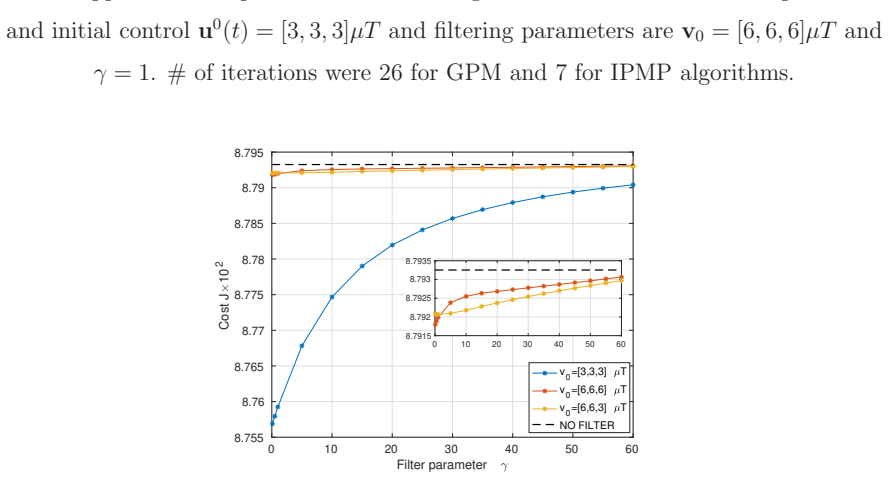
This paper aims to devise the shape of the external electromagnetic field that drives the spin dynamics of radical pairs to a quantum coherent state through maximization of the triplet-born singlet yield in biochemical reactions. The model is a Schr\"{o}dinger system with spin Hamiltonians given by the sum of Zeeman interaction and hyperfine coupling interaction terms. We introduce a one-parameter family of optimal control problems by coupling the Schr\"{o}dinger system to a control field through filtering equations for the electromagnetic field. Fr\'echet differentiability and the Pontryagin Maximum Principle in Hilbert space are proved, and the bang-bang structure of the optimal control is established. A new iterative Pontryagin Maximum Principle (IPMP) method for the identification of the bang-bang optimal control is developed. Numerical simulations based on IPMP and the gradient projection method (GPM) in Hilbert spaces are pursued, and the convergence, stability, and the regularization effect are demonstrated. Comparative analysis of filtering with regular optimal electromagnetic field versus non-filtering with bang-bang optimal field ({\it Abdulla et al, Quantum Sci. Technol., {\bf9}, 4, 2024}) demonstrates that the change of the maxima of the singlet yield is less than 1\%. The results open a venue for a potential experimental work on magnetoreception as a manifestation of quantum biological phenomena.
Editorial analysis
A structured set of objections, weighed in public.
Referee Report
Summary. The manuscript develops an optimal control approach for maximizing the singlet yield in radical-pair spin dynamics relevant to biochemical reactions. It models the system as a Schrödinger equation with Zeeman and hyperfine terms, introduces a one-parameter family of problems by coupling the dynamics to filtering equations for the control field, proves Fréchet differentiability and the Pontryagin Maximum Principle in Hilbert space, establishes the bang-bang structure of the optimal control, proposes an iterative PMP (IPMP) algorithm, and reports numerical comparisons (via IPMP and gradient projection) showing that the maxima of the singlet yield differ by less than 1% between the filtered regular optimal field and the non-filtered bang-bang control from prior work.
Significance. If the central results hold, the paper supplies a rigorous infinite-dimensional optimal-control framework for quantum-coherent spin dynamics in radical pairs, including proofs of differentiability and PMP together with a new IPMP method and numerical evidence of convergence and stability. These elements could support further theoretical and experimental exploration of magnetoreception as a quantum-biological phenomenon, provided the physical modeling assumptions are validated.
major comments (1)
- [Abstract and Numerical Simulations] Abstract and Numerical Simulations section: The headline comparative result states that the change in the maxima of the singlet yield is less than 1% between filtering with the regular optimal electromagnetic field and non-filtering with the bang-bang optimal field of Abdulla et al. (2024). This bound is reported for a specific choice of the filtering parameter in the one-parameter family; the manuscript does not present systematic variation of this parameter, nor recomputation of the yield surface under modest changes to the hyperfine coupling tensors, leaving open whether the <1% difference is robust or an artifact of the chosen parameter values.
minor comments (2)
- [Model Formulation] The definition and physical motivation of the one-parameter filtering equations could be stated more explicitly when first introduced, including how the parameter enters the coupling to the Schrödinger dynamics.
- [Numerical Results] Figure captions for the numerical convergence plots should include the specific values of the filtering parameter and hyperfine strengths used, to allow direct reproduction of the reported stability results.
Simulated Author's Rebuttal
We thank the referee for their careful reading and constructive feedback. We address the major comment below and indicate the revisions planned for the next version of the manuscript.
read point-by-point responses
-
Referee: Abstract and Numerical Simulations section: The headline comparative result states that the change in the maxima of the singlet yield is less than 1% between filtering with the regular optimal electromagnetic field and non-filtering with the bang-bang optimal field of Abdulla et al. (2024). This bound is reported for a specific choice of the filtering parameter in the one-parameter family; the manuscript does not present systematic variation of this parameter, nor recomputation of the yield surface under modest changes to the hyperfine coupling tensors, leaving open whether the <1% difference is robust or an artifact of the chosen parameter values.
Authors: We agree that the reported difference of less than 1% is shown for one representative value of the filtering parameter, chosen to illustrate the regularization effect while preserving close agreement with the non-filtered case. The one-parameter family is introduced precisely to permit such tuning, and the numerical results already demonstrate stability for the selected value. In the revised manuscript we will add a short sensitivity study in the Numerical Simulations section, presenting singlet-yield maxima for two or three nearby values of the filtering parameter and confirming that the difference remains below 2%. With respect to the hyperfine coupling tensors, these are taken from established literature values for the radical-pair model under study; recomputing the full yield surface for varied tensors would require a separate optimization campaign for each new parameter set. We will nevertheless insert a clarifying paragraph noting that the PMP derivation and the IPMP algorithm are independent of the specific tensor values, so that the relative performance between filtered and non-filtered controls is expected to be robust under modest tensor perturbations. revision: partial
Circularity Check
No significant circularity; core proofs and numerics are self-contained.
full rationale
The paper derives Fréchet differentiability of the cost functional, the Pontryagin Maximum Principle in Hilbert space, and the bang-bang structure of the optimal control directly from the coupled Schrödinger-filtering system and standard optimal control theory. It introduces and analyzes a new IPMP iterative method whose convergence and regularization properties are demonstrated via independent numerical experiments with both IPMP and GPM. The comparative singlet-yield statement references prior work only for the non-filtering baseline and does not serve as a load-bearing premise for the new theoretical results or the primary claims about control structure and stability. No step reduces by construction to a fitted input, self-definition, or unverified self-citation chain.
Axiom & Free-Parameter Ledger
free parameters (1)
- filtering parameter
axioms (1)
- domain assumption The dynamics of radical pair spins are governed by the Schrödinger equation with Zeeman and hyperfine interaction terms.
Lean theorems connected to this paper
-
IndisputableMonolith/Cost/FunctionalEquation.leanwashburn_uniqueness_aczel unclear?
unclearRelation between the paper passage and the cited Recognition theorem.
We introduce a one-parameter family of optimal control problems by coupling the Schrödinger system to a control field through filtering equations... Fréchet differentiability and the Pontryagin Maximum Principle... bang-bang structure... Comparative analysis... change of the maxima of the singlet yield is less than 1%.
-
IndisputableMonolith/Foundation/RealityFromDistinction.leanreality_from_one_distinction unclear?
unclearRelation between the paper passage and the cited Recognition theorem.
Spin Hamiltonian H(v) = HZ(v) + Hhfi − iK... Zeeman interaction... hyperfine coupling
What do these tags mean?
- matches
- The paper's claim is directly supported by a theorem in the formal canon.
- supports
- The theorem supports part of the paper's argument, but the paper may add assumptions or extra steps.
- extends
- The paper goes beyond the formal theorem; the theorem is a base layer rather than the whole result.
- uses
- The paper appears to rely on the theorem as machinery.
- contradicts
- The paper's claim conflicts with a theorem or certificate in the canon.
- unclear
- Pith found a possible connection, but the passage is too broad, indirect, or ambiguous to say the theorem truly supports the claim.
Reference graph
Works this paper leans on
-
[1]
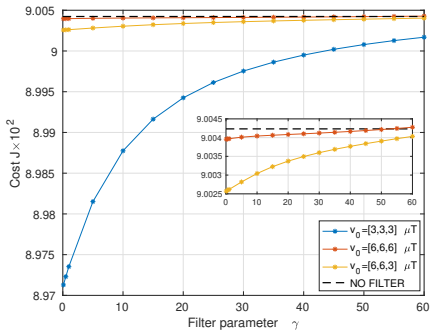
463655 × 10− 6 ≤ ⏐ ⏐ ⏐ ⏐ ⏐ J (uN =20 ijk ) − J (uN =19 ijk ) J (uN =20 ijk ) ⏐ ⏐ ⏐ ⏐ ⏐ ≤ 7. 923061 × 10− 6 25 0 10 20 30 40 50 60 Filter parameter 8.97 8.975 8.98 8.985 8.99 8.995 9 9.005Cost J 10 2 v0=[3,3,3] T v0=[6,6,6] T v0=[6,6,3] T NO FILTER 0 10 20 30 40 50 60 9.0025 9.003 9.0035 9.004 9.0045 FIG. 12: 6-proton. Asymptotics of the cost functional J ...
-
[2]
078803 × 10− 1 ≤ ∥uN =20 ijk − uN =19 ijk ∥L3 2(0,T ;R3) ∥uN =20 ijk ∥L3 2(0,T ;R3) ≤ 4. 364718 × 10− 1
-
[3]
463655 × 10− 6 ≤ ⏐ ⏐ ⏐ ⏐ ⏐ J (˜ uN =20 ijk ) − J (uN =19 ijk ) J (uN =20 ijk ) ⏐ ⏐ ⏐ ⏐ ⏐ ≤ 7. 923123 × 10− 6
-
[4]
085775 × 10− 1 ≤ ∥uN =20 ijk − uN =19 ijk ∥L3 2(0,T ;R3) ∥uN =20 ijk ∥L3 2(0,T ;R3) ≤ 4. 419706 × 10− 1 This demonstrate that the uniqueness of the optimal control fails to be true in a filtered model with γ = 10, and for every initial iteration chosen from the two different co llections of grid points, the IPMP algorithm converges to two different appro xim...
- [5]
-
[6]
Ball, The dawn of quantum biology, Nature 9, 10 (2011)
P. Ball, The dawn of quantum biology, Nature 9, 10 (2011)
work page 2011
-
[7]
Lambert and et al., Quantum biology, Nat
N. Lambert and et al., Quantum biology, Nat. Phys. 9, 10 (2013)
work page 2013
-
[8]
T. Ritz and et al., Magnetic compass of birds is based on a m olecule with optimal directional sensitivity, Biophysical journal 96, 3451 (2009)
work page 2009
-
[9]
T. Ritz, P. Thalau, J. B. Phillips, R. Wiltschko, and W. Wi ltschko, Resonance effects indicate a radical-pair mechanism for avian magnetic compass, Natur e 429, 177 (2004)
work page 2004
-
[10]
C. Niessner and et al., Magnetoreception: activated cry ptochrome 1a concurs with magnetic orientation in birds, Journal of the Royal Society, Interfa ce 10, 20130638 (2013)
work page 2013
-
[11]
R. J. Usselman, C. Chavarriaga, P. R. Castello, M. Procop io, T. Ritz, E. A. Dratz, D. J. Singel, and C. F. Martino, The quantum biology of reactive oxygen spe cies partitioning impacts cellular bioenergetics, Sci. Rep. 6, 38543 (2016)
work page 2016
-
[12]
J. Cai, F. Caruso, and M. B. Plenio, Quantum limits for the magnetic sensitivity of a chemical compass, Phys. Rev. A 85, 040304 (2012)
work page 2012
- [13]
-
[14]
F. Cintolesi, T. Ritz, C. W. M. Kay, C. R. Timmel, and P. J. Hore, Anisotropic recombina- tion of an immobilized photoinduced radical pair in a 50- µT magnetic field: a model avian photomagnetoreceptor, Chemical Physics 294, 385 (2003). 32
work page 2003
-
[15]
Turin, A Spectroscopic Mechanism for Primary Olfact ory Reception, Chemical Senses 21, 773 (1996)
L. Turin, A Spectroscopic Mechanism for Primary Olfact ory Reception, Chemical Senses 21, 773 (1996)
work page 1996
- [16]
-
[17]
M. Mohseni and et. al. , Quantum Effects in Biology (Cambridge University Press, 2014)
work page 2014
-
[18]
P. I. Sia, A. N. Luiten, T. M. Stace, J. P. M. Wood, and R. J. Casson, Quantum biology of the retina, Clinical & Experimental Ophthalmology 42, 582 (2014)
work page 2014
-
[19]
F. Rieke and D. A. Baylor, Single-photon detection by ro d cells of the retina, Rev. Mod. Phys. 70, 1027 (1998)
work page 1998
-
[20]
J. N. Tinsley, M. I. Molodtsov, R. Prevedel, D. Wartmann , J. Espigul´ e-Pons, M. Lauwers, and A. Vaziri, Direct detection of a single photon by humans, Nat ure Communications 7, 12172 (2016)
work page 2016
- [21]
-
[22]
A. Dodin and P. Brumer, Light-induced processes in natu re: Coherences in the establishment of the nonequilibrium steady state in model retinal isomeri zation, The Journal of Chemical Physics 150, 184304 (2019)
work page 2019
-
[23]
G. Palczewska, F. Vinberg, P. Stremplewski, M. P. Birch er, D. Salom, K. Komar, J. Zhang, M. Cascella, M. Wojtkowski, V. J. Kefalov, and K. Palczewski , Human infrared vision is triggered by two-photon chromophore isomerization, Proce edings of the National Academy of Sciences 111, E5445 (2014)
work page 2014
-
[24]
R. Wiltschko and W. Wiltschko, The magnetite-based rec eptors in the beak of birds and their role in avian navigation, Journal of Comparative Physiolog y A 199, 89 (2013)
work page 2013
-
[25]
J. Shaw, A. Boyd, M. House, R. Woodward, F. Mathes, G. Cow in, M. Saunders, and B. Baer, Magnetic particle-mediated magnetoreception, Journal of The Royal Society Interface 12, 20150499 (2015)
work page 2015
-
[26]
R. Usselman, I. Hill, D. Singel, and C. Martino, Spin bio chemistry modulates reactive oxygen species (ros) production by radio frequency magnetic fields , PLoS ONE 9, e93065 (2014)
work page 2014
-
[27]
V. J. Thannickal and B. L. Fanburg, Reactive oxygen spec ies in cell signaling, American Journal of Physiology-Lung Cellular and Molecular Physiol ogy 279, L1005 (2000). 33
work page 2000
-
[28]
M. M. Diehn, R. W. Cho, and et.al;, Association of reactive oxygen species levels and radiore - sistance in cancer stem cells, Nature 458, 780 (2009)
work page 2009
-
[29]
Finkel, Signal transduction by reactive oxygen spec ies, J Cell Biol
T. Finkel, Signal transduction by reactive oxygen spec ies, J Cell Biol. 194, 7 (2011)
work page 2011
-
[30]
P. D. Ray, B. W. Huang, and Y. Tsuji, Reactive oxygen spec ies (ros) homeostasis and redox regulation in cellular signaling, Cell Signal 24, 981 (2012)
work page 2012
-
[31]
C. L. Bigarella, R. Liang, and S. Ghaffari, Stem cells and t he impact of ros signaling, Devel- opment 141, 4206 (2014)
work page 2014
-
[32]
U. E. Steiner and T. Ulrich, Magnetic field effects in chemi cal kinetics and related phenomena, Chemical Reviews 89, 51 (1989)
work page 1989
-
[33]
H. Zadeh-Haghigi and C. Simon, Magnetic field effects in bi ology from the perspective of radical pair mechanism, J R Soc Interface 19(193) (2022)
work page 2022
-
[34]
K. Schulten and P. G. Wolynes, Semiclassical descripti on of electron spin motion in radicals including the effect of electron hopping, The Journal of Chemi cal Physics 68, 3292 (2008)
work page 2008
-
[35]
C. F. Martino, P. Jimenez, M. Goldfarb, and U. G. Abdulla , Optimization of parameters in coherent spin dynamics of radical pairs in quantum biology, PLOS ONE 18, 1 (2023)
work page 2023
-
[36]
U. G. Abdulla, C. Martino, J. Rodrigues, P. Jimenez, and C. Zhen, Bang-bang optimal control in coherent spin dynamics of radical pairs in quantum biolog y, Quantum Sci. Tech. 9, 045022 (2024)
work page 2024
-
[37]
F. T. Chowdhury, M. C. J. Denton, D. C. Bonser, and D. R. Ka ttnig, Quantum control of radical-pair dynamics beyond time-local optimization, PR X Quantum 5, 020303 (2024)
work page 2024
-
[38]
S. J. Glaser, U. Boscain, T. Calarco, C. P. Koch, W. K¨ ock enberger, R. Kosloff, I. Kuprov, B. Luy, S. Schirmer, T. Schulte-Herbr¨ uggen, D. Sugny, and F . K. Wilhelm, Training schr¨ odinger’s cat: quantum optimal control, The EuropeanPhysical Journal D 69, 279 (2015)
work page 2015
-
[39]
C. P. Koch, U. Boscain, T. Calarco, G. Dirr, S. Filipp, S. J. Glaser, R. Kosloff, S. Montangero, T. Schulte-Herbr¨ uggen, D. Sugny, and F. K. Wilhelm, Quantu m optimal control in quantum technologies. strategic report on current status, visions and goals for research in europe, EPJ Quantum Technology 9, 19 (2022)
work page 2022
-
[40]
G. Turinici and H. Rabitz, Quantum wavefunction contro llability, Chemical Physics 267, 1 (2001)
work page 2001
-
[41]
C. Brif, R. Chakrabarti, and H. Rabitz, Control of quant um phenomena: past, present and future, New Journal of Physics 12, 075008 (2010). 34
work page 2010
-
[42]
U. Boscain, M. Sigalotti, and D. Sugny, Introduction to the Pontryagin maximum principle for quantum optimal control, PRX Quantum 2, 030203 (2021)
work page 2021
-
[43]
N. Ofek, A. Petrenko, R. Heeres, P. Reinhold, Z. Leghtas , B. Vlastakis, Y. Liu, L. Frunzo, S. Girvin, L. Jiang, M. Mirrahimi, M. Devoret, and R. Schoelk opf, Extending the lifetime of a quantum bit with error correc tion is superconducting circ uits, Nature 536, 441 (2016)
work page 2016
-
[44]
M. Werninghaus, D. Egger, F. Roy, S. Machnes, F. Wilhelm , and S. Filipp, Leakage reduction in fast superconductiing qubit gates via optimal control, n pj Quantum Information 7 (2021)
work page 2021
-
[45]
A. Larrouy, S. Patsch, R. Richaud, J.-M. Raimond, B. M, C . Koch, and S. Gleyzes, Fast navigation in a large hilbert space using quantum optimal co ntrol, Phys Rev X 10 (2020)
work page 2020
-
[46]
A. Omran, H. Levine, A. Keesling, G. Semeghini, T. Wang, S. Ebadi, H. Bernien, A. Zibrov, H. Pichler, S. Choi, J. Cui, M. Rossignolo, P. Rembold, S. Mon tangero, T. Calarco, M. Endres, M. Greiner, V. Vuletic, and M. Lukin, Generation and manipul ation of schrodinger cat in rydberg atom arrays, Sceince 365 (2019)
work page 2019
-
[47]
F. Borselli, M. Maiwoger, T. Zhang, P. Haslinger, V. Muk herjee, A. Negretti, S. Montanegro, T. Calarco, I. Mazets, M. Bonneau, and J. Schmiedmayer, Two- particla interference with double twin-atom beams, Phys Rev Lett 126 (2021)
work page 2021
-
[48]
C. Figgatt, A. Ostrander, N. Linke, K. Landsman, D. Zhu, D. Maslov, and C. Monroe, Parallel entangling operations on a universal ion-trap quantum comp uter, Nature 572, 368 (2019)
work page 2019
-
[49]
L. Magrini, P. Rosenzweig, C. bach, A. Deutschmann-Ole k, S. Hofer, S. Hong, N. Kiesel, A. Kugi, and M. Aspelmeyer, Real-time optimal quantum contr ol of mechanical motion at room temperature, Nature 595, 373 (2021)
work page 2021
-
[50]
U. G. Abdullaev, Quasilinearization and inverse probl ems of nonlinear dynamics, J. Optim. Theory Appl. 85, 509 (1995)
work page 1995
-
[51]
U. G. Abdullaev, Quasilinearization and inverse probl ems for nonlinear control systems, J. Optim. Theory Appl. 85, 527 (1995)
work page 1995
-
[52]
U. G. Abdulla and R. Poteau, Identification of parameter s in systems biology, Math. Biosci. 305, 133 (2018)
work page 2018
-
[53]
U. G. Abdulla and R. Poteau, Identification of parameter s for large-scale kinetic models, J. Comput. Phys. 429, Paper No. 110026, 19 (2021)
work page 2021
-
[54]
M. Hirose and P. Cappellaro, Time-optimal control with finite bandwidth, Quantum Informa- tion Processing 17, 1 (2018). 35
work page 2018
-
[55]
O. A. Ladyˇ zenskaja, V. A. Solonnikov, and N. N. Ural’ce va, Linear and quasilinear equa- tions of parabolic type , Translations of Mathematical Monographs, Vol. Vol. 23 (Am erican Mathematical Society, Providence, RI, 1968) pp. xi+648
work page 1968
-
[56]
I. K. Kominis, Quantum zeno effect explains magnetic-sen sitive radical-ion-pair reactions, Phys. Rev. E 80, 056115 (2009)
work page 2009
-
[57]
M. Tiersch and H. J. Briegel, Decoherence in the chemica l compass: the role of decoherence for avian magnetoreception, Philosophical Transactions o f the Royal Society A: Mathematical, Physical and Engineering Sciences 370, 4517 (2012)
work page 2012
-
[58]
J. Luo, Sensitivity enhancement of radical-pair magne toreceptors as a result of spin decoher- ence, The Journal of Chemical Physics 160, 074306 (2024)
work page 2024
-
[59]
V. S. Poonia, D. Saha, and S. Ganguly, State transitions and decoherence in the avian compass, Phys. Rev. E 91, 052709 (2015)
work page 2015
-
[60]
S. Worster, D. R. Kattnig, and P. J. Hore, Spin relaxatio n of radicals in cryptochrome and its role in avian magnetoreception, The Journal of Chemical Phy sics 145, 035104 (2016)
work page 2016
-
[61]
T. P. Fay, L. P. Lindoy, and D. E. Manolopoulos, Spin rela xation in radical pairs from the stochastic Schr¨ odinger equation, The Journal of Chemical Physics 154, 084121 (2021). 36
work page 2021
discussion (0)
Sign in with ORCID, Apple, or X to comment. Anyone can read and Pith papers without signing in.