REVIEW 1 major objections 4 minor 44 references
Distributed quantum sensing with multi-mode $N00N$ states
T0 review · 1 major / 4 minor · reviewed 2026-08-06 · deepseek-v4-flash
Pith's one-line read Multi-mode N00N states can estimate distributed phase averages at the Heisenberg 1/N² limit, with a two-phase photonic demonstration beating the SQL by 2.74 dB.
desk verdict Sound theory, clean but post-selected N=2 proof-of-principle; abstract and conclusion oversell the unconditional gain. read the letter →
The pith
A machine-rendered reading of the paper's core claim, the machinery that carries it, and where it could break.
The reading
What carries the argument
The load-bearing object is the multi-mode $N00N$ state, a coherent superposition in which all $N$ photons sit entirely in one mode of one node, in either arm of the local interferometer, with every other mode empty and equal amplitude across all $d$ nodes; the four-mode $2002$ state is its $N=2, d=2$ instance. Its quantum Fisher information matrix has a uniform negative off-diagonal structure, $-N^2/d^2$, which cancels when contracted with the equal-weight vector $\nu = (1/d,\dots,1/d)$, yielding the Heisenberg bound $1/N^2$. The second mechanism is the local measurement of a $2\times2$ beam splitter plus photon-number-resolving detectors, which diagonalizes the classical Fisher information matrix into entries $N^2/d$, so the classical Cramér-Rao bound reproduces the quantum bound; the saturation proof is given in the Supplemental Material. Experimentally, the state is generated from a Bell state via Hong-Ou-Mandel interference, phase-encoded with wave plates at each node, and read out with fiber beam splitters and superconducting nanowire single-photon detectors.
What would settle it
To test the unconditional claim, repeat the two-node experiment without post-selection, including losses, vacuum, and all other detection outcomes when computing the Fisher information of the estimated average phase; if the variance then fails to beat the standard quantum limit (1/N for N=2) or fails to approach 1/$N^{2}$ scaling as N grows, the central claim as stated is refuted.
Extended reading notes
Core claim
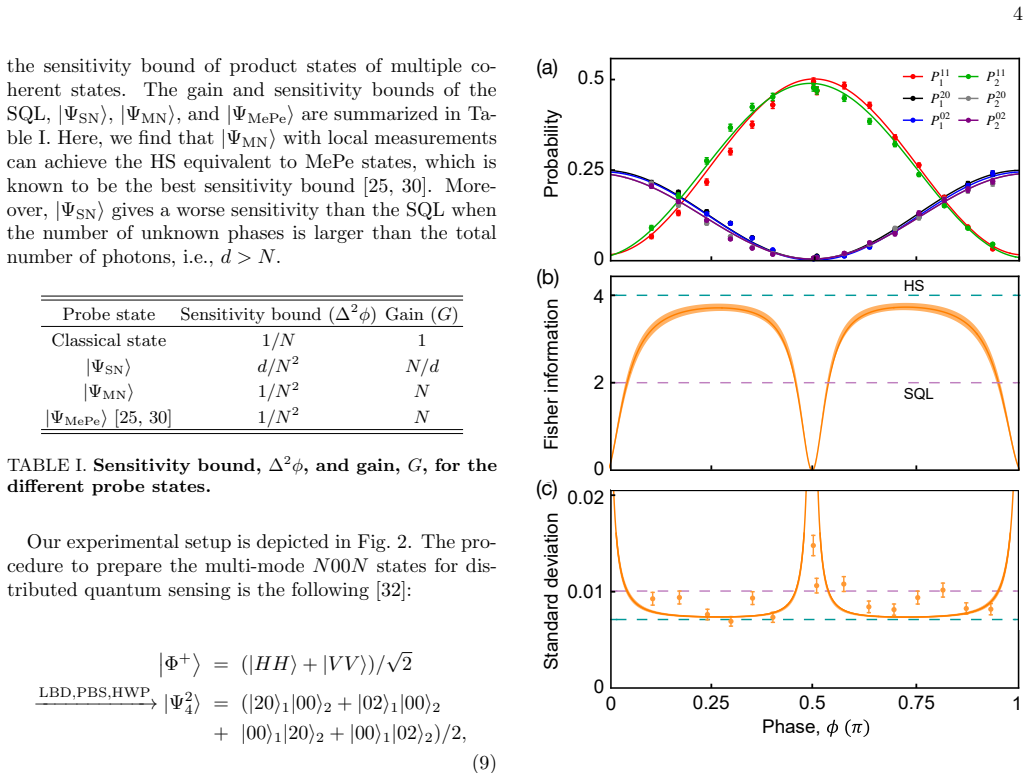
The central discovery is that the multi-mode $N00N$ state $|\Psi_{MN}\rangle = (1/\sqrt{d})\sum_{j=1}^{d} (1/\sqrt{2})(|N0\rangle_j + |0N\rangle_j)\otimes_{k\neq j}|00\rangle_k$, when used to estimate the equal-weight average $\phi = (1/d)\sum_j \phi_j$ of $d$ distributed phases, yields a quantum Fisher information matrix whose contraction with the weight vector gives exactly $\nu^T F_Q^{-1} \nu = 1/N^2$. The QFIM has diagonal entries $(2d-1)N^2/d^2$ and off-diagonal entries $-N^2/d^2$, and their cancellation along the equal-weight direction produces the Heisenberg bound. The paper further shows that a local measurement -- a $2\times2$ beam splitter and photon-number-resolving detection at each node -- gives a diagonal classical Fisher information matrix with entries $N^2/d$, so the classical Cramér-Rao bound also saturates at $1/N^2$, meaning no joint measurement across nodes is required to reach the quantum limit. Experimentally, the authors use the four-mode $2002$ state (two photons, four modes) to estimate $(\phi_1+\phi_2)/2$ and report a Fisher information of 3.76, beyond the SQL value of 2, and a 2.74 dB improvement in the standard deviation over the SQL, with the estimated phase variance tracking the Heisenberg limit.
Load-bearing premise
The experimental demonstration is post-selected, since only two-photon detection events enter the 2.74 dB gain, so the claimed advantage is not established unconditionally under loss; a second load-bearing premise is that the local beam-splitter plus photon-counting measurement saturates the quantum Cramér-Rao bound, a proof relegated to the Supplemental Material.
Editorial extensions
If this is right
- Distributed sensor networks can estimate the average of $d$ unknown phases at the Heisenberg limit using only local measurements, because the classical Cramér-Rao bound reaches $1/N^2$ with beam splitters and photon-number-resolving detection.
- The multi-mode $N00N$ probe matches the known best sensitivity of mode-and-particle-entangled states and strictly outperforms separable $N00N$ states, whose variance $d/N^2$ falls below the SQL when $d>N$.
- The demonstrated four-mode $2002$ state provides a proof-of-concept 2.74 dB enhancement over the SQL for the average of two phases, with the estimated standard deviation tracking the Heisenberg limit.
- The scheme extends to more than two nodes and to cases where the number of photons is smaller than the number of phases, because the Heisenberg bound $1/N^2$ is independent of $d$.
Reading between the lines
- A quantitative loss-threshold analysis, which the post-selected experiment leaves open, would determine whether the $1/N^2$ scaling survives realistic channel losses; loss models for multi-mode $N00N$ states suggest the advantage persists only below a per-mode loss rate that shrinks as $N$ grows.
- Because the off-diagonal Fisher information cancels only along the equal-weight direction, estimating weighted averages with non-uniform coefficients will generally yield variance larger than $1/N^2$; a test with unequal weights would map the boundary of the scheme.
- The comparison with separable states implies a design rule: concentrating all $N$ photons in one multi-mode entangled state is strictly better than splitting them into $d$ local $N/d$-photon $N00N$ states, which matters for photon-budget-limited sensor networks.
- Since the Heisenberg bound does not depend on $d$, an experiment with three or four nodes would directly test whether the per-photon precision survives in larger arrays, a scaling the paper motivates but does not demonstrate.
Editorial analysis
A structured set of objections, weighed in public.
Referee Report
Summary. The paper proposes a distributed quantum sensing scheme based on multi-mode N00N states, with the goal of estimating the average of d spatially distributed phases. Theoretically, it derives the quantum Fisher information matrix for these states (Eq. (4)), obtains the quantum Cramér-Rao bound 1/N^2 for the average phase, and shows that local measurements consisting of a 50/50 beam splitter and photon-number-resolving detectors achieve the same bound through the classical Fisher information matrix (Eq. (5)). It compares this with separable N00N states, which give d/N^2, and with MePe states, which also give 1/N^2. Experimentally, the authors generate a four-mode 2002 state, distribute it over two nodes, estimate the average of two phases using maximum likelihood estimation, and report a Fisher information of 3.76 versus the standard quantum limit value of 2, corresponding to a 2.74 dB enhancement. The experimental section explicitly states that the result is post-selected on two-photon detection events and is presented as a proof of concept.
Significance. If the results hold, the paper establishes that multi-mode N00N states are a viable discrete-variable resource for distributed quantum sensing with Heisenberg scaling, complementing continuous-variable and spin-squeezed approaches. The theoretical analysis is sound: the QFIM in Eq. (4) and the resulting QCRB 1/N^2 check out under the stated phase-encoding convention, and the CFIM in Eq. (5) is consistent with saturation of the bound at the optimal working point. The experimental demonstration, while post-selected, is a useful proof of concept and includes measured visibilities, bootstrapped error bars, and a clear comparison with the SQL and HS. The main weakness is the unqualified restatement of the post-selected 2.74 dB enhancement in the abstract and conclusion, even though the body correctly limits the claim.
major comments (1)
- [Experimental results, final paragraph; Abstract; Conclusion] The reported Fisher information of 3.76 and the 2.74 dB enhancement are computed from the post-selected two-photon probability set {P_1^{11}, P_1^{20}, P_1^{02}, P_2^{11}, P_2^{20}, P_2^{02}}, as the authors explicitly state in the final paragraph of the experimental section. The body correctly limits the claim to a proof of concept, but the Abstract and the Conclusion restate the enhancement without this qualifier, e.g., 'achieving a 2.74 dB sensitivity enhancement over the standard quantum limit.' Since the unconditional measurement includes loss and other imperfections not captured by the post-selected conditional probabilities, the headline claim overstates what the data establish. Please reword the Abstract and Conclusion to state that the enhancement is conditional on two-photon detection events, or provide an unconditional sensitivity estimate that accounts for the discarded events.
minor comments (4)
- [Experimental section, Fig. 3(c) discussion] The text reads '∆ϕSQL = 1/√µN and ∆ϕHS = 1/√µN'; as printed the two bounds are identical. The Heisenberg-limited standard deviation should be 1/(√µ N), not 1/√(µN). Please correct this typo, otherwise the HS curve in Fig. 3(c) is mislabeled.
- [Eq. (5) and local-measurement saturation] The main text states that the local BS+PNRD measurement saturates the QCRB for the multi-mode N00N state, but the calculation is delegated entirely to the Supplemental Material. A brief statement in the main text of the conditional probabilities or the optimal working point would make this central claim easier to verify and more self-contained.
- [References] There are several reference formatting typos: Ref. [5] should read 'AVS Quantum Sci.' rather than 'A VS Quantum Sci.', and Ref. [6] contains a stray 'J.' before 'Integrable atomtronic interferometry.' Please check the reference list.
- [Fig. 1 caption] The notation |ψ⟩_j for the j-th node is used in the caption and Eq. (2), but the normalization convention is not immediately clear until one compares with Eq. (2). Aligning the notation between the figure caption and the equation would improve readability.
Circularity Check
No significant circularity: the 1/N^2 Heisenberg scaling is a first-principles QFIM/CFIM calculation, and the 2.74 dB experimental gain is a measured, post-selected statistic that the paper explicitly discloses as such.
full rationale
The central theoretical chain is self-contained. The state is defined in Eq. (2), the QFIM in Eq. (4) is computed directly from the standard definition F_Q(j,k) = 4Re[<∂_jΨ|∂_kΨ> - <∂_jΨ|Ψ><Ψ|∂_kΨ>] quoted in the paper, and the bound Δ²φ ≥ 1/N² in Eq. (6) follows by inserting ν = (1/d,...,1/d). No fitted parameter enters this chain, and the 1/N² Heisenberg scaling is the standard scaling of N00N-type states, not an assumed conclusion. The same holds for the practical bound: the diagonal CFIM in Eq. (5) is stated as the result of a calculation (delegated to the Supplemental Material) for local 50/50 beam splitters plus photon-number-resolving detectors, and it again yields ν^T F_C^{-1}ν = 1/N² at the working point; the saturation claim is a computation, not an ansatz that builds in the answer. The experimental gain is derived from measured fringe visibilities (0.94-0.99) via a conventional model; the maximum Fisher information of 3.76 is a derived statistic, and the 2.74 dB figure is 10 log10(3.76/2), so the claimed enhancement is not a fitted parameter relabeled as a prediction. Two caveats do not rise to circularity. First, the paper explicitly acknowledges the experimental result is post-selected: 'Note that we used post-selection, which does not take into account the imperfections of the experiment; however, this does not affect the proof-of-concept of quantum-enhanced sensitivity.' The Fisher information is therefore a property of the conditional two-photon detection subensemble, which limits the strength of the experimental claim but is a statistical and framing concern, not a circular step. Second, the authors cite their own prior work for the state-generation procedure ([32] in Eq. (9)) and for the scaling outlook ([27]); these citations are not load-bearing for the central 1/N² derivation, and the state quality is independently supported by the measured visibilities. The comparison benchmarks (separable N00N states, MePe states [25, 30], and the SQL) are external. I therefore find no circular step meeting the evidentiary bar; the score of 1 reflects only the presence of minor self-citations, none of which carries the derivation.
Assumptions & free parameters
free parameters (1)
- per-fringe visibility v_l =
0.94 to 0.99
assumptions (6)
- standard math Quantum Fisher information matrix for pure states: F_Q(j,k) = 4Re[<∂_j ψ|∂_k ψ> - <∂_j ψ|ψ><ψ|∂_k ψ>]
- domain assumption Phase encoding is a single-arm phase shift generated by H_j = n_{b,j}
- domain assumption The four-mode 2002 state generated from a Bell state via Hong-Ou-Mandel interference equals the theoretical multi-mode N00N state
- domain assumption Local 2x2 beam splitter plus photon-number-resolving detection saturates the quantum Cramér-Rao bound
- domain assumption The standard quantum limit for the global average with total photon number N is 1/N
- ad hoc to paper Post-selection on two-photon detection events gives a valid sensitivity figure for the proof of concept
Cite this review
Pith. "Pith review of Distributed quantum sensing with multi-mode $N00N$ states." pith.science (2026). https://pith.science/paper/4WWZXZ6U
@misc{pith2026250802070,
  author       = {Pith},
  title        = {Pith review of: Distributed quantum sensing with multi-mode $N00N$ states},
  year         = {2026},
  howpublished = {\url{https://pith.science/paper/4WWZXZ6U}},
  note         = {Machine review of arXiv:2508.02070}
}
abstract
Distributed quantum sensing, which estimates a global parameter across distant nodes, has attracted significant interest for applications such as quantum imaging, sensor networks, and global-scale clock synchronization. $N00N$ states are regarded as one of the optimal quantum resources for quantum metrology, enabling the Heisenberg scaling. Recently, the concept of $N00N$ states has been extended to multi-mode $N00N$ states for quantum-enhanced multiple-parameter estimation. However, the application of multi-mode $N00N$ states in distributed quantum sensing remains unexplored. Here, we propose a distributed quantum sensing scheme that achieves the Heisenberg scaling using multi-mode $N00N$ states. We theoretically show that multi-mode $N00N$ states can reach the Heisenberg scaling by examining both the Cram\'er-Rao bound and the quantum Cram\'er-Rao bound. For experimental demonstration, we employ a four-mode $2002$ state to estimate the average of two spatially distributed phases, achieving a 2.74 dB sensitivity enhancement over the standard quantum limit. We believe that utilizing multi-mode $N00N$ states for distributed quantum sensing offers a promising approach for developing entanglement-enhanced sensor networks.
Figures


Reference graph
Works this paper leans on
-
[1]
J. P. Dowling. Quantum optical metrology — the low- down on high-N00N states. Contemp. Phys. 49, 125–143 (2008)
work page 2008
-
[2]
V. Giovannetti, S. Lloyd, and L. Maccone, Advances in quantum metrology. Nat. Photon. 5, 222–229 (2011)
work page 2011
-
[3]
S. Pirandola, B. R. Bardhan, T. Gehring, C. Weedbrook, and S. Lloyd, Advances in photonic quantum sensing. Nat. Photon. 12, 724–733 (2018)
work page 2018
-
[4]
B. J. Lawrie, P. D. Lett, A. M. Marino, and R. C. Pooser, Quantum sensing with squeezed light. Acs Photonics. 6, 1307–1318 (2019)
work page 2019
- [5]
-
[6]
D. S. Gr¨ un, L. H. Ymai, K. Wittmann W., A. P. Tonel, A. Foerster, and J. Links, J. Integrable atomtronic inter- ferometry. Phys. Rev. Lett. 129, 020401 (2022)
work page 2022
- [7]
-
[8]
H. Defienne, M. Reichert, J. W. Fleischer, and D. Fac- cio, Quantum image distillation. Sci. Adv. 5, eaax0307 (2019)
work page 2019
Show all 44 references
-
[9]
Yonezawa, D
H. Yonezawa, D. Nakane, T. A. Wheatley, K. Iwasawa, S. Takeda, H. Arao, K. Ohki, K. Tsumura, D. W. Berry, T. C. Ralph, et al., Quantum-Enhanced Optical-Phase Tracking. Science 337, 1514–1517 (2012)
2012
-
[10]
K´ om´ ar, E
P. K´ om´ ar, E. Kessler, M. Bishof, L. Jiang, A. S. Sørensen, J. Ye, and M. D. Lukin, A quantum network of clocks. Nat. Phys. 10, 582–587 (2014)
2014
-
[11]
B. K. Malia, Y. Wu, J. Mart ´ ınez-Rinc´ on, and M. A. Kasevich, Distributed quantum sensing with mode- entangled spin-squeezed atomic states. Nature. 612, 661–665 (2022)
2022
-
[12]
K. M. Backes, D. A. Palken, S. Al Kenany, B. M. Brubaker, S. B. Cahn, A. Droster, G. C. Hilton, S. Ghosh, H. Jackson, S. K. Lamoreaux, et al., A quantum enhanced search for dark matter axions. Nature. 590, 238–242 (2021)
2021
-
[13]
Shi and Q
H. Shi and Q. Zhuang, Ultimate precision limit of noise 6 sensing and dark matter search. npj Quantum Inf. 9, 27 (2023)
2023
-
[14]
A. J. Brady, X. Chen, Y. Xia, J. Manley, M. D. Chowd- hury, K. Xiao, Z. Liu, R. Harnik, D. J. Wilson, Z. Zhang, et al., Entanglement-enhanced optomechanical sensor array with application to dark matter searches. Commun. Phys. 6, 237 (2023)
2023
-
[15]
Eldredge, M
Z. Eldredge, M. Foss-Feig, J. A. Gross, S. L. Rolston, and A. V. Gorshkov, Optimal and secure measurement pro- tocols for quantum sensor networks. Phys. Rev. A. 97, 042337 (2018)
2018
-
[16]
Gessner, A
M. Gessner, A. Smerzi, and L. Pezz´ e, Multiparameter squeezing for optimal quantum enhancements in sensor networks. Nat. Commun. 11, 3817 (2020)
2020
-
[17]
W. Ge, K. Jacobs, Z. Eldredge, A. V. Gorshkov, and M. Foss-Feig, Distributed quantum metrology with lin- ear networks and separable inputs. Phys. Rev. Lett. 121, 043604 (2018)
2018
-
[18]
T. J. Proctor, P. A. Knott, and J. A. Dunningham, Mul- tiparameter estimation in networked quantum sensors. Phys. Rev. Lett. 120, 080501 (2018)
2018
-
[19]
C. Oh, C. Lee, S. H. Lie, and H. Jeong, Optimal dis- tributed quantum sensing using Gaussian states. Phys. Rev. Res. 2, 023030 (2020)
2020
-
[20]
Zhang and Q
Z. Zhang and Q. Zhuang, Distributed quantum sensing. Quantum Sci. Technol 6, 043001 (2021)
2021
-
[21]
C. Oh, L. Jiang, and C. Lee, Distributed quantum phase sensing for arbitrary positive and negative weights. Phys. Rev. Res. 4, 023164 (2022)
2022
-
[22]
Liu, K.-X
B. Liu, K.-X. Yang, Y.-L. Mao, L. Feng, B. Guo, S. Xu, H. Chen, Z.-D. Li, and J. Fan, Experimental adaptive Bayesian estimation for a linear function of distributed phases in photonic quantum networks. Optica. 11, 1419– 1424 (2024)
2024
-
[23]
X. Guo, C. R. Breum, J. Borregaard, S. Izumi, M. V. Larsen, T. Gehring, M. Christandl, J. S. Neergaard- Nielsen, and U. L. Andersen, Distributed quantum sensing in a continuous-variable entangled network. Nat. Phys. 16, 281–284 (2020)
2020
-
[24]
S. Hong, M. A. Feldman, C. E. Marvinney, D. Lee, C. Lee, M. T. Febbraro, A. M. Marino, and R. C. Pooser, Quantum enhanced distributed phase sensing with a tru- cated SU(1,1) interferometer. arXiv:2403.17119
-
[25]
Liu, Y.-Z
L.-Z. Liu, Y.-Z. Zhang, Z.-D. Li, R. Zhang, X.-F. Yin, Y.- Y. Fei, L. Li, N.-L. Liu, F. Xu, Y.-A. Chen, and J.-W. Pan, Distributed quantum phase estimation with entan- gled photons. Nat. Photon. 15, 137–142 (2021)
2021
-
[26]
Zhao, Y.-Z
S.-R. Zhao, Y.-Z. Zhang, W.-Z. Liu, J.-Y. Guan, W. Zhang, C.-L. Li, B. Bai, M.-H. Li, Y. Liu, L. You, J. Zhang, J. Fan, F. Xu, Q. Zhang, and J.-W. Pan, Field demonstration of distributed quantum sensing without post-selection. Phys. Rev. X. 11, 031009 (2021)
2021
-
[27]
D.-H. Kim, S. Hong, Y.-S. Kim, Y. Kim, S.-W. Lee, R. C. Pooser, K. Oh, S.-Y. Lee, C. Lee, and H.-T. Lim, Dis- tributed quantum sensing of multiple phases with fewer photons. Nat Commun. 15, 266 (2024)
2024
-
[28]
Zhuang, J
Q. Zhuang, J. Preskill, and L. Jiang, Distributed quan- tum sensing enhanced by continuous-variable error cor- rection. New J. Phys. 22, 022001 (2020)
2020
-
[29]
Nehra, C
R. Nehra, C. Oh, L. Jiang, and A. Marandi, All- optical Loss-tolerant Distributed Quantum Sensing. arXiv:2407.13654
-
[30]
Gessner, L
M. Gessner, L. Pezz´ e, and A. Smerzi, Sensitiv- ity Bounds for Multiparameter Quantum Metrology. Phys. Rev. Lett. 121, 130503 (2018)
2018
-
[31]
P. C. Humphreys, M. Barbieri, A. Datta, and I. A. Walmsley, Quantum Enhanced Multiple Phase Estima- tion. Phys. Rev. Lett. 111, 070403 (2013)
2013
-
[32]
S. Hong, J. ur Rehman, Y.-S. Kim, Y.-W. Cho, S.-W. Lee, H. Jung, S. Moon, S.-W. Han, and H.-T. Lim, Quan- tum enhanced multiple-phase estimation with multi- mode N 00N states. Nat. Commun. 12, 5211 (2021)
2021
-
[33]
S. Hong, J. ur Rehman, Y.-S. Kim, Y.-W. Cho, S.- W. Lee, S.-Y. Lee, and H.-T. Lim, Practical Sensitivity Bound for Multiple Phase Estimation with Multi-Mode N00N States. Laser Photonics Rev. 16, 2100682 (2022)
2022
-
[34]
ur Rehman, S
J. ur Rehman, S. Hong, S.-W. Lee, Y.-S. Kim, Y.-W. Cho, H. Jung, S. Moon, H. Shin, S.-W. Han, and H.- T. Lim, Optimal strategy for multiple-phase estimation under practical measurement with multimode NOON states. Phys. Rev. A 106, 032612 (2022)
2022
-
[35]
Namkung, D.-H
M. Namkung, D.-H. Kim, S. Hong, Y.-S. Kim, C. Lee, and H.-T. Lim, Optimal multiple-phase estima- tion with multi-mode N00N states against photon loss. New J. Phys 26, 073028 (2024)
2024
-
[36]
Namkung, D.-H
M. Namkung, D.-H. Kim, S. Hong, C. Lee, and H.- T. Lim, Persistent quantum advantage with definite photon-number states in lossy multiple-phase estimation. arXiv:2407.16246
-
[37]
[1, 25, 26, 30, 32, 40]
See Supplemental Material at http://link.aps.org/supplemental/10.1103/4vdx-7224 for more details on theoretical sensitivity bounds and ex- perimental details, including Refs. [1, 25, 26, 30, 32, 40]
-
[38]
J. Liu, H. Yuan, X.-M. Lu, and X. Wang, Quantum Fisher information matrix and multiparameter estima- tion. J. Phys. A: Math. Theor. 53, 023001 (2019)
2019
-
[39]
Malitesta, A
M. Malitesta, A. Smerzi, and L. Pezz´ e, Distributed Quantum Sensing with Squeezed-Vacuum Light in a Configurable Network of Mach-Zehnder Interferometers. Phys. Rev. A 108, 032621 (2023)
2023
-
[40]
Slussarenko, M
S. Slussarenko, M. M. Weston, H. M. Chrzanowski, L. K. Shalm, V. B. Verma, S. W. Nam, and G. J. Pryde, Un- conditional violation of the shot-noise limit in photonic quantum metrology. Nat. Photon. 11, 700–703 (2017)
2017
-
[41]
X.-M. Hu, Y. Guo, B.-H. Liu, Y.-F. Huang, C.-F. Li, and G.-C. Guo, Beating the channel capacity limit for superdense coding with entangled ququarts. Sci. Adv. 4, eaat9304 (2018)
2018
-
[42]
Y. Tian, Q. Liu, Z. Tian, Q. Gong, and Y. Gu, Near- symmetric multiport beam splitting for high-N00N state preparation on nonlocal metasurface. arXiv:2408.14002
-
[43]
Dorner, R
U. Dorner, R. Demkowicz-Dobrza´ nski, B. J. Smith, J. S. Lundeen, W. Wasilewski, K. Banaszek, and I. A. Walmsley, Optimal Quantum Phase Estimation. Phys. Rev. Lett. 102, 040403 (2009)
2009
-
[44]
Kacprowicz, R
M. Kacprowicz, R. Demkowicz-Dobrza´ nski, W. Wasilewski, K. Banaszek, and I. A. Walmsley, Ex- perimental quantum-enhanced estimation of a lossy phase shift. Nat. Photon. 4, 357–360 (2010)
2010
Reviewed August 6, 2026 · model on record in the stance chip above.
Discussion (0). Sign in to comment.