REVIEW 2 major objections 8 minor 96 references
An equivalence between time-symmetry and cyclic causality in quantum theory
T0 review · 2 major / 8 minor · reviewed 2026-08-06 · deepseek-v4-flash
Pith's one-line read The paper proves that every multi-time quantum object—however it is pre- and post-selected—can be realized as a time-labelled P-CTC-assisted comb, and vice versa.
desk verdict Genuinely new constructive equivalence between MTS and P-CTC combs, but the key MTS-to-2TO reduction needs a proper proof before the theorem is fully closed. read the letter →
The pith
A machine-rendered reading of the paper's core claim, the machinery that carries it, and where it could break.
The reading
What carries the argument
The load-bearing object is the time-labelled P-CTC-assisted comb: a quantum circuit with empty slots, explicit time labels on its wires, and closed loops formed by pre- and post-selecting on maximally entangled states, so that an output system is teleported backwards in time to an input. It carries the equivalence in both directions because its slot structure reproduces the open times of a multi-time state, while its loops reproduce cyclic influence. The constructive proof also leans on two auxiliary mechanisms: the decomposition of an arbitrary two-time operator into a diagonal form with factored coefficients (Proposition 5.1), and the time-teleportation primitive (Proposition 5.3) that moves selected backward- or forward-evolving systems to the times required by the target multi-time state.
What would settle it
For a concrete four-time state used in the proof of Proposition 5.3, write down the time-labelled P-CTC-assisted comb produced by the mapping and compute the conditional probability of a sequence of slot outcomes using the comb probability rule; compare it with the pre- and post-selection probability rule applied to the original multi-time state. The theorem predicts exact equality for every choice of measurements, so any mismatch is a counterexample.
Extended reading notes
Core claim
The central result, Theorem 1.1, states that for every (possibly mixed) multi-time object there exists an operationally equivalent time-labelled P-CTC-assisted comb, and vice versa. The direction from P-CTCs to multi-time objects follows from known ingredients: each P-CTC is a maximally entangled two-time state, and composing such states with channels yields multi-time objects. The converse is the paper's new construction. Starting with an arbitrary pure two-time operator (a multi-time object whose backward-evolving systems all sit earlier than its forward-evolving ones), the paper shows it can be implemented by a single P-CTC of dimension equal to the relevant Hilbert space, after a basis rotation that factors out all coefficients; then it shows any pure multi-time state can be obtained from a two-time operator by P-CTCs that teleport individual backward-evolving systems to the future or forward-evolving systems to the past; finally, mixed multi-time states are handled by taking convex mixtures controlled by an ancilla. The result operationalizes all multi-time instruments, not just states.
Load-bearing premise
The construction from multi-time states to P-CTC circuits assumes that one post-selected teleportation loop can move a chosen system's interaction to an earlier or later time without changing the times of any other system, so the target temporal order is reproduced exactly.
Editorial extensions
If this is right
- Any multi-time instrument—not just states—can be operationally prepared by a P-CTC-assisted circuit, so arbitrary pre- and post-selected measurements have a concrete implementation.
- Every prediction of the multi-time formalism, including all conditional probabilities for mixed states, can be reproduced by a time-labelled P-CTC-assisted comb, making the two frameworks interchangeable for any experiment.
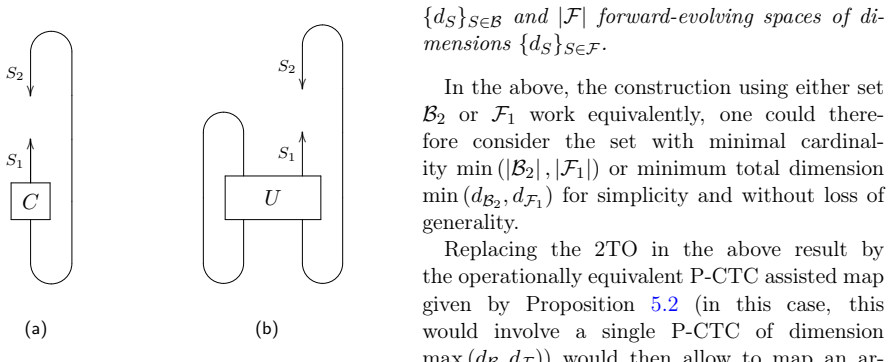
- The construction gives explicit resource counts: a multi-time state with backward-evolving set $B_2$ and forward-evolving set $F_1$ needs either $|B_2|$ P-CTCs of dimensions $\{d_S\}_{S\in B_2}$ or $|F_1|$ P-CTCs of dimensions $\{d_S\}_{S\in F_1}$, plus one P-CTC of dimension $\max(d_B,d_F)$.
- Under the partial order defined by P-CTC-free transformations, two-time states sit above all isomorphic multi-time states and two-time operators sit below, and this order transfers to P-CTC-assisted combs.
- A P-CTC-assisted comb can be transformed by free operations into an isomorphic P-CTC-assisted map, so every cyclic-causal network with slots can be compressed to a single P-CTC-assisted map without using additional P-CTCs.
Reading between the lines
- If the equivalence is taken at face value, the dichotomy between retrocausal and causal-loop explanations of a quantum experiment is purely representational: any probabilistic phenomenon admitting one description admits the other, so debates about which is more fundamental cannot be settled by measurement statistics alone.
- The minimal number and total dimension of P-CTCs needed to realize a given multi-time state could serve as a quantitative measure of how far the state is from an ordinary acyclic circuit, and may behave monotonically under the paper's free operations.
- A direct experimental test would be to implement the constructed P-CTC-assisted comb in a photonic post-selection experiment and compare its outcome statistics with the pre- and post-selection probability rule for the target multi-time state; the paper's operational equivalence predicts exact agreement.
- The strict partial order suggests searching for an information-processing task in which a two-time state strictly outperforms its isomorphic two-time operator; finding one would give the resource order concrete operational meaning beyond the mathematical ordering.
Editorial analysis
A structured set of objections, weighed in public.
Referee Report
Summary. The paper claims an operational equivalence between two extensions of standard quantum theory: the multi-time state (MTS) formalism, which implements time symmetry through arbitrary pre- and post-selections over multiple times, and the post-selected closed timelike curve (P-CTC) framework, which models cyclic causal influence via pre- and post-selection on maximally entangled states. The authors introduce the class of time-labelled P-CTC-assisted combs, which endow P-CTC circuits with open processing slots and explicit time labels, thereby matching the structure of multi-time objects. Their main result (Theorem 1.1) states that every (possibly mixed) multi-time object is operationally equivalent to a time-labelled P-CTC-assisted comb, and vice versa. The P-CTC-to-MTS direction is drawn from prior results (Section 4), while the MTS-to-P-CTC direction is the novel contribution, built in three stages: (i) explicit P-CTC-assisted circuits for arbitrary pure two-time operators (Section 5.1, with a basis-change proposition proven in Appendix C.2); (ii) a reduction of arbitrary MTS to two-time operators by time-teleportation with P-CTCs (Proposition 5.3, proven in Appendix C.3); and (iii) an extension to mixed objects (Section 5.3). The paper also defines a partial order on isomorphic MTS under transformations that do not use P-CTCs (Section 6), showing that two-time states are maximally useful and two-time operators minimally so.
Significance. If the main theorem is fully established, this is a substantial unification: it would show that the time-symmetric MTS framework and the cyclic-causality P-CTC framework are operationally interchangeable, allowing results, constructions, and complexity-theoretic statements to be transferred in both directions. The paper's strengths include several explicit computations (Lemma 3.2 in Appendix B.1; the two-P-CTC construction for pure 2TOs in Appendix C.1), a nontrivial and apparently correct proof of Proposition 5.1 via the intermediate value theorem (Appendix C.2), careful resource accounting (numbers and dimensions of the P-CTCs used), and a first step toward a resource theory in the partial order of Section 6. The significance is, however, conditional on closing a gap in the proof of Proposition 5.3, which is the pivot of the novel direction and is currently a pictorial and verbal sketch rather than an explicit verification.
major comments (2)
- [Section 5.2 / Proposition 5.3 / Appendix C.3] The proof of Proposition 5.3 in Appendix C.3 is the load-bearing step of the novel direction of Theorem 1.1, yet as written it is a verbal and pictorial sketch. The key operation is the assertion that the target MTS can be obtained from an isomorphic 2TO by teleporting each backward-evolving system in B2 (or forward-evolving system in F1) to its target time 'using a P-CTC of the same dimension as Si', but (i) the 'P-CTC with an open end' of Figs. 18-19 is not shown to be an admitted primitive of the time-labelled P-CTC-assisted comb formalism: in Definition B.4/B.5 the P-CTCs act on ancillas connecting the comb's global future to its global past, whereas the open-end P-CTC acts on a system at a slot boundary in the middle of the comb; (ii) no computation is given showing that this operation, which at the MTS level is composition with the maximally entangled 2TS of Eq. (21), preserves the coefficients of the 2TO up to an overall constant, reproduces the target time labels, and leaves the labels and slot structure of the remaining systems untouched, in the general multi-system case with |B2| or |F1| larger than one; and (iii) the proof does not demonstrate that the final object is a time-labelled P-CTC-assisted comb with the same slots as the target MTS rather than a more general cyclic circuit, so the claimed match with Definition B.5 is not established. Since Propositions 5.2 and 5.4 depend on this step, Theorem 1.1 is not fully proven until Proposition 5.3 receives an explicit proof: I would ask the authors to define the open-wire teleportation as an MTS composition rule, compute its action on a general (entangled) 2TO, and show that the resulting object falls under Definition B.5, at least for the single-system bending step with the multi-system case following by iteration.
- [Section 5.1, Eqs. (22)-(24) and Fig. 12] The central claim of Section 5.1 - that the circuit of Fig. 12 implements C_CTC = sum_i a_i |psi_i><i| whenever the C_i satisfy C_i|i> = a_i|psi_i> - is asserted without proof. The role of the SWAP is essential but unexplained: taking Eq. (20) literally, the partial trace over A of the controlled operation sum_i (C_i)_S ⊗ |i><i|_A alone gives the sum sum_i C_i, whose action on a basis state |j> includes the off-diagonal contributions sum_{i≠j} C_i|j>; for the operators constructed in Appendix C.1 these are generally nonzero (Tr_Q(U_i)|j> = 2 W_i|j> for j ≠ i), so without the SWAP the implemented operator would not be sum_i a_i|psi_i><i|. The missing identity is Tr_A[(sum_i C_i ⊗ |i><i|_A) ∘ SWAP] = sum_i C_i|i><i|, which restricts the action to the diagonal blocks and makes Eq. (24) sufficient for Eq. (23). I recommend adding this computation, and its analogue in the single-P-CTC construction of Fig. 15, so that the reduction from Eq. (24) to Eq. (23), and hence Proposition 5.2, is explicit.
minor comments (8)
- [Section 5.1, Eq. (24)] There is an indexing typo: the set of operators is written as {C_i}_{i=1}^{d-1} in the sentence preceding Eq. (24), but the condition is over i ∈ {0,...,d-1}; it should be {C_i}_{i=0}^{d-1}.
- [Section 3.3] In the paragraph introducing time-labelled P-CTC-assisted combs, 'former' and 'latter' are interchanged: the slots are provided by the comb formalism, while the time labels are the additional structure, so the sentence 'For the former feature, we will associate time labels... For the latter feature, we will use the concept of quantum combs' should have the two clauses swapped.
- [Definition 3.3] Operational equivalence for P-CTC objects is restricted to proportionality constants k ∈ R, whereas Definition 2.8 allows k ∈ C; since probabilities are insensitive to an overall complex phase, the restriction appears unnecessary and should either be extended to C or justified.
- [Theorem 6.2] The strict chain M2TO ≺ M ≺ M2TS cannot hold when M coincides with M2TO or M2TS themselves; the statement should either exclude the endpoints from the quantification over M, or use non-strict inequalities at the extremes.
- [Section 2.3] The argument that arbitrary MT instruments are operationally preparable goes through the equal-probability case explicitly, but a general instrument J_k = sum_chi A_{k,chi} ⊗ A^dagger_{k,chi} need not have equal weights; the reduction should state that non-uniform weights can be absorbed into the Kraus vectors up to an overall constant, so that the construction of Section 5.3 applies to each instrument element.
- [Appendix C.3] The two routes in the proof of Proposition 5.3 are presented in the opposite order from the proposition statement (the |F1|-P-CTC route is described first although the statement lists the |B2|-P-CTC route first); aligning the presentation would avoid confusion about which construction yields which resource count.
- [References] References [9] and [10] are identical (both cite Araújo, Guérin and Baumeler, Phys. Rev. A 96, 052315 (2017)); the intended second citation should be corrected, and the URLs in Refs. [50] and [68] contain typos.
- [Section 4, Proposition 4.3] The proof of Proposition 4.3 is a one-sentence sketch; since this proposition supplies the 'vice versa' direction of Theorem 1.1, a short explicit argument (reducing a comb to its tooth maps and composing the P-CTC-to-2TS correspondence of Proposition 4.2) would make the equivalence self-contained.
Circularity Check
No circular reduction found: Theorem 1.1's mappings are derived from the explicit P-CTC and MTS definitions plus independent linear-algebra constructions; the Appendix C.3 teleportation sketch is an omitted verification, not a self-referential reduction.
full rationale
The central equivalence is not circular. Section 5.1 constructs arbitrary pure 2TOs from the independent P-CTC action formula (Eq. (20) and Lemma 3.2, proved in Appendix B.1) and a controlled-unitary circuit; the equality C_CTC = (1/r')C is checked by computation in Appendix C.1. Proposition 5.1 is a self-contained linear-algebra argument (rotation plus intermediate value theorem) that equalizes coefficients in a suitable basis; it does not assume the MTS/P-CTC equivalence. Section 5.2 reduces general MTS to 2TOs via the P-CTC teleportation primitive; the proof of Proposition 5.3 in Appendix C.3 is pictorial and does not explicitly verify the multi-system 'P-CTC with an open end' primitive (see Fig. 18 and the surrounding text: 'The backward-evolving state S2 of the 2TO is teleported to the future using a P-CTC with an open end'). This is a proof-completeness gap for the novel direction, not a circular step: the primitive is asserted to implement teleportation, not asserted to reproduce the target MTS by definition. Proposition 4.3 (P-CTC to MTS) is a compositionality argument over known results (Aharonov et al., Lloyd et al.) and the explicit Definition B.5; the authors' own citations [3,8] concern the MTS formalism and positivity lemmas, and the equivalence claim itself is not reduced to them. No equation reduces to its own input, no fitted parameter is relabelled a prediction, and no author-imported uniqueness theorem forces the choice. Hence no circularity; score 0.
Assumptions & free parameters
assumptions (4)
- domain assumption Standard quantum mechanics with post-selection, including the Born rule and conditional probabilities, is the foundational setting of the MTS formalism.
- domain assumption Post-selected teleportation on maximally entangled states provides a valid model of closed timelike curves, as established in refs [4,5] and reviewed in Section 3.
- standard math Quantum combs and the link product, introduced in ref [36] and reviewed in Appendix B.3.1, correctly describe acyclic quantum circuits with open slots.
- domain assumption The MTS composition rule (Definition A.1) and probability rule (Eq. 10) are taken as the defining axioms of the multi-time formalism.
invented entities (1)
-
Time-labelled P-CTC assisted comb
Cite this review
Pith. "Pith review of An equivalence between time-symmetry and cyclic causality in quantum theory." pith.science (2026). https://pith.science/paper/7BP5MSSM
@misc{pith2026250802463,
  author       = {Pith},
  title        = {Pith review of: An equivalence between time-symmetry and cyclic causality in quantum theory},
  year         = {2026},
  howpublished = {\url{https://pith.science/paper/7BP5MSSM}},
  note         = {Machine review of arXiv:2508.02463}
}
read the original abstract
Understanding the relationship between the time-symmetric nature of physical laws and the apparent directionality of causality is a central question in quantum foundations. The standard operational formulation, widely used in quantum information, imposes a definite, acyclic causal order on agents' operations, contrasting with time-symmetric dynamics. Two prominent extensions of this framework are the multi-time state (MTS) formalism, which incorporates time symmetry via arbitrary pre- and post-selection, and the post-selected closed timelike curve (P-CTC) framework, which enables cyclic causal influences through post-selection on maximally entangled states. While prior work has noted structural connections between MTS and P-CTCs, it remained unclear whether an operational equivalence exists, or whether constructive mappings can be established between their most general objects. In this work, we address this gap by extending the P-CTC framework to define time-labelled P-CTC assisted combs, a more general class of P-CTC-assisted objects that support open processing slots and explicit temporal structure. We prove that for every (possibly mixed) MTS, there exists an operationally equivalent time-labelled P-CTC-assisted comb, and vice versa. The equivalence is shown via explicit mappings, while discussing the number and dimensionality of the P-CTCs involved. We also explore a resource-theoretic view of MTS, defining a partial order under free transformations that do not use P-CTCs. We conclude by discussing future directions informed by the operational equivalence between time symmetry and cyclic causality established here.
Figures


Figures from the paper (22 more)




Reference graph
Works this paper leans on
-
[10]
Quantum computation with indefinite causal structures
Mateus Araújo, Philippe Allard Guérin, and Ämin Baumeler. Quantum computation with indefinite causal structures. Physi- cal Review A, 96(5):052315, 2017. URL https://link.aps.org/doi/10.1103/ PhysRevA.96.052315
2017
-
[1]
Yakir Aharonov, Peter G. Bergmann, and Joel L. Lebowitz. Time Symme- try in the Quantum Process of Measure- ment. Physical Review, 134(6B):B1410– B1416, 1964. URLhttps://link.aps.org/ doi/10.1103/PhysRev.134.B1410
-
[2]
Com- plete description of a quantum system at a given time
Yakir Aharonov and Lev Vaidman. Com- plete description of a quantum system at a given time. Journal of Physics A: Math- ematical and General , 24(10):2315–2328,
-
[3]
Short, and Sandu Popescu
Ralph Silva, Yelena Guryanova, Nicolas Brunner, Noah Linden, Anthony J. Short, and Sandu Popescu. Pre- and post- selected quantum states: Density ma- trices, tomography, and Kraus opera- tors. Physical Review A , 89(1):012121,
-
[4]
Rozema, Ardavan Darabi, Yasaman Souda- gar, Lynden K
Seth Lloyd, Lorenzo Maccone, Raul Garcia-Patron, Vittorio Giovannetti, Yu- taka Shikano, Stefano Pirandola, Lee A. Rozema, Ardavan Darabi, Yasaman Souda- gar, Lynden K. Shalm, and Aephraim M. Steinberg. Closed Timelike Curves via Postselection: Theory and Experimen- tal Test of Consistency. Physical Re- view Letters, 106(4):040403, 2011. URL https://link....
2011
-
[5]
Quantum mechanics of time travel through post-selected telepor- tation
Seth Lloyd, Lorenzo Maccone, Raul Garcia- Patron, Vittorio Giovannetti, and Yu- taka Shikano. Quantum mechanics of time travel through post-selected telepor- tation. Physical Review D, 84(2):025007,
-
[6]
Quantum correlations with no causal order
Ognyan Oreshkov, Fabio Costa, and Časlav Brukner. Quantum correlations with no causal order. Nature Communications, 3(1): 1092, 2012. URLhttp://www.nature.com/ articles/ncomms2076
2012
-
[7]
Quantum computations with- out definite causal structure
Giulio Chiribella, Giacomo Mauro D’Ariano, Paolo Perinotti, and Benoit Valiron. Quantum computations with- out definite causal structure. Phys- ical Review A - Atomic, Molecular, and Optical Physics , 88(2):1–15, 2013. URL https://journals.aps.org/pra/ abstract/10.1103/PhysRevA.88.022318
Show all 96 references
-
[8]
Short, Paul Skrzypczyk, Nicolas Brunner, and Sandu Popescu
Ralph Silva, Yelena Guryanova, Anthony J. Short, Paul Skrzypczyk, Nicolas Brunner, and Sandu Popescu. Connecting pro- cesses with indefinite causal order and multi-time quantum states. New Journal of Physics, 19(10):103022, 2017. URL https://iopscience.iop.org/article/ 10.1088...
2017 doi
-
[11]
Causal categories: Relativistically interacting pro- cesses
Bob Coecke and Raymond Lal. Causal categories: Relativistically interacting pro- cesses. Foundations of Physics , 43(4): 458–501, 2012. URL http://dx.doi.org/ 10.1007/s10701-012-9646-8
2012 doi
-
[12]
Time asymmetry of probabilities versus rela- tivistic causal structure: An arrow of time
Bob Coecke and Raymond Lal. Time asymmetry of probabilities versus rela- tivistic causal structure: An arrow of time. Physical Review Letters, 108(20),
-
[13]
Ognyan Oreshkov and Nicolas J. Cerf. Oper- ational formulation of time reversal in quan- tum theory.Nature Physics, 11(10):853–858,
-
[14]
Leifer and Matthew F
Matthew S. Leifer and Matthew F. Pusey. Is a time symmetric interpretation of quan- tum theory possible without retrocausality? Proceedings of the Royal Society A: Mathe- matical, Physical and Engineering Sciences, 473(2202):20160607, 2017. URLhttp://dx. doi.org/10.1098/rspa.2016.0607
2017
-
[15]
Categorical semantics for time travel, 2019
Nicola Pinzani, Stefano Gogioso, and Bob Coecke. Categorical semantics for time travel, 2019. URL https://arxiv.org/ abs/1902.00032
2019 arXiv
-
[16]
Selby, Maria E
John H. Selby, Maria E. Stasinou, Stefano Gogioso, and Bob Coecke. Time symmetry 28 in quantum theories and beyond, 2024. URL https://arxiv.org/abs/2209.07867
2024 arXiv
-
[17]
Cyclic quantum causal models
Jonathan Barrett, Robin Lorenz, and Ognyan Oreshkov. Cyclic quantum causal models. Nature Communications, 12(1),
-
[18]
Quantum computing, postselection, and probabilistic polynomial- time, 2004
Scott Aaronson. Quantum computing, postselection, and probabilistic polynomial- time, 2004. URLhttps://arxiv.org/abs/ quant-ph/0412187
2004 arXiv
-
[19]
Brun and Mark M
Todd A. Brun and Mark M. Wilde. Perfect State Distinguishability and Computational Speedups with Postselected Closed Timelike Curves. Foundations of Physics, 42(3):341– 361, 2012. URL http://link.springer. com/10.1007/s10701-011-9601-0
2012 doi
-
[20]
Richard P. Feynman. Space-time ap- proach to non-relativistic quantum me- chanics. Rev. Mod. Phys. , 20:367–387,
-
[21]
Schrödinger’s cat and the clock: lessons for quantum gravity
Robert Oeckl. Schrödinger’s cat and the clock: lessons for quantum gravity. Classi- cal and Quantum Gravity, 20(24):5371–5380,
-
[22]
general boundary
Robert Oeckl. A “general boundary” formulation for quantum mechanics and quantum gravity. Physics Letters B , 575(3):318–324, 2003. URL https: //www.sciencedirect.com/science/ article/pii/S0370269303013066
2003
-
[23]
Quantum mechanics near closed timelike lines
David Deutsch. Quantum mechanics near closed timelike lines. Physical Re- view D, 44(10):3197–3217, 1991. URL https://link.aps.org/doi/10.1103/ PhysRevD.44.3197
1991
-
[24]
Quantum mechanics, local realistic theories, and lorentz-invariant re- alistic theories
Lucien Hardy. Quantum mechanics, local realistic theories, and lorentz-invariant re- alistic theories. Phys. Rev. Lett., 68:2981– 2984, 1992. URL https://link.aps.org/ doi/10.1103/PhysRevLett.68.2981
1992 doi
-
[25]
Struppa, and Jeff Tollaksen
Yakir Aharonov, Fabrizio Colombo, Sandu Popescu, Irene Sabadini, Daniele C. Struppa, and Jeff Tollaksen. The quan- tum pigeonhole principle and the nature of quantum correlations, 2014. URL https://arxiv.org/abs/1407.3194
2014 arXiv
-
[26]
Struppa, and Jeff Tollaksen
Yakir Aharonov, Fabrizio Colombo, Sandu Popescu, Irene Sabadini, Daniele C. Struppa, and Jeff Tollaksen. Quantum violation of the pigeonhole principle and the nature of quantum correlations.Proceedings of the National Academy of Sciences, 113(3): 532–535, 2016. URL https://www...
2016 doi
-
[27]
The Two-State Vector Formalism: An Up- dated Review
Yakir Aharonov and Lev Vaidman. The Two-State Vector Formalism: An Up- dated Review. In Time in Quantum Mechanics, volume 734, pages 399–447. Springer Berlin Heidelberg, Berlin, Heidel- berg, 2007. URL http://link.springer. com/10.1007/978-3-540-73473-4{_}13
2007 doi
-
[28]
Yakir Aharonov and David Z. Albert. Is the usual notion of time evolution adequate for quantum-mechanical systems? i.Phys. Rev. D, 29:223–227, 1984. URL https://link. aps.org/doi/10.1103/PhysRevD.29.223
1984 doi
-
[29]
Albert, and Susan S
Yakir Aharonov, David Z. Albert, and Susan S. D’Amato. Multiple-time properties of quantum-mechanical systems. Physical Review D, 32(8):1975–1984, 1985. URL https://link.aps.org/doi/10.1103/ PhysRevD.32.1975
1975
-
[30]
PhD thesis, Tel Aviv Univer- sity, 1987
Lev Vaidman. PhD thesis, Tel Aviv Univer- sity, 1987. Unpublished
1987
-
[31]
PhD thesis, Tel Aviv Uni- versity, 1991
Sandu Popescu. PhD thesis, Tel Aviv Uni- versity, 1991. Unpublished
1991
-
[32]
Multiple-time states andmultiple-timemeasurementsinquantum mechanics
YakirAharonov, SanduPopescu, JeffTollak- sen, and Lev Vaidman. Multiple-time states andmultiple-timemeasurementsinquantum mechanics. Physical Review A, 79(5):052110,
-
[33]
Springer Berlin Heidelberg, Berlin, 1983
Karl Kraus.States, Effects, and Operations: Fundamental Notions of Quantum Theory, volume 190 of Lecture Notes in Physics. Springer Berlin Heidelberg, Berlin, 1983. URL https://link.springer.com/book/ 10.1007/3-540-12732-1. Lecture Notes in Physics, vol. 190
1983 doi
-
[34]
Talk at QUPON Wien, 2005
Charles H Bennett. Talk at QUPON Wien, 2005
2005
-
[35]
Horowitz and Juan Maldacena
Gary T. Horowitz and Juan Maldacena. The black hole final state. Journal of High En- ergy Physics, 2004(02):008–008, 2004. URL http://stacks.iop.org/1126-6708/ 2004/i=02/a=008?key=crossref. e6d2ae7d6fc0a9a1d872cde95cc8e45e
2004
-
[36]
D’Ariano, and Paolo Perinotti
Giulio Chiribella, Giacomo M. D’Ariano, and Paolo Perinotti. Quantum circuit ar- 29 chitecture. Phys. Rev. Lett., 101:060401,
-
[37]
D’Ariano, and Paolo Perinotti
Giulio Chiribella, Giacomo M. D’Ariano, and Paolo Perinotti. Probabilistic theories with purification. Phys. Rev. A, 81:062348,
-
[38]
D’Ariano, Giulio Chiri- bella, and Paolo Perinotti
Giacomo M. D’Ariano, Giulio Chiri- bella, and Paolo Perinotti. Quantum Theory from First Principles: An Infor- mational Approach. Cambridge University Press, Cambridge, 2017. URL https: //www.cambridge.org/core/books/ quantum-theory-from-first-principles/ 4B583F61C12E168F55FBC...
2017
-
[39]
Cat- egorical Quantum Mechanics I: Causal Quantum Processes , volume 1
Bob Coecke and Aleks Kissinger. Cat- egorical Quantum Mechanics I: Causal Quantum Processes , volume 1. Ox- ford University Press, 2018. ISBN 9780198748991. URL https://oxford. universitypressscholarship.com/view/ 10.1093/oso/9780198748991.001.0001/ oso-9780198748991-chapter-12
2018
-
[40]
Cambridge University Press, 2017
Bob Coecke and Aleks Kissinger.Picturing Quantum Processes: A First Course in Quantum Theory and Diagrammatic Rea- soning. Cambridge University Press, 2017. URL https://www.cambridge.org/core/ books/picturing-quantum-processes/ 1119568B3101F3A685BE832FEEC53E52
2017
-
[41]
Maximal incompatibility of locally classical behavior and global causal order in multiparty scenarios.Physical Review A, 90 (4), 2014
Ämin Baumeler, Adrien Feix, and Stefan Wolf. Maximal incompatibility of locally classical behavior and global causal order in multiparty scenarios.Physical Review A, 90 (4), 2014. URL http://dx.doi.org/10. 1103/PhysRevA.90.042106
2014
-
[42]
The space of logically consistent classical pro- cesses without causal order
Ämin Baumeler and Stefan Wolf. The space of logically consistent classical pro- cesses without causal order. New Journal of Physics , 18(1):013036, 2016. URL http://dx.doi.org/10.1088/1367-2630/ 18/1/013036
2016 doi
-
[43]
Reversible dynamics with closed time-like curves and freedom of choice
Germain Tobar and Fabio Costa. Reversible dynamics with closed time-like curves and freedom of choice. Classical and Quantum Gravity, 37(20):205011, 2020. URLhttp:// dx.doi.org/10.1088/1361-6382/aba4bc
2020 doi
-
[44]
Vilasini and Roger Colbeck
V. Vilasini and Roger Colbeck. Im- possibility of superluminal signaling in minkowski spacetime does not rule out causal loops. Physical Review Letters, 129 (11), 2022. URL http://dx.doi.org/10. 1103/PhysRevLett.129.110401
2022
-
[45]
Vilasini and Roger Colbeck
V. Vilasini and Roger Colbeck. Gen- eral framework for cyclic and fine-tuned causal models and their compatibility with space-time. Physical Review A , 106(3),
-
[46]
Vi- lasini
Carla Ferradini, Victor Gitton, and V. Vi- lasini. Cyclicquantumcausalmodellingwith a graph separation theorem, 2025. URL https://arxiv.org/abs/2502.04168
2025 arXiv
-
[47]
Vi- lasini
Carla Ferradini, Victor Gitton, and V. Vi- lasini. Cyclic functional causal models be- yond unique solvability with a graph separa- tion theorem, 2025. URL https://arxiv. org/abs/2502.04171
2025 arXiv
-
[48]
Vilasini and Roger Colbeck
V. Vilasini and Roger Colbeck. Information- processing in theories constrained by no su- perluminal causation vs no superluminal sig- nalling, 2024. URL https://arxiv.org/ abs/2402.12446
2024 arXiv
-
[49]
Quantum cheshire cats
Yakir Aharonov, Sandu Popescu, Daniel Rohrlich, and Paul Skrzypczyk. Quantum cheshire cats. New Journal of Physics, 15 (11):113015, 2013. URL http://dx.doi. org/10.1088/1367-2630/15/11/113015
2013 doi
-
[50]
Each instant of time a new Universe
Yakir Aharonov, Sandu Popescu, and Jeff Tollaksen. Each instant of time a new Universe. Quantum Theory: A Two-Time Success Story, pages 21–36, 2013. URL http://link.springer.com/10.1007/ 978-88-470-5217-8{_}3http://arxiv. org/abs/1305.1615http://dx.doi.org/ 10.1007/978-88-470-...
2013 arXiv
-
[51]
Pusey and Matthew S
Matthew F. Pusey and Matthew S. Leifer. Logicalpre-andpost-selectionparadoxesare proofs of contextuality. Electronic Proceed- ings in Theoretical Computer Science, 195 (Qpl):295–306, 2015. URL http://arxiv. org/abs/1506.07850v2
2015 arXiv
-
[52]
Oper- ational quantum theory without predefined time
Ognyan Oreshkov and Nicolas J Cerf. Oper- ational quantum theory without predefined time. New Journal of Physics, 18(7):073037,
-
[53]
Time symmetry in opera- tional theories, 2021
Lucien Hardy. Time symmetry in opera- tional theories, 2021. URLhttps://arxiv. org/abs/2104.00071
2021 arXiv
-
[54]
Quan- 30 tum operations with indefinite time di- rection
Giulio Chiribella and Zixuan Liu. Quan- 30 tum operations with indefinite time di- rection. Communications Physics, 5(1),
-
[55]
Lucien Hardy. The operator tensor formula- tion of quantum theory.Philosophical Trans- actions of the Royal Society A: Mathemati- cal, Physical and Engineering Sciences, 370 (1971):3385–3417, 2012. URL http://dx. doi.org/10.1098/rsta.2011.0326
1971
-
[56]
Jones, and Vlatko Vedral
Joseph Fitzsimons, Jonathan A. Jones, and Vlatko Vedral. Quantum correlations which imply causation.Scientific Reports, 5:18281,
-
[57]
Parzygnat
James Fullwood and Arthur J. Parzygnat. On quantum states over time. Proceedings of the Royal Society A: Mathematical, Phys- ical and Engineering Sciences, 478(2264),
-
[58]
Vilasini and Renato Renner
V. Vilasini and Renato Renner. Embed- ding cyclic information-theoretic structures in acyclic space-times: No-go results for in- definite causality.Phys. Rev. A, 110:022227,
-
[59]
Vilasini and Renato Renner
V. Vilasini and Renato Renner. Fundamen- tal limits for realizing quantum processes in spacetime. Physical Review Letters, 133(8),
-
[60]
Vilasini, Lin-Qing Chen, Liuhang Ye, and RenatoRenner
V. Vilasini, Lin-Qing Chen, Liuhang Ye, and RenatoRenner. Eventsandtheirlocalisation are relative to a lab, 2025. URLhttps:// arxiv.org/abs/2505.21797
2025 arXiv
-
[61]
Experimental superposition of orders of quantum gates.Nature commu- nications, 6(1):7913, 2015
Lorenzo M Procopio, Amir Moqanaki, Mateus Araújo, Fabio Costa, Irati Alonso Calafell, Emma G Dowd, Deny R Hamel, Lee A Rozema, Časlav Brukner, and Philip Walther. Experimental superposition of orders of quantum gates.Nature commu- nications, 6(1):7913, 2015. URL https:// www.n...
2015
-
[62]
Rozema, Adrien Feix, Mateus Araújo, Jonas M
Giulia Rubino, Lee A. Rozema, Adrien Feix, Mateus Araújo, Jonas M. Zeuner, Lorenzo M. Procopio, Časlav Brukner, and Philip Walther. Experimental verification of an indefinite causal order.Science Advances, 3(3), 2017. URL http://dx.doi.org/10. 1126/sciadv.1602589
2017
-
[63]
CausalBoxes: QuantumInformation- Processing Systems Closed under Compo- sition
Christopher Portmann, Christian Matt, Ueli Maurer, Renato Renner, and Bjorn Tack- mann. CausalBoxes: QuantumInformation- Processing Systems Closed under Compo- sition. IEEE Transactions on Information Theory, 63(5):3277–3305, 2017. ISSN 0018-
2017
-
[64]
Vilasini
V. Vilasini. Causality in quantum the- ory (and beyond). Masters Thesis, ETH Zürich, 2017. URL https://foundations. ethz.ch/wp-content/uploads/2019/07/ vilasini_master_thesis-v2.pdf
2017
-
[65]
Time-delocalized quan- tum subsystems and operations: on the ex- istence of processes with indefinite causal structure in quantum mechanics.Quantum, 3:206, 2019
Ognyan Oreshkov. Time-delocalized quan- tum subsystems and operations: on the ex- istence of processes with indefinite causal structure in quantum mechanics.Quantum, 3:206, 2019. URL https://doi.org/10. 22331/q-2019-12-02-206
2019
-
[66]
Causal orders, quantum circuits and space- time: distinguishing between definite and superposed causal orders
Nikola Paunković and Marko Vojinović. Causal orders, quantum circuits and space- time: distinguishing between definite and superposed causal orders. Quantum, 4:275,
-
[67]
Causal structure in the presence of sectorial constraints, with appli- cation to the quantum switch.Quantum, 7: 1028, 2023
Nick Ormrod, Augustin Vanrietvelde, and Jonathan Barrett. Causal structure in the presence of sectorial constraints, with appli- cation to the quantum switch.Quantum, 7: 1028, 2023. URL http://dx.doi.org/10. 22331/q-2023-06-01-1028
2023
-
[68]
URL http://dx.doi.org/10.1038/ s42005-022-00967-3
-
[69]
Map- ping indefinite causal order processes to composable quantum protocols in a space- time
Matthias Salzger and V Vilasini. Map- ping indefinite causal order processes to composable quantum protocols in a space- time. New Journal of Physics, 27(2):023002,
-
[70]
Connecting indefinite causal order processes to composable quan- tum protocols in a spacetime, 2023
Matthias Salzger. Connecting indefinite causal order processes to composable quan- tum protocols in a spacetime, 2023. URL https://arxiv.org/abs/2304.06735
2023 arXiv
-
[71]
URL https://doi.org/10.1038/ srep18281
-
[72]
Completely posi- tive linear maps on complex matrices
Man-Duen Choi. Completely posi- tive linear maps on complex matrices. Linear Algebra and its Applications , 10(3):285–290, 1975. URL https: //www.sciencedirect.com/science/ article/pii/0024379575900750
1975
-
[73]
URL http://dx.doi.org/10.1098/ rspa.2022.0104
2022
-
[74]
empty slots
Giulio Chiribella, Giacomo Mauro D’Ariano, and Paolo Perinotti. Theoretical framework for quantum networks. Phys. Rev. A, 80: 022339, 2009. URL https://link.aps. org/doi/10.1103/PhysRevA.80.022339. A MTS framework: details and proofs A.1 Composition Definition A.1(Composition)...
2009 doi
-
[77]
URL http://dx.doi.org/10.1103/ PhysRevLett.133.080201
-
[88]
Identification is pointless: Quantum coordinates, localisation of events, and the quantum hole argument, 2025
Viktoria Kabel, Anne-Catherine de la Hamette, Luca Apadula, Carlo Cepollaro, Henrique Gomes, Jeremy Butterfield, and Časlav Brukner. Identification is pointless: Quantum coordinates, localisation of events, and the quantum hole argument, 2025. URL ttps://arxiv.org/abs/2402.10267
2025 arXiv
-
[92]
Causal boxes: Quantum information- processing systems closed under composi- tion
Christopher Portmann, Christian Matt, Ueli Maurer, Renato Renner, and Bjorn Tack- 31 mann. Causal boxes: Quantum information- processing systems closed under composi- tion. IEEE Transactions on Information Theory, pages 1–1, 2017. URL https:// doi.org/10.1109%2Ftit.2017.2676805
2017
-
[94]
Jamiołkowski
A. Jamiołkowski. Linear transforma- tions which preserve trace and pos- itive semidefiniteness of operators. Reports on Mathematical Physics , 3 (4):275–278, 1972. URL https: //www.sciencedirect.com/science/ article/pii/0034487772900110
1972
-
[96]
The coefficientsaθ (θ) and aθ⊥ (θ) are both continuous functions inθ
-
[97]
The states|ψθ⟩,|ψθ⊥⟩ and all|ψj⟩ are normalized and can depend onθ
-
[98]
The coefficients satisfy|aθ (0)|2 =|amax|2 and ⏐⏐aθ (π 2 )⏐⏐2 =|amin|2. Proof. Recall from Eq. (74) thatC can be written as C =amax|ψmax⟩⟨max| +amin|ψmin⟩⟨min| + ∑ j̸=max,min aj|ψj⟩⟨j| (79) 43 Then consider the rotation in the plane defined by{|max⟩,|min⟩} as given in Eq. (75)...
-
[1948]
URL https://link.aps.org/doi/ 10.1103/RevModPhys.20.367
-
[1991]
URLhttps://iopscience.iop.org/ article/10.1088/0305-4470/24/10/018
-
[2003]
URL http://dx.doi.org/10.1088/ 0264-9381/20/24/009
-
[2008]
URL https://link.aps.org/doi/ 10.1103/PhysRevLett.101.060401
-
[2009]
URL https://link.aps.org/doi/ 10.1103/PhysRevA.79.052110
-
[2010]
URL https://link.aps.org/doi/ 10.1103/PhysRevA.81.062348
-
[2011]
URL https://link.aps.org/doi/ 10.1103/PhysRevD.84.025007
-
[2012]
URL http://dx.doi.org/10.1103/ PhysRevLett.108.200403
-
[2014]
URL https://link.aps.org/doi/ 10.1103/PhysRevA.89.012121
-
[2015]
URL http://dx.doi.org/10.1038/ nphys3414
-
[2016]
URL http://dx.doi.org/10.1088/ 1367-2630/18/7/073037
- [2020]
-
[2021]
URL http://dx.doi.org/10.1038/ s41467-020-20456-x
-
[2022]
URL http://dx.doi.org/10.1103/ PhysRevA.106.032204
-
[2024]
URL https://link.aps.org/doi/ 10.1103/PhysRevA.110.022227
-
[2025]
URLhttps://dx.doi.org/10.1088/ 1367-2630/ad9d6f
Reviewed August 6, 2026 · model on record in the stance chip above.
Discussion (0). Sign in to comment.