REVIEW 3 major objections 6 minor 1 cited by
The KG-ER Conceptual Schema Language
T0 review · 3 major / 6 minor · reviewed 2026-08-06 · deepseek-v4-flash
Pith's one-line read This paper proposes KG-ER, a representation-independent schema language for knowledge graphs with first-order semantics, tree-pattern keys, and EXPTIME-decidable entailment.
desk verdict Useful schema language with clean FOL semantics; unproved EXPTIME claim is the main gap. read the letter →
The pith
A machine-rendered reading of the paper's core claim, the machinery that carries it, and where it could break.
The reading
What carries the argument
The central object is the tree-pattern key: a term with attribute names at the leaves and role names at internal nodes, rooted at an entity or relationship, formalized as an acyclic conjunctive query whose first-order translation depends on whether the root is an entity or a relationship. The Key statement enforces uniqueness of the values extracted by the patterns; the Identity statement adds totality and uniqueness of the whole tuple, which is what lets KG-ER express weak entities, composite keys, and the restriction of multi-edge relationships. Around this mechanism sit the first-order semantics of Figure 3, which convert every schema statement into a formula, and the claimed reification encoding into FunDL feature-based description logics, which is the step that would yield EXPTIME-decidability of entailment.
What would settle it
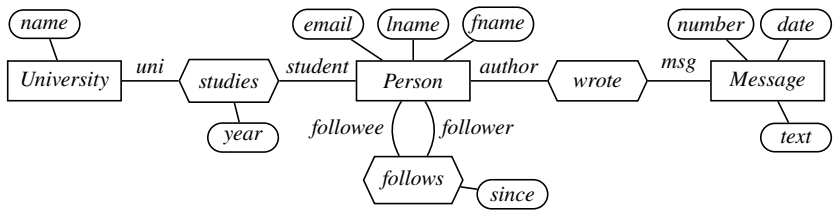
Apply the Section 4.2 reification to the running example schema: encode its tree-pattern identity keys, including the weak-entity key $\mathit{Identity}(\mathit{Message}, [\mathit{msg}(\mathit{author}(\mathit{fname},\mathit{lname})), \mathit{number}])$, as FunDL concept inclusions with relationships reified as features; if any such key resists the encoding, or if the encoding's verdict on a small hand-checked entailment between two schemas disagrees with the first-order semantics of Figure 3, the claimed EXPTIME decidability is refuted.
Extended reading notes
Core claim
The paper establishes KG-ER as a schema language whose statements divide into a shape graph (entity, relationship, attribute, and role declarations) and constraints: participation, simple keys, identity keys, and an entity type hierarchy with disjointness and coverage statements. Every statement receives a first-order-logic translation, so a schema denotes the set of knowledge graphs satisfying its formulas. The distinctive machinery is the tree-pattern key, an acyclic conjunctive query over the shape graph whose role literals are read direction-sensitively depending on whether the pattern is rooted at an entity or a relationship, and which identifies entity and relationship instances independently of the storage representation. The paper further claims that entailment among KG-ER schemas is decidable in EXPTIME, using a reification of relationships as features and an encoding into FunDL feature-based description logics, and it demonstrates the language's scope by capturing a major social-network benchmark schema and by translating its running example into relational SQL, SHACL, ShEx, and PG-Schema. Two deliberate choices frame the semantics: identity keys must be ground patterns (leaves are concrete attribute values only), and implicit disjointness of unrelated entities is offered as an optional semantics $\mathcal{L}_\bot$ rather than the default.
Load-bearing premise
The load-bearing premise is the claim, stated without proof in Section 4.2, that entailment between KG-ER schemas can be encoded soundly and completely into FunDL feature-based description logics while preserving the EXPTIME bound, because if that encoding is not correct the paper loses its concrete reasoning route and its complexity yardstick even though the first-order semantics would remain valid.
Editorial extensions
If this is right
- A KG-ER schema can act as a canonical intermediate for translating schemas across representations, so an RDF graph validated by SHACL and a property graph described by PG-Schema can be aligned to the same conceptual description.
- Entailment between KG-ER schemas being decidable in EXPTIME means automated tools could in principle check whether one schema implies another, supporting schema integration and validation.
- The social-network benchmark schema used in the paper is expressible, showing the language handles weak entities and multi-edge relationships at realistic scale.
- Verbalized KG-ER statements improve LLM performance on text-to-query, query optimization, and schema-normalization tasks, as demonstrated in the appendix with a widely used large language model.
- Ground identity keys make instance identification independent of representation artifacts such as surrogate keys, at the price of requiring concrete attribute values in the identifying patterns.
Reading between the lines
- If the FunDL encoding is worked out and proved, a practical consequence the paper leaves implicit follows: SHACL, ShEx, and PG-Schema fragments could be compared for relative expressiveness by translating them into KG-ER and deciding mutual entailment.
- The restriction of identity keys to ground patterns implies a boundary: entity instances distinguishable only by system-generated identifiers cannot be canonically identified in KG-ER, so global distinguishability holds only over concrete data values.
- A natural testable extension is to allow bounded cycles in key patterns, which would bring KG-ER's keys closer to the regular-path-query constraints of SHACL but would likely push reasoning complexity beyond EXPTIME.
- The appendix's LLM experiments suggest a cheap empirical follow-up: measure whether conceptual-schema verbalization improves cross-model mapping tasks, such as translating an RDF graph into a property graph, rather than only single-model SQL tasks.
Editorial analysis
A structured set of objections, weighed in public.
Referee Report
Summary. The paper proposes KG-ER, a conceptual schema language for knowledge graphs that combines entity types, relationship types, attributes, inheritance, participation constraints, and tree-pattern-based keys. The language is given a first-order semantics in Figure 3, with patterns evaluated via an explicit translation to FOL. The paper also introduces two semantics (L◦ and L⊥) depending on whether implicit disjointness is assumed, and claims EXPTIME decidability of schema reasoning via an encoding into FunDL. Appendices provide LLM-based illustrations of the language's usefulness and translations to relational, SHACL, ShEx, and PG-Schema.
Significance. The main strength of the paper is its systematic formalization: the FOL semantics in Figure 3 is clear, appears correct, and covers all statement types, including composite keys over tree patterns. The design is thoughtful, and the translations in Appendix B demonstrate that the language can be mapped to concrete schema formalisms. The LDBC-SNB capture in Figure 1 is a useful real-world touchstone. However, the central theoretical claim of EXPTIME decidability is asserted but not proved, and the LLM evidence is anecdotal. If the EXPTIME result can be substantiated, the paper would provide a valuable formal yardstick for schema reasoning in a practical KG schema language; as it stands, the promise of concrete reasoning algorithms is unverified.
major comments (3)
- [Section 4.2] The claim that schema reasoning in KG-ER is decidable in EXPTIME is unsupported. The text states that this follows by encoding entailment to FunDL 'by reifying the relationships using features as suggested in [22]', but no encoding is given, no soundness and completeness theorem is stated, and no argument is made that the encoding preserves the EXPTIME bound. The difficulties are nontrivial: multi-valued attributes (e.g., Person.email), composite identity keys over branching patterns (Identity(Message, [msg(author(fname,lname)), number])), and relationship-level keys with WF4 all require an explicit treatment of set-valued features. Since the cited 'full version' [12] is the present arXiv manuscript, the proof is not available elsewhere. The EXPTIME statement must be either proved or withdrawn and reworded as a conjecture.
- [Section 4.2] The decision problem is not precisely defined. 'Entailment among graphs' is ambiguous: it could mean entailment of a sentence by a schema, subsumption between schemas, or instance checking. Without a precise definition of the input and output of the alleged EXPTIME algorithm, the complexity claim cannot be verified or interpreted.
- [Appendix A] The LLM experiments are presented as evidence that verbalizing KG-ER improves answer quality, but they are anecdotal. Each experiment consists of one or a few manually selected prompts, with no statistical analysis, no quantitative quality metric, and no repeated runs reported (the text claims consistency but gives no data). The claim in the Introduction that KG-ER 'can be easily fed into a specific AI model' and the implied usefulness conclusion are not supported by the evidence as presented. Either a systematic evaluation should be added, or the role of these examples should be explicitly reduced to informal illustration.
minor comments (6)
- [Section 1] The sentence 'In the full version of the paper [12] we we illustrate...' contains a duplicated 'we'.
- [Section 2.2] In the formal definition of valid patterns, condition (2) reads 'p is a role name R' where R is a metavariable used for relationship names; this is confusing and should use a different symbol (e.g., B).
- [Figure 3] The formula for Identity uses 'V_i' where the text elsewhere uses '∧_i'; if the symbol is intended as a conjunction, it should be typeset consistently (e.g., as \wedge).
- [Section 2.3.1] 'An analogous subclass of cardinality constraints allow to specify' should be 'allows'.
- [Appendix B.5] The PG-Schema example has syntactic errors, e.g., '( universityType : University { name STRING )' is missing a closing brace; compare with the surrounding lines.
- [References] Reference [12] is a self-citation to the manuscript itself under a different arXiv version; the 'full version' is not a distinct publication, which matters for the promised proof in Section 4.2.
Circularity Check
No circularity: KG-ER's formal semantics is self-contained and its claims are either definitional or externally supported; the unproven EXPTIME encoding is an unsupported correctness claim, not a circular derivation.
full rationale
KG-ER is a design proposal with prescriptive first-order semantics given in Figure 3; there are no fitted parameters, no empirical predictions derived from fitted inputs, and no equation in the paper equates a claimed output with an input by construction. The language constructs (entity, relationship, attribute, key, identity, participation, type hierarchy) are given explicit FOL translations, and the accompanying examples and mappings to SQL, SHACL, ShEx, and PG-Schema are illustrative translations rather than derived predictions. The only load-bearing theoretical assertion, that KG-ER entailment is EXPTIME-decidable via an encoding to FunDL, is stated without proof ('It can be shown ... by encoding entailment KG-ER to the FunDL Feature-Based Description Logics—by reifying the relationships using features as suggested in [22]'); this is an unsupported or at least unsubstantiated correctness/complexity claim, not a circular step, because the cited FunDL work is external and the claim does not reduce to the paper's own definitions. The self-citation to the full version [12] is not load-bearing for the formal semantics or the decidability claim, and the LLM experiments in the appendix are qualitative demonstrations with no fitted parameters, so no 'prediction' is forced by construction. Accordingly, no circularity step can be exhibited with a specific reduction, and the honest finding is no significant circularity.
Assumptions & free parameters
assumptions (5)
- domain assumption Global uniqueness of attribute and role names in a schema (Section 2.1).
- domain assumption The type hierarchy is acyclic (WF5, Section 2.3.3).
- ad hoc to paper The encoding to FunDL feature-based description logics is sound, complete, and yields EXPTIME entailment (Section 4.2).
- domain assumption Every relationship and every root entity must have an identifying key (WF4, WF6).
- domain assumption The omission of cardinality constraints and relationship inheritance is appropriate for KG practice (Section 1).
Cite this review
Pith. "Pith review of The KG-ER Conceptual Schema Language." pith.science (2026). https://pith.science/paper/7DKWGJAI
@misc{pith2026250802548,
  author       = {Pith},
  title        = {Pith review of: The KG-ER Conceptual Schema Language},
  year         = {2026},
  howpublished = {\url{https://pith.science/paper/7DKWGJAI}},
  note         = {Machine review of arXiv:2508.02548}
}
read the original abstract
We propose KG-ER, a conceptual schema language for knowledge graphs that describes the structure of knowledge graphs independently of their representation (relational databases, property graphs, RDF) while helping to capture the semantics of the information stored in a knowledge graph.
Figures


Figures from the paper (1 more)

Forward citations
Cited by 1 Pith paper
-
More with Less -- Bethel Allocation and Precision-Preserving Sample Size Reduction via Hierarchical Bayes Modelling
Combining Bethel multivariate allocation with Hierarchical Bayes small-area modelling can meet multi-variable, multi-domain CV targets with a smaller sample than ad-hoc Neyman-max designs.
Reference graph
Works this paper leans on
-
[22]
Stephanie McIntyre, David Toman, and Grant E. Weddell. Fundl - A family of feature-based description logics, with applications in querying structured data sources. In Carsten Lutz, Uli Sattler, Cesare Tinelli, Anni-Yasmin Turhan, and Frank Wolter, editors,Description Logic, Theory Combination, and All That - Essays Dedicated to Franz Baader on the Occasio...
work page 2019
-
[12]
The kg-er conceptual schema language, 2025
Enrico Franconi, Benoît Groz, Jan Hidders, Nina Pardal, Sławek Staworko, Jan Van den Bussche, and Piotr Wieczorek. The kg-er conceptual schema language, 2025
work page 2025
-
[1]
Common foundations for shacl, shex, and pg-schema
ShqiponjaAhmetaj,IovkaBoneva,JanHidders,KatjaHose,MaximeJakubowski,JoseEmilioLabraGayo, Wim Martens, Fabio Mogavero, Filip Murlak, Cem Okulmus, Axel Polleres, Ognjen Savković, Mantas Šimkus, and Dominik Tomaszuk. Common foundations for shacl, shex, and pg-schema. InProceedings of the ACM on Web Conference 2025, WWW ’25, page 8–21, New York, NY, USA, 2025....
work page 2025
-
[2]
The LDBC Social Network Benchmark
Renzo Angles, János Benjamin Antal, Alex Averbuch, Peter A. Boncz, Orri Erling, Andrey Gubichev, Vlad Haprian, Moritz Kaufmann, Josep-Lluís Larriba-Pey, and Norbert Martínez-Bazan et al. The LDBC social network benchmark.CoRR, abs/2001.02299, 2020
work page Pith review arXiv 2001
-
[3]
Pg-schema: Schemas for property graphs.Proc
Renzo Angles, Angela Bonifati, Stefania Dumbrava, George Fletcher, Alastair Green, Jan Hidders, Bei Li, Leonid Libkin, Victor Marsault, Wim Martens, Filip Murlak, Stefan Plantikow, Ognjen Savkovic, Michael Schmidt, Juan Sequeda, Slawek Staworko, Dominik Tomaszuk, Hannes Voigt, Domagoj Vrgoc, Mingxi Wu, and Dusan Zivkovic. Pg-schema: Schemas for property g...
work page 2023
-
[4]
Reasoning on UML class diagrams
Daniela Berardi, Diego Calvanese, and Giuseppe De Giacomo. Reasoning on UML class diagrams. Artificial Intelligence, 168(1-2):70–118, October 2005
work page 2005
-
[5]
Threshold queries in theory and in the wild.Proc
Angela Bonifati, Stefania Dumbrava, George Fletcher, Jan Hidders, Matthias Hofer, Wim Martens, Filip Murlak, Joshua Shinavier, Slawek Staworko, and Dominik Tomaszuk. Threshold queries in theory and in the wild.Proc. VLDB Endow., 15(5):1105–1118, 2022
work page 2022
-
[6]
Threshold queries.SIGMOD Rec., 52(1):64–73, 2023
Angela Bonifati, Stefania Dumbrava, George Fletcher, Jan Hidders, Matthias Hofer, Wim Martens, Filip Murlak, Joshua Shinavier, Slawek Staworko, and Dominik Tomaszuk. Threshold queries.SIGMOD Rec., 52(1):64–73, 2023
work page 2023
Show all 33 references
-
[7]
Knowledge Graphs: Introduction, History, and Perspectives.AI Magazine, 43(1):17–29, 2022
Vinay K Chaudhri, Chaitanya Baru, Naren Chittar, Xin Luna Dong, Michael Genesereth, James Hendler, Amit Kalyanpur, Douglas B Lenat, Juan Sequeda, Denny Vrandečić, and Kun Wang. Knowledge Graphs: Introduction, History, and Perspectives.AI Magazine, 43(1):17–29, 2022. Provides a...
2022
-
[8]
Peter P. Chen. The entity-relationship model - toward a unified view of data.ACM Trans. Database Syst., 1(1):9–36, 1976
1976
-
[9]
Deductiveentityrelationshipmodeling
G.DiBattistaandM.Lenzerini. Deductiveentityrelationshipmodeling. IEEETransactionsonKnowledge and Data Engineering, 5(3):439–450, June 1993
1993
-
[10]
Knowledge Graphs: The Future of Data Integration and Insightful Discovery.arXiv preprint arXiv:2502.15689, 2025
Kirollos Farah et al. Knowledge Graphs: The Future of Data Integration and Insightful Discovery.arXiv preprint arXiv:2502.15689, 2025. This recent preprint directly addresses knowledge graphs as the future of data integration. 10
2025 arXiv
-
[11]
UMLDistilled: ABriefGuidetotheStandardObjectModelingLanguage
MartinFowler. UMLDistilled: ABriefGuidetotheStandardObjectModelingLanguage . Addison-Wesley Longman Publishing Co., Inc., USA, 3 edition, 2003
2003
-
[13]
ORM abstract syntax and semantics: normative specification
Enrico Franconi and Terry Halpin. ORM abstract syntax and semantics: normative specification. Technical report, 2020. https://gitlab.com/orm-syntax-and-semantics/ orm-syntax-and-semantics-docs
2020
-
[14]
GQL and SQL/PGQ: Theoretical models and expressive power
Amélie Gheerbrant, Leonid Libkin, Liat Peterfreund, and Alexandra Rogova. GQL and SQL/PGQ: Theoretical models and expressive power. arXiv:2409.01102 [cs.DB], 2024
2024 arXiv
-
[15]
Inferenceofshape graphsforgraph databases
BenoîtGroz, Aurélien Lemay, Slawek Staworko, andPiotr Wieczorek. Inferenceofshape graphsforgraph databases. InDanOlteanuandNilsVortmeier,editors, 25thInternationalConferenceonDatabaseTheory, ICDT 2022, March 29 to April 1, 2022, Edinburgh, UK (Virtual Conference), volume 220 o...
2022
-
[16]
Halpin and Tony Morgan.Information modeling and relational databases
Terry A. Halpin and Tony Morgan.Information modeling and relational databases. Morgan Kaufmann, 3rd edition, 2024
2024
-
[17]
KnowledgeGraphs
AidanHoganetal. KnowledgeGraphs. SynthesisLecturesonData,Semantics,andNetworks ,11(1):1–257,
-
[18]
Maria Keet and Pablo Rubén Fillottrani
C. Maria Keet and Pablo Rubén Fillottrani. An analysis and characterisation of publicly available conceptual models. In Paul Johannesson, Mong Li Lee, Stephen W. Liddle, Andreas L. Opdahl, and Óscar Pastor López, editors,Conceptual Modeling, pages 585–593, Cham, 2015. Springer...
2015
-
[19]
Morgan & Claypool Publishers LLC, sep 2017
Jose Emilio Labra Gayo, Eric Prud'hommeaux, Iovka Boneva, and Dimitris Kontokostas.Validating RDF Data, volume 7 ofSynthesis Lectures on the Semantic Web: Theory and Technology. Morgan & Claypool Publishers LLC, sep 2017
2017
-
[20]
O’Reilly Media, 2023
Victor Lee, Phuc Kien Nguyen, and Alexander Thomas.Graph-Powered Analytics and Machine Learning with TigerGraph. O’Reilly Media, 2023
2023
-
[21]
A Survey of Knowledge Graph Reasoning on Graph Types: Static, Dynamic, and Multimodal
Ke Liang et al. A Survey of Knowledge Graph Reasoning on Graph Types: Static, Dynamic, and Multimodal. arXiv preprint arXiv:2212.05767, 2022
2022 arXiv
-
[23]
Knowledge graphs for NLP: A comprehensive analysis.The Scientific Temper, 1(1):21–28, 2025
Sharayu Mirasdar and Mangesh Bedekar. Knowledge graphs for NLP: A comprehensive analysis.The Scientific Temper, 1(1):21–28, 2025
2025
-
[24]
A study on information-preserving schema transformations
Nonyelum Ndefo and Enrico Franconi. A study on information-preserving schema transformations. International Journal of Semantic Computing, 14(1):27–53, 2020
2020
-
[25]
Springer International Publishing, Cham, 2022
Paolo Pareti and George Konstantinidis.A Review of SHACL: From Data Validation to Schema Reasoning for RDF Graphs, pages 115–144. Springer International Publishing, Cham, 2022
2022
-
[26]
RDF 1.2 Semantics
Peter Patel-Schneider, Dörthe Arndt, and Enrico Franconi. RDF 1.2 Semantics . W3C, https://www.w3.org/TR/rdf12-semantics/, 2025
2025
-
[27]
Prud’hommeaux, and HaroldR.Solbrig
Slawek Staworko, Iovka Boneva, José Emilio Labra Gayo, Samuel Hym, Eric G. Prud’hommeaux, and HaroldR.Solbrig. ComplexityandexpressivenessofshexforRDF. InMarceloArenasandMartínUgarte, editors,18th International Conference on Database Theory, ICDT 2015, March 23-27, 2015, Bruss...
2015
-
[28]
Knowledge graphs for integrated AI
Matthias Thalhammer et al. Knowledge graphs for integrated AI. InProceedings of the 2022 ACM SIGMOD International Conference on Management of Data, pages 2501–2507. ACM, 2022. This paper discusseshowknowledgegraphsfacilitateintegratedAIsystems,withdataintegrationbeingafoundati...
2022
-
[29]
Beyond the Box: Exploring Knowledge Graphs for Semantic Search, Syntactic Search, and Graph Search
Ajay Verma. Beyond the Box: Exploring Knowledge Graphs for Semantic Search, Syntactic Search, and Graph Search. InArtificial Intelligence in Plain English (Medium), 2024. While from Medium, this article provides a good overview and references academic concepts regarding KGs fo...
2024
-
[31]
Join the ‘Department ‘ and ‘Works_in ‘ tables
-
[32]
Group the result by department
-
[33]
universal
Count how many employees are associated with each department . Here is the SQL query : SELECT d.dpt_id , d. dpt_name , COUNT (w. employee_id ) AS num_employees FROM Department d JOIN Works_in w ON d. dpt_id = w. department_id GROUP BY d.dpt_id , d. dpt_name ; ### Explanation :...
2000
-
[2021]
Acomprehensiveandhighlycitedtutorial-stylebookonknowledgegraphs,coveringvariousaspects from models to applications
Reviewed August 6, 2026 · model on record in the stance chip above.
Discussion (0). Sign in to comment.