New high-precision b, c, and s masses from pseudoscalar-pseudoscalar correlators in n_f=4 lattice QCD
Pith reviewed 2026-05-19 00:32 UTC · model grok-4.3
The pith
Lattice QCD simulations with four quark flavors and small spacings down to 0.032 fm determine updated MS-bar masses for the bottom, charm, and strange quarks including QED corrections.
A machine-rendered reading of the paper's core claim, the machinery that carries it, and where it could break.
Core claim
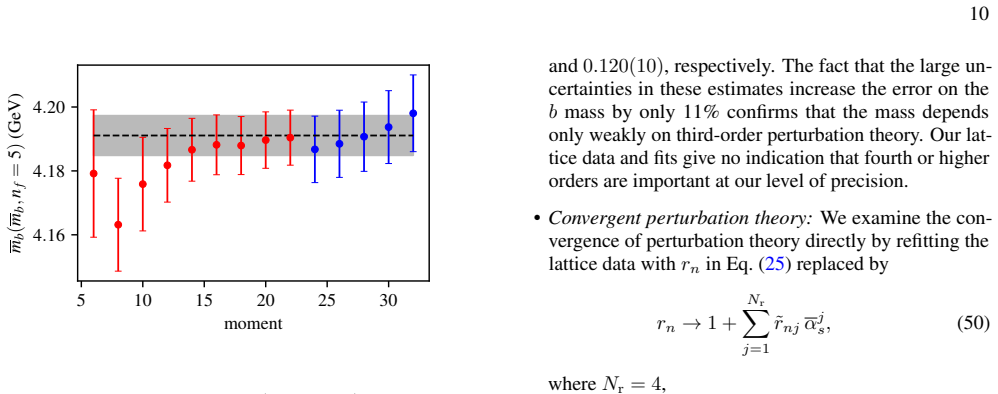
We extend an earlier lattice QCD analysis of heavy-quark current-current correlators to obtain new values for the MSbar masses of the b, c, and s quarks. The analysis uses gluon configurations from the MILC collaboration with vacuum polarization contributions from u, d, s, and c quarks (nf=4), and lattice spacings down to 0.032 fm. We find that m_b(m_b, nf=5)=4.1923(63) GeV, m_c(3 GeV, nf=4)=0.9813(34) GeV, and m_s(3 GeV, nf=4)=83.39(26) MeV. These results are corrected for QED by including (quenched) QED in the simulations. We give a detailed analysis of finite lattice-spacing errors that shows why the HISQ discretization of the quark action is particularly useful for b-quark simulations.
What carries the argument
Pseudoscalar-pseudoscalar current-current correlators computed on nf=4 HISQ lattices, whose moments or fits yield the quark masses after continuum extrapolation and QED subtraction.
If this is right
- Improved inputs for calculations of B-meson and D-meson decay rates and mixing parameters.
- Tighter constraints on CKM matrix elements from lattice determinations of semileptonic form factors.
- More precise tests of the Standard Model through comparison with experimental measurements of heavy-quarkonia spectra.
- Better control of isospin-breaking and electromagnetic effects in light-meson masses used for scale setting.
Where Pith is reading between the lines
- These masses can be fed directly into global fits that extract the strong coupling or test heavy-quark effective theory.
- Repeating the analysis with dynamical QED instead of quenched QED would test the size of the present QED correction.
- The same correlator data could be used to extract the gluon condensate or higher-dimensional operator matrix elements.
Load-bearing premise
Finite lattice-spacing errors remain under control and the HISQ action stays reliable for b quarks even when the b mass in lattice units is close to one.
What would settle it
An independent calculation on lattices with spacing substantially below 0.032 fm that shifts any of the three reported masses by more than the quoted uncertainty.
Figures




read the original abstract
We extend an earlier lattice QCD analysis of heavy-quark current-current correlators to obtain new values for the $\overline{\mathrm{MS}}$ masses of the $b$, $c$, and $s$~quarks. The analysis uses gluon configurations from the MILC collaboration with vacuum polarization contributions from $u$, $d$, $s$, and~$c$ quarks ($n_f=4$), and lattice spacings down to~0.032~fm. We find that $\overline{m}_b(\overline{m}_b, n_f=5)=4.1923(63)$~GeV, $\overline{m}_c(3~\mathrm{GeV}, n_f=4)=0.9813(34)$~GeV, and $\overline{m}_s(3~\mathrm{GeV}, n_f=4)=83.39(26)$~MeV. These results are corrected for QED by including (quenched) QED in the simulations. They are among the most accurate values by any method to date. We give a detailed analysis of finite lattice-spacing errors that shows why the HISQ discretization of the quark action is particularly useful for $b$-quark simulations even for lattices where~$am_b\approx1$. We also calculate QED and isospin corrections to the (fictitious) $\eta_s$-meson mass, which is used to tune $s$-quark masses in lattice simulations.
Editorial analysis
A structured set of objections, weighed in public.
Referee Report
Summary. The manuscript extends prior lattice QCD work on heavy-quark current-current correlators to extract new MS-bar masses for the b, c, and s quarks from pseudoscalar-pseudoscalar correlator moments. Simulations use n_f=4 MILC HISQ ensembles with lattice spacings down to 0.032 fm, include quenched QED, and report m_b(m_b, n_f=5)=4.1923(63) GeV, m_c(3 GeV, n_f=4)=0.9813(34) GeV, and m_s(3 GeV, n_f=4)=83.39(26) MeV. A detailed analysis of finite lattice-spacing errors is presented to support the reliability of the HISQ action for b-quarks even when am_b approaches 1.
Significance. If the central values and error budgets hold, these results would rank among the most precise quark-mass determinations available from any method, with direct utility for precision flavor phenomenology and hadronic matrix-element calculations. The explicit treatment of QED corrections and the focused study of discretization effects for heavy quarks constitute methodological strengths that improve control over systematics in lattice extractions.
major comments (1)
- [finite lattice-spacing errors analysis] The section detailing the finite lattice-spacing analysis for b-quark correlators: the 0.15% precision claimed for m_b requires that residual O(a^4) and higher cutoff effects after extrapolation are smaller than the quoted uncertainty. The manuscript states that a detailed analysis justifies HISQ reliability at am_b ≈ 0.7–1, but the error budget would be strengthened by an explicit statement of whether a^4 or a^6 terms are included in the continuum-extrapolation ansatz for the moments, together with a stability test under removal of the coarsest ensembles. If these checks are already performed, please identify the relevant fit form and table of results.
minor comments (2)
- [Abstract] The abstract states that the results 'are among the most accurate values by any method to date'; a short parenthetical comparison to the most recent FLAG or sum-rule averages would help readers place the improvement in context.
- [Results section] Notation for the renormalization scale in the c- and s-quark results is given as '3 GeV'; confirming that this is the same scale used in the perturbative matching for all three masses would remove any potential ambiguity.
Simulated Author's Rebuttal
We thank the referee for their careful reading of the manuscript and for the constructive suggestion regarding the continuum extrapolation. We address the major comment below and will incorporate the requested clarifications in the revised version.
read point-by-point responses
-
Referee: The section detailing the finite lattice-spacing analysis for b-quark correlators: the 0.15% precision claimed for m_b requires that residual O(a^4) and higher cutoff effects after extrapolation are smaller than the quoted uncertainty. The manuscript states that a detailed analysis justifies HISQ reliability at am_b ≈ 0.7–1, but the error budget would be strengthened by an explicit statement of whether a^4 or a^6 terms are included in the continuum-extrapolation ansatz for the moments, together with a stability test under removal of the coarsest ensembles. If these checks are already performed, please identify the relevant fit form and table of results.
Authors: We appreciate the referee's recommendation to make the continuum-extrapolation procedure more explicit. The detailed analysis of finite lattice-spacing errors for the b-quark correlators, including the justification for the reliability of the HISQ action at am_b ≈ 0.7–1, is presented in Section 5 of the manuscript. The extrapolations of the moments employ fit ansätze that incorporate O(a²) and O(a⁴) terms (with O(a⁶) contributions tested and found negligible at our precision level). Stability under removal of the coarsest ensembles has been verified and yields results consistent with the central values and uncertainties quoted for m_b. To strengthen the presentation as suggested, we will add an explicit statement in the revised manuscript identifying the precise fit forms used for the moments and referencing the corresponding table of fit results and stability checks. revision: yes
Circularity Check
No significant circularity detected
full rationale
The derivation extracts MSbar quark masses by non-perturbatively tuning lattice spacings from external quantities (e.g., eta_s mass) and then fitting moments of pseudoscalar-pseudoscalar correlators computed on n_f=4 HISQ ensembles to independent continuum perturbative expressions. The central results for m_b, m_c and m_s are new determinations on finer lattices with explicit discretization analysis; they do not reduce to the input data or to any self-citation by construction. Self-citations to prior HPQCD methodology are present but supply only supporting techniques and are not load-bearing for the quoted mass values.
Axiom & Free-Parameter Ledger
free parameters (2)
- lattice spacing a
- fit parameters for correlator fits
axioms (2)
- domain assumption The HISQ action provides adequate control of discretization errors for heavy quarks even when a m_b ≈ 1.
- domain assumption Quenched QED approximates electromagnetic corrections sufficiently for the quoted precision.
Reference graph
Works this paper leans on
-
[1]
We first fit the Rn from each gluon ensemble s to de- termine an MS b-quark mass m(s) b (m(s) b ) for each en- semble separately. In doing so we correct for systematic errors in the lattice values for the Rn and in the pertur- bation theory for the rn. We use the mb values given in Table II. 6 TABLE II. Gluon ensembles used in this paper. These were produ...
work page 2086
-
[2]
The four m(s) b (m(s) b ) obtained in the first fit do not agree with each other because of systematic errors in the lattice results for the ηb mass used to determine the bareb-quark mass mb for each gluon ensemble. These are corrected in a second fit which extrapolates theMS masses to zero lattice spacing, while also accounting for the detuned sea-quark ...
-
[3]
(9)): rn = 1 + NrX j=1 rnj(ρn) αj s(ξαµn)
Truncated perturbation theory We truncate the perturbative expansion for rn (Eq. (9)): rn = 1 + NrX j=1 rnj(ρn) αj s(ξαµn). (27) The coefficients for the first three orders are given in Table I; coefficients for higher-order terms are set equal to 0 ± rmax n where rmax n is given by Eq. (13). We take Nr = 4, to allow for higher-order corrections, but we g...
-
[4]
aΛn errors The largest errors in the lattice values for R(s) n are from the finite lattice spacings used in the simulations. As discussed in Sec. II B, these are dominated by errors of order(ap/π)2j where p is the typical three momentum of the valence heavy- quarks. We correct for this error by including a factor 1 + NaX j=1 c(n,s) j (mh/mb) aΛn(mh) π 2j ...
-
[5]
Nonzero mc As mentioned above, the perturbative coefficients rn2 and rn3 in Table I are calculated assuming zero sea-quark masses. While this approximation is reasonable for u, d, and s quarks, there could be appreciable corrections, of order rn2 α2 s(µn) times (mc/mh)2, for the c quark. We allow for such correc- tions by including a factor 1 + dpth n (mc...
-
[6]
Nonperturbative and finite-volume effects There are nonperturbative corrections to perturbative expres- sion for the reduced moments (Eq. (7)) coming from gluon and light-quark condensates, but these are suppressed by a factor of 1/m4 h. Condensates were negligible (less than 0.05%) in our earlier determination of the c-quark mass [7]; they should be much...
work page 1975
-
[7]
G. P. Lepage, P. B. Mackenzie, and M. E. Peskin, (2014), arXiv:1404.0319 [hep-ph]
work page internal anchor Pith review Pith/arXiv arXiv 2014
-
[8]
Freitas et al., (2019), arXiv:1906.05379 [hep-ph]
A. Freitas et al., (2019), arXiv:1906.05379 [hep-ph]
-
[9]
de Blas et al., Higgs Boson Studies at Future Particle Colliders, JHEP 01 (2020) 139 [1905.03764]
J. de Blas et al., JHEP 01, 139, arXiv:1905.03764 [hep-ph]
-
[10]
Highly Improved Staggered Quarks on the Lattice, with Applications to Charm Physics
E. Follana et al. (HPQCD Collaboration, UKQCD Collabora- tion), Phys.Rev. D75, 054502 (2007), arXiv:hep-lat/0610092 [hep-lat]
work page internal anchor Pith review Pith/arXiv arXiv 2007
-
[11]
I. Allison et al. (HPQCD), Phys. Rev. D 78, 054513 (2008), arXiv:0805.2999 [hep-lat]
work page internal anchor Pith review Pith/arXiv arXiv 2008
-
[12]
C. McNeile, C. T. H. Davies, E. Follana, K. Hornbostel, and G. P. Lepage, Phys. Rev. D82, 034512 (2010), arXiv:1004.4285 [hep-lat]
work page internal anchor Pith review Pith/arXiv arXiv 2010
-
[13]
High-precision quark masses and QCD coupling from $n_f=4$ lattice QCD
B. Chakraborty, C. T. H. Davies, B. Galloway, P. Knecht, J. Ko- ponen, G. C. Donald, R. J. Dowdall, G. P. Lepage, and C. Mc- Neile, Phys. Rev. D 91, 054508 (2015), arXiv:1408.4169 [hep- lat]
work page internal anchor Pith review Pith/arXiv arXiv 2015
- [14]
-
[15]
Precise charm to strange mass ratio and light quark masses from full lattice QCD
C. Davies, C. McNeile, K. Wong, E. Follana, R. Horgan,et al. (HPQCD Collaboration), Phys.Rev.Lett. 104, 132003 (2010), arXiv:0910.3102 [hep-ph]
work page internal anchor Pith review Pith/arXiv arXiv 2010
- [16]
-
[17]
G. P. Lepage and P. B. Mackenzie, Phys. Rev. D48, 2250 (1993), arXiv:hep-lat/9209022
work page internal anchor Pith review Pith/arXiv arXiv 1993
-
[18]
Four-loop moments of the heavy quark vacuum polarization function in perturbative QCD
K. Chetyrkin, J. H. Kuhn, and C. Sturm, Eur.Phys.J. C48, 107 (2006), arXiv:hep-ph/0604234 [hep-ph]
work page internal anchor Pith review Pith/arXiv arXiv 2006
-
[19]
Charm and Bottom Quark Masses from Perturbative QCD
R. Boughezal, M. Czakon, and T. Schutzmeier, Phys.Rev.D74, 074006 (2006), arXiv:hep-ph/0605023 [hep-ph]
work page internal anchor Pith review Pith/arXiv arXiv 2006
-
[20]
The second physical moment of the heavy quark vector correlator at O(alpha_s^3)
A. Maier, P. Maierhofer, and P. Marqaurd, Phys.Lett.B669, 88 (2008), arXiv:0806.3405 [hep-ph]
work page internal anchor Pith review Pith/arXiv arXiv 2008
-
[21]
Y . Kiyo, A. Maier, P. Maierhofer, and P. Marquard, Nucl.Phys. B823, 269 (2009), arXiv:0907.2120 [hep-ph]
work page internal anchor Pith review Pith/arXiv arXiv 2009
-
[22]
Low energy moments of heavy quark current correlators at four loops
A. Maier, P. Maierhofer, P. Marquard, and A. Smirnov, Nucl.Phys. B824, 1 (2010), arXiv:0907.2117 [hep-ph]. 13 Note that the physical values of the denominators of RmQCD and RmQCD+QED are not the same. They differ by∆E(m2 π+ − m2 π0), which is 0.17% of the QCD+QED denominator. This explains why the ratio of ra- tios in Eq. (C8) is smaller than 1 while the ...
work page internal anchor Pith review Pith/arXiv arXiv 2010
-
[23]
Higher Moments of Heavy Quark Correlators in the Low Energy Limit at O(alpha_s^2)
A. Maier, P. Maierhofer, and P. Marquard, Nucl. Phys. B 797, 218 (2008), arXiv:0711.2636 [hep-ph]
work page internal anchor Pith review Pith/arXiv arXiv 2008
-
[24]
A. X. El-Khadra, A. S. Kronfeld, and P. B. Mackenzie, Phys. Rev. D 55, 3933 (1997), arXiv:hep-lat/9604004
work page internal anchor Pith review Pith/arXiv arXiv 1997
-
[25]
G. P. Lepage, Nucl. Phys. B Proc. Suppl. 26, 45 (1992)
work page 1992
-
[26]
See Appendix C in: G. C. Donald, C. T. H. Davies, R. J. Dow- dall, E. Follana, K. Hornbostel, J. Koponen, G. P. Lepage, and C. McNeile, Phys. Rev. D 86, 094501 (2012), arXiv:1208.2855 [hep-lat]
work page internal anchor Pith review Pith/arXiv arXiv 2012
- [27]
- [28]
-
[30]
A. Bazavov et al. , Phys. Rev. D 98, 074512 (2018), arXiv:1712.09262 [hep-lat]
-
[31]
Up-, down-, strange-, charm-, and bottom-quark masses from four-flavor lattice QCD
A. Bazavov et al. (Fermilab Lattice, MILC, TUMQCD), Phys. Rev. D 98, 054517 (2018), arXiv:1802.04248 [hep-lat]
work page internal anchor Pith review Pith/arXiv arXiv 2018
-
[32]
C. Bernard and D. Toussaint (MILC), Phys. Rev. D 97, 074502 (2018), arXiv:1707.05430 [hep-lat]
work page internal anchor Pith review Pith/arXiv arXiv 2018
-
[33]
Vus from pi and K decay constants in full lattice QCD with physical u, d, s and c quarks
R. Dowdall, C. Davies, G. Lepage, and C. McNeile (HPQCD Collaboration), Phys.Rev.D88, 074504 (2013), arXiv:1303.1670 [hep-lat]
work page internal anchor Pith review Pith/arXiv arXiv 2013
- [34]
-
[35]
High-precision scale setting in lattice QCD
S. Borsanyi, S. Durr, Z. Fodor, C. Hoelbling, S. D. Katz,et al., JHEP 1209, 010, arXiv:1203.4469 [hep-lat]
work page internal anchor Pith review Pith/arXiv arXiv
-
[36]
See Sec. 5.2 on the Empirical Bayes criterion in G. Lepage, B. Clark, C. Davies, K. Hornbostel, P. Mackenzie, et al. , Nucl.Phys.Proc.Suppl. 106, 12 (2002), arXiv:hep-lat/0110175 [hep-lat]
work page internal anchor Pith review Pith/arXiv arXiv 2002
- [37]
-
[38]
The splines are implemented using the gvar Python mod- ule: G. P. Lepage, gvar v. 13.1.6, github.com/gplepage/gvar, doi:10.5281/zenodo.15132844 (2025)
-
[39]
Fits were done using the lsqfit Python module: G. P. Lepage, lsqfit v. 13.3, github.com/gplepage/lsqfit, doi:10.5281/zenodo.14837295 (2025)
-
[40]
The four-loop beta-function in Quantum Chromodynamics
T. van Ritbergen, J. Vermaseren, and S. Larin, Phys.Lett.B400, 379 (1997), arXiv:hep-ph/9701390 [hep-ph]. 20
work page internal anchor Pith review Pith/arXiv arXiv 1997
-
[41]
M. Czakon, Nucl.Phys. B710, 485 (2005), arXiv:hep- ph/0411261 [hep-ph]
-
[42]
The 4-loop quark mass anomalous dimension and the invariant quark mass
J. Vermaseren, S. Larin, and T. van Ritbergen, Phys.Lett.B405, 327 (1997), arXiv:hep-ph/9703284 [hep-ph]
work page internal anchor Pith review Pith/arXiv arXiv 1997
-
[43]
K. Chetyrkin, Phys.Lett. B404, 161 (1997), arXiv:hep- ph/9703278 [hep-ph]
-
[44]
Decoupling Relations to O(alpha_s^3) and their Connection to Low-Energy Theorems
K. Chetyrkin, B. A. Kniehl, and M. Steinhauser, Nucl.Phys. B510, 61 (1998), arXiv:hep-ph/9708255 [hep-ph]
work page internal anchor Pith review Pith/arXiv arXiv 1998
-
[45]
The five-loop beta function of Yang-Mills theory with fermions
F. Herzog, B. Ruijl, T. Ueda, J. A. M. Vermaseren, and A. V ogt, JHEP 02, 090, arXiv:1701.01404 [hep-ph]
work page internal anchor Pith review Pith/arXiv arXiv
-
[46]
P. A. Baikov, K. G. Chetyrkin, and J. H. K¨uhn, JHEP 10, 076, arXiv:1402.6611 [hep-ph]
work page internal anchor Pith review Pith/arXiv arXiv
-
[47]
G. P. Lepage, qcdevol v. 4.1, github.com/gplepage/qcdevol, doi:/10.5281/zenodo.15007009 (2025)
- [48]
- [49]
-
[50]
Jegerlehner, CERN Yellow Reports: Monographs3, 9 (2020)
F. Jegerlehner, CERN Yellow Reports: Monographs3, 9 (2020)
work page 2020
-
[51]
E. B. Gregory et al. , Phys. Rev. D 83, 014506 (2011), arXiv:1010.3848 [hep-lat]
work page internal anchor Pith review Pith/arXiv arXiv 2011
-
[52]
Lattice QCD ensembles with four flavors of highly improved staggered quarks
A. Bazavov et al. (MILC), Phys. Rev. D 87, 054505 (2013), arXiv:1212.4768 [hep-lat]
work page internal anchor Pith review Pith/arXiv arXiv 2013
-
[53]
Mass of the b-quark and B-decay constants from Nf=2+1+1 twisted-mass Lattice QCD
A. Bussone et al. (ETM), Phys. Rev. D 93, 114505 (2016), arXiv:1603.04306 [hep-lat]
work page internal anchor Pith review Pith/arXiv arXiv 2016
-
[54]
The $\Upsilon$ and $\Upsilon^{\prime}$ Leptonic Widths, $a_{\mu}^b$ and $m_b$ from full lattice QCD
B. Colquhoun, R. Dowdall, C. Davies, K. Hornbostel, and G. Lepage (HPQCD Collaboration), (2014), arXiv:1408.5768 [hep-lat]
work page internal anchor Pith review Pith/arXiv arXiv 2014
-
[55]
A. Conigli, J. Frison, P. Fritzsch, A. G´erardin, J. Heitger, G. Her- doiza, S. Kuberski, C. Pena, H. Simma, and R. Sommer, PoS LATTICE2023, 237 (2024), arXiv:2312.10017 [hep-lat]
-
[56]
P. Petreczky and J. H. Weber, Phys. Rev. D100, 034519 (2019), arXiv:1901.06424 [hep-lat]
-
[57]
Quark masses and strong coupling constant in 2+1 flavor QCD
Y . Maezawa and P. Petreczky, Phys. Rev. D94, 034507 (2016), arXiv:1606.08798 [hep-lat]
work page internal anchor Pith review Pith/arXiv arXiv 2016
-
[58]
The mass of the b-quark from lattice NRQCD and lattice perturbation theory
A. Lee et al. (HPQCD Collaboration), Phys.Rev. D87, 074018 (2013), arXiv:1302.3739 [hep-lat]
work page internal anchor Pith review Pith/arXiv arXiv 2013
-
[59]
S. Narison, Phys. Lett. B 802, 135221 (2020), arXiv:1906.03614 [hep-ph]
-
[60]
The charm/bottom quark mass from heavy quarkonium at N$^3$LO
C. Peset, A. Pineda, and J. Segovia, JHEP 09, 167, arXiv:1806.05197 [hep-ph]
work page internal anchor Pith review Pith/arXiv arXiv
-
[61]
Y . Kiyo, G. Mishima, and Y . Sumino, Phys. Lett. B 752, 122 (2016), [Erratum: Phys.Lett.B 772, 878–878 (2017)], arXiv:1510.07072 [hep-ph]
work page internal anchor Pith review Pith/arXiv arXiv 2016
-
[62]
Precision determination of the CKM element Vcb
A. Alberti, P. Gambino, K. J. Healey, and S. Nandi, Phys. Rev. Lett. 114, 061802 (2015), arXiv:1411.6560 [hep-ph]
work page internal anchor Pith review Pith/arXiv arXiv 2015
-
[63]
The bottom-quark mass from non-relativistic sum rules at NNNLO
M. Beneke, A. Maier, J. Piclum, and T. Rauh, Nucl. Phys. B891, 42 (2015), arXiv:1411.3132 [hep-ph]
work page internal anchor Pith review Pith/arXiv arXiv 2015
-
[64]
Bottom and Charm Mass Determinations with a Convergence Test
B. Dehnadi, A. H. Hoang, and V . Mateu, JHEP 08, 155, arXiv:1504.07638 [hep-ph]
work page internal anchor Pith review Pith/arXiv arXiv
-
[65]
A. A. Penin and N. Zerf, JHEP 04, 120, arXiv:1401.7035 [hep- ph]
work page internal anchor Pith review Pith/arXiv arXiv
-
[66]
Accurate bottom-quark mass from Borel QCD sum rules for $f_B$ and $f_{B_s}$
W. Lucha, D. Melikhov, and S. Simula, Phys. Rev. D88, 056011 (2013), arXiv:1305.7099 [hep-ph]
work page internal anchor Pith review Pith/arXiv arXiv 2013
-
[67]
Bottom-quark mass from finite energy QCD sum rules
S. Bodenstein, J. Bordes, C. A. Dominguez, J. Penarrocha, and K. Schilcher, Phys. Rev. D 85, 034003 (2012), arXiv:1111.5742 [hep-ph]
work page internal anchor Pith review Pith/arXiv arXiv 2012
-
[68]
Quark-antiquark potential to order 1/m and heavy quark masses
A. Laschka, N. Kaiser, and W. Weise, Phys. Rev. D83, 094002 (2011), arXiv:1102.0945 [hep-ph]
work page internal anchor Pith review Pith/arXiv arXiv 2011
-
[69]
Measurement and interpretation of moments in inclusive semileptonic decays Bbar --> X_c l- nubar
B. Aubert et al. (BaBar), Phys. Rev. D 81, 032003 (2010), arXiv:0908.0415 [hep-ex]
work page internal anchor Pith review Pith/arXiv arXiv 2010
-
[70]
Charm and Bottom Quark Masses: an Update
K. Chetyrkin, J. Kuhn, A. Maier, P. Maierhofer, P. Marquard, et al., Phys.Rev.D80, 074010 (2009), arXiv:0907.2110 [hep-ph]
work page internal anchor Pith review Pith/arXiv arXiv 2009
-
[71]
C. Schwanda et al. (Belle), Phys. Rev. D 78, 032016 (2008), arXiv:0803.2158 [hep-ex]
work page internal anchor Pith review Pith/arXiv arXiv 2008
-
[72]
J. L. Goity and C. P. Jayalath, Phys. Lett. B 650, 22 (2007), arXiv:hep-ph/0701245
work page internal anchor Pith review Pith/arXiv arXiv 2007
-
[73]
C. T. H. Davies, C. McNeile, E. Follana, G. P. Lepage, H. Na, and J. Shigemitsu, Phys. Rev. D82, 114504 (2010), arXiv:1008.4018 [hep-lat]
work page internal anchor Pith review Pith/arXiv arXiv 2010
-
[74]
Matching lattice and continuum axial-vector and vector currents with NRQCD and HISQ quarks
C. Monahan, J. Shigemitsu, and R. Horgan, Phys. Rev. D 87, 034017 (2013), arXiv:1211.6966 [hep-lat]
work page internal anchor Pith review Pith/arXiv arXiv 2013
-
[75]
G. P. Lepage, L. Magnea, C. Nakhleh, U. Magnea, and K. Horn- bostel, Phys. Rev. D 46, 4052 (1992), arXiv:hep-lat/9205007
work page internal anchor Pith review Pith/arXiv arXiv 1992
-
[76]
R. F. Dashen, Phys. Rev. 183, 1245 (1969)
work page 1969
-
[77]
Electromagnetic Splittings and Light Quark Masses in Lattice QCD
A. Duncan, E. Eichten, and H. Thacker, Phys. Rev. Lett. 76, 3894 (1996), arXiv:hep-lat/9602005
work page internal anchor Pith review Pith/arXiv arXiv 1996
-
[78]
QED in finite volume and finite size scaling effect on electromagnetic properties of hadrons
M. Hayakawa and S. Uno, Prog. Theor. Phys. 120, 413 (2008), arXiv:0804.2044 [hep-ph]
work page internal anchor Pith review Pith/arXiv arXiv 2008
-
[79]
Electromagnetic effects on the light pseudoscalar mesons and determination of $m_u/m_d$
S. Basak et al. (MILC), PoS LATTICE2015, 259 (2016), arXiv:1606.01228 [hep-lat]
work page internal anchor Pith review Pith/arXiv arXiv 2016
-
[80]
T. Blum, T. Doi, M. Hayakawa, T. Izubuchi, and N. Yamada, Phys. Rev. D 76, 114508 (2007), arXiv:0708.0484 [hep-lat]
work page internal anchor Pith review Pith/arXiv arXiv 2007
-
[81]
Finite-Volume Electromagnetic Corrections to the Masses of Mesons, Baryons and Nuclei
Z. Davoudi and M. J. Savage, Phys. Rev.D90, 054503 (2014), arXiv:1402.6741 [hep-lat]
work page internal anchor Pith review Pith/arXiv arXiv 2014
discussion (0)
Sign in with ORCID, Apple, or X to comment. Anyone can read and Pith papers without signing in.