REVIEW 2 major objections 5 minor 3 cited by
The shadow and quasinormal modes of the asymptotically flat hairy black holes with a dilaton potential
T0 review · 2 major / 5 minor · reviewed 2026-08-06 · deepseek-v4-flash
Pith's one-line read For this exact family of hairy charged black holes, the dilaton coupling visibly alters shadows and quasinormal ringing only near extremal charge, and scalar high-frequency modes are governed by the photon-sphere orbit.
desk verdict Routine but legitimate parameter study of AAM hairy black hole shadows and QNMs; numerics look sound, but a wrong Lyapunov formula and unspecified α make the paper non-reproducible as written. read the letter →
The pith
A machine-rendered reading of the paper's core claim, the machinery that carries it, and where it could break.
The reading
What carries the argument
The argument is carried by the exact static, spherically symmetric AAM solution, $ds^2 = \Psi(x)[-f(x)dt^2 + \eta^2 dx^2/f(x) + d\Omega_2^2]$, together with the constraint $\nu = 1 + 24Q^2\eta^4/(\alpha + 3\eta^2 + 6M\eta^3)$ linking the hair parameter $\eta$, mass $M$, charge $Q$, and dilaton coupling $\nu$. This constraint turns $\eta$ into the control parameter that interpolates between a hairy Reissner-Nordström-like regime and the low-energy string-theory regime. The shadow and geodesic quantities follow from the null orbital equation, with the photon sphere fixed by $f'(x_{\rm ph})=0$, the shadow radius $x_{\rm sh}=x_{\rm ph}/\sqrt{\Psi(x_{\rm ph})f(x_{\rm ph})}$, and the Lyapunov exponent and angular velocity defined from the second derivative of the geodesic potential. For perturbations, a massless scalar reduces to a Schrödinger-like equation whose effective potential is $V(x) = \frac{f(x)}{\eta^2}\frac{1}{\sqrt{\Psi(x)}}(f(x)\sqrt{\Psi(x)})' + \ell(\ell+1)f(x)$, and the quasinormal frequencies are computed with a Borel-summed high-order WKB method and cross-checked with higher-order WKB with Padé summation.
What would settle it
One decisive check is to substitute the metric (9)--(12) into the equations of motion (2)--(4) for representative parameters and verify the constraint (17) and the horizon-existence condition (26); a violation in any allowed region would invalidate the background. A second check targets the eikonal claim: compute scalar quasinormal modes for $\ell=200$, $n=2$, $Q=0.7$, and $\eta=70$ by direct numerical integration and compare with Fig. 6; if the deviations $\Delta\omega_R$ and $\Delta\omega_I$ are not of those sizes, the $\Omega_c$-$\lambda$ correspondence is refuted.
Extended reading notes
Core claim
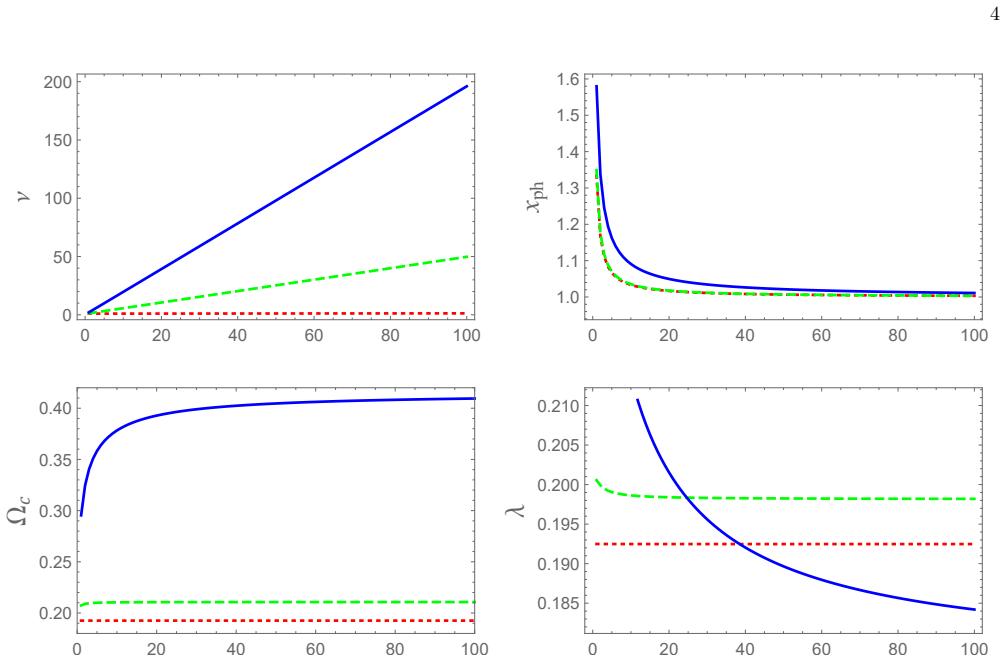
The paper's central assertion is that for the exact asymptotically flat AAM hairy charged black hole, the dilaton coupling $\nu$ leaves the shadow radius, the Lyapunov exponent $\lambda$, and the coordinate angular velocity $\Omega_c$ essentially unchanged except when $Q$ is close to the extremal value, with the largest deviations appearing near $\nu\to 1$. In the eikonal limit of scalar perturbations, the quasinormal frequencies obey $\omega_R \simeq \ell\Omega_c$ and $\omega_I \simeq (n+1/2)\lambda$, and the numerical data support a refined real part $(\ell + 1/2)\sqrt{f(x_{\rm ph})}$ that reduces the discrepancy with the Borel-summed WKB results. The paper further finds that for large $\eta$, where the dilaton coupling $\gamma$ tends to the low-energy string-theory value, the quasinormal spectrum approaches the known results for that string limit. It reports, for example, $Q=0.7$, $\ell=3$, $n=0$, $\eta=400$, a computed mode $\omega=1.451472-0.089668i$, close to the string-limit value obtained by the higher-order WKB with Padé summation.
Load-bearing premise
The load-bearing premise is that the exact AAM background, its asymptotic flatness, and the constraint tying $\eta$, $M$, $Q$, and $\nu$ are all correct, because every shadow and quasinormal result is computed on that background rather than re-derived from it.
Editorial extensions
If this is right
- Measuring the shadow radius of these black holes constrains the dilaton coupling only when the charge is near extremal; otherwise the shadow is virtually identical to that of an uncharged hairy black hole.
- The eikonal correspondence means the scalar ringdown spectrum is encoded entirely in the unstable photon-sphere orbit, so high-frequency observations would directly read off $\Omega_c$ and $\lambda$.
- At large $\eta$, the scalar quasinormal frequencies of the AAM black hole approach those of the low-energy string-theory limit, bridging the Einstein-Maxwell-like and stringy regimes of the model.
- Using $(\ell + 1/2)\sqrt{f(x_{\rm ph})}$ for the real part instead of $\ell\sqrt{f(x_{\rm ph})}$ gives the more accurate eikonal prediction for this family.
Reading between the lines
- Because the analysis is restricted to test scalar fields, a natural extension is to repeat it for electromagnetic and gravitational perturbations; if the geometric-optics correspondence survives there, the $\Omega_c$ and $\lambda$ relations would govern the full ringdown, not just scalar modes.
- A direct observational consequence, not drawn by the paper, is that only near-extremal charged black holes could reveal this dilaton hair through shadows; neutral astrophysical black holes would be blind to it.
- The larger deviation in the real part than in the imaginary part suggests that next-to-leading eikonal corrections are sensitive to the shape of the photon-sphere potential, so a next-order WKB expansion for general $\nu$ would be a concrete quantitative extension.
Editorial analysis
A structured set of objections, weighed in public.
Referee Report
Summary. The paper studies the shadow, photon sphere, and scalar quasinormal modes of the exact asymptotically flat hairy charged black hole solution of Anabalón, Astefanesei, and Mann, with a non-trivial dilaton potential. Using the constraint relation among the black hole mass, charge, dilaton coupling, and integration constant η, the authors compute the shadow radius, Lyapunov exponent λ, and coordinate angular velocity Ω_c as functions of η for several charges. They then compute scalar QNM frequencies with the Hatsuda method and cross-check them with higher-order WKB-Padé summation. The central claims are that the dilaton coupling significantly affects the shadow and QNM observables only when the charge is close to extremal, that the large-η limit reproduces the low-energy string theory results, and that in the eikonal limit the QNM real and imaginary parts are controlled by Ω_c and λ.
Significance. If the results hold, the paper provides a useful comparative framework for hairy black hole observables and a further test of the geometric-optical correspondence between null geodesics and quasinormal modes. The numerical cross-checks are a genuine strength: the Schwarzschild and Reissner-Nordström limits are checked, the large-η string limit is compared with Ref. [129], and two independent numerical methods (Hatsuda and higher-order WKB with Padé summation) are used. No parameter fitting is performed, so the geodesic/QNM comparison is not circular. The main obstacles are a displayed formula for λ that is inconsistent with the Schwarzschild limit and with Eq. (33), and an unspecified convention for the potential parameter α; both are correctable within the manuscript's scope.
major comments (2)
- [III, Eq. (23)] The displayed formula for the Lyapunov exponent is inconsistent with the Schwarzschild limit and with the paper's own eikonal result. Taking Q→0, ν→1, with Ψ=1/[η²(x-1)²], f=η²(x-1)²(1-2η(x-1)) and x_ph=1+1/(3η), Eq. (23) gives λ² = -1/27, whereas the correct Cardoso-type result, and the result quoted in Eq. (33), give λ² = +1/27. The corrected expression should carry an overall minus sign, equivalently λ² = -(Ψ²f²/2) d²/dx²(1 - b²f/(η²Ψ²)) at x_ph, which reduces to λ² = -f(x_ph)f''(x_ph)/(2η²). Because λ is one of the three headline observables and is used to verify the geometric-optical correspondence in Fig. 6, please correct Eq. (23) and confirm that all plotted λ(η) values were computed with the corrected formula.
- [II, Eqs. (14)-(17)] The parameter α is never assigned a numerical value, and the rescaling sentence after Eq. (16) does not make the convention transparent. Equation (17) still contains α explicitly, so the relation ν(Q,η) used in Fig. 1 and in every subsequent QNM calculation depends on α; the proposed transformations η→√α η, M→√α M, Q→√α Q do not by themselves remove α once M=1 is imposed. Please state explicitly the value or convention used in the numerics (for example, 'we set α=1 in units with M=1'), or demonstrate the α-independence of all reported observables by rewriting the metric and the constraint equations in explicitly rescaled variables.
minor comments (5)
- [Abstract and Sec. IV.B] The abstract says the real and imaginary parts of the eikonal QNMs are 'proved to be given by Ω_c and λ', but Sec. IV.B immediately finds that a (l+1/2)√f correction is needed to reduce Δω_R. The statement is acceptable as an asymptotic statement for l≫1, but the wording 'proved' should be qualified to avoid overstating the precision of the eikonal formula.
- [Throughout] There are several typos: 'Chian' should be 'China' in the author affiliation; the phrase 'the the dilaton field' appears twice in the introduction; and 'diatonic Reissner-Nordström' in Sec. V should presumably be 'dilatonic Reissner-Nordström'.
- [IV.B, Eq. (32)] The phrase 'expanding Eq. 32 to infinity about l' is unclear; it should read 'expanding Eq. (32) in powers of 1/l to high order' or similar.
- [Ref. [132]] The footnote 'the expression in [130] should be slightly modified' is too vague for a reader who wants to reproduce the third-order WKB calculation; please specify the modification or give a precise reference for the corrected term.
- [Fig. 1] The caption says 'for all subfigures, the horizontal coordinate is η', but the top-left panel plots ν on the vertical axis while the other panels plot x_ph, Ω_c, and λ; please make the panel labels more explicit so the reader can identify which curve corresponds to which quantity in each panel.
Circularity Check
No significant circularity: the geodesic observables and QNMs are computed independently from an externally adopted exact solution, and the eikonal relation is a mathematical consistency check rather than an input.
full rationale
The paper's derivation chain is self-contained against external benchmarks. The AAM metric and dilaton potential are adopted from Refs. [71,73], which are not by the present authors, so the background is external input rather than a self-citation. The shadow radii, Lyapunov exponent, and coordinate angular velocity are computed from null geodesics of that metric, while QNMs are obtained separately by solving the scalar perturbation equation with the Hatsuda method and cross-checked with higher-order WKB-Padé approximation. No parameter is fitted to any subset of the data and then renamed as a prediction; the constraint relation (17) merely parametrizes the chosen background. The eikonal identification omega_R = l Omega_c and omega_I = (n+1/2) lambda is derived in Eqs. (32)-(34) from the WKB expansion of the same potential and then verified numerically; this is a standard consistency relation, not a tautology. The only self-citation is to Matyjasek's earlier WKB-Padé papers [120,121], but that method is an independent, widely used computational tool and is not load-bearing for the paper's conclusions. The skeptical observation that Eq. (23) may have a sign error in the Schwarzschild limit concerns correctness of a displayed formula, not circularity, since the plotted results could in principle be checked against a corrected expression and the numerical QNM computation does not rely on Eq. (23). Overall, no step reduces by construction to its own input.
Assumptions & free parameters
free parameters (1)
- alpha (dilaton potential strength) =
not stated
assumptions (5)
- domain assumption The AAM metric (9)-(12) is an exact asymptotically flat solution of action (1) with potential (7).
- domain assumption The horizon-existence condition (26) follows from demanding f'(x to infinity) < 0.
- standard math Hatsuda/Borel-Padé WKB and higher-order WKB-Padé converge to the true quasinormal frequencies for the modes studied.
- standard math The eikonal QNM-geodesic correspondence of Cardoso et al. [92] applies to this spherically symmetric asymptotically flat metric.
- ad hoc to paper With M=1, the parameter alpha can be fixed by the rescaling (16) without loss of generality.
Cite this review
Pith. "Pith review of The shadow and quasinormal modes of the asymptotically flat hairy black holes with a dilaton potential." pith.science (2026). https://pith.science/paper/4EA2MZYI
@misc{pith2026250803270,
  author       = {Pith},
  title        = {Pith review of: The shadow and quasinormal modes of the asymptotically flat hairy black holes with a dilaton potential},
  year         = {2026},
  howpublished = {\url{https://pith.science/paper/4EA2MZYI}},
  note         = {Machine review of arXiv:2508.03270}
}
abstract
In this article, the shadow and the quasinormal modes (QNMs) of an exact asymptotically flat hairy electrically charged black hole solution with a dilaton potential are investigated. Using the {constraint} equation among the integration constant $\eta$ of the gravitational field, the mass $M$, the electric charge $Q$ and the coupling constant $\nu$ between the $U(1)$ field and the dilaton field, we find that the shadow radii, the Lyapunov exponent $\lambda$ and the coordinate angular velocity $\Omega_{c}$ only significantly affected by $\nu$ if the $Q$ is close to the extremal value, especially when $\nu$ approaches to one. Furthermore, the QNMs are numerically computed by using the Hatsuda method and verify with the higher-order WKB approximations with the Pad\'e summation. We find that the QNMs are close to that of the low energy limit of the string theory when $\nu$ is large enough. In the eikonal limit, the real and imaginary parts are proved to be given by $\Omega_{c}$ and $\lambda$, respectively.
Figures


Figures from the paper (3 more)


Forward citations
Cited by 3 Pith papers
-
Photon rings and shadows of black holes with non-minimal couplings between curvature and electromagnetic field
Three distinct non-minimal curvature-EM couplings produce different enlargements or reductions of black hole shadows and alter photon ring separations in characteristic ways.
-
Echoes of a hairy black hole from gravitational decoupling
Axial perturbations around a hairy black hole from gravitational decoupling produce echo-like gravitational-wave signals that arise dynamically from a double-peak trapping cavity in the effective potential.
-
Echoes of a hairy black hole from gravitational decoupling
Axial perturbations of a gravitationally decoupled hairy black hole develop a double-peak potential that dynamically generates echo-like late-time waveforms in a suitable (α, β) region.
Reference graph
Works this paper leans on
-
[129]
C. F. E. Holzhey and F. Wilczek, Black holes as el- ementary particles, Nucl. Phys. B 380, 447 (1992), arXiv:hep-th/9202014
arXiv 1992
-
[1]
Israel, Event horizons in static electrovac space- times, Commun
W. Israel, Event horizons in static electrovac space- times, Commun. Math. Phys.8, 245 (1968)
1968
-
[2]
S. W. Hawking, Black holes in general relativity, Com- mun. Math. Phys.25, 152 (1972)
1972
-
[3]
D. C. Robinson, Uniqueness of the Kerr black hole, Phys. Rev. Lett.34, 905 (1975)
1975
-
[4]
P. O. Mazur, PROOF OF UNIQUENESS OF THE KERR-NEWMAN BLACK HOLE SOLUTION, J. Phys. A 15, 3173 (1982)
1982
-
[5]
no-scalar-hair
J. D. Bekenstein, Novel “no-scalar-hair” theorem for black holes, Phys. Rev. D51, R6608 (1995)
1995
-
[6]
A. E. Mayo and J. D. Bekenstein, No hair for spherical black holes: Charged and nonminimally coupled scalar field with self-interaction, Phys. Rev. D54, 5059 (1996)
1996
-
[7]
A. E. Broderick, T. Johannsen, A. Loeb, and D. Psaltis, Testing the No-Hair Theorem with Event Horizon Tele- scope Observations of Sagittarius A*, Astrophys. J. 784, 7 (2014), arXiv:1311.5564 [astro-ph.HE]
arXiv 2014
Show all 139 references
-
[8]
C. A. R. Herdeiro and E. Radu, Asymptotically flat black holes with scalar hair: a review, Int. J. Mod. Phys. D 24, 1542014 (2015), arXiv:1504.08209 [gr-qc]
2015 arXiv
-
[9]
Gürlebeck, No-hair theorem for Black Holes in As- trophysical Environments, Phys
N. Gürlebeck, No-hair theorem for Black Holes in As- trophysical Environments, Phys. Rev. Lett.114, 151102 (2015), arXiv:1503.03240 [gr-qc]
2015 arXiv
-
[10]
B. R. Greene, S. D. Mathur, and C. M. O’Neill, Eluding the no hair conjecture: Black holes in spontaneously broken gauge theories, Phys. Rev. D47, 2242 (1993), arXiv:hep-th/9211007
1993 arXiv
-
[11]
K. G. Zloshchastiev, On co-existence of black holes and scalar field, Phys. Rev. Lett. 94, 121101 (2005), arXiv:hep-th/0408163
2005 arXiv
-
[12]
C. A. R. Herdeiro and E. Radu, Kerr black holes with scalar hair, Phys. Rev. Lett.112, 221101 (2014)
2014
-
[13]
C. A. R. Herdeiro, E. Radu, and H. Rúnarsson, Kerr black holes with self-interacting scalar hair: hairier but not heavier, Phys. Rev. D 92, 084059 (2015), arXiv:1509.02923 [gr-qc]
2015 arXiv
-
[14]
S. W. Hawking, M. J. Perry, and A. Strominger, Soft Hair on Black Holes, Phys. Rev. Lett. 116, 231301 (2016), arXiv:1601.00921 [hep-th]
2016 arXiv
-
[15]
Bousso and M
R. Bousso and M. Porrati, Soft Hair as a Soft Wig, Class. Quant. Grav. 34, 204001 (2017), arXiv:1706.00436 [hep-th]
2017 arXiv
-
[16]
J. F. M. Delgado, C. A. R. Herdeiro, and E. Radu, Kerr black holes with synchronised scalar hair and higher az- imuthal harmonic index, Phys. Lett. B792, 436 (2019), arXiv:1903.01488 [gr-qc]
2019 arXiv
-
[17]
Peng, No hair theorem for massless scalar fields out- 8 side asymptotically flat horizonless reflecting compact stars, Eur
Y. Peng, No hair theorem for massless scalar fields out- 8 side asymptotically flat horizonless reflecting compact stars, Eur. Phys. J. C79, 850 (2019), arXiv:1904.00911 [gr-qc]
2019 arXiv
-
[18]
J.-P. Hong, M. Suzuki, and M. Yamada, Spherically Symmetric Scalar Hair for Charged Black Holes, Phys. Rev.Lett. 125,111104(2020),arXiv:2004.03148[gr-qc]
2020 arXiv
-
[19]
C. A. R. Herdeiro and E. Radu, Spherical electro- vacuum black holes with resonant, scalarQ-hair, Eur. Phys. J. C80, 390 (2020), arXiv:2004.00336 [gr-qc]
2020 arXiv
-
[20]
J. F. M. Delgado, C. A. R. Herdeiro, and E. Radu, Kerr black holes with synchronized axionic hair, Phys. Rev. D 103, 104029 (2021), arXiv:2012.03952 [gr-qc]
2021 arXiv
-
[21]
Gao and J
C. Gao and J. Qiu, On black holes with scalar hairs, Gen. Rel. Grav. 54, 158 (2022), arXiv:2111.11582 [gr- qc]
2022 arXiv
-
[22]
Bakopoulos and T
A. Bakopoulos and T. Nakas, Analytic and asymp- totically flat hairy (ultra-compact) black-hole solu- tions and their axial perturbations, JHEP 04, 096, arXiv:2107.05656 [gr-qc]
-
[23]
B. P. Abbott et al. (LIGO Scientific, Virgo), Obser- vation of Gravitational Waves from a Binary Black Hole Merger, Phys. Rev. Lett. 116, 061102 (2016), arXiv:1602.03837 [gr-qc]
2016 arXiv
-
[24]
Akiyamaet al
K. Akiyamaet al. (Event Horizon Telescope), First M87 Event Horizon Telescope Results. I. The Shadow of the Supermassive Black Hole, Astrophys. J. Lett.875, L1 (2019), arXiv:1906.11238 [astro-ph.GA]
2019 arXiv
-
[25]
Akiyama et al
K. Akiyama et al. (Event Horizon Telescope), First Sagittarius A* Event Horizon Telescope Results. I. The Shadow of the Supermassive Black Hole in the Center of the Milky Way, Astrophys. J. Lett.930, L12 (2022), arXiv:2311.08680 [astro-ph.HE]
2022 arXiv
-
[26]
For testing the no-hair theorem in other ways, like the electromagnetic spectrum X-ray observations, see [134– 139] and references therein
-
[27]
Psaltis, N
D. Psaltis, N. Wex, and M. Kramer, A Quantitative Test of the No-Hair Theorem with Sgr A* using stars, pulsars, and the Event Horizon Telescope, Astrophys. J. 818, 121 (2016), arXiv:1510.00394 [astro-ph.HE]
2016 arXiv
-
[28]
P. V. P. Cunha, C. A. R. Herdeiro, E. Radu, and H. F. Runarsson,ShadowsofKerrblackholeswithscalarhair, Phys. Rev. Lett.115, 211102 (2015), arXiv:1509.00021 [gr-qc]
2015 arXiv
-
[29]
Afrin, R
M. Afrin, R. Kumar, and S. G. Ghosh, Parameter esti- mation of hairy Kerr black holes from its shadow and constraints from M87*, Mon. Not. Roy. Astron. Soc. 504, 5927 (2021), arXiv:2103.11417 [gr-qc]
2021 arXiv
-
[30]
Khodadi, G
M. Khodadi, G. Lambiase, and D. F. Mota, No-hair theorem in the wake of Event Horizon Telescope, JCAP 09, 028, arXiv:2107.00834 [gr-qc]
-
[31]
Tang and Z
M. Tang and Z. Xu, The no-hair theorem and black hole shadows, JHEP 12, 125, arXiv:2209.08202 [gr-qc]
-
[32]
X. Wang, Z. Zhao, X.-X. Zeng, and X.-Y. Wang, Revis- iting the shadow of Johannsen-Psaltis black holes, Phys. Rev. D 111, 084054 (2025), arXiv:2501.08287 [gr-qc]
2025 arXiv
-
[33]
Gulia, J
H. Gulia, J. K. Singh, F. Atamurotov, and S. G. Ghosh, Observational signatures of shadows in GUP-corrected Kerr black holes and constraints from EHT data, Phys. Dark Univ. 48, 101954 (2025)
2025
-
[34]
Vagnozziet al., Horizon-scale tests of gravity theories and fundamental physics from the Event Horizon Tele- scope image of Sagittarius A, Class
S. Vagnozziet al., Horizon-scale tests of gravity theories and fundamental physics from the Event Horizon Tele- scope image of Sagittarius A, Class. Quant. Grav.40, 165007 (2023), arXiv:2205.07787 [gr-qc]
2023 arXiv
-
[35]
Glampedakis and G
K. Glampedakis and G. Pappas, Is a black hole shadow a reliable test of the no-hair theorem?, Phys. Rev. D 107, 064001 (2023), arXiv:2302.06140 [gr-qc]
2023 arXiv
-
[36]
Ye, Z.-Q
J.-P. Ye, Z.-Q. He, A.-X. Zhou, Z.-Y. Huang, and J.-H. Huang, Shadows and photon rings of a quan- tum black hole, Phys. Lett. B 851, 138566 (2024), arXiv:2312.17724 [gr-qc]
2024 arXiv
-
[37]
C. A. Benavides-Gallego and E. Larrañaga, The Image of Scalar Hairy Black Holes with Asymmetric Potential, arXiv preprint (2024), 2411.13049 [gr-qc]
2024 arXiv
-
[38]
X. Yang, M. Tang, and Z. Xu, Exploring the possibility oftestingtheno-hairtheoremwithMinkowski-deformed regular hairy black holes via photon rings, Eur. Phys. J. C 84, 977 (2024), arXiv:2408.12318 [gr-qc]
2024 arXiv
-
[39]
L. Zhao, M. Tang, and Z. Xu, Periodic orbits and grav- itational wave radiation in short hair black hole space- times for an extreme mass ratio system, Eur. Phys. J. C 85, 36 (2025), arXiv:2411.01979 [gr-qc]
2025 arXiv
-
[40]
Qi, X.-M
Q. Qi, X.-M. Kuang, Y.-Z. Li, and Y. Sang, Timelike bound orbits and pericenter precession around black hole with conformally coupled scalar hair, Eur. Phys. J. C 84, 645 (2024), arXiv:2407.01958 [gr-qc]
2024 arXiv
-
[41]
Liu, M.-Y
H. Liu, M.-Y. Lai, X.-Y. Pan, H. Huang, and D.-C. Zou, Gravitational lensing effect of black holes in effec- tive quantum gravity, Phys. Rev. D110, 104039 (2024), arXiv:2408.11603 [gr-qc]
2024 arXiv
-
[42]
Shu and J.-H
Y.-H. Shu and J.-H. Huang, Circular orbits and thin accretion disk around a quantum corrected black hole, Phys. Lett. B864, 139411 (2025), arXiv:2412.05670 [gr- qc]
2025
-
[43]
M. A. Raza, M. Zubair, F. Atamurotov, and A. Ab- dujabbarov, Influence of Quantum Correction on Kerr Black Hole in Effective Loop Quantum Gravity via Shadows and EHT Results, arXiv preprint (2025), 2501.01308 [gr-qc]
2025
-
[44]
Lim and X
K.-G. Lim and X. Y. Chew, Shadow of the scalar hairy black hole with inverted Higgs potential, Phys. Rev. D 111, 084085 (2025), arXiv:2501.07029 [gr-qc]
2025 arXiv
-
[45]
Meng, X.-J
Y. Meng, X.-J. Wang, Y.-Z. Li, and X.-M. Kuang, Ef- fects of hair on the image of a rotating black hole illu- minated by a thin accretion disk, Eur. Phys. J. C85, 627 (2025), arXiv:2501.02496 [gr-qc]
2025 arXiv
-
[46]
C. Li, C. Chen, and X. Y. Chew, Oscillations of the black hole photon ring as a probe of ultralight dilaton fields, arXiv preprint (2025), 2503.07947 [gr-qc]
2025 arXiv
-
[47]
T. A. Apostolatos, G. Lukes-Gerakopoulos, and G. Con- topoulos, How to Observe a Non-Kerr Spacetime Us- ing Gravitational Waves, Phys. Rev. Lett.103, 111101 (2009), arXiv:0906.0093 [gr-qc]
2009 arXiv
-
[48]
Meidam, M
J. Meidam, M. Agathos, C. Van Den Broeck, J. Veitch, and B. S. Sathyaprakash, Testing the no-hair theorem with black hole ringdowns using TIGER, Phys. Rev. D 90, 064009 (2014), arXiv:1406.3201 [gr-qc]
2014 arXiv
-
[49]
Yunes, K
N. Yunes, K. Yagi, and F. Pretorius, Theoretical Physics Implications of the Binary Black-Hole Mergers GW150914 and GW151226, Phys. Rev. D94, 084002 (2016), arXiv:1603.08955 [gr-qc]
2016 arXiv
-
[50]
Cardoso and L
V. Cardoso and L. Gualtieri, Testing the black hole ‘no- hair’ hypothesis, Class. Quant. Grav.33, 174001 (2016), arXiv:1607.03133 [gr-qc]
2016 arXiv
-
[51]
Dhanpal, A
S. Dhanpal, A. Ghosh, A. K. Mehta, P. Ajith, and B. S. Sathyaprakash, A no-hair test for binary black holes, Phys. Rev. D99, 104056 (2019), arXiv:1804.03297 [gr- qc]
2019 arXiv
-
[52]
Islam, A
T. Islam, A. K. Mehta, A. Ghosh, V. Varma, P. Ajith, 9 and B. S. Sathyaprakash, Testing the no-hair nature of binary black holes using the consistency of multipo- lar gravitational radiation, Phys. Rev. D101, 024032 (2020), arXiv:1910.14259 [gr-qc]
2020 arXiv
-
[53]
M. Isi, M. Giesler, W. M. Farr, M. A. Scheel, and S. A. Teukolsky, Testing the no-hair theorem with GW150914, Phys. Rev. Lett. 123, 111102 (2019), arXiv:1905.00869 [gr-qc]
2019 arXiv
-
[54]
Calderón Bustillo, P
J. Calderón Bustillo, P. D. Lasky, and E. Thrane, Black- hole spectroscopy, the no-hair theorem, and GW150914: Kerr versus Occam, Phys. Rev. D103, 024041 (2021), arXiv:2010.01857 [gr-qc]
2021 arXiv
-
[55]
Lei, Z.-H
Y.-H. Lei, Z.-H. Yang, and X.-M. Kuang, Scalar field perturbation around a rotating hairy black hole: quasinormal modes, quasibound states and superra- diant instability, Eur. Phys. J. C 84, 438 (2024), arXiv:2310.05190 [gr-qc]
2024 arXiv
-
[56]
Yunes, X
N. Yunes, X. Siemens, and K. Yagi, Gravitational-wave tests of general relativity with ground-based detectors and pulsar-timing arrays, Living Rev. Rel.28, 3 (2025)
2025
-
[57]
J. M. Maldacena, Black holes in string theory, Ph.D. thesis, Princeton U. (1996), arXiv:hep-th/9607235
1996 arXiv
-
[58]
Mohaupt, Black holes in supergravity and string the- ory, Class
T. Mohaupt, Black holes in supergravity and string the- ory, Class. Quant. Grav. 17, 3429 (2000), arXiv:hep- th/0004098
2000
-
[59]
Alexeyev and M
S. Alexeyev and M. Sendyuk, Black Holes and Worm- holes in Extended Gravity, Universe6, 25 (2020)
2020
-
[60]
Bojowald, Black-Hole Models in Loop Quantum Gravity, Universe 6, 125 (2020), arXiv:2009.13565 [gr- qc]
M. Bojowald, Black-Hole Models in Loop Quantum Gravity, Universe 6, 125 (2020), arXiv:2009.13565 [gr- qc]
2020 arXiv
-
[61]
D. R. Mayerson, Fuzzballs and Observations, Gen. Rel. Grav. 52, 115 (2020), arXiv:2010.09736 [hep-th]
2020 arXiv
-
[62]
Zhang, Loop Quantum Black Hole, Universe9, 313 (2023), arXiv:2308.10184 [gr-qc]
X. Zhang, Loop Quantum Black Hole, Universe9, 313 (2023), arXiv:2308.10184 [gr-qc]
2023 arXiv
-
[63]
Bambi, L
C. Bambi, L. Modesto, and I. Shapiro, eds., Handbook of Quantum Gravity (Springer Singapore, 2024)
2024
-
[64]
G. W. Gibbons and K.-i. Maeda, Black Holes and Mem- branes in Higher Dimensional Theories with Dilaton Fields, Nucl. Phys. B298, 741 (1988)
1988
-
[65]
Garfinkle, G
D. Garfinkle, G. T. Horowitz, and A. Strominger, Charged black holes in string theory, Phys. Rev. D43, 3140 (1991)
1991
-
[66]
S. J. Poletti and D. L. Wiltshire, Global properties of static spherically symmetric charged dilaton spacetimes with a liouville potential, Phys. Rev. D50, 7260 (1994)
1994
-
[67]
Sheykhi, Rotating black holes in einstein-maxwell- dilaton gravity, Phys
A. Sheykhi, Rotating black holes in einstein-maxwell- dilaton gravity, Phys. Rev. D77, 104022 (2008)
2008
-
[68]
B. H. Fahim and M. Ghezelbash, New class of exact solutions to Einstein–Maxwell-dilaton theory on four- dimensional Bianchi type IX geometry, Eur. Phys. J. C 81, 587 (2021), arXiv:2103.10849 [gr-qc]
2021 arXiv
-
[69]
Anabalón, Exact Black Holes and Universality in the Backreaction of non-linear SigmaModels with a poten- tial in (A)dS4, JHEP 2012 (127), arXiv:1204.2720v5 [hep-th]
A. Anabalón, Exact Black Holes and Universality in the Backreaction of non-linear SigmaModels with a poten- tial in (A)dS4, JHEP 2012 (127), arXiv:1204.2720v5 [hep-th]
2012 arXiv
-
[70]
Anabalon, D
A. Anabalon, D. Astefanesei, and R. Mann, Exact asymptoticallyflatchargedhairyblackholeswithadila- ton potential, JHEP10, 184, arXiv:1308.1693 [hep-th]
-
[71]
Astefanesei, D
D. Astefanesei, D. Choque, F. Gómeza, and R. Ro- jas, Thermodynamically stable asymptotically flat hairy black holes with a dilaton potential, J. High Energ. Phys. 03 (205)
-
[72]
Astefanesei, J
D. Astefanesei, J. L. Blázquez-Salcedo, C. Herdeiro, E. Radu, and N. Sanchis-Gual, Dynamically and ther- modynamically stable black holes in Einstein-Maxwell- dilaton gravity, JHEP07, 063, arXiv:1912.02192 [gr-qc]
1912 arXiv
-
[73]
Astefanesei, J
D. Astefanesei, J. L. Blázquez-Salcedo, F. Gómeza, and R. Rojas, Thermodynamically stable asymptotically at hairy black holes with a dilaton potential: the general case, J. High Energ. Phys.02 (233)
-
[74]
Anabalón, D
A. Anabalón, D. Astefanesei, A. Gallerati, and M. Tri- giante, Hairy Black Holes and Duality in an Extended Supergravity Model, JHEP 04, 058, arXiv:1712.06971 [hep-th]
-
[75]
Maki and K
T. Maki and K. Shiraishi, Motion of test particles around a charged dilatonic black hole, Class. Quant. Grav. 11, 227 (1994), arXiv:1707.05463 [gr-qc]
1994 arXiv
-
[76]
Younesizadeh, F
Y. Younesizadeh, F. Younesizadeh, and M. M. Qaem- maqami, Gravitational lensing and shadow of charged black holes in the low-energy limit of string theory, Eur. Phys. J. Plus137, 76 (2022), arXiv:2206.05456 [hep-th]
2022 arXiv
-
[77]
Heydari-Fard, M
M. Heydari-Fard, M. Heydari-Fard, and H. R. Sepa- ngi, Null geodesics and shadow of hairy black holes in Einstein-Maxwell-dilaton gravity, Phys. Rev. D105, 124009 (2022), arXiv:2110.02713 [gr-qc]
2022 arXiv
-
[78]
Promsiri, W
C. Promsiri, W. Horinouchi, and E. Hirunsirisawat, Re- marks on the light ring images and the optical ap- pearance of hairy black holes in Einstein–Maxwell- dilaton gravity, Eur. Phys. J. C 84, 910 (2024), arXiv:2310.04221 [gr-qc]
2024 arXiv
-
[79]
Azreg-Ainou, Light paths of normal and phantom Einstein-Maxwell-dilaton black holes, Phys
M. Azreg-Ainou, Light paths of normal and phantom Einstein-Maxwell-dilaton black holes, Phys. Rev. D87, 024012 (2013), arXiv:1209.5232 [gr-qc]
2013 arXiv
-
[80]
Övgün, G
A. Övgün, G. Gyulchev, and K. Jusufi, Weak Gravi- tational lensing by phantom black holes and phantom wormholes using the Gauss-Bonnet theorem, Annals Phys. 406, 152 (2019), arXiv:1806.03719 [gr-qc]
2019 arXiv
-
[81]
Amarilla and E
L. Amarilla and E. F. Eiroa, Shadow of a Kaluza-Klein rotating dilaton black hole, Phys. Rev. D 87, 044057 (2013), arXiv:1301.0532 [gr-qc]
2013 arXiv
-
[82]
Amarilla and E
L. Amarilla and E. F. Eiroa, Shadow cast by a Kaluza-Klein spinning dilaton black hole, in 2nd Argentinian-Brazilian Meeting on Gravitation, Astrophysics, and Cosmology (2015) pp. 57–62, arXiv:1511.05047 [gr-qc]
2015 arXiv
-
[83]
Wei and Y.-X
S.-W. Wei and Y.-X. Liu, Observing the shadow of Einstein-Maxwell-Dilaton-Axion black hole, JCAP11, 063, arXiv:1311.4251 [gr-qc]
-
[84]
Flathmann and S
K. Flathmann and S. Grunau, Analytic solutions of the geodesic equation for Einstein-Maxwell-dilaton- axion black holes, Phys. Rev. D 92, 104027 (2015), arXiv:1509.03135 [gr-qc]
2015 arXiv
-
[85]
Soroushfar, R
S. Soroushfar, R. Saffari, and E. Sahami, Geodesic equa- tions in the static and rotating dilaton black holes: An- alytical solutions and applications, Phys. Rev. D 94, 024010 (2016), arXiv:1601.03143 [gr-qc]
2016 arXiv
-
[86]
Javed, R
W. Javed, R. Babar, and A. Övgün, Effect of the dilaton field and plasma medium on deflection angle by black holes in Einstein-Maxwell-dilaton-axion theory, Phys. Rev. D 100, 104032 (2019), arXiv:1910.11697 [gr-qc]
2019 arXiv
-
[87]
M. Amir, A. Banerjee, and S. D. Maharaj, Shadow of charged wormholes in Einstein–Maxwell–dilaton theory, Annals Phys.400, 198 (2019), arXiv:1805.12435 [gr-qc]
2019 arXiv
-
[88]
Kala, Saurabh, H
S. Kala, Saurabh, H. Nandan, and P. Sharma, Deflec- tion of light and shadow cast by a dual-charged stringy black hole, Int. J. Mod. Phys. A35, 2050177 (2020), arXiv:2010.03615 [gr-qc]
2020 arXiv
-
[89]
Heydari-Fard, M
M. Heydari-Fard, M. Heydari-Fard, and H. R. Sepangi, 10 Thin accretion disks and charged rotating dilaton black holes, Eur. Phys. J. C80, 351 (2020), arXiv:2004.05552 [gr-qc]
2020 arXiv
-
[90]
Badía and E
J. Badía and E. F. Eiroa, Shadows of rotating einstein- maxwell-dilaton black holes surrounded by a plasma, Phys. Rev. D107, 124028 (2023)
2023
-
[91]
Javed, J
W. Javed, J. Abbas, and A. Övgün, Effect of the Hair on Deflection Angle by Asymptotically Flat Black Holes in Einstein-Maxwell-Dilaton Theory, Phys. Rev. D100, 044052 (2019), arXiv:1908.05241 [gr-qc]
2019 arXiv
-
[92]
Cardoso, A
V. Cardoso, A. S. Miranda, E. Berti, H. Witek, and V. T. Zanchin, Geodesic stability, Lyapunov exponents and quasinormal modes, Phys. Rev. D 79, 064016 (2009), arXiv:0812.1806 [hep-th]
2009 arXiv
-
[93]
I. Z. Stefanov, S. S. Yazadjiev, and G. G. Gyulchev, Connection between Black-Hole Quasinormal Modes and Lensing in the Strong Deflection Limit, Phys. Rev. Lett. 104, 251103 (2010), arXiv:1003.1609 [gr-qc]
2010 arXiv
-
[94]
R. A. Konoplya and A. Zhidenko, Correspondence be- tween grey-body factors and quasinormal modes, JCAP 09, 068, arXiv:2406.11694 [gr-qc]
-
[95]
R. A. Konoplya, Quasinormal modes of the electrically charged dilaton black hole, Gen. Rel. Grav. 34, 329 (2002), arXiv:gr-qc/0109096
2002 arXiv
-
[96]
Fernando and K
S. Fernando and K. Arnold, Scalar perturbations of charged dilaton black holes, Gen. Rel. Grav.36, 1805 (2004), arXiv:hep-th/0312041
2004 arXiv
-
[97]
Moderski and M
R. Moderski and M. Rogatko, Late time evolution of charged massless scalar field in the space-time of dilaton black hole, Phys. Rev. D63, 084014 (2009), arXiv:hep- th/0104157 [hep-th]
2009
-
[98]
Ferrari, M
V. Ferrari, M. Pauri, and F. Piazza, Quasinormal modes of charged, dilaton black holes, Phys. Rev. D63, 064009 (2001), arXiv:gr-qc/0005125
2001 arXiv
-
[99]
Shu and Y.-G
F.-W. Shu and Y.-G. Shen, Quasinormal modes of charged black holes in string theory, Phys. Rev. D70, 084046 (2004), arXiv:gr-qc/0410108
2004 arXiv
-
[100]
Chen and J.-L
S.-B. Chen and J.-L. Jing, Dirac quasinormal modes of the Garfinkle-Horowitz-Strominger dilaton black-hole spacetime, Class. Quant. Grav.22, 1129 (2005)
2005
-
[101]
Fernando, Quasinormal modes of charged scalars around dilaton black holes in 2+1 dimensions: Ex- act frequencies, Phys
S. Fernando, Quasinormal modes of charged scalars around dilaton black holes in 2+1 dimensions: Ex- act frequencies, Phys. Rev. D 77, 124005 (2008), arXiv:0802.3321 [hep-th]
2008 arXiv
-
[102]
Fernando, P
S. Fernando, P. A. González, and Y. Vásquez, Ex- treme dilaton black holes in 2 + 1 dimensions: quasi- normal modes, Eur. Phys. J. C 82, 600 (2022), arXiv:2204.02755 [gr-qc]
2022 arXiv
-
[103]
Lopez-Ortega, Hawking radiation and Dirac quasi- normal modes of 3D EMD Lambda black holes, Gen
A. Lopez-Ortega, Hawking radiation and Dirac quasi- normal modes of 3D EMD Lambda black holes, Gen. Rel. Grav. 37, 167 (2005)
2005
-
[104]
Fernando, Quasinormal modes of dilaton-de Sitter black holes: scalar perturbations, Gen
S. Fernando, Quasinormal modes of dilaton-de Sitter black holes: scalar perturbations, Gen. Rel. Grav.48, 24 (2016), arXiv:1601.06407 [gr-qc]
2016 arXiv
-
[105]
R. A. Konoplya and A. Zhidenko, Bernstein spectral method for quasinormal modes of a generic black hole spacetime and application to instability of dilaton–de Sitter solution, Phys. Rev. D 107, 044009 (2023), arXiv:2211.02997 [gr-qc]
2023 arXiv
-
[106]
R. A. Konoplya, A. F. Zinhailo, and Z. Stuchlík, Quasi- normal modes, scattering, and Hawking radiation in the vicinity of an Einstein-dilaton-Gauss-Bonnet black hole, Phys. Rev. D99, 124042 (2019), arXiv:1903.03483 [gr- qc]
2019 arXiv
-
[107]
A. N. Malybayev, K. A. Boshkayev, and V. D. Ivashchuk, Quasinormal modes in the field of a dyon- like dilatonic black hole, Eur. Phys. J. C81, 475 (2021), arXiv:2103.10920 [gr-qc]
2021 arXiv
-
[108]
Becar, S
R. Becar, S. Lepe, and J. Saavedra, Quasinormal modes and stability criterion of dilatonic black hole in 1+1 and 4+1 dimensions, Phys. Rev. D75, 084021 (2007), arXiv:gr-qc/0701099
2007 arXiv
-
[109]
Lopez-Ortega, Quasinormal modes and stability of a five-dimensional dilatonic black hole, Int
A. Lopez-Ortega, Quasinormal modes and stability of a five-dimensional dilatonic black hole, Int. J. Mod. Phys. D 18, 1441 (2009), arXiv:0905.0073 [gr-qc]
2009 arXiv
-
[110]
Malik, Quasinormal Modes of Dilaton Black Holes: Analytic Approximations, Int
Z. Malik, Quasinormal Modes of Dilaton Black Holes: Analytic Approximations, Int. J. Theor. Phys.63, 128 (2024), arXiv:2409.09872 [gr-qc]
2024 arXiv
-
[111]
Sakalli and G
I. Sakalli and G. T. Hyusein, Quasinormal modes of charged fermions in linear dilaton black hole space- time:exact frequencies, Turk. J. Phys. 45, 43 (2021), arXiv:2102.03595 [hep-th]
2021 arXiv
-
[112]
Brito and C
R. Brito and C. Pacilio, Quasinormal modes of weakly charged Einstein-Maxwell-dilaton black holes, Phys. Rev. D 98, 104042 (2018), arXiv:1807.09081 [gr-qc]
2018 arXiv
-
[113]
Pan and J.-L
Q.-Y. Pan and J.-L. Jing, Quasinormal modes of a sta- tionary axisymmetric EMDA black hole, Chin. Phys. 15, 77 (2006)
2006
-
[114]
Luis Blázquez-Salcedo, C
J. Luis Blázquez-Salcedo, C. A. R. Herdeiro, S. Kahlen, J. Kunz, A. M. Pombo, and E. Radu, Quasinor- mal modes of hot, cold and bald Einstein–Maxwell- scalar black holes, Eur. Phys. J. C 81, 155 (2021), arXiv:2008.11744 [gr-qc]
2021 arXiv
-
[115]
Rincon and G
A. Rincon and G. Panotopoulos, Quasinormal modes of black holes with a scalar hair in Einstein-Maxwell- dilaton theory, Phys. Scripta 95, 085303 (2020), arXiv:2007.01717 [gr-qc]
2020 arXiv
-
[116]
C. N. Pope, D. O. Rohrer, and B. F. Whiting, Per- turbations of Gibbons-Maeda black holes in Einstein- Maxwell-dilaton theories, Phys. Rev. D 110, 104036 (2024), arXiv:2405.11042 [hep-th]
2024 arXiv
-
[117]
C. M. Bender and T. T. Wu, Anharmonic oscillator, Phys. Rev. 184, 1231 (1969)
1969
-
[118]
T.SulejmanpasicandM.Ünsal,Aspectsofperturbation theory in quantum mechanics: The benderwu math- ematica package, Comput. Phys. Commun. 228, 273 (2018)
2018
-
[119]
Hatsuda, Quasinormal modes of black holes and borel summation, Phys
Y. Hatsuda, Quasinormal modes of black holes and borel summation, Phys. Rev. D101, 024008 (2020)
2020
-
[120]
Matyjasek and M
J. Matyjasek and M. Opala, Quasinormal modes of black holes. The improved semianalytic approach, Phys. Rev. D 96, 024011 (2017), arXiv:1704.00361 [gr-qc]
2017 arXiv
-
[121]
Matyjasek and M
J. Matyjasek and M. Telecka, Quasinormal modes of black holes. II. Padé summation of the higher- order WKB terms, Phys. Rev. D100, 124006 (2019), arXiv:1908.09389 [gr-qc]
2019 arXiv
-
[122]
Perlick and O
V. Perlick and O. Y. Tsupko, Calculating black hole shadows: Review of analytical studies, Phys. Rept.947, 1 (2022), arXiv:2105.07101 [gr-qc]
2022 arXiv
-
[123]
R. A. Konoplya and A. Zhidenko, Quasinormal modes of black holes: From astrophysics to string theory, Rev. Mod. Phys. 83, 793 (2011)
2011
-
[124]
K. D. Kokkotas and B. G. Schmidt, Quasinormal modes of stars and black holes, Living Rev. Rel.2, 2 (1999), arXiv:gr-qc/9909058
1999 arXiv
-
[125]
Berti, V
E. Berti, V. Cardoso, and A. O. Starinets, Quasinormal modes of black holes and black branes, Class. Quant. Grav. 26, 163001 (2009), arXiv:0905.2975 [gr-qc]. 11
2009 arXiv
-
[126]
To verify this, using the 50th order WKB with the Padé summation the result becomes ω = 0.833692 − 0.490325i, which is additionally confirmed by the con- tinued fraction method
-
[127]
L. A. H. Mamani, A. D. D. Masa, L. T. Sanches, and V. T. Zanchin, Revisiting the quasinormal modes of the Schwarzschild black hole: Numerical analysis, Eur. Phys. J. C82, 897 (2022), arXiv:2206.03512 [gr-qc]
2022 arXiv
-
[128]
Shu and Y.-G
F.-W. Shu and Y.-G. Shen, Quasinormal modes in schwarzschild black holes due to arbitrary spin fields, Physics Letters B619, 340 (2005)
2005
-
[130]
Iyer and C
S. Iyer and C. M. Will, Black Hole Normal Modes: A WKB Approach. 1. Foundations and Application of a Higher Order WKB Analysis of Potential Barrier Scat- tering, Phys. Rev. D35, 3621 (1987)
1987
-
[131]
R. A. Konoplya, A. Zhidenko, and A. F. Zinhailo, Higher order WKB formula for quasinormal modes and grey-body factors: recipes for quick and accurate calculations, Class. Quant. Grav. 36, 155002 (2019), arXiv:1904.10333 [gr-qc]
2019 arXiv
-
[132]
However, one should note that the expression in [130] should be slightly modified
-
[133]
R. A. Konoplya, Decay of a charged scalar field around a black hole: Quasinormal modes of rn, rn-ads, and dilaton black holes, Phys. Rev. D66, 084007 (2002)
2002
-
[134]
Y. Ni, M. Zhou, A. Cardenas-Avendano, C. Bambi, C. A. R. Herdeiro, and E. Radu, Iron K α line of Kerr black holes with scalar hair, JCAP 07, 049, arXiv:1606.04654 [gr-qc]
-
[135]
Johannsen, Testing the No-Hair Theorem with Observations of Black Holes in the Electromagnetic Spectrum, Class
T. Johannsen, Testing the No-Hair Theorem with Observations of Black Holes in the Electromagnetic Spectrum, Class. Quant. Grav. 33, 124001 (2016), arXiv:1602.07694 [astro-ph.HE]
2016 arXiv
-
[136]
Nampalliwar, Testing the Kerr black hole hy- pothesis using X-ray reflection spectroscopy, Astrophys
C.Bambi, A.Cardenas-Avendano, T.Dauser, J.A.Gar- cia, and S. Nampalliwar, Testing the Kerr black hole hy- pothesis using X-ray reflection spectroscopy, Astrophys. J. 842, 76 (2017), arXiv:1607.00596 [gr-qc]
2017 arXiv
-
[137]
J. Wang, A. B. Abdikamalov, D. Ayzenberg, C. Bambi, T. Dauser, J. A. Garcia, S. Nampalliwar, and J. F. Steiner, Testing the Kerr metric using X-ray reflection spectroscopy: spectral analysis of GX 339-4, JCAP05, 026, arXiv:1806.00126 [gr-qc]
-
[138]
Bambi, J
C. Bambi, J. Jiang, and J. F. Steiner, Testing the no- hair theorem with the continuum-fitting and the iron line methods: a short review, Class. Quant. Grav.33, 064001 (2016), arXiv:1511.07587 [gr-qc]
2016 arXiv
-
[139]
Yagi and L
K. Yagi and L. C. Stein, Black Hole Based Tests of Gen- eral Relativity, Class. Quant. Grav.33, 054001 (2016), arXiv:1602.02413 [gr-qc]
2016 arXiv
Reviewed August 6, 2026 · model on record in the stance chip above.
Discussion (0). Sign in to comment.