REVIEW 2 major objections 4 minor 17 references
Intent Preserving Generation of Diverse and Idiomatic (Code-)Artifacts
T0 review · 2 major / 4 minor · reviewed 2026-08-06 · deepseek-v4-flash
Pith's one-line read The paper claims that intent, described once as a wiring diagram of typed abstract idioms, can generate idiomatic programs, behavior specifications, and task descriptions that stay semantically coherent.
desk verdict A clean, well-specified framework for generating synchronized artifacts from one abstract intent, but the 'intent preserving' guarantee rests on an unverified assumption about the educator's fragment library, not on the generation machinery. read the letter →
The pith
A machine-rendered reading of the paper's core claim, the machinery that carries it, and where it could break.
The reading
What carries the argument
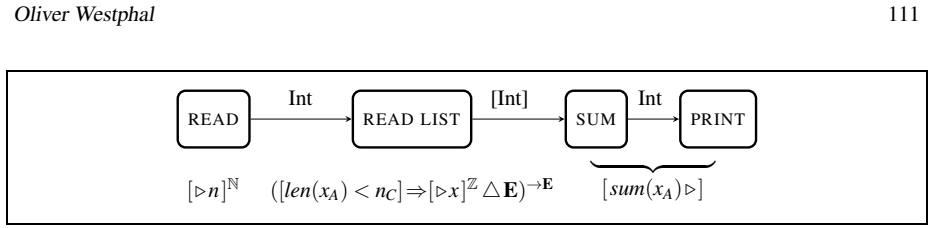
The central object is the abstract implementation: a labeled, acyclic wiring diagram in which abstract idioms (typed operations, some marked as producing IO side effects) are connected by black data-flow wires and by red wires that totally order the IO effects. The two transformations that carry the argument are substitution—cutting out one idiom and inserting a more detailed diagram with the same external interface—and merging—cutting out a pattern of idioms and replacing it with a single idiom; both preserve the outside interface and must not create cycles in the combined data-flow/effect order. A second kind of idiom, the APPLY idiom, acts as a catalyst: alternatives split an atomic idiom into a function application plus parameters, and merge rules consume the APPLY idiom by folding it into a neighboring idiom. Concrete idioms are functions from inputs to artifact fragments plus silent outputs, and higher-order cases are handled by allowing partial outputs with holes that downstream idioms fill in, which avoids non-idiomatic beta-reducible expressions in generated code.
What would settle it
Define a small abstract implementation for the running example and give MODIFIED SUM two concrete idioms with different semantics—say one that sums all values and one that sums only values not equal to the second parameter—while keeping the same generated specification; if the two resulting programs are tested against that specification and one fails, the claim that a consistent original diagram guarantees coherent artifacts is refuted. A simpler check: generate the same abstract implementation twice with READ LIST realized by two concrete idioms that read values in different orders; identical console input should produce identical program behavior, and any divergence shows the process changed the intent.
Extended reading notes
Core claim
On the paper's own terms, the central claim is that an intent is a data-flow structure rather than a behavior predicate: an acyclic wiring diagram whose boxes are abstract idioms with typed inputs and outputs and whose red wires fix a total order on the boxes that perform IO. From this diagram, artifacts are generated by picking, for each abstract idiom, a concrete idiom appropriate to the target artifact kind, resolving data dependencies along the black wires, and combining the resulting fragments in any total order compatible with both data flow and IO order. Substitution replaces one idiom with a more detailed diagram having the same outer interface, and merging folds a pattern of idioms back into one; these two operations, driven by per-idiom alternative implementations and merge rules, produce variants of the diagram that realize the same intent. The paper shows that this process turns a four-step example intent into twenty distinct idiomatic Haskell programs and, by changing the artifact kind of the concrete idioms, into a matching IO-behavior specification and a verbal task description. Because every concrete fragment is handwritten, the generated programs are idiomatic by construction, and because all artifacts come from one diagram, they are coordinated as long as the idiom collection is consistent.
Load-bearing premise
The load-bearing premise is that the educator's handwritten set of concrete idioms, alternatives, and merge rules is mutually consistent, because the generation process does not check coherence and a single inconsistent fragment pair can silently produce artifacts that contradict each other.
Editorial extensions
If this is right
- One abstract implementation yields multiple distinct artifact kinds—program, specification, and description—that describe the same behavior, because only the concrete idioms change.
- Swapping one abstract idiom, such as replacing SUM by PRODUCT, changes the intent uniformly across every artifact derived from the diagram, without rewriting the other fragments.
- The number of generated variants multiplies: given two READ LIST, one READ LOOP, six MODIFIED SUM, and two MODIFIED SUM FOLD concrete idioms, the example produces 20 programs, and adding one new fragment multiplies all compatible combinations.
- Data-flow variants such as merging a loop with its summation or its print continuation change the decomposition of the code but not the observable IO behavior, so the same intent can be presented at different difficulty levels.
- Abstract patterns with dashed boxes and refinement rules act like a grammar for intents, so the framework can also vary which behavior is generated, not only how one behavior is realized.
Reading between the lines
- The framework's real product may be the idiom library: authoring cost is front-loaded into writing consistent concrete idioms and merge rules, and the combinatorial payoff makes larger libraries increasingly valuable, so reuse across courses could be the decisive factor.
- The stated coherence assumption invites an automated check that the paper does not develop: randomly sample generated programs and specifications from the same abstract implementation and run the property-based tests from the paper's earlier work to hunt for inconsistent idiom sets before exercises reach students.
- Because concrete idioms are functions into any monoid of fragments, the same machinery could generate non-code artifacts such as configuration files, circuit layouts, or test data, as long as an educator supplies matching fragments and a merge-compatible idiom set.
- A natural next experiment is difficulty modeling: the generator knows exactly which concrete idiom and which data-flow variant produced each exercise, so collected student performance data could be correlated with those choices to predict task difficulty.
Editorial analysis
A structured set of objections, weighed in public.
Referee Report
Summary. The paper presents a framework for generating multiple related artifacts (Haskell IO programs, behavior specifications, natural-language descriptions) from a single abstract specification, called an abstract implementation: a wiring diagram of typed abstract idioms with data-flow and IO-effect ordering. For each abstract idiom, an educator supplies sets of concrete idioms (artifact fragments) for various artifact kinds, and the framework composes chosen concrete idioms according to the wiring. Two diagram transformations (substitution and merging) generate variants of the abstract implementation, including context-sensitive fusion of idioms (e.g., folding a sum into a read loop). The paper also introduces abstract patterns, a grammar-like mechanism for varying the underlying intent. The central claim is that this approach is 'intent preserving': all artifacts generated from one abstract implementation realize the same intent. The paper is explicit, however, that the framework does not check coherence; it assumes the educator's set of concrete idioms, alternatives, and merge rules is mutually consistent (Section 4.1), and that preservation of intent of transformations 'cannot be enforced or checked automatically at the level of abstract implementations' (Section 3.3).
Significance. The framework is a clean, compositional alternative to monolithic generators for programming-exercise tasks, and the paper's emphasis on deriving code, tests, and descriptions from a shared abstract structure is practically motivated and plausible. Strengths include: no fitted parameters (so no fit-to-data circularity); a fully worked, reproducible-looking example with concrete Haskell fragments; and unusual intellectual honesty about the coherence assumption, which is stated directly and not hidden. If the intent-preservation claim could be made formal or at least validated by automated checks, the approach would be a useful contribution to the TFPiE community. As it stands, the significance is limited because the central guarantee is explicitly delegated to the educator, and the paper offers no method or evidence that such a delegation is practical beyond a single hand-crafted example.
major comments (2)
- [Section 4.1 / Section 3.3] The paper's central claim of 'intent preserving' generation is not established; it is assumed. Section 4.1 states that the generation process 'does not do anything to check coherence' and that 'validation of concrete idiom sets, alternatives, and merge-rules is therefore the responsibility of the educator.' Section 3.3 concedes that preservation of intent by alternative implementations and merge rules 'cannot be enforced or checked automatically at the level of abstract implementations.' This is not a peripheral caveat: all guarantees about different artifacts being realizations of the same intent rest on this unverified premise. For example, two concrete idioms with the same signature but different behavioral semantics (e.g., two READ LIST realizations that consume different numbers of inputs) would silently produce mutually contradictory programs, specifications, and descriptions while the pipeline reports success. Since the paper's own testing framework [16] could, in principle, verify behavioral equivalence among generated concrete programs and between programs and specifications, this is fixable: the authors should either re-scope the title and abstract from 'intent preserving' to 'intent preserving up to an educator-provided, externally validated idiom library,' or add an automated compatibility check over the concrete idiom set.
- [Section 5.4] The only quantitative evidence for the framework's utility is the statement that 'we get a total of 20 slightly different concrete programs' from the example idiom library (Section 5.4). This is a combinatorics count, not a validation of diversity, idiomaticity, or intent preservation; it merely reflects the number of hand-written fragments and substitutions. The paper provides no evaluation of whether these 20 programs are actually behaviorally equivalent, whether they are idiomatic by any criterion, or whether the effort of constructing the idiom library is justified by the resulting variability. Adding a small automated equivalence check (e.g., using the [16] framework) for all or a sample of the 20 programs would substantially strengthen the central claim.
minor comments (4)
- [Section 2 / Figure 1] In Figure 1, the specification expression is shown aligned with the data-flow diagram, but the text does not explain how the alignment was obtained; this is a key step in the motivation (inferring composition boundaries from a specification) that the paper then abandons. A sentence clarifying that the alignment is only illustrative would avoid confusion.
- [Section 5.3] The graphical notation for 'higher-order' idioms, especially the partial-output type 'Int<Int,Int>' and the fragment 'if ... then 2*x ... else ...' in the MODIFIED SUM FOLD figure, is difficult to read in the rendered text. A concise textual explanation of the hole-filling mechanism, with a concrete example of the final β-reduced expression, would improve accessibility.
- [Section 3.3] The text says 'For SUM, we get the following alternative version' but the figure and surrounding discussion actually refer to a 'MODIFIED SUM' idiom from the running example. This naming inconsistency makes the transformation harder to follow.
- [Throughout] The paper lacks a reference to a public prototype implementation or repository. Section 8 mentions 'a prototype implementation' but gives no URL or artifact availability information; adding this would support reproducibility, which is otherwise one of the paper's strengths.
Circularity Check
No significant circularity: the generation pipeline is a constructive composition over hand-written concrete idioms, and the coherence caveat is an explicit assumption, not a circular derivation.
full rationale
The paper makes no empirical predictions and fits no parameters. Its derivation chain is constructive: an abstract implementation is the input; substitution and merge rules transform it; then each abstract idiom is replaced by an educator-supplied concrete idiom, and the resulting fragments are combined in an order compatible with the data-flow and IO-effect ordering. Idiomaticity and diversity are inherited from the hand-written fragment library and from the combinatorial number of choices, not derived from the generator itself. The only point that could resemble circularity is the title claim of 'intent preserving', since Section 4.1 explicitly disclaims any formal connection: 'there is no formal connection between the wiring diagram of the abstract implementation and the artifact resulting from the generation procedure other than the generation process itself', and 'The generation process does not do anything to check coherence but assumes that the set of concrete idioms is built such that possible results are coherent by construction.' Section 3.3 similarly concedes that preservation of intent 'cannot be enforced or checked automatically at the level of abstract implementations.' This is an honest and load-bearing validity caveat: the framework's guarantee is conditional on the educator's library being mutually consistent. But it is not a circular reduction in the sense of an output being defined in terms of the claimed prediction or a fitted parameter being renamed as a result. There is no equation in which the generated artifact is used to define the abstract implementation, and no benchmark is predicted from fitted data. The self-citations [15,16,17] supply prior tooling and example languages; they are not used as the sole justification for the central claim. Accordingly, the derivation is self-contained as a constructive engineering proposal, and the coherence assumption should be weighed as a correctness/validation risk rather than as circularity.
Assumptions & free parameters
assumptions (4)
- domain assumption Well-formed abstract implementations are acyclic wiring diagrams over typed abstract idioms, with a total IO-effect order compatible with the data-flow order (Section 3.1).
- domain assumption Concrete idioms, alternative implementations, and merge rules are authored by the educator such that all artifacts generated from them are semantically coherent by construction (Section 4.1).
- domain assumption Combining concrete fragments in any total order compatible with data-flow and IO effects yields a valid artifact of the target kind (Section 4).
- ad hoc to paper Substitution and merging transformations preserve intent; asserted informally in Section 3.2 and stated to be uncheckable in Section 3.3.
invented entities (2)
-
APPLY idioms (catalysts)
-
Abstract patterns with dashed non-terminal boxes
Cite this review
Pith. "Pith review of Intent Preserving Generation of Diverse and Idiomatic (Code-)Artifacts." pith.science (2026). https://pith.science/paper/W6DWO7OK
@misc{pith2026250803642,
  author       = {Pith},
  title        = {Pith review of: Intent Preserving Generation of Diverse and Idiomatic (Code-)Artifacts},
  year         = {2026},
  howpublished = {\url{https://pith.science/paper/W6DWO7OK}},
  note         = {Machine review of arXiv:2508.03642}
}
read the original abstract
When automatically generating programming exercise tasks one often also needs to automatically generate programs. At the very least when providing sample solutions is part of automated feedback. But programs can also be used as part of the exercise task description to communicate a task's requirements. Writing good program generators that produce varied yet idiomatic code while being easily adaptable for new tasks is challenging. The challenges are intensified if task generation requires additional artifacts, like a more general behavior specification for testing or additional textual descriptions. Manually writing generators for multiple different but strongly related artifacts gets complicated quickly. We present an approach where instead of writing monolithic generators for multiple connected artifacts one specifies a small set of abstract building blocks and for each such building block defines sets of concrete realizations for various kinds of artifacts. Then the intended structure of the resulting artifacts is specified as a composition of the small abstract building blocks. This abstract description then serves as the common source from which related artifacts can be derived automatically. The approach is generic in the kind of artifacts it can produce and is therefore adaptable to a wide range of contexts.
Figures


Figures from the paper (4 more)


Reference graph
Works this paper leans on
-
[16]
Oliver Westphal & Janis V oigtl¨ ander (2020): Describing Console I/O Behavior for T esting Student Submis - sions in Haskell . In Jurriaan Hage, editor: Proceedings Eighth and Ninth International Workshop on Tre nds in Functional Programming in Education , EPTCS 321, Open Publishing Association, pp. 19–36, doi: 10. 4204/eptcs.321.2
work page 2020
-
[1]
In: Proceedings of the 55th ACM Technical Symposium on Computer Science Education V
Doga Cambaz & Xiaoling Zhang (2024): Use of AI-driven Code Generation Models in T eaching and Learn- ing Programming: a Systematic Literature Review . In: Proceedings of the 55th ACM Technical Symposium on Computer Science Education V . 1, SIGCSE 2024, ACM, p. 172–178, doi: 10.1145/3626252.3630958. Oliver Westphal 129
arXiv 2024
-
[2]
Proceedings of the Royal Society A 477(2250), doi: 10.1098/ rspa.2021.0099
John D Foley, Spencer Breiner, Eswaran Subrahmanian & Jo hn M Dusel (2021): Operads for complex system design specification, analysis and synthesis . Proceedings of the Royal Society A 477(2250), doi: 10.1098/ rspa.2021.0099
-
[3]
Spivak (2019): An Invitation to Applied Category Theory: Seven Sketches in Compositionality
Brendan Fong & David I. Spivak (2019): An Invitation to Applied Category Theory: Seven Sketches in Compositionality. Cambridge University Press, doi: 10.1017/9781108668804
-
[4]
International Journal of Artificial Intelligence in Education 27, pp
Alex Gerdes, Bastiaan Heeren, Johan Jeuring & L Thomas V a n Binsbergen (2017): Ask-Elle: an Adaptable Programming Tutor for Haskell Giving Automated Feedback . International Journal of Artificial Intelligence in Education 27, pp. 65–100, doi: 10.1007/s40593-015-0080-x
-
[5]
Mathematics in Computer Science 3, pp
Bastiaan Heeren, Johan Jeuring & Alex Gerdes (2010): Specifying Rewrite Strategies for Interactive Exer- cises. Mathematics in Computer Science 3, pp. 349–370, doi: 10.1007/s11786-010-0027-4
-
[6]
Emanuel Kitzelmann (2010): Inductive Programming: A Survey of Program Synthesis T echn iques. In Ute Schmid, Emanuel Kitzelmann & Rinus Plasmeijer, editors: Approaches and Applications of Inductive Pro- gramming, Springer, pp. 50–73, doi: 10.1007/978-3-642-11931-6_3
-
[7]
Triet H. M. Le, Hao Chen & Muhammad Ali Babar (2020): Deep Learning for Source Code Modeling and Generation: Models, Applications, and Challenges . ACM Computing Surveys 53(3), doi: 10.1145/ 3383458
work page 2020
Show all 17 references
-
[8]
London Mathematical Society Lecture Note Series, Cambridge University Press, doi: 10.4204/eptcs.321.2
Tom Leinster (2004): Higher Operads, Higher Categories . London Mathematical Society Lecture Note Series, Cambridge University Press, doi: 10.4204/eptcs.321.2
2004 doi
-
[9]
In: Proceedings of the 2022 ACM Conference on International Computing Education Research - V olume 1 , ICER ’22, ACM, p
Sami Sarsa, Paul Denny, Arto Hellas & Juho Leinonen (2022 ): Automatic Generation of Programming Exer- cises and Code Explanations Using Large Language Models . In: Proceedings of the 2022 ACM Conference on International Computing Education Research - V olume 1 , ICER ’22, ACM...
2022
-
[10]
New Structures for Physics, pp
Peter Selinger (2011): A Survey of Graphical Languages for Monoidal Categories . New Structures for Physics, pp. 289–355, doi: 10.1007/978-3-642-12821-9_4
2011 doi
-
[11]
Kumar (2002): A tutoring system for parameter passing in programming lan- guages
Harsh Shah & Amruth N. Kumar (2002): A tutoring system for parameter passing in programming lan- guages. In: Proceedings of the 7th Annual Conference on Innovation and T echnology in Computer Science Education, ITiCSE ’02, ACM, p. 170–174, doi: 10.1145/544414.544464
2002
- [12]
-
[13]
Computer Languages, Systems & Structures 52, pp
Eugene Syriani, Lechanceux Luhunu & Houari Sahraoui (2 018): Systematic mapping study of template- based code generation . Computer Languages, Systems & Structures 52, pp. 43–62, doi: 10.1016/j.cl. 2017.11.003
2017 doi
-
[14]
In: Proceedings of the 50th ACM Technical Symposium on Computer Science Education , SIGCSE ’19, ACM, p
Anderson Thomas, Troy Stopera, Pablo Frank-Bolton & Ra hul Simha (2019): Stochastic Tree-Based Gener- ation of Program-Tracing Practice Questions . In: Proceedings of the 50th ACM Technical Symposium on Computer Science Education , SIGCSE ’19, ACM, p. 91–97, doi: 10.1145/32873...
2019
-
[15]
In Michael Hanus & Claudio Sacerdoti Coen, editors: Functional and Constraint Logic Programming , LNCS 12560, Springer, pp
Oliver Westphal (2021): A Framework for Generating Diverse Haskell-I/O Exercise T asks. In Michael Hanus & Claudio Sacerdoti Coen, editors: Functional and Constraint Logic Programming , LNCS 12560, Springer, pp. 97–114, doi: 10.1007/978-3-030-75333-7_6
2021 doi
-
[17]
In: Proceedings of the 15th International Symposium on Functio nal and Logic Programming , LNCS 12073, Springer, pp
Oliver Westphal & Janis V oigtl¨ ander (2020): Implementing, and Keeping in Check, a DSL Used in E- Learning. In: Proceedings of the 15th International Symposium on Functio nal and Logic Programming , LNCS 12073, Springer, pp. 179–197, doi: 10.1007/978-3-030-59025-3_11
2020 doi
Reviewed August 6, 2026 · model on record in the stance chip above.
Discussion (0). Continue with ORCID to comment.