Chirality-Induced Spin Selectivity: Nonlinear Spin Response from Electron-Phonon Scattering
Pith reviewed 2026-05-19 00:13 UTC · model grok-4.3
The pith
Spin-dependent electron-phonon scattering produces the nonlinear, length-dependent spin accumulation that defines chirality-induced spin selectivity.
A machine-rendered reading of the paper's core claim, the machinery that carries it, and where it could break.
Core claim
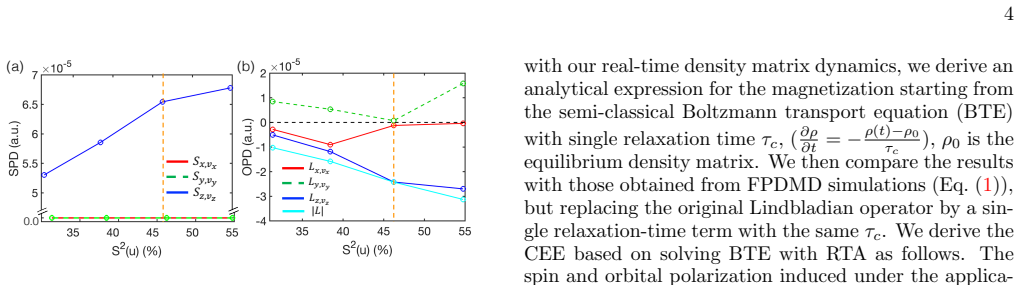
In trigonal selenium the collinear Edelstein effect yields a spatially uniform spin polarization that scales linearly with the applied electric field. When the first-principles spatiotemporal density-matrix dynamics are extended to include explicit spin-dependent electron-phonon scattering with self-consistent spin-orbit coupling, the spin response becomes nonlinear (S_z ∝ E²) and the spin accumulation depends on sample length. The microscopic origin of this nonlinearity is intervalley scattering mediated by chiral phonon angular momentum.
What carries the argument
Intervalley scattering mediated by chiral phonon angular momentum within the spatiotemporal density-matrix dynamics that incorporate self-consistent spin-orbit coupling and spin-dependent electron-phonon interactions.
If this is right
- CISS is experimentally distinguishable from the collinear Edelstein effect by its quadratic field dependence and its length-dependent accumulation.
- The nonlinear response originates specifically from intervalley scattering processes involving chiral phonon angular momentum.
- First-principles density-matrix methods can now be used to predict the magnitude of CISS in other chiral solids from standard inputs.
- Chiral phonons act as the intermediary that converts structural handedness into spin selectivity during scattering.
Where Pith is reading between the lines
- Device geometries that vary sample length could be used to tune the strength of CISS-based spin currents.
- Similar intervalley mechanisms may operate in molecular junctions or other low-dimensional chiral systems where phonon modes are also chiral.
- Direct measurement of the quadratic coefficient in the spin-versus-field curve of trigonal selenium would provide a quantitative test of the proposed scattering channel.
Load-bearing premise
The chosen phonon dispersion and the density-matrix treatment of trigonal selenium capture all relevant intervalley processes without missing higher-order channels or needing material-specific adjustments beyond standard first-principles inputs.
What would settle it
An experiment that measures spin polarization scaling linearly rather than quadratically with electric-field strength, or spin accumulation that is independent of sample length, in trigonal selenium would show that spin-dependent electron-phonon scattering does not drive the CISS nonlinearity.
Figures




read the original abstract
Chirality-induced spin selectivity (CISS) generates spin-polarized currents in nonmagnetic materials from structural chirality alone, yet its microscopic origin remains debated. Using a first-principles spatiotemporal density-matrix dynamics approach including electron-phonon scatterings with self-consistent spin-orbit coupling (SOC), we elucidate the interplay of SOC, structural chirality, and spin-dependent electron-phonon interactions in driving the generation and transport of spin and orbital angular momentum. In particular we quantitatively distinguish CISS from the collinear Edelstein effect (CEE) in trigonal selenium, a prototypical chiral solid. CEE yields a spatially uniform spin polarization scaling linearly with applied field ($S_z \propto E$). In contrast, explicit spin-dependent electron-phonon scattering produces a nonlinear response ($S_z \propto E^2$) and a length-dependent spin accumulation -- the hallmark experimental signature of CISS. We identify intervalley scattering mediated by chiral phonon angular momentum as the microscopic origin of this nonlinearity.
Editorial analysis
A structured set of objections, weighed in public.
Referee Report
Summary. The manuscript presents a first-principles spatiotemporal density-matrix dynamics simulation of trigonal selenium incorporating electron-phonon scattering and self-consistent spin-orbit coupling. It claims to distinguish chirality-induced spin selectivity (CISS) from the collinear Edelstein effect (CEE) by demonstrating that explicit spin-dependent electron-phonon interactions yield a nonlinear spin polarization (S_z ∝ E²) and length-dependent spin accumulation, with intervalley scattering mediated by chiral phonon angular momentum identified as the microscopic origin.
Significance. If the central simulation results hold without numerical artifacts, the work provides a microscopic mechanism for the hallmark length-dependent spin accumulation in CISS experiments, linking it directly to intervalley processes involving chiral phonons via direct numerical integration of the density-matrix equations. The parameter-free character of the approach and the quantitative separation of CISS from CEE are notable strengths that could advance understanding beyond phenomenological models.
major comments (2)
- [§ on methods] § on methods: The spatiotemporal density-matrix simulation employs open boundaries and finite propagation time; explicit convergence tests with respect to system length, chain size, and evolution duration are required to rule out boundary or truncation artifacts that could artificially generate length-dependent spin accumulation scaling with system size even without the claimed intervalley mechanism.
- [Abstract] Abstract and results: The reported nonlinear response and length-dependent accumulation lack accompanying error bars, statistical convergence checks on the scattering matrix elements, or direct numerical comparison to experimental CISS polarization magnitudes, which is necessary to establish that the S_z ∝ E² scaling is physically robust rather than sensitive to simulation parameters.
minor comments (1)
- Figure captions and text should explicitly define the notation for spin (S_z) versus orbital angular momentum to avoid ambiguity when discussing their interplay.
Simulated Author's Rebuttal
We thank the referee for the positive evaluation and constructive feedback on our first-principles density-matrix study of CISS in trigonal selenium. We address each major comment below and will revise the manuscript accordingly.
read point-by-point responses
-
Referee: § on methods: The spatiotemporal density-matrix simulation employs open boundaries and finite propagation time; explicit convergence tests with respect to system length, chain size, and evolution duration are required to rule out boundary or truncation artifacts that could artificially generate length-dependent spin accumulation scaling with system size even without the claimed intervalley mechanism.
Authors: We agree that explicit convergence tests are necessary to exclude numerical artifacts. In the revised manuscript we will add dedicated sections presenting convergence data with respect to system length, number of chains, and propagation time. These tests confirm that the nonlinear S_z ∝ E² response and the length-dependent accumulation remain stable and originate from the intervalley chiral-phonon scattering rather than boundary or truncation effects. revision: yes
-
Referee: Abstract and results: The reported nonlinear response and length-dependent accumulation lack accompanying error bars, statistical convergence checks on the scattering matrix elements, or direct numerical comparison to experimental CISS polarization magnitudes, which is necessary to establish that the S_z ∝ E² scaling is physically robust rather than sensitive to simulation parameters.
Authors: We acknowledge the value of error bars and convergence diagnostics. The revised manuscript will include error estimates obtained by varying the scattering matrix elements within their numerical uncertainty and will report statistical convergence checks. Direct quantitative comparison to specific experimental polarization values is limited by the absence of exact experimental parameters (e.g., precise temperature, defect density) in the literature; we will therefore add a discussion of qualitative agreement with the observed length dependence while noting this as a current limitation of the parameter-free approach. revision: partial
Circularity Check
No significant circularity; results from direct numerical integration
full rationale
The paper's derivation proceeds via first-principles spatiotemporal density-matrix dynamics that incorporate electron-phonon scattering and self-consistent SOC as explicit inputs. The reported nonlinear spin response (S_z ∝ E^2) and length-dependent accumulation are computed outputs of this integration rather than algebraic reductions, fitted parameters renamed as predictions, or self-citation chains. The distinction between CISS and CEE follows from the explicit inclusion of spin-dependent scattering channels in trigonal selenium without invoking uniqueness theorems or ansatzes from prior self-work that would render the central claim tautological. The simulation is self-contained and falsifiable against independent benchmarks.
Axiom & Free-Parameter Ledger
axioms (1)
- domain assumption Standard first-principles approximations (DFT + electron-phonon matrix elements) accurately represent the band structure and scattering rates in trigonal selenium.
Lean theorems connected to this paper
-
IndisputableMonolith/Foundation/AbsoluteFloorClosure.leanreality_from_one_distinction unclear?
unclearRelation between the paper passage and the cited Recognition theorem.
explicit spin-dependent electron-phonon scattering produces a nonlinear response (S_z ∝ E²) and a length-dependent spin accumulation -- the hallmark experimental signature of CISS. We identify intervalley scattering mediated by chiral phonon angular momentum
-
IndisputableMonolith/Foundation/AlexanderDuality.leanalexander_duality_circle_linking unclear?
unclearRelation between the paper passage and the cited Recognition theorem.
spatiotemporal density-matrix dynamics with self-consistent SOC and the chosen phonon dispersion in trigonal selenium
What do these tags mean?
- matches
- The paper's claim is directly supported by a theorem in the formal canon.
- supports
- The theorem supports part of the paper's argument, but the paper may add assumptions or extra steps.
- extends
- The paper goes beyond the formal theorem; the theorem is a base layer rather than the whole result.
- uses
- The paper appears to rely on the theorem as machinery.
- contradicts
- The paper's claim conflicts with a theorem or certificate in the canon.
- unclear
- Pith found a possible connection, but the passage is too broad, indirect, or ambiguous to say the theorem truly supports the claim.
Reference graph
Works this paper leans on
-
[1]
B. P. Bloom, Y. Paltiel, R. Naaman, and D. H. Waldeck, Chiral induced spin selectivity, Chemical Reviews 124, 1950 (2024)
work page 1950
-
[2]
B. G¨ ohler, V. Hamelbeck, T. Z. Markus, M. Kettner, G. F. Hanne, Z. Vager, R. Naaman, and H. Zacharias, Spin selectivity in electron transmission through self- assembled monolayers of double-stranded dna, Science 331, 894 (2011)
work page 2011
-
[3]
S. G. Ray, S. S. Daube, G. Leitus, Z. Vager, and R. Naa- man, Chirality-induced spin-selective properties of self- assembled monolayers of dna on gold, Phys. Rev. Lett. 96, 036101 (2006)
work page 2006
-
[4]
J. Ahn, E. Lee, J. Tan, W. Yang, B. Kim, and J. Moon, A new class of chiral semiconductors: chiral- organic-molecule-incorporating organic–inorganic hybrid perovskites, Mater. Horiz. 4, 851 (2017)
work page 2017
-
[5]
J. Wang, B. Mao, and Z. V. Vardeny, Chirality induced spin selectivity in chiral hybrid organic–inorganic per- ovskites, The Journal of Chemical Physics 159, 091002 (2023)
work page 2023
-
[6]
T. Furukawa, Y. Shimokawa, K. Kobayashi, and T. Itou, Observation of current-induced bulk magnetization in elemental tellurium, Nature Communications 8, 954 (2017)
work page 2017
- [7]
-
[8]
R. Naaman and D. H. Waldeck, Spintronics and chiral- ity: Spin selectivity in electron transport through chiral molecules, Annual Review of Physical Chemistry 66, 263 (2015)
work page 2015
-
[9]
A. Moharana, Y. Kapon, F. Kammerbauer, D. Anthofer, S. Yochelis, H. Shema, E. Gross, M. Kl¨ aui, Y. Paltiel, and A. Wittmann, Chiral-induced unidirectional spin- to-charge conversion, Science Advances 11, eado4285 (2025)
work page 2025
-
[10]
Y. Adhikari, T. Liu, H. Wang, Z. Hua, H. Liu, E. Lochner, P. Schlottmann, B. Yan, J. Zhao, and P. Xiong, Interplay of structural chirality, electron spin and topological orbital in chiral molecular spin valves, Nature Communications 14, 5163 (2023)
work page 2023
-
[11]
Q. Qian, H. Ren, J. Zhou, Z. Wan, J. Zhou, X. Yan, J. Cai, P. Wang, B. Li, Z. Sofer, B. Li, X. Duan, X. Pan, Y. Huang, and X. Duan, Chiral molecular intercalation superlattices, Nature 606, 902 (2022)
work page 2022
-
[12]
H. J. Eckvahl, N. A. Tcyrulnikov, A. Chiesa, J. M. Bradley, R. M. Young, S. Carretta, M. D. Krzyaniak, and M. R. Wasielewski, Direct observation of chirality- induced spin selectivity in electron donor–acceptor molecules, Science 382, 197 (2023)
work page 2023
-
[13]
M. R. Safari, F. Matthes, C. M. Schneider, K.-H. Ernst, and D. E. B¨ urgler, Spin-selective electron trans- port through single chiral molecules, Small 20, 2308233 (2024)
work page 2024
-
[14]
T. Wang, H. Sun, X. Li, and L. Zhang, Chiral phonons: Prediction, verification, and application, Nano Letters 24, 4311 (2024)
work page 2024
-
[15]
K. Ohe, H. Shishido, M. Kato, S. Utsumi, H. Matsuura, and Y. Togawa, Chirality-induced selectivity of phonon angular momenta in chiral quartz crystals, Phys. Rev. Lett. 132, 056302 (2024)
work page 2024
-
[16]
K. Kim, E. Vetter, L. Yan, C. Yang, Z. Wang, R. Sun, Y. Yang, A. H. Comstock, X. Li, J. Zhou, L. Zhang, W. You, D. Sun, and J. Liu, Chiral-phonon-activated spin seebeck effect, Nature Materials 22, 322 (2023)
work page 2023
-
[17]
J. Xu, A. Habib, S. Kumar, F. Wu, R. Sundararaman, 7 and Y. Ping, Spin-phonon relaxation from a universal ab initio density-matrix approach, Nature Communications 11, 2780 (2020)
work page 2020
-
[18]
J. Xu, A. Habib, R. Sundararaman, and Y. Ping, Ab initio ultrafast spin dynamics in solids, Physical Review B 104, 184418 (2021)
work page 2021
- [19]
-
[20]
J. Xu, K. Li, U. N. Huynh, M. Fadel, J. Huang, R. Sun- dararaman, V. Vardeny, and Y. Ping, How spin relaxes and dephases in bulk halide perovskites, Nat. Commun. 15, 188 (2024)
work page 2024
- [21]
- [22]
- [23]
-
[24]
P. Cherin and P. Unger, The crystal structure of trigonal selenium, Inorganic Chemistry 6, 1589 (1967)
work page 1967
-
[25]
F. D. Saeva, G. R. Olin, and J. Y. C. Chu, Circular dichroism of trigonal selenium formed in a chiral poly- mer matrix, Molecular Crystals and Liquid Crystals 41, 5 (1977)
work page 1977
-
[26]
M. Hirayama, R. Okugawa, S. Ishibashi, S. Murakami, and T. Miyake, Weyl node and spin texture in trigonal tellurium and selenium, Phys. Rev. Lett. 114, 206401 (2015)
work page 2015
-
[27]
M. Sakano, M. Hirayama, T. Takahashi, S. Akebi, M. Nakayama, K. Kuroda, K. Taguchi, T. Yoshikawa, K. Miyamoto, T. Okuda, K. Ono, H. Kumigashira, T. Ideue, Y. Iwasa, N. Mitsuishi, K. Ishizaka, S. Shin, T. Miyake, S. Murakami, T. Sasagawa, and T. Kondo, Radial spin texture in elemental tellurium with chiral crystal structure, Phys. Rev. Lett. 124, 136404 (2020)
work page 2020
-
[28]
G. H. Fecher, J. K¨ ubler, and C. Felser, Chirality in the solid state: Chiral crystal structures in chiral and achiral space groups, Materials 15, 10.3390/ma15175812 (2022)
-
[29]
A. Grieder, S. Tu, and Y. Ping, Relation of continuous chirality measure to spin and orbital polarization, and chiroptical properties in solids (2025), arXiv:2504.11596 [cond-mat.mtrl-sci]
-
[30]
S. S. Tsirkin, P. A. Puente, and I. Souza, Gyrotropic effects in trigonal tellurium studied from first principles, Phys. Rev. B 97, 035158 (2018)
work page 2018
discussion (0)
Sign in with ORCID, Apple, or X to comment. Anyone can read and Pith papers without signing in.