REVIEW 3 major objections 5 minor 63 references
Prototype-Driven Structure Synergy Network for Remote Sensing Images Segmentation
T0 review · 3 major / 5 minor · reviewed 2026-08-06 · deepseek-v4-flash
Pith's one-line read PDSSNet tops three remote-sensing segmentation benchmarks
desk verdict A coherent, well-ablated combination of known ideas with a plausible SOTA claim, but the test-time handling of the GT-initialized prototypes is unspecified and the comparison tables lack variance estimates. read the letter →
The pith
A machine-rendered reading of the paper's core claim, the machinery that carries it, and where it could break.
The reading
What carries the argument
The core mechanism is the three-module synergy inside PDSSNet. APEM (Adaptive Prototype Extraction Module) creates a per-class prototype by masking the feature map with one-hot ground truth and averaging, then dynamically updates that prototype using structure-refined features. SSCM (Semantic-Structure Coordination Module) feeds a semantic sequence into a state-space model, captures its final hidden state, and uses that as the initial state for a second scan over structural features, following a semantics-first, structure-second hierarchy. CSAM (Channel Similarity Adjustment Module) uses cosine similarity between hidden state and current input to scale the SSM step size, so similar channels
What would settle it
Re-run the nine compared methods under PDSSNet's exact training and testing protocol on Vaihingen, Potsdam, and LoveDA; if the re-run mIoU of at least one baseline (for example LoG-CAN++ or RS-Mamba) meets or exceeds PDSSNet's reported numbers, the central superiority claim would fail. Alternatively, train PDSSNet itself across five random seeds on Vaihingen and check whether the 0.48-0.93 point ablation gaps for module removal remain outside the standard deviation.
Extended reading notes
Core claim
The central claim is that PDSSNet outperforms state-of-the-art methods on three standard remote sensing segmentation benchmarks: it reports 84.68 mIoU / 91.60 F1 / 91.94 OA on Vaihingen, 87.55 / 93.25 / 91.84 on Potsdam, and 56.10 / 71.20 / 73.02 on LoveDA, beating all nine compared methods in every table. The mechanism behind the claim is that a complete object is jointly defined by invariant class semantics and variant spatial structure, and the network implements this with three modules: APEM, which uses ground truth to aggregate unbiased class prototypes; SSCM, which first establishes global semantics and then uses structure to refine them via F-SS2D, a bidirectional state-space scan; an
Load-bearing premise
The claim that PDSSNet outperforms all nine baseline methods assumes that the baseline numbers cited from their papers were produced under the same protocol (crop size, backbone details, test augmentation, optimization, and data splits) as PDSSNet, and that the 0.5-1.1 point margins are larger than run-to-run noise; the authors did not re-run the baselines and report no variance estimates.
Editorial extensions
If this is right
- If the reported numbers reproduce, PDSSNet would provide a new reference point for remote sensing segmentation, with both transformer-based and SSM-based competitors needing to catch up.
- The use of ground-truth-derived prototypes suggests that class-guided methods do not have to rely on coarse, potentially misleading intermediate predictions, a direction that could generalize beyond remote sensing.
- The SimStep mechanism implies that explicit similarity-aware control of state-space updates can improve class discrimination, a finding applicable to any sequence model facing confusable tokens.
- The hierarchical semantics-then-structure scan provides a template for injecting structural priors into state-space models without quadratic attention cost.
- The backbone-sweep results indicate that PDSSNet's gains are not tied to a single encoder, since it outperforms its baselines across ConvNeXt, Swin, ResNet, and Mamba-style backbones.
- The paper claims that both the cross-entropy and dice losses contribute, with the dice loss playing an auxiliary role in region overlap and class imbalance.
Reading between the lines
- A natural extension, not tested in the paper, is whether APEM's ground-truth prototype construction works in a semi-supervised regime where full masks are only available for part of the training set; if the prototype update mechanism degrades gracefully with missing annotations, the method would be more broadly usable.
- Because the ablation gains are on the order of 0.5-1.1 mIoU and the paper reports no variance across runs, an independent check with multiple seeds could determine whether the module contributions are distinguishable from noise.
- The F-SS2D hierarchy could be transferred to video segmentation, where the 'structure' of an object across frames could play the role of spatial structure, and the SimStep mechanism could help separate objects with similar motion patterns.
Editorial analysis
A structured set of objections, weighed in public.
Referee Report
Summary. The paper proposes PDSSNet, a semantic segmentation network for remote sensing images, combining a ConvNeXt encoder with three decoder modules: APEM (which aggregates class prototypes from one-hot ground-truth masks), SSCM (hierarchical SSM-based semantic-then-structure refinement), and CSAM (channel-wise similarity-adjusted SSM step sizes). The authors report state-of-the-art mIoU/F1/OA on Vaihingen (84.68/91.60/91.94), Potsdam (87.55/93.25/91.84), and LoveDA (56.10/71.20/73.02), outperforming nine baselines including LoG-CAN++, RS-Mamba, and Samba. Ablation studies attribute positive, non-redundant gains to each module and loss component.
Significance. If the claims hold, PDSSNet would be a meaningful architectural contribution: it combines prototype-driven class modeling with SSM-based semantic-structure coordination and a similarity-aware step-size mechanism, and the reported results exceed current published numbers on three standard benchmarks. The code is promised to be public, and the module ablation pattern is internally coherent (removing any component hurts, adding it helps). However, the central SOTA claim is currently not verifiable: the APEM's ground-truth dependency is not specified as training-only, and the comparison tables lack variance estimates and per-baseline protocol information. These are load-bearing issues, not presentation issues.
major comments (3)
- [III-B2, Eqs. (12)-(14)] APEM initialization and update both use the one-hot ground-truth mask L: Eq. (12) initializes M[k] from L, and Eq. (14) updates M'[k] using L[k] in Eq. (13). The text never states that this ground-truth use is restricted to training, and it never provides a test-time initialization/update procedure. Figure 2 has an 'Only Train' annotation, but the main text does not explain it. If GT is used at inference, all reported numbers in Tables V-VII and I-II are contaminated by label leakage and the SOTA claim collapses. If GT is used only during training, the paper must state this explicitly and describe exactly how M is initialized and updated at test time (e.g., from training-set statistics, learned embeddings, or model predictions). This is the first issue to resolve before any further evaluation.
- [IV-B, Tables I-II and V-VII] The text in Section IV-B says 'The experimental results are averaged over multiple trials,' but no table reports error bars, standard deviations, number of seeds, or statistical tests. Many margins are small: e.g., Table VI PDSSNet vs LoG-CAN++ is 87.55 vs 87.50 mIoU (0.05 percentage points); Table V PDSSNet vs LoG-CAN++ is 84.68 vs 83.57; several class-level F1 differences are below 1%. Without variance estimates, these differences cannot be distinguished from run-to-run noise. The authors should report mean ± std over at least three independent training runs and, where appropriate, a paired significance test. This directly affects the 'outperforms state-of-the-art' claim.
- [Tables V-VII, Section IV-C] The comparison tables do not provide a protocol for each baseline. It is not stated whether the nine prior methods were retrained by the authors under the same crop size (1024x1024), optimizer, learning rate schedule, data augmentation (including random scaling up to 1.5), multi-scale and flip test-time augmentation, and validation/test splits, or whether numbers were copied from the original papers. The authors' settings differ from the original papers for several baselines, and the margins of 0.5-1.1 mIoU are meaningful only if all methods are evaluated under a common protocol. Provide a per-method settings table or rerun all baselines under the identical pipeline; otherwise the SOTA claim is not supported.
minor comments (5)
- [Table V] The LoG-CAN entry is cited as [58], but the text and reference list identify LoG-CAN as [39]. Reference [58] is a different paper. Please correct the citation.
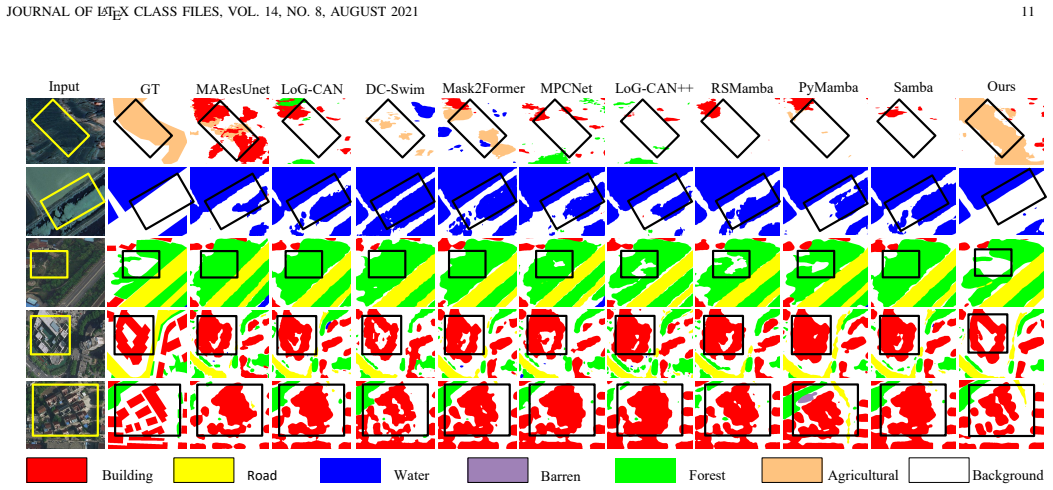
- [Figures 10-11] Figure captions use 'DC-Swim' and 'PyramidManba' inconsistently with the text's 'DC-Swin' and 'PyMamba'. Please unify the names.
- [III-B2] Equation (13) introduces 'eA[k]' but the surrounding text and Eq. (14) use 'A˜[k]' and 'M'[k]'; the tilde and prime notation is inconsistent and should be cleaned up.
- [Table II] The table lists Baseline, +APEM, +SSCM, and +CSAM separately, but the sequential combination Baseline+APEM+SSCM+CSAM (full PDSSNet) is not shown in the table even though it is described in the text and Fig. 7. Add the full combination to make the additive gains directly readable.
- [IV-B] The phrase 'averaged over multiple trials' is vague. Specify the number of trials, the random seeds, and whether the reported numbers are the mean of the final epoch or the best epoch; this is needed to interpret the ablation tables.
Circularity Check
No significant circularity: the claimed SOTA result is an empirical benchmark outcome, and the modules are evaluated on held-out test splits rather than derived from their own inputs.
full rationale
The paper's central claim is empirical (Tables V-VII), not a formal derivation from premises that would reduce to its inputs by construction. APEM initializes the class prototype storage matrix M[k] via Eq. (12) using the one-hot ground-truth mask L, and updates it via Eq. (14) using the SSCM output masked again by L. This is training-time supervised conditioning in the same class of operations as masked average pooling; the final segmentation is produced by the decoder from image features, not from ground-truth labels at inference. The paper labels the update branch as 'Only Train' in Fig. 2, and no passage states that GT is used at test time. The omission of an explicit test-time initialization of M is a reproducibility / possible label-leakage concern, not a demonstrated circular step. The comparison against published baselines without re-running them, and the selection of beta=0.7 from Table VIII on the same benchmarks, are protocol and statistical issues (stale baselines, test-set tuning), not instances where a prediction is equivalent to its inputs by construction. The authors' own prior work (e.g., photometric-stereo papers [10], [20], [24], [25], [32], [33] and PromptRestorer [14]) is cited in the related-work context and is not load-bearing for the PDSSNet architecture; there is no imported uniqueness theorem. I therefore find no circular step that satisfies the evidence standard of quoting a specific equation-to-equation or fit-to-prediction reduction.
Assumptions & free parameters
free parameters (3)
- Loss weighting (Lce + Ldice, equal weights) =
1.0 + 1.0
- Prototype update factor beta =
0.7
- Class weight alpha_k in prototype initialization =
1 / log(C_k + 1)
assumptions (4)
- domain assumption Ground truth is available for all training pixels and is used directly in APEM without error or domain-shift
- domain assumption The VSS block and Mamba state-space machinery work as described in the cited papers
- ad hoc to paper Sobel-derived structural information is a meaningful and sufficient structural prior
- ad hoc to paper Cosine similarity is an adequate measure of feature similarity for the SimStep mechanism
Cite this review
Pith. "Pith review of Prototype-Driven Structure Synergy Network for Remote Sensing Images Segmentation." pith.science (2026). https://pith.science/paper/KOQPAK3D
@misc{pith2026250804022,
  author       = {Pith},
  title        = {Pith review of: Prototype-Driven Structure Synergy Network for Remote Sensing Images Segmentation},
  year         = {2026},
  howpublished = {\url{https://pith.science/paper/KOQPAK3D}},
  note         = {Machine review of arXiv:2508.04022}
}
read the original abstract
In the semantic segmentation of remote sensing images, acquiring complete ground objects is critical for achieving precise analysis. However, this task is severely hindered by two major challenges: high intra-class variance and high inter-class similarity. Traditional methods often yield incomplete segmentation results due to their inability to effectively unify class representations and distinguish between similar features. Even emerging class-guided approaches are limited by coarse class prototype representations and a neglect of target structural information. Therefore, this paper proposes a Prototype-Driven Structure Synergy Network (PDSSNet). The design of this network is based on a core concept, a complete ground object is jointly defined by its invariant class semantics and its variant spatial structure. To implement this, we have designed three key modules. First, the Adaptive Prototype Extraction Module (APEM) ensures semantic accuracy from the source by encoding the ground truth to extract unbiased class prototypes. Subsequently, the designed Semantic-Structure Coordination Module (SSCM) follows a hierarchical semantics-first, structure-second principle. This involves first establishing a global semantic cognition, then leveraging structural information to constrain and refine the semantic representation, thereby ensuring the integrity of class information. Finally, the Channel Similarity Adjustment Module (CSAM) employs a dynamic step-size adjustment mechanism to focus on discriminative features between classes. Extensive experiments demonstrate that PDSSNet outperforms state-of-the-art methods. The source code is available at https://github.com/wangjunyi-1/PDSSNet.
Figures


Figures from the paper (8 more)


Reference graph
Works this paper leans on
-
[1]
R. Li, S. Zheng, C. Duan, L. Wang, and C. Zhang, “Land cover classification from remote sensing images based on multi-scale fully convolutional network,” Geo-spatial Information Science, vol. 25, no. 2, pp. 278–294, 2022
work page 2022
-
[2]
D. Marcos, M. V olpi, B. Kellenberger, and D. Tuia, “Land cover mapping at very high resolution with rotation equivariant cnns: Towards small yet accurate models,” ISPRS Journal of Photogrammetry and Remote Sensing, vol. 145, no. 11, pp. 96–107, 2018
work page 2018
-
[3]
A scale-invariant change detection method for land use/cover change research,
J. Xing, R. Sieber, and T. Caelli, “A scale-invariant change detection method for land use/cover change research,” ISPRS Journal of Pho- togrammetry and Remote Sensing , vol. 141, pp. 252–264, 2018
work page 2018
-
[4]
Siamese kpconv: 3d multiple change detection from raw point clouds using deep learning,
I. de G ´elis, S. Lef `evre, and T. Corpetti, “Siamese kpconv: 3d multiple change detection from raw point clouds using deep learning,” ISPRS Journal of Photogrammetry and Remote Sensing , vol. 197, pp. 274– 291, 2023
work page 2023
-
[5]
A. Samie, A. Abbas, M. M. Azeem, S. Hamid, M. A. Iqbal, S. S. Hasan, and X. Deng, “Examining the impacts of future land use/land cover changes on climate in punjab province, pakistan: Implications for environmental sustainability and economic growth,” Environmental Science and Pollution Research , vol. 27, pp. 25 415–25 433, 2020
work page 2020
-
[6]
Dgnet: Distribution guided efficient learning for oil spill image segmentation,
F. Chen, H. Balzter, F. Zhou, P. Ren, and H. Zhou, “Dgnet: Distribution guided efficient learning for oil spill image segmentation,” IEEE Trans- actions on Geoscience and Remote Sensing , vol. 61, pp. 1–17, 2023
work page 2023
-
[7]
Fully convolutional networks for semantic segmentation,
J. Long, E. Shelhamer, and T. Darrell, “Fully convolutional networks for semantic segmentation,” in Proceedings of the IEEE Conference on Computer Vision and Pattern Recognition , 2015, pp. 3431–3440
work page 2015
-
[8]
U-net: Convolutional networks for biomedical image segmentation,
O. Ronneberger, P. Fischer, and T. Brox, “U-net: Convolutional networks for biomedical image segmentation,” in Medical Image Computing and Computer-Assisted Intervention – MICCAI 2015. Springer International Publishing, 2015, pp. 234–241
work page 2015
Show all 63 references
-
[9]
Encoder- decoder with atrous separable convolution for semantic image segmen- tation,
L.-C. Chen, Y . Zhu, G. Papandreou, F. Schroff, and H. Adam, “Encoder- decoder with atrous separable convolution for semantic image segmen- tation,” in Proceedings of the European Conference on Computer Vision (ECCV), 2018, pp. 801–818
2018
-
[10]
Normattention- psn: A high-frequency region enhanced photometric stereo network with normalized attention,
Y . Ju, B. Shi, M. Jian, L. Qi, J. Dong, and K.-M. Lam, “Normattention- psn: A high-frequency region enhanced photometric stereo network with normalized attention,” International Journal of Computer Vision , vol. 130, no. 12, pp. 3014–3034, 2022
2022
-
[12]
Combining swin transformer with unet for remote sensing image semantic segmentation,
L. Fan, Y . Zhou, H. Liu, Y . Li, and D. Cao, “Combining swin transformer with unet for remote sensing image semantic segmentation,” IEEE Transactions on Geoscience and Remote Sensing , vol. 61, pp. 1–11, 2023. JOURNAL OF LATEX CLASS FILES, VOL. 14, NO. 8, AUGUST 2021 14
2023
-
[13]
Unetformer: A unet-like transformer for efficient semantic segmentation of remote sensing urban scene imagery,
L. Wang, R. Li, C. Zhang, S. Fang, C. Duan, X. Meng, and P. M. Atkinson, “Unetformer: A unet-like transformer for efficient semantic segmentation of remote sensing urban scene imagery,” ISPRS Journal of Photogrammetry and Remote Sensing , vol. 190, pp. 196–214, 2022
2022
-
[14]
Promptrestorer: A prompting image restoration method with degrada- tion perception,
C. Wang, J. Pan, W. Wang, J. Dong, M. Wang, Y . Ju, and J. Chen, “Promptrestorer: A prompting image restoration method with degrada- tion perception,” Advances in Neural Information Processing Systems , vol. 36, pp. 8898–8912, 2023
2023
-
[15]
Category-guided graph convolu- tion network for semantic segmentation,
Z. Xu, Z. Yang, D. Wang, and Z. Wu, “Category-guided graph convolu- tion network for semantic segmentation,” IEEE Transactions on Network Science and Engineering , vol. 11, no. 6, pp. 6080–6089, 2024
2024
-
[16]
Category attention guided network for semantic segmentation of fine-resolution remote sensing images,
S. Wang, Q. Hu, S. Wang, P. Zhao, J. Li, and M. Ai, “Category attention guided network for semantic segmentation of fine-resolution remote sensing images,” International Journal of Applied Earth Observation and Geoinformation, vol. 127, p. 103661, 2024
2024
-
[17]
Cgglnet: Semantic seg- mentation network for remote sensing images based on category-guided global-local feature interaction,
Y . Ni, J. Liu, W. Chi, X. Wang, and D. Li, “Cgglnet: Semantic seg- mentation network for remote sensing images based on category-guided global-local feature interaction,” IEEE Transactions on Geoscience and Remote Sensing, vol. 62, pp. 1–17, 2024
2024
-
[18]
Class- guided swin transformer for semantic segmentation of remote sensing imagery,
X. Meng, Y . Yang, L. Wang, T. Wang, R. Li, and C. Zhang, “Class- guided swin transformer for semantic segmentation of remote sensing imagery,” IEEE Geoscience and Remote Sensing Letters , vol. 19, pp. 1–5, 2022
2022
-
[19]
Enhanced multi-level features for very high resolution remote sensing scene classification,
C. Sitaula, S. KC, and J. Aryal, “Enhanced multi-level features for very high resolution remote sensing scene classification,” Neural Computing and Applications, vol. 36, no. 13, pp. 7071–7083, 2024
2024
-
[20]
Recovering surface normal and arbitrary images: A dual regression network for photometric stereo,
Y . Ju, J. Dong, and S. Chen, “Recovering surface normal and arbitrary images: A dual regression network for photometric stereo,” IEEE Transactions on Image Processing , vol. 30, pp. 3676–3690, 2021
2021
-
[21]
Attention is all you need,
A. Vaswani, N. Shazeer, N. Parmar, J. Uszkoreit, L. Jones, A. N. Gomez, Ł. Kaiser, and I. Polosukhin, “Attention is all you need,” Advances in Neural Information Processing Systems , vol. 30, pp. 5998–6008, 2017
2017
-
[22]
Rethinking attention with performers,
K. Choromanski, V . Likhosherstov, D. Dohan, X. Song, A. Gane, T. Sar- los, P. Hawkins, J. Davis, A. Mohiuddin, L. Kaiser et al., “Rethinking attention with performers,” arXiv preprint arXiv:2009.14794 , 2020
2009 arXiv
-
[23]
Transformers are rnns: Fast autoregressive transformers with linear attention,
A. Katharopoulos, A. Vyas, N. Pappas, and F. Fleuret, “Transformers are rnns: Fast autoregressive transformers with linear attention,” in International Conference on Machine Learning , 2020, pp. 5156–5165
2020
-
[24]
Deep learning methods for calibrated photometric stereo and beyond,
Y . Ju, K.-M. Lam, W. Xie, H. Zhou, J. Dong, and B. Shi, “Deep learning methods for calibrated photometric stereo and beyond,” IEEE Transactions on Pattern Analysis and Machine Intelligence , vol. 46, no. 11, pp. 7154–7172, 2024
2024
-
[25]
Esti- mating high-resolution surface normals via low-resolution photometric stereo images,
Y . Ju, M. Jian, C. Wang, C. Zhang, J. Dong, and K.-M. Lam, “Esti- mating high-resolution surface normals via low-resolution photometric stereo images,” IEEE Transactions on Circuits and Systems for Video Technology, vol. 34, no. 4, pp. 2512–2524, 2023
2023
-
[26]
Mamba: Linear-time sequence modeling with selective state spaces,
A. Gu and T. Dao, “Mamba: Linear-time sequence modeling with selective state spaces,” arXiv preprint arXiv:2312.00752 , 2023
2023 arXiv
-
[27]
Vmamba: Visual state space model,
Y . Liu, Y . Tian, Y . Zhao, H. Yu, L. Xie, Y . Wang, Q. Ye, J. Jiao, and Y . Liu, “Vmamba: Visual state space model,” Advances in Neural Information Processing Systems , vol. 37, pp. 103 031–103 063, 2024
2024
-
[28]
Rs-mamba for large remote sensing image dense prediction,
S. Zhao, H. Chen, X. Zhang, P. Xiao, L. Bai, and W. Ouyang, “Rs-mamba for large remote sensing image dense prediction,” IEEE Transactions on Geoscience and Remote Sensing , vol. 62, pp. 1–14, 2024
2024
-
[29]
Rscama: Remote sensing image change captioning with state space model,
C. Liu, K. Chen, B. Chen, H. Zhang, Z. Zou, and Z. Shi, “Rscama: Remote sensing image change captioning with state space model,” IEEE Geoscience and Remote Sensing Letters , vol. 21, pp. 1–5, 2024
2024
-
[30]
A mamba-aware spatial spectral cross-modal network for remote sensing classification,
M. Ma, J. Zhao, W. Ma, L. Jiao, L. Li, X. Liu, F. Liu, and S. Yang, “A mamba-aware spatial spectral cross-modal network for remote sensing classification,” IEEE Transactions on Geoscience and Remote Sensing , vol. 63, pp. 1–15, 2025
2025
-
[31]
Fusionmamba: Efficient remote sensing image fusion with state space model,
S. Peng, X. Zhu, H. Deng, L.-J. Deng, and Z. Lei, “Fusionmamba: Efficient remote sensing image fusion with state space model,” IEEE Transactions on Geoscience and Remote Sensing , vol. 62, pp. 1–16, 2024
2024
-
[32]
Incorporating lambertian priors into surface normals measurement,
Y . Ju, M. Jian, S. Guo, Y . Wang, H. Zhou, and J. Dong, “Incorporating lambertian priors into surface normals measurement,”IEEE Transactions on Instrumentation and Measurement , vol. 70, pp. 1–13, 2021
2021
-
[33]
Gr-psn: Learning to estimate surface normal and reconstruct photometric stereo images,
Y . Ju, B. Shi, Y . Chen, H. Zhou, J. Dong, and K.-M. Lam, “Gr-psn: Learning to estimate surface normal and reconstruct photometric stereo images,” IEEE Transactions on Visualization and Computer Graphics , vol. 30, no. 9, pp. 6192–6207, 2023
2023
-
[34]
Pyramid scene parsing network,
H. Zhao, J. Shi, X. Qi, X. Wang, and J. Jia, “Pyramid scene parsing network,” in Proceedings of the IEEE Conference on Computer Vision and Pattern Recognition, 2017, pp. 2881–2890
2017
-
[35]
Multistage attention resu-net for semantic segmentation of fine-resolution remote sensing images,
R. Li, S. Zheng, C. Duan, J. Su, and C. Zhang, “Multistage attention resu-net for semantic segmentation of fine-resolution remote sensing images,” IEEE Geoscience and Remote Sensing Letters , vol. 19, pp. 1–5, 2021
2021
-
[36]
A novel transformer based semantic segmentation scheme for fine-resolution remote sensing images,
L. Wang, R. Li, C. Duan, C. Zhang, X. Meng, and S. Fang, “A novel transformer based semantic segmentation scheme for fine-resolution remote sensing images,” IEEE Geoscience and Remote Sensing Letters , vol. 19, pp. 1–5, 2022
2022
-
[37]
Masked-attention mask transformer for universal image segmentation,
B. Cheng, I. Misra, A. G. Schwing, A. Kirillov, and R. Girdhar, “Masked-attention mask transformer for universal image segmentation,” in Proceedings of the IEEE/CVF Conference on Computer Vision and Pattern Recognition, 2022, pp. 1290–1299
2022
-
[38]
Multiscale prototype contrast network for high-resolution aerial imagery semantic segmentation,
Q. Wang, X. Luo, J. Feng, G. Zhang, X. Jia, and J. Yin, “Multiscale prototype contrast network for high-resolution aerial imagery semantic segmentation,” IEEE Transactions on Geoscience and Remote Sensing , vol. 61, pp. 1–14, 2023
2023
-
[39]
Log-can: local-global class-aware network for semantic segmentation of remote sensing images,
X. Ma, M. Ma, C. Hu, Z. Song, Z. Zhao, T. Feng, and W. Zhang, “Log-can: local-global class-aware network for semantic segmentation of remote sensing images,” in ICASSP 2023-2023 IEEE International Conference on Acoustics, Speech and Signal Processing (ICASSP) . IEEE, 2023, pp. 1–5
2023
-
[40]
Logcan++: Adaptive local-global class-aware network for semantic segmentation of remote sensing images,
X. Ma, R. Lian, Z. Wu, H. Guo, F. Yang, M. Ma, S. Wu, Z. Du, W. Zhang, and S. Song, “Logcan++: Adaptive local-global class-aware network for semantic segmentation of remote sensing images,” IEEE Transactions on Geoscience and Remote Sensing , vol. 63, pp. 1–16, 2025
2025
-
[41]
Class guided channel weighting network for fine-grained semantic segmentation,
X. Zhang, W. Zhao, H. Luo, J. Peng, and J. Fan, “Class guided channel weighting network for fine-grained semantic segmentation,” in Proceedings of the AAAI Conference on Artificial Intelligence , vol. 36, no. 3, 2022, pp. 3344–3352
2022
-
[42]
Learning to refine human pose estimation,
M. Fieraru, A. Khoreva, L. Pishchulin, and B. Schiele, “Learning to refine human pose estimation,” in Proceedings of the IEEE Conference on Computer Vision and Pattern Recognition Workshops, 2018, pp. 205– 214
2018
-
[43]
Prototypical networks for few-shot learning,
J. Snell, K. Swersky, and R. Zemel, “Prototypical networks for few-shot learning,” Advances in Neural Information Processing Systems , vol. 30, p. 4077–4087, 2017
2017
-
[44]
Hippo: Recurrent memory with optimal polynomial projections,
A. Gu, T. Dao, S. Ermon, A. Rudra, and C. R ´e, “Hippo: Recurrent memory with optimal polynomial projections,” Advances in Neural Information Processing Systems , vol. 33, pp. 1474–1487, 2020
2020
-
[45]
Combining recurrent, convolutional, and continuous-time models with linear state space layers,
A. Gu, I. Johnson, K. Goel, K. Saab, T. Dao, A. Rudra, and C. R ´e, “Combining recurrent, convolutional, and continuous-time models with linear state space layers,” Advances in Neural Information Processing Systems, vol. 34, pp. 572–585, 2021
2021
-
[46]
Efficiently modeling long sequences with structured state spaces,
A. Gu, K. Goel, and C. R ´e, “Efficiently modeling long sequences with structured state spaces,” arXiv preprint arXiv:2111.00396 , 2021
2021 arXiv
-
[47]
Liquid structural state-space models,
R. Hasani, M. Lechner, T.-H. Wang, M. Chahine, A. Amini, and D. Rus, “Liquid structural state-space models,”arXiv preprint arXiv:2209.12951, 2022
2022 arXiv
-
[48]
Simplified state space layers for sequence modeling,
J. T. Smith, A. Warrington, and S. W. Linderman, “Simplified state space layers for sequence modeling,” arXiv preprint arXiv:2208.04933 , 2022
2022 arXiv
-
[49]
Samba: Semantic segmentation of remotely sensed images with state space model,
Q. Zhu, Y . Cai, Y . Fang, Y . Yang, C. Chen, L. Fan, and A. Nguyen, “Samba: Semantic segmentation of remotely sensed images with state space model,” Heliyon, vol. 10, no. 19, 2024
2024
-
[50]
Pyra- midmamba: rethinking pyramid feature fusion with selective space state model for semantic segmentation of remote sensing imagery,
L. Wang, D. Li, S. Dong, X. Meng, X. Zhang, and D. Hong, “Pyra- midmamba: rethinking pyramid feature fusion with selective space state model for semantic segmentation of remote sensing imagery,” arXiv preprint arXiv:2406.10828, 2024
2024 arXiv
-
[51]
A convnet for the 2020s,
Z. Liu, H. Mao, C.-Y . Wu, C. Feichtenhofer, T. Darrell, and S. Xie, “A convnet for the 2020s,” in Proceedings of the IEEE/CVF Conference on Computer Vision and Pattern Recognition , 2022, pp. 11 976–11 986
2022
-
[52]
Pin the memory: Learning to generalize semantic segmentation,
J. Kim, J. Lee, J. Park, D. Min, and K. Sohn, “Pin the memory: Learning to generalize semantic segmentation,” in Proceedings of the IEEE/CVF Conference on Computer Vision and Pattern Recognition , 2022, pp. 4350–4360
2022
-
[53]
Structtoken: Rethinking semantic segmentation with structural prior,
F. Lin, Z. Liang, S. Wu, J. He, K. Chen, and S. Tian, “Structtoken: Rethinking semantic segmentation with structural prior,” IEEE Transac- tions on Circuits and Systems for Video Technology , vol. 33, no. 10, pp. 5655–5663, 2023
2023
-
[54]
Semantic segmentation of remote sensing images using multiway fusion network,
X. Wu, L. Wang, C. Wu, C. Guo, H. Yan, and Z. Qiao, “Semantic segmentation of remote sensing images using multiway fusion network,” Signal Processing, vol. 215, p. 109272, 2024
2024
-
[55]
Rwkv: Reinventing rnns for the transformer era,
B. Peng, E. Alcaide, Q. Anthony, A. Albalak, S. Arcadinho, S. Bider- man, H. Cao, X. Cheng, M. Chung, M. Grella et al., “Rwkv: Reinventing rnns for the transformer era,” arXiv preprint arXiv:2305.13048 , 2023. JOURNAL OF LATEX CLASS FILES, VOL. 14, NO. 8, AUGUST 2021 15
2023 arXiv
-
[56]
Hyena hierarchy: Towards larger con- volutional language models,
M. Poli, S. Massaroli, E. Nguyen, D. Y . Fu, T. Dao, S. Baccus, Y . Bengio, S. Ermon, and C. R´e, “Hyena hierarchy: Towards larger con- volutional language models,” in International Conference on Machine Learning. PMLR, 2023, pp. 28 043–28 078
2023
-
[57]
Deep learning face representa- tion by joint identification-verification,
Y . Sun, Y . Chen, X. Wang, and X. Tang, “Deep learning face representa- tion by joint identification-verification,” Advances in Neural Information Processing Systems, vol. 27, 2014
2014
-
[58]
Dual-branch network for spatial-channel stream modeling based on the state space model for remote sensing image segmentation,
Y . Yang, G. Yuan, and J. Li, “Dual-branch network for spatial-channel stream modeling based on the state space model for remote sensing image segmentation,” IEEE Transactions on Geoscience and Remote Sensing, vol. 63, pp. 1–19, 2025
2025
-
[59]
Parallelizing linear recurrent neural nets over sequence length,
E. Martin and C. Cundy, “Parallelizing linear recurrent neural nets over sequence length,” arXiv preprint arXiv:1709.04057 , 2017
2017 arXiv
-
[60]
Loveda: A remote sensing land-cover dataset for domain adaptive semantic segmentation,
J. Wang, Z. Zheng, A. Ma, X. Lu, and Y . Zhong, “Loveda: A remote sensing land-cover dataset for domain adaptive semantic segmentation,” arXiv preprint arXiv:2110.08733 , 2021
2021 arXiv
-
[61]
Maxvit: Multi-axis vision transformer,
Z. Tu, H. Talebi, H. Zhang, F. Yang, P. Milanfar, A. Bovik, and Y . Li, “Maxvit: Multi-axis vision transformer,” in European Conference on Computer Vision. Springer, 2022, pp. 459–479
2022
-
[62]
Swin transformer: Hierarchical vision transformer using shifted windows,
Z. Liu, Y . Lin, Y . Cao, H. Hu, Y . Wei, Z. Zhang, S. Lin, and B. Guo, “Swin transformer: Hierarchical vision transformer using shifted windows,” in Proceedings of the IEEE/CVF International Conference on Computer Vision, 2021, pp. 10 012–10 022
2021
-
[63]
Vision mamba: A comprehensive survey and taxonomy,
X. Liu, C. Zhang, and L. Zhang, “Vision mamba: A comprehensive survey and taxonomy,” arXiv preprint arXiv:2405.04404 , 2024. Junyi Wang received his bachelor’s degree from the College of Computer Science, Liaocheng University, Liaocheng, China in 2024. Currently studying for a...
2024 arXiv
-
[1991]
Subsequently, he served as an Associate Dean for the College of Engineering for eight years
He was the Head of the Division of Informa- tion Engineering and the Vice Dean of Research with the School of Electrical and Electronic Engineering. Subsequently, he served as an Associate Dean for the College of Engineering for eight years. He is currently a Professor and the...
2004
Reviewed August 6, 2026 · model on record in the stance chip above.
Discussion (0). Sign in to comment.