Coupling phase enabled level transitions in pseudo-Hermitian magnon-polariton systems
Pith reviewed 2026-05-19 00:42 UTC · model grok-4.3
The pith
In pseudo-Hermitian magnon-polariton systems, symmetry breaking is linked to transitions in coupling modes.
A machine-rendered reading of the paper's core claim, the machinery that carries it, and where it could break.
Core claim
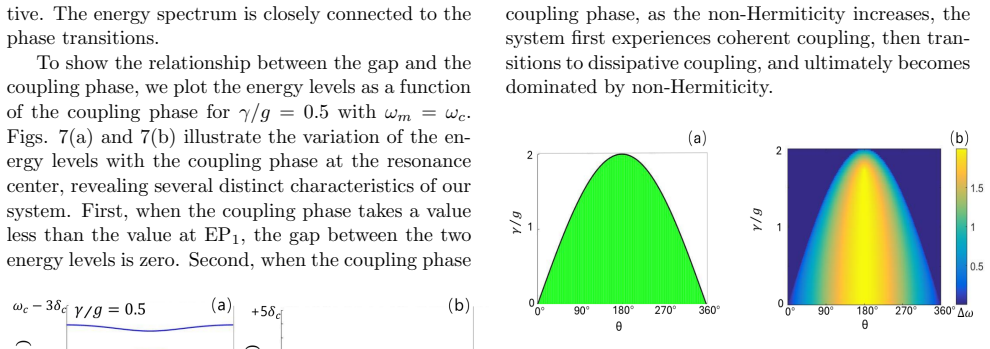
We propose a pseudo-Hermitian model with two magnon and two cavity modes coupled via phase-dependent interaction. Linking the energy spectrum to phase transitions, we observe exceptional points when pseudo-Hermitian symmetry breaks. Level attraction corresponds to four phase transitions and appears as a double Z-shaped energy spectrum, while level repulsion corresponds to two phase transitions with a gap depending on the coupling phase. In the phase diagram defined by non-Hermiticity and coupling phase, pseudo-Hermitian symmetry breaking is intrinsically linked to coupling mode transitions.
What carries the argument
The phase diagram in non-Hermiticity and coupling phase space that reveals the intrinsic link between pseudo-Hermitian symmetry breaking and coupling mode transitions.
If this is right
- Exceptional points emerge precisely when the pseudo-Hermitian symmetry breaks.
- Level attraction manifests as a double Z-shaped spectrum tied to four phase transitions.
- Level repulsion shows a phase-dependent gap across two transitions.
- This correspondence enables new strategies for controlling hybrid quantum states in spintronic systems.
Where Pith is reading between the lines
- Similar phase-dependent mechanisms could be explored in other non-Hermitian hybrid systems to achieve tunable level structures.
- Experimental setups with adjustable gain in magnon-cavity systems might test and utilize these transitions for quantum sensing.
- The model suggests potential for designing devices that switch between attractive and repulsive regimes via phase control.
Load-bearing premise
Tunable external gain can be introduced at the macroscopic scale to maintain gain-loss balance in the magnon and cavity modes while preserving the pseudo-Hermitian description.
What would settle it
An experiment that varies the coupling phase and non-Hermiticity parameter and finds no correspondence between symmetry breaking and the expected level transitions or exceptional points would disprove the claimed link.
Figures




read the original abstract
While cavity-magnon hybridization offers intriguing physics, its practical implementation is hindered by intrinsic damping in both cavity and magnon modes, leading to short coherence times and constrained applications. Recently, with the emergence of tunable external gain at the macroscopic scale, the research focus has shifted from purely lossy systems to gain-loss balanced non-Hermitian systems. Here, we propose a pseudo-Hermitian model with two magnon and two cavity modes coupled via phase-dependent interaction. We link the energy spectrum to phase transitions, observing exceptional points when pseudo-Hermitian symmetry breaks. We also observed level attraction and level repulsion. The former corresponds to four phase transitions and manifests as a double Z-shaped energy spectrum, the latter corresponds to two phase transitions, with the repulsive gap depending on the coupling phase. In the phase diagram defined by non-Hermiticity and coupling phase, we reveal a distinctive correspondence: pseudo-Hermitian symmetry breaking is intrinsically linked to coupling mode transitions, enabling new strategies for controlling hybrid quantum states in spintronic systems.
Editorial analysis
A structured set of objections, weighed in public.
Referee Report
Summary. The manuscript proposes a pseudo-Hermitian model with two magnon modes and two cavity modes coupled by a phase-dependent interaction. The authors derive the energy spectra, locate exceptional points associated with the breaking of pseudo-Hermitian symmetry, and present a phase diagram in the plane of non-Hermiticity strength and coupling phase. They report level attraction as a double Z-shaped spectrum linked to four phase transitions and level repulsion whose gap depends on the coupling phase and corresponds to two transitions. The central result is an observed correspondence between pseudo-Hermitian symmetry breaking and coupling-mode transitions.
Significance. If the derived correspondence holds, the work supplies a concrete theoretical link between symmetry breaking and mode transitions that could be exploited to control hybrid magnon-polariton states by tuning the coupling phase. The explicit construction of the metric operator and the numerical phase diagram constitute reproducible elements that strengthen the internal consistency of the mapping.
major comments (1)
- [§4] §4, phase-diagram construction: the reported one-to-one linkage between symmetry-breaking points and mode-transition lines follows directly from the eigenvalue analysis of the non-Hermitian Hamiltonian; the manuscript should state explicitly whether this correspondence is an independent physical prediction or a direct consequence of the chosen phase-dependent coupling term.
minor comments (2)
- [Figure 3] Figure 3: the color bar for the phase diagram lacks explicit labels for the symmetry-breaking and mode-transition regions, complicating direct visual comparison with the text description.
- [Eq. (8)] Eq. (8): the definition of the metric operator is given without a brief derivation step; adding one sentence would improve traceability from the Hamiltonian to the pseudo-Hermitian condition.
Simulated Author's Rebuttal
We thank the referee for the positive evaluation of our manuscript and for the constructive comment regarding the phase-diagram construction. We address the point raised below and have made revisions to improve clarity.
read point-by-point responses
-
Referee: §4, phase-diagram construction: the reported one-to-one linkage between symmetry-breaking points and mode-transition lines follows directly from the eigenvalue analysis of the non-Hermitian Hamiltonian; the manuscript should state explicitly whether this correspondence is an independent physical prediction or a direct consequence of the chosen phase-dependent coupling term.
Authors: We agree that the reported one-to-one correspondence between pseudo-Hermitian symmetry-breaking points and coupling-mode transition lines follows directly from the eigenvalue analysis of the non-Hermitian Hamiltonian. This linkage is not presented as an independent physical prediction but arises as a direct consequence of the phase-dependent coupling term in our four-mode model. The phase dependence specifically enables the double Z-shaped spectrum associated with four transitions (level attraction) and the phase-tunable gap with two transitions (level repulsion), both tied to symmetry breaking. In the revised Section 4, we have added explicit language clarifying that the correspondence is a feature of the chosen interaction form and the resulting spectral structure, while noting its utility for controlling hybrid magnon-polariton states. This revision does not change the central results but addresses the requested distinction. revision: yes
Circularity Check
No significant circularity; derivation self-contained
full rationale
The paper defines a pseudo-Hermitian Hamiltonian with explicit phase-dependent coupling between magnon and cavity modes, then computes the energy spectra, exceptional points, level attraction/repulsion features, and the phase diagram directly from the eigenvalue problem of that Hamiltonian. The reported correspondence between pseudo-Hermitian symmetry breaking and coupling-mode transitions is an observed outcome of varying the non-Hermiticity strength and coupling phase within the model; it does not reduce to a fitted parameter renamed as prediction, a self-definitional loop, or a load-bearing self-citation. The derivation remains independent of external benchmarks and contains no quoted step that equates an output to its input by construction.
Axiom & Free-Parameter Ledger
free parameters (1)
- coupling phase
axioms (1)
- domain assumption The four-mode system admits a pseudo-Hermitian description once external gain balances intrinsic losses.
Reference graph
Works this paper leans on
-
[1]
Huebl H, Zollitsch C W, Lotze J, Hocke F, Greifenstein M, Marx A, Gross R and Goennenwein S T B 2013 Phys. Rev. Lett. 111 127003 7
work page 2013
-
[2]
Zhang X, Zou C L, Jiang L and Tang H X 2014 Phys. Rev. Lett. 113 156401
work page 2014
-
[3]
Zhang X, Zou C L, Zhu N, Marquardt F, Jiang L and Tang H X 2015 Nat. Commun. 6 8914
work page 2015
-
[4]
Bai L, Harder M, Hyde P, Zhang Z, Hu C M, Chen Y P and Xiao J Q 2017 Phys. Rev. Lett. 118 217201
work page 2017
-
[5]
Zhang D, Luo X Q, Wang Y P, Li T F and You J Q 2017 Nat. Commun. 8 1368
work page 2017
-
[6]
Wang Y P, Zhang G Q, Zhang D, Li T F, Hu C M and You J Q 2018 Phys. Rev. Lett. 120 057202
work page 2018
-
[7]
Lin S, Nie Z, Yan W, Liang Y, Lin H, Zhao Q and Jia B 2019 Nanophotonics 8 2177-2188
work page 2019
- [8]
-
[9]
Zhou C-L, Wu X-H, Zhang Y, Yi H-L, Antezza M 2021 Phys. Rev. B 103 155404
work page 2021
-
[10]
Wu H, Huang L, Fang C, Yang B S, Wan C H, Yu G Q, Feng J F, Wei H X, Han X F 2018 Phys. Rev. Lett. 120 097205
work page 2018
-
[11]
Han X, Wu H, Zhang T 2024 Appl. Phys. Lett. 125 2
work page 2024
-
[12]
Wu H, Wan C H, Zhang X, Yuan Z H, Zhang Q T, Qin J Y, Wei H X, Han X F and Zhang S 2016 Phys. Rev. B 93 060403
work page 2016
-
[13]
Guo Y, Zhang X, Huang Z, Chen J, Luo Z, Zhang J, Li J, Zhang Z, Zhao J, Han X and others 2024 npj Spintronics 2 36
work page 2024
-
[14]
Jiang Z, Lim J, Li Y, Pfaff W, Lo T H, Qian J, Schleife A, Zuo J M, Novosad V and Hoffmann A 2023 Appl. Phys. Lett. 123 13
work page 2023
-
[15]
Agarwal G S 1984 Phys. Rev. Lett. 53 1732
work page 1984
- [16]
-
[17]
Xie H, He L W, Shang X, Lin G W and Lin X M 2022 Phys. Rev. A 106 053707
work page 2022
-
[18]
Bhoi B, Cliff T, Maksymov I S, Kostylev M, Aiyar R P R C, Venkataramani N, Prasad S V G V A and Stamps R L 2014 J. Appl. Phys. 116 24
work page 2014
-
[19]
Tabuchi Y, Ishino S, Ishikawa T, Yamazaki R, Usami K and Nakamura Y 2014 Phys. Rev. Lett. 113 083603
work page 2014
-
[20]
Zhang D, Wang X M, Li T F, Luo X Q, Wu W, Nori F and You J Q 2015 NPJ Quantum Inf. 1 1-6
work page 2015
-
[21]
Yan P, Wang X S and Wang X R 2011 Phys. Rev. Lett. 107 177207
work page 2011
-
[22]
Nair J M P, Zhang Z, Scully M O and Agarwal G S 2020 Phys. Rev. B 102 104415
work page 2020
-
[23]
Yao B, Gui Y S, Rao J W, Kaur S, Chen X S, Lu W, Xiao Y, Guo H, Marzlin K-P and Hu C-M 2017 Nat. Commun. 8 1437
work page 2017
-
[24]
Lachance-Quirion D, Tabuchi Y, Ishino S, Noguchi A, Ishikawa T, Yamazaki R, Nakamura Y 2017 Sci. Adv. 3 e1603150
work page 2017
-
[25]
Bai L, Harder M, Chen Y P, Fan X, Xiao J Q and Hu C-M 2015 Phys. Rev. Lett. 114 227201
work page 2015
-
[26]
Grigoryan V L, Shen K and Xia K 2018 Phys. Rev. B 98 024406
work page 2018
-
[27]
Harder M, Yang Y, Yao B M, Yu C H, Rao J W, Gui Y S, Stamps R L and Hu C-M 2018 Phys. Rev. Lett. 121 137203
work page 2018
-
[28]
Yuan H Y, Liu Q, Xia K, Yuan Z and Wang X R 2019 Europhys. Lett. 126 67006
work page 2019
-
[29]
Wang Y-P, Rao J W, Yang Y, Xu P-C, Gui Y S, Yao B M, You J Q and Hu C-M 2019 Phys. Rev. Lett. 123 127202
work page 2019
-
[30]
Zhang C, Jia C L, Shi Y Z, Jiang C J, Xue D S, Ong C K and Chai G 2021 Phys. Rev. B 103 184427
work page 2021
-
[31]
Yuan H Y, Yan P, Zheng S, He Q Y, Xia K and Yung M-H 2020 Phys. Rev. Lett. 124 053602
work page 2020
-
[32]
Lin S, Liang Y, Zhang J C, Chen M K and Tsai D P 2023 Appl. Phys. Lett. 123 22
work page 2023
-
[33]
Zhang G-Q and You J Q 2019 Phys. Rev. B 99 054404
work page 2019
-
[34]
Mostafazadeh A 2002 J. Math. Phys. 43 205–214
work page 2002
-
[35]
Vogt K, Fradin F Y, Pearson J E, Sebastian T, Bader S D, Hillebrands B, Hoffmann A and Schultheiss H 2014 Nat. Commun. 5 3727
work page 2014
- [36]
- [37]
-
[38]
Liu H, Sun D, Zhang C, Groesbeck M, McLaughlin R and Vardeny Z V 2019 Sci. Adv. 5 eaax9144
work page 2019
-
[39]
Wang C and Wang X R 2020 Phys. Rev. B 101 165114
work page 2020
-
[40]
Wang C and Wang X R 2023 Phys. Rev. B 107 024202
work page 2023
-
[41]
Wang C and Wang X R 2022 Phys. Rev. B 106 045142
work page 2022
-
[42]
Zhang X, Liu C, Zhu Z, Zhang Y 2024 Phys. Rev. B 109 184426
work page 2024
-
[43]
Holstein T and Primakoff H 1940 Phys. Rev. 58 1098
work page 1940
-
[44]
Cao Y and Yan P 2019 Phys. Rev. B 99 214415
work page 2019
-
[45]
Shen X, Wang F, Li Z and Wu Z 2019 Phys. Rev. A 100 062514
work page 2019
-
[46]
Soykal ¨O O, Flatt´ e M E 2010Phys. Rev. Lett. 104 077202
-
[47]
Lin S, Wang L, Yuan L and Chen X 2022 Phys. Rev. Appl. 17 064029
work page 2022
-
[48]
Gardin A, Bourhill J, Vlaminck V, Person C, Fumeaux C, Castel V and Tettamanzi G C 2023 Phys. Rev. Appl. 19 054069
work page 2023
-
[49]
Gardin A, Bourcin G, Bourhill J, Vlaminck V, Person C, Fumeaux C, Tettamanzi G C and Castel V 2024 Phys. Rev. Appl. 21 064033
work page 2024
-
[50]
Gardiner C W and Collett M J 1985 Phys. Rev. A 31 3761 8
work page 1985
discussion (0)
Sign in with ORCID, Apple, or X to comment. Anyone can read and Pith papers without signing in.