Stochastic Calculus for Pathwise Observables of Markov-Jump Processes: Unification of Diffusion and Jump Dynamics
Pith reviewed 2026-05-18 23:57 UTC · model grok-4.3
The pith
Markov-jump processes admit a stochastic calculus for pathwise observables in exact parallel to diffusion processes.
A machine-rendered reading of the paper's core claim, the machinery that carries it, and where it could break.
Core claim
We develop, in an exact parallelism with continuous-space diffusion, a complete stochastic calculus for path-wise observables of Markov-jump processes. We formulate a Langevin equation for jump processes, define general path-wise observables, establish their covariation structure whereby we fully account for transients and time-inhomogeneous dynamics, prove the known kinds of thermodynamic inequalities in their most general form and discuss saturation conditions, determine the response of path-wise observables to general perturbations and introduce a corresponding response-function formalism, carry out the continuum limit to achieve the complete unification of diffusion and jump dynamics, in
What carries the argument
The Langevin equation for Markov-jump processes, which generates stochastic increments and defines the covariation structure for pathwise observables in exact parallel to the diffusion case.
Load-bearing premise
A Langevin equation for jump processes can be formulated such that the covariation structure and thermodynamic inequalities follow in exact structural parallelism with the diffusion case, without additional ad-hoc rules for transients or time-inhomogeneity.
What would settle it
A concrete calculation for a time-inhomogeneous Markov-jump process in which the covariation between two specific pathwise observables deviates from the structure predicted by the Langevin equation, or in which a thermodynamic inequality fails to hold under conditions the framework claims to cover.
Figures


read the original abstract
Path-wise observables--functionals of stochastic trajectories--are at the heart of time-average statistical mechanics and are central to thermodynamic inequalities such as uncertainty relations, speed limits, and correlation-bounds. They provide a means of thermodynamic inference in the typical situation, when not all dissipative degrees of freedom in a system are experimentally accessible. So far, theories focusing on path-wise observables have been developing in two major directions, diffusion processes and Markov-jump dynamics, in a virtually disjoint manner. Moreover, even the respective results for diffusion and jump dynamics were derived with a patchwork of different approaches that are predominantly indirect. Stochastic calculus was recently shown to provide a direct approach to path-wise observables of diffusion processes, while a corresponding framework for jump dynamics remained elusive. In our work we develop, in an exact parallelism with continuous-space diffusion, a complete stochastic calculus for path-wise observables of Markov-jump processes. We formulate a "Langevin equation" for jump processes, define general path-wise observables, and establish their covariation structure, whereby we fully account for transients and time-inhomogeneous dynamics. We prove the known kinds of thermodynamic inequalities in their most general form and discus saturation conditions. We determine the response of path-wise observables to general (incl. thermal) perturbations and introduce a corresponding response-function formalism. We carry out the continuum limit to achieve the complete unification of diffusion and jump dynamics. In addition, we connect the framework to quantum unraveling and the Belavkin equation for open quantum systems, associating quantum and classical descriptions of thermal systems.
Editorial analysis
A structured set of objections, weighed in public.
Referee Report
Summary. The paper develops a stochastic calculus for path-wise observables of Markov-jump processes in exact structural parallelism with the diffusion case. It formulates a Langevin equation for jumps, defines general path-wise observables, establishes their covariation structure while fully accounting for transients and time-inhomogeneous dynamics, proves thermodynamic inequalities in general form with saturation conditions, introduces a response-function formalism for general (including thermal) perturbations, performs the continuum limit to unify diffusion and jump dynamics, and connects the framework to quantum unraveling and the Belavkin equation for open quantum systems.
Significance. If the derivations are rigorous and the claimed exact parallelism holds without hidden ad-hoc rules, the work would provide a valuable unification of two previously disjoint lines of research on path-wise observables in stochastic thermodynamics. This could streamline proofs of uncertainty relations, speed limits, and correlation bounds for jump processes common in chemical and biological systems, while the explicit treatment of time-inhomogeneity and the quantum-classical link add breadth. The direct stochastic-calculus approach, as opposed to patchwork indirect methods, is a methodological strength if substantiated by explicit equations.
major comments (1)
- [Covariation structure (following Langevin formulation for jumps)] The central claim of exact covariation parallelism with diffusion requires that, for a time-dependent jump rate λ(t), the quadratic covariation of an integrated path-wise observable acquires no extra integral term involving dλ/dt that lacks a counterpart in the diffusion Itô table. Please provide the explicit derivation (likely in the section establishing the covariation structure following the Langevin equation) and show how any such term is either absent or absorbed without redefining the noise or introducing case-specific compensators; otherwise the structural identity and the subsequent continuum limit unification are at risk.
minor comments (2)
- [Abstract] The abstract contains the typo 'discus saturation conditions' (should be 'discuss').
- [Introduction or Langevin equation section] The quotation marks around 'Langevin equation' for jump processes are appropriate but would benefit from an early explicit statement of how this equation differs in interpretation and noise properties from the standard diffusion Langevin equation.
Simulated Author's Rebuttal
We thank the referee for the careful reading of our manuscript and the constructive comment regarding the covariation structure. We address this point in detail below and will incorporate clarifications into the revised version.
read point-by-point responses
-
Referee: [Covariation structure (following Langevin formulation for jumps)] The central claim of exact covariation parallelism with diffusion requires that, for a time-dependent jump rate λ(t), the quadratic covariation of an integrated path-wise observable acquires no extra integral term involving dλ/dt that lacks a counterpart in the diffusion Itô table. Please provide the explicit derivation (likely in the section establishing the covariation structure following the Langevin equation) and show how any such term is either absent or absorbed without redefining the noise or introducing case-specific compensators; otherwise the structural identity and the subsequent continuum limit unification are at risk.
Authors: We agree that an explicit derivation is needed for full clarity. In the section establishing the covariation structure (immediately following the Langevin equation for jumps), the quadratic covariation is obtained directly from the definition for semimartingales: for a path-wise observable O_t = ∫_0^t f(s) dN_s where N is the counting process with intensity λ(t), the quadratic variation process [O,O]_t equals the sum of squared jumps ∑_{s≤t} (ΔO_s)^2. Because jumps are of finite size and occur at random times, this sum contains no continuous contribution and therefore no term proportional to dλ/dt. The intensity λ(t) enters only the compensator (predictable quadratic variation) ⟨O,O⟩_t = ∫_0^t λ(s) f(s)^2 ds, which is the expectation of [O,O]_t but does not alter the pathwise quadratic covariation itself. Consequently, no extra integral involving dλ/dt appears in the covariation table, and no redefinition of the noise or case-specific compensators is required. This construction is identical in structure to the diffusion case, where the quadratic variation likewise arises solely from the continuous martingale part without derivative terms on the drift. We will add a step-by-step expansion of this derivation, including the explicit Itô product rule for two such observables, to the revised manuscript. The continuum limit to diffusion then proceeds unchanged, as the jump size vanishes while the rate diverges such that the compensator converges to the diffusion quadratic variation. revision: yes
Circularity Check
No significant circularity; derivation develops independent jump-process framework
full rationale
The paper formulates a Langevin equation for Markov-jump processes, defines path-wise observables, derives their covariation structure while explicitly handling transients and time-inhomogeneous rates, proves thermodynamic inequalities, introduces a response-function formalism, and performs the continuum limit to recover diffusion results. These steps are presented as direct constructions and proofs within the manuscript rather than reductions to prior fitted inputs or self-citations. The unification claim rests on showing that the newly defined jump calculus limits to the known diffusion case, which is a consistency check rather than a definitional equivalence. No load-bearing premise is justified solely by overlapping-author citations or by renaming an input as a prediction. The framework is therefore self-contained against external benchmarks for the jump case.
Axiom & Free-Parameter Ledger
axioms (1)
- domain assumption Markov-jump processes admit a well-defined stochastic calculus with covariation rules that parallel those of Itô calculus for diffusions
Forward citations
Cited by 1 Pith paper
-
Mutual Linearity in and out of Stationarity for Markov Jump Processes: A Trajectory-Based Approach
A trajectory-level derivation shows mutual linearity holds for non-stationary Markov jump processes and generalizes to other systems.
Reference graph
Works this paper leans on
-
[1]
(see App. A 6), so that the large t quality factor be- comes Q t→∞ − − − →1 log ϵ (ϵ + 1)2 + (ϵ − 1)2 (ϵ2 − 1) − ϵ + 1 ϵ − 1 1 pvarFps(V A) = (ϵ − 1) (ϵ + 1) logϵ 1 pvarFps(V A) . (130) Recall that the choice of F (τ) is free for stationary sys- tems, hence we can choose F (τ) = ⟨V A x + V A y ⟩ps/2 s.t. pvarF ps(V A) = var ps(V A). Using Popoviciu’s ineq...
-
[2]
(see App. A 8 for details). However, Eq. (139) al- lows for the same result to be obtained using correlations of stochastic differentials without invoking perturbative calculations. B. Equilibrium Response to Temperature Perturbations For MJP in equilibrium we havepeq i ∝ e−Ei/T in terms of free energies Ei. In addition, we have detailed balance, which, h...
-
[3]
(37) and time spent in a state in Eq
Proof of Noise-Time Correlation Lemma To prove how the noise Eq. (37) and time spent in a state in Eq. (36) correlate, i.e., ⟨dεxy(τ)dτi(τ ′)⟩, we consider three cases: the transition from x to y happens (i) before τ ′, (ii) at τ ′, or (iii) after τ ′, corresponding to τ < τ ′, τ = τ ′, and τ > τ ′, respectively. Specifically, we can write ⟨dεxy(τ)dτi(τ ′...
-
[4]
Jump-Time Correlations We see for an explicit expression for ⟨dnxy(τ)dτi(τ ′)⟩
Derivation of Increment Correlations a. Jump-Time Correlations We see for an explicit expression for ⟨dnxy(τ)dτi(τ ′)⟩. We can decompose this expectation using Eq. (38) as ⟨dnxy(τ)dτi(τ ′)⟩ = ⟨dεxy(τ)dτi(τ ′)⟩ + rxy⟨dτx(τ)τi(τ ′)⟩. (A7) Using the last two equations in Eqs. (41), we get ⟨dnxy(τ)dτi(τ ′)⟩ rxydτdτ ′ =1τ <τ′P (i, τ ′|y, τ)px(τ) + 1τ ≥τ ′P (x,...
-
[5]
From Equations of Motion to Ensemble Description a. Continuous Space: Langevin to Fokker-Planck To highlight the analogy between continuous- and discrete space dynamics, we first recapitulate how the Fokker-Planck equation follows directly from the Langevin Equation in Eq. (31). The calculation is well ´known (see e.g., Ref. [132]). Let K(x) be an arbitra...
-
[6]
Derivation of Eq. (76) Starting from Eq. (75), we can simplify the sum over x, y by using the symmetry of Zxy(τ)[P (i, τ ′|y, τ) − P (i, τ ′|x, τ)] to get ⟨AtJII t ⟩ =1 2 Z t 0 dτ ′ Z t 0 dτ X i,j κij(τ ′)rij1τ <τ′ × X x,y [P (i, τ ′|y, τ) − P (i, τ ′|x, τ)] [px(τ)rxy − py(τ)ryx] = − Z t 0 dτ ′ Z t 0 dτ X i,j κij(τ ′)rij1τ <τ′ (A19) × X x P (i, τ ′|x, τ) ...
-
[7]
Let the current defining tran- sition weights be κij(τ) = e4τ (δi1δj2 − δi2δj1)
Indispensability of the Modified Current Consider a three-state system with generator L = −4 2 1 1 −3 1 3 1 −2 , (A22) with eigenvalues 0, −4, −5. Let the current defining tran- sition weights be κij(τ) = e4τ (δi1δj2 − δi2δj1). Figure 13 shows various quality factors of the transient system with initial distribution pi(0) = (δi1 + 2δi2)/3. Expli...
-
[8]
(123) applied to the driven ring Sec
Long-time limit of driven ring Integrated Covariance Here we present details on the large- t limit of the sta- tionary correlation bound in Eq. (123) applied to the driven ring Sec. IV A with the assumption that ϵ > 1. We start by realizing that ∆ V ≡ V A − ⟨ V A⟩1 = 1 2(1, 1, −1, −1)T . Hence, we can write Z t 0 dτcovs[V A τ , V A 0 ] = 1 4 Z t 0 dτ∆V T ...
-
[9]
Physically Motivated Rates - Pseudo Potential Form We specifically assume the transition rates to be of the form [164] rxy = Dxye−Vxy/T = ˜DxyT e−Vxy/T , (A37) where Dxy is an edge specific “diffusion coefficient” and Vxy is a pseudo-potential on the edge. This pseudo- potential allows for general nonequilibrium systems to be implemented and therefore all...
-
[10]
(A40) is valid for both, single-time and path observables
Perturbations of Path Observables We already stated that Eq. (A40) is valid for both, single-time and path observables. The latter, however, perhaps need some clarification in the context of evalu- ating expectations over path ensembles. To clarify this, consider some hollow matrix b, O(t) = Z s=t s=0 Tr[bT dε(s)]. (A41) In this case, Eq. (139) simplifies...
-
[11]
(139) easily allows for time-dependent rates to be included
Time-Dependent Rates The result in Eq. (139) easily allows for time-dependent rates to be included. In fact, the Radon-Nikodym deriva- tive in Eq. (138) is already written in a form that al- lows to accommodate time-inhomogeneous dynamics. If ˜rxy(t) depends on t, then it may even be seen as a time- dependent perturbation
-
[12]
14 we further elaborate on the influence of c(t) in the CTUR
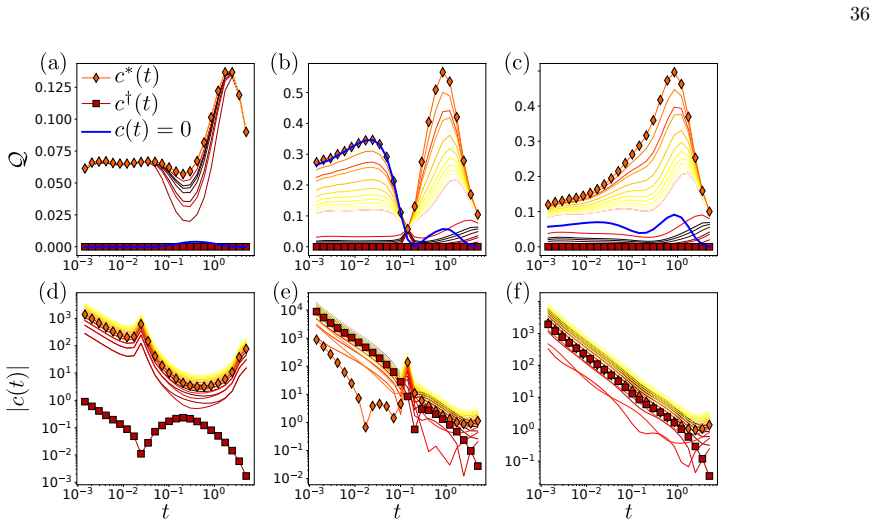
Optimization of CTUR In Fig. 14 we further elaborate on the influence of c(t) in the CTUR. The quality factor Q for the calmodulin system (see Fig. 6) for currents with κ(12), κ(56), and κ(26) (recall the notation κ(kl) ij = δikδjl − δilδjk) and den- sity with Vi(τ) = δi3 is shown in Fig. 14a-Fig. 14c. Var- ious values of c(t) are used, including c(t) = 0...
-
[13]
Transition rates used in the calmodulin example from Ref
Simulation Parameters Transition i → j Rate rij 1 → 2 5.997 2 → 1 0.774 1 → 4 13.439 4 → 1 127.968 1 → 5 15.330 5 → 1 0.121 5 → 6 3.749 6 → 5 13.326 2 → 3 1514.820 3 → 2 53.0661 2 → 6 13.441 6 → 2 2.922 TABLE II. Transition rates used in the calmodulin example from Ref. [149] which are adapted from Ref. [88]
-
[14]
G. J. Moro, Kinetic equations for site populations from the Fokker–Planck equation, J. Chem. Phys. 103, 7514 (1995)
work page 1995
-
[15]
B. Gaveau and L. S. Schulman, Dynamical metastabil- ity, J. Phys. A: Math. Gen. 20, 2865 (1987)
work page 1987
-
[16]
B. Gaveau and L. Schulman, A general framework for non-equilibrium phenomena: the master equation and its formal consequences, Phys. Lett. A 229, 347 (1997)
work page 1997
-
[18]
U. Seifert, Entropy production along a stochastic tra- jectory and an integral fluctuation theorem, Phys. Rev. Lett. 95, 040602 (2005)
work page 2005
-
[19]
Seifert, Stochastic thermodynamics, fluctuation the- orems and molecular machines, Rep
U. Seifert, Stochastic thermodynamics, fluctuation the- orems and molecular machines, Rep. Prog. Phys. 75, 126001 (2012)
work page 2012
-
[20]
M. Esposito and C. Van den Broeck, Three faces of the second law. I. master equation formulation, Phys. Rev. E 82, 011143 (2010)
work page 2010
-
[21]
Seifert, Stochastic thermodynamics: From principles to the cost of precision, Phys
U. Seifert, Stochastic thermodynamics: From principles to the cost of precision, Phys. A: Stat. Mech. Appl.504, 176 (2018)
work page 2018
-
[22]
Seifert, From stochastic thermodynamics to thermo- dynamic inference, Annu
U. Seifert, From stochastic thermodynamics to thermo- dynamic inference, Annu. Rev. Condens. Matter Phys. 10, 171 (2019)
work page 2019
-
[23]
´Edgar Rold´ an, I. Neri, R. Chetrite, S. Gupta, S. Pigolotti, F. J¨ ulicher, and K. Sekimoto, Martingales for physicists: a treatise on stochastic thermodynamics and beyond, Adv. Phys. 72, 1 (2023)
work page 2023
-
[24]
G. Falasco and M. Esposito, Local detailed balance across scales: From diffusions to jump processes and beyond, Phys. Rev. E 103, 042114 (2021). Symbol Value γ 5 x 2 lA 20 lB 1 eout A 30 ein A 10 ein B 2 TABLE III. Values of fixed parameters in SAT simulations which are adapted from Ref. [146]. State Ei 1 0 .1 2 0 .3 3 0 .5 4 0 .2 TABLE IV. Overview of fr...
work page 2021
-
[25]
Esposito, Stochastic thermodynamics under coarse graining, Phys
M. Esposito, Stochastic thermodynamics under coarse graining, Phys. Rev. E 85, 041125 (2012)
work page 2012
-
[26]
S. Pigolotti and A. Vulpiani, Coarse graining of master equations with fast and slow states, J. Chem. Phys.128, 154114 (2008)
work page 2008
-
[27]
Schnakenberg, Network theory of microscopic and macroscopic behavior of master equation systems, Rev
J. Schnakenberg, Network theory of microscopic and macroscopic behavior of master equation systems, Rev. Mod. Phys. 48, 571 (1976). 36 10 3 10 2 10 1 100 0.000 0.025 0.050 0.075 0.100 0.125 10 3 10 2 10 1 100 0.0 0.1 0.2 0.3 0.4 0.5 10 3 10 2 10 1 100 0.0 0.1 0.2 0.3 0.4 10 3 10 2 10 1 10010 3 10 2 10 1 100 101 102 103 10 3 10 2 10 1 100 10 2 10 1 100 101...
work page 1976
-
[28]
R. K. P. Zia and B. Schmittmann, Probability currents as principal characteristics in the statistical mechanics of non-equilibrium steady states, J. Stat. Mech.: Theory Exp. 2007 (07), P07012
work page 2007
-
[29]
D. Hartich and A. Godec, Emergent memory and kinetic hysteresis in strongly driven networks, Phys. Rev. X11, 041047 (2021)
work page 2021
-
[30]
P. E. Harunari, S. Dal Cengio, V. Lecomte, and M. Po- lettini, Mutual linearity of nonequilibrium network cur- rents, Phys. Rev. Lett. 133, 047401 (2024)
work page 2024
-
[31]
T. Aslyamov and M. Esposito, General theory of static response for markov jump processes, Phys. Rev. Lett. 133, 107103 (2024)
work page 2024
-
[32]
C. Dieball and A. Godec, Perspective: Time irreversibil- ity in systems observed at coarse resolution, J. Chem. Phys. 162, 090901 (2025)
work page 2025
-
[33]
C. Maes, K. Netoˇ cn´ y, and B. Wynants, On and beyond entropy production: the case of Markov jump processes, Markov Proc. Rel. Fields 14, 445 (2008)
work page 2008
-
[34]
J. M. Horowitz and M. Esposito, Thermodynamics with continuous information flow, Phys. Rev. X 4, 031015 (2014)
work page 2014
- [35]
-
[36]
N. Shiraishi, An Introduction to Stochastic Thermody- namics: From Basic to Advanced (Springer Nature Sin- gapore, 2023)
work page 2023
- [37]
- [38]
-
[39]
K. Hiura and S.-i. Sasa, Kinetic uncertainty relation on first-passage time for accumulated current, Phys. Rev. E 103, L050103 (2021)
work page 2021
-
[40]
I. D. Terlizzi and M. Baiesi, Kinetic uncertainty relation, J. Phys. A 52, 02LT03 (2018)
work page 2018
-
[41]
D. Hartich and A. Godec, Interlacing relaxation and first-passage phenomena in reversible discrete and con- tinuous space Markovian dynamics, J. Stat. Mech.: Theory Exp. 2019 (2), 024002
work page 2019
-
[42]
V. Lecomte, C. Appert-Rolland, and F. van Wijland, Thermodynamic formalism for systems with markov dy- namics, J. Stat. Phys. 127, 51 (2007)
work page 2007
-
[43]
N. Shiraishi and K. Saito, Information-theoretical bound of the irreversibility in thermal relaxation pro- cesses, Phys. Rev. Lett. 123, 110603 (2019)
work page 2019
- [44]
-
[45]
T. Van Vu and Y. Hasegawa, Toward relaxation asym- metry: Heating is faster than cooling, Phys. Rev. Res. 3, 043160 (2021)
work page 2021
- [46]
-
[47]
A. Kolchinsky, N. Ohga, and S. Ito, Thermodynamic bound on spectral perturbations, with applications to oscillations and relaxation dynamics, Phys. Rev. Res. 6, 013082 (2024)
work page 2024
-
[48]
K. Blom and A. Godec, Criticality in cell adhesion, Phys. Rev. X 11, 031067 (2021). 37
work page 2021
-
[49]
Maes, Local detailed balance, SciPost Phys
C. Maes, Local detailed balance, SciPost Phys. Lect. Notes , 32 (2021)
work page 2021
-
[50]
D. Hartich and A. Godec, Violation of local detailed bal- ance upon lumping despite a clear timescale separation, Phys. Rev. Res. 5, L032017 (2023)
work page 2023
-
[51]
G. Gallavotti and E. G. D. Cohen, Dynamical ensem- bles in nonequilibrium statistical mechanics, Phys. Rev. Lett. 74, 2694 (1995)
work page 1995
-
[52]
Jarzynski, Nonequilibrium equality for free energy differences, Phys
C. Jarzynski, Nonequilibrium equality for free energy differences, Phys. Rev. Lett. 78, 2690 (1997)
work page 1997
-
[53]
G. E. Crooks, Entropy production fluctuation theorem and the nonequilibrium work relation for free energy differences, Phys. Rev. E 60, 2721 (1999)
work page 1999
- [54]
-
[55]
Maes, The fluctuation theorem as a gibbs property, J
C. Maes, The fluctuation theorem as a gibbs property, J. Stat. Phys. 95, 367–392 (1999)
work page 1999
-
[56]
Kurchan, Fluctuation theorem for stochastic dynam- ics, J
J. Kurchan, Fluctuation theorem for stochastic dynam- ics, J. Phys. A: Math. Gen. 31, 3719 (1998)
work page 1998
-
[57]
K. Brandner, K. Saito, and U. Seifert, Strong bounds on onsager coefficients and efficiency for three-terminal thermoelectric transport in a magnetic field, Phys. Rev. Lett. 110, 070603 (2013)
work page 2013
-
[58]
N. Shiraishi, K. Funo, and K. Saito, Speed limit for clas- sical stochastic processes, Phys. Rev. Lett. 121, 070601 (2018)
work page 2018
-
[59]
G. Falasco and M. Esposito, Dissipation-time uncer- tainty relation, Phys. Rev. Lett. 125, 120604 (2020)
work page 2020
-
[60]
K. Yoshimura and S. Ito, Thermodynamic uncertainty relation and thermodynamic speed limit in determinis- tic chemical reaction networks, Phys. Rev. Lett. 127, 160601 (2021)
work page 2021
- [61]
-
[62]
E. Potanina, C. Flindt, M. Moskalets, and K. Brand- ner, Thermodynamic bounds on coherent transport in periodically driven conductors, Phys. Rev. X11, 021013 (2021)
work page 2021
-
[63]
K. Brandner, K. Saito, and U. Seifert, Strong bounds on Onsager coefficients and efficiency for three-terminal thermoelectric transport in a magnetic field, Phys. Rev. Lett. 110, 070603 (2013)
work page 2013
-
[64]
C. Dieball and A. Godec, Thermodynamic bounds on generalized transport: From single-molecule to bulk ob- servables, Phys. Rev. Lett. 133, 067101 (2024)
work page 2024
-
[65]
A. C. Barato and U. Seifert, Thermodynamic uncer- tainty relation for biomolecular processes, Phys. Rev. Lett. 114, 158101 (2015)
work page 2015
-
[66]
A. Pal, S. Reuveni, and S. Rahav, Thermodynamic uncertainty relation for first-passage times on Markov chains, Phys. Rev. Res. 3, L032034 (2021)
work page 2021
-
[67]
V. T. Vo, T. V. Vu, and Y. Hasegawa, Unified thermo- dynamic–kinetic uncertainty relation, J. Phys. A Math. Theor. 55, 405004 (2022)
work page 2022
-
[68]
I. Neri, Universal tradeoff relation between speed, un- certainty, and dissipation in nonequilibrium stationary states, SciPost Phys. 12, 139 (2022)
work page 2022
-
[69]
L. Ziyin and M. Ueda, Universal thermodynamic uncer- tainty relation in nonequilibrium dynamics, Phys. Rev. Res. 5, 013039 (2023)
work page 2023
-
[70]
A. Dechant and S.-i. Sasa, Improving thermodynamic bounds using correlations, Phys. Rev. X 11, 041061 (2021)
work page 2021
-
[71]
J. M. Horowitz and T. R. Gingrich, Thermodynamic uncertainty relations constrain non-equilibrium fluctua- tions, Nat. Phys. 16, 15–20 (2019)
work page 2019
-
[72]
T. Koyuk and U. Seifert, Thermodynamic uncertainty relation for time-dependent driving, Phys. Rev. Lett. 125, 260604 (2020)
work page 2020
-
[73]
E. Kwon and J. S. Lee, A unified framework for classical and quantum uncertainty relations using stochastic rep- resentations (2024), arXiv:2412.04988 [cond-mat.stat- mech]
-
[74]
C. Dieball and A. Godec, Direct route to thermody- namic uncertainty relations and their saturation, Phys. Rev. Lett. 130, 087101 (2023)
work page 2023
-
[75]
A. Lapolla and A. Godec, Faster uphill relaxation in thermodynamically equidistant temperature quenches, Phys. Rev. Lett. 125, 110602 (2020)
work page 2020
-
[76]
C. Dieball, G. Wellecke, and A. Godec, Asymmetric thermal relaxation in driven systems: Rotations go op- posite ways, Phys. Rev. Res. 5, L042030 (2023)
work page 2023
-
[77]
M. Ib´ a˜ nez, C. Dieball, A. Lasanta, A. Godec, and R. A. Rica, Heating and cooling are fundamentally asymmet- ric and evolve along distinct pathways, Nat. Phys. 20, 135–141 (2024)
work page 2024
-
[78]
A. Dechant and S.-i. Sasa, Fluctuation–response in- equality out of equilibrium, Proc. Natl. Acad. Sci. 117, 6430–6436 (2020)
work page 2020
-
[79]
U. Basu, M. Kr¨ uger, A. Lazarescu, and C. Maes, Fre- netic aspects of second order response, Phys. Chem. Chem. Phys. 17, 6653–6666 (2015)
work page 2015
-
[80]
M. Colangeli, C. Maes, and B. Wynants, A meaningful expansion around detailed balance, J. Phys. A: Math. Theor. 44, 095001 (2011)
work page 2011
-
[82]
K. Ptaszy´ nski, T. Aslyamov, and M. Esposito, Dissi- pation bounds precision of current response to kinetic perturbations, Phys. Rev. Lett. 133, 227101 (2024)
work page 2024
discussion (0)
Sign in with ORCID, Apple, or X to comment. Anyone can read and Pith papers without signing in.