Probabilistic quantum algorithm for Lyapunov equations and matrix inversion
Pith reviewed 2026-05-18 23:58 UTC · model grok-4.3
The pith
A probabilistic quantum algorithm prepares mixed states proportional to the solutions of Lyapunov equations.
A machine-rendered reading of the paper's core claim, the machinery that carries it, and where it could break.
Core claim
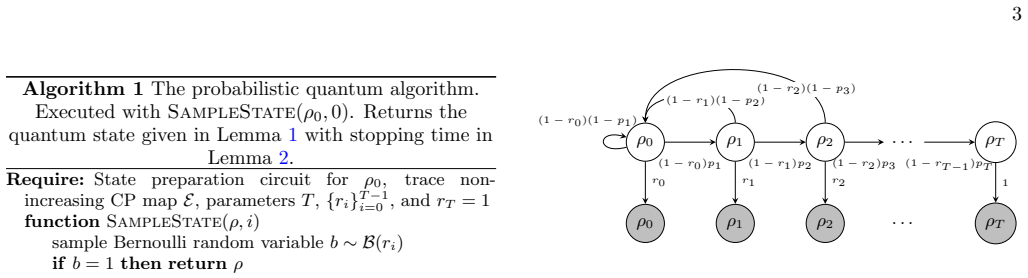
The authors establish a probabilistic quantum procedure that, with access to oracles for the matrices A and C, produces a mixed state whose expectation is proportional to the unique solution X of the Lyapunov equation A X + X A^* = C. A deterministic stopping rule ensures the expected number of oracle calls remains bounded. The framework additionally prepares states approximating the normalized inverse of a positive definite matrix and handles matrix-valued integrals in general.
What carries the argument
The probabilistic procedure offering the choice to return the current state, apply a trace-nonincreasing completely positive map, or restart, together with the deterministic stopping rule that bounds the expected oracle usage.
If this is right
- The algorithm produces an efficient procedure with bounded expected oracle calls for Lyapunov equations that arise in stability analysis.
- The same method yields mixed states approximating the normalized inverse of any positive definite matrix.
- The construction generates mixed states that approximate arbitrary matrix-valued weighted sums and integrals.
- Block encodings and mixed-state encodings constitute incomparable computational resources even for identical input data.
Where Pith is reading between the lines
- The distinction between block encodings and state encodings suggests hybrid algorithms that switch between the two resources depending on the linear-algebra task.
- Further development of state-based function encoding could complement existing unitary-based methods for quantum linear algebra.
- The approach may be tested on concrete dynamical systems where the Lyapunov solution is computable by other means to confirm the expectation matching.
Load-bearing premise
The algorithm assumes oracles exist for the two input matrices and that a deterministic stopping rule can be implemented to produce only a bounded expected number of oracle calls.
What would settle it
For a small Lyapunov equation whose exact solution is known classically, execute the quantum circuit many times, collect the output mixed states, and verify whether their statistical average is proportional to the known solution within sampling error.
Figures
read the original abstract
We present a probabilistic quantum algorithm for preparing mixed states which, in expectation, are proportional to the solutions of Lyapunov equations -- linear matrix equations ubiquitous in the analysis of classical and quantum dynamical systems. Building on previous results by Zhang et al., arXiv:2304.04526, at each step the algorithm can (i) return the current state, (ii) apply a trace nonincreasing completely positive map, or (iii) restart. We introduce a deterministic stopping rule, which leads to an efficient algorithm with a bounded expected number of calls to oracles representing the two input matrices of the Lyapunov equations. We also consider preparing a mixed state that approximates the normalized inverse of a positive definite matrix $A$. In its most general form, the algorithm generates mixed states, which approximate matrix-valued weighted sums and integrals. It can be shown that block encodings and states yield two incomparable computational resources even when they represent the same piece of data. While block encodings of functions have received much attention in the literature, our work takes a step toward the less explored problem of encoding functions into mixed states.
Editorial analysis
A structured set of objections, weighed in public.
Referee Report
Summary. The manuscript presents a probabilistic quantum algorithm for preparing mixed states that are, in expectation, proportional to the solutions X of Lyapunov equations AX + XB = C. Building on Zhang et al. (arXiv:2304.04526), the algorithm proceeds by iteratively choosing to return the current state, apply a trace-nonincreasing CP map, or restart, with a deterministic stopping rule introduced to ensure an efficient procedure with bounded expected oracle calls to the input matrices A and B. The work also treats the special case of preparing a mixed state approximating the normalized inverse of a positive definite matrix and generalizes to mixed states encoding matrix-valued weighted sums and integrals.
Significance. If the deterministic stopping rule indeed produces a bounded expected number of oracle calls with polynomial dependence on the relevant parameters (dimension, condition number, and spectral gap of the Lyapunov operator), the result would offer a distinct resource model for encoding linear-algebraic solutions into mixed states rather than block encodings. This could be useful for quantum algorithms involving dynamical systems or control theory. The paper correctly notes that block encodings and mixed-state encodings are incomparable resources, which is a useful observation.
major comments (2)
- [Algorithm description and stopping rule] Stopping-rule analysis (main algorithmic section): The claim that the deterministic stopping rule yields an efficient algorithm with bounded expected oracle calls is load-bearing for the central contribution, yet the manuscript does not derive an explicit upper bound on the expected number of steps that is polynomial in the dimension and independent of the spectral gap of the Lyapunov operator L(X) = AX + XB. For matrices A, B whose eigenvalues have real parts near zero, the contraction rate of the trace-nonincreasing CP map can become arbitrarily slow, potentially making the expectation exponential in the condition number; a concrete counter-example or a spectral-gap assumption should be stated and proved.
- [Complexity analysis] Complexity statement (complexity or runtime paragraph): No explicit query complexity or gate complexity is given in terms of the matrix dimension n, the condition number κ, or the desired accuracy ε. The abstract asserts efficiency, but without a theorem relating expected oracle calls to these parameters the efficiency claim cannot be verified.
minor comments (2)
- [Algorithm description] Notation for the CP map: the trace-nonincreasing completely positive map is referenced but its Kraus operators or Choi representation are not written explicitly; adding the explicit form would improve readability.
- [Introduction] Reference to Zhang et al.: the citation arXiv:2304.04526 is given, but the precise technical difference (new stopping rule versus prior probabilistic method) should be stated in one sentence for clarity.
Simulated Author's Rebuttal
We thank the referee for their detailed and insightful comments on our manuscript. We have carefully considered the concerns regarding the stopping rule analysis and the lack of explicit complexity bounds. We believe these points can be addressed by adding clarifications and theorems to the revised version, as detailed in our point-by-point responses below. We are committed to improving the manuscript accordingly.
read point-by-point responses
-
Referee: Stopping-rule analysis (main algorithmic section): The claim that the deterministic stopping rule yields an efficient algorithm with bounded expected oracle calls is load-bearing for the central contribution, yet the manuscript does not derive an explicit upper bound on the expected number of steps that is polynomial in the dimension and independent of the spectral gap of the Lyapunov operator L(X) = AX + XB. For matrices A, B whose eigenvalues have real parts near zero, the contraction rate of the trace-nonincreasing CP map can become arbitrarily slow, potentially making the expectation exponential in the condition number; a concrete counter-example or a spectral-gap assumption should be stated and proved.
Authors: We thank the referee for highlighting this important aspect of our analysis. The manuscript does provide a bound on the expected number of oracle calls, but it is expressed in terms of the spectral properties of the Lyapunov operator rather than being independent of the spectral gap. Specifically, the contraction of the trace-nonincreasing CP map depends on the minimal real part of the eigenvalues of A and B. To strengthen the presentation, we will add an explicit theorem in the revised manuscript that derives the expected number of steps as O(1/γ), where γ denotes the spectral gap (minimal real part). We will also state the assumption that γ is at least inverse-polynomial in the dimension n to ensure overall polynomial efficiency, which is a standard requirement for such algorithms to avoid ill-conditioned cases. This addresses the potential for exponential behavior when the gap is exponentially small. We disagree that the bound must be independent of the gap, as that would not hold in general, but we will make the dependence explicit and prove the bound. revision: yes
-
Referee: Complexity statement (complexity or runtime paragraph): No explicit query complexity or gate complexity is given in terms of the matrix dimension n, the condition number κ, or the desired accuracy ε. The abstract asserts efficiency, but without a theorem relating expected oracle calls to these parameters the efficiency claim cannot be verified.
Authors: We agree with the referee that providing an explicit complexity statement will enhance the clarity and verifiability of our results. In the revised version, we will introduce a new theorem that bounds the expected number of oracle calls in terms of the dimension n, the condition number κ (which is related to the spectral gap γ), and the accuracy parameter ε. The gate complexity will also be discussed assuming efficient implementations of the oracles for A and B and the quantum operations for the CP maps. This will directly support the efficiency claims made in the abstract and throughout the paper. revision: yes
Circularity Check
No significant circularity; derivation introduces independent stopping rule on top of cited prior work
full rationale
The paper's central construction builds on Zhang et al. (arXiv:2304.04526) by adding a deterministic stopping rule that selects among return, trace-nonincreasing CP map application, or restart at each step, with termination tied to the fixed point of the map. This rule and the resulting bounded expected oracle calls constitute an independent algorithmic contribution rather than a redefinition or statistical fit of the Lyapunov solution itself. No equations reduce the claimed efficiency or state preparation to the inputs by construction, no self-citation chain is load-bearing for the uniqueness or correctness of the bound, and the abstract explicitly separates the new stopping rule from the referenced prior results. The derivation remains self-contained against external benchmarks for the map and oracles.
Axiom & Free-Parameter Ledger
axioms (2)
- domain assumption Availability of oracles for the two input matrices of the Lyapunov equation.
- domain assumption Existence and quantum implementability of a trace-nonincreasing completely positive map.
Lean theorems connected to this paper
-
IndisputableMonolith/Cost/FunctionalEquation.leanwashburn_uniqueness_aczel unclear?
unclearRelation between the paper passage and the cited Recognition theorem.
at each step the algorithm can (i) return the current state, (ii) apply a trace nonincreasing completely positive map, or (iii) restart... deterministic stopping rule... bounded expected number of calls
-
IndisputableMonolith/Foundation/ArithmeticFromLogic.leanembed_strictMono_of_one_lt unclear?
unclearRelation between the paper passage and the cited Recognition theorem.
expected output state E[ρ] = sum rk Rk E^k(ρ0) / sum rl Rl tr[E^l(ρ0)]
What do these tags mean?
- matches
- The paper's claim is directly supported by a theorem in the formal canon.
- supports
- The theorem supports part of the paper's argument, but the paper may add assumptions or extra steps.
- extends
- The paper goes beyond the formal theorem; the theorem is a base layer rather than the whole result.
- uses
- The paper appears to rely on the theorem as machinery.
- contradicts
- The paper's claim conflicts with a theorem or certificate in the canon.
- unclear
- Pith found a possible connection, but the passage is too broad, indirect, or ambiguous to say the theorem truly supports the claim.
Reference graph
Works this paper leans on
-
[1]
A. C. Antoulas, Approximation of Large-Scale Dynamical Systems (SIAM, Philadelphia, PA, 2005)
work page 2005
-
[2]
Z. Gajic and M. T. J. Qureshi, Lyapunov Matrix Equa- tion in System Stability and Control (Dover Publications, Mineola, N.Y., 2008)
work page 2008
-
[3]
Classical simulation of dissipative fermionic linear optics
S. Bravyi and R. Koenig, Classical simulation of dis- sipative fermionic linear optics (2011), arXiv:1112.2184 [quant-ph]
work page internal anchor Pith review Pith/arXiv arXiv 2011
-
[4]
A. Purkayastha, Lyapunov equation in open quantum systems and non-Hermitian physics, Physical Review A 105, 062204 (2022), arXiv:2201.00677
-
[5]
P. D. Moral and A. Niclas, A taylor expansion of the square root matrix functional (2018), arXiv:1705.08561 [math.NA]
work page internal anchor Pith review Pith/arXiv arXiv 2018
-
[6]
M. G. A. Paris, Quantum estimation for quantum tech- nology (2009), arXiv:0804.2981 [quant-ph]
work page internal anchor Pith review Pith/arXiv arXiv 2009
-
[7]
G. W´ ojtowicz, S. F. Huelga, M. M. Rams, and M. B. Ple- nio, Quantum fisher information from tensor network in- tegration of lyapunov equation (2025), arXiv:2506.11330 [quant-ph]
-
[8]
R. H. Bartels and G. W. Stewart, Algorithm 432 [C2]: Solution of the matrix equation AX + XB = C [F4], Commun. ACM 15, 820 (1972)
work page 1972
-
[9]
S. P. Boyd, L. El Ghaoui, E. Feron, and V. Balakrish- nan, Linear Matrix Inequalities in System and Control Theory, SIAM Studies in Applied Mathematics No. 15 (SIAM, Society for Industrial and Applied Mathematics, Philadelphia, PA, 1994)
work page 1994
-
[10]
Simoncini, Computational Methods for Linear Matrix Equations, SIAM Review 58, 377 (2016)
V. Simoncini, Computational Methods for Linear Matrix Equations, SIAM Review 58, 377 (2016)
work page 2016
- [11]
-
[12]
P. C. Costa, D. An, Y. R. Sanders, Y. Su, R. Babbush, and D. W. Berry, Optimal Scaling Quantum Linear- Systems Solver via Discrete Adiabatic Theorem, PRX Quantum 3, 040303 (2022)
work page 2022
-
[13]
A. M. Dalzell, A shortcut to an optimal quantum linear system solver (2024), arXiv:2406.12086 [quant-ph]
work page internal anchor Pith review Pith/arXiv arXiv 2024
- [14]
-
[15]
N. Liu, Q. Wang, M. M. Wilde, and Z. Zhang, Quantum algorithms for matrix geometric means, npj Quantum In- formation 11, 101 (2025)
work page 2025
- [16]
- [17]
- [18]
-
[19]
D. Orsucci and V. Dunjko, On solving classes of positive- definite quantum linear systems with quadratically im- proved runtime in the condition number, Quantum 5, 573 (2021)
work page 2021
-
[20]
A. W. Harrow, A. Hassidim, and S. Lloyd, Quantum al- gorithm for linear systems of equations, Phys. Rev. Lett. 103, 150502 (2009), arXiv:0811.3171
work page internal anchor Pith review Pith/arXiv arXiv 2009
-
[21]
G. H. Low and I. L. Chuang, Hamiltonian simulation by qubitization, Quantum 3, 163 (2019)
work page 2019
-
[22]
A. Gily´ en, Y. Su, G. H. Low, and N. Wiebe, Quantum singular value transformation and beyond: Exponential improvements for quantum matrix arithmetics, in Pro- ceedings of the 51st Annual ACM SIGACT Symposium on Theory of Computing , STOC 2019 (Association for Computing Machinery, New York, NY, USA, 2019) pp. 193–204, arXiv:1806.01838
-
[23]
Here we use that 1 / ln(1/∥A′∥) = 1/ ln 1/ p 1 − 1/κ < 2κ for κ > 1
-
[24]
A. Sinap and W. Van Assche, Polynomial interpolation and Gaussian quadrature for matrix-valued functions, Linear Algebra and its Applications 207, 71 (1994)
work page 1994
-
[25]
R. A. Horn and C. R. Johnson, Matrix Analysis, 2nd ed. (Cambridge University Press, New York City, NY, 2017). 7 Appendix A: Analysis of the probabilistic algorithm The algorithm is described in the main text and presented as pseudocode in Algorithm 1. Here we show one iteration of the algorithm as a transformation, while hiding all the intermediary steps ...
work page 2017
-
[26]
kY i=0 (1 − ri) # tr E k(ρ0) − tr E k+1(ρ0) E[ρ] (A5) + . . . (A6) +
Expected output state (Lemma 1) We calculate the expected output state E[ρ] of the algorithm following the derivation in Zhang et al. [17]. Here ρ denotes the quantum state of the stopped process. We begin by noting that whenever the algorithm restarts, it does so from the initial state ρ0 and the iteration counter is reset to i = 0. In this case the whol...
-
[27]
(A12) When the Bernoulli probabilities rk are given by Eq
Expected stopping time (Lemma 2 and Corollary 3) For the expected stopping time E[τ] of the algorithm one simply follows the derivation in [17, Lemma 7] to get E[τ] = PT k=0 Rk tr E k(ρ0) PT l=0 rlRl tr[E l(ρ0)] . (A12) When the Bernoulli probabilities rk are given by Eq. (A11), we have Rk = 1 −Pk−1 j=0 cj. Then E[τ] = PT k=0 1 −Pk−1 j=0 cj tr E k(ρ0) PT ...
-
[28]
Proof of Theorem 4 (Solution of discrete-time Lyapunov equation) Let us recap the setting of the theorem. We want to solve discrete-time Lyapunov equation AXA † − X + B = 0, (B6) where B is positive semidefinite, tr( B) = 1, [ A, A†] = 0, and all eigenvalues of A have magnitude strictly less than 1 (the following are equivalent: (i) it is Schur stable, (i...
-
[29]
Proof of Theorem 5 (Solution of continuous-time Lyapunov equation) We consider the continuous-time Lyapunov equation AX + XA † + B = 0, (B19) where B is positive semidefinite, tr(B) = 1, [A, A†] = 0, and all eigenvalues of A satisfy Re[λ(A)] < 0 (Hurwitz stable). Equation (B19) has a unique solution if and only if the eigenvalues of A satisfy λi + λ∗ j ̸=...
-
[30]
Robustness In this section we discuss the effect of approximations on the block-encoding. The diamond norm of a linear map A : Cd×d → Cd×d is defined as ∥A∥⋄ = max {∥(A ⊗ Id)(X)∥1 | X ∈ C2d×2d, ∥X∥1 ≤ 1}. The diamond norm is submultiplicative under composition of maps, ∥B ◦ A∥ ⋄ ≤ ∥B∥ ⋄∥A∥⋄, thus ∥B ◦ A − D ◦ C∥ ⋄ ≤ ∥B ◦ A − B ◦ C∥ ⋄ + ∥B ◦ C − D ◦ C∥ ⋄ (...
-
[31]
Lower bound for the discrete time algorithm We can show that the choice of T ∗ := l 1 2 ln 1 ϵ ln 1 ∥A∥ m in Theorem 4 is asymptotically optimal. In particular, the following theorem implies that, if we had chosen T ∗ < 1 4 ln 1 ϵ ln 10 ∥A∥ in Theorem 4, then it would have been false. Theorem 7. For every 1/2 ≤ λ < 1, there exist a normal matrix A of oper...
discussion (0)
Sign in with ORCID, Apple, or X to comment. Anyone can read and Pith papers without signing in.