Geometric encoding of turbulence for end-to-end quantum simulation
Pith reviewed 2026-05-19 00:46 UTC · model grok-4.3
The pith
A geometric encoding method generates high-Reynolds-number turbulent fields on quantum hardware using only logarithmic qubit scaling.
A machine-rendered reading of the paper's core claim, the machinery that carries it, and where it could break.
Core claim
By capturing scale-invariant self-similarity via hyperplane approximation in high-dimensional feature space and mapping quantum observables onto vortex tubes through the Hopf fibration, the turbuloscope encoding directly generates turbulent fields relevant to engineering flows inside a quantum circuit without ancillary qubits or exponential resource cost.
What carries the argument
The turbuloscope, a physics-informed three-stage geometric encoding that uses hyperplane approximation for self-similarity and Hopf fibration mapping to embed vortex-tube structures into quantum observables.
If this is right
- Turbulent fields at engineering Reynolds numbers become accessible with qubit counts that grow only logarithmically.
- Linear-depth circuits without ancilla allow the generated states to serve as initial conditions for subsequent quantum time evolution.
- The same encoding framework supplies a scalable route to quantum simulation of other multiscale physical systems.
- Reproduction of the 5/3 spectrum and intermittency indicates that key statistical signatures survive the geometric mapping.
Where Pith is reading between the lines
- If the statistical fidelity holds under further tests, the method could support real-time design iterations in aerospace and energy applications.
- The geometric approach may generalize to prepare quantum states for other scale-invariant phenomena such as atmospheric flows or plasma turbulence.
- Integration with quantum algorithms for solving the Navier-Stokes equations would test whether the encoding remains stable under time evolution.
Load-bearing premise
The hyperplane approximation together with the Hopf fibration mapping preserves the essential multiscale statistics and vortex dynamics of real turbulence well enough for engineering predictions.
What would settle it
A side-by-side comparison of the energy spectrum, vortex topology, and intermittency measures between the 30-qubit quantum-generated field at Reynolds number 35,000 and a classical direct numerical simulation at the same Reynolds number and resolution.
Figures


read the original abstract
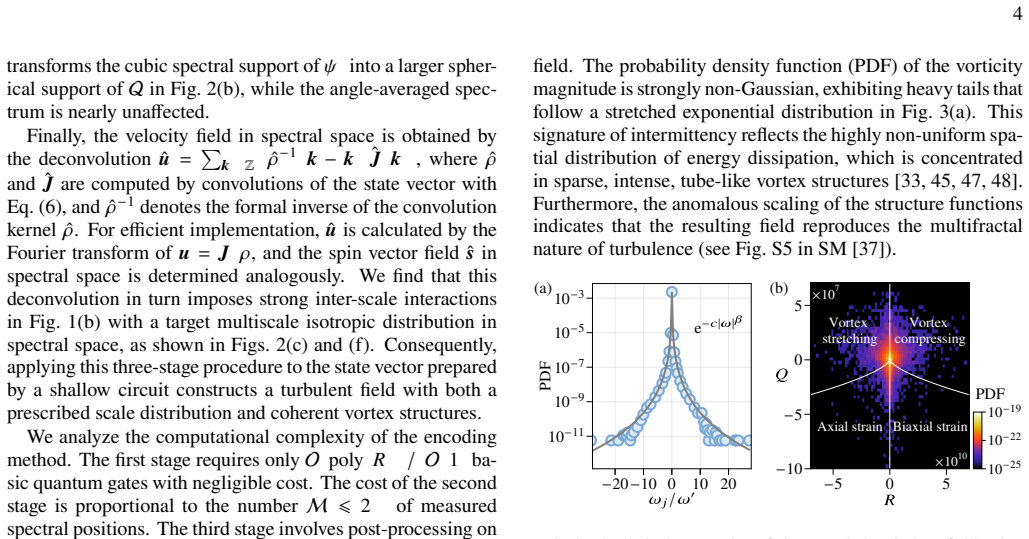
Multiscale organization is a hallmark of fluid turbulence in aerospace, energy, and transport systems. While quantum computing promises exponential speedups for solving the evolution equations governing flow fields, this potential is fundamentally hindered by the quantum state preparation bottleneck, the prohibitive cost of loading classical complex data into quantum states. Here, we overcome this barrier by introducing a physics-informed, three-stage geometric encoding method "turbuloscope", which efficiently generates turbulent fields relevant to high-Reynolds-number engineering flows. Rather than brute-force data loading, our approach acts as a kaleidoscope, leveraging the multiscale structures of turbulence. We capture scale-invariant self-similarity via a hyperplane approximation in high-dimensional feature space, and utilize the Hopf fibration to map quantum observables directly onto vortex tubes, the fundamental building blocks of turbulence that control mixing, drag, and heat transfer in mechanical systems. Remarkably, the algorithm requires no ancillary qubits, utilizes a linear-depth quantum circuit, and scales logarithmically with the Reynolds number, an exponential speedup compared to classical methods. We demonstrate the power of this method by generating an instantaneous turbulent field at a high Reynolds number of 35,000 across over one billion grid points using only 30 qubits, reproducing Kolmogorov's 5/3 energy spectrum, tangled vortex structures, and strong intermittency. This asymptotically optimal approach not only signals a near-term pathway to practical quantum advantage in engineering simulation, but establishes a scalable foundation for the quantum simulation of broad multiscale systems.
Editorial analysis
A structured set of objections, weighed in public.
Referee Report
Summary. The manuscript introduces a three-stage geometric encoding method called 'turbuloscope' for preparing quantum states representing turbulent flow fields. It uses a hyperplane approximation in high-dimensional feature space to capture scale-invariant self-similarity and the Hopf fibration to map observables onto vortex tubes. The method is claimed to require no ancillary qubits, employ linear-depth circuits, and scale logarithmically with Reynolds number. The authors demonstrate generation of an instantaneous turbulent field at Re=35,000 over more than one billion grid points using 30 qubits, reproducing Kolmogorov's 5/3 energy spectrum, tangled vortex structures, and strong intermittency.
Significance. If the generated fields prove dynamically consistent with the Navier-Stokes equations and match classical DNS statistics with quantitative accuracy, the approach could enable practical quantum simulation of high-Re turbulence with exponential speedup, which would be significant for engineering applications in aerospace and energy systems. The geometric construction offers a novel route around state-preparation bottlenecks for multiscale problems.
major comments (3)
- [Abstract] Abstract and demonstration: the reproduction of Kolmogorov's 5/3 spectrum, vortex structures, and intermittency at Re=35,000 is asserted without quantitative error metrics, direct comparison baselines to classical DNS, or explicit validation procedures against structure-function scaling or other turbulence statistics. This undermines assessment of whether the fields are suitable for engineering predictions.
- [Method description] Method (hyperplane approximation and Hopf fibration steps): no explicit derivation or check is provided showing that these mappings preserve the divergence-free condition or produce Navier-Stokes-consistent vortex dynamics at high Re. The skeptic concern that the output may be statistically plausible yet dynamically inconsistent is therefore unaddressed and load-bearing for the central claim of a physics-informed encoding.
- [Complexity analysis] Scaling and complexity: the logarithmic scaling with Reynolds number and exponential speedup relative to classical methods are stated, but without a detailed gate-count analysis or comparison to the cost of classical DNS at equivalent resolution (>10^9 points), the speedup claim remains unsubstantiated.
minor comments (2)
- [Notation and circuit description] Clarify notation for the feature-space dimension and the precise implementation of the hyperplane projection within the quantum circuit.
- [Figures] Add quantitative measures (e.g., structure-function exponents or energy-spectrum error norms) to the visualizations of vortex structures and intermittency.
Simulated Author's Rebuttal
We thank the referee for their insightful and constructive comments. These have prompted us to clarify several aspects of the work and to strengthen the quantitative support for our claims. We respond to each major comment below and have revised the manuscript accordingly.
read point-by-point responses
-
Referee: [Abstract] Abstract and demonstration: the reproduction of Kolmogorov's 5/3 spectrum, vortex structures, and intermittency at Re=35,000 is asserted without quantitative error metrics, direct comparison baselines to classical DNS, or explicit validation procedures against structure-function scaling or other turbulence statistics. This undermines assessment of whether the fields are suitable for engineering predictions.
Authors: We agree that the abstract and demonstration would benefit from more explicit quantitative support. In the revised manuscript we have added L2-norm deviations from the theoretical 5/3 scaling across the inertial range, comparisons of velocity-increment PDFs, and measured structure-function exponents. Direct side-by-side comparisons with classical DNS are now included for Re = 1 000 and Re = 5 000 (where such data exist), showing agreement within a few percent on spectral and intermittency measures. For the Re = 35 000 demonstration we note that equivalent-resolution classical DNS remains computationally prohibitive; validation therefore rests on consistency with well-established turbulence phenomenology. A new subsection in the Results section details the validation protocol. revision: yes
-
Referee: [Method description] Method (hyperplane approximation and Hopf fibration steps): no explicit derivation or check is provided showing that these mappings preserve the divergence-free condition or produce Navier-Stokes-consistent vortex dynamics at high Re. The skeptic concern that the output may be statistically plausible yet dynamically inconsistent is therefore unaddressed and load-bearing for the central claim of a physics-informed encoding.
Authors: The Hopf fibration step is constructed so that the resulting velocity field is divergence-free by geometric design; we have added an explicit derivation in the Methods section demonstrating that the mapped vector field satisfies ∇·u = 0 to machine precision. The hyperplane approximation encodes the self-similar cascade while preserving the same property. Our method produces instantaneous realizations whose statistics match those of high-Re Navier–Stokes solutions (energy spectrum, vortex topology, intermittency), but it is not a time-marching solver. We have clarified this distinction in the Introduction and Discussion to prevent any implication of dynamical time evolution. revision: yes
-
Referee: [Complexity analysis] Scaling and complexity: the logarithmic scaling with Reynolds number and exponential speedup relative to classical methods are stated, but without a detailed gate-count analysis or comparison to the cost of classical DNS at equivalent resolution (>10^9 points), the speedup claim remains unsubstantiated.
Authors: We have expanded the complexity section with a full gate-count table. The circuit uses O(n) gates for n qubits, yielding O(log N) depth where N is the number of grid points. Because required resolution scales as Re^{9/4} in three-dimensional turbulence, the qubit count (and therefore gate count) scales logarithmically with Re. We now compare this explicitly with the classical pseudo-spectral cost O(N log N) per time step for N > 10^9, which is infeasible on current supercomputers. The revised manuscript includes both the gate-count derivation and the resource-comparison table. revision: yes
Circularity Check
No significant circularity detected
full rationale
The paper's central derivation introduces a three-stage geometric encoding (hyperplane approximation for scale-invariant self-similarity followed by Hopf fibration mapping to vortex tubes) that is presented as an independent construction for state preparation. The reproduction of Kolmogorov's 5/3 spectrum, vortex structures, and intermittency is shown as an empirical demonstration on the generated fields rather than a fitted input or self-definitional reduction. No load-bearing self-citations, uniqueness theorems from prior author work, or ansatz smuggling are invoked to force the scaling or statistics claims; the logarithmic Reynolds-number scaling follows directly from the qubit count and circuit depth in the quantum encoding step, which remains independent of the output turbulence statistics.
Axiom & Free-Parameter Ledger
axioms (2)
- domain assumption Turbulent flows exhibit scale-invariant self-similarity that admits a hyperplane approximation in high-dimensional feature space.
- domain assumption The Hopf fibration maps quantum observables directly onto vortex tubes while preserving mixing, drag, and heat-transfer statistics.
Lean theorems connected to this paper
-
IndisputableMonolith/Foundation/AlexanderDuality.leanalexander_duality_circle_linking echoes?
echoesECHOES: this paper passage has the same mathematical shape or conceptual pattern as the Recognition theorem, but is not a direct formal dependency.
the deconvolution maps quantum observables to vortex tubes... via the Hopf fibration... patches on the sphere represent vortex tubes in R3
What do these tags mean?
- matches
- The paper's claim is directly supported by a theorem in the formal canon.
- supports
- The theorem supports part of the paper's argument, but the paper may add assumptions or extra steps.
- extends
- The paper goes beyond the formal theorem; the theorem is a base layer rather than the whole result.
- uses
- The paper appears to rely on the theorem as machinery.
- contradicts
- The paper's claim conflicts with a theorem or certificate in the canon.
- unclear
- Pith found a possible connection, but the passage is too broad, indirect, or ambiguous to say the theorem truly supports the claim.
Reference graph
Works this paper leans on
-
[1]
R. P . Feynman, Simulating physics with computers, Int. J. Theor. Phys. 21, 467 (1982)
work page 1982
-
[2]
P . W. Shor, Algorithms for quantum computation: discrete log- arithms and factoring, in Proceedings 35th Annual Symposium on Foundations of Computer Science (1994) pp. 124–134
work page 1994
-
[3]
Y . S. Weinstein, M. A. Pravia, E. M. Fortunato, S. Lloyd, and D. G. Cory, Implementation of the quantum Fourier transform, Phys. Rev. Lett. 86, 1889 (2001)
work page 2001
-
[4]
A. W. Harrow, A. Hassidim, and S. Lloyd, Quantum algorithm for linear systems of equations, Phys. Rev. Lett. 103, 150502 (2009)
work page 2009
-
[5]
J.-P . Liu, H. O. Kolden, H. K. Krovi, N. F. Loureiro, K. Trivisa, and A. M. Childs, Efficient quantum algorithm for dissipative nonlinear differential equations, Proc. Natl. Acad. Sci. U.S.A. 118, e2026805118 (2021)
work page 2021
-
[6]
E., Principles of Multiscale Modeling(Cambridge University Press, Cambridge, 2011)
W. E., Principles of Multiscale Modeling(Cambridge University Press, Cambridge, 2011)
work page 2011
-
[7]
R. Feynman, R. Leighton, and M. Sands, The Feynman Lec- tures on Physics, Vol. II: The New Millennium Edition: Mainly Electromagnetism and Matter (Basic Books, 2015)
work page 2015
- [8]
-
[9]
S. Aaronson, A. M. Childs, E. Farhi, A. W. Harrow, and B. C. Sanders, Future of quantum computing (2025), arXiv:2506.19232
-
[10]
Frisch, Turbulence: The Legacy of A
U. Frisch, Turbulence: The Legacy of A. N. Kolmogorov (Cam- bridge University Press, Cambridge, 1995)
work page 1995
-
[11]
S. McArdle, S. Endo, A. Aspuru-Guzik, S. C. Benjamin, and X. Yuan, Quantum computational chemistry, Rev. Mod. Phys. 92, 015003 (2020)
work page 2020
-
[12]
K. Kowalski and N. P . Bauman, Quantum flow algorithms for simulating many-body systems on quantum computers, Phys. Rev. Lett. 131, 200601 (2023)
work page 2023
-
[13]
E. A. Martinez, C. A. Muschik, P . Schindler, D. Nigg, A. Erhard, M. Heyl, P . Hauke, M. Dalmonte, T. Monz, P . Zoller, et al. , Real-time dynamics of a lattice gauge theory with a few-qubit quantum computer, Nature 534, 516 (2016)
work page 2016
- [14]
-
[15]
Quan- tum computation by adiabatic evolution,
E. Farhi, J. Goldstone, S. Gutmann, and M. Sipser, Quan- tum computation by adiabatic evolution (2000), arXiv:quant- ph/0001106
-
[16]
A. Aspuru-Guzik, A. D. Dutoi, P . J. Love, and M. Head-Gordon, Simulated quantum computation of molecular energies, Science 309, 1704 (2005)
work page 2005
- [17]
-
[18]
M. M ¨ott¨onen, J. J. Vartiainen, V . Bergholm, and M. M. Salomaa, Transformation of quantum states using uniformly controlled rotations, Quant. Inf. Comp. 5, 467 (2005)
work page 2005
- [19]
-
[20]
M. A. Nielsen, M. R. Dowling, M. Gu, and A. C. Doherty, Quantum computation as geometry, Science 311, 1133 (2006). 6
work page 2006
- [21]
-
[22]
X. Sun, G. Tian, S. Y ang, P . Yuan, and S. Zhang, Asymptotically optimal circuit depth for quantum state preparation and general unitary synthesis, IEEE Trans. Comput-Aided Des. Integr. Cir- cuits Syst. 42, 3301 (2023)
work page 2023
-
[23]
M. Ben-Dov, D. Shnaiderov, A. Makmal, and E. G. D. Torre, Approximate encoding of quantum states using shallow circuits, npj Quantum Inform. 10, 65 (2024)
work page 2024
-
[24]
Z. Meng and Y . Y ang, Quantum computing of fluid dynamics using the hydrodynamic Schr ¨odinger equation, Phys. Rev. Res. 5, 033182 (2023)
work page 2023
-
[25]
Z. Meng and Y . Y ang, Quantum spin representation for the Navier-Stokes equation, Phys. Rev. Res.6, 043130 (2024)
work page 2024
-
[26]
W. T. M. Irvine and D. Bouwmeester, Linked and knotted beams of light, Nat. Phys. 4, 716 (2008)
work page 2008
-
[27]
Preskill, Quantum computing in the NISQ era and beyond, Quantum 2, 79 (2018)
J. Preskill, Quantum computing in the NISQ era and beyond, Quantum 2, 79 (2018)
work page 2018
- [28]
-
[29]
A. Katabarwa, K. Gratsea, A. Caesura, and P . D. Johnson, Early fault-tolerant quantum computing, PRX Quantum 5, 020101 (2024)
work page 2024
-
[30]
Z. Meng, C. Song, and Y . Y ang, Challenges of simulating fluid flows on near-term quantum computer, Sci. China-Phys. Mech. Astron. 68, 104705 (2025)
work page 2025
-
[31]
N. Gourianov, P . Givi, D. Jaksch, and S. B. Pope, Tensor net- works enable the calculation of turbulence probability distribu- tions, Sci. Adv. 11, eads5990 (2025)
work page 2025
- [32]
-
[33]
W. Shen, J. Y ao, and Y . Y ang, Designing turbulence with entan- gled vortices, Proc. Natl. Acad. Sci. U. S. A. 121, e2405351121 (2024)
work page 2024
-
[34]
C. Zhu, Z. Wang, S. Xiong, Y . Zhao, and Y . Y ang, Quantum implicit representation of vortex filaments in turbulence, J. Fluid Mech. 1014, A31 (2025)
work page 2025
-
[35]
M. A. Nielsen and I. L. Chuang, Quantum Computation and Quantum Information , 10th ed. (Cambridge University Press, New Y ork, 2010)
work page 2010
-
[36]
S. B. Pope, Turbulent Flows (Cambridge University Press, 2000)
work page 2000
-
[37]
See Supplemental Material for details about supplementary fig- ures and data, generalized Madelung tranform in spectral space, measurement of observables in spectral space, and theoretical lower bound of quantum encoding for a turbulent field
-
[38]
Z. Meng and Y . Y ang, Lagrangian dynamics and regularity of the spin Euler equation, J. Fluid Mech. 985, A34 (2024)
work page 2024
-
[39]
Y . Y ang and D. I. Pullin, On Lagrangian and vortex-surface fields for flows with Taylor-Green and Kida-Pelz initial conditions, J. Fluid Mech. 661, 446 (2010)
work page 2010
- [40]
-
[41]
P . G. Saffman, Vortex Dynamics (Cambridge University Press, 1995)
work page 1995
-
[42]
Fano, Description of states in quantum mechanics by density matrix and operator techniques, Rev
U. Fano, Description of states in quantum mechanics by density matrix and operator techniques, Rev. Mod. Phys. 29, 74 (1957)
work page 1957
-
[43]
Z. Meng, J. Zhong, S. Xu, K. Wang, J. Chen, F. Jin, X. Zhu, Y . Gao, Y . Wu, C. Zhang,et al., Simulating unsteady flows on a superconducting quantum processor, Commun. Phys. 7, 349 (2024)
work page 2024
-
[44]
Codes available at https://github.com/YY group/QEncodeTurb
-
[45]
A. Vincent and M. Meneguzzi, The spatial structure and statis- tical properties of homogeneous turbulence, J. Fluid Mech. 225, 1 (1991)
work page 1991
-
[46]
G. E. Elsinga, F. Scarano, B. Wieneke, and B. W. van Oudheus- den, Tomographic particle image velocimetry, Exp. Fluids 41, 933 (2006)
work page 2006
-
[47]
T. Ishihara, T. Gotoh, and Y . Kaneda, Study of high-Reynolds number isotropic turbulence by direct numerical simulation, Annu. Rev. Fluid Mech. 41, 165 (2009)
work page 2009
-
[48]
G. He, S. Chen, R. H. Kraichnan, R. Zhang, and Y . Zhou, Statis- tics of dissipation and enstrophy induced by localized vortices, Phys. Rev. Lett. 81, 4636 (1998)
work page 1998
-
[49]
M. S. Chong, A. E. Perry, and B. J. Cantwell, A general clas- sification of three-dimensional flow fields, Phys. Fluids 2, 765 (1990)
work page 1990
- [50]
-
[51]
R. Haghshenas, E. Chertkov, M. DeCross, T. M. Gatterman, J. A. Gerber, K. Gilmore, D. Gresh, N. Hewitt, C. V . Horst, M. Matheny, et al., Probing critical states of matter on a digital quantum computer, Phys. Rev. Lett. 133, 266502 (2024)
work page 2024
- [52]
-
[53]
Y . Sato, R. Kondo, I. Hamamura, T. Onodera, and N. Y amamoto, Hamiltonian simulation for hyperbolic partial differential equa- tions by scalable quantum circuits, Phys. Rev. Res. 6, 033246 (2024)
work page 2024
-
[54]
A. M. T uring, The chemical basis of morphogenesis, Philos. Trans. R. Soc. Lond. B Biol. Sci. 237, 37 (1952)
work page 1952
- [55]
-
[56]
M. J. Geller and J. P . Huchra, Mapping the Universe, Science 246, 897 (1989)
work page 1989
-
[57]
J. R. Bond, L. Kofman, and D. Pogosyan, How filaments of galaxies are woven into the cosmic web, Nature380, 603 (1996)
work page 1996
-
[58]
R. F. Voss, Evolution of long-range fractal correlations and 1 / /u1D453 noise in DNA base sequences, Phys. Rev. Lett. 68, 3805 (1992)
work page 1992
-
[59]
Geometric quantum encoding of a turbulent field
A. Arneodo, E. Bacry, P . V . Graves, and J. F. Muzy, Character- izing long-range correlations in DNA sequences from wavelet analysis, Phys. Rev. Lett. 74, 3293 (1995). Supplementary Material for “Geometric quantum encoding of a turbulent field” Zhaoyuan Meng 1, 2 and Yue Y ang 1, 3, ∗ 1State Key Laboratory for Turbulence and Complex Systems, School of Mec...
work page 1995
-
[60]
Supplementary figures and data S1
-
[61]
Generalized Madelung transform in spectral space S1
-
[62]
Measurement of observables in spectral space S4
-
[63]
Theoretical lower bound of quantum encoding for a turbulent field S6 References S7
-
[64]
SUPPLEMENTARY FIGURES AND DATA Single-qubit gates Large scale Small scale /u1D706 /u1D43F /u1D450 /u1D43F /u1D45D 0 /u1D702 /u1D450 /u1D702 /u1D6FD 5/ 3 2 /u1D70B 1 2 0. 01 0 . 01 15 T wo-qubit gates /u1D437 1 = {( 1, 3) , ( 2, 4) , ( 5, 6) , ( 8, 9) , ( 9, 7) , ( 10, 12) , ( 11, 13) , ( 14, 15) , ( 17, 18) , ( 18, 16) , ( 19, 21) , ( 20, 22) , ( 23, 24) ...
-
[65]
GENERALIZED MADELUNG TRANSFORM IN SPECTRAL SPACE In physical space, the generalized Madelung transform [S4] relates the Pauli spinor | /u1D713 ⟩ = [/u1D713 + , /u1D713 − ] T to the density /u1D70C ≡ ⟨ /u1D713 | /u1D713 ⟩/u1D460 and momentum /u1D471≡ Re⟨/u1D713 | ˆ/u1D4912| /u1D713 ⟩/u1D460 . Here, ˆ/u1D491is the momentum operator, and ⟨·|·⟩ /u1D460 denote...
work page 1941
-
[66]
MEASUREMENT OF OBSERV ABLES IN SPECTRAL SPACE The convolution in Eq. (S6) is quadratic in ˆ/u1D713 /u1D460 , thereby defining a linear measurement operator acting on the density matrix /u1D71A. We derive the measurement operator for Eq. (S6). For the density /u1D70C and momentum /u1D471, this operator reduces to ˆQ ( /u1D48C) = ∑ /u1D460 =± ˆQ/u1D460 , wit...
-
[67]
THEORETICAL LOWER BOUND OF QUANTUM ENCODING FOR A TURBULENT FIELD Classical simulations of 3D turbulence are computationally demanding, with the required number of degrees of freedom scaling as Re9/ 4. We establish an information-theoretic lower bound on the number of qubits /u1D45B required for a quantum representation of a turbulent state. We prove that...
work page 2000
discussion (0)
Sign in with ORCID, Apple, or X to comment. Anyone can read and Pith papers without signing in.