Symmetry Resolved Entanglement Entropy in a Non-Abelian Fractional Quantum Hall State
Pith reviewed 2026-05-19 00:14 UTC · model grok-4.3
The pith
Symmetry-resolved entanglement entropy shows approximate equipartition in the non-Abelian Moore-Read quantum Hall state even with distinct mode velocities.
A machine-rendered reading of the paper's core claim, the machinery that carries it, and where it could break.
Core claim
Numerical results for the Moore-Read state reveal an approximate equipartition of entanglement among symmetry sectors that remains valid even though the topological sectors cannot be distinguished by the Abelian U(1) symmetry alone and even though neutral and charged modes possess distinct velocities. Finite-size corrections are present but consistent with expectations, and the entanglement spectrum agrees closely with the Li-Haldane conjecture across sectors.
What carries the argument
Symmetry-resolved entanglement entropy, which partitions the total entanglement according to symmetry sectors, evaluated numerically in the Moore-Read state.
If this is right
- Equipartition of entanglement among sectors survives in non-Abelian states where U(1) charge does not separate topological sectors.
- Differences in neutral and charged mode velocities produce only finite-size corrections that do not destroy the overall equipartition.
- The Li-Haldane conjecture accounts for the observed structure and sector dependence of finite-size effects in the entanglement spectrum.
- Full counting statistics remain accessible and consistent with the same symmetry resolution.
Where Pith is reading between the lines
- The same numerical route could be applied to other non-Abelian states such as Read-Rezayi to test whether equipartition is a general feature.
- Accounting explicitly for velocity mismatch may improve how finite-size data are used to extract topological entanglement properties.
- If the pattern holds, symmetry resolution could become a practical diagnostic for identifying non-Abelian order in future experiments.
Load-bearing premise
The numerical representations and system sizes used are accurate enough to capture the non-Abelian order and the different speeds of the modes without misleading errors from limited scale or approximations.
What would settle it
A calculation on significantly larger systems that finds the symmetry-resolved entanglement entropies differing by amounts that grow rather than shrink with size would show the equipartition does not hold.
Figures







read the original abstract
Symmetry-resolved entanglement entropy provides a powerful framework for probing the internal structure of quantum many-body states by decomposing entanglement into contributions from distinct symmetry sectors. In this work, we apply matrix product state techniques to study the bosonic, non-Abelian Moore-Read quantum Hall state, enabling precise numerical evaluation of both the full counting statistics and symmetry-resolved entanglement entropies. Our results reveal an approximate equipartition of entanglement among symmetry sectors, consistent with theoretical expectations and subject to finite-size corrections. The results also show that these expectations for symmetry-resolved entanglement entropy remain valid in the case of a non-Abelian state where the topological sectors cannot be distinguished by the Abelian $\mathrm{U}(1)$ symmetry alone, and where neutral and charged modes possess distinct velocities. We additionally perform a detailed comparison of the entanglement spectrum with predictions from the Li-Haldane conjecture, finding remarkable agreement, and enabling a more precise understanding of the effects of the distinct neutral and charged velocities. This not only provides a stringent test of the conjecture but also highlights its explanatory power in understanding the origin and structure of finite-size effects across different symmetry sectors.
Editorial analysis
A structured set of objections, weighed in public.
Referee Report
Summary. The paper numerically studies symmetry-resolved entanglement entropy (EE) in the bosonic Moore-Read non-Abelian fractional quantum Hall state using matrix product states (MPS). It reports an approximate equipartition of EE among symmetry sectors that is consistent with theoretical expectations, even though U(1) charge symmetry alone cannot distinguish topological sectors and neutral/charged modes have distinct velocities. The work also compares the entanglement spectrum to Li-Haldane conjecture predictions, finding good agreement that helps explain finite-size corrections across sectors.
Significance. If the MPS results are sufficiently converged, the manuscript provides a valuable extension of symmetry-resolved EE analysis to non-Abelian states, confirming that equipartition expectations hold beyond Abelian cases and offering a concrete test of the Li-Haldane conjecture for velocity-induced finite-size effects. The numerical approach for a non-Abelian state with mode-dependent velocities is a technical strength.
major comments (2)
- [Numerical Methods] Numerical Methods (assumed §3 or equivalent): The manuscript does not report the MPS bond dimension employed or any explicit bond-dimension scaling analysis. For the Moore-Read state, capturing Ising anyon fusion rules and neutral-sector degeneracy typically demands higher bond dimensions than Abelian Laughlin states; without this check, truncation artifacts could artificially enforce the reported equipartition.
- [Results] Results on finite-size corrections (assumed §4 or equivalent): While finite-size corrections and Li-Haldane agreement are noted in the abstract, the text does not demonstrate that corrections remain uniform across sectors when neutral and charged velocities differ. If cylinder circumference or system size is insufficient, mode-dependent correlation lengths can produce spurious equipartition that vanishes at larger sizes.
minor comments (2)
- [Abstract] The abstract states 'remarkable agreement' with Li-Haldane; a quantitative metric (e.g., overlap or deviation per sector) should be added in the main text or a table.
- [Introduction] Notation for symmetry sectors and anyonic labels should be defined explicitly on first use to aid readers unfamiliar with non-Abelian FQH conventions.
Simulated Author's Rebuttal
We thank the referee for their careful reading of our manuscript and for the constructive comments, which help improve the clarity and rigor of our numerical analysis. We address each major comment point by point below.
read point-by-point responses
-
Referee: [Numerical Methods] Numerical Methods (assumed §3 or equivalent): The manuscript does not report the MPS bond dimension employed or any explicit bond-dimension scaling analysis. For the Moore-Read state, capturing Ising anyon fusion rules and neutral-sector degeneracy typically demands higher bond dimensions than Abelian Laughlin states; without this check, truncation artifacts could artificially enforce the reported equipartition.
Authors: We agree that explicit reporting of the bond dimension and a convergence check are important for establishing the reliability of the results, particularly for a non-Abelian state. The calculations were performed with bond dimensions sufficient to resolve the low-lying entanglement spectrum and the relevant anyonic sectors, but we acknowledge that these details and a scaling discussion were omitted from the text. In the revised manuscript we will add the maximum bond dimension used, along with a short paragraph or supplementary note demonstrating that the equipartition and entanglement spectrum remain stable upon increasing the bond dimension within the range accessible to our simulations. revision: yes
-
Referee: [Results] Results on finite-size corrections (assumed §4 or equivalent): While finite-size corrections and Li-Haldane agreement are noted in the abstract, the text does not demonstrate that corrections remain uniform across sectors when neutral and charged velocities differ. If cylinder circumference or system size is insufficient, mode-dependent correlation lengths can produce spurious equipartition that vanishes at larger sizes.
Authors: We thank the referee for emphasizing the need to explicitly connect the velocity mismatch to the observed corrections. Our comparison to the Li-Haldane conjecture already incorporates the distinct neutral and charged velocities and shows consistent agreement across symmetry sectors, which accounts for the finite-size effects rather than indicating an artifact. Nevertheless, to strengthen the presentation we will revise the results section to include a more direct illustration—such as a plot or tabulated comparison—of how the sector-dependent corrections follow the velocity-induced pattern predicted by the conjecture, thereby demonstrating their uniformity in the sense relevant to the equipartition statement. revision: yes
Circularity Check
No significant circularity: numerical verification of symmetry-resolved EE expectations
full rationale
The paper performs direct MPS numerical computations of symmetry-resolved entanglement entropy and full counting statistics on the bosonic Moore-Read state. Results are reported as approximately consistent with prior theoretical expectations for equipartition, with explicit acknowledgment of finite-size corrections and comparison to the external Li-Haldane conjecture. No load-bearing step reduces a claimed prediction or first-principles result to a fitted parameter, self-definition, or self-citation chain by construction; the central claim is an independent numerical test rather than a tautological renaming or ansatz smuggling. The study is therefore self-contained against external benchmarks.
Axiom & Free-Parameter Ledger
Lean theorems connected to this paper
-
IndisputableMonolith/Cost/FunctionalEquation.leanwashburn_uniqueness_aczel unclear?
unclearRelation between the paper passage and the cited Recognition theorem.
We apply matrix product state techniques to study the bosonic, non-Abelian Moore-Read quantum Hall state, enabling precise numerical evaluation of both the full counting statistics and symmetry-resolved entanglement entropies... distinct velocities of neutral and charged modes
-
IndisputableMonolith/Foundation/AlexanderDuality.leanalexander_duality_circle_linking unclear?
unclearRelation between the paper passage and the cited Recognition theorem.
HA = 2πvb/L (L(b)0 − 1/24) + 2πvf/L (L(f)0 − 1/48) ... irrelevant perturbations ... Δi ≥ 4
What do these tags mean?
- matches
- The paper's claim is directly supported by a theorem in the formal canon.
- supports
- The theorem supports part of the paper's argument, but the paper may add assumptions or extra steps.
- extends
- The paper goes beyond the formal theorem; the theorem is a base layer rather than the whole result.
- uses
- The paper appears to rely on the theorem as machinery.
- contradicts
- The paper's claim conflicts with a theorem or certificate in the canon.
- unclear
- Pith found a possible connection, but the passage is too broad, indirect, or ambiguous to say the theorem truly supports the claim.
Reference graph
Works this paper leans on
-
[1]
From the expressions above, the asymptotic be- havior as L → ∞ is readily extracted
Topological entanglement entropy As a preliminary consistency check, we examine the large-L behavior of the entanglement entropy to confirm that the mismatch between the neutral and charged ve- locities does not alter the topological entanglement en- tropy. From the expressions above, the asymptotic be- havior as L → ∞ is readily extracted. In the Abelian...
-
[2]
FCS a. FCS in the σ sector In the non-Abelian sector σ the FCS is described by the discrete Gaussian distribution pq = 1 Z(Φ) σ e− q2 2σ2 , σ 2 = L 2πvb , q ∈ Z + 1 2 + Φ , (B11) 15 where the normalization factor is given by Z(Φ) σ = X q∈Z+ 1 2 +Φ e− q2 2σ2 = ϑ " Φ + 1 2 0 # (0 | τb) , (B12) which at large L behaves asymptotically as Z(Φ) σ ∼ r L vb = √ 2...
-
[3]
Indeed Tr [ρA(q)n] = 2(n−1)/2 s θ2(nτf)η(τf)n θ2(τf)nη(bτf) η(τb)n η(nτb) (B26) does not depend on q
Symmetry-resolved entropies In the non-Abelian sector we have strict equipartition within the leading-order approximation of the modular Hamiltonian. Indeed Tr [ρA(q)n] = 2(n−1)/2 s θ2(nτf)η(τf)n θ2(τf)nη(bτf) η(τb)n η(nτb) (B26) does not depend on q. In the Abelian sectors, the symmetry-resolved entanglement entropy depends only on the fermion parity, ev...
-
[4]
Calculation of the corrections to the entanglement spectrum To compute the synthetic entanglement spectrum it- self, we need to diagonalize the linear combination Eq. (43). We begin by generating a basis for all of the descendant states of each charge primary state for all of the levels above the primary state in the CFT Hilbert space that we consider. Fo...
-
[5]
Detailed description of the fitting procedure In the previous subsection, we described how to com- pute the synthetic entanglement spectrum for a given choice of parameters gi in Eq. (43). However, as noted previously, these gi are non-universal and depend on mi- croscopic details. Thus, they are not known in advance: to build the synthetic entanglement s...
-
[6]
Fitting data In Tables III and IV, we enumerate the parameters gi of Eq. (43) for the synthetic entanglement spectrum found by the exponentially suppressed fits to the MPS data, as described in the previous subsection. In Ta- ble III, these fits are performed with the full set of six integrals of the ϕi(y) of Table I, while in Table IV we instead try to f...
-
[7]
Truncation analysis of MPS data One important characterization of the MPS data that must be performed is understanding the effect of the truncation in Pmax. As described in Section V A and Appendix D, this is the approach of truncating the CFT Hilbert space that is the virtual space of the MPS to in- clude only states of conformal dimension above the pri-...
-
[8]
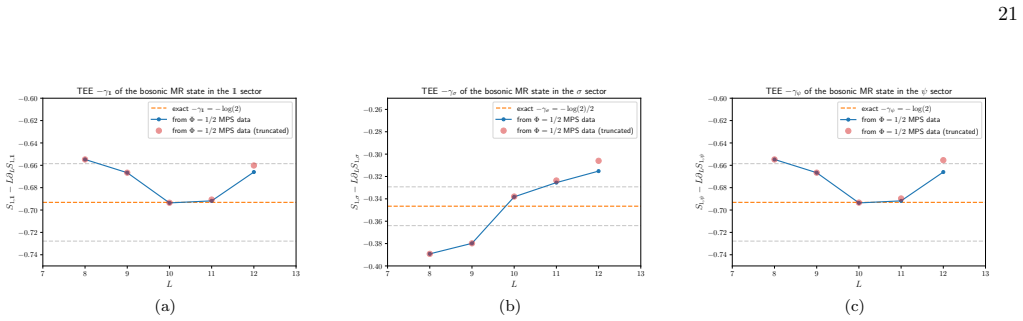
The calculated TEE γa(L) and the expected exact values γa lie within ±5 percent (gray dashed lines) in the range 8 ≤ L ≤ 12, which constitute the validated system sizes toward which we direct our analysis. For smaller perimeters, the MPS data is converged with respect to the truncation parameter but is affected by finite-size effects, whereas for larger p...
-
[9]
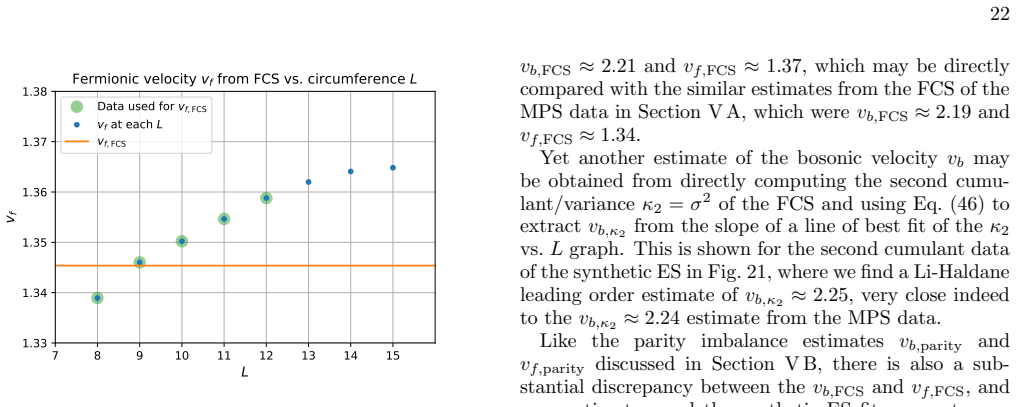
Comparison between the vb and vf obtained by the two-parameter Gaussian fits to the FCS of the MPS at different L In Section V A, we simultaneously fit the FCS of the MPS in all topological sectors with a single set of Gaus- sian forms [Eqs. (22) and (23)], depending on only two global parameters vb,fit and vf,fit, over the range of cylin- der circumferen...
-
[10]
We can start with the second cumulant, κ2, which is simply the variance of the FCS
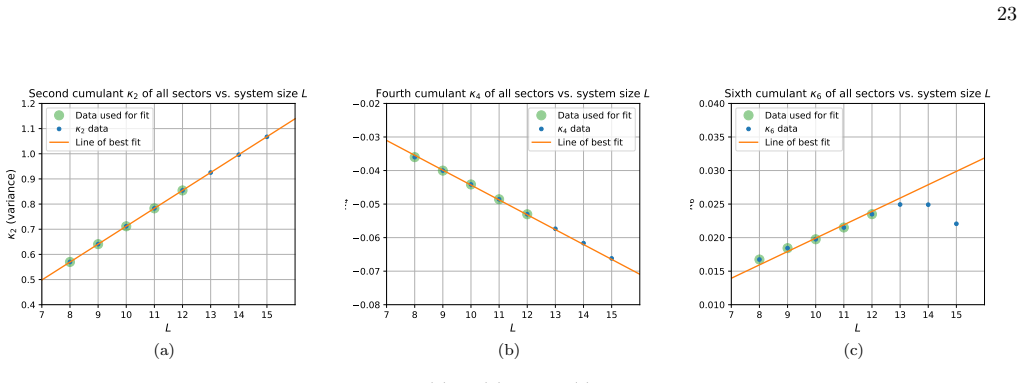
Cumulant analysis of the MPS FCS data It is also instructive to look at the cumulants of the MPS FCS data, which were considered analytically at the level of the Li-Haldane leading order in Appendix B 2. We can start with the second cumulant, κ2, which is simply the variance of the FCS. This should therefore yield a result close to that obtained via the G...
-
[11]
Additional comparisons between the MPS and synthetic ES data In this Appendix we consider some additional compar- isons between the synthetic ES data and the MPS data: direct comparison of entanglement spectra, the calcula- tion of the symmetry-resolved entanglement entropy, and the FCS for both data sets. It is useful to compare the entanglement spectra ...
- [12]
-
[13]
P. Calabrese, J. Cardy, and B. Doyon, Entanglement en- tropy in extended quantum systems, J. Phys. A: Math. Theor. 42, 500301 (2009)
work page 2009
-
[14]
Quantum entanglement in condensed matter systems
N. Laflorencie, Quantum entanglement in con- densed matter systems, Phys. Rep. 646, 1 (2016), arXiv:1512.03388
work page internal anchor Pith review Pith/arXiv arXiv 2016
-
[15]
Holographic Entanglement Entropy
M. Rangamani and T. Takayanagi, Holographic Entan- glement Entropy , Lecture Notes in Physics, Vol. 931 (Springer, 2017) arXiv:1609.01287
work page internal anchor Pith review Pith/arXiv arXiv 2017
-
[16]
M. Srednicki, Entropy and area, Phys. Rev. Lett. 71, 666 (1993), arXiv:hep-th/9303048
work page internal anchor Pith review Pith/arXiv arXiv 1993
-
[17]
Area laws for the entanglement entropy - a review
J. Eisert, M. Cramer, and M. B. Plenio, Colloquium: Area laws for the entanglement entropy, Rev. Mod. Phys. 82, 277 (2010), arXiv:0808.3773
work page internal anchor Pith review Pith/arXiv arXiv 2010
-
[18]
Geometric and Renormalized Entropy in Conformal Field Theory
C. Holzhey, F. Larsen, and F. Wilczek, Geometric and renormalized entropy in conformal field theory, Nucl. Phys. B 424, 443 (1994), arXiv:hep-th/9403108
work page internal anchor Pith review Pith/arXiv arXiv 1994
-
[19]
Entanglement in quantum critical phenomena
G. Vidal, J. I. Latorre, E. Rico, and A. Kitaev, En- tanglement in quantum critical phenomena, Phys. Rev. Lett. 90, 227902 (2003), arXiv:quant-ph/0211074
work page internal anchor Pith review Pith/arXiv arXiv 2003
-
[20]
Entanglement Entropy and Quantum Field Theory
P. Calabrese and J. Cardy, Entanglement entropy and quantum field theory, J. Stat. Mech.: Theory Exp.2004 (06), P06002, arXiv:hep-th/0405152
work page internal anchor Pith review Pith/arXiv arXiv 2004
-
[21]
A. Kitaev and J. Preskill, Topological entanglement en- tropy, Phys. Rev. Lett. 96, 110404 (2006), arXiv:hep- th/0510092
-
[22]
Detecting topological order in a ground state wave function
M. Levin and X.-G. Wen, Detecting topological order Quantity fit vb vf parity MPS 2.11 1.40 Φ = 0 synthetic 2.17 1.42 parity MPS — 1.40 Φ = 1/2 synthetic — 1.42 FCS MPS 2.19 1.34 synthetic 2.21 1.37 κ2 MPS 2.24 — synthetic 2.25 — ES synthetic 1.82 0.774 TABLE VI. In this table, we collect the various estimates of the bosonic velocity vb and fermionic velo...
work page internal anchor Pith review Pith/arXiv arXiv 2006
-
[23]
B. Estienne and J.-M. St´ ephan, Entanglement spec- troscopy of chiral edge modes in the quantum Hall effect, Phys. Rev. B 101, 115136 (2020), arXiv:1911.10125
-
[24]
B. Estienne, B. Oblak, and J.-M. St´ ephan, Ergodic edge 23 7 8 9 10 11 12 13 14 15 L 0.4 0.5 0.6 0.7 0.8 0.9 1.0 1.1 1.22 (variance) Second cumulant 2 of all sectors vs. system size L Data used for fit 2 data Line of best fit (a) 7 8 9 10 11 12 13 14 15 L 0.08 0.07 0.06 0.05 0.04 0.03 0.02 4 Fourth cumulant 4 of all sectors vs. system size L Data used fo...
-
[25]
Microscopic Study of the Halperin - Laughlin Interface through Matrix Product States
V. Cr´ epel, N. Claussen, N. Regnault, and B. Estienne, Microscopic study of the Halperin–Laughlin interface through matrix product states, Nat. Commun. 10, 1860 (2019), arXiv:1904.11023
work page internal anchor Pith review Pith/arXiv arXiv 2019
-
[26]
Model States for a Class of Chiral Topological Order Interfaces
V. Cr´ epel, N. Claussen, B. Estienne, and N. Reg- nault, Model states for a class of chiral topologi- cal order interfaces, Nat. Commun. 10, 1861 (2019), arXiv:1806.06858. 0 1 2 3 4 5 6 Momentum 0 5 10 15 20 25 30 35 40 45Entanglement energy ψ sector bosonic MR ES at L = 12, q = −1/2 (Φ = 1 /2) 0 1 2 3 2 4 6 Inset of the lower levels MPS data Synthetic E...
work page internal anchor Pith review Pith/arXiv arXiv 2019
-
[27]
V. Cr´ epel, B. Estienne, and N. Regnault, Variational ansatz for an Abelian to non-Abelian topological phase transition in ν = 1 /2 + 1/2 bilayers, Phys. Rev. Lett. 123, 126804 (2019), arXiv:1904.01589
-
[28]
H. F. Song, S. Rachel, and K. Le Hur, General relation between entanglement and fluctuations in one dimen- sion, Phys. Rev. B 82, 012405 (2010), arXiv:1002.0825
work page internal anchor Pith review Pith/arXiv arXiv 2010
-
[29]
H. F. Song, S. Rachel, C. Flindt, I. Klich, N. Lafloren- cie, and K. Le Hur, Bipartite fluctuations as a probe of many-body entanglement, Phys. Rev. B 85, 035409 24 -5 -4 -3 -2 -1 0 1 2 3 4 5 q −1.50 −1.25 −1.00 −0.75 −0.50 −0.25 0.00 0.25 0.50 S2(q) − S2 + 1 2 log(L) Subtracted R´ enyi-2 SREE forL = 10, Φ = 0 , 1/2 vacuum (even) (MPS) ψ(even) (MPS) σ(MPS...
work page internal anchor Pith review Pith/arXiv arXiv 2012
-
[30]
Fluctuations and Entanglement spectrum in quantum Hall states
A. Petrescu, H. F. Song, S. Rachel, Z. Ristivojevic, C. Flindt, N. Laflorencie, I. Klich, N. Regnault, and K. Le Hur, Fluctuations and entanglement spectrum in quantum Hall states, J. Stat. Mech.: Theory Exp. 2014 (10), P10005, arXiv:1405.7816
work page internal anchor Pith review Pith/arXiv arXiv 2014
-
[31]
L. S. Levitov and G. B. Lesovik, Charge distribution in quantum shot noise, JETP Lett. 58, 230 (1993)
work page 1993
-
[32]
L. S. Levitov, H. Lee, and G. B. Lesovik, Electron count- ing statistics and coherent states of electric current, J. Math. Phys. 37, 4845 (1996), arXiv:cond-mat/9607137
work page internal anchor Pith review Pith/arXiv arXiv 1996
-
[33]
Detecting Quantum Critical Points using Bipartite Fluctuations
S. Rachel, N. Laflorencie, H. F. Song, and K. Le Hur, Detecting quantum critical points using bipartite fluctuations, Phys. Rev. Lett. 108, 116401 (2012), arXiv:1110.0743
work page internal anchor Pith review Pith/arXiv arXiv 2012
-
[34]
A. Hackenbroich, A. Hudomal, N. Schuch, B. A. Bernevig, and N. Regnault, Fractional chiral hinge insulator, Phys. Rev. B 103, L161110 (2021), arXiv:2010.09728
-
[35]
V. Cr´ epel, A. Hackenbroich, N. Regnault, and B. Esti- enne, Universal signatures of Dirac fermions in entangle- ment and charge fluctuations, Phys. Rev. B103, 235108 (2021), arXiv:2102.09571
-
[36]
B. Estienne, J.-M. St´ ephan, and W. Witczak-Krempa, Cornering the universal shape of fluctuations, Nat. -5 -4 -3 -2 -1 0 1 2 3 4 5 q −1.50 −1.25 −1.00 −0.75 −0.50 −0.25 0.00 0.25 0.50 S2(q) − S2 + 1 2 log(L) Subtracted R´ enyi-2 SREE forL = 12, Φ = 0 , 1/2 vacuum (even) (MPS) ψ(even) (MPS) σ(MPS) vacuum (odd) (MPS) ψ(odd) (MPS) vacuum (even) (fit) ψ(even)...
-
[37]
Probing entanglement in a many-body-localized system
A. Lukin, M. Rispoli, R. Schittko, M. E. Tai, A. M. Kaufman, S. Choi, V. Khemani, J. L´ eonard, and M. Greiner, Probing entanglement in a many- body–localized system, Science 364, 256 (2019), arXiv:1805.09819
work page internal anchor Pith review Pith/arXiv arXiv 2019
- [38]
- [39]
- [40]
-
[41]
Spin-resolved entanglement spectroscopy of critical spin chains and Luttinger liquids
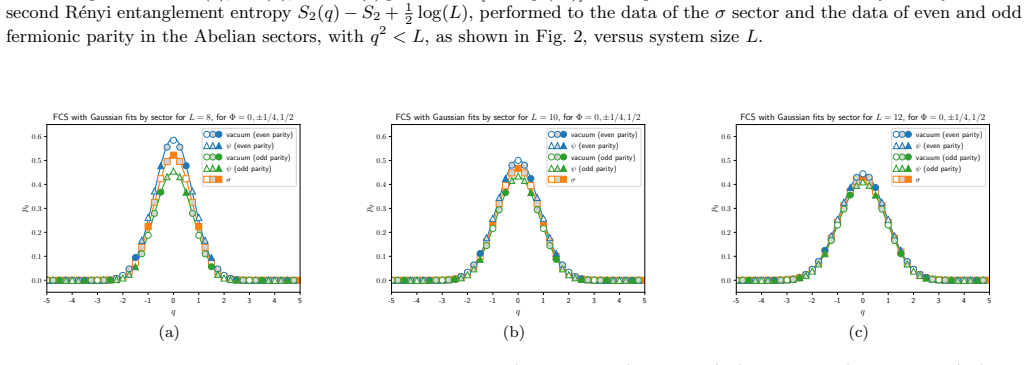
N. Laflorencie and S. Rachel, Spin-resolved entangle- ment spectroscopy of critical spin chains and Luttinger liquids, J. Stat. Mech.: Theory Exp. 2014 (11), P11013, arXiv:1407.3779. 25 -5 -4 -3 -2 -1 0 1 2 3 4 5 q 0.0 0.1 0.2 0.3 0.4 0.5 0.6 pq FCS from fit and MPS with Gaussians (from fit) for L = 8, Φ = 0 , 1/2 MPS 1 (even) MPS ψ(even) MPS 1 (odd) MPS ψ(...
work page internal anchor Pith review Pith/arXiv arXiv 2014
- [42]
-
[43]
Symmetry-resolved entanglement in many-body systems
M. Goldstein and E. Sela, Symmetry-resolved entan- glement in many-body systems, Phys. Rev. Lett. 120, 200602 (2018), arXiv:1711.09418
work page internal anchor Pith review Pith/arXiv arXiv 2018
-
[44]
J. C. Xavier, F. C. Alcaraz, and G. Sierra, Equipartition of the entanglement entropy, Phys. Rev. B 98, 041106 (2018), arXiv:1804.06357
work page internal anchor Pith review Pith/arXiv arXiv 2018
-
[45]
P. Calabrese, J. Dubail, and S. Murciano, Symmetry- resolved entanglement entropy in Wess-Zumino-Witten models, J. High Energy Phys. 2021 (10), 67, arXiv:2106.15946
-
[46]
N. Feldman and M. Goldstein, Dynamics of charge- resolved entanglement after a local quench, Phys. Rev. B 100, 235146 (2019), arXiv:1905.10749
-
[47]
Imbalance Entanglement: Symmetry Decomposition of Negativity
E. Cornfeld, M. Goldstein, and E. Sela, Imbalance en- tanglement: Symmetry decomposition of negativity, Phys. Rev. A 98, 032302 (2018), arXiv:1804.00632
work page internal anchor Pith review Pith/arXiv arXiv 2018
-
[48]
S. Murciano, R. Bonsignori, and P. Calabrese, Symmetry decomposition of negativity of mass- less free fermions, SciPost Phys. 10, 111 (2021), arXiv:2102.10054
-
[49]
L. Capizzi, P. Ruggiero, and P. Calabrese, Symmetry resolved entanglement entropy of excited states in a CFT, J. Stat. Mech.: Theory Exp. 2020 (7), 073101, arXiv:2003.04670
-
[50]
R. Bonsignori and P. Calabrese, Boundary effects on symmetry resolved entanglement, J. Phys. A: Math. Theor. 54, 015005 (2020), arXiv:2009.08508
-
[51]
B. Estienne, Y. Ikhlef, and A. Morin-Duchesne, Finite- size corrections in critical symmetry-resolved entangle- ment, SciPost Phys. 10, 054 (2021), arXiv:2010.10515
-
[52]
Chen, Symmetry decomposition of relative en- tropies in conformal field theory, J
H.-H. Chen, Symmetry decomposition of relative en- tropies in conformal field theory, J. High Energy Phys. 2021 (7), 84, arXiv:2104.03102
-
[53]
L. Capizzi and P. Calabrese, Symmetry resolved rela- tive entropies and distances in conformal field theory, J. High Energy Phys. 2021 (10), 195, arXiv:2105.08596
- [54]
- [55]
- [56]
- [57]
-
[58]
H. Barghathi, E. Casiano-Diaz, and A. Del Maestro, Op- erationally accessible entanglement of one-dimensional spinless fermions, Phys. Rev. A 100, 022324 (2019), arXiv:1905.03312
-
[59]
P. Calabrese, M. Collura, G. Di Giulio, and S. Murciano, Full counting statistics in the gapped XXZ spin chain, Europhys. Lett. 129, 60007 (2020), arXiv:2002.04367
-
[60]
R\'enyi generalization of the operational entanglement entropy
H. Barghathi, C. M. Herdman, and A. Del Mae- stro, R´ enyi generalization of the accessible entangle- ment entropy, Phys. Rev. Lett. 121, 150501 (2018), arXiv:1804.01114
work page internal anchor Pith review Pith/arXiv arXiv 2018
- [61]
-
[62]
R. Bonsignori, P. Ruggiero, and P. Calabrese, Sym- metry resolved entanglement in free fermionic sys- tems, J. Phys. A: Math. Theor. 52, 475302 (2019), arXiv:1907.02084
-
[63]
S. Fraenkel and M. Goldstein, Symmetry resolved entan- glement: exact results in 1d and beyond, J. Stat. Mech.: Theory Exp. 2020 (3), 033106, arXiv:1910.08459
-
[64]
S. Murciano, G. Di Giulio, and P. Calabrese, Entangle- ment and symmetry resolution in two dimensional free quantum field theories, J. High Energy Phys. 2020 (8), 73, arXiv:2006.09069
-
[65]
S. Murciano, P. Ruggiero, and P. Calabrese, Symme- try resolved entanglement in two-dimensional systems via dimensional reduction, J. Stat. Mech.: Theory Exp. 2020 (8), 083102, arXiv:2003.11453
-
[66]
M. Kiefer-Emmanouilidis, R. Unanyan, J. Sirker, and M. Fleischhauer, Bounds on the entanglement entropy by the number entropy in non-interacting fermionic sys- tems, SciPost Phys. 8, 083 (2020), arXiv:2003.03112
- [67]
- [68]
-
[69]
S. Fraenkel and M. Goldstein, Entanglement mea- sures in a nonequilibrium steady state: Exact re- sults in one dimension, SciPost Phys. 11, 085 (2021), arXiv:2105.00740
-
[70]
Chen, Charged R´ enyi negativity of massless free bosons, J
H.-H. Chen, Charged R´ enyi negativity of massless free bosons, J. High Energy Phys. 2022 (2), 117, arXiv:2111.11028
- [71]
-
[72]
A. Foligno, S. Murciano, and P. Calabrese, Entangle- ment resolution of free Dirac fermions on a torus, J. High Energy Phys. 2023 (3), 96, arXiv:2212.07261
-
[73]
L. Capizzi, S. Murciano, and P. Calabrese, Full counting statistics and symmetry resolved entanglement for free conformal theories with interface defects, J. Stat. Mech.: Theory Exp. 2023 (7), 073102, arXiv:2302.08209
-
[74]
S. Murciano, G. D. Giulio, and P. Calabrese, Symmetry resolved entanglement in gapped integrable systems: a corner transfer matrix approach, SciPost Phys. 8, 046 (2020), arXiv:1911.09588
- [75]
- [76]
-
[77]
L. Capizzi, D. X. Horv´ ath, P. Calabrese, and O. A. Castro-Alvaredo, Entanglement of the 3-state Potts model via form factor bootstrap: total and symmetry resolved entropies, J. High Energy Phys. 2022 (5), 113, arXiv:2108.10935
- [78]
-
[79]
L. Capizzi, O. A. Castro-Alvaredo, C. De Fazio, M. Mazzoni, and L. Santamar´ ıa-Sanz, Symmetry re- solved entanglement of excited states in quantum field theory. Part I. Free theories, twist fields and qubits, J. High Energy Phys. 2022 (12), 127, arXiv:2203.12556
-
[80]
L. Capizzi, C. De Fazio, M. Mazzoni, L. Santamar´ ıa- Sanz, and O. A. Castro-Alvaredo, Symmetry resolved entanglement of excited states in quantum field the- ory. Part II. Numerics, interacting theories and higher dimensions, J. High Energy Phys. 2022 (12), 128, arXiv:2206.12223
discussion (0)
Sign in with ORCID, Apple, or X to comment. Anyone can read and Pith papers without signing in.