REVIEW 2 major objections 4 minor 77 references
A Physics-Augmented Machine Learning Constitutive Model for Damage in Solids
T0 review · 2 major / 4 minor · reviewed 2026-08-06 · deepseek-v4-flash
Pith's one-line read A physics-augmented neural network learns anisotropic damage from stress–strain data, reproducing direction-dependent softening in hydrogels.
desk verdict A genuinely new anisotropic damage architecture, undermined by a mismatch between the derived evolution laws and the final energy—worth review but not acceptance as is. read the letter →
The pith
A machine-rendered reading of the paper's core claim, the machinery that carries it, and where it could break.
The reading
What carries the argument
The load-bearing object is the free-energy representation $\bar\psi_e(C,L_i,\alpha_i,\alpha_0)$: an isotropic function of the right Cauchy–Green tensor $C$, structural tensors $L_i$ for material symmetry, and scalar amplitudes $\alpha_0,\alpha_i$ from the second-order damage tensor $D_{\rm aniso}=\sum_i \alpha_i L_i$. Polyconvex invariants $I_C=C:I$, $II_C=\mathrm{cof}(C):I$, $III_C=\det C$, $\tilde I^{(i)}=C:\tilde L^{(i)}$, $\tilde J^{(i)}=\mathrm{cof}(C):\tilde L^{(i)}$ feed non-decreasing input-convex neural networks, whose composition preserves convexity. The attenuation envelope $p(\alpha)$ is a trainable weighted sum of convex decreasing functions $(1-\alpha/a)^{q_j}$, and damage evolves through potentials $g_i=G_i(y_i)-G_i(r_i)$ with consistency and loading/unloading conditions. A two-stage training procedure first fits the unloading branches to learn the elastic energy, then fits damage evolution on the full cyclic data.
What would settle it
Train the model on a multiaxial protocol and then subject the material to non-proportional loading, such as uniaxial pre-stretch followed by shear at 45 degrees; if measurements of damage orientation (for example from X-ray scattering or birefringence) show the damage axes rotating away from the original symmetry axes, the co-axial assumption fails and the predicted stresses will diverge from the measured ones.
Extended reading notes
Core claim
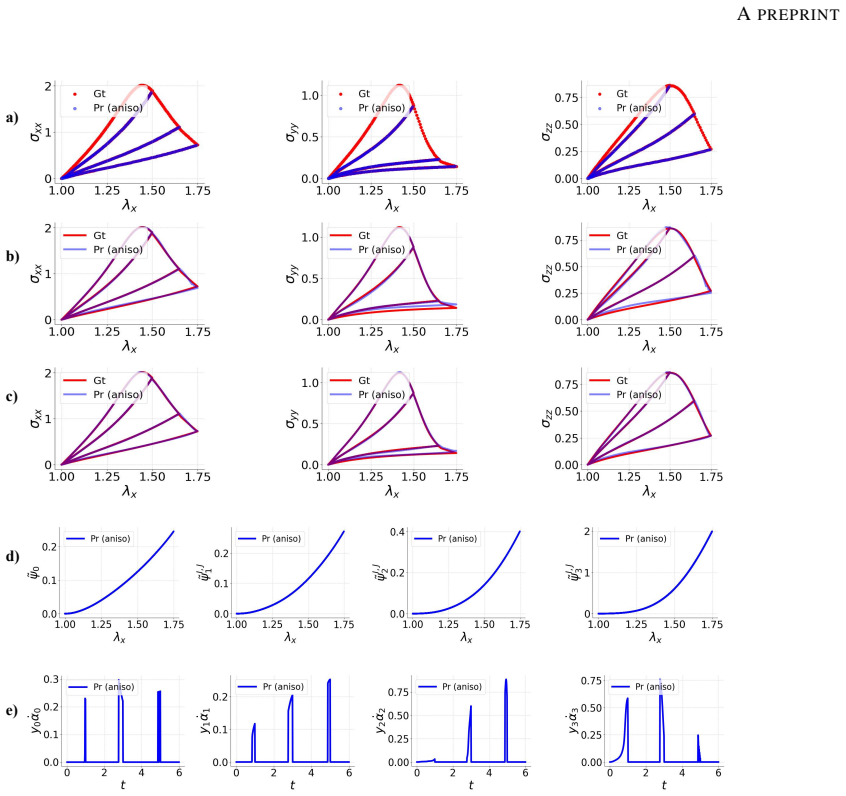
On the paper's own terms, the discovery is a general data-driven anisotropic damage formulation. The Helmholtz free energy is written as an isotropic function of deformation invariants and structural tensors, with damage encoded by a second-order damage tensor whose principal directions are assumed to remain co-axial with the virgin material's symmetry axes. Non-decreasing input-convex neural networks parameterize the strain-energy potentials, so polyconvexity holds by construction; attenuation of energy under damage is a trainable weighted sum of convex decreasing functions $(1-\alpha/a)^{q_j}$, generalizing the classical $(1-d)$ degradation; and damage evolution is governed by conjugate thermodynamic forces through damage potentials with thresholds and KKT consistency conditions. Additional terms are included so that energy and stress vanish at the undeformed state, satisfying the normality condition. The authors demonstrate accurate recovery of synthetic isotropic, transversely isotropic, and compressible orthotropic responses, and show that on double-network hydrogel data the anisotropic model captures the dominant multiaxial behavior where an isotropic damage model falls short.
Load-bearing premise
The load-bearing premise, stated in Section 3.1, is that damage principal directions stay fixed and aligned with the material's original symmetry axes throughout loading; the paper also notes in Sections 2.6 and 2.7 that growth conditions are omitted and energy non-negativity is verified numerically rather than by construction.
Editorial extensions
If this is right
- The same formulation covers incompressible and compressible orthotropic materials, so one architecture can model gels, elastomers, and soft tissue without switching constitutive forms.
- Because polyconvexity and thermodynamic consistency are enforced by construction, the learned strain-energy function can be used directly in finite-element simulations of failure.
- The nonlinear convex decreasing attenuation functions replace the classical $(1-d)$ degradation, so the model can represent richer damage evolution while keeping energy non-negative in the demonstrated range.
- The decoupled training strategy learns elastic response from unloading branches and damage evolution from full cycles, reducing the cost of fitting path-dependent models and improving scalability.
- For the double-network hydrogel validation, the anisotropic model reproduces the dominant multiaxial response in equal-biaxial, unequal-biaxial, and planar tests, whereas the isotropic model misses key stress components.
Reading between the lines
- An implicit extension: adding independent structural tensors for damage axes would let the same architecture track rotating damage fabrics under shear or non-proportional loading, relaxing the co-axial assumption.
- Because the authors note that multiple internal states can fit the same stress–strain data, pairing the model with damage-orientation measurements could disambiguate the hidden state and make predictions more physical.
- The inclusion of $III_C$ in the potentials means volumetric damage is representable, pointing toward applications in rocks and concrete, though the reported examples are dominated by deviatoric loading.
- A natural test of extrapolation is to train on one loading mode and predict another, such as training on uniaxial and planar data and testing on pure shear; the paper's experiments do not isolate this.
Editorial analysis
A structured set of objections, weighed in public.
Referee Report
Summary. The manuscript proposes a data-driven constitutive framework for anisotropic damage in solids, built around a second-order damage tensor, an ICNN-parameterized strain energy with polyconvex invariant inputs, convex decreasing attenuation functions, a damage potential with KKT conditions, and additional normality-correction terms. Damage evolution is formulated through conjugate thermodynamic forces, and a decoupled training scheme is introduced to separate unloading-branch energy fitting from damage-evolution fitting. The framework is demonstrated on synthetic incompressible isotropic, transversely isotropic, and compressible orthotropic benchmarks, and on experimental double-network hydrogel data under multiaxial loading, where the anisotropic model is reported to outperform an isotropic damage model.
Significance. If the theoretical claims are fully established, this would be a useful contribution: it combines several nontrivial constraints (objectivity, polyconvexity, normality, and thermodynamic consistency) in a trainable constitutive model and demonstrates predictive capability on multiaxial damage data. The decoupled training scheme and the explicit treatment of damage-induced anisotropy are practically valuable. The paper also honestly acknowledges that non-negativity of the energy is verified numerically on the training range rather than proven globally. The main theoretical concern, detailed below, concerns the consistency between the damage evolution equations used in the implementation and the conjugate forces associated with the final energy, which is load-bearing for the central 'thermodynamically consistent as designed' claim.
major comments (2)
- [Sections 3.2, 4, 5.3, and 8, Eqs. (3.15), (4.4), (5.4), (5.12)-(5.13)] The damage evolution equations (3.15) and (4.4) are derived from the conjugate forces in Eq. (3.10), namely y_i = -p'_i(alpha_i) bar-psi_i and y_0 = -p'_0(alpha_0) bar-psi_0. However, the actual model defined in Section 5.3 includes the normality-correction term psi_stress, and the final conjugate forces in Eq. (5.4) are y_i = -p'_i(alpha_i) hat-psi_i^ICNN - d psi_stress/d alpha_i, with an analogous expression for y_0. Because psi_stress depends on alpha_i and alpha_0 through p_i and p_0, the extra derivatives d psi_stress/d alpha_i are generally nonzero. No corrected version of (3.15) or (4.4) is supplied, and the experimental validation in Section 8 explicitly states that the anisotropic model is trained using (3.15)_1 and (4.4). The alpha_i-update actually implemented is therefore not the derivative of the stated Helmholtz free energy. The dissipation inequality (2.6)_2 is established for the energy and evolution equations only when the conjugate forces are those of Eq. (3.10); it is not established for the model that includes psi_stress. The numerical dissipation plots in Sections 8 cannot close this gap unless the plotted dissipation is computed with the full conjugate forces and the corrected evolution equations. This is a load-bearing inconsistency for the central claim that the formulation is thermodynamically consistent by construction.
- [Section 3.1, Eq. (3.2), and Section 9] The damage tensor is assumed to remain coaxial with the virgin material symmetry axes and to have fixed principal directions throughout the damage process. The invariant basis in Eq. (3.7) is built from the fixed structural tensors L_i, so the model cannot represent a damage state whose principal directions rotate relative to the material axes, for example under non-proportional shear with evolving crack orientation. This is an explicit assumption, and Remark 2 sketches a generalization, but the abstract and concluding remarks present the model as a general anisotropic damage model for orthotropic materials without this qualification. Since the experimental validation is limited to biaxial and planar tests where the loading directions coincide with the symmetry axes, the scope of the model should be stated explicitly in the abstract and conclusions, or the generalized formulation of Remark 2 should be implemented and tested to support the unqualified claim.
minor comments (4)
- [Section 2.7 and Section 9] The paper correctly notes that non-negativity of the trained energy is verified only on the training range. The concluding sentence that 'numerical results across all examples demonstrate that the resulting strain energy density functions are non-negative' should be qualified as a data-range verification, not a global property, to avoid overstating the physics guarantee.
- [Section 5.3, Eq. (5.7)] The function 'softplus' is used without definition. Although it is standard in machine learning, a brief definition or reference would improve readability for the mechanics audience.
- [Section 8, experimental example] The text refers to 'Mullin's effect' in one place; this should be 'Mullins effect' for consistency with the literature and with the rest of the manuscript.
- [Section 8, experimental example] The comparison between the isotropic and anisotropic models would be clearer if a quantitative measure of fit error (for example, normalized RMS error per loading mode) were reported, since the qualitative improvement of the anisotropic model is otherwise assessed only visually from Figs. 5 and 6.
Circularity Check
Experimental 'prediction' is a training-data fit; the constitutive derivation itself is otherwise self-contained.
-
fitted input called prediction
[Sections 7-8 (Training scheme and hydrogel example) and Section 9 (Concluding remarks)]
"The training data is only the stress-strain curves for all synthetic and the experimental cases. ... For the first model, we train an isotropic damage data-driven model, similar to (8.3), against all data. ... To obtain the results, we first applied the proposed decoupled training procedure, then performed full-parameter training for both the isotropic and anisotropic models. ... the anisotropic model successfully captures the dominant characteristics of the response."
All parameters entering the reported stress predictions are optimized against the same experimental curves: Stage I fits the strain-energy potentials and per-cycle attenuation values to the unloading branches (Eqs. 7.3-7.5), Stage II fits the damage potentials, attenuation parameters, and energy scaling constants to the full loading-unloading cycles (Eqs. 7.6-7.7), and then a final full-parameter pass is performed. The 'predicted' hydrogel curves are therefore the fitted output of the loss function (7.2), not independent predictions. The concluding claim that the anisotropic model 'successfully captures' the response, and the comparison showing it outperforms the isotropic model, reduce by construction to the training objective on the same data.
full rationale
No load-bearing self-citation chain is present: the authors cite their own prior isotropic framework [1], but the anisotropic extension, the invariant architecture, the polyconvexity argument, and the normality-correction construction are derived in this paper from stated assumptions and standard results. The polyconvexity, objectivity, and normality steps are constructions rather than circular predictions. The one clear circular pattern is that the experimental 'validation' for the double-network hydrogel is performed on the same stress-strain curves used to train all model parameters, so the reported success is a training-fit comparison. A separate, non-circular correctness caveat must be weighed: the damage-evolution equations (3.15) and (4.4) are derived from conjugate forces (3.10) that omit the psi_stress terms introduced in Eq. (5.4); no corrected consistency equations are supplied for the final energy (5.12)-(5.13), so the implemented model is not literally the derivative of the stated free energy. This is an internal-consistency problem, not a circularity, but it undercuts the 'thermodynamically consistent, as designed' claim and is flagged here with location: Eqs. (3.15), (4.4) versus (5.4). The score of 5 reflects the partial reduction of the headline experimental claim to the training fit while the theoretical construction retains substantial independent content.
Assumptions & free parameters
free parameters (7)
- ICNN weights and biases for psi_0 and psi_i =
not reported
- ICNN weights and biases for G'_0 and G'_i =
not reported
- Attenuation weights w_j and cutoffs a0, a_i in p(alpha) =
not reported
- Per-cycle attenuation values P_i(alpha_i,cycle) =
not reported
- Energy scale constants C0 and C_i =
not reported
- q_j exponents in Eq. (5.5) =
fixed lists, e.g. [1, 1.5, 2, 3, ..., 200]
- beta in the loss function =
not reported
assumptions (7)
- standard math Symmetric right Cauchy-Green tensor, cofactor, and determinant form admissible polyconvex arguments (Ball's theorem, Definition 4).
- standard math Any anisotropic scalar function can be represented as an isotropic function of C, structural tensors, and internal variables (Zhang and Rychlewski [40]).
- domain assumption The virgin material is at most orthotropic, and the damage principal axes are co-axial with the material symmetry axes and fixed during evolution.
- domain assumption The Helmholtz free energy is convex in the damage variables, following generalized standard material theory.
- domain assumption Damage state remains frozen during unloading branches of cyclic tests.
- ad hoc to paper Non-negativity of the trained energy is checked numerically on the training range, not proven globally.
- domain assumption Growth condition at extreme deformations is not enforced.
Cite this review
Pith. "Pith review of A Physics-Augmented Machine Learning Constitutive Model for Damage in Solids." pith.science (2026). https://pith.science/paper/QNXAEYVH
@misc{pith2026250805638,
  author       = {Pith},
  title        = {Pith review of: A Physics-Augmented Machine Learning Constitutive Model for Damage in Solids},
  year         = {2026},
  howpublished = {\url{https://pith.science/paper/QNXAEYVH}},
  note         = {Machine review of arXiv:2508.05638}
}
read the original abstract
We propose a data-driven constitutive framework for anisotropic damage mechanics based on the second-order damage tensor approach for both compressible and incompressible materials. The formulation is thermodynamically consistent and satisfies the Clausius-Duhem inequality. The strain energy density potentials are expressed as isotropic functions of the right Cauchy-Green deformation tensor, along with structural tensors that encode anisotropy either present in the virgin material or resulting from damage. To guarantee the polyconvexity condition, non-decreasing convex neural networks with inputs that ensure polyconvexity are used to parameterize the strain energy density potentials. The model vanishes in the undeformed state, fulfilling the normality condition. In contrast to classical [1-d] damage models, the expressiveness of the new data-driven model is enhanced by employing a family of nonlinear, convex, decreasing functions to capture the effect of damage. Damage evolution is governed through a damage potential, where the corresponding threshold is defined in terms of the damage conjugate forces. As a special case of the general formulation, a new anisotropic generic format is introduced to predict constitutive responses under damage-induced anisotropy in initially isotropic materials. To reduce the computational burden during training, a decoupled training scheme is introduced, and its accuracy is demonstrated in all numerical examples. These include benchmarks for incompressible isotropic, transversely isotropic, and compressible orthotropic materials. The framework is also validated against experimental data capturing anisotropic Mullins-type damage.
Figures


Figures from the paper (6 more)


Reference graph
Works this paper leans on
-
[1]
Data-driven continuum damage mechanics with built-in physics,
V . Tac, E. Kuhl, and A. B. Tepole, “Data-driven continuum damage mechanics with built-in physics,”Extreme Mechanics Letters, vol. 71, p. 102220, 2024
work page 2024
-
[2]
Comparison of discontinuous damage models of mullins-type,
A. Ricker, N. H. Kröger, and P. Wriggers, “Comparison of discontinuous damage models of mullins-type,”Archive of Applied Mechanics, vol. 91, no. 10, pp. 4097–4119, 2021
work page 2021
-
[3]
A review on data-driven constitutive laws for solids,
J. N. Fuhg, G. Anantha Padmanabha, N. Bouklas, B. Bahmani, W. Sun, N. N. Vlassis, M. Flaschel, P. Carrara, and L. De Lorenzis, “A review on data-driven constitutive laws for solids,”Archives of Computational Methods in Engineering, pp. 1–43, 2024
work page 2024
-
[4]
Rupture time under creep conditions,
L. M. Kachanov, “Rupture time under creep conditions,”International journal of fracture, vol. 97, no. 1, pp. 11–18, 1999
work page 1999
-
[5]
Y . N. Rabotnov,Creep Problem in Structural Members. Amsterdam: North-Holland, 1969
work page 1969
-
[6]
D. Hayhurst and F. Leckie, “The effect of creep constitutive and damage relationships upon the rupture time of a solid circular torsion bar,” Journal of the Mechanics and Physics of Solids, vol. 21, no. 6, pp. 431–432, 1973
work page 1973
-
[7]
Behavior of rubber under repeated stresses,
W. Holt, “Behavior of rubber under repeated stresses,”Rubber Chemistry and Technology, vol. 5, no. 1, pp. 79–89, 1932
work page 1932
-
[8]
Effect of stretching on the properties of rubber,
L. Mullins, “Effect of stretching on the properties of rubber,”Rubber chemistry and technology, vol. 21, no. 2, pp. 281–300, 1948
work page 1948
Show all 77 references
-
[9]
Theoretical model for the elastic behavior of filler-reinforced vulcanized rubbers,
L. Mullins and N. Tobin, “Theoretical model for the elastic behavior of filler-reinforced vulcanized rubbers,” Rubber chemistry and technology, vol. 30, no. 2, pp. 555–571, 1957
1957
-
[10]
Double-network hydrogels with extremely high mechanical strength,
J. P. Gong, Y . Katsuyama, T. Kurokawa, and Y . Osada, “Double-network hydrogels with extremely high mechanical strength,” Advanced materials, vol. 15, no. 14, pp. 1155–1158, 2003
2003
-
[11]
Induced anisotropy by mullins effect in filled elastomers subjected to stretching with various geometries,
T.-T. Mai, Y . Morishita, and K. Urayama, “Induced anisotropy by mullins effect in filled elastomers subjected to stretching with various geometries,” Polymer, vol. 126, pp. 29–39, 2017
2017
-
[12]
Distinctive characteristics of internal fracture in tough double network hydrogels revealed by various modes of stretching,
T.-T. Mai, T. Matsuda, T. Nakajima, J. P. Gong, and K. Urayama, “Distinctive characteristics of internal fracture in tough double network hydrogels revealed by various modes of stretching,”Macromolecules, vol. 51, no. 14, pp. 5245–5257, 2018
2018
-
[13]
Toughening elastomers with sacrificial bonds and watching them break,
E. Ducrot, Y . Chen, M. Bulters, R. P. Sijbesma, and C. Creton, “Toughening elastomers with sacrificial bonds and watching them break,” Science, vol. 344, no. 6180, pp. 186–189, 2014
2014
-
[14]
Mechanics of elastomeric molecular composites,
P. Millereau, E. Ducrot, J. M. Clough, M. E. Wiseman, H. R. Brown, R. P. Sijbesma, and C. Creton, “Mechanics of elastomeric molecular composites,” Proceedings of the National Academy of Sciences , vol. 115, no. 37, pp. 9110–9115, 2018. 23 A PREPRINT
2018
-
[15]
A micro-mechanically based continuum damage model for carbon black-filled rubbers incorporating mullins’ effect,
S. Govindjee and J. Simo, “A micro-mechanically based continuum damage model for carbon black-filled rubbers incorporating mullins’ effect,” Journal of the Mechanics and Physics of Solids, vol. 39, no. 1, pp. 87–112, 1991
1991
-
[16]
The constitutive equations of continuum creep damage mechanics,
F. A. Leckie, “The constitutive equations of continuum creep damage mechanics,”Philosophical Transactions of the Royal Society of London. Series A, Mathematical and Physical Sciences, vol. 288, no. 1350, pp. 27–47, 1978
1978
-
[17]
Anisotropic damage in elasticity and plasticity,
J. Cordebois and F. Sidoroff, “Anisotropic damage in elasticity and plasticity,”Journal de mecanique theorique et appliquee, pp. 45–60, 1982
1982
-
[18]
Damage induced elastic anisotropy,
J. Cordebois and F. Sidoroff, “Damage induced elastic anisotropy,” in Mechanical Behavior of Anisotropic Solids/Comportment Méchanique des Solides Anisotropes: Proceedings of the Euromech Colloquium 115 Villard- de-Lans, June 19–22, 1979/Colloque Euromech 115 Villard-de-Lans, ...
1979
-
[19]
How to use damage mechanics,
J. Lemaitre, “How to use damage mechanics,” Nuclear engineering and design, vol. 80, no. 2, pp. 233–245, 1984
1984
-
[20]
A continuous damage mechanics model for ductile fracture,
J. Lemaitre, “A continuous damage mechanics model for ductile fracture,” Journal of Engineering Materials and Technology, vol. 107, no. 1, pp. 83–89, 1985
1985
-
[21]
Application of continuous damage mechanics to strain and fracture behavior of concrete,
J. Mazars and J. Lemaitre, “Application of continuous damage mechanics to strain and fracture behavior of concrete,” in Application of fracture mechanics to cementitious composites, pp. 507–520, Springer, 1985
1985
-
[22]
Strain-and stress-based continuum damage models—i. formulation,
J. C. Simo and J. Ju, “Strain-and stress-based continuum damage models—i. formulation,” International journal of solids and structures, vol. 23, no. 7, pp. 821–840, 1987
1987
-
[23]
On energy-based coupled elastoplastic damage theories: constitutive modeling and computational aspects,
J. Ju, “On energy-based coupled elastoplastic damage theories: constitutive modeling and computational aspects,” International Journal of Solids and structures, vol. 25, no. 7, pp. 803–833, 1989
1989
-
[24]
A unified theory of elastic degradation and damage based on a loading surface,
I. Carol, E. Rizzi, and K. Willam, “A unified theory of elastic degradation and damage based on a loading surface,” International journal of solids and structures, vol. 31, no. 20, pp. 2835–2865, 1994
1994
-
[25]
Tensorial nature of damage measuring internal variables,
F. Leckie and E. Onat, “Tensorial nature of damage measuring internal variables,” inPhysical Non-Linearities in Structural Analysis: Symposium Senlis, France May 27–30, 1980, pp. 140–155, Springer, 1981
1980
-
[26]
Representation of mechanical behavior in the presence of changing internal structure,
E. Onat and F. Leckie, “Representation of mechanical behavior in the presence of changing internal structure,” 1988
1988
-
[27]
Description of anisotropic damage application to elasticity,
F. Sidoroff, “Description of anisotropic damage application to elasticity,” inPhysical non-linearities in structural analysis: symposium senlis, France May 27–30, 1980, pp. 237–244, Springer, 1981
1980
-
[28]
On an anisotropic damage theory,
P. Ladevèze, “On an anisotropic damage theory,” in The CNRS International College on Failure Criteria of Structured Media, vol. 351, pp. 355–363, 1983
1983
-
[29]
An anisotropic theory of elasticity for continuum damage mechanics,
C. Chow and J. Wang, “An anisotropic theory of elasticity for continuum damage mechanics,” International Journal of fracture, vol. 33, pp. 3–16, 1987
1987
-
[30]
Isotropic and anisotropic damage variables in continuum damage mechanics,
J. Ju, “Isotropic and anisotropic damage variables in continuum damage mechanics,” Journal of Engineering Mechanics, vol. 116, no. 12, pp. 2764–2770, 1990
1990
-
[31]
A new formulation of continuum damage mechanics (cdm) for composite materials,
J. Maire and J. Chaboche, “A new formulation of continuum damage mechanics (cdm) for composite materials,” Aerospace Science and Technology, vol. 1, no. 4, pp. 247–257, 1997
1997
-
[32]
Continuum damage modelling: approximation of crack induced anisotropy,
S. Fichant, G. Pijaudier-Cabot, and C. La Borderie, “Continuum damage modelling: approximation of crack induced anisotropy,”Mechanics Research Communications, vol. 24, no. 2, pp. 109–114, 1997
1997
-
[33]
On the formulation of anisotropic elastic degradation. i. theory based on a pseudo-logarithmic damage tensor rate,
I. Carol, E. Rizzi, and K. Willam, “On the formulation of anisotropic elastic degradation. i. theory based on a pseudo-logarithmic damage tensor rate,”International Journal of Solids and Structures, vol. 38, no. 4, pp. 491–518, 2001
2001
-
[34]
Murakami, Continuum damage mechanics: a continuum mechanics approach to the analysis of damage and fracture, vol
S. Murakami, Continuum damage mechanics: a continuum mechanics approach to the analysis of damage and fracture, vol. 185. Springer Science & Business Media, 2012
2012
-
[35]
A continuum theory of creep and creep damage,
S. Murakami and N. Ohno, “A continuum theory of creep and creep damage,” in Creep in Structures: 3rd Symposium, Leicester, UK, September 8–12, 1980, pp. 422–444, Springer, 1981
1980
-
[36]
Mechanical modeling of material damage,
S. Murakami, “Mechanical modeling of material damage,” Journal of Applied Mechanics, vol. 55, pp. 280–286, 06 1988
1988
-
[37]
A simple derivation of representations for non-polynomial constitutive equations in some cases of anisotropy,
J.-P. Boehler, “A simple derivation of representations for non-polynomial constitutive equations in some cases of anisotropy,”ZAMM-Journal of Applied Mathematics and Mechanics/Zeitschrift für Angewandte Mathematik und Mechanik, vol. 59, no. 4, pp. 157–167, 1979
1979
-
[38]
On representations of anisotropic invariants,
I.-s. Liu et al., “On representations of anisotropic invariants,” International Journal of Engineering Science , vol. 20, no. 10, pp. 1099–1109, 1982. 24 A PREPRINT
1982
-
[39]
Theory of representations for tensor functions—a unified invariant approach to constitutive equations,
Q.-S. Zheng, “Theory of representations for tensor functions—a unified invariant approach to constitutive equations,” Applied Mechanics Reviews, vol. 47, no. 11, pp. 545–587, 1994
1994
-
[40]
Structural tensors for anisotropic solids,
J. M. Zhang and J. Rychlewski, “Structural tensors for anisotropic solids,” Archives of Mechanics, vol. 42, no. 3, pp. 267–277, 1990
1990
-
[41]
Itskov, Tensor algebra and tensor analysis for engineers, vol
M. Itskov, Tensor algebra and tensor analysis for engineers, vol. 2. Springer, 2009
2009
-
[42]
Invariant formulation of hyperelastic transverse isotropy based on polyconvex free energy functions,
J. Schröder and P. Neff, “Invariant formulation of hyperelastic transverse isotropy based on polyconvex free energy functions,” International journal of solids and structures, vol. 40, no. 2, pp. 401–445, 2003
2003
-
[43]
A class of orthotropic and transversely isotropic hyperelastic constitutive models based on a polyconvex strain energy function,
M. Itskov and N. Aksel, “A class of orthotropic and transversely isotropic hyperelastic constitutive models based on a polyconvex strain energy function,”International journal of solids and structures, vol. 41, no. 14, pp. 3833–3848, 2004
2004
-
[44]
Anisotropic polyconvex energies on the basis of crystallographic motivated structural tensors,
J. Schröder, P. Neff, and V . Ebbing, “Anisotropic polyconvex energies on the basis of crystallographic motivated structural tensors,” Journal of the Mechanics and Physics of Solids, vol. 56, no. 12, pp. 3486–3506, 2008
2008
-
[45]
On damage induced anisotropy for fiber composites,
A. Matzenmiller and J. L. Sackman, “On damage induced anisotropy for fiber composites,” International Journal of Damage Mechanics, vol. 3, no. 1, pp. 71–86, 1994
1994
-
[46]
A framework for geometrically nonlinear continuum damage mechanics,
P. Steinmann and I. Carol, “A framework for geometrically nonlinear continuum damage mechanics,”International Journal of Engineering Science, vol. 36, no. 15, pp. 1793–1814, 1998
1998
-
[47]
A theoretical and computational framework for anisotropic continuum damage mechanics at large strains,
A. Menzel and P. Steinmann, “A theoretical and computational framework for anisotropic continuum damage mechanics at large strains,” International Journal of Solids and Structures, vol. 38, no. 52, pp. 9505–9523, 2001
2001
-
[48]
On the modelling of anisotropic elastic and inelastic material behaviour at large deformation,
B. Svendsen, “On the modelling of anisotropic elastic and inelastic material behaviour at large deformation,” International Journal of Solids and Structures, vol. 38, no. 52, pp. 9579–9599, 2001
2001
-
[49]
Using structural tensors for inelastic material modeling in the finite strain regime–a novel approach to anisotropic damage,
S. Reese, T. Brepols, M. Fassin, L. Poggenpohl, and S. Wulfinghoff, “Using structural tensors for inelastic material modeling in the finite strain regime–a novel approach to anisotropic damage,” Journal of the Mechanics and Physics of Solids, vol. 146, p. 104174, 2021
2021
-
[50]
Multilayer feedforward networks are universal approximators,
K. Hornik, M. Stinchcombe, and H. White, “Multilayer feedforward networks are universal approximators,” Neural networks, vol. 2, no. 5, pp. 359–366, 1989
1989
-
[51]
TensorFlow: Large-scale machine learning on heterogeneous systems,
M. Abadi et al., “TensorFlow: Large-scale machine learning on heterogeneous systems,” 2015. Software available from tensorflow.org
2015
-
[52]
JAX: composable transformations of Python+NumPy programs,
J. Bradbury, R. Frostig, P. Hawkins, M. J. Johnson, C. Leary, D. Maclaurin, G. Necula, A. Paszke, J. VanderPlas, S. Wanderman-Milne, and Q. Zhang, “JAX: composable transformations of Python+NumPy programs,” 2018
2018
-
[53]
Geometric deep learning for computational mechanics part i: Anisotropic hyperelasticity,
N. N. Vlassis, R. Ma, and W. Sun, “Geometric deep learning for computational mechanics part i: Anisotropic hyperelasticity,”Computer Methods in Applied Mechanics and Engineering, vol. 371, p. 113299, 2020
2020
-
[54]
Constitutive artificial neural networks: A fast and general approach to predictive data-driven constitutive modeling by deep learning,
K. Linka, M. Hillgärtner, K. P. Abdolazizi, R. C. Aydin, M. Itskov, and C. J. Cyron, “Constitutive artificial neural networks: A fast and general approach to predictive data-driven constitutive modeling by deep learning,” Journal of Computational Physics, vol. 429, p. 110010, 2021
2021
-
[55]
Polyconvex neural networks for hyperelastic constitutive models: A rectification approach,
P. Chen and J. Guilleminot, “Polyconvex neural networks for hyperelastic constitutive models: A rectification approach,” Mechanics Research Communications, vol. 125, p. 103993, 2022
2022
-
[56]
A mechanics-informed artificial neural network approach in data-driven constitutive modeling,
F. As’ ad, P. Avery, and C. Farhat, “A mechanics-informed artificial neural network approach in data-driven constitutive modeling,” International Journal for Numerical Methods in Engineering, vol. 123, no. 12, pp. 2738– 2759, 2022
2022
-
[57]
Learning hyperelastic anisotropy from data via a tensor basis neural network,
J. N. Fuhg, N. Bouklas, and R. E. Jones, “Learning hyperelastic anisotropy from data via a tensor basis neural network,” Journal of the Mechanics and Physics of Solids, vol. 168, p. 105022, 2022
2022
-
[58]
Fe ann: an efficient data-driven multiscale approach based on physics-constrained neural networks and automated data mining,
K. A. Kalina, L. Linden, J. Brummund, and M. Kästner, “Fe ann: an efficient data-driven multiscale approach based on physics-constrained neural networks and automated data mining,” Computational Mechanics, vol. 71, no. 5, pp. 827–851, 2023
2023
-
[59]
Data-driven tissue mechanics with polyconvex neural ordinary differential equations,
V . Tac, F. S. Costabal, and A. B. Tepole, “Data-driven tissue mechanics with polyconvex neural ordinary differential equations,” Computer Methods in Applied Mechanics and Engineering, vol. 398, p. 115248, 2022
2022
-
[60]
Neural networks meet hyperelasticity: A guide to enforcing physics,
L. Linden, D. K. Klein, K. A. Kalina, J. Brummund, O. Weeger, and M. Kästner, “Neural networks meet hyperelasticity: A guide to enforcing physics,” Journal of the Mechanics and Physics of Solids , vol. 179, p. 105363, 2023
2023
-
[61]
A new family of constitutive artificial neural networks towards automated model discovery,
K. Linka and E. Kuhl, “A new family of constitutive artificial neural networks towards automated model discovery,” Computer Methods in Applied Mechanics and Engineering, vol. 403, p. 115731, 2023. 25 A PREPRINT
2023
-
[62]
Benchmarking physics-informed frameworks for data-driven hyperelasticity,
V . Taç, K. Linka, F. Sahli-Costabal, E. Kuhl, and A. B. Tepole, “Benchmarking physics-informed frameworks for data-driven hyperelasticity,”Computational mechanics, vol. 73, no. 1, pp. 49–65, 2024
2024
-
[63]
Input convex neural networks,
B. Amos, L. Xu, and J. Z. Kolter, “Input convex neural networks,” in International conference on machine learning, pp. 146–155, PMLR, 2017
2017
-
[64]
Neural ordinary differential equations,
R. T. Chen, Y . Rubanova, J. Bettencourt, and D. K. Duvenaud, “Neural ordinary differential equations,”Advances in neural information processing systems, vol. 31, 2018
2018
-
[65]
Convexity conditions and existence theorems in nonlinear elasticity,
J. M. Ball, “Convexity conditions and existence theorems in nonlinear elasticity,”Archive for rational mechanics and Analysis, vol. 63, pp. 337–403, 1976
1976
-
[66]
Recovering mullins damage hyperelastic behaviour with physics augmented neural networks,
M. Zlati´c and M. ˇCana ¯dija, “Recovering mullins damage hyperelastic behaviour with physics augmented neural networks,” Journal of the Mechanics and Physics of Solids, vol. 193, p. 105839, 2024
2024
-
[67]
On a fully three-dimensional finite-strain viscoelastic damage model: formulation and computational aspects,
J. C. Simo, “On a fully three-dimensional finite-strain viscoelastic damage model: formulation and computational aspects,” Computer methods in applied mechanics and engineering, vol. 60, no. 2, pp. 153–173, 1987
1987
-
[68]
Thermodynamics with internal state variables,
B. D. Coleman and M. E. Gurtin, “Thermodynamics with internal state variables,”The journal of chemical physics, vol. 47, no. 2, pp. 597–613, 1967
1967
-
[69]
Quasi-convexity and the lower semicontinuity of multiple integrals,
C. B. J. Morrey, “Quasi-convexity and the lower semicontinuity of multiple integrals,”Pacific Journal of Mathe- matics, vol. 2, no. 1, pp. 25–53, 1952
1952
-
[70]
On a new class of elastic deformations not allowing for cavitation,
S. Müller, T. Qi, and B. Yan, “On a new class of elastic deformations not allowing for cavitation,” inAnnales de l’Institut Henri Poincaré C, Analyse non linéaire, vol. 11, pp. 217–243, Elsevier, 1994
1994
-
[71]
G. A. Holzapfel, Nonlinear Solid Mechanics: A Continuum Approach for Engineering. John Wiley & Sons, 2000
2000
-
[72]
Polyconvex anisotropic hyperelasticity with neural networks,
D. K. Klein, M. Fernández, R. J. Martin, P. Neff, and O. Weeger, “Polyconvex anisotropic hyperelasticity with neural networks,” Journal of the Mechanics and Physics of Solids, vol. 159, p. 104703, 2022
2022
-
[73]
Lemaitre and J.-L
J. Lemaitre and J.-L. Chaboche, Mechanics of solid materials. Cambridge university press, 1994
1994
-
[74]
G. A. Maugin, The thermomechanics of nonlinear irreversible behaviours, vol. 27. World scientific, 1999
1999
-
[75]
Modeling neurodegeneration in chronic traumatic encephalopathy using gradient damage models,
L. Noël and E. Kuhl, “Modeling neurodegeneration in chronic traumatic encephalopathy using gradient damage models,” Computational Mechanics, vol. 64, no. 5, pp. 1375–1387, 2019
2019
-
[76]
On the implementation of finite deformation gradient-enhanced damage models,
R. Ostwald, E. Kuhl, and A. Menzel, “On the implementation of finite deformation gradient-enhanced damage models,” Computational Mechanics, vol. 64, pp. 847–877, 2019
2019
-
[77]
Damage models for soft tissues: a survey,
W. Li, “Damage models for soft tissues: a survey,”Journal of Medical and Biological Engineering, vol. 36, no. 3, pp. 285–307, 2016. 26
2016
Reviewed August 6, 2026 · model on record in the stance chip above.
Discussion (0). Continue with ORCID to comment.