REVIEW 4 major objections 4 minor 1 cited by
Stacked Hybrid RNN-CNN Reconstruction of X-ray Influence on 21-cm Brightness Temperature
T0 review · 4 major / 4 minor · reviewed 2026-08-05 · deepseek-v4-flash
Pith's one-line read A stacked hybrid neural network aims to reconstruct the global 21-cm brightness temperature from X-ray heating during the Epoch of Reionization with 99.93% accuracy and roughly a millionfold speedup over the 21SSD simulation.
desk verdict New application but the headline accuracy claim is invalidated by a target-leaking residual feature that the paper never explains how to compute at inference time. read the letter →
The pith
A machine-rendered reading of the paper's core claim, the machinery that carries it, and where it could break.
The reading
What carries the argument
Stacked generalization with a residual-correction feature is the mechanism. A DNN and a random forest generate base forecasts; the residual feature DNN_res — the gap between those forecasts and the target values — becomes an input to a hybrid meta-model. The meta-model couples LSTM layers (temporal sequence), one-dimensional convolutional layers with max pooling (local spatial structure), and GRU layers with attention (simplified temporal dynamics), regularized with dropout and L1/L2 penalties and trained with ADAM. The residual feature carries the argument: it tells the meta-model where the base ensemble errs, and the reported accuracy numbers depend on the meta-model learning those error p
What would settle it
Run the trained meta-model on the held-out test set with the DNN_res column removed, using only z, f_X, r_H/S, and f_alpha as inputs, and compare R² to the 21SSD outputs. If accuracy falls far below 99.93%, the headline metric depended on a feature that encodes the answer. A stronger version recomputes DNN_res from out-of-fold training predictions only and applies it to test inputs with no access to test targets.
Extended reading notes
Core claim
The paper's central claim is that a two-stage stacked hybrid neural architecture can reconstruct the global 21-cm brightness temperature from the 21SSD simulation over a grid of X-ray efficiency f_X, hard-to-soft X-ray ratio r_H/S, and Lyman-band emissivity f_alpha. Stage one is a base ensemble (DNN plus random forest) that produces preliminary predictions; the residual between those predictions and the true values is engineered into a feature, DNN_res, which is fed along with the raw parameters to a meta-model made of LSTM, convolutional, and GRU layers. The reported outcome is R² = 99.93% (99.91% on the test set), errors below 0.35 mK, and a reduction from about 3×$10^{6}$ CPU hours to roughly
Load-bearing premise
The load-bearing premise is that the residual feature DNN_res, defined in Section 4.2 as the difference between base-model forecasts and target values, can be computed at inference time even though the target brightness temperature is unavailable then; the paper does not say how.
Editorial extensions
If this is right
- A full 21SSD-scale run takes the emulator about 15 minutes instead of roughly 3×10^6 CPU hours, making dense MCMC sampling over X-ray parameters practical on this dataset.
- The emulator's inverse f_X–reionization-timing trend could be used to convert a measured global 21-cm spectrum into a constraint on X-ray efficiency.
- Fast prediction across f_X, r_H/S, and f_alpha makes SKA-era sensitivity forecasts and parameter-inference pipelines inexpensive to run.
- If the stacked-residual design transfers, the same architecture could emulate other costly summary observables such as 21-cm power spectra or full brightness-temperature PDFs.
Reading between the lines
- Editorial inference: the 99.93% test accuracy is only interpretable as emulator skill if DNN_res can be computed at inference without knowing the target; Section 4.2 defines it as a function of target values and gives no test-time recipe, so the reported score may partly reflect information leakage.
- Editorial inference: an out-of-fold stacking test — computing DNN_res from training-only residual predictions, then freezing it before scoring test data — would separate genuine emulation from target-derived information.
- Editorial inference: if a residual-free evaluation still holds up, a natural next test is to reconstruct the full redshift-dependent T_b PDFs rather than the single per-redshift maximum PDF value used in this paper.
Editorial analysis
A structured set of objections, weighed in public.
Referee Report
Summary. This paper proposes a stacked hybrid emulator to reconstruct the sky-averaged 21-cm brightness temperature T_b(z) from astrophysical parameters (f_X, r_H/S, f_alpha) using the 21SSD simulation database. The architecture combines DNN and random forest base learners with an LSTM-GRU-CNN meta-model; a hand-crafted feature DNN_res, defined as the residual between base-model forecasts and the target T_b, is added to the meta-model inputs. The authors report R^2=99.93%, MAE~0.27 mK, and a ~10^6 speedup over 21SSD, and present reconstructed T_b curves plus a simulated expanded f_X grid. The core claim is not established because DNN_res can only be computed from the target at test time, making the performance figures a product of target leakage rather than generalization. The extension to f_X values outside the simulated set rests on mock data and residuals, and the data reduction to PDF maxima introduces unquantified selection effects.
Significance. A reliable, fast emulator of the global 21-cm signal would be genuinely useful for EoR parameter inference and for interpreting upcoming SKA-era observations. The paper has positive features: it uses a public simulation database (21SSD), compares against several plausible baselines (DNN, RNN, SVR, RF) with the same split, and applies regularization (dropout, L1/L2, early stopping, OOB). The qualitative discussion of physical trends in f_X, r_H/S and f_alpha is consistent with standard reionization physics. However, the central quantitative contribution - 99.93% accuracy with sub-0.35 mK errors - is invalidated by the target-leaking DNN_res feature, and the expanded-grid predictions in Fig. 7 are not validated against independent simulations. As presented, the paper provides neither a working inference-time procedure nor reproducible code or data artifacts that would let a reader separate genuine emulation performance from leakage.
major comments (4)
- [§4.2 and §4.4; Table 1] DNN_res is defined in §4.2 as 'the residuals between the forecasts of base models and the target values' and is fed, together with raw astrophysical parameters, into the LSTM-GRU-CNN meta-model (§4.4). At inference time the target T_b is unknown, so a residual computed against the true target cannot be obtained. The paper never specifies a test-time formula or a surrogate for this residual. Fig. 1 shows that DNN_res has the strongest feature-target correlation (-0.57), which is the expected signature of target leakage rather than a legitimate predictive feature. Because DNN_res enters the meta-model, the reported R^2=99.93%, MSE_test=0.324 and MAE_test=0.272 (Table 1) do not measure generalization to unseen parameter combinations; they can be achieved by reading the target off the leaked feature. The abstract's accuracy and 0.35 mK claims are therefore unsupported.
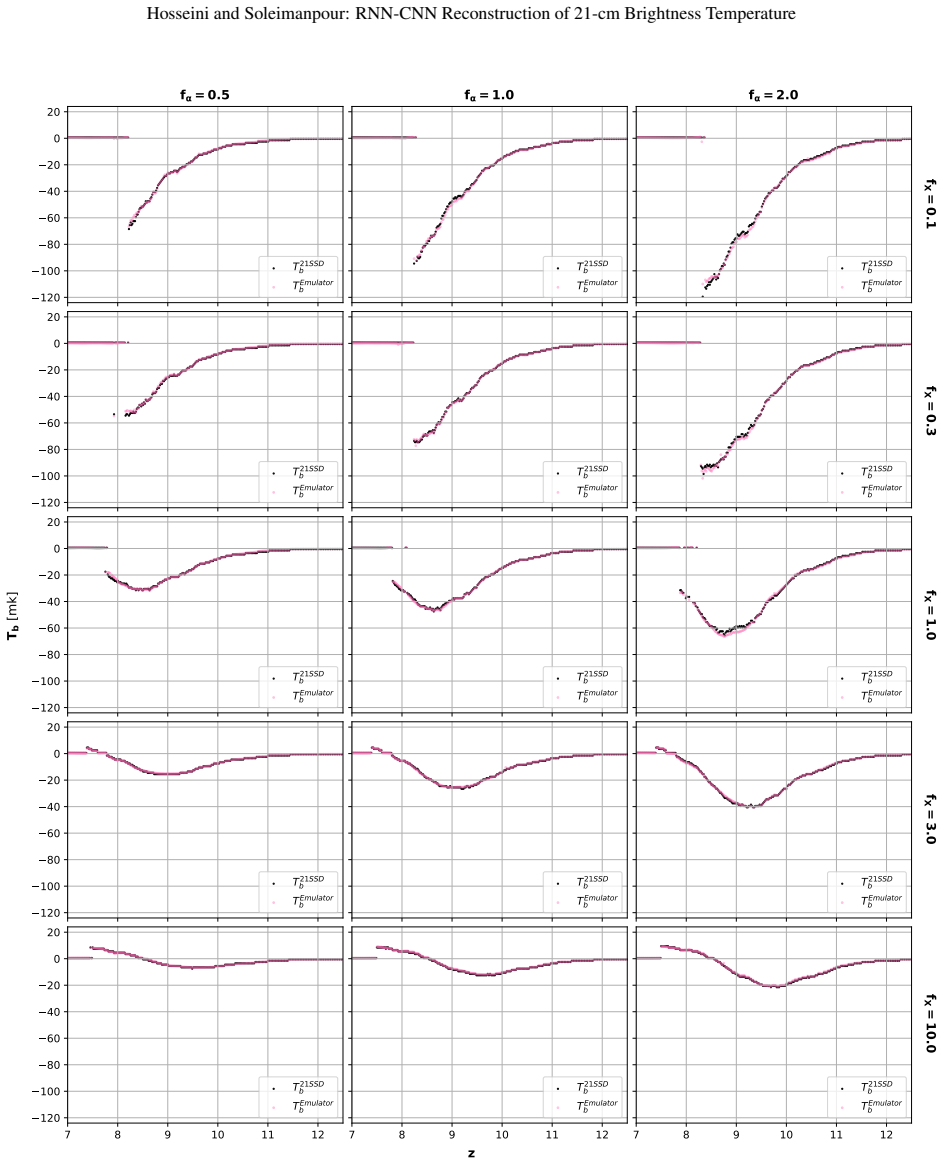
- [§4.1 and §5] The expanded f_X grid (0.1-10 with finer steps) is not supported by actual 21SSD simulation outputs. §4.1 states that 'a core component of the algorithm generates mock data based on these simulations,' and §5 says the expanded coverage is obtained from 'simulation data and residuals between simulations and early-stage reconstructed data.' No independent simulated T_b(z) for intermediate f_X values is used for validation. Consequently the smooth f_X trend in Fig. 7 is a prediction of the model on internally generated mock data and is circular; it cannot corroborate the emulator's accuracy outside the five original f_X values.
- [§4.1] The target itself is a heavily reduced summary: one T_b value per redshift, chosen as the maximum of the PDF, reducing the dataset from 5.4 million to 18,000 points. The step-like structure visible in Figs. 4-6 is acknowledged in §5 as an inherent feature of this PDF-maximum selection, but no analysis quantifies how this selection biases the emulator or the quoted errors. The filtering sentence is also self-contradictory: 'we only include maximum PDFs corresponding to T_b values below -190 mK' is inconsistent with the plotted T_b range (roughly -120 to +20 mK). If the intended filter is 'above -190 mK,' this is an arbitrary threshold that further shapes the training distribution. The reported performance therefore applies to a specially selected subset, not to the global 21-cm brightness temperature as claimed in the abstract.
- [§5 versus Table 1] The text reporting the headline numbers is internally inconsistent. §5 gives MAE_test=0.345, while Table 1 lists MAE_test=0.272 for the proposed model. §5 says the MSE reduction relative to RF is '1.955->0.311,' but Table 1 shows 1.955->0.317. The abstract/§6 says 'errors below 0.35 mK' while the table's MSE (0.324 mK^2, implying RMSE~0.57 mK) suggests a different error definition. These discrepancies make it impossible to know which number is authoritative and further undermine the reproducibility of the central accuracy claim.
minor comments (4)
- [Figure captions and Eq. (28)] Fig. 5's caption says 'The emulator's fluctuations at f_X=1 are inferior to those depicted in Fig. 2,' but the intended cross-reference is almost certainly Fig. 4. In Eq. (28), the update-gate expression has a stray bracket: 'z_t = σ(W_z·h_{t-1}, x_t] + b_z)' should be 'z_t = σ(W_z·[h_{t-1}, x_t] + b_z)'.
- [Table 1] Units for MSE and MAE are not specified. With MSE=0.324 and MAE=0.272, the claim 'errors below 0.35 mK' is ambiguous: if the quoted error is MAE, the text should say so; if it is RMSE, the value is inconsistent with the table.
- [§2.1] In the definition of T* = hc/(k_B λ_21), the text says 'h is the dimensionless Hubble constant,' but in this expression h is Planck's constant. This is a physics typo that should be corrected.
- [§2.2] The citation 'Lomba & Høye 2014' (Molecular Physics) appears next to a statement about the Ly-alpha background and cosmological volumes; this reference seems unrelated and should be replaced or removed.
Circularity Check
Target-defined DNN_res feature leaks T_b into the meta-model input, making the 99.93% accuracy and expanded-grid predictions circular by construction.
-
self definitional
[§4.2 Feature Engineering / Fig. 1; §4.4 Architecture]
""We included a new feature obtained from the residuals between the forecasts of base models and the target values to improve the predictive capability of our model. The basis of this new feature is created by a DNN as the main base model, and applied RFs as auxiliary base models." ... "The base models generate preliminary predictions and residuals, which are subsequently utilized to enhance the input space of the meta-model.""
DNN_res is defined as the residual between base-model forecasts and the target brightness temperature, i.e. DNN_res = T_b − T_b_hat. The meta-model then receives raw astrophysical parameters plus DNN_res and is asked to predict T_b. For any base forecast T_b_hat, the meta-model can recover T_b almost exactly by learning T_b = T_b_hat + DNN_res. At inference on new parameters, T_b is unknown, so DNN_res cannot be formed; the paper specifies no test-time procedure for producing it. The reported R2=99.93% and errors <0.35 mK are therefore obtained from a feature that encodes the answer, not from a genuine prediction based on parameters. Fig. 1's strong DNN_res–T_b correlation (−0.57) confirms the leakage.
-
fitted input called prediction
[§4.1 Dataset and Preprocessing; §5 Result, Fig. 7]
""A core component of the algorithm generates mock data based on these simulations, ensuring that subsequent processing stages have access to these mock data to calculate residuals for final predictions of the global 21-cm brightness temperature." ... "Using hybrid stacked learning applied to simulation data and residuals between simulations and early-stage reconstructed data, we achieve two optimized sampling windows..." ... "These are all of the models that are predicted using approaches that are outlined in §4.""
The expanded fX grid between 0.1 and 10 is not populated by independent 21SSD simulations; it is generated from the simulation data plus residuals between simulations and early-stage reconstructed data. These mock values are then used to compute residuals and produce the 'predictions' shown in Fig. 7. Because the input residuals already contain the reconstruction output, the extended-grid curves are self-confirming rather than validated emulations. The paper presents these as predictions of unseen parameter combinations, but the procedure feeds the model's own output back into its input, making the generalization claim circular.
full rationale
The central emulation claim rests on DNN_res, defined in §4.2 as 'the residuals between the forecasts of base models and the target values.' Since the target T_b is exactly the quantity the meta-model must predict, feeding DNN_res into the LSTM-GRU-CNN meta-model (§4.4) makes the output nearly equal to the target by construction: T_b ≈ T_b_hat + (T_b − T_b_hat). The paper never specifies how this residual is obtained for new parameters at inference; if it is computed from simulations, the emulator is not independent, and if it is not available, the reported test metrics (R2=99.93%, MSEtest=0.324, <0.35 mK) cannot be reproduced. The correlation heatmap (Fig. 1) itself documents DNN_res's strongest feature-target correlation, consistent with this leakage. The expanded fX grid in §4.1/§5 is similarly generated from 'mock data based on these simulations' and 'residuals between simulations and early-stage reconstructed data,' so Fig. 7's curves are fed back from the same reconstruction rather than independently validated emulation. Apart from a non-load-bearing self-citation in the introduction, no other circularity was found. Because the headline accuracy metric is forced by the target-derived input feature, this is a direct self-definitional reduction.
Assumptions & free parameters
free parameters (3)
- Tb selection threshold =
-190 mK (stated, direction ambiguous)
- fX interpolation grid =
steps of 0.1 for fX in [0.1,1] and 1.0 in [1,10]
- Network hyperparameters =
e.g., 512 LSTM units, 288 CNN units, 512 GRU units, dropout 0.15, L2 1e-8, L1 4.67e-6
assumptions (4)
- domain assumption 21SSD simulation output is a valid ground truth for the global 21-cm brightness temperature.
- domain assumption The maximum-PDF value per redshift adequately represents the global 21-cm signal.
- ad hoc to paper Residual features are computable at inference time without access to the target.
- ad hoc to paper Mock data generated from the model can substitute for missing simulation data at intermediate fX values.
Cite this review
Pith. "Pith review of Stacked Hybrid RNN-CNN Reconstruction of X-ray Influence on 21-cm Brightness Temperature." pith.science (2026). https://pith.science/paper/JC2VUYPL
@misc{pith2026250805842,
  author       = {Pith},
  title        = {Pith review of: Stacked Hybrid RNN-CNN Reconstruction of X-ray Influence on 21-cm Brightness Temperature},
  year         = {2026},
  howpublished = {\url{https://pith.science/paper/JC2VUYPL}},
  note         = {Machine review of arXiv:2508.05842}
}
read the original abstract
The X-ray photons substantially affect the thermal and ionization states of the intergalactic medium (IGM) during the Epoch of Reionization (EoR), thereby significantly influencing the 21-cm line observables such as its sky-averaged (global) brightness temperature. Nevertheless, the complicated dependency of astrophysical processes on a broad spectrum of parameters, including X-ray efficiency, spectral characteristics, and gas dynamics, makes precisely simulating the effect of X-ray flux challenging. Traditional approaches, including N-body and hydrodynamical simulations, are computationally intensive and struggle to explore high-dimensional parameter spaces efficiently. We present a stacked hybrid model trained on a specific simulation intended to reconstruct the effect of X-ray flux on the global 21-cm brightness temperature during the EoR. Along with Convolutional Neural Networks (CNNs), this architecture combines two substantial forms of recurrent neural networks (RNNs), Long Short-Term Memory (LSTM) and Gated Recurrent Unit (GRU), therefore enabling fast adaptation to several X-ray flux levels. Without demanding repeated simulations, this emulator preserves temporal and spatial dependencies and generalizes to unseen parameter combinations. This matter reduces computation time by a factor of one million while preserving excellent prediction accuracy of 99.93\%, facilitating studies on high-dimensional parameter inference and sensitivity with an error margin of less than 0.35 mK. Our LSTM-GRU-CNN emulator combines recurrent and convolutional architectures to enable a robust and scalable analysis of X-ray heating effects on the global 21-cm brightness temperature during the EoR.
Figures


Figures from the paper (5 more)



Forward citations
Cited by 1 Pith paper
-
Learning Cosmology from Nearest Neighbour Statistics
Nearest-neighbour distance maps, combined with kNN-CDFs in a hybrid neural network, constrain Ωm and σ8 from Quijote halos with R2=0.80 and 0.93, matching or beating point-cloud methods at a fraction of the compute.
Reference graph
Works this paper leans on
-
[1]
& Haehnelt, M
Abel, T. & Haehnelt, M. G. 1999, The Astrophysical Journal, 520, L13
1999
-
[2]
E., Alexander, P., et al
Adams, T., Aguirre, J. E., Alexander, P., et al. 2023, The Astrophysical Journal, 945, 124
2023
-
[3]
2020, Astronomy & Astrophysics, 641, A6
Aghanim, N., Akrami, Y ., Ashdown, M., et al. 2020, Astronomy & Astrophysics, 641, A6
2020
-
[4]
B., & Schaffer, M
Ahrens, A., Hansen, C. B., & Schaffer, M. E. 2023, The Stata Journal, 23, 909
2023
-
[5]
2020, in 2020 international conference on emerging trends in information technology and engineering (ic-ETITE), IEEE, 1–5 Al Bataineh, A., Kaur, D., & Jalali, S
Ajit, A., Acharya, K., & Samanta, A. 2020, in 2020 international conference on emerging trends in information technology and engineering (ic-ETITE), IEEE, 1–5 Al Bataineh, A., Kaur, D., & Jalali, S. M. J. 2022, IEEE Access, 10, 36963
2020
-
[6]
S., Parsons, A
Ali, Z. S., Parsons, A. R., Zheng, H., et al. 2015, The Astrophysical Journal, 809, 61
2015
-
[7]
& Geetha, M
Aloysius, N. & Geetha, M. 2017, in 2017 international conference on communi- cation and signal processing (ICCSP), IEEE, 0588–0592
2017
-
[8]
2018, in Journal of physics: conference series, V ol
Alzubi, J., Nayyar, A., & Kumar, A. 2018, in Journal of physics: conference series, V ol. 1142, IOP Publishing, 012012
2018
Show all 175 references
-
[9]
B., Liu, T., & Langlois, O
Amrani, A., Hamida, A. B., Liu, T., & Langlois, O. 2018, in Transport Research Arena (TRA) 2018
2018
-
[10]
F., Rocha, A
Azevedo, B. F., Rocha, A. M. A., & Pereira, A. I. 2024, Machine Learning, 113, 4055
2024
-
[11]
2009, Astronomy & Astrophysics, 495, 389
Baek, S., Di Matteo, P., Semelin, B., Combes, F., & Revaz, Y . 2009, Astronomy & Astrophysics, 495, 389
2009
-
[12]
2010, Astronomy & Astrophysics, 523, A4
Baek, S., Semelin, B., Di Matteo, P., Revaz, Y ., & Combes, F. 2010, Astronomy & Astrophysics, 523, A4
2010
-
[13]
2021, Swarm and Evolutionary Computation, 65, 100913
Bakurov, I., Castelli, M., Gau, O., Fontanella, F., & Vanneschi, L. 2021, Swarm and Evolutionary Computation, 65, 100913
2021
-
[14]
& Loeb, A
Barkana, R. & Loeb, A. 2001, Physics reports, 349, 125
2001
-
[15]
& Loeb, A
Barkana, R. & Loeb, A. 2005, The Astrophysical Journal, 624, L65
2005
-
[16]
1994, IEEE transactions on neural net- works, 5, 157
Bengio, Y ., Simard, P., & Frasconi, P. 1994, IEEE transactions on neural net- works, 5, 157
1994
-
[17]
2012, The Journal of Machine Learning Research, 13, 1063
Biau, G. 2012, The Journal of Machine Learning Research, 13, 1063
2012
-
[18]
Blessie, E. C. & Karthikeyan, E. 2012, Journal of Algorithms & Computational Technology, 6, 385
2012
-
[19]
D., Rogers, A
Bowman, J. D., Rogers, A. E., Monsalve, R. A., Mozdzen, T. J., & Mahesh, N. 2018, Nature, 555, 67
2018
-
[20]
1996, University of California Berkeley
Breiman, L. 1996, University of California Berkeley
1996
-
[21]
G., et al
Breitman, D., Mesinger, A., Murray, S. G., et al. 2024, Monthly Notices of the Royal Astronomical Society, 527, 9833
2024
-
[22]
K., Bekki, K., & Groves, B
Cavanagh, M. K., Bekki, K., & Groves, B. A. 2021, Monthly Notices of the Royal Astronomical Society, 506, 659
2021
- [23]
-
[24]
2023, The Astrophysical Journal, 943, 138
Chen, N., Trac, H., Mukherjee, S., & Cen, R. 2023, The Astrophysical Journal, 943, 138
2023
-
[25]
2021, Information Sciences, 579, 15
Cheng, S., Wu, Y ., Li, Y ., Yao, F., & Min, F. 2021, Information Sciences, 579, 15
2021
-
[26]
J., & Jurman, G
Chicco, D., Warrens, M. J., & Jurman, G. 2021, PeerJ Computer Science, 7, e623
2021
-
[27]
Y ., Coyner, A
Choi, R. Y ., Coyner, A. S., Kalpathy-Cramer, J., Chiang, M. F., & Campbell, J. P. 2020, Translational vision science & technology, 9, 14
2020
-
[28]
2014, arXiv preprint arXiv:1412.3555
Chung, J., Gulcehre, C., Cho, K., & Bengio, Y . 2014, arXiv preprint arXiv:1412.3555
2014 arXiv
-
[29]
& Xiao, B
Cong, J. & Xiao, B. 2014, in International conference on artificial neural net- works, Springer, 281–290
2014
-
[30]
& Zhou, Y
Cong, S. & Zhou, Y . 2023, Artificial Intelligence Review, 56, 1905
2023
-
[31]
R., & Stevens, J
Cutler, A., Cutler, D. R., & Stevens, J. R. 2012, Ensemble machine learning: Methods and applications, 157
2012
-
[32]
K., Ghara, R., Majumdar, S., et al
Datta, K. K., Ghara, R., Majumdar, S., et al. 2016, Journal of Astrophysics and Astronomy, 37, 1
2016
-
[33]
& Ferrara, A
Dayal, P. & Ferrara, A. 2018, Physics Reports, 780, 1 de Lera Acedo, E. 2019, in 2019 International Conference on Electromagnetics in Advanced Applications (ICEAA), IEEE, 0626–0629
2018
-
[34]
Demiss, B. A. & Elsaigh, W. A. 2024, Engineering Research Express, 6, 032102
2024
-
[35]
E., Hall, P
Dewdney, P. E., Hall, P. J., Schilizzi, R. T., & Lazio, T. J. L. 2009, Proceedings of the IEEE, 97, 1482
2009
-
[36]
T., et al
Dhandha, J., Gessey-Jones, T., Bevins, H. T., et al. 2025, arXiv preprint arXiv:2503.21687
2025 arXiv
-
[37]
2011, Journal of machine learning research, 12
Duchi, J., Hazan, E., & Singer, Y . 2011, Journal of machine learning research, 12
2011
-
[38]
2020, in 2020 International Joint Conference on Neural Networks (IJCNN), IEEE, 1–8
Dudek, G. 2020, in 2020 International Joint Conference on Neural Networks (IJCNN), IEEE, 1–8
2020
-
[39]
2018, in NASA Formal Methods Symposium, Springer, 121–138
Dutta, S., Jha, S., Sankaranarayanan, S., & Tiwari, A. 2018, in NASA Formal Methods Symposium, Springer, 121–138
2018
-
[40]
2022, arXiv preprint arXiv:2203.08056
Dvorkin, C., Mishra-Sharma, S., Nord, B., et al. 2022, arXiv preprint arXiv:2203.08056
2022 arXiv
-
[41]
B., Graziani, L., Ciardi, B., et al
Eide, M. B., Graziani, L., Ciardi, B., et al. 2018, Monthly Notices of the Royal Astronomical Society, 476, 1174
2018
-
[42]
2015, Monthly Notices of the Royal Astronomical Society, 451, 904
Erkal, D. 2015, Monthly Notices of the Royal Astronomical Society, 451, 904
2015
-
[43]
Ewen, H. I. & Purcell, E. M. 1951, Nature, 168, 356
1951
-
[44]
2024, International Journal of Mathematics, Statistics, and Com- puter Science, 2, 96
Faaique, M. 2024, International Journal of Mathematics, Statistics, and Com- puter Science, 2, 96
2024
-
[45]
2014, Nature, 506, 197
Fialkov, A., Barkana, R., & Visbal, E. 2014, Nature, 506, 197
2014
-
[46]
2017, Monthly Notices of the Royal Astronomical Society, 464, 3498
Fialkov, A., Cohen, A., Barkana, R., & Silk, J. 2017, Monthly Notices of the Royal Astronomical Society, 464, 3498
2017
-
[47]
Field, G. B. 1958, Proceedings of the IRE, 46, 240
1958
-
[48]
L., Ryan, R
Finkelstein, S. L., Ryan, R. E., Papovich, C., et al. 2015, The Astrophysical Jour- nal, 810, 71
2015
-
[49]
2016, in 2016 31st Youth academic annual conference of Chinese association of automation (Y AC), IEEE, 324–328
Fu, R., Zhang, Z., & Li, L. 2016, in 2016 31st Youth academic annual conference of Chinese association of automation (Y AC), IEEE, 324–328
2016
-
[50]
Furlanetto, S. R. & Oh, S. P. 2016, Monthly Notices of the Royal Astronomical Society, 457, 1813
2016
-
[51]
R., Oh, S
Furlanetto, S. R., Oh, S. P., & Briggs, F. H. 2006, Physics reports, 433, 181
2006
-
[52]
G., Mukthar, A., Husham, F., Maaroof, R
Galety, M. G., Mukthar, A., Husham, F., Maaroof, R. J., & Rofoo, F. 2021, Tech- nium, 3
2021
-
[53]
A., Hu, M., Malik, A
Ganaie, M. A., Hu, M., Malik, A. K., Tanveer, M., & Suganthan, P. N. 2022, Engineering Applications of Artificial Intelligence, 115, 105151
2022
-
[54]
2017, Big Data Research, 9, 28
Genuer, R., Poggi, J.-M., Tuleau-Malot, C., & Villa-Vialaneix, N. 2017, Big Data Research, 9, 28
2017
- [55]
-
[56]
Gnedin, N. Y . & Madau, P. 2022, Living Reviews in Computational Astro- physics, 8, 3
2022
-
[57]
& Mesinger, A
Greig, B. & Mesinger, A. 2015, Monthly Notices of the Royal Astronomical Society, 449, 4246
2015
-
[58]
2013, Scholarpedia, 8, 1888
Grossberg, S. 2013, Scholarpedia, 8, 1888
2013
-
[59]
2018, Pattern recognition, 77, 354
Gu, J., Wang, Z., Kuen, J., et al. 2018, Pattern recognition, 77, 354
2018
-
[60]
2024, Research in Astronomy and Astrophysics, 24, 125019
Guo, X., Fang, G., Feng, H., & Zhang, R. 2024, Research in Astronomy and Astrophysics, 24, 125019
2024
-
[61]
S., Habaebi, M
Halbouni, A., Gunawan, T. S., Habaebi, M. H., et al. 2022, IEEE Access, 10, 99837
2022
-
[62]
Hasan, M. A. M., Nasser, M., Ahmad, S., & Molla, K. I. 2016, Journal of infor- mation security, 7, 129
2016
-
[63]
P., Cohen, W
Healey, S. P., Cohen, W. B., Yang, Z., et al. 2018, Remote Sensing of Environ- ment, 204, 717 HERA Collaboration. 2023, The Astrophysical Journal, 945, 124
2018
-
[64]
Hirata, C. M. 2006, Monthly Notices of the Royal Astronomical Society, 367, 259
2006
-
[65]
& Schmidhuber, J
Hochreiter, S. & Schmidhuber, J. 1997, Neural computation, 9, 1735
1997
-
[66]
O., Over, T
Hodson, T. O., Over, T. M., & Foks, S. S. 2021, Journal of Advances in Modeling Earth Systems, 13, e2021MS002681
2021
-
[67]
Hogg, D. W. & Foreman-Mackey, D. 2018, The Astrophysical Journal Supple- ment Series, 236, 11
2018
-
[68]
M., Salmasi, B
Hosseini, S. M., Salmasi, B. S., Tabasi, S. S., & Firouzjaee, J. T. 2023, arXiv preprint arXiv:2306.12954
2023 arXiv
-
[69]
Jaiswal, J. K. & Samikannu, R. 2017, in 2017 world congress on computing and communication technologies (WCCCT), Ieee, 65–68
2017
-
[70]
2024, arXiv preprint arXiv:2411.08943
Jamieson, N., Smith, A., Neyer, M., et al. 2024, arXiv preprint arXiv:2411.08943
2024 arXiv
-
[71]
2018, Advances in Data Analysis and Classification, 12, 885
Janitza, S., Celik, E., & Boulesteix, A.-L. 2018, Advances in Data Analysis and Classification, 12, 885
2018
-
[72]
Jie, H. J. & Wanda, P. 2020, International Journal of Computational Intelligence Systems, 13, 66
2020
-
[73]
& Fluri, J
Kacprzak, T. & Fluri, J. 2022, Physical Review X, 12, 031029
2022
-
[74]
M., Nikolic, B., Thyagarajan, N., et al
Keller, P. M., Nikolic, B., Thyagarajan, N., et al. 2023, Monthly Notices of the Royal Astronomical Society, 524, 583
2023
-
[75]
Kingma, D. P. & Ba, J. 2014, arXiv preprint arXiv:1412.6980
2014 arXiv
-
[76]
2021, Mechanical systems and sig- nal processing, 151, 107398
Kiranyaz, S., Avci, O., Abdeljaber, O., et al. 2021, Mechanical systems and sig- nal processing, 151, 107398
2021
-
[77]
2003, New Astronomy Reviews, 47, 939
Kosowsky, A. 2003, New Astronomy Reviews, 47, 939
2003
-
[78]
V ., Klypin, A
Kravtsov, A. V ., Klypin, A. A., & Khokhlov, A. M. 1997, The Astrophysical Journal Supplement Series, 111, 73
1997
-
[79]
2023, Computers, 12, 151
Krichen, M. 2023, Computers, 12, 151
2023
-
[80]
& Johnson, K
Kuhn, M. & Johnson, K. 2019, Feature engineering and selection: A practical approach for predictive models (Chapman and Hall/CRC) Article number, page 17 A&A proofs:manuscript no. main
2019
-
[81]
2021, IEEE transactions on neural networks and learning systems, 33, 6999
Li, Z., Liu, F., Yang, W., Peng, S., & Zhou, J. 2021, IEEE transactions on neural networks and learning systems, 33, 6999
2021
-
[82]
R., & Zavala, J
Liu, H., Slatyer, T. R., & Zavala, J. 2016, Physical Review D, 94, 063507
2016
-
[83]
& Høye, J
Lomba, E. & Høye, J. S. 2014, Molecular Physics, 112, 2892
2014
-
[84]
Lui, H. F. & Wolf, W. R. 2019, Journal of Fluid Mechanics, 872, 963
2019
-
[85]
Ma, Q.-B., Fiaschi, S., Ciardi, B., Busch, P., & Eide, M. B. 2022, Monthly No- tices of the Royal Astronomical Society, 513, 1513
2022
-
[86]
J., V olonteri, M., Haardt, F., & Oh, S
Madau, P., Rees, M. J., V olonteri, M., Haardt, F., & Oh, S. P. 2004, The Astro- physical Journal, 604, 484
2004
-
[87]
2006, Monthly Notices of the Royal Astronomical Society, 369, 1719
Mapelli, M., Ferrara, A., & Pierpaoli, E. 2006, Monthly Notices of the Royal Astronomical Society, 369, 1719
2006
-
[88]
G., Bobin, J., & Carucci, I
Mertens, F. G., Bobin, J., & Carucci, I. P. 2024, Monthly Notices of the Royal Astronomical Society, 527, 3517
2024
-
[89]
2011, Monthly Notices of the Royal Astronomical Society, 411, 955
Mesinger, A., Furlanetto, S., & Cen, R. 2011, Monthly Notices of the Royal Astronomical Society, 411, 955
2011
-
[90]
2016, Monthly Notices of the Royal Astronomical Society, 459, 2342
Mesinger, A., Greig, B., & Sobacchi, E. 2016, Monthly Notices of the Royal Astronomical Society, 459, 2342
2016
-
[91]
2011, Astronomy & Astrophysics, 528, A149
Mirabel, I., Dijkstra, M., Laurent, P., Loeb, A., & Pritchard, J. 2011, Astronomy & Astrophysics, 528, A149
2011
-
[92]
Mirocha, J., Harker, G. J. A., & Burns, J. O. 2017, The Astrophysical Journal, 843, 46
2017
-
[93]
R., & Ferrara, A
Mitra, S., Choudhury, T. R., & Ferrara, A. 2015, Monthly Notices of the Royal Astronomical Society: Letters, 454, L76
2015
-
[94]
& Kulkarni, G
Mittal, S. & Kulkarni, G. 2022, Monthly Notices of the Royal Astronomical Society, 515, 3947
2022
-
[95]
& Barkana, R
Mondal, R. & Barkana, R. 2023, Nature Astronomy, 7, 1025
2023
-
[96]
Morales, M. F. & Wyithe, J. S. B. 2010, Annual review of astronomy and astro- physics, 48, 127
2010
-
[97]
G., Greig, B., Mesinger, A., et al
Murray, S. G., Greig, B., Mesinger, A., et al. 2020, arXiv preprint arXiv:2010.15121
2020 arXiv
-
[98]
& D’Aloisio, A
Nasir, F. & D’Aloisio, A. 2020, Monthly Notices of the Royal Astronomical Society, 494, 3080
2020
-
[99]
2017, Horizons
Nasteski, V . 2017, Horizons. b, 4, 56
2017
-
[100]
R., Bradley, R
Neben, A. R., Bradley, R. F., Hewitt, J. N., et al. 2016, The Astrophysical Journal, 826, 199
2016
-
[101]
2016, Advances in neural information pro- cessing systems, 29
Neil, D., Pfeiffer, M., & Liu, S.-C. 2016, Advances in neural information pro- cessing systems, 29
2016
-
[102]
H., Ly, H.-B., Ho, L
Nguyen, Q. H., Ly, H.-B., Ho, L. S., et al. 2021, Mathematical Problems in En- gineering, 2021, 4832864
2021
-
[103]
2023, arXiv preprint arXiv:2310.07358
Ni, S., Li, Y ., & Zhang, X. 2023, arXiv preprint arXiv:2310.07358
2023
-
[104]
Nosouhian, S., Nosouhian, F., & Khoshouei, A. K. 2021, Preprints
2021
-
[105]
2019, arXiv preprint arXiv:1902.10159
Ntampaka, M., Avestruz, C., Boada, S., et al. 2019, arXiv preprint arXiv:1902.10159
2019 arXiv
-
[106]
2015, Understanding LSTM Networks
Olah, C. 2015, Understanding LSTM Networks
2015
-
[107]
G., Bandura, K., et al
Paciga, G., Albert, J. G., Bandura, K., et al. 2013, Monthly Notices of the Royal Astronomical Society, 433, 639
2013
-
[108]
2013, in International conference on machine learning, Pmlr, 1310–1318
Pascanu, R., Mikolov, T., & Bengio, Y . 2013, in International conference on machine learning, Pmlr, 1310–1318
2013
-
[109]
& Rane, M
Patil, A. & Rane, M. 2021, Information and Communication Technology for Intelligent Systems: Proceedings of ICTIS 2020, V olume 1, 21
2021
-
[110]
K., Šoltinsk `y, T., Maitra, S., & Kulkarni, G
Patil, S. K., Šoltinsk `y, T., Maitra, S., & Kulkarni, G. 2025, arXiv preprint arXiv:2507.11611
2025
-
[111]
2013, Ex- perimental Astronomy, 36, 319
Patra, N., Subrahmanyan, R., Raghunathan, A., & Udaya Shankar, N. 2013, Ex- perimental Astronomy, 36, 319
2013
-
[112]
2011, Journal of machine learning research, 12, 2825
Pedregosa, F., Varoquaux, G., Gramfort, A., et al. 2011, Journal of machine learning research, 12, 2825
2011
-
[113]
D., Warnars, H
Prabowo, Y . D., Warnars, H. L. H. S., Budiharto, W., et al. 2018, in 2018 Indone- sian association for pattern recognition international conference (INAPR), IEEE, 51–56
2018
-
[114]
Pritchard, J. R. & Furlanetto, S. R. 2007, Monthly Notices of the Royal Astro- nomical Society, 376, 1680
2007
-
[115]
Pritchard, J. R. & Loeb, A. 2012, Reports on Progress in Physics, 75, 086901
2012
-
[116]
2022, International Journal of Robotics and Control Systems, 2, 739
Purwono, P., Ma’arif, A., Rahmaniar, W., et al. 2022, International Journal of Robotics and Control Systems, 2, 739
2022
-
[117]
Rani, P., Kumar, R., Ahmed, N. M. S., & Jain, A. 2021, Journal of Reliable Intelligent Environments, 7, 263
2021
-
[118]
Resende, P. A. A. & Drummond, A. C. 2018, ACM Computing Surveys (CSUR), 51, 1
2018
-
[119]
2002, Monthly Notices of the Royal Astronomical Society, 336, L33
Ricotti, M. 2002, Monthly Notices of the Royal Astronomical Society, 336, L33
2002
-
[120]
2019, Advances in neural information processing systems, 32
Roelofs, R., Shankar, V ., Recht, B., et al. 2019, Advances in neural information processing systems, 32
2019
-
[121]
Rozos, E., Dimitriadis, P., Mazi, K., & Koussis, A. D. 2021, Hydrology, 8, 67
2021
- [122]
-
[123]
A., Carlstrom, J
Ruhl, J., Ade, P. A., Carlstrom, J. E., et al. 2004, in Millimeter and Submillimeter Detectors for Astronomy II, V ol. 5498, SPIE, 11–29
2004
-
[124]
Rybicki, G. B. & Lightman, A. P. 2024, Radiative processes in astrophysics (John Wiley & Sons)
2024
-
[125]
G., Ferramacho, L., Silva, M., Amblard, A., & Cooray, A
Santos, M. G., Ferramacho, L., Silva, M., Amblard, A., & Cooray, A. 2010, Monthly Notices of the Royal Astronomical Society, 406, 2421
2010
-
[126]
2023, Monthly Notices of the Royal Astronomical Society, 525, 6097
Saxena, A., Cole, A., Gazagnes, S., et al. 2023, Monthly Notices of the Royal Astronomical Society, 525, 6097
2023
-
[127]
2015, Neural networks, 61, 85
Schmidhuber, J. 2015, Neural networks, 61, 85
2015
-
[128]
Schmit, C. J. & Pritchard, J. R. 2018, Monthly Notices of the Royal Astronomical Society, 475, 1213
2018
-
[129]
& Rees, M
Scott, D. & Rees, M. J. 1990, Monthly Notices of the Royal Astronomical Soci- ety, vol. 247, p. 510, 247, 510
1990
-
[130]
& Grolinger, K
Sehovac, L. & Grolinger, K. 2020, Ieee Access, 8, 36411
2020
-
[131]
2007, Astronomy & Astrophysics, 474, 365
Semelin, B., Combes, F., & Baek, S. 2007, Astronomy & Astrophysics, 474, 365
2007
-
[132]
2017, Monthly Notices of the Royal Astronomical Society, 472, 4508
Semelin, B., Eames, E., Bolgar, F., & Caillat, M. 2017, Monthly Notices of the Royal Astronomical Society, 472, 4508
2017
-
[133]
2022, in Radar Remote Sensing (Elsevier), 175–186
Shakya, A., Biswas, M., & Pal, M. 2022, in Radar Remote Sensing (Elsevier), 175–186
2022
-
[134]
2021, Processes, 9, 2015
Shanmugasundar, G., Vanitha, M., ˇCep, R., et al. 2021, Processes, 9, 2015
2021
-
[135]
2023, Nature Astronomy, 7, 1116
Shao, Y ., Xu, Y ., Wang, Y ., et al. 2023, Nature Astronomy, 7, 1116
2023
-
[136]
Shewalkar, A., Nyavanandi, D., & Ludwig, S. A. 2019, Journal of Artificial In- telligence and Soft Computing Research, 9, 235
2019
-
[137]
2019, in 2019 Asia-Pacific signal and information processing association annual summit and conference (AP- SIPA ASC), IEEE, 939–944
Shi, X., Wang, T., Wang, L., Liu, H., & Yan, N. 2019, in 2019 Asia-Pacific signal and information processing association annual summit and conference (AP- SIPA ASC), IEEE, 939–944
2019
-
[138]
2023, Publications of the Astronomical Society of Japan, 75, S1
Shimabukuro, H., Hasegawa, K., Kuchinomachi, A., Yajima, H., & Yoshiura, S. 2023, Publications of the Astronomical Society of Japan, 75, S1
2023
-
[139]
& Semelin, B
Shimabukuro, H. & Semelin, B. 2017, Monthly Notices of the Royal Astronom- ical Society, 468, 3869
2017
-
[140]
T., & Shapiro, P
Shukla, H., Mellema, G., Iliev, I. T., & Shapiro, P. R. 2016, Monthly Notices of the Royal Astronomical Society, 458, 135
2016
-
[141]
2022, Nature Astronomy, 6, 607
Singh, S., Nambissan T, J., Subrahmanyan, R., et al. 2022, Nature Astronomy, 6, 607
2022
-
[142]
Siraj, M. S. & Ahad, M. 2020, in 2020 Joint 9th International Conference on
2020
-
[143]
Informatics, Electronics & Vision (ICIEV) and 2020 4th International Con- ference on Imaging, Vision & Pattern Recognition (icIVPR), IEEE, 1–7
2020
-
[144]
& James, A
Smagulova, K. & James, A. P. 2019, The European Physical Journal Special Topics, 228, 2313 Šoltinsk`y, T., Kulkarni, G., Tendulkar, S. P., & Bolton, J. S. 2025, Monthly No- tices of the Royal Astronomical Society, 537, 364
2019
-
[145]
L., Miller, M
Speiser, J. L., Miller, M. E., Tooze, J., & Ip, E. 2019, Expert systems with appli- cations, 134, 93
2019
-
[146]
2021, Machine Learning: Science and Technology, 2, 035022
Stuke, A., Rinke, P., & Todorovi ´c, M. 2021, Machine Learning: Science and Technology, 2, 035022
2021
-
[147]
& Zel’Dovich, Y
Sunyaev, R. & Zel’Dovich, Y . B. 1980, Annual review of astronomy and astro- physics, 18, 537
1980
-
[148]
& Konde, A
Thakur, A. & Konde, A. 2021, International Journal for Research in Applied Science and Engineering Technology, 9, 407
2021
-
[149]
2020, The Astrophysical Journal Letters, 891, L10
Tilvi, V ., Malhotra, S., Rhoads, J., et al. 2020, The Astrophysical Journal Letters, 891, L10
2020
-
[150]
J., Goeke, R., Bowman, J
Tingay, S. J., Goeke, R., Bowman, J. D., et al. 2013, Publications of the Astro- nomical Society of Australia, 30, e007
2013
-
[151]
2024, Monthly Notices of the Royal Astronomical Society, 528, 1945
Tripathi, A., Datta, A., Choudhury, M., & Majumdar, S. 2024, Monthly Notices of the Royal Astronomical Society, 528, 1945
2024
-
[152]
2021, in NeurIPS 2020 Competition and Demonstration Track, PMLR, 3–26 Van de Hulst, H
Turner, R., Eriksson, D., McCourt, M., et al. 2021, in NeurIPS 2020 Competition and Demonstration Track, PMLR, 3–26 Van de Hulst, H. 1945, Nederlandsch Tijdschrift voor Natuurkunde, 11, 210 Van de Schoot, R., Depaoli, S., King, R., et al. 2021, Nature Reviews Methods Primers, ...
2021
-
[153]
2017, Quantum Science and Tech- nology, 3, 015004
Varsamopoulos, S., Criger, B., & Bertels, K. 2017, Quantum Science and Tech- nology, 3, 015004
2017
-
[154]
2019, Astronomy & Astrophysics, 627, A5
Vazza, F., Ettori, S., Roncarelli, M., et al. 2019, Astronomy & Astrophysics, 627, A5
2019
-
[155]
L., & Shull, J
Venkatesan, A., Giroux, M. L., & Shull, J. M. 2001, The Astrophysical Journal, 563, 1
2001
-
[156]
2018, Physical Review D, 98, 103513
Venumadhav, T., Dai, L., Kaurov, A., & Zaldarriaga, M. 2018, Physical Review D, 98, 103513
2018
-
[157]
2010, in Lectures on Cosmology: Accelerated Expansion of the Uni- verse (Springer), 147–177
Verde, L. 2010, in Lectures on Cosmology: Accelerated Expansion of the Uni- verse (Springer), 147–177
2010
-
[158]
Victoria, A. H. & Maragatham, G. 2021, Evolving Systems, 12, 217 V onlanthen, P., Semelin, B., Baek, S., & Revaz, Y . 2011, Astronomy & Astro- physics, 532, A97
2021
-
[159]
H., Dahlsten, O., Kristjánsson, H., Gardner, R., & Kim, M
Wan, K. H., Dahlsten, O., Kristjánsson, H., Gardner, R., & Kim, M. 2017, npj Quantum information, 3, 36
2017
-
[160]
2023, ACM Computing Surveys, 55, 1
Wang, X., Jin, Y ., Schmitt, S., & Olhofer, M. 2023, ACM Computing Surveys, 55, 1
2023
-
[161]
Wolpert, D. H. 1992, Neural networks, 5, 241
1992
-
[162]
1952, The Astronomical Journal, 57, 31
Wouthuysen, S. 1952, The Astronomical Journal, 57, 31
1952
-
[163]
2022, Information Sciences, 608, 453
Xue, Y ., Tong, Y ., & Neri, F. 2022, Information Sciences, 608, 453
2022
-
[164]
A., Subasi, A., & Rattay, F
Yaman, M. A., Subasi, A., & Rattay, F. 2018, Symmetry, 10, 651 Article number, page 18 Hosseini and Soleimanpour: RNN-CNN Reconstruction of 21-cm Brightness Temperature
2018
-
[165]
Yamashita, R., Nishio, M., Do, R. K. G., & Togashi, K. 2018, Insights into imag- ing, 9, 611
2018
-
[166]
2015, Monthly Notices of the Royal Astronomical Society, 447, 1692
Yang, Q.-X., Xie, F.-G., Yuan, F., et al. 2015, Monthly Notices of the Royal Astronomical Society, 447, 1692
2015
-
[167]
2020, in 2020 International workshop on electronic communication and artificial intelligence (IWECAI), IEEE, 98–101 Yi˘git, G
Yang, S., Yu, X., & Zhou, Y . 2020, in 2020 International workshop on electronic communication and artificial intelligence (IWECAI), IEEE, 98–101 Yi˘git, G. & Amasyali, M. F. 2021, in 2021 international conference on INnova- tions in intelligent SysTems and applications (INIST...
2020
-
[168]
2019, in Journal of physics: Conference series, V ol
Ying, X. 2019, in Journal of physics: Conference series, V ol. 1168, IOP Publish- ing, 022022
2019
-
[169]
2003, The Astrophysical Journal, 591, L1
Yoshida, N., Sokasian, A., Hernquist, L., & Springel, V . 2003, The Astrophysical Journal, 591, L1
2003
-
[170]
& Liu, H
Yu, L. & Liu, H. 2003, in Proceedings of the 20th international conference on machine learning (ICML-03), 856–863
2003
-
[171]
2007, The Astrophysical Journal, 654, 12
Zahn, O., Lidz, A., McQuinn, M., et al. 2007, The Astrophysical Journal, 654, 12
2007
-
[172]
2021, Department of Mechanical and Aerospace Engineering, North Carolina State University, Raleigh, North Carolina, 27606
Zargar, S. 2021, Department of Mechanical and Aerospace Engineering, North Carolina State University, Raleigh, North Carolina, 27606
2021
-
[173]
2012, The first galaxies: theoretical predictions and observational clues, 45
Zaroubi, S. 2012, The first galaxies: theoretical predictions and observational clues, 45
2012
-
[174]
2022, Ieee Access, 10, 47361
Zeng, C., Ma, C., Wang, K., & Cui, Z. 2022, Ieee Access, 10, 47361
2022
-
[175]
2005, The Astrophysical Journal, 622, 1356 Article number, page 19
Zygelman, B. 2005, The Astrophysical Journal, 622, 1356 Article number, page 19
2005
Reviewed August 5, 2026 · model on record in the stance chip above.
Discussion (0). Sign in to comment.