Topological bound states in a lattice of rings with nearest-neighbour interactions
Pith reviewed 2026-05-19 00:52 UTC · model grok-4.3
The pith
Bound pairs of bosons in a staggered ring lattice map onto SSH chains and support topologically protected edge states.
A machine-rendered reading of the paper's core claim, the machinery that carries it, and where it could break.
Core claim
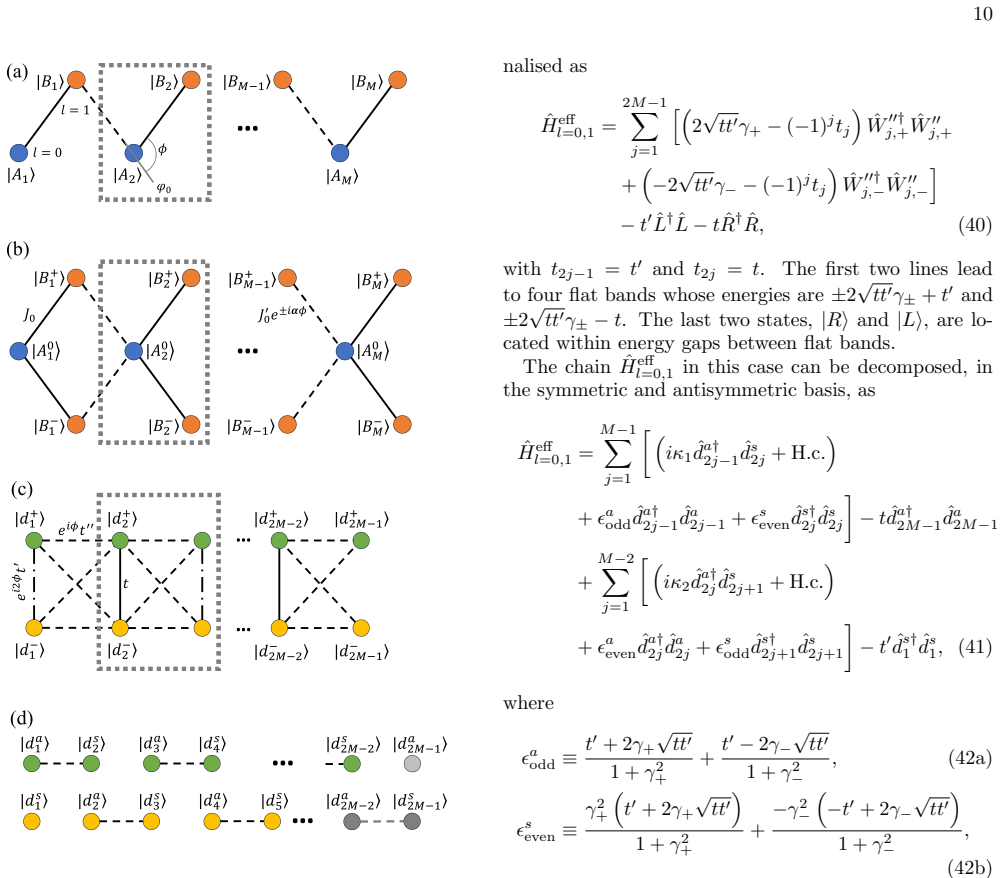
With l=1 the physical system is equivalent to a Creutz ladder whose doublon effective model consists of two SSH chains and two Bose-Hubbard chains, allowing topologically protected edge states. In the alternating l=0/l=1 geometry the original system maps to a diamond chain; the corresponding doublon model is a Creutz ladder with extra vertical hoppings that reduces exactly to two SSH chains when all couplings are equal. Tuning the spatial profile of the couplings destroys inversion symmetry of the SSH chains but generates multiple flat bands.
What carries the argument
The effective doublon Hamiltonian obtained by projecting the full interacting Bose-Hubbard model onto the manifold of next-neighbor bound pairs, which is then rewritten in terms of circulations as a synthetic dimension to yield a Creutz ladder whose parameters map onto SSH chains.
If this is right
- Topologically protected edge states appear in the doublon spectrum for the uniform l=1 case.
- The alternating l=0/l=1 geometry yields an effective Creutz ladder whose equal-coupling limit is exactly two decoupled SSH chains.
- Spatially varying the tunnel amplitudes generates multiple flat bands while breaking the inversion symmetry of the SSH chains.
- The mapping supplies a route to topological physics for interacting bosons using only orbital angular momentum as a synthetic dimension.
Where Pith is reading between the lines
- The same projection technique could be applied to other bound-state manifolds, such as trimers, to generate higher-order topological models.
- Because the synthetic dimension comes from orbital angular momentum, the construction may be realized in existing ring-trap experiments without additional laser-induced gauge fields.
- Flat bands obtained by tuning couplings might host interaction-driven fractional states when the doublon filling is adjusted.
Load-bearing premise
Strong nearest-neighbor interactions bind two particles on next-neighboring sites so that the low-energy physics stays entirely inside the manifold of those bound states.
What would settle it
Numerically diagonalize the two-particle Schrödinger equation for the l=1 ring lattice and check whether the lowest-energy bound-state wave functions localize at the chain ends with energies inside the gap predicted by the effective SSH model.
Figures




read the original abstract
We study interaction-induced bound states in a system of ultracold bosons loaded into the states with orbital angular momentum in a one-dimensional staggered lattice of rings. We consider the hard-core limit and strong nearest-neighbour interactions such that two particles in next neighbouring sites are bound. Focusing on the manifold of such bound states, we have derived the corresponding effective model for doublons. With orbital angular momentum $l=1$, the original physical system is described as a Creutz ladder by using the circulations as a synthetic dimension, and the effective model obtained consists of two Su-Schrieffer-Heeger (SSH) chains and two Bose-Hubbard chains. Therefore, the system can exhibit topologically protected edge states. In a structure that alternates $l=1$ and $l=0$ states, the original system can be mapped to a diamond chain. In this case, the effective doublon model corresponds to a Creutz ladder with extra vertical hoppings between legs and can be mapped to two SSH chains if all the couplings in the original system are equal. Tuning spatially the amplitude of the couplings destroys the inversion symmetry of these SSH chains, but enables the appearance of multiple flat bands.
Editorial analysis
A structured set of objections, weighed in public.
Referee Report
Summary. The manuscript claims that ultracold bosons in a staggered 1D lattice of rings, restricted to the hard-core limit with strong nearest-neighbour interactions, form bound doublon states on next-neighbour sites. For orbital angular momentum l=1 the physical system maps to a Creutz ladder (using circulations as synthetic dimension) whose effective doublon model consists of two SSH chains plus two Bose-Hubbard chains, thereby supporting topologically protected edge states. In the alternating l=0/l=1 geometry the system maps to a diamond chain whose effective model is a Creutz ladder with additional vertical hoppings; when all couplings are equal this further reduces to two SSH chains, while spatially varying the couplings breaks inversion symmetry yet produces multiple flat bands.
Significance. If the doublon-manifold projection and the resulting effective Hamiltonians are rigorously justified, the work supplies a concrete ultracold-atom route to interaction-induced topological bound states that combines synthetic dimensions with nearest-neighbour binding. The reduction to SSH chains and the appearance of flat bands under broken inversion symmetry are potentially useful for exploring protected edge modes and flat-band physics in bosonic systems.
major comments (2)
- The central claim that topologically protected edge states appear rests on the assertion that strong NN interactions plus the hard-core constraint confine the low-energy sector to the manifold of next-neighbour doublons, allowing the mapping to two SSH chains. The manuscript must supply the explicit projection onto this subspace, the resulting effective hoppings, and a quantitative estimate of the gap to scattering states or other orbital configurations so that virtual processes do not renormalise the topological parameters.
- For the l=1 case the abstract states that the Creutz-ladder description yields two SSH chains, yet no explicit effective Hamiltonian or dimerisation parameters are shown. Without these equations it is impossible to verify that the edge-state localisation length and the topological invariant remain protected once the full many-body Hilbert space is considered.
minor comments (2)
- The role of the two Bose-Hubbard chains that appear alongside the SSH chains in the l=1 effective model is not clarified; a short statement on whether they couple to or decouple from the topological edge states would improve readability.
- The statement that spatial tuning of couplings 'destroys the inversion symmetry of these SSH chains, but enables the appearance of multiple flat bands' would benefit from a brief indication of the mechanism (e.g., which bands become flat and at what parameter values).
Simulated Author's Rebuttal
We thank the referee for the careful reading of our manuscript and for the constructive comments. We address the two major points below and have prepared revisions to strengthen the presentation of the effective models and their justification.
read point-by-point responses
-
Referee: The central claim that topologically protected edge states appear rests on the assertion that strong NN interactions plus the hard-core constraint confine the low-energy sector to the manifold of next-neighbour doublons, allowing the mapping to two SSH chains. The manuscript must supply the explicit projection onto this subspace, the resulting effective hoppings, and a quantitative estimate of the gap to scattering states or other orbital configurations so that virtual processes do not renormalise the topological parameters.
Authors: We agree that a more explicit derivation of the projection is necessary to rigorously justify the low-energy manifold. In the revised manuscript we will add a dedicated subsection (or appendix) that performs the explicit projection onto the next-neighbour doublon subspace, derives the resulting effective hoppings, and provides quantitative estimates of the gap to scattering states obtained from exact diagonalisation on small systems. These additions will demonstrate that virtual processes do not renormalise the topological parameters within the parameter regime considered. revision: yes
-
Referee: For the l=1 case the abstract states that the Creutz-ladder description yields two SSH chains, yet no explicit effective Hamiltonian or dimerisation parameters are shown. Without these equations it is impossible to verify that the edge-state localisation length and the topological invariant remain protected once the full many-body Hilbert space is considered.
Authors: We acknowledge that the explicit form of the effective Hamiltonian and the dimerisation parameters were not written out in sufficient detail. In the revision we will insert the full effective doublon Hamiltonian for the l=1 Creutz-ladder geometry, explicitly stating the dimerisation parameters that arise from the mapping. We will also compute and report the topological invariant (winding number) and the localisation length of the edge states directly from this effective model, confirming their protection within the projected subspace. revision: yes
Circularity Check
No circularity; effective-model mappings are independent derivations
full rationale
The derivation projects the hard-core bosons with strong NN interactions onto the next-neighbour doublon manifold, then maps the l=1 case to a Creutz ladder (via synthetic dimension from circulations) whose effective Hamiltonian decomposes into two SSH chains plus two Bose-Hubbard chains. The alternating l=0/1 case maps to a diamond chain that further reduces to two SSH chains when couplings are equal. These steps use standard tight-binding projection and synthetic-dimension techniques; the resulting topological edge states are consequences of the effective Hamiltonian's structure rather than any self-definition, fitted parameter renamed as prediction, or load-bearing self-citation. The paper is self-contained against external benchmarks and contains no quoted reduction of a claimed result to its own inputs.
Axiom & Free-Parameter Ledger
axioms (2)
- domain assumption Hard-core limit for bosons
- domain assumption Strong nearest-neighbour interactions bind particles on next-neighbour sites
Lean theorems connected to this paper
-
IndisputableMonolith/Cost/FunctionalEquation.leanwashburn_uniqueness_aczel unclear?
unclearRelation between the paper passage and the cited Recognition theorem.
Focusing on the manifold of such bound states, we have derived the corresponding effective model for doublons... consists of two Su-Schrieffer-Heeger (SSH) chains and two Bose-Hubbard chains.
What do these tags mean?
- matches
- The paper's claim is directly supported by a theorem in the formal canon.
- supports
- The theorem supports part of the paper's argument, but the paper may add assumptions or extra steps.
- extends
- The paper goes beyond the formal theorem; the theorem is a base layer rather than the whole result.
- uses
- The paper appears to rely on the theorem as machinery.
- contradicts
- The paper's claim conflicts with a theorem or certificate in the canon.
- unclear
- Pith found a possible connection, but the passage is too broad, indirect, or ambiguous to say the theorem truly supports the claim.
Reference graph
Works this paper leans on
-
[1]
is the intracell (intercell) hopping strength between OAM modes with the same circulation, and the coefficient J3 (J ′
-
[2]
is the intracell (intercell) hop- ping strength between OAM modes with different cir- culations. Particularly, the intercell hopping between ± modes contains a complex factor e−i2αϕ [59, 64], where the staggering angle ϕ can be tuned. We consider the interval [0, 2π/3) for ϕ such that the hopping term be- tween Aj (Bj) and Aj±1 (Bj±1) sites is negligible ...
-
[3]
the intracell (intercell) hopping strength between OAM modes, and e−iαϕ the complex factor for the intercell hopping be- tween l = 0 and the α = ± circulation of l = 1, ˆH U l=0,1 = U NcX j=1 " 1 2 ˆn0 a,j(ˆn0 a,j − 1) + X α=± 1 2 ˆnα b,j(ˆnα b,j − 1) + 2ˆn+ b,j ˆn− b,j # , (12) with U the on-site interaction strength, and ˆH V l=0,1 = X α=± V NcX j=1 ...
-
[4]
We consider two particles exclusively in this work, but it is possible to generalize our discussion of doublons to clusters of N particles. A. Case of l = 1 In the case of l = 1, we adopt the symmetric and antisymmetric basis introduced in Eq. (4) and define the doublon states. There are four types of doublons in the system: both particles in the symmetri...
-
[5]
2(b), all the sites in the effective chain ˆHeff,1 l=0,1 in Eq
A site ending If the original chain ends with an A site, as shown in Fig. 2(b), all the sites in the effective chain ˆHeff,1 l=0,1 in Eq. (28) are coupled through the effective inter-leg hoppings [see Fig. 2(c)]. In this case, we have Nc = M + 1/2 with M ∈ N. The presence of a π-flux in the plaquette of the effective Creutz model is related to the existen...
-
[6]
9(a) and (b), such that Nc = M with M ∈ N
B site ending Now, we consider the second case where the original chain ends with a B site, as shown in Figs. 9(a) and (b), such that Nc = M with M ∈ N. In this case, the coupling between the doublons d+ 2M −1 and d− 2M −1 at the right edge is suppressed [see Fig. 9(c)]. Because of this, we need to modify the CLSs near the right edge, and thus we replace ...
-
[7]
Varying vertical coupling Up to this point, we have considered V = V ′ and J0 = J ′ 0 so that the on-site energy in the bulk of the effective doublon model is uniform. Let us now con- sider the case of V ̸= V ′ and J0 ̸= J ′ 0 and impose V ′ − V = 3( J ′2 0 − J2 0 )/V in the bulk to make the bulk on-site energy uniform as ϵ2j+1 = ϵ2j [see Eq. (27)]. This ...
-
[8]
In this scenario, rings, rather than stars, are the dominant structure
Generation of multiple flat bands The two vertical hoppings in the previous subsection alternate at every site, i.e. {−t′, t, −t′, t, . . .}. Follow- ing Ref. [72], we will show that, if the vertical hop- ping strengths vary with a longer periodicity, such as {−t1, t2, −t3, t4, −t1, . . .}, more flat bands are generated. This can be designed by inducing d...
-
[9]
M. Z. Hasan and C. L. Kane, Colloquium: Topological insulators, Rev. Mod. Phys. 82, 3045 (2010)
work page 2010
-
[10]
N. Goldman, J. C. Budich, and P. Zoller, Topological quantum matter with ultracold gases in optical lattices, Nat. Phys. 12, 639 (2016)
work page 2016
-
[11]
N. R. Cooper, J. Dalibard, and I. B. Spielman, Topo- logical bands for ultracold atoms, Rev. Mod. Phys. 91, 015005 (2019)
work page 2019
-
[12]
L. Lu, J. D. Joannopoulos, and M. Soljaˇ ci´ c, Topological photonics, Nat. Photonics 8, 821 (2014)
work page 2014
- [13]
-
[14]
D. Leykam and L. Yuan, Topological phases in ring res- onators: recent progress and future prospects, Nanopho- tonics 9, 4473 (2020)
work page 2020
-
[15]
H. Price, Y. Chong, A. Khanikaev, H. Schomerus, L. J. Maczewsky, M. Kremer, M. Heinrich, A. Szameit, O. Zil- berberg, Y. Yang, B. Zhang, A. Al` u, R. Thomale, I. Carusotto, P. St-Jean, A. Amo, A. Dutt, L. Yuan, S. Fan, X. Yin, C. Peng, T. Ozawa, and A. Blanco- Redondo, Roadmap on topological photonics, J. Phys. Photonics 4, 032501 (2022)
work page 2022
-
[16]
M. Jalali Mehrabad, S. Mittal, and M. Hafezi, Topolog- ical photonics: Fundamental concepts, recent develop- ments, and future directions, Phys. Rev. A 108, 040101 (2023)
work page 2023
-
[17]
C. H. Lee, S. Imhof, C. Berger, F. Bayer, J. Brehm, L. W. Molenkamp, T. Kiessling, and R. Thomale, Topolectrical circuits, Commun. Phys. 1, 39 (2018)
work page 2018
-
[18]
Y. Wang, H. M. Price, B. Zhang, and Y. D. Chong, Cir- cuit implementation of a four-dimensional topological in- sulator, Nat. Commun. 11, 2356 (2020)
work page 2020
-
[19]
Z. Yang, F. Gao, X. Shi, X. Lin, Z. Gao, Y. Chong, and B. Zhang, Topological acoustics, Phys. Rev. Lett. 114, 114301 (2015)
work page 2015
- [20]
-
[21]
H. Xue, Y. Yang, and B. Zhang, Topological acoustics, 14 Nat. Rev. Mater. 7, 974 (2022)
work page 2022
-
[22]
X.-L. Qi and S.-C. Zhang, Topological insulators and su- perconductors, Rev. Mod. Phys. 83, 1057 (2011)
work page 2011
-
[23]
C.-K. Chiu, J. C. Y. Teo, A. P. Schnyder, and S. Ryu, Classification of topological quantum matter with sym- metries, Rev. Mod. Phys. 88, 035005 (2016)
work page 2016
-
[24]
Rachel, Interacting topological insulators: a review, Rep
S. Rachel, Interacting topological insulators: a review, Rep. Prog. Phys. 81, 116501 (2018)
work page 2018
-
[25]
L. Fidkowski and A. Kitaev, Effects of interactions on the topological classification of free fermion systems, Phys. Rev. B 81, 134509 (2010)
work page 2010
-
[26]
X. Chen, Z.-C. Gu, Z.-X. Liu, and X.-G. Wen, Symmetry- protected topological orders in interacting bosonic sys- tems, Science 338, 1604 (2012)
work page 2012
-
[27]
L. Lin, Y. Ke, and C. Lee, Topological invariants for interacting systems: From twisted boundary conditions to center-of-mass momentum, Phys. Rev. B 107, 125161 (2023)
work page 2023
-
[28]
S. de L´ es´ eleuc, V. Lienhard, P. Scholl, D. Barredo, S. We- ber, N. Lang, H. P. B¨ uchler, T. Lahaye, and A. Browaeys, Observation of a symmetry-protected topological phase of interacting bosons with Rydberg atoms, Science 365, 775 (2019)
work page 2019
-
[29]
J. G. C. Martinez, C. S. Chiu, B. M. Smitham, and A. A. Houck, Flat-band localization and interaction-induced delocalization of photons, Sci. Adv. 9, eadj7195 (2023)
work page 2023
- [30]
-
[31]
J. Maciejko and A. R¨ uegg, Topological order in a corre- lated Chern insulator, Phys. Rev. B 88, 241101 (2013)
work page 2013
-
[32]
J. C. Budich, B. Trauzettel, and G. Sangiovanni, Fluctuation-driven topological Hund insulators, Phys. Rev. B 87, 235104 (2013)
work page 2013
-
[33]
D. C. Mattis, The few-body problem on a lattice, Rev. Mod. Phys. 58, 361 (1986)
work page 1986
-
[34]
S. F¨ olling, S. Trotzky, P. Cheinet, M. Feld, R. Saers, A. Widera, T. M¨ uller, and I. Bloch, Direct observation of second-order atom tunnelling, Nature 448, 1029–1032 (2007)
work page 2007
-
[35]
K. Winkler, G. Thalhammer, F. Lang, R. Grimm, J. Hecker Denschlag, A. J. Daley, A. Kantian, H. P. B¨ uchler, and P. Zoller, Repulsively bound atom pairs in an optical lattice, Nature 441, 853 (2006)
work page 2006
-
[36]
P. M. Preiss, R. Ma, M. E. Tai, A. Lukin, M. Rispoli, P. Zupancic, Y. Lahini, R. Islam, and M. Greiner, Strongly correlated quantum walks in optical lattices, Science 347, 1229 (2015)
work page 2015
-
[37]
M. E. Tai, A. Lukin, M. Rispoli, R. Schittko, T. Menke, Dan Borgnia, P. M. Preiss, F. Grusdt, A. M. Kauf- man, and M. Greiner, Microscopy of the interacting Harper–Hofstadter model in the two-body limit, Nature 546, 519 (2017)
work page 2017
- [38]
-
[39]
S. Mukherjee, M. Valiente, N. Goldman, A. Spracklen, E. Andersson, P. ¨Ohberg, and R. R. Thomson, Observa- tion of pair tunneling and coherent destruction of tun- neling in arrays of optical waveguides, Phys. Rev. A 94, 053853 (2016)
work page 2016
-
[40]
N. A. Olekhno, E. I. Kretov, A. A. Stepanenko, P. A. Ivanova, V. V. Yaroshenko, E. M. Puhtina, D. S. Filonov, B. Cappello, L. Matekovits, and M. A. Gorlach, Topolog- ical edge states of interacting photon pairs emulated in a topolectrical circuit, Nat. Commun. 11, 1436 (2020)
work page 2020
-
[41]
M. Di Liberto, A. Recati, I. Carusotto, and C. Menotti, Two-body physics in the Su-Schrieffer-Heeger model, Phys. Rev. A 94, 062704 (2016)
work page 2016
- [42]
-
[43]
M. Di Liberto, A. Recati, I. Carusotto, and C. Menotti, Two-body bound and edge states in the extended SSH Bose-Hubbard model, Eur. Phys. J.: Spec. Top. 226, 2751 (2017)
work page 2017
-
[44]
A. M. Marques and R. G. Dias, Multihole edge states in Su-Schrieffer-Heeger chains with interactions, Phys. Rev. B 95, 115443 (2017)
work page 2017
-
[45]
M. A. Gorlach and A. N. Poddubny, Topological edge states of bound photon pairs, Phys. Rev. A 95, 053866 (2017)
work page 2017
-
[46]
A. M. Marques and R. G. Dias, Topological bound states in interacting Su–Schrieffer–Heeger rings, J. Phys.: Con- dens. Matter 30, 305601 (2018)
work page 2018
-
[47]
M. A. Gorlach, M. Di Liberto, A. Recati, I. Carusotto, A. N. Poddubny, and C. Menotti, Simulation of two- boson bound states using arrays of driven-dissipative cou- pled linear optical resonators, Phys. Rev. A 98, 063625 (2018)
work page 2018
-
[48]
P. M. Azcona and C. A. Downing, Doublons, topology and interactions in a one-dimensional lattice, Sci. Rep. 11, 12540 (2021)
work page 2021
- [49]
-
[50]
Y. Kuno, T. Mizoguchi, and Y. Hatsugai, Interaction- induced doublons and embedded topological subspace in a complete flat-band system, Phys. Rev. A 102, 063325 (2020)
work page 2020
-
[51]
G. Pelegr´ ı, S. Flannigan, and A. J. Daley, Few-body bound topological and flat-band states in a Creutz lad- der, Phys. Rev. B 109, 235412 (2024)
work page 2024
-
[52]
G. Salerno, M. Di Liberto, C. Menotti, and I. Caru- sotto, Topological two-body bound states in the inter- acting Haldane model, Phys. Rev. A 97, 013637 (2018)
work page 2018
-
[53]
M. A. Gorlach and A. N. Poddubny, Interaction-induced two-photon edge states in an extended Hubbard model realized in a cavity array, Phys. Rev. A 95, 033831 (2017)
work page 2017
- [54]
-
[55]
M. Lyubarov and A. Poddubny, Edge states of photon pairs in cavity arrays with spatially modulated nonlin- earity, Phys. Rev. A 100, 053813 (2019)
work page 2019
-
[56]
L. Lin, Y. Ke, and C. Lee, Interaction-induced topo- logical bound states and Thouless pumping in a one- dimensional optical lattice, Phys. Rev. A 101, 023620 (2020)
work page 2020
-
[57]
A. A. Stepanenko and M. A. Gorlach, Interaction- induced topological states of photon pairs, Phys. Rev. A 102, 013510 (2020)
work page 2020
-
[58]
W.-Z. Ling, Z.-F. Cai, and T. Liu, Interaction-induced second-order skin effect, Phys. Rev. B 111, 205418 (2025). 15
work page 2025
- [59]
-
[60]
G. Pelegr´ ı, A. M. Marques, V. Ahufinger, J. Mompart, and R. G. Dias, Interaction-induced topological proper- ties of two bosons in flat-band systems, Phys. Rev. Res. 2, 033267 (2020)
work page 2020
-
[61]
Y. Ke, X. Qin, Y. S. Kivshar, and C. Lee, Multiparti- cle wannier states and Thouless pumping of interacting bosons, Phys. Rev. A 95, 063630 (2017)
work page 2017
-
[62]
X. Qin, F. Mei, Y. Ke, L. Zhang, and C. Lee, Topological magnon bound states in periodically modulated heisen- berg XXZ chains, Phys. Rev. B 96, 195134 (2017)
work page 2017
-
[63]
P. Brighi and A. Nunnenkamp, Nonreciprocal dynamics and the non-hermitian skin effect of repulsively bound pairs, Phys. Rev. A 110, L020201 (2024)
work page 2024
-
[64]
Y. Zheng and S.-J. Yang, Two-body bound and edge bound states in a ladder lattice with synthetic flux, J. Phys. B: At. Mol. Opt. Phys. 56, 125301 (2023)
work page 2023
-
[65]
H. Guo and S.-Q. Shen, Topological phase in a one- dimensional interacting fermion system, Phys. Rev. B84, 195107 (2011)
work page 2011
-
[66]
G. Salerno, G. Palumbo, N. Goldman, and M. Di Liberto, Interaction-induced lattices for bound states: Designing flat bands, quantized pumps, and higher-order topolog- ical insulators for doublons, Phys. Rev. Res. 2, 013348 (2020)
work page 2020
-
[67]
J. Polo, J. Mompart, and V. Ahufinger, Geometrically induced complex tunnelings for ultracold atoms carry- ing orbital angular momentum, Phys. Rev. A 93, 033613 (2016)
work page 2016
-
[68]
G. Pelegr´ ı, A. M. Marques, R. G. Dias, A. J. Daley, V. Ahufinger, and J. Mompart, Topological edge states with ultracold atoms carrying orbital angular momentum in a diamond chain, Phys. Rev. A 99, 023612 (2019)
work page 2019
-
[69]
G. Pelegr´ ı, A. M. Marques, R. G. Dias, A. J. Daley, J. Mompart, and V. Ahufinger, Topological edge states and Aharanov-Bohm caging with ultracold atoms carry- ing orbital angular momentum, Phys. Rev. A 99, 023613 (2019)
work page 2019
-
[70]
G. Pelegr´ ı, A. M. Marques, V. Ahufinger, J. Mompart, and R. G. Dias, Second-order topological corner states with ultracold atoms carrying orbital angular momentum in optical lattices, Phys. Rev. B 100, 205109 (2019)
work page 2019
-
[71]
G. Pelegr´ ı, J. Mompart, V. Ahufinger, and A. J. Da- ley, Quantum magnetism with ultracold bosons carrying orbital angular momentum, Phys. Rev. A 100, 023615 (2019)
work page 2019
-
[72]
E. Nicolau, A. M. Marques, R. G. Dias, J. Mompart, and V. Ahufinger, Many-body Aharonov-Bohm caging in a lattice of rings, Phys. Rev. A 107, 023305 (2023)
work page 2023
-
[73]
E. Nicolau, G. Pelegr´ ı, J. Polo, A. M. Marques, A. J. Da- ley, J. Mompart, R. G. Dias, and V. Ahufinger, Ultracold atoms carrying orbital angular momentum: Engineering topological phases in lattices, Europhys. Lett.145, 35001 (2024)
work page 2024
-
[74]
W. P. Su, J. R. Schrieffer, and A. J. Heeger, Solitons in polyacetylene, Phys. Rev. Lett. 42, 1698 (1979)
work page 1979
-
[75]
E. Nicolau, A. M. Marques, J. Mompart, R. G. Dias, and V. Ahufinger, Bosonic orbital Su-Schrieffer-Heeger model in a lattice of rings, Phys. Rev. A 108, 023317 (2023)
work page 2023
-
[76]
D. Jaksch and P. Zoller, The cold atom Hubbard toolbox, Ann. Phys. 315, 52 (2005), special Issue
work page 2005
-
[77]
J. F. E. Croft, J. L. Bohn, and G. Qu´ em´ ener, Anomalous lifetimes of ultracold complexes decaying into a single channel, Phys. Rev. A 107, 023304 (2023)
work page 2023
-
[78]
J. D. Bodyfelt, D. Leykam, C. Danieli, X. Yu, and S. Flach, Flatbands under correlated perturbations, Phys. Rev. Lett. 113, 236403 (2014)
work page 2014
-
[79]
W. Maimaiti, A. Andreanov, H. C. Park, O. Gendelman, and S. Flach, Compact localized states and flat-band gen- erators in one dimension, Phys. Rev. B95, 115135 (2017)
work page 2017
-
[80]
Kuno, Extended flat band, entanglement, and topo- logical properties in a Creutz ladder, Phys
Y. Kuno, Extended flat band, entanglement, and topo- logical properties in a Creutz ladder, Phys. Rev. B 101, 184112 (2020)
work page 2020
discussion (0)
Sign in with ORCID, Apple, or X to comment. Anyone can read and Pith papers without signing in.