REVIEW 3 major objections 4 minor 1 cited by
LightSwitch: Multi-view Relighting with Material-guided Diffusion
T0 review · 3 major / 4 minor · reviewed 2026-08-05 · deepseek-v4-flash
Pith's one-line read Fine-tuning a diffusion model to relight many views at once, conditioned by inferred material maps, lets it match physics-based inverse rendering in minutes instead of hours.
desk verdict A strong systems paper with a real 2D win, but the headline 3D claim overstates what Table 3 shows on PSNR — still worth a serious refereeing round. read the letter →
The pith
A machine-rendered reading of the paper's core claim, the machinery that carries it, and where it could break.
The reading
What carries the argument
The machinery is a fine-tuned multi-view relighting diffusion UNet, initialized from Stable Diffusion 2.1's UNet. The input layer concatenates encoded source RGB images, encoded material maps (albedo $I_d$ and $I_{orm}$ for occlusion, roughness, metallicness), and Plücker ray maps $\mathcal{P}$ (camera-ray geometry) with the noisy target latent $z_t$. A lighting cross-attention module attends to the concatenation of two encoded target environment maps—one normalized, one tonemapped—plus a directional embedding map. Multi-view consistency comes from multi-view self-attention over the latent batch; at inference the batch is shuffled and re-sampled each denoising iteration so every view attends
What would settle it
Two direct tests would settle the claim. First, relight a set of reflective and translucent objects using (a) the predicted material maps, (b) ground-truth material maps, and (c) deliberately corrupted maps; if (a) is close to (c), material conditioning is not doing the claimed work, and if (a) is close to (b), the claim survives but its generalization rests on the material prior. Second, relight the same novel view rendered both from the optimized 3D Gaussian splat and from ground-truth geometry under the same source illumination; a large quality gap would show the relighting inherits splat a
Extended reading notes
Core claim
LightSwitch's central claim: multi-view consistency and inferred material properties make direct generative relighting competitive with inverse rendering. It fine-tunes a Stable Diffusion UNet—single-view, then multi-view self-attention, then 512×512 upscaling—conditioning on source images, predicted albedo/roughness/metallicness maps, and Plücker ray maps, plus cross-attention to the target environment map. Novel views are rendered with a 3D Gaussian splat and denoised with the source views via a shuffled-batch scheme. On synthetic and real benchmarks it matches or beats inverse-rendering baselines at ~2 minutes versus 120–240 minutes; ablating materials or multi-view attention lowers quali
Load-bearing premise
The relighting quality depends on the accuracy of the material maps produced by the separate material-prediction prior [23] and on the fidelity of the 3D Gaussian splat renderings used to create novel views; the paper measures neither against ground truth.
Editorial extensions
If this is right
- If the reported numbers hold up, relighting a captured object moves from a batch job taking 2–8 hours to an interactive step taking minutes, making relightable rendering practical for virtual production, product visualization, and AR/VR import pipelines.
- The paper's ablations imply that both inputs—inferred materials and multi-view context—are each worth roughly 0.5–1.5 PSNR, so any competitive method in this space likely needs both cues.
- The scene-level rescaling result (SLR drop of only 0.15 PSNR) suggests the relit views are consistent enough to be used directly in 3D rendering without per-view brightness correction, a precondition for the output being a usable 3D asset rather than a set of independent images.
- Because the shuffle-and-denoise scheme decouples runtime from view count, the same model can relight sparse captures and dense scans alike, with quality improving as more views are added.
Reading between the lines
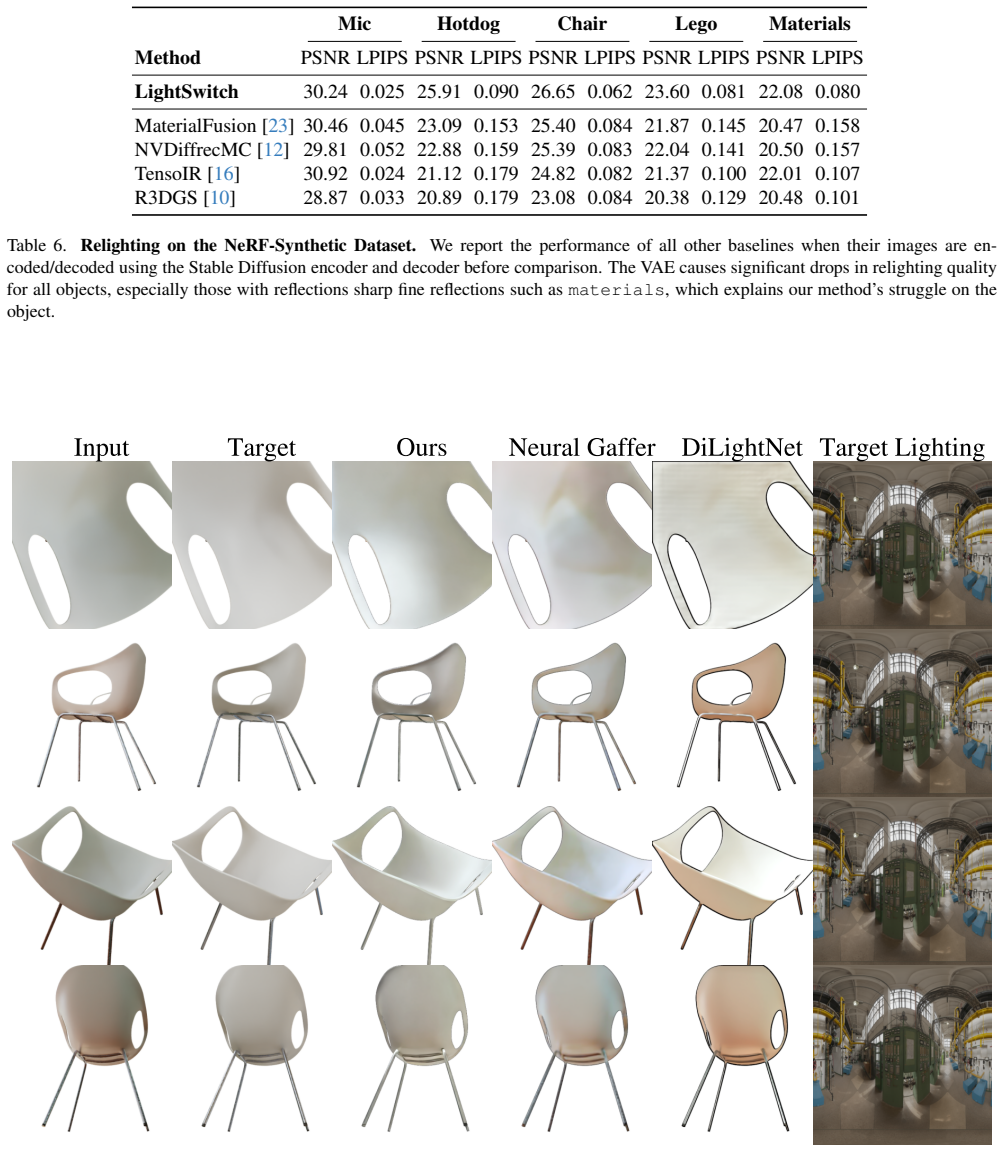
- The paper's appendix shows the Stable Diffusion VAE smears sharp specular reflections (the largest per-object gap on NeRF-Synthetic is on the Materials object); training or swapping in a higher-frequency decoder could directly close the remaining gap to physics-based renderers.
- Since the material maps are predicted independently of the relighting model and never refined against the relit output, a two-pass scheme that re-estimates materials from the relit views could further lift consistency and physical plausibility—an extension the paper does not explore.
- If material conditioning is the main driver of the improvement, the framework's ceiling may currently be set by the material prior's generalization; replacing it with a material estimator trained on a wider distribution of real PBR assets is a concrete way to test and push that bound.
- The same batched shuffling idea transfers naturally to video relighting, where frames can be treated as views; temporal smoothness would then need an additional mechanism, since the current scheme only enforces cross-view, not cross-time, consistency.
Editorial analysis
A structured set of objections, weighed in public.
Referee Report
Summary. The paper proposes LightSwitch, a multi-view relighting framework built by finetuning Stable Diffusion 2.1 with multi-view self-attention and material-conditioning. Given posed multi-view images under unknown lighting and a target environment map, the method infers material maps (albedo, ORM) using StableMaterialMV, concatenates these maps with Plücker ray maps and source latents, and denoises target latents with a multi-view UNet. For 3D novel-view relighting, the method renders test views with a 3D Gaussian splat and relights them using a distributed, shuffled-batch denoising scheme. The paper reports 2D image-to-image relighting gains over DiLightNet and Neural Gaffer on a synthetic object test set, and 3D relighting comparisons against inverse rendering methods on NeRF-Synthetic, Objects with Lighting, and Stanford-ORB, claiming state-of-the-art or comparable quality at much lower runtime.
Significance. If the claims hold, the contribution is practically significant: it is a fast diffusion-based alternative to slow inverse rendering pipelines, and it explicitly addresses multi-view consistency that single-view relighting priors lack. The 2D evaluation is reasonably controlled: the same synthetic objects, target illuminations, and two rescaling protocols (ILR and SLR) are used, and the ablations in Table 4 show that both material cues and multi-view attention contribute. The distributed denoising scheme in Sec. 3.2 is a useful engineering contribution for scaling multi-view attention to many views. However, the headline 3D claim is not fully supported by the paper's own Table 3 on the synthetic NeRF-Synthetic dataset, and the dependence on an unvalidated, same-group material predictor needs to be addressed before the central contribution can be accepted at face value.
major comments (3)
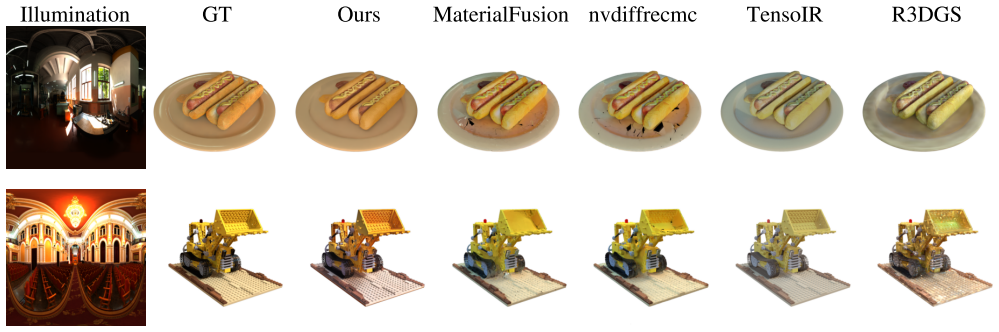
- [Abstract and §4.3, Table 3] The claim that LightSwitch 'matches or outperforms state-of-the-art diffusion inverse rendering methods' is not supported by the unadjusted NeRF-Synthetic results in Table 3. Averaging the per-object PSNRs gives LightSwitch 25.66, MaterialFusion 26.28, and NVDiffrecMC 26.04; LightSwitch is lower than both. Per object, LightSwitch loses clearly on Materials (22.08 vs 25.29/25.37) and Mic (30.24 vs 30.94). The supplementary Table 6, which passes baselines through the Stable Diffusion VAE, does support the claim, but that is a post hoc correction that must be presented as the primary comparison in the main text if it is to carry the headline. As written, the abstract and Table 3 caption overstate the synthetic-dataset result.
- [§4.1, §4.2, and Table 4] Material conditioning is a core contribution, and the ablation shows it is worth +0.74 dB in PSNR (26.01 vs 25.27). Yet the paper never evaluates the accuracy of the predicted material maps against ground truth, either on synthetic data with known PBR values or on real data. Since the material predictor is StableMaterialMV, refined by the same authors, and is used as conditioning at both training and test time, the reader cannot determine how much of the reported gain is attributable to genuinely accurate material estimation versus the diffusion model's ability to use any structured input. At minimum, report material-map error (e.g., albedo/ORM MSE on held-out synthetic objects) and show the 2D predicted-material gap (26.01 vs 28.29 with GT materials) also holds in the 3D setting.
- [§3.2 and §4.3] For 3D novel-view relighting, the test views are first rendered by a 3D Gaussian splat optimized on the source images, and the relit output is compared against ground truth. The paper provides no sensitivity analysis to splat quality. Since the relit test view is a rendered image that already contains splat geometry/reconstruction errors, the method's measured performance is contingent on the splat's quality. A simple experiment varying the number/quality of training views for the splat, or comparing against directly relighting the source views, would clarify how much of the 3D result depends on the splat rather than on the relighting model itself.
minor comments (4)
- [§4.3 and Table 2] Table 2 reports LPIPS 0.297 for LightSwitch on Objects with Lighting, but the text says 'our method matches and outperforms a multitude of inverse rendering baselines.' The difference between LightSwitch and the best LPIPS baseline (Mitsuba+NeuS, 0.227) is sizable; the claim should be qualified to specific metrics, since it is not uniformly true across all metrics in that table.
- [§4.3, runtime] The runtime comparison uses 8 RTX A6000 GPUs for LightSwitch and 1 RTX A6000 for baselines. This is disclosed, but the 'as little as 2 minutes' headline should state the hardware configuration more prominently in the abstract or intro, since a 1-GPU run is reported as 14 minutes.
- [Fig. 3 and §3.2] The distributed denoising scheme is described only briefly. It would help to state explicitly how many denoising iterations are used, how many batches per iteration, and whether the batch shuffling is random or deterministic across views. This affects reproducibility and the 'consistency' claim.
- [Supplementary Table 6] The supplementary table uses the Stable Diffusion VAE to encode/decode all baseline images before comparison, but the choice of the VAE is the same one LightSwitch uses internally. This is a reasonable fairness correction, but it should be justified with an analysis of which objects are most affected and why, rather than only a statement about 'sharp fine reflections.'
Circularity Check
No significant circularity found; the material-prior self-citation is not load-bearing and the central relighting claim is evaluated against external baselines.
full rationale
The paper's derivation chain is self-contained in the relevant sense. The relighting model is trained with a standard diffusion v-prediction loss (Eq. 1 and Eq. 2) on rendered synthetic data, and its inputs (source images, Plücker ray maps, material maps, target environment maps) are not defined in terms of the outputs or the baselines. The material maps come from StableMaterialMV [23], a prior work by the same group, which is a same-group prior rather than circular evidence: the maps are produced independently of the relighting model, and the paper's own ablation (Table 4: Ours 26.01 vs No Materials 25.27 vs Single View 24.59) empirically demonstrates that material conditioning helps, so the benefit is not merely imported by citation. The use of [23] is a component choice, not a justification of the central claim. The headline statement in Sec. 4.3 that LightSwitch 'matches or outperforms' inverse-rendering baselines is weakened by the aggregate PSNR in Table 3 (LightSwitch 25.66 vs MaterialFusion 26.28 and NVDiffrecMC 26.04), and the supplementary VAE-adjusted comparison (Table 6) is a post-hoc correction; however, this is a correctness/consistency issue about the evidence, not a circularity-of-derivation issue. The comparison is against external, independently implemented baselines and is falsifiable. No equation reduces to its own inputs, no fitted parameter is renamed as a prediction, and no uniqueness theorem is imported from the authors' prior work. The conclusion's candid acknowledgement of limitations (fixed SD latent space, non-physical plausibility) further indicates that the authors are not forcing a self-consistent story. Therefore, no circular step is present.
Assumptions & free parameters
free parameters (4)
- CFG guidance scale =
3.0
- Training view count k =
4
- Training iteration and LR schedule =
20K, 15K, 15K; 5e-5, 2.5e-5, 1e-5
- Upsampling material model =
512x512 finetune
assumptions (4)
- domain assumption Stable Diffusion 2.1 UNet and VAE provide a strong image prior and are kept frozen except for finetuned parts.
- domain assumption StableMaterialMV predicts materially useful albedo and ORM maps.
- domain assumption The simplified Disney BRDF material maps (albedo, roughness, metallicness) are sufficient cues for relighting.
- domain assumption 3D Gaussian splatting renders novel views that are faithful enough for relighting.
Cite this review
Pith. "Pith review of LightSwitch: Multi-view Relighting with Material-guided Diffusion." pith.science (2026). https://pith.science/paper/VOG55CXY
@misc{pith2026250806494,
  author       = {Pith},
  title        = {Pith review of: LightSwitch: Multi-view Relighting with Material-guided Diffusion},
  year         = {2026},
  howpublished = {\url{https://pith.science/paper/VOG55CXY}},
  note         = {Machine review of arXiv:2508.06494}
}
read the original abstract
Recent approaches for 3D relighting have shown promise in integrating 2D image relighting generative priors to alter the appearance of a 3D representation while preserving the underlying structure. Nevertheless, generative priors used for 2D relighting that directly relight from an input image do not take advantage of intrinsic properties of the subject that can be inferred or cannot consider multi-view data at scale, leading to subpar relighting. In this paper, we propose Lightswitch, a novel finetuned material-relighting diffusion framework that efficiently relights an arbitrary number of input images to a target lighting condition while incorporating cues from inferred intrinsic properties. By using multi-view and material information cues together with a scalable denoising scheme, our method consistently and efficiently relights dense multi-view data of objects with diverse material compositions. We show that our 2D relighting prediction quality exceeds previous state-of-the-art relighting priors that directly relight from images. We further demonstrate that LightSwitch matches or outperforms state-of-the-art diffusion inverse rendering methods in relighting synthetic and real objects in as little as 2 minutes.
Figures


Figures from the paper (8 more)




Forward citations
Cited by 1 Pith paper
-
Diffusion-Based Material Regularization for Physics-Based Inverse Rendering
A regularization technique that treats diffusion model outputs as a similarity kernel during material optimization in inverse rendering, enabling joint reconstruction of geometry, materials, and illumination that sati...
Reference graph
Works this paper leans on
-
[1]
Barron, Jia-Bin Huang, Pratul P
Hadi Alzayer, Philipp Henzler, Jonathan T. Barron, Jia-Bin Huang, Pratul P. Srinivasan, and Dor Verbin. Generative multiview relighting for 3d reconstruction under extreme il- lumination variation. In CVPR, 2025. 2
2025
-
[2]
Barron, Ben Mildenhall, Dor Verbin, Pratul P
Jonathan T. Barron, Ben Mildenhall, Dor Verbin, Pratul P. Srinivasan, and Peter Hedman. Mip-nerf 360: Unbounded anti-aliased neural radiance fields. In CVPR, 2022. 2
2022
-
[3]
Barron, Ben Mildenhall, Dor Verbin, Pratul P
Jonathan T. Barron, Ben Mildenhall, Dor Verbin, Pratul P. Srinivasan, and Peter Hedman. Zip-nerf: Anti-aliased grid- based neural radiance fields. In ICCV, 2023. 2
2023
-
[4]
Bar- ron, Ce Liu, and Hendrik P.A
Mark Boss, Raphael Braun, Varun Jampani, Jonathan T. Bar- ron, Ce Liu, and Hendrik P.A. Lensch. Nerd: Neural re- flectance decomposition from image collections. In ICCV,
-
[5]
Barron, and Hendrik P.A
Mark Boss, Varun Jampani, Raphael Braun, Ce Liu, Jonathan T. Barron, and Hendrik P.A. Lensch. Neural-pil: Neural pre-integrated lighting for reflectance decomposition. In NeurIPS, 2021. 2, 7
2021
-
[6]
Physically-based shading at disney
Brent Burley and Walt Disney Animation Studios. Physically-based shading at disney. In SIGGRAPH,
-
[7]
Mvsplat360: Feed-forward 360 scene synthesis from sparse views
Yuedong Chen, Chuanxia Zheng, Haofei Xu, Bohan Zhuang, Andrea Vedaldi, Tat-Jen Cham, and Jianfei Cai. Mvsplat360: Feed-forward 360 scene synthesis from sparse views. In NeurIPS, 2024. 2
2024
-
[8]
Objaverse: A universe of annotated 3d objects
Matt Deitke, Dustin Schwenk, Jordi Salvador, Luca Weihs, Oscar Michel, Eli VanderBilt, Ludwig Schmidt, Kiana Ehsani, Aniruddha Kembhavi, and Ali Farhadi. Objaverse: A universe of annotated 3d objects. In CVPR, 2023. 5
2023
Show all 51 references
-
[9]
Relightvid: Temporal-consistent diffusion model for video relighting
Ye Fang, Zeyi Sun, Shangzhan Zhang, Tong Wu, Yinghao Xu, Pan Zhang, Jiaqi Wang, Gordon Wetzstein, and Dahua Lin. Relightvid: Temporal-consistent diffusion model for video relighting. arXiv, 2025. 2
2025
-
[10]
Relightable 3d gaussian: Real-time point cloud relighting with brdf decomposition and ray trac- ing
Jian Gao, Chun Gu, Youtian Lin, Hao Zhu, Xun Cao, Li Zhang, and Yao Yao. Relightable 3d gaussian: Real-time point cloud relighting with brdf decomposition and ray trac- ing. In ECCV, 2024. 2, 8
2024
-
[11]
Learning to predict indoor illumi- nation from a single image
Marc-Andr ´e Gardner, Kalyan Sunkavalli, Ersin Yumer, Xi- aohui Shen, Emiliano Gambaretto, Christian Gagn ´e, and Jean-Franc ¸ois Lalonde. Learning to predict indoor illumi- nation from a single image. ACM Transactions on Graphics (ToG), 2017. 5
2017
-
[12]
Shape, Light, and Material Decomposition from Images us- ing Monte Carlo Rendering and Denoising
Jon Hasselgren, Nikolai Hofmann, and Jacob Munkberg. Shape, Light, and Material Decomposition from Images us- ing Monte Carlo Rendering and Denoising. In NeurIPS,
-
[13]
2d gaussian splatting for geometrically ac- curate radiance fields
Binbin Huang, Zehao Yu, Anpei Chen, Andreas Geiger, and Shenghua Gao. 2d gaussian splatting for geometrically ac- curate radiance fields. In SIGGRAPH, 2024. 2
2024
-
[14]
Ma- terial anything: Generating materials for any 3d object via diffusion
Xin Huang, Tengfei Wang, Ziwei Liu, and Qing Wang. Ma- terial anything: Generating materials for any 3d object via diffusion. In CVPR, 2025. 5
2025
-
[15]
Mitsuba 3 renderer, 2022
Wenzel Jakob, S ´ebastien Speierer, Nicolas Roussel, Merlin Nimier-David, Delio Vicini, Tizian Zeltner, Baptiste Nicolet, Miguel Crespo, Vincent Leroy, and Ziyi Zhang. Mitsuba 3 renderer, 2022. https://mitsuba-renderer.org. 7
2022
-
[16]
Tensoir: Tensorial inverse rendering
Haian Jin, Isabella Liu, Peijia Xu, Xiaoshuai Zhang, Song- fang Han, Sai Bi, Xiaowei Zhou, Zexiang Xu, and Hao Su. Tensoir: Tensorial inverse rendering. In CVPR, 2023. 2, 7, 8
2023
-
[17]
Neu- ral gaffer: Relighting any object via diffusion
Haian Jin, Yuan Li, Fujun Luan, Yuanbo Xiangli, Sai Bi, Kai Zhang, Zexiang Xu, Jin Sun, and Noah Snavely. Neu- ral gaffer: Relighting any object via diffusion. In NeurIPS,
-
[18]
3d gaussian splatting for real-time radiance field rendering
Bernhard Kerbl, Georgios Kopanas, Thomas Leimk ¨uhler, and George Drettakis. 3d gaussian splatting for real-time radiance field rendering. ACM Transactions on Graphics (ToG), 2023. 1, 2, 5
2023
-
[19]
In- trinsic image diffusion for indoor single-view material esti- mation
Peter Kocsis, Vincent Sitzmann, and Matthias Nießner. In- trinsic image diffusion for indoor single-view material esti- mation. In CVPR, 2024. 2
2024
-
[20]
Neroic: Neural rendering of objects from online image collections
Zhengfei Kuang, Kyle Olszewski, Menglei Chai, Zeng Huang, Panos Achlioptas, and Sergey Tulyakov. Neroic: Neural rendering of objects from online image collections. ACM Transactions on Graphics (ToG), 2022. 7
2022
-
[21]
Diffusion- renderer: Neural inverse and forward rendering with video diffusion models
Ruofan Liang, Zan Gojcic, Huan Ling, Jacob Munkberg, Jon Hasselgren, Zhi-Hao Lin, Jun Gao, Alexander Keller, Nan- dita Vijaykumar, Sanja Fidler, and Zian Wang. Diffusion- renderer: Neural inverse and forward rendering with video diffusion models. CVPR, 2025. 2
2025
-
[22]
Gs-ir: 3d gaussian splatting for inverse rendering
Zhihao Liang, Qi Zhang, Ying Feng, Ying Shan, and Kui Jia. Gs-ir: 3d gaussian splatting for inverse rendering. In CVPR,
-
[23]
Materialfusion: Enhancing inverse rendering with material diffusion priors
Yehonathan Litman, Or Patashnik, Kangle Deng, Aviral Agrawal, Rushikesh Zawar, Fernando De la Torre, and Shub- ham Tulsiani. Materialfusion: Enhancing inverse rendering with material diffusion priors. In 3DV, 2025. 2, 3, 5, 7, 8
2025
-
[24]
One-2-3-45++: Fast single image to 3d objects with consistent multi-view generation and 3d diffusion
Minghua Liu, Ruoxi Shi, Linghao Chen, Zhuoyang Zhang, Chao Xu, Xinyue Wei, Hansheng Chen, Chong Zeng, Ji- ayuan Gu, and Hao Su. One-2-3-45++: Fast single image to 3d objects with consistent multi-view generation and 3d diffusion. In CVPR, 2024. 2
2024
-
[25]
Wonder3d: Sin- gle image to 3d using cross-domain diffusion
Xiaoxiao Long, Yuan-Chen Guo, Cheng Lin, Yuan Liu, Zhiyang Dou, Lingjie Liu, Yuexin Ma, Song-Hai Zhang, Marc Habermann, Christian Theobalt, et al. Wonder3d: Sin- gle image to 3d using cross-domain diffusion. In CVPR,
-
[26]
3dgsr: Implicit surface reconstruction with 3d gaussian splat- ting
Xiaoyang Lyu, Yang-Tian Sun, Yi-Hua Huang, Xiuzhe Wu, Ziyi Yang, Yilun Chen, Jiangmiao Pang, and Xiaojuan Qi. 3dgsr: Implicit surface reconstruction with 3d gaussian splat- ting. ACM Transactions on Graphics (TOG), 2024. 2
2024
-
[27]
Srinivasan, Matthew Tancik, Jonathan T
Ben Mildenhall, Pratul P. Srinivasan, Matthew Tancik, Jonathan T. Barron, Ravi Ramamoorthi, and Ren Ng. Nerf: Representing scenes as neural radiance fields for view syn- thesis. In ECCV, 2020. 1, 2, 6
2020
-
[28]
Instant neural graphics primitives with a mul- tiresolution hash encoding
Thomas M ¨uller, Alex Evans, Christoph Schied, and Alexan- der Keller. Instant neural graphics primitives with a mul- tiresolution hash encoding. ACM Transactions on Graphics (ToG), 2022. 2
2022
-
[29]
Extracting Triangular 3D Models, Materials, and Light- ing From Images
Jacob Munkberg, Jon Hasselgren, Tianchang Shen, Jun Gao, Wenzheng Chen, Alex Evans, Thomas M¨uller, and Sanja Fi- dler. Extracting Triangular 3D Models, Materials, and Light- ing From Images. In CVPR, 2022. 2, 7
2022
-
[30]
High-resolution image syn- thesis with latent diffusion models
Robin Rombach, Andreas Blattmann, Dominik Lorenz, Patrick Esser, and Bj¨orn Ommer. High-resolution image syn- thesis with latent diffusion models. In CVPR, 2022. 3
2022
-
[31]
Progressive distillation for fast sampling of diffusion models
Tim Salimans and Jonathan Ho. Progressive distillation for fast sampling of diffusion models. In ICLR, 2021. 4
2021
-
[32]
Mvdream: Multi-view diffusion for 3d gen- eration
Yichun Shi, Peng Wang, Jianglong Ye, Mai Long, Kejie Li, and Xiao Yang. Mvdream: Multi-view diffusion for 3d gen- eration. In ICLR, 2024. 4
2024
-
[33]
Srinivasan, Boyang Deng, Xiuming Zhang, Matthew Tancik, Ben Mildenhall, and Jonathan T
Pratul P. Srinivasan, Boyang Deng, Xiuming Zhang, Matthew Tancik, Ben Mildenhall, and Jonathan T. Barron. Nerv: Neural reflectance and visibility fields for relighting and view synthesis. In CVPR, 2021. 2
2021
-
[34]
Richter, Shenlong Wang, and Germ ´an Ros
Benjamin Ummenhofer, Sanskar Agrawal, Rene Sep ´ulveda, Yixing Lao, Kai Zhang, Tianhang Cheng, Stephan R. Richter, Shenlong Wang, and Germ ´an Ros. Objects with lighting: A real-world dataset for evaluating reconstruction and rendering for object relighting. In 3DV, 2024. 7
2024
-
[35]
Nerf-casting: Improved view-dependent appearance with consistent reflections
Dor Verbin, Pratul P Srinivasan, Peter Hedman, Ben Milden- hall, Benjamin Attal, Richard Szeliski, and Jonathan T Bar- ron. Nerf-casting: Improved view-dependent appearance with consistent reflections. In SIGGRAPH Asia, 2024. 2
2024
-
[36]
Sv3d: Novel multi-view syn- thesis and 3d generation from a single image using latent video diffusion
Vikram V oleti, Chun-Han Yao, Mark Boss, Adam Letts, David Pankratz, Dmitry Tochilkin, Christian Laforte, Robin Rombach, and Varun Jampani. Sv3d: Novel multi-view syn- thesis and 3d generation from a single image using latent video diffusion. In ECCV, 2024. 2
2024
-
[37]
Imagedream: Image-prompt multi-view diffusion for 3d generation
Peng Wang and Yichun Shi. Imagedream: Image-prompt multi-view diffusion for 3d generation. arXiv, 2023. 4
2023
-
[38]
Neus: Learning neural implicit surfaces by volume rendering for multi-view reconstruction
Peng Wang, Lingjie Liu, Yuan Liu, Christian Theobalt, Taku Komura, and Wenping Wang. Neus: Learning neural implicit surfaces by volume rendering for multi-view reconstruction. In NeurIPS, 2021. 7
2021
-
[39]
Reconfusion: 3d reconstruction with diffusion priors
Rundi Wu, Ben Mildenhall, Philipp Henzler, Keunhong Park, Ruiqi Gao, Daniel Watson, Pratul P Srinivasan, Dor Verbin, Jonathan T Barron, Ben Poole, et al. Reconfusion: 3d reconstruction with diffusion priors. In CVPR, 2024. 2
2024
-
[40]
Chen Xi, Peng Sida, Yang Dongchen, Liu Yuan, Pan Bowen, Lv Chengfei, and Zhou. Xiaowei. Intrinsicanything: Learn- ing diffusion priors for inverse rendering under unknown il- lumination. In ECCV, 2024. 2
2024
-
[41]
Multi-scale 3d gaussian splatting for anti-aliased rendering
Zhiwen Yan, Weng Fei Low, Yu Chen, and Gim Hee Lee. Multi-scale 3d gaussian splatting for anti-aliased rendering. In CVPR, 2024. 2
2024
-
[42]
Dilightnet: Fine-grained light- ing control for diffusion-based image generation
Chong Zeng, Yue Dong, Pieter Peers, Youkang Kong, Hongzhi Wu, and Xin Tong. Dilightnet: Fine-grained light- ing control for diffusion-based image generation. In SIG- GRAPH, 2024. 2, 5, 6
2024
-
[43]
PhySG: Inverse rendering with spherical gaussians for physics-based material editing and relighting
Kai Zhang, Fujun Luan, Qianqian Wang, Kavita Bala, and Noah Snavely. PhySG: Inverse rendering with spherical gaussians for physics-based material editing and relighting. In CVPR, 2021. 7
2021
-
[44]
Relitlrm: Generative relightable radiance for large reconstruction models
Tianyuan Zhang, Zhengfei Kuang, Haian Jin, Zexiang Xu, Sai Bi, Hao Tan, He Zhang, Yiwei Hu, Milos Hasan, William T Freeman, et al. Relitlrm: Generative relightable radiance for large reconstruction models. In ICLR, 2025. 2
2025
-
[45]
Ner- factor: Neural factorization of shape and reflectance under an unknown illumination
Xiuming Zhang, Pratul P Srinivasan, Boyang Deng, Paul De- bevec, William T Freeman, and Jonathan T Barron. Ner- factor: Neural factorization of shape and reflectance under an unknown illumination. ACM Transactions on Graphics (ToG), 2021. 2, 7
2021
-
[46]
Modeling indirect illumination for inverse rendering
Yuanqing Zhang, Jiaming Sun, Xingyi He, Huan Fu, Rongfei Jia, and Xiaowei Zhou. Modeling indirect illumination for inverse rendering. In CVPR, 2022. 2, 7
2022
-
[47]
Srinivasan, Dor Verbin, Keunhong Park, Ricardo Martin Brualla, and Philipp Henzler
Xiaoming Zhao, Pratul P. Srinivasan, Dor Verbin, Keunhong Park, Ricardo Martin Brualla, and Philipp Henzler. IllumiN- eRF: 3D Relighting Without Inverse Rendering. InNeurIPS,
-
[48]
Bigs: Bidirectional gaussian primitives for re- lightable 3d gaussian splatting
Liu Zhenyuan, Yu Guo, Xinyuan Li, Bernd Bickel, and Ran Zhang. Bigs: Bidirectional gaussian primitives for re- lightable 3d gaussian splatting. In 3DV, 2025. 2
2025
-
[49]
Sparsefusion: Dis- tilling view-conditioned diffusion for 3d reconstruction
Zhizhuo Zhou and Shubham Tulsiani. Sparsefusion: Dis- tilling view-conditioned diffusion for 3d reconstruction. In CVPR, 2023. 2 LightSwitch: Multi-view Relighting with Material-guided Diffusion Supplementary Material Relighting Method PSNR-L ↑ PSNR-H ↑ SSIM ↑ LPIPS ↓ LightSwi...
2023
-
[50]
Additional Visualizations We show additional visualizations of LightSwitch’s 2D and 3D relighting on BlenderVault 2D data as well as NeRF- Synthetic in Figs. 8-11
-
[51]
LightSwitch was trained in three stages using 8 RTX A6000 GPUs, first by finetuning for single view for 20K iterations on 256 ×256 data with a batch size of 512
Additional Details Training. LightSwitch was trained in three stages using 8 RTX A6000 GPUs, first by finetuning for single view for 20K iterations on 256 ×256 data with a batch size of 512. An AdamW 8-bit optimizer was used with a learning rate of 5e − 5. For the second multi...
Reviewed August 5, 2026 · model on record in the stance chip above.
Discussion (0). Sign in to comment.