REVIEW 4 major objections 6 minor 14 references
Cosmic Hysteresis in Reconstructed $f(R)$ Bounce Models: A Thermodynamic Study
T0 review · 4 major / 6 minor · reviewed 2026-08-05 · deepseek-v4-flash
Pith's one-line read In bouncing universes built from modified f(R) gravity, the paper claims, the scalar field performs nonzero thermodynamic work per cycle, making cyclic cosmologies generically irreversible even when the geometry is time-symmetric.
desk verdict The reported nonzero work integral contradicts the paper's own time-symmetric setup; the central claim is unsupported by the stated equations. read the letter →
The pith
A machine-rendered reading of the paper's core claim, the machinery that carries it, and where it could break.
The reading
What carries the argument
The carrying mechanism is the thermodynamic work integral $W = \oint p_\phi\,dV = \int_{\text{cycle}} 3a^3 H\left(\tfrac{1}{2}\dot{\phi}^2 - V(\phi)\right) dt$ evaluated over a closed cosmological cycle, together with the f(R) reconstruction procedure that turns a prescribed scale factor $a(t)$ into a Lagrangian $f(R)$ via the modified Friedmann equations. The sign-changing Hubble parameter $H(t)$ in the Klein–Gordon friction term $3H\dot{\phi}$ is what the paper identifies as the source of hysteresis: the same geometry is traversed with damping in one direction and anti-damping in the other, so pressure and equation-of-state parameter $w_\phi$ trace different branches and enclose a loop who
What would settle it
Run the exponential-bounce configuration of Section 4.1 with exactly the stated inputs ($a_0=1$, $\beta=0.1$, $V=\tfrac{1}{2}m^2\phi^2$, $\phi(0)=0.1$, $\dot{\phi}(0)=0$) and integrate Eq. (29) over any time-symmetric cycle $[-T,T]$. Since $H(t)$ is odd and $\phi(t)$ is even, the integrand is odd and the integral is zero to machine precision; a nonzero result would require the code to use asymmetric cycle bounds, asymmetric initial data, or additional dissipation, and identifying which one would settle whether the hysteresis is intrinsic or imposed.
Extended reading notes
Core claim
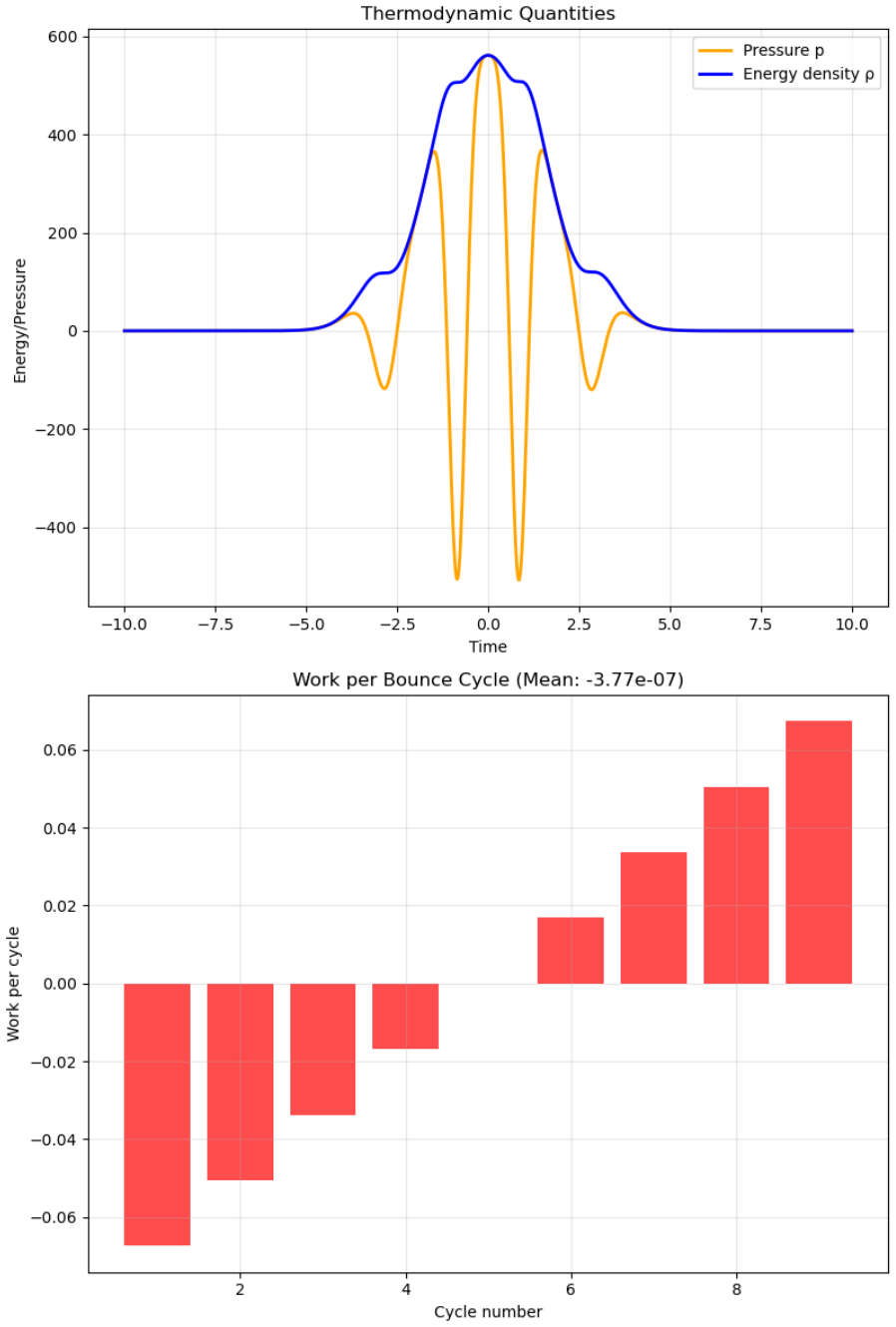
The central claim is that thermodynamic hysteresis is a robust, generic attribute of f(R) bouncing cosmologies. For exponential and power-law scale factors, the authors reconstruct the f(R) action from the assumed $a(t)$, then solve the scalar-field Klein–Gordon equation numerically. Because $H(t)$ changes sign across the bounce, the friction term $3H\dot{\phi}$ damps in expansion and anti-damps in contraction, so the pressure $p_\phi = \tfrac{1}{2}\dot{\phi}^2 - V(\phi)$ follows different paths for the same scale-factor value. Closed loops in the $(w_\phi, a)$ plane and a nonzero $\oint p_\phi\,dV$ per cycle result; the exponential model shows 10 bounces, 9 cycles, and mean work $W \approx
Load-bearing premise
The nonzero work result rests on the scalar field's pressure genuinely differing between contraction and expansion over the cycle; with the paper's own setup—a time-symmetric geometry and a field started at rest at the bounce—the two halves mirror each other and the work integral vanishes, so an unspecified time asymmetry in the cycle or the field's state is doing the work.
Editorial extensions
If this is right
- Cyclic f(R) bounce models carry an intrinsic arrow of time: the geometry returns to its starting point but the thermodynamic state does not, so successive cycles do not repeat identically.
- The hysteresis loop area in the $(w_\phi, a)$ plane is a quantitative per-cycle dissipation measure—large for sharp exponential bounces (area about 343.8) and small but nonzero for quasi-static power-law evolution (area about 6.78).
- With negative mean work per cycle, the scalar field acts as an energy source during cosmic expansion, so bounce thermodynamics can feed the expanding phase and shape long-term cyclic dynamics.
- Because the friction term changes sign with $H(t)$, the effect is not tied to one specific potential; hysteresis is expected across the class of canonical scalar fields in reconstructed f(R) backgrounds.
- Nonzero work per cycle implies entropy production over many cycles, so bounce models accumulate dissipation and may relax toward attractor behavior instead of oscillating forever.
Reading between the lines
- A symmetry check the paper leaves implicit: with its own stated even initial data ($\phi(0)=0.1$, $\dot{\phi}(0)=0$), Eq. (30) preserves an even $\phi(t)$, making the integrand in Eq. (29) odd on any time-symmetric interval—so reproducing the reported nonzero $W$ requires an explicit time asymmetry (in the cycle bounds, the initial velocity, or an added dissipative term) that the paper never speci
- A direct extension is to parameterize that asymmetry: set $\dot{\phi}(0)=v_0$ or integrate over $[-T_1, T_2]$ with $T_1 \neq T_2$, then map $W$ as a function of the asymmetry. That would show whether hysteresis is intrinsic to the geometry or inherited from the chosen cycle definition.
- The mechanism—sign-changing Hubble friction in the Klein–Gordon equation—is independent of the f(R) reconstruction details, so the same work-integral analysis applies to any bouncing model with a prescribed symmetric scale factor (for example, ekpyrotic or matter-bounce settings), and loop areas could be compared across theories as a dissipation diagnostic.
Editorial analysis
A structured set of objections, weighed in public.
Referee Report
Summary. The paper claims to study cosmic hysteresis in bouncing universes within analytically reconstructed f(R) gravity. For two symmetric bouncing scale factors—an exponential a(t)=a0 exp(βt²) and a power-law a(t)=a0(t²+t0²)^n—the authors reconstruct the corresponding f(R) models, evolve a minimally coupled scalar field, and compute the thermodynamic work integral W=∮pφ dV over a full cycle. They report nonzero work (e.g., W≈−135.11 for the exponential model), closed hysteresis loops in the (wφ,a) plane, and conclude that thermodynamic hysteresis is a robust, generic attribute of f(R) bouncing cosmologies, leading to a natural thermodynamic arrow of time. Numerical results include loop areas, multiple bounce events, and cycle statistics for the two configurations.
Significance. If the central claims were correct, this would be a notable contribution: it would show that time-symmetric bounce geometries can still yield net work per cycle through scalar-field dynamics, implying generic irreversibility in cyclic f(R) cosmologies. The use of exact bouncing scale factors and the thermodynamic formalism is a reasonable starting point. However, the paper does not establish these claims. The non-vanishing work integral is mathematically inconsistent with the stated time-symmetric setup and initial conditions, the f(R) reconstruction is left as an undetermined ansatz, and the numerical results do not correspond to the analytic models. The paper therefore does not currently provide a sound basis for its conclusions.
major comments (4)
- [Section 2.5, 2.6, Eqs. (15), (19), (20)] The result W≠0 contradicts the stated equations. For the exponential bounce a=a0 exp(βt²), H=2βt is odd; for the power-law bounce a=a0(t²+t0²)^n, H=2nt/(t²+t0²) is also odd. With the stated even initial data φ(0)=0.1, φ̇(0)=0 and the quadratic potential V=½m²φ², the Klein–Gordon equation (21) is invariant under t→−t, so by uniqueness φ(t)=φ(−t). Hence pφ=½φ̇²−V is even. The integrand in Eq. (29) is 3a³H pφ, with a even, H odd, and pφ even, making the integrand odd. Any integral over a time interval symmetric about t=0—which is a full cycle in this symmetric bounce—vanishes exactly. The reported W≈−135.11 and the hysteresis loop areas therefore cannot arise from the stated equations and initial conditions; an unstated asymmetry (e.g., asymmetric cycle interval, φ̇(0)≠0, or a different potential) is required but never disclosed.
- [Section 2.5, 2.6, Eqs. (15), (19), (20)] The claimed f(R) reconstruction is not actually performed. In Eq. (15) the result is only written as f(R)≃R+α1R^2+α2R ln R+…, and in Eq. (19) as f(R)≃R+γ1R^2+γ2R^{-1}+…, with the coefficients α1, α2, γ1, γ2 never determined. Eq. (20) gives an integral form but is not evaluated. The abstract's phrase 'analytically reconstructed f(R)' is therefore unsupported. Since the coefficients remain free, the modified-gravity content is unspecified, and the subsequent thermodynamics depends only on the background H and the scalar field, not on any concrete f(R) function.
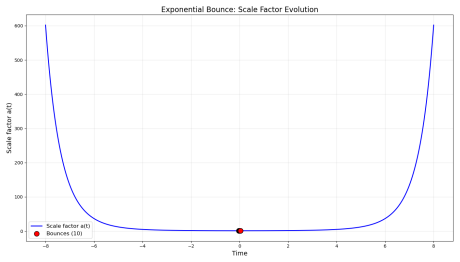
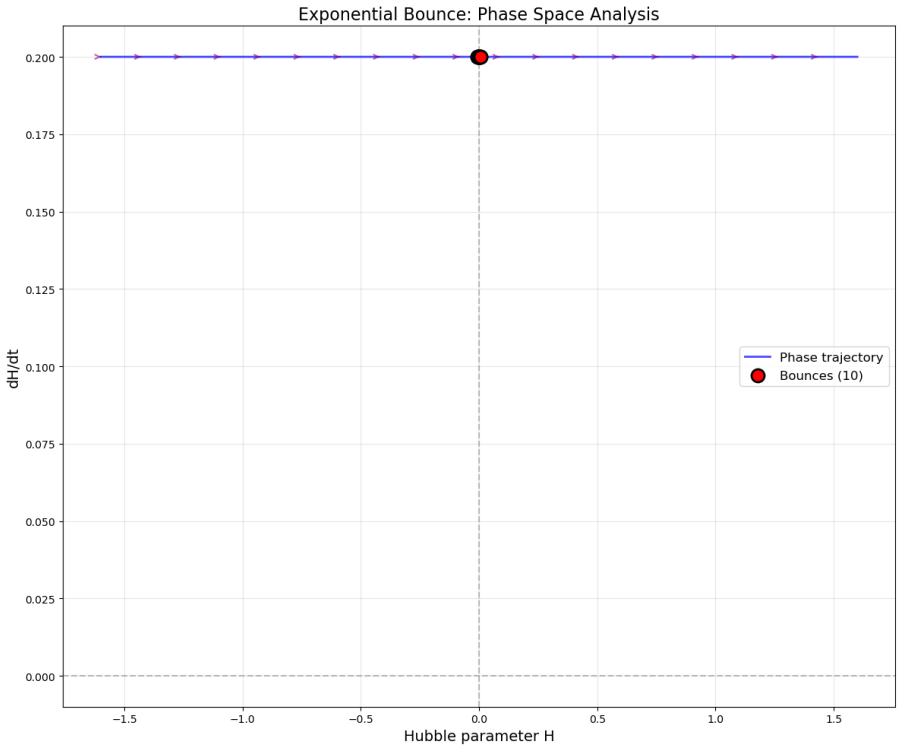
- [Section 5, Eqs. (31) and (35)] The numerical results are inconsistent with the stated scale factors. The exponential scale factor a(t)=a0 exp(βt²) has exactly one minimum at t=0 and is not periodic; it cannot produce '10 discrete bounce events' or '9 complete cycles' as reported in Section 5. Similarly, the power-law scale factor a(t)=a0(t²+t0²)^n with n=0.3, t0=1 has H=0 and Ḣ>0 at t=0, i.e., a bounce, yet the text states this model 'did not exhibit any discrete bounce or turnaround events'. The simulations therefore appear to use different models or different parameter regimes than those described analytically, so the reported loop areas and work values are not attributable to the models defined in the paper.
- [Section 4.3, Eq. (38)] The claimed proportionality Aloop ∝ W is not correct. With V=a³, dV=3a² da, and d(ln a³)=3 da/a=dV/a³, the loop-area integral ∮ wφρφ d(ln a³)=∮ pφ dV/a³, not ∮ pφ dV. The two integrals differ by a factor a^{-3}, which is not constant over a bounce cycle. Thus the loop area in the (wφ,a) plane is not a valid proxy for the thermodynamic work, and the 'negative area implies net work' interpretation is unsupported.
minor comments (6)
- [Throughout] The metric is called 'FRLW' instead of 'FLRW' in several places (e.g., Section 2.2 and the Introduction).
- [Section 2.5] The sentence 'This analytic control enables ... reconstructed f(R) gravity model.' is duplicated verbatim at the end of the section.
- [Section 2.6] The text uses 'ans¨atze' with an incorrect spelling; should be 'Ansätze'.
- [References] Several references are duplicated: [6] and [15], [9] and [17], [18] and [7], [19] and [8], [20] and [1], [21] and [3]. This suggests incomplete bibliographic cleanup.
- [Section 5] The paper switches from a quadratic potential V=½m²φ² with m=0.15 (used in Section 4.1) to a quartic potential with λ=0.01 in the exponential simulation without explaining whether the analytic results still apply or why the potential was changed.
- [Figures] Figure captions are often imprecise: Figure 5 is titled 'Power law Bounce scale factor evolution demonstration' even though the text states the power-law model has no bounces. Please align captions with the actual content and with the analytic models.
Circularity Check
Claimed W≠0 is not derivable: for even φ, the integrand in Eq. (29) is odd, so W=0 on any symmetric bounce cycle; the reported values require an unstated asymmetry.
-
self definitional
[§4.1 (Eqs. 21, 29); §2.5 (Eqs. 12–13); §5 (W≈−135.11)]
"W = ∫_cycle 3a^3 H (1/2 φ˙^2 − V(φ)) dt ; using initial conditions near the bounce (e.g., φ(0)=0.1, φ˙(0)=0, a(0)=a0, H(0)=0) ; a(t)=a0 exp(βt²), H(t)=2βt"
With V=½m²φ², Eq. (21) is invariant under t→−t for odd H; the stated even initial data force φ(t)=φ(−t), so pφ=½φ˙²−V is even and φ˙ is odd. In Eq. (29), a³ and pφ are even while H is odd, so the integrand is odd. Therefore W=0 identically on any cycle symmetric about the bounce. The reported W≈−135.11 and hysteresis loops cannot follow from the stated equations; they require an unstated asymmetry (asymmetric interval, non-even initial data, or different dynamics). The claim that thermodynamic hysteresis is robust and generic is thus equivalent to that unstated choice, not to the f(R) bounce model.
full rationale
The central quantitative claim—a non-vanishing work integral ∮pφ dV and closed hysteresis loops—is contradicted by the paper's own time-symmetric construction. Both bounce profiles have even a(t) and odd H(t); the stated Klein–Gordon equation with V=½m²φ² and even initial data gives φ even. Then the integrand in Eq. (29) is odd, so W=0 for any cycle symmetric about t=0. The nonzero values in Section 5 must originate from an undisclosed asymmetry or numerical artifact, not from the reconstructed f(R) models. This is a load-bearing circularity in the sense that the 'prediction' of hysteresis is manufactured by the choice of cycle/initial data, rather than derived from the stated equations. The f(R) reconstruction itself (Eqs. 15 and 19) is also only an ansatz with undetermined coefficients and does not enter the scalar-field or work calculation, further weakening the claim that the result is a property of modified gravity. No self-citation issues are central here. The score reflects that the main result reduces by construction to an unstated asymmetric choice, though the failure is partly an internal inconsistency rather than a clean fit-based circularity.
Assumptions & free parameters
free parameters (5)
- β (exponential bounce rate) =
0.1
- n and t0 (power-law bounce indices) =
n=0.3, t0=1.0
- scalar potential parameters =
m=0.15 (quadratic, power-law run); λ=0.01 (quartic, exponential run)
- initial field values =
φ(0)=0.1, φ̇(0)=0
- f(R) expansion coefficients α1, α2, γ1, γ2 =
unspecified
assumptions (4)
- domain assumption The scalar field obeys the Klein-Gordon equation (9)/(21) with a canonical kinetic term and a potential V(φ).
- standard math The f(R) action (1) and field equations (3),(7),(8) correctly describe the geometry and the scalar field coupling.
- ad hoc to paper The ansatz f(R) ≈ R + α1 R^2 + α2 R ln R (exponential) and f(R) ≈ R + γ1 R^2 + γ2 R^{-1} (power-law) captures the reconstructed gravity model.
- ad hoc to paper The time-symmetric bounce solutions (12) and (16) describe the complete cosmic history, and the simulated bounce events correspond to cycles of these solutions.
invented entities (1)
-
None
Cite this review
Pith. "Pith review of Cosmic Hysteresis in Reconstructed $f(R)$ Bounce Models: A Thermodynamic Study." pith.science (2026). https://pith.science/paper/PFQCHSI4
@misc{pith2026250806590,
  author       = {Pith},
  title        = {Pith review of: Cosmic Hysteresis in Reconstructed $f(R)$ Bounce Models: A Thermodynamic Study},
  year         = {2026},
  howpublished = {\url{https://pith.science/paper/PFQCHSI4}},
  note         = {Machine review of arXiv:2508.06590}
}
abstract
We study the emergence of cosmic hysteresis in cyclic bouncing universes within the framework of analytically reconstructed $f(R)$ gravity. Using exact bouncing scale factor solutions of exponential and power-law forms, we reconstruct the corresponding $f(R)$ models and investigate the thermodynamic behavior of a minimally coupled scalar field in these geometries. The pressure evolution during expansion and contraction phases is shown to be asymmetric, leading to a non-vanishing thermodynamic work integral over each cycle, defined by $\oint p_\phi\, dV$. We identify closed hysteresis loops in the equation-of-state space and quantify the net energy transfer per cycle. Our results reveal that such reconstructed $f(R)$ models generically support irreversible evolution, demonstrating a natural emergence of the thermodynamic arrow of time. These findings provide new insight into the dissipative features of modified gravity and the long-term dynamics of cyclic cosmological scenarios.
Figures

Figures from the paper (6 more)


Reference graph
Works this paper leans on
-
[2]
Bouncing Cosmologies: Progress and Problems,
R. Brandenberger and P. Peter, “Bouncing Cosmologies: Progress and Problems,” Found. Phys.47, 797-850 (2017) [arXiv:1603.05834 [hep-th]]
arXiv 2017
-
[4]
Bouncing Cosmology made simple,
A. Ijjas and P. J. Steinhardt, “Bouncing Cosmology made simple,”Class. Quant. Grav. 35, 135004 (2018) [arXiv:1803.01961 [astro-ph.CO]]
arXiv 2018
-
[10]
V. K. Oikonomou, ‘Effects of a pre-inflationary de Sitter bounce on the primor- dial gravitational waves in f(R) gravity theories,” Nucl. Phys. B984(2022), 115985 doi:10.1016/j.nuclphysb.2022.115985 [arXiv:2210.02861 [gr-qc]]
arXiv 2022
-
[11]
Pre-inflationary bounce effects on pri- mordial gravitational waves of f(R) gravity,
S. D. Odintsov and V. K. Oikonomou, “Pre-inflationary bounce effects on pri- mordial gravitational waves of f(R) gravity,” Phys. Lett. B824(2022), 136817 doi:10.1016/j.physletb.2021.136817 [arXiv:2112.02584 [gr-qc]]
-
[12]
Unification of a Bounce with a Viable Dark Energy Era in Gauss-Bonnet Gravity
S. D. Odintsov, V. K. Oikonomou, F. P. Fronimos and K. V. Fasoulakos, “Unification of a Bounce with a Viable Dark Energy Era in Gauss-Bonnet Gravity,” Phys. Rev. D 102(2020) no.10, 104042 doi:10.1103/PhysRevD.102.104042 [arXiv:2010.13580 [gr-qc]]
work page Pith review arXiv 2020
-
[13]
Modified Gravity Theories on a Nutshell: Inflation, Bounce and Late-time Evolution,
S. Nojiri, S. D. Odintsov and V. K. Oikonomou, “Modified Gravity Theories on a Nutshell: Inflation, Bounce and Late-time Evolution,” Phys. Rept.692(2017), 1-104 doi:10.1016/j.physrep.2017.06.001 [arXiv:1705.11098 [gr-qc]]
arXiv 2017
-
[14]
Thermodynamics in f (R) gravity in the Palatini formalism,
K. Bamba and C. Q. Geng, “Thermodynamics in f (R) gravity in the Palatini formalism,”JCAP06, 014 (2010) [DOI:10.1088/1475-7516/2010/06/014]
-
[15]
Bounce cosmology from F(R) gravity and F(R) bigravity,
K. Bamba, A. N. Makarenko, A. N. Myagky, S. Nojiri, and S. D. Odintsov, “Bounce cosmology from F(R) gravity and F(R) bigravity,” JCAP01, 008 (2014) [arXiv:1309.3748 [hep-th]]
arXiv 2014
Show all 14 references
-
[16]
Unified cosmic history in modified gravity: from F(R) theory to Lorentz non-invariant models,
S. Nojiri and S. D. Odintsov, “Unified cosmic history in modified gravity: from F(R) theory to Lorentz non-invariant models,” Phys. Rept.505, 59-144 (2011) [arXiv:1011.0544 [gr-qc]]. 18
2011 arXiv
-
[17]
Irreversible thermodynamics of the bouncing braneworld,
N. Kanekar, V. Sahni, and Y. Shtanov, “Irreversible thermodynamics of the bouncing braneworld,” Phys. Rev. D63, 083520 (2001) [arXiv:astro-ph/0101448]
2001 arXiv
-
[18]
Bouncing cosmology with future singularity from modified gravity,
S. D. Odintsov and V. K. Oikonomou, “Bouncing cosmology with future singularity from modified gravity,” Phys. Rev. D92, 024016 (2015) [arXiv:1504.06866 [gr-qc]]
2015 arXiv
-
[19]
Matter Bounce Cos- mology with the f(T) Gravity,
Y.-F. Cai, S.-H. Chen, J. B. Dent, S. Dutta, and E. N. Saridakis, “Matter Bounce Cos- mology with the f(T) Gravity,” Class. Quant. Grav.28, 215011 (2011) [arXiv:1104.4349 [astro-ph.CO]]
2011 arXiv
-
[20]
Bouncing Cosmologies,
M. Novello and S. E. Perez Bergliaffa, “Bouncing Cosmologies,” Phys. Rept.463, 127-213 (2008) [arXiv:0802.1634 [astro-ph]]
2008 arXiv
-
[21]
A Critical Review of Classical Bouncing Cosmologies,
D. Battefeld and P. Peter, “A Critical Review of Classical Bouncing Cosmologies,” Phys. Rept.571, 1-66 (2015) [arXiv:1406.2790 [astro-ph.CO]]. 19
2015 arXiv
Reviewed August 5, 2026 · model on record in the stance chip above.
Discussion (0). Sign in to comment.